


Google Business Profile Under the NMC Guidelines (2026): What Clinics Can Publish
Under the NMC's October 2026 guidelines, a clinic's Google Business Profile may carry factual details (para 8.3) but no outcome or superiority claims, offers, testimonials or review incentives. Field-by-field guide, post checklist and reply templates.
No pitch. Written root-cause diagnosis. AI-powered, healthcare only.
Direct answer
Under the NMC's October 2026 guidelines, a clinic's Google Business Profile may carry factual details (para 8.3) but no outcome or superiority claims, offers, testimonials or review incentives. Field-by-field guide, post checklist and reply templates.
TL;DR
TL;DR
- The NMC's Guidelines on Ethical Advertising and Public Communication (6 October 2026) treat search-engine and platform-based communication as advertising when it promotes (para 3.2). A Google Business Profile description, Google Posts, photos and review replies all fall inside that net when they promote a hospital, clinic or doctor.
- What a clinic may publish: factual, objective and verifiable information such as name, location, contact, departments, facilities, equipment, services, emergency services, accreditation status and charges (para 8.3), plus factual details of its doctors (para 9.1).
- What it may not: outcome promises (Explanation II), "best", "No.1", "top" or "most trusted" claims (para 8.1(ix)), comparisons, offers and free procedures (para 8.1(x)), testimonials and before-after images (paras 8.1(v), 8.1(xi)), and promotional portrayal of an individual doctor (para 8.3).
- Reviews: a clinic may ask all its patients for genuine feedback, with no incentives and no gating. Fake, paid or manipulated reviews are barred (Explanation V; para 8.1(xii)). Review replies must never disclose patient information (para 7.4).
Updated 8 October 2026 to the National Medical Commission's Guidelines on Ethical Advertising and Public Communication by Hospitals/Medical Institutions and Registered Medical Practitioners (public notice No. R-13014/01/2024-Ethics, dated 6 October 2026, in force immediately). Paragraph numbers in this article refer to those guidelines. General information, not legal advice.
Every hospital, clinic and registered medical practitioner (RMP) in India is covered by the NMC's October 2026 advertising guidelines, and that does not switch off on Google Business Profile (GBP). For the full rules, see the complete guide to the NMC advertising guidelines 2026; for what an institution may say about itself across channels, see hospital and clinic advertising under the guidelines. This page covers GBP specifically.
A common assumption is that Google is a marketing platform, not a clinical one, and sits outside the rules. It does not. The guidelines cover digital, sponsored, search-engine and platform-based communication when it is promotional (para 3.2), and publishing through an agency does not shift responsibility away from the clinic or doctor (para 4.4). Information given in the normal course without promotional intent, such as opening hours or a holiday closure, is exempt (Explanation I).
A description that promises outcomes, a Google Post claiming the "highest success rates in the city", or a review reply that confirms a patient relationship all carry regulatory risk. Unlike a signboard, digital content is indexed, easy to find and attributable. Most of the problems we see in GBP audits at intake are unintentional, and all are correctable. This guide is the correction framework.
Section 1 — The five categories of content to keep off GBP
1.1 Outcome promises
Factual information on services, equipment and diagnostics is allowed, but not with guaranteed-outcome or guaranteed-accuracy claims (para 3.2, Explanation II). Para 8.1(vi) also rules out creating unrealistic expectations or hiding risks.
Examples of outcome language to remove:
- "We cure back pain in 3 sessions"
- "Our IVF programme delivers a baby for 70% of couples"
- "Guaranteed pain relief after knee replacement"
- "LASIK that gives you 6/6 vision"
- "Acne treatment that clears your skin in 4 weeks"
The compliant alternative: describe what is done and what is available.
- "Pain management combining physiotherapy, interventional pain procedures and lifestyle modification"
- "IVF following ICMR-recommended protocols, with an in-house embryology laboratory"
- "Total knee replacement surgery for advanced arthritis of the knee"
- "LASIK laser vision correction, with consultation and pre-operative assessment"
- "Medical and procedural acne management"
The prohibited version promises a result. The compliant version describes the service and leaves outcomes to the consultation.
1.2 Superiority claims
Para 8.1(ix) bars "best", "No.1", "leading", "most trusted", "top" and "unmatched" claims unless objectively verifiable with a disclosed methodology, and it binds hospitals as well as doctors. Para 8.1(iii) adds "best doctor", "100% success" and "painless".
Examples to remove:
- "Delhi's best cardiologist"
- "India's most trusted IVF centre"
- "Number one dermatologist in Bengaluru"
- "Top-rated orthopaedic hospital in Maharashtra"
- "The only clinic in India with [technology]"
The compliant alternative: factual, verifiable statements.
- "Cardiology department: Dr [Name], DM Cardiology, Reg. No. [SMC/NMR number]"
- "IVF centre operating since [year], with a dedicated embryology laboratory"
- "Dermatology clinic: acne, pigmentation and hair-loss consultations"
- "NABH-accredited hospital with a joint replacement department"
- "Equipped with [specific device] for [specific procedure]"
1.3 Comparative claims
Comparative claims are excluded from permitted factual information (Explanation II).
- "Better outcomes than corporate hospitals"
- "Unlike other clinics, we..."
- "Why patients choose us over [hospital name]"
The compliant alternative: describe your own practice without reference to anyone else, for example "Consultant-led care, with the same consultant at each follow-up visit".
1.4 Testimonials, patient stories and before-after images
RMPs may not use promotional cases, before-after photos, celebrity patients or success stories (para 8.1(v)) or patient testimonials (para 8.1(xi)). Patient consent does not make a prohibited testimonial or before-after image lawful (para 6.2). An RMP may not request or share testimonials or reviews for professional promotion on social media (Explanation V).
On GBP this means: do not turn reviews into Google Posts, do not upload before-after photos or patient photographs, and do not caption images with outcomes. Patients' own reviews are their words; the clinic's job is to leave them as they are and reply carefully (see below). For the detail, see patient testimonials and before-after photos under the guidelines.
1.5 Offers and inducements
Para 8.1(x) bars discounts, offers, coupons, cashback and free procedures used as inducements, and requires price disclosure to be factual. It binds hospitals as well as doctors. GBP "Offer" posts for clinical services ("Free consultation this week", "20% off laser packages") should not be used. Factual charges, stated plainly, are permitted information (para 8.3).
Section 2 — Field-by-field GBP compliance guide
Business name field
Google's own guidelines prohibit keyword-stuffed names, and the NMC guidelines rule out the claims that usually get stuffed in.
Not acceptable in the name field:
- "Dr Sharma — Best Knee Replacement Surgeon Delhi"
- "Priya IVF — Highest Success Rate IVF Centre Gurgaon"
- "Skin Glow Clinic — Guaranteed Acne Treatment Mumbai"
Compliant name formats: "Dr Sharma Orthopaedic Clinic", "Priya IVF Centre", "Skin Glow Dermatology Clinic". The name must match your signage and legal registration. Nothing more.
Business description (750 characters)
The description is where most problems accumulate, and it also matters for GBP relevance. Build it from the para 8.3 list of factual information.
Compliant description structure:
- What the clinic is (specialty, departments)
- Services and conditions treated, in patient language
- Facilities and equipment, factually
- Accreditation status and registrations
- Doctors named with qualifications and registration numbers (Explanation IV), if named at all
- Contact and timings
Example compliant description (IVF clinic): "Fertility and reproductive medicine centre. Consultant: Dr [Name], MD Obstetrics & Gynaecology, Fellowship in Reproductive Medicine, Reg. No. [SMC/NMR number]. Services: IVF, IUI, egg freezing, PGT-A, donor programmes and male infertility evaluation. In-house embryology laboratory. NABH-accredited. Registered under the ART (Regulation) Act 2021. Appointments: [phone]."
Google Posts
Posts are the highest-risk area because they are written quickly, often by non-clinical staff, without review.
Post checklist (run before every post):
- Does the post make an outcome claim? → Rewrite (Explanation II; 8.1(vi))
- Does it use "best", "top", "No.1", "highest", "guaranteed" or "painless"? → Rewrite (8.1(iii), 8.1(ix))
- Does it compare us with another provider? → Remove the comparison
- Does it include patient-identifiable information or case details? → Remove (7.4)
- Does it offer a discount, free service or other inducement? → Do not post (8.1(x))
- Does it include a before-after image or a patient review as promotion? → Do not post (8.1(v), 8.1(xi))
- Does it promote an individual doctor? → Rewrite around the department or service (8.3)
- Was any text or image AI-generated? → Add a source mark (7.2)
Post formats that fit the guidelines:
- Health-awareness content (World Heart Day, Diabetes Awareness Month), under para 5.1 and Explanation I
- New service or equipment, stated factually: "We have added a [device] for [procedure]" (Explanation II)
- Formal announcements such as a change of address, new timings, a doctor's absence or resumption of practice (paras 8.2(ii) and 9.3)
- Patient education ("what to expect at a first IVF consultation")
- Operational updates ("extended OPD hours this month", "new location")
Photos
Use photographs of the facility, equipment and signage without patients. Do not upload patient photographs, case images or before-after pairs (paras 7.4, 8.1(v)); where any image could identify a person, identifying features must be blurred or cropped (para 6.4). A doctor's photograph is not permitted where it constitutes self-advertisement (para 9.2), so keep doctor images out of promotional posts.
Asking for reviews
No RMP or institution may solicit, purchase, procure or manipulate fake, paid or misleading reviews or ratings (Explanation V), and para 8.1(xii) bars manipulation of reviews, ratings and rankings. Our position: a hospital or clinic may ask all its patients for genuine feedback. That means no incentives of any kind, no gating (asking only the patients you expect to be happy), no review targets for the front desk, and no requests made by or for an individual doctor on social media. Google's own policies point the same way. More in Google reviews and the NMC guidelines.
Review responses
Two sets of rules apply to every reply:
The NMC guidelines: no outcome claims and no superiority claims in replies. "We're glad our treatment resolved your [condition]" is an outcome claim in a public forum. Identifiable patient data must not be disclosed (para 7.4).
DPDP Act 2023: a reply that confirms the reviewer was a patient, refers to their clinical situation or includes anything from their visit discloses personal data. The guidelines require communication to follow the DPDP Act and its 2025 Rules (para 7.6).
The safe response framework:
- Thank the reviewer for sharing their experience, without confirming they are a patient
- Acknowledge the sentiment without adding clinical context
- For negative reviews, say the experience is not what you aim for and invite them to contact you privately
- Keep replies at experience level: "we're glad your experience was positive", not "we're glad the treatment worked"
Template — positive review response: "Thank you for taking the time to share your experience. We're glad you felt comfortable and well-supported. — [Clinic name] team"
Template — negative review response: "Thank you for sharing your feedback. We're sorry to hear that your experience did not meet the standard we aim to provide. Please contact us directly at [phone/email] so we can understand your concerns and work toward a resolution. — [Clinic name] team"
Section 3 — Content audit framework
Our GBP compliance audit covers twelve elements. Use it as a self-audit checklist:
| Content element | What to check | Common problem |
|---|---|---|
| Business name | No keywords, descriptors or claims | "Best" / city descriptors / outcome words in the name |
| Primary category | Accurate to actual specialty | Over-broad categories to appear in more searches |
| Business description | Para 8.3 facts only; no outcome or superiority claims | "Highest success rate", "guaranteed results" |
| Services list | Accurate service names, no claim language | "Revolutionary treatment" / "permanent cure" |
| Attributes | Only genuinely applicable attributes | False attributes (e.g. "appointment not required" when it is) |
| Photos — captions | No outcome claims | Before-after captions with outcome claims |
| Photos — content | No patients, no before-after, no promotional doctor images | Patient photos; doctor portraits used as promotion |
| Q&A answers | Factual, no outcome promises | Answering "will this cure me?" with yes |
| Google Posts and Offers | All posts checked against the post checklist; no offers | Discount offers, outcome language, before-after |
| Review requests and replies | Asked of all patients, no incentives or gating; replies disclose nothing | Review-for-discount schemes; replies confirming treatment |
| Website URL linked | The website itself follows the guidelines | A clean GBP linking to a non-compliant website |
| Booking link | No misleading claims on the booking page | "Book now for guaranteed results" |
Section 4 — Red Cross emblem (compliance note)
Do not use the red cross emblem anywhere in GBP photos, the name or the logo. In India the emblem is protected under the Geneva Conventions Act 1960, which gives effect to the Geneva Conventions, and private healthcare providers may not use it commercially.
This is one of the most overlooked issues in Indian healthcare branding, and it shows up directly in signage photographs on GBP.
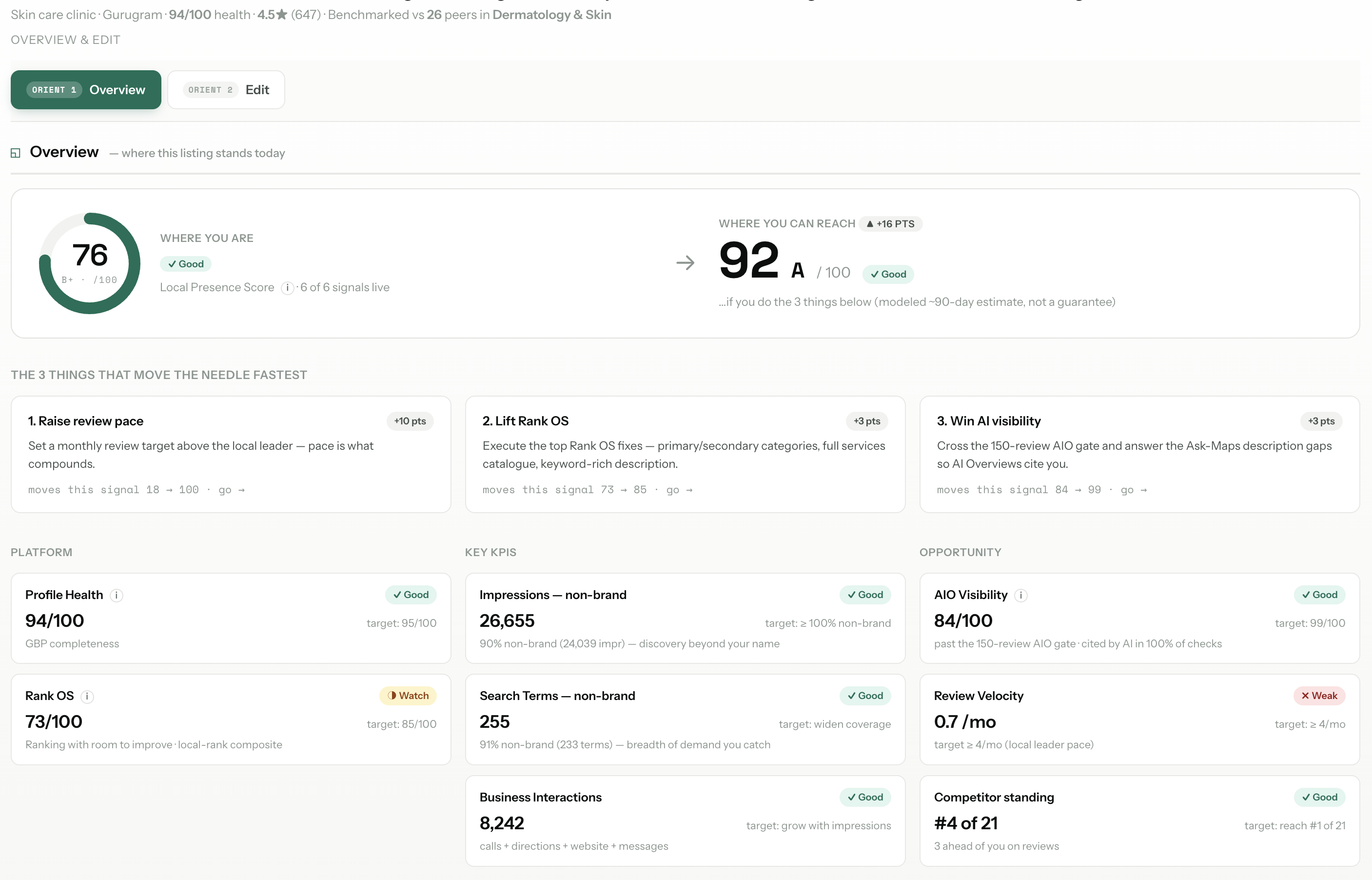
On listings ICG manages through Angryturtle, descriptions, Google Posts and review replies go through a compliance review before they go live.
Sources:
- NMC Guidelines on Ethical Advertising and Public Communication by Hospitals/Medical Institutions and Registered Medical Practitioners, public notice No. R-13014/01/2024-Ethics, 6 October 2026 — nmc.org.in
- Indian Medical Council (Professional Conduct, Etiquette and Ethics) Regulations 2002 — nmc.org.in
- Geneva Conventions Act 1960 — Government of India
- DPDP Act 2023 — meity.gov.in
- NMC Telemedicine Practice Guidelines 2020 — nmc.org.in
Internal links:
- Local SEO for Healthcare — Complete 2026 Guide
- Google Business Profile Management Services
- Google Review Management — How Reviews Drive Rankings
- GBP Optimization Guide 2026
- DPDP Act 2023 Healthcare Compliance
How ICG works within these guidelines
ICG is a healthcare marketing agency. Our clients are hospitals, clinics and medical institutions, which may publish factual, objective and verifiable information about themselves (paras 8.3 and 9.1). For individual doctors, ICG supports only genuinely educational content in the doctor's own name and designation (para 8.2(iii)). For doctors and their practices, we run patient-education-driven campaigns: awareness content that helps patients understand their condition and their options, published in the doctor's own name and designation (para 8.2(iii)) and kept free of the self-promotion that para 8.1(ii) bars.
The work is education-first and runs across six channels:
- Awareness content on YouTube. Doctor-led educational videos on public health and disease awareness, in the doctor's own name and designation, without promoting the employer organisation (para 8.2(iii)). See YODA and YouTube marketing for healthcare.
- Research articles and blogs that help patients understand their options: information shared in the normal course, not promotion (para 3.2, Explanation I). See healthcare content marketing, ICG research reports and healthcare SEO.
- Expert answers on Reddit and Quora from named, disclosed accounts. No anonymous or fake posts, no undisclosed commercial relationships and no manufactured engagement (paras 8.1(xi) and 8.1(xii)). See Reddit and Quora programmes.
- Awareness campaigns on Meta, run from the hospital's or clinic's own page, with no discounts, offers, free procedures or other inducements (paras 8.1(x) and 8.3). See Meta advertising for hospitals and clinics.
- NMC-compliant Google Ads landing pages: factual departments, services and facilities, with no "best", "No.1", "100% success", "painless" or "guaranteed" claims (paras 8.1(iii) and 8.1(ix)). See Google Ads for hospitals and clinics.
- "Learn More" instead of "Book Now" on patient-facing pages, so that a page informs rather than solicits (paras 8.1(ii) and 8.3(ii)).
All six rest on three kinds of content: scientific (evidence-based, checked by a qualified clinician), persona-based (written for the questions a specific patient group asks) and consumer-based (built from how people search, compare and decide). AI-assisted drafts go through human medical review, and AI-generated content that is published carries an AI source mark (para 7.2). We do not publish patient testimonials, before-and-after images or superiority claims, and we never buy, incentivise or gate reviews.
Free NMC compliance check. We review a hospital's or clinic's website, Google Business Profile and social channels against the October 2026 guidelines and send back a written list of fixes.
See what the check covers · Request the check · Book a 30-minute call
General information, not legal advice. Source: NMC public notice No. R-13014/01/2024-Ethics, 6 October 2026.
Book a free 30-minute Brand & Growth Diagnostic.
It's a working session, not a sales pitch — you leave with a written root-cause analysis you can act on, whether or not you engage ICG.
Questions readers ask
about this topic.
The three platforms
behind every ICG engagement.
Beacon
CAPI middleware that fixes Event Match Quality, translates CRM statuses to Meta-standard events, dedups across channels.
Agency OS
Live client dashboard. GSC, GA4, Google Ads, Meta Ads, IVR calls in one view. Login anytime, not monthly.
Phoenix
Clinic revenue intelligence over your PMS. Daily action queue: Prevent Loss, Maintain & Engage, Grow Revenue. Multi-centre rollout.
Or book a free 30-min audit to see all three in action on your account.
Healthcare brands
that already run on ICG.
A representative slice of the 150+ healthcare brands ICG has delivered for across India. Most engagements remain under NDA.


What ICG clients say · on video.
"Scale up of organic channels and business consulting. ICG has absolute domain authority in their field."
"Working with ICG transformed how we acquire IVF patients in Gurgaon. They understand the fertility journey from inquiry to consult..."
"What Ichelon accomplished — they got all my ideas and worked over 3-4 months to create an amazing, super-customised website."
The intelligence stack behind this playbook.
Every ICG engagement runs on the Search Intelligence Trifecta — Angryturtle for GMB, SIE for search and AI Overview, YODA for YouTube. Live product screens below.
Need help operationalising this?
Every ICG service is healthcare-only, NMC + DPDP-aware, and built around the patient-research patterns that drive Indian healthcare growth in 2026.
Every practice welcome — packages from ₹20,000/mo.
Goals-Driven engagements · Performance-Linked Payout Models available



More from
ICG.
Five trends shaping Indian healthcare marketing through 2027: AI-first patient research, Conversions API adoption, ABDM discovery, the AEO w...
Healthcare AIO is the discipline of getting your clinic or hospital cited inside Google AI Overviews, ChatGPT and Perplexity answers — not j...
Conversational-search advertising places brand messages inside AI chat answers — ChatGPT, Perplexity, Copilot — rather than beside a results...
Stop guessing.
Book a Diagnostic.
30 minutes. Free. With the AI-powered healthcare-only marketing agency 150+ brands already run on. No slides, no pitch, no hard close.


