


Replace your IVR. Put every clinic call on the record.
Most Indian clinics pay for an IVR, then run their leads in a CRM that has no idea what happened on the phone. The telecaller says "I called them". The CRM says nothing. The recording sits on a vendor's portal. The patient who rang at lunch and got no answer is never called back.
AtomCRM closes that gap. Its calling app runs on the Android phones your telecallers already carry. It dials with one tap, captures every call from the handset itself, matches the handset's recording to the right lead, and hands a missed call to the next free colleague within seconds. The CRM behind it runs your specialty funnels, WhatsApp and ad attribution. You no longer need to buy an IVR.

- AtomCRM is ICG's healthcare CRM for Indian clinics and hospitals, with an Android calling app that replaces the clinic IVR.
- The calling app gives you one-tap dialling, automatic call capture from the handset, recordings matched to the right lead, missed-call escalation and telecaller performance.
- Call audio comes from the handset's built-in recorder, so it needs phones that have one (Samsung, Xiaomi, Realme, Vivo, OnePlus).
- In use at 80+ healthcare centres in India, including 15+ IVF centres, 20+ aesthetic centres and 10+ eye centres.
- Pricing: ₹50,000/- one-time setup + ₹799/- per telecaller per month.
Why clinics outgrow the IVR
An IVR was built to route calls. It was never built to tell a clinic owner whether the IVF enquiry from Tuesday was ever called back, what the patient said, or which telecaller let the phone ring out at 3 pm.
In most clinics we work with, the phone and the CRM are two separate worlds. The IVR logs the call on its own portal. The telecaller then types a note into the CRM, if they remember, usually at the end of a shift and forty calls later. Calls dialled from a personal phone, or returned from a notification, never reach either system. So the clinic pays twice, once for telephony and once for a CRM, and still cannot answer the simplest question: did we actually speak to this patient?
Calls and leads live apart
The IVR knows the number. The CRM knows the lead. Nobody joins them up, so call history never shows on the lead a telecaller is about to ring.
Missed calls just disappear
A patient rings during a busy hour, nobody picks up, and the call sits in a report nobody reads. By evening they have booked elsewhere.
Notes are written from memory
"Not interested" with no reason is a dead end for whoever picks the lead up next. Was it price, timing, a wrong number, or no answer at all?
Where AtomCRM sits in the patient journey
- 0Foundations
- 1Demand gen
- 2Capture
- 3Lead quality
- 4Lead mgmt
- 5Scheduling
- 6Show-up
- 7Conversion
- 8Retention
AtomCRM runs the Foundations · Lead management stages of the nine-stage patient journey. Calling app, healthcare CRM and callback queue in one system, so every enquiry and every call is on the record.
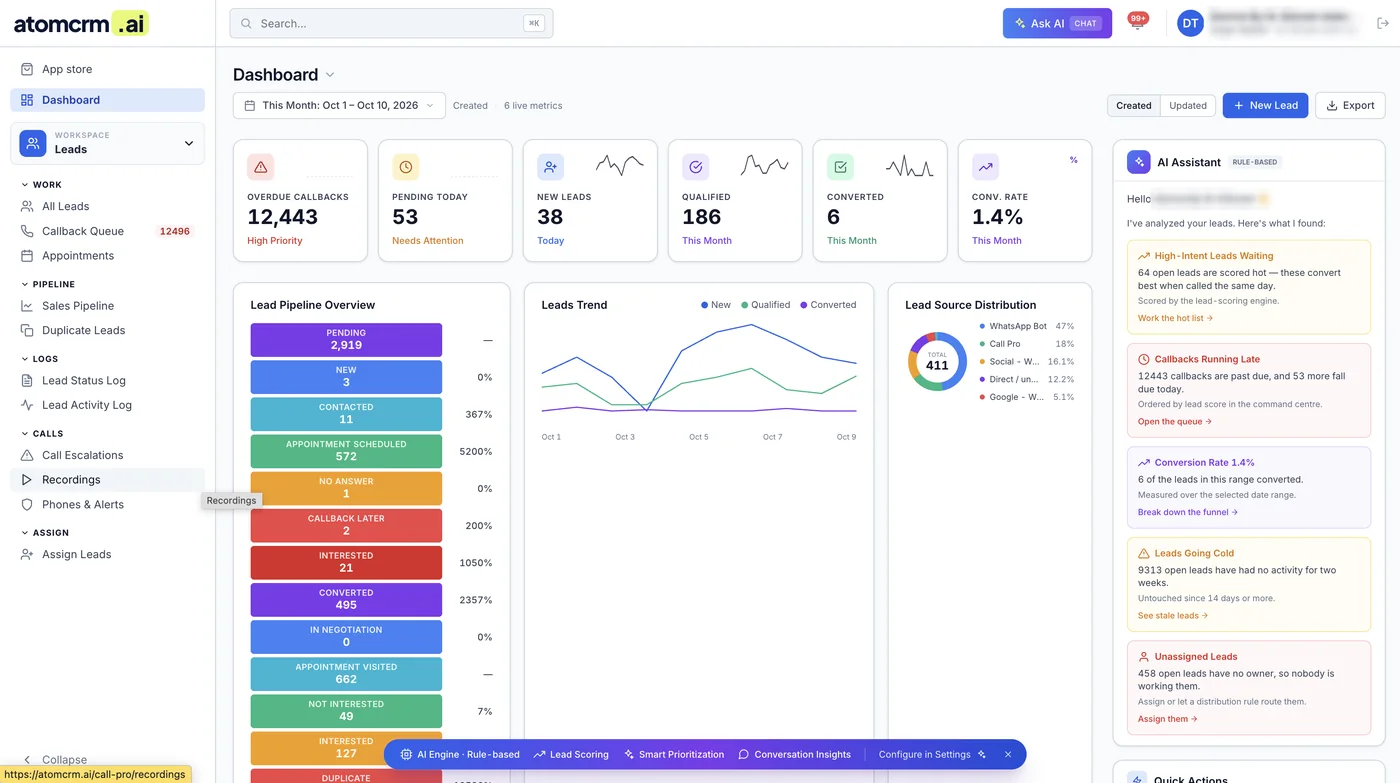
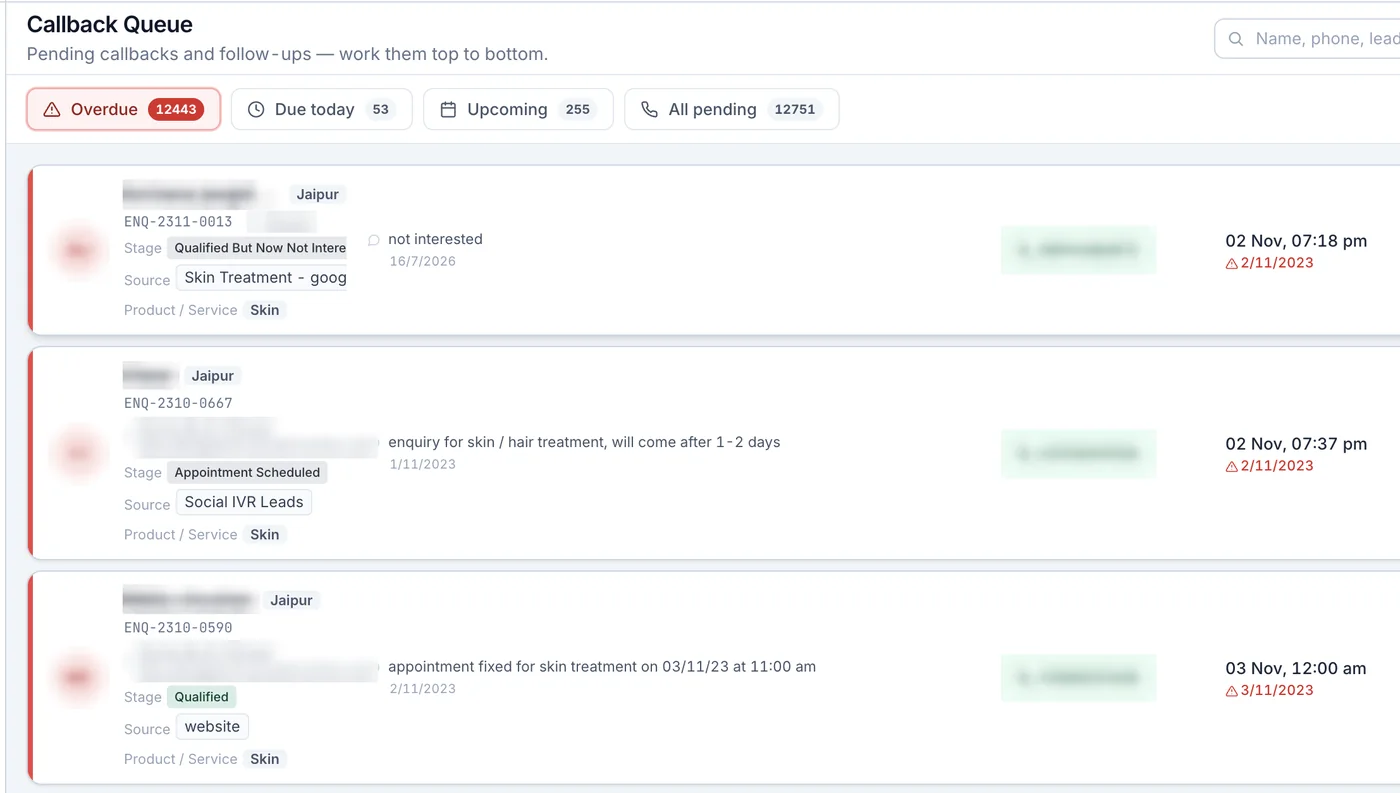
Inside AtomCRM: the screens your telecallers and managers use every day
AtomCRM is part of the Foundations stage: the CRM and calling layer every later stage depends on. Without it, leads from ads, search and WhatsApp have nowhere reliable to land. See all nine stages and the tool behind each one →
What the calling app does, all day, on the phone your telecaller already holds
The AtomCRM calling app is the screen a telecaller lives on. It has five tabs: My leads, Follow-ups, Calls, Missed and Me. Anything an administrator does stays in the desktop CRM. Every screen talks to the same AtomCRM account, so there is no second database to keep in sync and no separate reporting tool.
One-tap dialling
Every lead row has a dial button. The lead's own page has one green Call button and shows, before the call, whether the number has ever connected. When the telecaller comes back from the call, the update form is already open and asking what happened: stage, follow-up date and note, in one form with one Save.
Automatic call capture
Calls are read from the phone's own call log: direction, answered or missed, real talk time, time of day and which SIM. That means a call dialled outside the app, a redial from the call log or an incoming call answered from the notification still lands on the right lead.
Recordings on the right lead
The handset's built-in recorder writes the audio. The app finds the file, matches it to the right call and uploads it to your storage through a short-lived link. The recording then plays from the lead in the desktop CRM, like any other attachment.
Missed-call escalation
When a patient rings and nobody answers, the phone reports it within seconds. AtomCRM then offers the call-back to the next available colleague with a countdown, then the next, along a ladder you define. The patient is often called back while they are still holding the phone.
Telecaller performance
Each telecaller sees their own numbers: calls made and received, connect rate, talk time, follow-ups kept, and an hour-by-hour strip showing when their calls go unanswered. Someone who can see their connect rate at 4 pm still has an hour to change it.
Follow-ups that stay honest
Follow-ups sit in three buckets: overdue, today and upcoming, each with its count. A stage change without a note is refused, and stages that need a callback date will not save without one. The sentence gets written while the call is fresh.
A typical clinic IVR setup vs the AtomCRM calling app
This compares categories, not vendors. Hold it up against whatever telephony your clinic runs today.
| What you need | Typical IVR setup | AtomCRM calling app |
|---|---|---|
| Where the call is logged | On the telephony vendor's portal, separate from your leads | On the lead itself, in AtomCRM, including calls dialled outside the app |
| Call recordings | Stored with the telephony vendor, searched by number and time | Written by the handset, matched to the call and played from the lead |
| Missed incoming calls | Listed in a report | Offered to the next free colleague within seconds, with a countdown and a full audit of who was offered it |
| What happened on the call | Typed into the CRM later, if at all | Asked for the moment the telecaller returns from the call |
| Telecaller performance | Call counts from the IVR, outcomes from the CRM, joined by hand | Calls, connect rate, talk time and follow-ups in one place, per person |
| What you pay for | Telephony vendor plus CRM | AtomCRM only; calls go over your existing SIMs |
The honest truth about call recording on Android
This is the most important thing to understand before you evaluate any call-recording app, including ours.
Since Android 10, the operating system closes call audio to every app that is not the phone's default dialer. Google Play also bans the accessibility-service workaround that apps used to rely on. Any app that claims to record calls on a stock Android phone is either using a loophole that breaks on the next update, or is not doing what it says.
So the AtomCRM calling app does not record calls. The phone records, and the app collects the file. That is why it is built for handsets with a built-in automatic call recorder. Samsung, Xiaomi, Realme, Vivo and OnePlus all ship one.
Why we never match recordings by file name
A handset only writes the caller's name into the recording's file name when the number is already saved in the phone's contacts. For a telecaller, it almost never is, so the file that lands on the phone carries no phone number at all. Matching by file name would work in testing, where you ring your own contacts, and fail on nearly every real call.
AtomCRM pairs a recording with a call by when the call ended and how long it ran. The tolerances are tight, anything ambiguous is left unmatched, and every audio file is used exactly once. We made that choice deliberately: a call with no audio can be recovered, but a patient's conversation attached to another patient's record is a privacy incident.
The app also waits for the recorder. A phone finishes writing the audio a moment after the call ends, so a connected call with no recording yet is held back and retried, and only sent without audio after a grace period.
What the app measures, and what it will not pretend to know
From the handset it measures direction, answered or missed, rejected calls, talk seconds, ring time, time to answer, start and end time, and which SIM was used. One thing a normal Android phone cannot tell any app is who hung up. So AtomCRM does not show it. A figure that was never measured shows as a dash, never as a zero, because "no calls attempted" and "0% connect rate" are different facts.
Two layers for the calls a clinic nearly loses
An IVR's main job is to make sure a ringing phone gets answered. AtomCRM does that job with two mechanisms that work together.
Carrier call forwarding, for the live call
Conditional call forwarding has been part of every GSM network for decades. You draw one forwarding ladder in AtomCRM, each handset asks for its own next hop, and the app sends the code to the carrier by itself. Chained across handsets, a patient's call walks the ladder while they are still on the line. The app reports what it sent and when; it never claims forwarding is "on" when the network does not let it check.
Escalation ladder, for the call that still got missed
If nobody picks up, the handset reports the missed call and AtomCRM offers the call-back to colleagues one by one, each with a deadline of around twenty seconds. A red strip shows on every screen, so a telecaller can take it while reading a lead or typing a note. Opening an escalated call shows the whole ladder, including who was skipped and why.
Forwarding is fast but leaves no record. The escalation ladder is slower but tells a manager on Monday exactly which calls were rescued on Saturday and which were lost. "Three people offline at 10:32" is a staffing fact someone can act on.
The installed app is not a key to anything
Anyone can unpack an Android app file and read what is inside, so we assume everything in the build is public. The AtomCRM calling app ships with nothing worth stealing.
- Sign in pairs the phone. A telecaller signs in with their normal AtomCRM account, and that sign-in issues a key for this one handset, this one person and this one clinic workspace. There are no activation codes to hand out.
- No secrets in the app. No master key and no storage password. Recordings upload through short-lived links issued per file.
- Credentials stay in the Android Keystore, never in a plain file or a log.
- Everything is revocable. A lost phone is one row to revoke in AtomCRM. An administrator's block survives a fresh sign-in.
- One live credential per handset. When a colleague signs in on the same phone, the previous key stops working, so calls are always attributed to the person holding the phone.
- HTTPS only, with rate limits per device rather than per office connection, so fifty phones on one Wi-Fi are not punished together.
Privacy on a telecaller's own phone
Many clinics hand calling duty to phones that are also someone's personal device. The app is built for that. It uploads nothing from before it was installed, and a separate rule refuses anything older than twelve hours. Signing out unpairs the phone and stops all uploads. The app records nothing itself; the handset recorder is a setting the person holding the phone can see and control.
On the CRM side, AtomCRM captures consent at lead entry, uses role-based access so reception, doctors and billing each see only what they need, and logs who viewed or exported a record. ICG signs a data processing agreement with every clinic client, which your own DPDP Act 2023 compliance needs.
A healthcare CRM, not a sales pipeline with a hospital logo
Healthcare funnels are not seven-day sales pipelines. An IVF couple may research for weeks and consult more than one centre. A dental patient converts in days but is worth most over years of recalls. AtomCRM ships with stages built for those journeys.
Specialty funnels
Pre-configured stages for IVF and fertility, aesthetic dermatology, dental, orthopaedics and hospital OPDs, each with its own qualification questions and follow-up cadence. Your workspace's own stages and colours show up on the calling app too.
WhatsApp Business API, two-way
Templates are approved once and fire from inside the lead. Patient replies land back on the same lead record, and opt-outs are honoured on every future message.
Ad attribution via Beacon
Meta Conversions API and Google offline conversions are wired through ICG's Beacon layer. Stage changes such as "consultation booked" flow back to the ad platforms, so campaigns learn from real patients, not form fills.
Hawk intelligence
Hawk sits above AtomCRM and shows where leads leak: a caller leaderboard, follow-up adherence by stage and caller, and leads that were qualified but never followed up.
Recall and re-engagement
Rule-driven recalls for dental check-ups, package renewals and treatment cycles bring past patients back into the telecaller's list at the right time. See recall automation.
Every source in one inbox
Website forms, Meta and Google lead forms, WhatsApp, Google Business Profile and phone calls land as leads in one searchable list, filterable by stage, source, owner and date.
Where the calling app earns its keep
IVF and fertility centres
Couples call back several times before they commit. With every call and recording on the lead, the counsellor who takes the third call can hear the first one, and the overdue bucket stops a hesitant couple from going quiet.
Dental clinics and chains
Front desks juggle chair-side work and ringing phones. Missed-call escalation routes an unanswered call to whoever is free, and recall lists turn six-month check-ups into a daily calling queue.
Dermatology and aesthetic clinics
Patients who asked about one procedure often return for another. Call notes and recordings on the lead let the next telecaller pick up the conversation where it stopped, instead of starting cold.
Hospital OPDs
Many departments, one enquiry line. Forwarding ladders and escalation keep calls from dying at a busy desk, and the per-hour strip shows managers exactly when cover is thin.
Multi-location groups
Each branch's handsets can carry their own number and ladder, while owners see calls, connect rates and follow-ups across every location from one AtomCRM account.
Clinics running paid ads
When ads drive the phone to ring, the real question is which calls turned into consultations. Call outcomes on the lead, fed back through Beacon, answer it.
How AtomCRM gets onto your team's phones
- Pilot on two or three handsets. We confirm that your phones' built-in recorders write files the app can read and match.
- Distribute the app. The signed app file is installed directly, or pushed through any device management you already use.
- Each telecaller signs in. Their own AtomCRM password pairs their phone. No codes, no per-device setup.
- Updates arrive in place. New versions are offered inside the app, so nobody needs a cable and your team stays on one build.
The app is not on Google Play because Play does not allow apps to read the call log or the recording folder for this purpose. That is the same policy that makes the recording constraint real. Direct installation is the normal route for a workforce app on company handsets.
| Requirement | What is needed | If it is not met |
|---|---|---|
| Operating system | Android 10 or newer | The app will not install |
| Built-in call recorder | Samsung, Xiaomi, Realme, Vivo, OnePlus | Everything works except call audio |
| Google Play services | For push notifications | The app still works and checks in instead |
| Data connection | Any, 3G upward | Work is queued on the phone and sent when signal returns, without double-counting |
| SIM | One, with call forwarding allowed by the carrier | Escalation still works; live forwarding does not |
Features, specialties and guides
Features
IVR replacement for clinics
Telecaller calling app
Automatic call capture
Call recordings on the right lead
Missed-call escalation
Telecaller performance
Follow-up discipline
Data security and device pairing
By specialty
AtomCRM for IVF and fertility centres
AtomCRM for dental chains
AtomCRM for dermatology and aesthetic clinics
AtomCRM for hair transplant clinics
AtomCRM for multi-specialty hospital OPDs
AtomCRM for orthopaedic clinics
AtomCRM for eye hospitals and clinics
AtomCRM for cosmetic surgery clinics
AtomCRM for diagnostic labs
AtomCRM for Ayurveda and wellness centres
One setup fee, then a flat price per telecaller
₹50,000/- one-time setup
+ ₹799/- per telecaller per month
The calling app is included for every telecaller. There is no IVR to rent and no telephony vendor account, because calls go over the SIMs your team already uses. The only added running cost is storage for the call recordings you choose to keep, and you set that retention policy.
- Setup covers configuring your stages, lead sources, forwarding and escalation ladders, and the handset pilot.
- Monthly pricing scales with the size of your calling team, not with call minutes.
- Marketing is separate. If you also want ICG to run your campaigns, retainers start from ₹20,000/mo.
Questions clinic owners ask about AtomCRM
What is AtomCRM?
AtomCRM is ICG's healthcare CRM for Indian clinics and hospitals. It pairs a lead-management CRM, with specialty funnels for IVF, dental, dermatology and hospital OPDs, with an Android calling app that your telecallers work from all day. The calling app is what lets a clinic stop paying for a separate IVR.
How does the AtomCRM calling app replace an IVR?
An IVR routes and records calls on a telephony vendor's system, away from your leads. The AtomCRM calling app works on the phones your telecallers already hold. It dials leads with one tap, reads every call from the handset's own call log, attaches the handset's recording to the right lead, and escalates missed incoming calls to the next free colleague. There is no telephony vendor account in the loop.
Can the app record calls on any Android phone?
No, and no honest app can. Since Android 10, the operating system blocks call audio for every app except the default dialer. AtomCRM does not record calls itself. It collects the file written by the handset's built-in call recorder, which Samsung, Xiaomi, Realme, Vivo and OnePlus phones ship with. On a phone without a built-in recorder, everything else works, but there is no audio.
How does AtomCRM make sure a recording lands on the right lead?
It matches a recording to a call by when the call ended and how long it ran, never by the file name, because most handsets do not write the caller's number into the file name. The tolerances are tight, anything ambiguous is left unmatched, and every audio file is used once. A call with no audio can be fixed; a call with someone else's audio would be a privacy incident.
What happens when a patient calls and nobody answers?
The handset reports the missed call within seconds and AtomCRM walks an escalation ladder you set up. Each colleague in turn is offered the call-back with a countdown. If they do not take it, it moves to the next person. Every step is logged, so a manager can see which calls were rescued and which were lost. For live calls, the app can also set carrier call forwarding across handsets.
What does AtomCRM cost?
AtomCRM is priced at ₹50,000/- one-time setup plus ₹799/- per telecaller per month. The calling app is included. Because it runs on your team's handsets, you do not pay a separate IVR or telephony vendor. The only added running cost is storage for the call recordings you choose to keep.
Is the calling app on the Google Play Store?
No. Google Play does not allow apps to read the call log or the handset's recording folder for this purpose. The app is distributed as a signed APK, which is the normal route for a workforce app on company phones. It checks for new versions and updates itself in place, so your team does not end up on different builds.
Is AtomCRM DPDP-friendly?
AtomCRM is built for Indian healthcare data. Consent is captured at lead entry, access is role-based, and the calling app has privacy rules of its own: it uploads nothing from before it was installed, refuses anything older than twelve hours, and stops uploading the moment a telecaller signs out. ICG signs a data processing agreement with every clinic client.
Does AtomCRM work with WhatsApp, Meta Ads and Google Ads?
Yes. WhatsApp Business API is two-way inside the lead record, so patient replies land on the same lead. Meta Conversions API and Google offline conversions are wired through ICG's Beacon attribution layer, so your ad platforms learn from consultations booked, not only from form fills.
Is AtomCRM available outside India?
AtomCRM is built and priced for Indian clinics and hospitals. For practices in other markets, ICG works with the CRM you already run.
Build the rest of the stack around AtomCRM
Hawk
The intelligence layer above AtomCRM: lead leakage, caller leaderboard and follow-up adherence.
HealthApex OS
ICG's integrated platform for clinics, of which AtomCRM is one part.
Healthcare CRM agency
How ICG sets up a CRM and trains your telecallers and coordinators to use it.
CRM ROI calculator
Estimate what better follow-up discipline is worth to your clinic.
Client Elevation Programme
Telecaller training and quarterly reviews for the team that runs your calls.
Stop paying for an IVR that cannot tell you who called back
See the AtomCRM calling app on your own handsets. We start with a two- or three-phone pilot so you know exactly what you are buying.
