The only healthcare marketing agency built around Goals-Driven engagements and Performance-Linked Payout Models.
Every practice welcome — retainers starting from $499/mo (Global) or ₹20,000/mo (India). Every ICG engagement is Goals-Driven against a written monthly goal contract visible to you in real time on Ichelon Agency OS. Performance-Linked Payout Models available on top of the fixed retainer — scoped jointly at benchmarking.

- Ichelon Consulting Group runs healthcare marketing on a Goals-Driven engagement contract — a written monthly goal contract that lives on Ichelon Agency OS, visible to you in real time.
- Every engagement starts from $499/mo (Global) or ₹20,000/mo (India). Performance-Linked Payout Models are available on top of the fixed retainer — scoped jointly during benchmarking against the practice’s ambition and marketing scope.
- Payout scales with composite goal achievement — the higher your goals hit, the higher the payout earned. Details on the payment ladder appear further down the page for buyers who want them.
Healthcare marketing agencies get paid whether they perform or not. We changed that on purpose.
Every founder or medical director who has hired a marketing agency knows the shape of the disappointment. The proposal is confident. The kickoff is elaborate. Months one and two are described as "foundation" — audits, personas, brand voice, technical fixes that never quite finish. Month three arrives, then month four, and the practice is now $12,000 to $20,000 into the engagement with reports that describe activity rather than outcomes. Impressions are up. Bounce rate is down. The agency's slides are beautiful. The practice's phone is not ringing meaningfully faster than it was before the retainer began.
The mechanical reason this happens is simple and rarely spoken out loud: the standard healthcare marketing retainer pays the agency the same amount whether the practice's booked visits went up, stayed flat or went down. Every incentive in that contract is stacked toward retention through effort-reporting rather than through outcomes. So agencies get very good at effort-reporting. And practices get very good at cycling agencies every six to eight months — the industry norm — because a business owner can only look at a dashboard of activity metrics for so long before deciding to try a different vendor.
We built ICG’s engagement model to solve that structural incentive problem, not to be a nicer version of the same contract. The offer is straightforward. A portion of what you pay us is a fixed retainer — it covers the execution cost of running your account, the strategy time, the compliance review, the reporting cadence, the account-management overhead that has to happen whether campaigns hit or miss. A separate portion is Goal-based Variable Pay, and that portion is earned against a written monthly goal contract your leadership team agreed to at benchmarking. When the month lands inside the achievement bands on the payment ladder, the variable earns per the band. When the month misses badly, that variable line item does not settle until the following month brings the metrics back to band. No make-up work owed. No renegotiation on the next call.
The model works because it aligns three things that agencies and practices usually fight about: what the goal actually is, what the reporting says, and what the invoice looks like. When the goal is written down in a signed benchmarking document, the reporting comes off a shared live dashboard the client can see any time, and the variable line item on the invoice is a function of that dashboard, there is no longer any conversation to have about whether the month was good or not. The dashboard says. The invoice says. Everyone knows.
The rest of this page walks through exactly how the model operates — the four pillars, the payment ladder, the pricing tiers, the payment cadence, the 12 metric streams that make up the composite health score, the formula that produces the score, the three composite case studies that show the model at work across dermatology, plastic surgery and weight-loss verticals, and the FAQ that covers the questions the model raises. Every dollar figure on this page is in US dollars. Every compliance reference is HIPAA-federal and state-medical-board layered. The engagement is delivered from our Dallas headquarters and available to healthcare practices in every US state.
The four pillars — how goal-linked, performance-pay healthcare marketing actually operates
Every element of the engagement descends from four operating pillars. Skip any one of them and the model does not work. Do all four in the same engagement and it becomes the reason a healthcare practice keeps working with the same agency long enough for compounding growth work to actually compound — SEO authority, paid-account learning, review corpus, referral rails.
We start with benchmarking
Every engagement begins with a 2-week joint benchmarking phase against your last 90 days of measured performance. We plug into GSC, GA4, Google Business Profile, Google Ads, Meta Ads Manager, YouTube Studio and Instagram Insights, take a full read of where the practice currently is, and produce a written baseline document with the leadership team's sign-off before any campaign work begins. No goals get set from a proposal deck. Goals get set from the numbers your accounts actually produce today.
We set the goals with you
Not vague brand-lift language. Not "significant growth." Concrete monthly numbers written into a signed goal contract: GSC Clicks, GSC Impressions, GA4 Key Events, Google Ads Leads and Qualified Leads, Meta Ads Leads and Qualified Leads, YouTube Traffic and Watch Time, Instagram Reach and Engagement, and GMB Calls. Each goal is set jointly — your team knows the practice's operational capacity and revenue reality, our team knows the search and paid demand curves — and neither side signs a goal that the other side would not sign.
We get paid on hitting them
The fixed retainer covers execution. The variable line item only pays when the composite health score across your agreed goals lands in one of the four earning bands on the payment ladder. If we miss below 60% composite in a given month, the variable earns nothing for that month. Not deferred, not renegotiated, not carried forward. That is the point of the model — the risk of underperformance sits on us, not on the practice.
Ichelon Agency OS tracks it live
Your client-facing dashboard shows every goal, every pacing chart, every watch-list alert. Weekly reports auto-generate on Monday mornings, pulling from the same live data. A leadership team member can log in on day 12 of the month and see exactly where each metric sits versus its month-to-date expected pacing. No screenshot-and-email reporting theatre. No monthly-only visibility. The dashboard is the contract, and the contract is on the dashboard.
The payment ladder — what composite goal achievement earns of the variable
Composite goal achievement is a single percentage number that describes how the practice tracked against its agreed monthly goals across every metric family in scope. That number gets applied to the payment ladder below to determine how much of the month's variable target is earned. The ladder is deliberately non-linear — the top band is generous, the middle bands step down cleanly, and the bottom band is a hard floor at $0. That structure is what makes the model honest.
| Composite goal achievement | Variable payment earned |
|---|---|
| 80–100% of goal | 100% of variable — full month's variable target lands |
| 70–80% of goal | 80% of variable earned |
| 60–70% of goal | 50% of variable earned |
| Below 60% of goal | No variable earned that month — we focus on getting the underperforming metrics back to band |
A worked example (illustrative figures). A dermatology practice on a Growth Partnership with a variable target agreed at kickoff. In month three, composite goal achievement lands at 76% across the eight goals in scope. The 70–80% band pays 80% of the variable target for that month. The client is invoiced the fixed retainer for month four (in advance) plus that portion of the variable target for month three (in arrears) on the same monthly bill.
The bands are set the way they are for one reason: a healthcare practice's marketing month is a stochastic system, not a machine. Any given month can miss target by 5–10% on genuine reasons that had nothing to do with agency execution — a holiday weekend that fell in the middle of the month, a state health department bulletin that pushed elective demand, a payment processor outage that killed booked appointments for 48 hours, a national news cycle that pulled attention away from the practice's category. The 80% top band accepts that reality. The bands taper below that to keep both sides honest and to keep the variable line item calibrated to actual outcomes rather than headline effort.
Practices sometimes ask whether the top band should be higher — whether 80–100% is too easy. In our experience running this model, hitting the 80% threshold across a composite of 8 to 12 monthly metrics is materially harder than it reads on paper. A campaign that hits 90% of GSC Clicks but 65% of Meta Ads Qualified Leads and 78% of GMB Calls does not automatically land at 80% composite — it lands wherever the weighted average of those component percentages lands. Composite health rewards balanced performance across the whole funnel, not superstar performance on the one channel that happened to have a good month.
Three tiers — every practice welcome, from starter through enterprise
All three tiers include Ichelon Agency OS access, weekly benchmarking + goal-tracking reports, a monthly strategy call with the practice's leadership contact, and compliance monitoring against HIPAA and the state medical boards the practice is licensed in. The tiers differ in delivery scope and in the size of the Goal-based Variable Pay target when the engagement warrants one.
Starter · from $499/mo
Website SEO base package
For practices at the beginning of a search-first growth push. Includes Agency OS dashboard access, weekly benchmarking + goal-tracking reports, monthly strategy call, HIPAA and state medical board compliance monitoring, SEO base work on the current website (technical audit and remediation, on-page optimisation, GBP linkage, foundational content), and one dedicated account contact. Delivery is calibrated to what the starter scope can honestly move. A Goal-based Variable Pay component can be added at this tier when the engagement scope warrants it — scoped jointly at kickoff.
Growth · the anchor tier
Fixed retainer + Goal-based Variable Pay
Full growth partnership. Everything in Starter plus full paid ads management (Google, Meta, and where the vertical warrants it, YouTube and Instagram), content publishing cadence tied to your goal contract, deep SEO work (topic cluster build-out, entity graph, internal-link engineering), full attribution stack, and CRM or PMS integration for cost-per-booked-visit reporting. Fixed retainer + Goal-based Variable Pay target is scoped jointly during the benchmarking sprint against the practice's ambition, channel mix and marketing scope. Payment ladder above governs how the variable line item settles every month.
Enterprise · multi-location groups
Custom scope + per-location metrics
For multi-location healthcare groups — two or more clinical addresses, single or multi-state footprint, PE-backed platforms in build-out or roll-up mode. Fixed retainer + Goal-based Variable Pay target scoped against the group's revenue-tier and location-count goals. Everything in Growth plus per-location P&L attribution, per-provider content publishing where the group's clinicians participate, per-state creative review, and enterprise-grade CRM integration with call-tracking on every clinical line. Sales-cycle is longer at this tier — typically 4–8 weeks from first conversation to signed engagement — and benchmarking runs 3 weeks instead of the standard 2.
Payment cadence — you never pay the variable before we have earned it
The invoice cadence is one of the most important operational features of the model and one of the least visible in a normal proposal document. Standard healthcare marketing agencies bill their entire retainer monthly in advance. That means the client is paying for a full month of results before a single day of that month has produced any results. That is fine when the retainer is fixed and the agency's incentive is to keep the account. It is incompatible with a variable retainer whose entire point is to only be paid on earned outcomes.
We split the cadence to solve the timing problem cleanly:
The practice never pays a variable component before that variable component has been earned against the dashboard the practice can see live. That is not a marketing claim — it is how the invoice cadence is contractually structured before the engagement begins. Every practice signing a Growth or Enterprise engagement gets the payment-cadence schedule as an appendix to the master services agreement, with the ladder bands and the payment timing written into the same document that binds the goal contract.
The metric streams that compose the goal contract
The composite health score is calculated across 9 core metric families, spanning 12 individual metric streams that get pulled into the Agency OS dashboard every day. Which of the 12 apply to any given practice depends on the practice's channel mix and the tier of the engagement — a Starter engagement typically tracks 4 to 6 of these; a Growth engagement typically tracks 8 to 10; an Enterprise multi-location engagement typically tracks all 12 plus a set of custom per-location metrics added on top.
Each metric family is a signal at a different layer of the acquisition funnel. GSC Clicks and Impressions describe the top of the organic search funnel — how visible the practice is on the queries prospective patients are running. GA4 Key Events describe on-site conversion behaviour — the appointment-request submissions, calendar bookings, phone-click events, video engagement thresholds and thank-you page loads that mean the site is actually turning traffic into intent. Google Ads and Meta Ads Leads and Qualified Leads describe the paid-media funnel with a distinction between raw form-fills and the sub-set of those that meet the practice's qualification bar. YouTube Traffic and Watch Time describe the AI-Overview and long-form authority layer that a healthcare practice increasingly needs to be visible in. Instagram Reach and Engagement describe the aesthetic and word-of-mouth surface. GMB Calls describe the "someone found us on Maps and picked up the phone" outcome that is often the single highest-intent action a healthcare buyer takes.
The goal for each metric is set jointly at benchmarking against the prior 90-day baseline. Weights are set jointly too — a cash-pay cosmetic practice weights Meta Ads Qualified Leads and Instagram Engagement heavier than GMB Calls; an insurance-taking medical dermatology or primary care practice weights GMB Calls and GA4 Key Events heavier than Instagram. Default weights are equal across every metric in scope; custom weights get set when the practice's revenue reality warrants it, and the composite calculation is transparent and reproducible on the dashboard at any time.
How the health percentage is actually calculated — the formula, worked
The reason the model can be enforced in a dashboard rather than debated in a monthly meeting is that composite health is a formula, not an opinion. Every metric on the goal contract has an expected-by-now number for any given day of the month, and the actual-so-far number that the live account data produces gets divided by that expected-by-now number to produce that metric's health percentage. Composite health is the weighted average across every metric in scope.
Worked example. The monthly goal for Google Ads Qualified Leads is 100. By day 15 of a 30-day month, the pro-rata expected-by-now number is 50. If the practice's Google Ads account has produced 30 qualified leads by day 15, that metric's health for the day is 30 ÷ 50 = 60%. Composite health across all 9 metric families is the (weighted) average of every metric's individual health percentage on that day.
The formula deliberately uses "expected-by-now" rather than "month-end goal" as the denominator, because a healthcare marketing month is not front-loaded or back-loaded to the same degree across every channel. GSC Clicks pace fairly evenly across the month. GMB Calls have day-of-week weighting — Tuesday and Wednesday are typically the highest-call days for medical practices, Friday and Saturday for cosmetic and med-spa. Google Ads Qualified Leads pace against a working-day calendar that ignores Sundays. Instagram Reach compounds when a piece of content lands in an algorithm surge and can spike unpredictably. Rather than pretend all 12 metrics pace linearly, the Agency OS dashboard uses a channel-specific pacing curve for each metric — the "expected-by-now" number on day 15 is not necessarily 50% of the month-end goal, it is 50% of the goal adjusted for that channel's actual historical intra-month distribution.
Composite health is then the weighted average across every metric family in scope. A practice with 8 metrics in play at equal weights sees a composite that is simply the arithmetic mean of the 8 individual health percentages. A practice with custom weights — for example, 30% weight on Google Ads Qualified Leads, 20% on GMB Calls, 15% on GSC Clicks, 15% on Meta Ads Qualified Leads, 10% on GA4 Key Events, 10% on YouTube Traffic — sees a composite that reflects the practice's own weighting of what matters. Weights are set at benchmarking, signed by both sides, and can be revised jointly at any quarterly review.
The dashboard shows both today's composite health and the "projected month-end composite" — a linear extrapolation of the current pacing curve out to day 30. That projection is what triggers the watch-list alerts. When any metric family drops below 70% mid-month, the account team gets alerted and a corrective-action ticket opens. When composite drops below 70% mid-month, the account team convenes a same-week working session with the practice to review, reallocate budget, or adjust campaign posture before month-end. That mid-month intervention layer is why the average finish is higher than the mid-month reading would predict.
Ichelon Agency OS — what the client sees on the dashboard
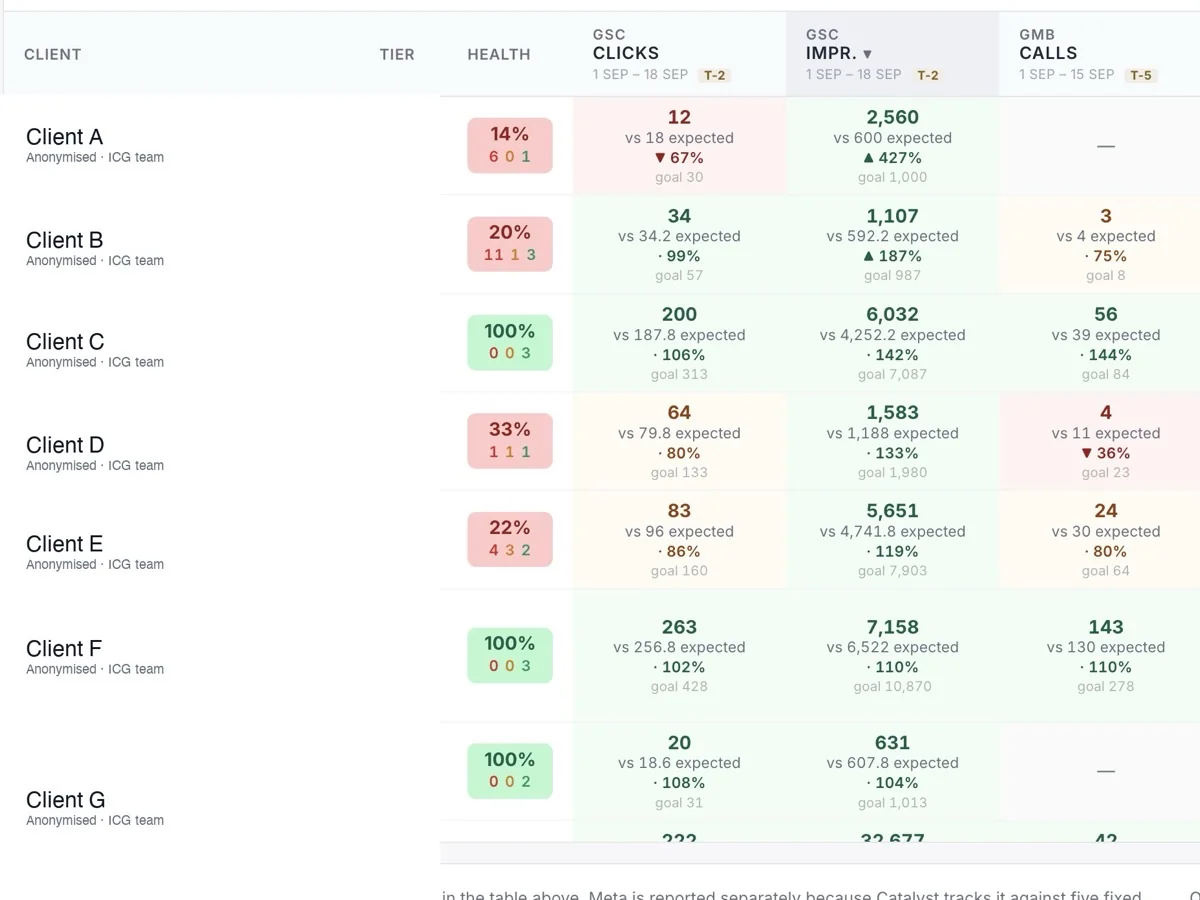
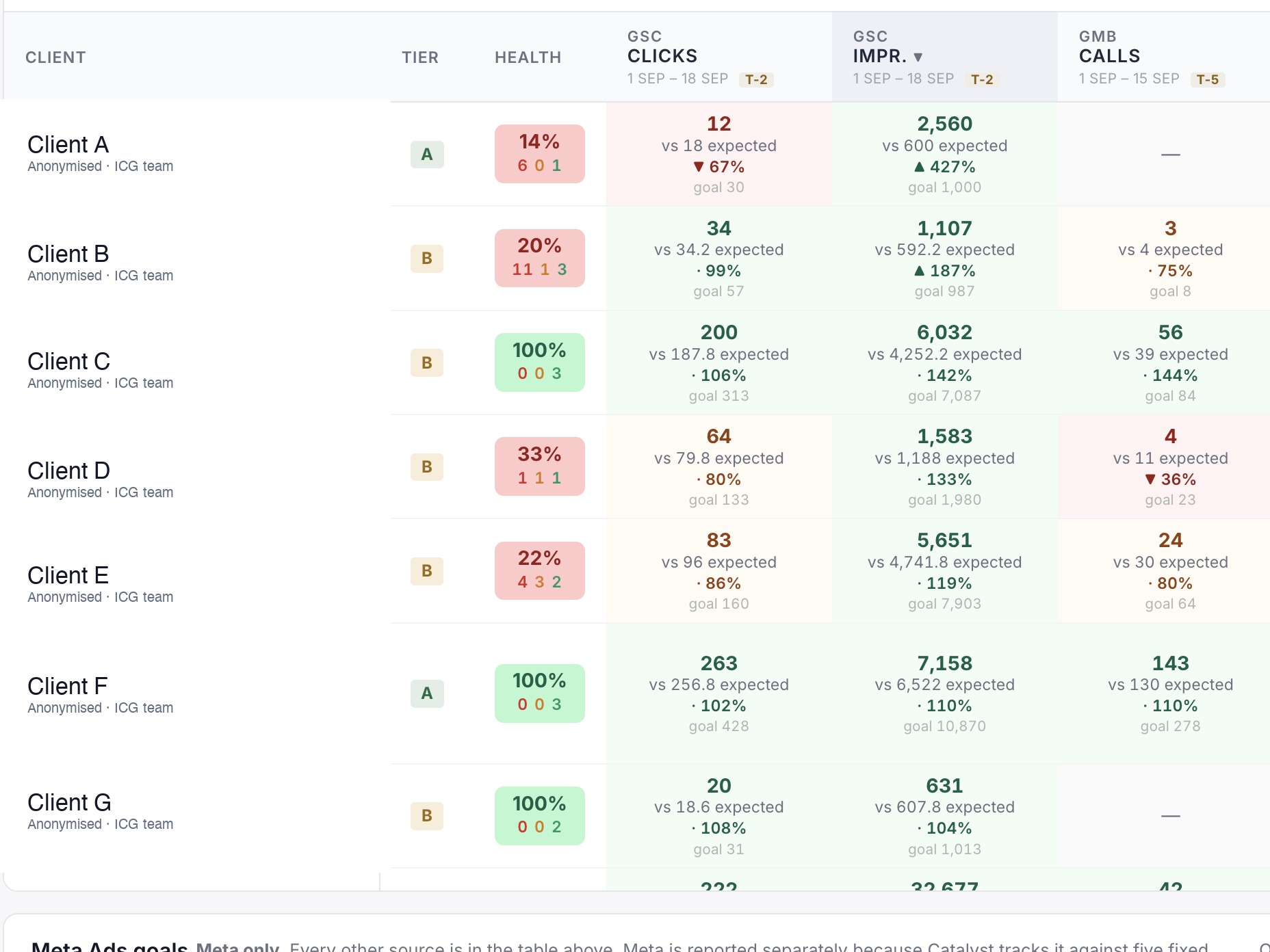
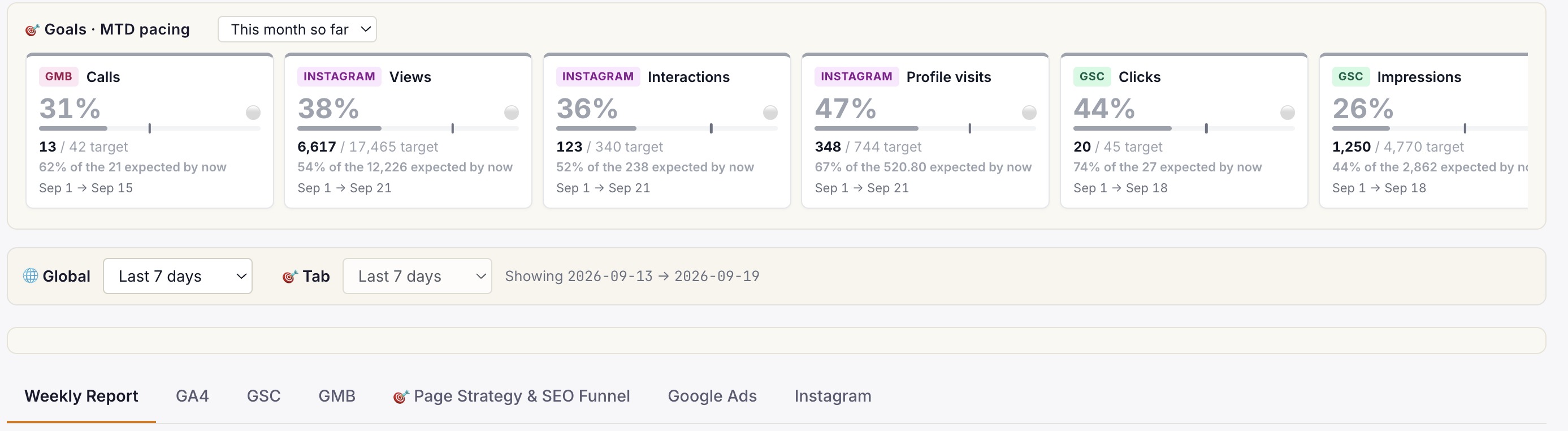
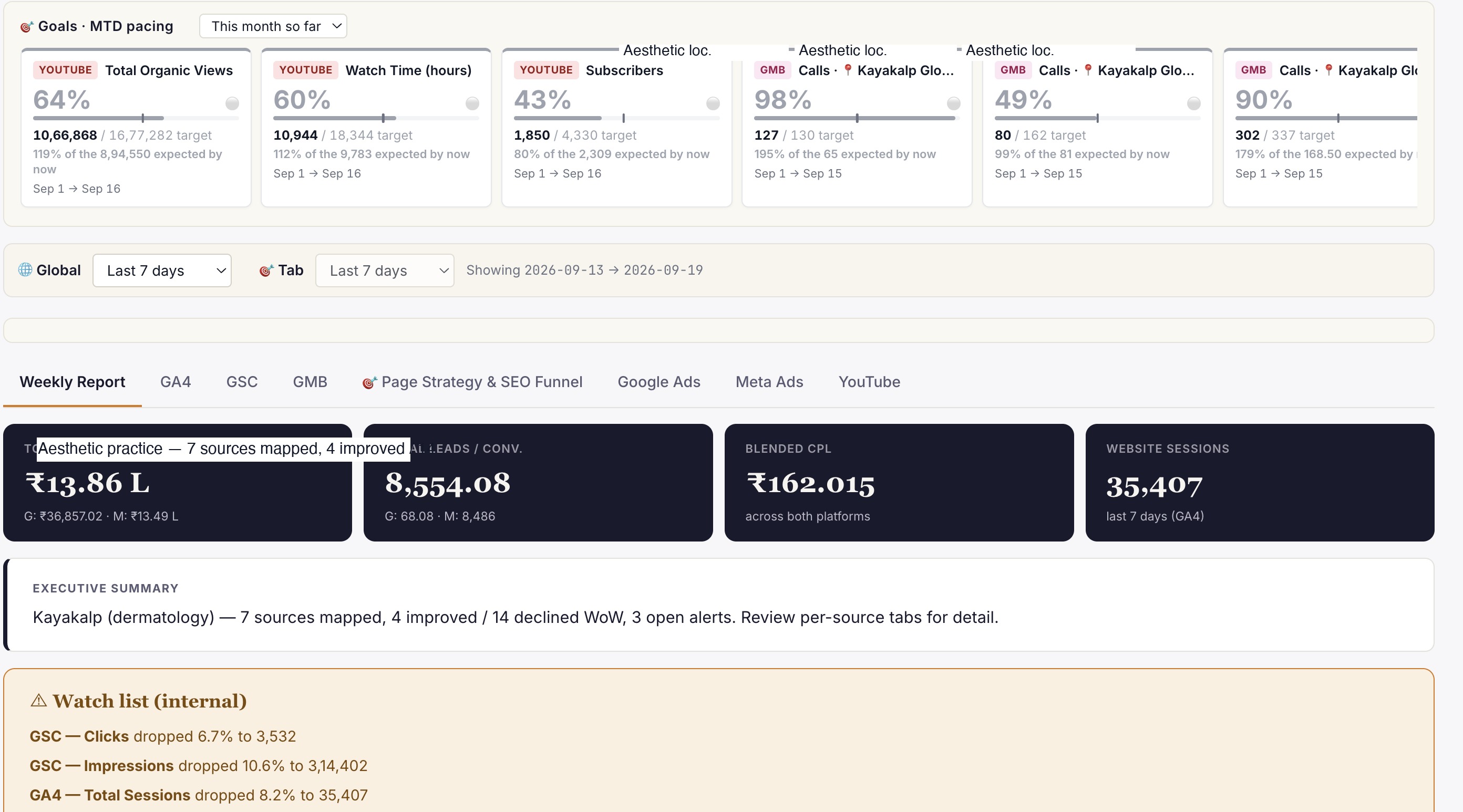
Agency OS is the client-facing dashboard every engagement runs on. It is the single source of truth for goal pacing, weekly reporting, watch-list alerts, and the composite health score that governs the variable retainer line item. There is no separate reporting product, no monthly PowerPoint, no "we will send you the numbers on Friday" — the dashboard is the reporting, and the dashboard is the contract. Below are three views of it. The first is the agency-wide client-health overview our internal team uses. The second is the client-visible month-to-date goal pacing view. The third is the weekly report the client receives every Monday morning.



Agency OS was built for one reason: to make the goal contract visible in real time to both sides. That visibility is what removes the argument. No side of a healthcare marketing engagement has ever benefited from a monthly reporting cadence that arrives ten days after the month ended and is the first time the client sees the numbers. By then, the month is over, the invoice is due, and both parties are having a conversation about numbers no one has time to actually act on. Live dashboarding compresses that cycle to hours instead of weeks — and gives the account team a fighting chance to close a mid-month gap while there is still runway to close it.
Three composite case studies — the model at work across dermatology, plastic surgery and weight-loss verticals
Each case study below shows the same underlying pattern the model produces: a written benchmark, an agreed goal, a measured composite health percentage, and the variable earned per the ladder. Practice names are withheld intentionally — the model is what is publishable, not the client. All three engagements are US-based and were run out of the Dallas delivery pod.
Case 1 · Multi-location dermatology practice (US)
A multi-location dermatology practice operating across four clinical addresses in a Sun Belt state, mix of medical and cosmetic, insurance-taking with a growing cash-pay cosmetic tier.
Benchmarked at 47 qualified leads/month across GSC + Meta Ads + GMB during the 2-week baseline sprint. Goal contract set at 90 qualified leads/month across the same channel mix. Fixed retainer + Goal-based Variable Pay target agreed at kickoff. Month 4 composite health landed at 117% on 105 QLs actual, which sits inside the 80–100% top band on the ladder — full variable target earned. Practice is currently in month 22 of engagement, renewed for a fifth quarter, still on the same goal-linked structure with the quarterly re-baselining that the model builds in.
Case 2 · Solo plastic surgeon (US)
A solo plastic surgeon operating a single high-volume aesthetic practice, cash-pay only, in a mid-CPC US metro. Fresh brand, well-credentialed surgeon, moving from a competing agency where the previous engagement had produced flat consult volume for eleven months.
Benchmarked at 12 consultations/month across Meta Ads + GSC + GMB. Goal contract set at 30 consults/month against a fresh site-build and a new-account paid launch. Fixed retainer + Goal-based Variable Pay target agreed at kickoff. Month 3 landed at 24 consults, a composite health of 80% inside the 70–80% band, so 80% of the variable target settled on that month's invoice. Currently in month 14 of engagement, with the goal contract re-baselined upward to 42 consults/month at the six-month review.
Case 3 · GLP-1 weight-loss clinic chain (US)
A GLP-1-focused weight-loss clinic chain operating out of two locations in a top-CPC metro, with a subscription-model patient economic that changes the acquisition math from single-visit to recurring monthly revenue. Included here specifically because it is the case where the model produced a partial-variable outcome rather than a full-band earn.
Benchmarked at 55 patient enrolments/month across the two locations. Goal contract set at 140 enrolments/month against a Meta-Ads-heavy paid stack with a GMB and content underlay. Fixed retainer + Goal-based Variable Pay target agreed at kickoff. Month 5 composite came in at 63% on 88 enrolments — inside the 60–70% band, so the variable line item that month settled at 50% of the agreed target. The client and ICG then jointly re-baselined the goal to 110/month for month 6 onward — because the honest read on the benchmark sprint had been slightly optimistic on the ramp curve for a two-location chain in that metro. That re-baselining is the model working as designed: goals can be revised together when the market gives you new information, and the variable-pay structure resets to the new goal.
Every case above follows the same shape: benchmark set from real 90-day baseline data, goal set jointly by both parties, month-by-month measurement pulled from the live dashboard, variable earned per the payment ladder against composite health. No case study on this page describes a "hit target" narrative that omits the months the target was missed. The model is designed to survive miss-months without either side feeling burned — and every case above has had at least one month where the composite dropped below 70% and the variable earned was reduced accordingly. That is what a working goal-linked model looks like from inside.
Every US healthcare vertical — the model is compliance-scoped to fit the practice
The goal-linked, performance-pay model is vertical-agnostic in structure and vertical-specific in delivery. The metric families are the same across every practice we serve. What changes is the weighting, the channel mix, the CPQL benchmarks, and the compliance envelope that scopes the creative. We currently run engagements across the healthcare verticals below and scope net-new engagements in any US healthcare category where a licensed clinician can advertise under their board's rules.
Dermatology
Medical and cosmetic dermatology, single-practice through multi-state PE-backed platforms. Weights Meta Ads Qualified Leads and Instagram Engagement heavier for cash-pay cosmetic; weights GMB Calls and GSC Clicks heavier for medical.
Plastic surgery
Aesthetic and reconstructive plastic surgery. Higher consult-value per lead, longer research window, tighter creative envelope on before/after imagery under state medical board rules.
Med spa
Cosmetic med spas, aesthetic clinics, injectables-first practices. Instagram-heavy discovery, tighter FTC and Meta Personal Attributes creative review, GMB density per address as the acquisition anchor.
IVF and fertility
Reproductive endocrinology and fertility clinics. Longer consideration cycle, higher LTV per patient, heavier weighting on GSC Impressions and long-form content authority (YouTube).
Weight loss and GLP-1
GLP-1-adjacent weight-loss clinics, subscription-model patient economics, Meta-Ads-heavy paid stack, GMB Calls anchor for local intent.
Dental and orthodontic
General dental, cosmetic dental, orthodontic practices. Strong GMB Calls signal, insurance-taking mix, ADA and state dental board scoping on creative claims.
Ophthalmology and LASIK
LASIK-heavy refractive surgery, cataract, general ophthalmology. Higher-consideration paid cycle, YouTube provider-authority builds heavily for AI-Overview capture.
Cardiology and orthopaedic
Specialty medical practices, insurance-taking, referral-partner heavy. Weights GSC Clicks and GA4 Key Events heavier; paid runs on brand-defence and specific-procedure intent rather than pure lead-gen.
Verticals outside this list — we take new-vertical engagements every quarter. The model does not change by vertical; the metric weighting and creative envelope do. Scope a benchmarking call and we will confirm whether the vertical has a channel mix that maps cleanly to the 9-metric framework, and if any custom metrics are needed on top.
-
 Primary Care · North Dallas, TXCase study →
-
 MedSpa · North Dallas, TX
-
 Skin Care · Beverly Hills, CA
-
 Dental · Christiansburg, VACase study →
-
 Pediatrics · Blacksburg, VACase study →
-
 Pediatric Dentistry · Blacksburg, VACase study →
-
 Dental · Roanoke, VACase study →
-
 Functional Medicine · Telehealth · USACase study →
“They were able to get all my ideas and work with me over a period of three to four months and create this amazing website. It's super customized, very modern, and it incorporates all the elements that I had wanted — the patient portal, nice pictures, a very interactive website, patient reviews. I would highly recommend their company to anyone who wants to make an excellent website.”
Goal-linked, performance-pay healthcare marketing — the questions the model raises
What actually happens if we miss the monthly goals?
No variable earned that month — not deferred, not rolled forward, not renegotiated on the next call. The fixed retainer still gets paid on schedule because it covers the execution cost of the work we ran. A month below the 60% floor also triggers an internal review inside the ICG delivery pod — the account team convenes with senior leadership to diagnose the miss and adjust posture for the following month. The practice’s downside risk is capped at the fixed portion of the retainer, which is exactly the point of the model.
How is the Goal-based Variable Pay component sized for our engagement?
Scoped jointly during the benchmarking sprint. The variable target is set against the practice’s revenue ambition, the goal contract we agree on, and the channel mix + marketing scope the engagement is running. Every practice is welcome regardless of budget scale — a small solo practice can run Goal-based Variable Pay at a modest target, a multi-location group can run it at a materially larger one. The math is proportional to the size of the outcome you are asking us to produce, not to a stated tier. If a variable component does not make sense for the engagement at kickoff, we can add it later once the benchmark and scope justify it.
Do you own or take custody of our ad accounts?
No. The practice always owns its Google Ads, Meta Business Manager, YouTube Studio, Google Business Profile and Instagram accounts, from day one and forever. ICG is granted access as an agency or authorised user on each platform, and that access can be revoked at any time. This is a structural principle, not a policy we bend for enterprise clients — we do not run engagements where the agency owns the client's ad accounts, because it creates a permanent lock-in that runs against the entire premise of a performance-pay model. Data portability, account portability, creative asset portability are yours by contract.
Can the goals be revised once they are set?
Yes, jointly — and typically at the quarterly review. The model is designed to accept market change without either side feeling burned. If the practice enters a category that grew faster than the benchmark predicted, the goals get revised upward together. If a market shift compressed demand — a state health department bulletin, a national news cycle, a payer-policy change — the goals get revised downward together. What does not happen is unilateral revision by either side. The written goal contract is the version of record until both signatures are on a new one.
What happens if we want to end the engagement early?
Thirty days written notice, no long-tail commitment, no data hostage-taking. The practice keeps all data, all creative, all ad account access, all CRM integrations, all analytics history, and every published asset. We hand off cleanly, including an exit brief that documents what was working, what was not, and what an incoming agency or in-house team should carry forward. The 30-day notice window covers offboarding, not lock-in — it is how long it takes to wind down a live paid stack responsibly without leaving budget stranded in campaigns nobody is watching.
What is the benchmarking sprint and what does it cost?
A 2-week joint measurement phase at the start of every engagement (3 weeks for Enterprise). We plug into GA4, GSC, GMB, the practice's CRM or PMS where applicable, and every relevant ad account, and produce the baseline document that the goal contract is built on. The benchmarking sprint is included in the first month's fixed retainer — it is not billed separately. During benchmarking, the practice pays only the standard fixed retainer for that first month; the variable component activates from month 2 onward, once the goal contract is signed.
What is Ichelon Agency OS and how do we access it?
Agency OS is the client-facing dashboard that runs every engagement. It shows every goal, every metric family, every day's pacing curve, every watch-list alert, and the composite health score that governs the variable retainer line. It is web-based, accessible from any browser, and every practice on Growth or Enterprise gets logins for the entire leadership team — not just one point person. Weekly reports auto-generate off the dashboard and land in the practice's inbox every Monday morning. Access is included in every tier including Starter.
Is the variable component capped at a maximum?
No hard cap. Variable target scales with the engagement’s marketing scope and the goal contract agreed at benchmarking. Enterprise multi-location engagements run larger variable targets than solo-practice engagements — the math is proportional to the size of the outcome we are being asked to produce, not to a stated tier.
Do you serve non-aesthetic healthcare verticals?
Yes. The model is compliance-scoped, not vertical-specific. We currently run engagements across dermatology, plastic surgery, med spa, IVF and fertility, weight loss and GLP-1, dental and orthodontic, ophthalmology and LASIK, cardiology, orthopaedic, and specialty medical practices. The metric families are the same across every vertical. Weighting, channel mix and CPQL benchmarks change. Compliance envelope scopes to the state medical or dental board that licensed the practice's clinicians.
How does the composite health calculation work across the 9 metric families?
Every metric in the goal contract has an "expected-by-now" pacing number and an actual number. Actual divided by expected-by-now produces that metric's health percentage. Composite is the weighted average across every metric family in scope. Default weights are equal; custom weights get set at benchmarking when the practice's revenue reality warrants it. The dashboard shows the current-day composite plus a projected month-end composite based on the pacing curve. The ladder is applied against the finished month's composite health at month-end to determine the variable earned.
How is the model different from a "pay-per-lead" agency?
Pay-per-lead structures pay the agency a flat fee per raw form-fill, which incentivises volume of low-quality leads and disincentivises the top-of-funnel content, SEO and reputation work that produces sustainable pipeline. The goal-linked, performance-pay model pays a fixed retainer that covers the full-stack work, plus a variable that rewards composite outcome across a balanced set of funnel signals. Qualified Leads, not raw leads, sit inside the metric mix — and Qualified Leads are only one of nine metric families. The incentive we operate under is to produce balanced, durable growth across the full acquisition system, not to spike a raw-lead-count number for one channel.
How compliance-heavy is the engagement in practice?
Every campaign runs inside a HIPAA (federal), TCPA, FTC 16 CFR §255, FDA 21 CFR §202.1, ADA WCAG 2.1 AA, and state medical board envelope. Creative is reviewed against the current rule set for every state the practice is licensed in, before it goes live in that state. Analytics and pixel scope is PHI-scrubbed under the OCR 2022/2024 tracking bulletin standard. The compliance workflow is included in every tier — it is not a premium add-on. In our view, a healthcare marketing agency that does not run this envelope is a liability, not a service.
Book your benchmarking call · See Agency OS live
Two ways to start. Book a benchmarking call and we will show you exactly how your last 90 days of GSC, GA4, GMB, Google Ads, Meta Ads, YouTube and Instagram data reads against the goal-linked model. Or ask for a live Agency OS demo and we will walk you through the dashboard, the ladder, the pacing curves and the weekly report cadence on an active engagement's view.
Vertical-specific US healthcare marketing pillar pages
The goal-linked, performance-pay model anchors every US healthcare engagement Ichelon Consulting US runs. Below are the vertical-specific pillar pages where the same model is scoped to the practice type, the compliance envelope and the buyer journey of the individual healthcare category.
Healthcare brands ICG
has worked with.
A representative slice of the 150+ healthcare brands ICG has delivered for across India. Full client list available under NDA during a Brand and Growth Diagnostic.


Performance marketing in the nine-stage patient journey
- 0Foundations
- 1Demand gen
- 2Capture
- 3Lead quality
- 4Lead mgmt
- 5Scheduling
- 6Show-up
- 7Conversion
- 8Retention
It spans demand generation and capture, with budget moved monthly toward whichever channel books visits at the lowest cost. Our own software runs the work, and every stage is reported against a monthly target on Ichelon Agency OS.
See all nine stages and the tool behind each one →