


DPDP Act 2023 for Healthcare — Complete Compliance Checklist 2026
India's healthcare sector generates some of the most sensitive personal data in existence — diagnoses, prescriptions, lab results, surgical histories, mental health records, genetic information. For y
No pitch. Written root-cause diagnosis. AI-powered, healthcare only.
Direct answer
India's healthcare sector generates some of the most sensitive personal data in existence — diagnoses, prescriptions, lab results, surgical histories, mental health records, genetic information. For y
TL;DR
TL;DR
- DPDP Act 2023 (Digital Personal Data Protection Act) is India's first comprehensive data protection law — healthcare data is "sensitive personal data" under the Act
- Core obligations: explicit consent before collecting patient data, purpose limitation, right to erasure, data breach notification (72-hour rule), DPO appointment for large healthcare entities
- Penalty: up to ₹250 crore per violation for significant data fiduciaries; ₹50–₹200 crore for smaller entities
- Healthcare-specific intersection: patient records, CRM systems, telemedicine platforms, lab data, and marketing databases all fall under the Act
- ABDM's Consent Manager framework directly supports DPDP Act compliance — hospitals integrating ABDM are ahead
India's healthcare sector generates some of the most sensitive personal data in existence — diagnoses, prescriptions, lab results, surgical histories, mental health records, genetic information. For years, this data was managed under a patchwork of sector-specific guidelines with limited patient rights and no unified enforcement.
The Digital Personal Data Protection Act 2023 (DPDP Act) changed this. Healthcare organisations are now "Data Fiduciaries" with defined obligations to their patients — "Data Principals" — with real penalties for non-compliance.
What the DPDP Act 2023 means for healthcare
The DPDP Act (full text available at meity.gov.in) received Presidential assent on August 11, 2023. Enforcement rules are being operationalised in phases through 2024–2026, with the Data Protection Board of India (DPBI) established as the enforcement authority.
Why healthcare is uniquely affected:
Healthcare data is processed at every touchpoint — OPD registration, lab testing, insurance claim, CRM follow-up, telemedicine consultation, hospital marketing database, and research datasets. The breadth of data collection, the sensitivity of the information, and the power asymmetry between provider and patient make healthcare one of the highest-risk sectors for DPDP non-compliance.
Who in healthcare must comply:
| Entity type | DPDP obligations |
|---|---|
| Hospitals and clinics | Patient consent, records management, breach notification |
| Diagnostic labs | Sample data, report data, patient identity data |
| Telemedicine platforms | All consultation data, prescriptions, video sessions |
| Healthcare CRM/marketing databases | Lead data, patient communication databases, re-engagement programmes |
| Pharma companies | HCP data, patient registry data, clinical trial data |
| Health insurance companies | Claims data, medical history, treatment records |
| Healthcare app developers | In-app health data, wearable data, symptom logs |
Key definitions under DPDP Act
Data Principal: The patient — the individual whose personal data is being processed.
Data Fiduciary: The healthcare organisation (hospital, clinic, lab, pharma company) that determines the purpose and means of processing personal data.
Significant Data Fiduciary (SDF): The Central Government may designate certain large healthcare organisations as SDFs based on volume of data processed, risk, national security implications. SDFs face additional obligations (DPO appointment, data protection impact assessments, periodic audits).
Consent Manager: An entity registered with DPBI through which a Data Principal can give, manage, review, and withdraw consents. ABDM's Consent Manager is a government-approved Consent Manager for health data.
The 5 core DPDP obligations for healthcare organisations
Obligation 1: Lawful and consensual processing
The Act requires that personal data — including health data — is processed only on a lawful basis. For most patient data in healthcare, the basis is consent. The Act specifies that consent must be:
- Free (not a condition of service where withholding would deny care — healthcare has a specific nuance here)
- Specific (for the stated purpose — not blanket)
- Informed (the patient must know what data, for what purpose)
- Unambiguous (clear affirmative action — pre-ticked boxes don't count)
- Withdrawable (the patient can withdraw consent; withdrawal does not affect data processing before withdrawal)
Healthcare-specific nuance: For clinical care data (necessary to provide the requested treatment), the basis is deemed consent under Section 7 — the patient is seeking medical help, so processing data necessary for that help is lawful. But for secondary use — marketing communications, research, sharing with third parties, insurance pre-authorisation beyond the immediate claim — explicit consent is required.
Practical implications:
- Your OPD registration form must separate "clinical care" consent from "marketing communication" consent
- Telemedicine platforms must present DPDP-compliant consent screens
- Insurance pre-authorisation sharing requires documented consent (going beyond what clinical necessity covers)
- Hospital CRM / remarketing database requires explicit opt-in, not assumed inclusion from registration
Obligation 2: Purpose limitation
Data collected for clinical care cannot be used for marketing. Data collected for Treatment A cannot be used for unrelated Treatment B research without additional consent. Data shared with your insurance partner cannot be shared by them with a pharmaceutical company.
Practical implications:
- Your HIS, CRM, and analytics systems must have purpose-tagging for data fields
- Data collected at registration for appointment purposes cannot be used to send promotional messages about new services without separate consent
- If you use a third-party marketing analytics platform (Google Analytics, Meta Pixel on your website), patient data passing through these platforms requires disclosure and consent
Obligation 3: Right to erasure (Right to be forgotten)
Data Principals have the right to request erasure of their personal data. For healthcare, this intersects with mandatory clinical record retention requirements (typically 7 years post-treatment under Indian law).
How to handle the intersection:
- Clinical records: Retain as legally required; inform the patient that erasure of clinical records cannot be honoured during the mandatory retention period
- Marketing data, CRM profiles, communication histories: Erasure must be honoured within a reasonable timeframe (the Act does not specify days; best practice is 30 days)
- Consent records: Retain even after erasure of personal data (you need to prove consent existed)
Practical implication: Your CRM must have a documented erasure process. "Delete from CRM within 30 days of request" must be an operational SOP, not just a policy.
Obligation 4: Data breach notification — the 72-hour rule
If a security breach occurs — unauthorised access to patient records, ransomware attack on your HIS, accidental email of patient data — you must notify:
- The Data Protection Board of India (DPBI): As soon as possible after becoming aware; the Act doesn't specify hours but international best practice and draft rules suggest 72 hours
- Each affected Data Principal (patient): In a form and language they can understand, explaining what happened, what data was affected, and what steps you are taking
Healthcare-specific breach scenarios:
- HIS ransomware attack (increasingly common — healthcare is the most targeted sector for ransomware globally)
- Accidental sharing of patient records via email or WhatsApp (common in smaller hospitals)
- Lab report SMS sent to wrong number
- Telemedicine session recording shared without patient consent
- Staff accessing patient records without clinical need (snooping)
What a breach response SOP must cover:
- Incident detection and classification (breach vs near-miss)
- Immediate containment actions
- DPBI notification (content: nature of breach, categories of data, approximate data subjects affected, steps taken)
- Patient notification (content: what happened, what data, what you are doing)
- CAPA documentation
Obligation 5: Data Protection Officer (DPO) appointment
Significant Data Fiduciaries (large hospitals, hospital chains, health insurance companies, large telemedicine platforms) designated by the Central Government must appoint a Data Protection Officer. DPO responsibilities:
- Point of contact for Data Principals exercising their rights
- Point of contact for the DPBI
- Internal monitoring of DPDP compliance
- Conducting or overseeing data protection impact assessments
For hospitals not yet designated as SDFs: appointing a DPO (or at minimum a "data protection focal point") is still best practice — and likely to become mandatory as the designation framework evolves.
20-point DPDP compliance checklist for hospitals
Hospital DPDP Compliance Checklist
- OPD registration form updated — clinical care consent and marketing consent separated
- Website privacy policy updated for DPDP Act 2023
- Cookie consent mechanism on hospital website (for tracking pixels/analytics)
- Telemedicine platform consent screens updated
- HIS vendor DPDP compliance letter obtained
- CRM / patient database DPDP compliance verified with vendor
- Data inventory completed (what data, where stored, who has access, retention period)
- Purpose-tagging implemented in CRM and HIS
- Data breach response SOP documented and tested
- DPBI notification template prepared
- Patient breach notification template prepared
- Erasure request process documented (30-day SLA)
- Consent withdrawal process documented
- Staff access logs for HIS and CRM reviewed quarterly
- Role-based access control (RBAC) implemented in HIS
- Third-party vendor data processing agreements (DPA) signed
- Insurance TPA data sharing agreements updated
- Research data anonymisation process documented
- DPO / data protection focal point appointed and contact published
- Annual DPDP review scheduled (data inventory refresh, policy updates)
15-point DPDP compliance checklist for clinics
Clinic DPDP Compliance Checklist
- Registration form updated — clinical and marketing consent separated
- WhatsApp broadcast list reviewed — confirm patients have opted in
- Patient data not shared in group chats (staff WhatsApp groups with patient names)
- SMS marketing database — verify opt-in status for all contacts
- Clinic software (HIS/CMS) vendor DPDP compliance confirmed
- Paper records locked in secure cabinets; access log maintained
- Digital records password-protected with role-based access
- Lab report email process — verify correct patient email before sending
- Erasure request process in place (respond within 30 days)
- Patient on request — can you provide all data you hold on them? Process documented.
- Privacy notice at reception desk (physical + digital)
- Staff briefed on not sharing patient names/details on personal devices
- If using Google Forms / Survey Monkey for patient feedback — DPDP implications reviewed
- Any referral partner data sharing — agreement updated
- Annual review scheduled
DPDP Act and ABDM intersection
The ABDM Consent Manager is a DPBI-aligned mechanism for health data consent. Hospitals integrated with ABDM benefit from:
- Patient consent managed through the ABHA app — DPDP-compliant consent artefacts
- Purpose-limited data sharing built into the Consent Manager protocol
- Audit trail of consent grants and withdrawals
Hospitals integrating ABDM are simultaneously building DPDP compliance infrastructure for health record sharing. See our ABDM integration guide.
Penalties under DPDP Act 2023
The Act's penalty structure under Section 33:
| Violation | Maximum penalty |
|---|---|
| Failure to implement adequate security measures | ₹250 crore |
| Failure to notify breach (DPBI + Data Principals) | ₹200 crore |
| Breach of children's data obligations | ₹200 crore |
| Failure to comply with Data Principal's rights requests | ₹50 crore |
| Failure to register Consent Manager (for Consent Managers) | ₹500 crore |
| General violations of the Act | ₹50 crore |
"Healthcare organisations that treat DPDP compliance as a legal checkbox will miss the strategic opportunity. Patient data trust is becoming a competitive differentiator. A hospital that can demonstrably tell patients 'your data is protected, here is how you control it, here is your ABHA-linked record' will outcompete hospitals that continue to process patient data opaquely. DPDP compliance isn't just about avoiding ₹250 crore penalties — it's about building the patient relationship of the next decade." — Deep Bhandari, Co-Founder — Product & AI Strategy, ICG
Children's data — special protection
The DPDP Act provides heightened protection for personal data of minors (under 18):
- Processing children's personal data requires consent of the parent or guardian (not the child)
- No targeted advertising or profiling of children is permitted
- For paediatric hospitals and clinics, this means: registration data, lab data, and CRM contact data for minor patients must be linked to parent/guardian consent
Practical implication: Your registration form must capture guardian details for minor patients, with explicit consent. Your CRM must tag minor patient records and exclude them from standard marketing communications.
Case snapshot
A 12-clinic ophthalmology chain in South India with 85,000 patient records in their CRM engaged ICG to conduct a DPDP readiness review. Findings: 62% of CRM contacts had no documented opt-in for marketing communications; the HIS vendor had no DPDP compliance statement; breach response SOP was absent; lab report emails were sent from a shared staff inbox with no access log. ICG's 90-day programme: consent re-capture campaign (28,000 valid opt-ins retained), HIS vendor DPA signed, breach SOP drafted and tabletop-tested, role-based HIS access implemented. DPDP-ready status achieved within 90 days. (ICG healthcare technology engagement, 2026.)
FAQ
Q1: Does DPDP Act apply to small clinics? Yes — the Act does not have a small-entity exemption for healthcare. Any entity processing personal health data of Indian citizens is a Data Fiduciary with obligations. The penalty thresholds mean enforcement focus will likely begin with larger entities, but compliance obligations exist regardless of size.
Q2: What consent is required for patient data processing under DPDP? For clinical care: deemed consent (processing necessary for the requested treatment). For marketing, research, insurance pre-authorisation beyond clinical necessity: explicit, informed, purpose-specific consent. The OPD registration form must separate these purposes.
Q3: Do hospitals need to appoint a DPO under DPDP Act? Mandatory for Significant Data Fiduciaries designated by the Central Government. Recommended best practice for all hospitals processing large volumes of patient data. The designation framework is being operationalised — monitor DPBI notifications.
Q4: What is the DPDP Act's 72-hour breach notification rule? The Act requires notifying DPBI "as soon as possible" after becoming aware of a data breach. Draft rules and international best practice suggest 72 hours as the target. Patient notification must also occur.
Q5: How does DPDP Act affect healthcare marketing CRM databases? All patient contacts in your CRM used for marketing must have documented opt-in consent under DPDP. Patients who registered for clinical care but did not separately consent to marketing communications must be excluded from marketing until consent is obtained.
Q6: What is the intersection between DPDP Act and ABDM? ABDM's Consent Manager framework implements purpose-limited, patient-controlled data sharing that aligns with DPDP Act consent obligations for health records. Hospitals integrating ABDM are ahead on DPDP compliance for health record sharing.
Q7: What is the maximum penalty under DPDP Act for healthcare? ₹250 crore for failure to implement adequate security measures. ₹200 crore for failure to notify a data breach. These are per-incident maximum penalties, not aggregate annual caps.
Q8: Does the DPDP Act affect hospital research databases and patient registries? Yes — using patient data for research (beyond the clinical care episode) requires separate consent under DPDP. Existing patient registries built without explicit research consent may require re-consenting campaigns.
Internal links
- ABDM integration for hospitals 2026
- NABH 6th edition standards 2026
- Best healthcare CRM India
- Healthcare website development guide 2026
- Hospital marketing agency India
- Book a strategy call with ICG
External sources
- DPDP Act 2023 full text — meity.gov.in
- Data Protection Board of India (DPBI) — dpbi.gov.in
- ABDM Consent Manager — abdm.gov.in
- MoHFW health data governance policy
- NHA on patient consent in digital health
Compliance note. This article discusses the DPDP Act 2023 as it applies to healthcare organisations. The Act's rules and enforcement guidance are being phased in through 2024–2026 — some provisions may have been updated after this article's publication. Verify current requirements with a DPDP-qualified legal or compliance professional. This article is for informational purposes only and does not constitute legal advice.
Book a free 30-minute Brand & Growth Diagnostic.
It's a working session, not a sales pitch — you leave with a written root-cause analysis you can act on, whether or not you engage ICG.
The three platforms
behind every ICG engagement.
Beacon
CAPI middleware that fixes Event Match Quality, translates CRM statuses to Meta-standard events, dedups across channels.
Agency OS
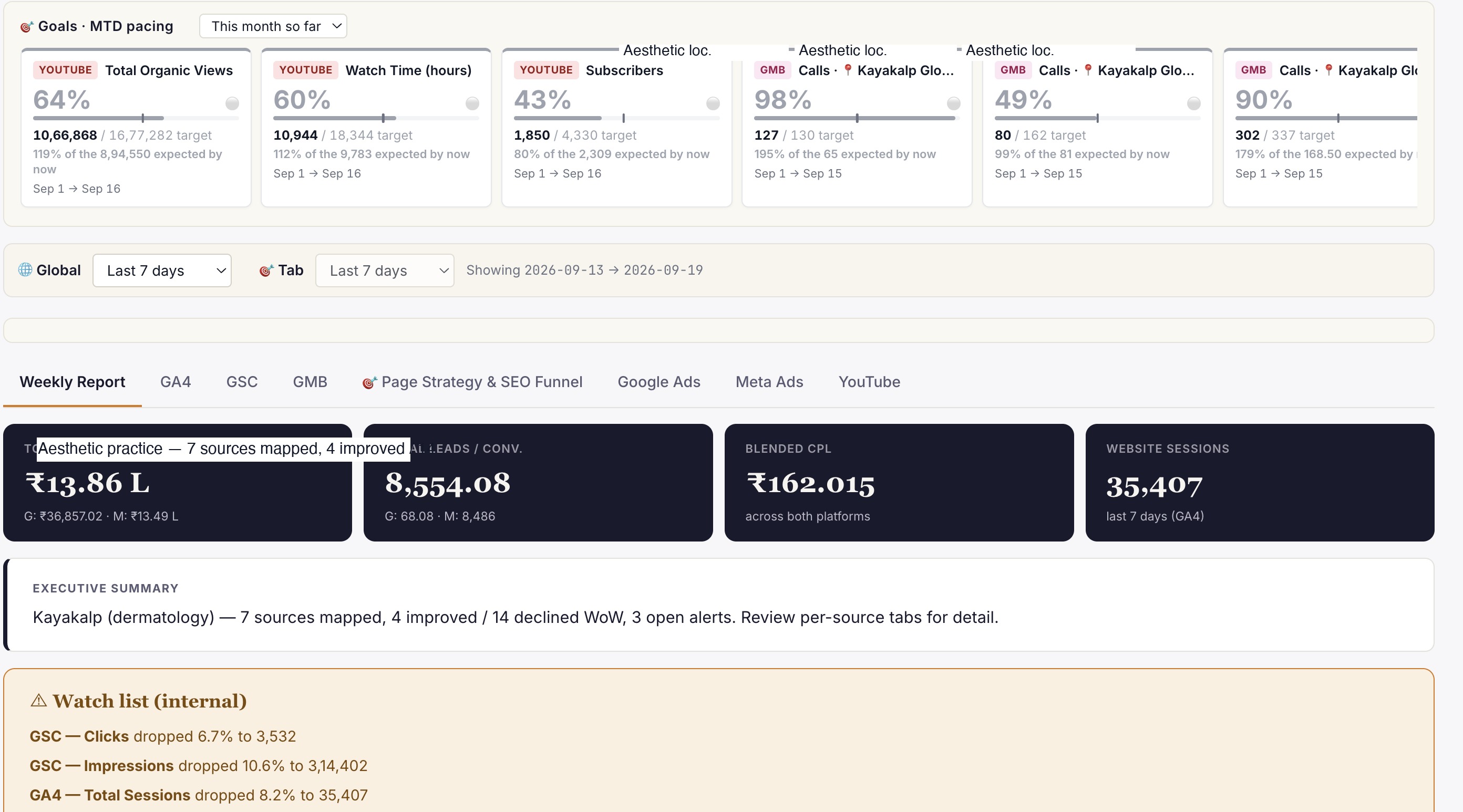
Live client dashboard. GSC, GA4, Google Ads, Meta Ads, IVR calls in one view. Login anytime, not monthly.
Phoenix
Clinic revenue intelligence over your PMS. Daily action queue: Prevent Loss, Maintain & Engage, Grow Revenue. Multi-centre rollout.
Or book a free 30-min audit to see all three in action on your account.
Healthcare brands
that already run on ICG.
A representative slice of the 150+ healthcare brands ICG has delivered for across India. Most engagements remain under NDA.


What ICG clients say · on video.
"Scale up of organic channels and business consulting. ICG has absolute domain authority in their field."
"Working with ICG transformed how we acquire IVF patients in Gurgaon. They understand the fertility journey from inquiry to consult..."
"What Ichelon accomplished — they got all my ideas and worked over 3-4 months to create an amazing, super-customised website."
Need help operationalising this?
Every ICG service is healthcare-only, NMC + DPDP-aware, and built around the patient-research patterns that drive Indian healthcare growth in 2026.
Every practice welcome — packages from ₹20,000/mo.
Goals-Driven engagements · Performance-Linked Payout Models available


More from
ICG.
Five trends shaping Indian healthcare marketing through 2027: AI-first patient research, Conversions API adoption, ABDM discovery, the AEO w...
Healthcare AIO is the discipline of getting your clinic or hospital cited inside Google AI Overviews, ChatGPT and Perplexity answers — not j...
Conversational-search advertising places brand messages inside AI chat answers — ChatGPT, Perplexity, Copilot — rather than beside a results...
Stop guessing.
Book a Diagnostic.
30 minutes. Free. With the AI-powered healthcare-only marketing agency 150+ brands already run on. No slides, no pitch, no hard close.


