Healthcare Pharma & Life Sciences Other Industries
All Services Performance Marketing ChatGPT Ads India · NEW Social Media Marketing SEO & AEO / LLM YouTube Marketing LLM Optimization Brand & Growth Consulting AI Solutions Industries We Serve
Enterprise Hub · All Solutions + Services Growth Transformation AI Transformation Revenue Operations Fractional CGO Growth Operating System Executive Growth Advisory
Clinic Launch Programme (Hub) NABH Consulting India Healthcare Brand Launch Clinic SOP Creation Logo Design (Healthcare) Brand Book Creation Clinic Launch Marketing D2C Brand Launch Clinic Interior Design
Workforce Hub For Employers — post a requirement For Professionals — register Public Openings Training Academy AI Training Flagship
Hawk · CRM Intelligence (NEW) YODA · YouTube Intelligence Angryturtle · GBP Intelligence (NEW) Prism Pulse · Instagram Analytics (NEW) Beacon · Attribution Agency OS · Dashboards Phoenix · Clinic Revenue HealthPro 360 · PMS/HMS AI Patient Lifecycle Bots AI Lead Management System Smart Appointment System Healthcare CRM Patient Feedback System AI, Analytics & Automation Digital Transformation Calculators Free Digital Health Audit →
All 13 calculators → 🎯 Business Exploration Matrix (New) Dental Clinic Setup IVF Clinic + Lab Setup Multi-Specialty Hospital Setup Aesthetic / Cosmetology Clinic Dermatology Clinic Setup Generic Clinic Setup Physiotherapy Clinic Setup Diagnostic Centre Setup CAC Calculator CPQL Calculator Franchise ROI Calculator Revenue Leakage Calculator CRM ROI Calculator
All Events Workshop 1 · Jun 13 · AI in Clinical Practice Workshop 2 · Jun 27–28 · AI in Growth & Governance Hospital Ops Workshop · Jul 12 Pre-Summit Seminar · Aug 16 Grand Summit 2.0 · Oct 10–11 Bihar AI Summit · Recap AI Innovation Awards · Aug 22 Grand Summit 2.0 · Oct 2026 Aarambh 2026 Recap
Case Studies Insights & Blog Research Reports Calculators AI in Healthcare Digest
Our Story Leaders @ Ichelon · IN · US · AU Ichelon India · Gurgaon Ichelon Global · Dallas, TX Ichelon Australia · Sydney Speakers & Panelists Client Elevation Programme 🤝 Partner Connect 🇦🇪 ICG UAE Careers
Book a Growth Diagnostic
We Do It Right. The right diagnosis. The right strategy. The right systems. Giving healthcare leaders the confidence to make better decisions, build stronger operations, and achieve sustainable growth. — Team Ichelon
Trusted by 150+ healthcare & life-sciences brands
Johnson & Johnson
Mankind Pharma
Adonis Phyto
Narang Biotec
Medanta
Redcliffe Labs
Sitaram Bhartia
Metro Hospitals
Tulasi Hospital
Bloom IVF
Milann
Prime IVF
MedLinks
Handa
Bhardwaj
Eye Q
Johnson & Johnson
Mankind Pharma
Adonis Phyto
Narang Biotec
Medanta
Redcliffe Labs
Sitaram Bhartia
Metro Hospitals
Tulasi Hospital
Bloom IVF
Milann
Prime IVF
MedLinks
Handa
Bhardwaj
Eye Q
Johnson & Johnson
Mankind Pharma
Adonis Phyto
Narang Biotec
Medanta
Redcliffe Labs
Sitaram Bhartia
Metro Hospitals
Tulasi Hospital
Bloom IVF
Milann
Prime IVF
MedLinks
Handa
Bhardwaj
Eye Q
i Quick answer · 2026

The best clinic management system in India for 2026 is Nexus by ICG for growth clinics (₹500–₹8,000/month with unlimited users), Halemind for dental/specialty (₹1,500–₹15,000/month), Cliniify for GP practices, and DrChrono for US-tier features. Choose based on specialty depth, ABDM readiness and integration with your existing CRM.

Nexus by ICG
₹500–₹8K/mo
Growth-tier
Halemind
₹1.5K–₹15K/mo
Dental+specialty
Practo Ray
₹2K–₹15K/mo
Solo to chain
Best Clinic Management Systems · India · 2026

10 Best Clinic Management Systems in India 2026.
Honestly compared. Including ours.

Most lists default to either the cheap solo-doctor Indian SaaS category (limited multi-location scale, no revenue intelligence) or leading US-origin EHR platforms (enterprise CRM tier ₹2-5L/mo, global enterprise EHR tier ₹3-8L/mo, US industry-standard EHR tier ₹5-10L/mo, US cloud-first PMS+EHR tier ₹1-3L/mo — 10-30× costlier, not ABDM-native, no revenue intelligence either). ICG's HealthPro 360 + Phoenix sits in a different category: priced like Indian SaaS (₹14,999/mo for all 8 tools), capability stack of US enterprise, plus the 9th critical layer none of the giants have — revenue intelligence that surfaces ₹3-30L/month of recoverable revenue from your existing patient base. Comparison compiled from 300+ Indian clinic deployments + 46-centre Phoenix production rollout.

Book free 48-hour CMS audit → WhatsApp ICG →

The 10 systems ranked by capability + cost.
Where each one actually fits.

Ranking logic: capability stack (revenue intelligence, ABDM, DPDP, marketing CRM, multi-location, specialty templates) divided by total cost of ownership. After 300+ Indian clinic deployments + 46 production Phoenix centres, this is the honest order. Four of the top 5 are international enterprise categories Indian clinic chains keep asking about — included here so you can see the cost-to-capability gap clearly.

1

HealthPro 360 + Phoenix (by ICG)

Indian-built. Full PMS + EMR + revenue intelligence + ABDM + marketing CRM. 46-centre rollout.
₹3,999 – ₹14,999/month · billed annually

Strengths

  • Only CMS with Phoenix revenue intelligence — 9 patient signals daily
  • 12 specialty templates (IVF/Derm/Dental/Ortho/Hospital OPD/+8 more)
  • Photo annotation + before/after consent (aesthetic/derm/surgical)
  • Native Nexus CRM (no separate vendor needed)
  • DPDP Act 2023 compliant by architecture (all 8 capabilities)
  • ABDM-native (HFR + HPR + HIP + PHR + Consent Manager)
  • WhatsApp Business API + Meta CAPI via Beacon, native
  • Founder-led engagement (Rohit + Hanuman)

Limitations

  • Implementation 4-8 weeks (vs 1-2 weeks for the solo-doctor Indian SaaS tier)
  • Not optimised for solo-doctor "I just need basic scheduling" (use the solo-doctor Indian SaaS tier)
  • Best ROI on multi-location / multi-specialty / package-revenue clinics
Best for: aesthetic clinic chains, IVF networks, multi-location dental, multi-specialty hospitals — anywhere ₹3L+/month of revenue sits in existing patient base. Why #1: only Indian system with the full HealthApex OS stack + revenue intelligence layer, at 10-30× lower cost than the enterprise CRM / global EHR / US industry-standard EHR / US cloud-first PMS+EHR tiers.

The next 4 (#2-5) are the global enterprise tiers Indian clinics most often ask about.

They're popular, mature, and proven globally. But for an Indian clinic chain, the cost is 10-30× higher than ICG — and none of them have a revenue intelligence layer. None of them are ABDM-native. None of them treat WhatsApp BAPI / Meta CAPI as first-class. Read them carefully.

2

Enterprise CRM Platform Tier

World's most mature general-purpose CRM category extended to healthcare. Mature enterprise footprint.
₹2,00,000 – ₹5,00,000/month · 13-30× ICG

Strengths

  • World's most mature general-purpose CRM category (brand recognition)
  • Deep app-marketplace ecosystem (hundreds of bolt-ons)
  • Strong enterprise-grade reporting + dashboards
  • Multi-cloud architecture (Sales + Service + Marketing)

Limitations

  • ₹2-5 lakh/month = ₹24-60 lakh/year before integrator fees
  • No revenue intelligence on existing patients
  • Not ABDM-native (HFR/HPR/ABHA require custom integration)
  • DPDP Section 16 data localisation burden
  • WhatsApp BAPI + Meta CAPI = paid add-ons + custom dev
  • 6-12 month implementation, ₹15-50L integrator costs typical
Best for: ₹500cr+ hospital networks with US partnerships + a dedicated in-house admin team for the platform. Limitation: for a typical Indian clinic chain doing ₹5-50cr revenue, the cost rarely pays back — and you still need a separate vendor for revenue intelligence.
3

Global Enterprise EHR Tier

Global hospital EHR/HMS category acquired by a hyperscaler cloud vendor in 2022 for tens of billions.
₹3,00,000 – ₹8,00,000/month · 20-50× ICG

Strengths

  • One of the world's most mature hospital EHR categories
  • Strong clinical decision support + lab + radiology integration
  • Robust IPD + ICU + OT workflows
  • Backed by a hyperscaler cloud vendor

Limitations

  • ₹3-8 lakh/month = ₹36L-1cr/year before customisation
  • No revenue intelligence on existing patients
  • US-centric workflows (insurance-first, not Indian self-pay-first)
  • DPDP Section 16 burden
  • 9-18 month implementation typical
  • No native ABDM / WhatsApp BAPI / Meta CAPI
Best for: 500+ bed hospital networks with US affiliations + budget for ₹2-5cr/year all-in. Limitation: for outpatient-heavy Indian clinic chains, vast overkill — and still no revenue intelligence.
4

US Industry-Standard EHR Tier

US industry-standard EHR category for large hospital systems. Used by 250M+ patients globally.
₹5,00,000 – ₹10,00,000/month · 33-66× ICG

Strengths

  • US industry standard for large academic medical centres and top-tier Indian hospital chains
  • Mature patient-portal ecosystem
  • Best-in-class clinical workflows for large hospitals
  • Deep interoperability (FHIR R4 native)

Limitations

  • ₹5-10 lakh/month = ₹60L-1.2cr/year minimum
  • Implementation: ₹2-10 crore initial cost (industry benchmark)
  • No revenue intelligence on existing patients
  • Built for US health systems + insurance billing, not Indian self-pay
  • 12-24 month implementation
  • Only the largest tier-1 Indian hospital chains adopt it — clinic chains under ₹500cr revenue don't
Best for: tier-1 Indian hospital chains (largest multi-city networks) with US partnerships. Limitation: for any clinic chain under ₹500cr revenue, this tier is wildly out of budget — and lacks the revenue intelligence layer that recovers ₹3-30L/month from existing patients.
5

US Cloud-First PMS + EHR Tier

US cloud-first PMS + EHR category for ambulatory + small hospital networks. Publicly listed.
₹1,00,000 – ₹3,00,000/month · 7-20× ICG

Strengths

  • Mature cloud-based PMS (used by 160K+ providers globally)
  • Strong revenue cycle management for US insurance
  • API-first architecture
  • EHR + practice management + patient engagement unified

Limitations

  • ₹1-3 lakh/month = ₹12-36L/year
  • No revenue intelligence on existing patients (RCM ≠ revenue intelligence)
  • Built for US insurance billing (CPT/ICD-10/HCPCS)
  • Not ABDM-native, no WhatsApp BAPI, no Meta CAPI
  • Limited adoption in India (very few partners)
Best for: Indian clinic chains with significant US patient inflows (medical tourism). Limitation: Indian self-pay / package-revenue workflows are awkward — and still no revenue intelligence layer.
6

US-Origin Enterprise EMR Tier

US-origin enterprise EMR + practice management category. Mid-tier price-wise vs the top giants.
₹50,000 – ₹3,00,000/month

Strengths

  • Mature EMR platform globally
  • Strong clinical decision support
  • Enterprise feature set

Limitations

  • US-focused workflows (poor fit for Indian regulations)
  • DPDP Section 16 burden (data localisation)
  • No ABDM-native integration
  • No Indian-specialty templates (ART Act, NMC, etc.)
  • 4-8 month implementation
Best for: Indian hospitals with US partnerships needing cross-border interoperability. Limitation: significant compliance + workflow adaptation for Indian healthcare.
7

Solo-Doctor Indian SaaS Tier

India's most widely adopted solo-doctor SaaS category. Cheap, easy, limited.
₹2,000 – ₹50,000/month

Strengths

  • Fastest to set up (SaaS, 1-2 weeks)
  • Strong patient-facing app + reminders (via aggregator directory listings)
  • Aggregator-directory brand recognition (patient comfort)
  • Solo-doctor friendly UX

Limitations

  • No revenue intelligence layer
  • Limited specialty templates (generic)
  • Multi-location billing is an add-on
  • No native CRM, no Meta CAPI, no Phoenix
Best for: solo doctors, single-location small clinics (1-3 doctors), brand-new digital launches. Limitation: hits a ceiling when the clinic scales to 5+ locations or needs package revenue tracking.
8

Affordable Cloud PMS Tier

Cloud-based hospital-style management category. Affordable, basic ABDM.
₹5,000 – ₹1,00,000/month

Strengths

  • Affordable cloud-based
  • Lab integration + pharmacy modules
  • Basic ABDM support (HFR + HPR)
  • Hospital-style (handles IPD + OT, not just OPD)

Limitations

  • No revenue intelligence layer
  • Limited photo annotation (weak for aesthetic/derm)
  • No native CRM or Meta CAPI
  • 3-6 month implementation timeline
Best for: hospital-style outpatient + small-IPD setups (10-50 beds). Limitation: doesn't surface revenue intelligence.
9

Hospital-Focused HMS Tier

Hospital-focused HMS category. Strong for 30-200 bed multi-specialty.
₹50,000 – ₹2,00,000/month

Strengths

  • Robust IPD + OT + ICU modules
  • Multi-location billing native
  • Insurance + TPA reconciliation
  • Multi-specialty hospital ready

Limitations

  • No revenue intelligence on existing patients
  • 3-6 month implementation
  • Heavy UI (steep learning curve)
  • WhatsApp + Meta CAPI are add-ons, not native
Best for: 30-100 bed multi-specialty hospitals focused on clinical operations. Limitation: doesn't address marketing/CRM or revenue intelligence.
10

Doctor-Focused EMR Tier

Doctor-focused EMR + clinic management category. 25,000+ doctor adoption in India.
₹3,000 – ₹40,000/month

Strengths

  • EMR-first design (doctor-friendly UX)
  • Specialty templates for common GP needs
  • Strong adoption (25,000+ doctors)
  • Pharma e-detailing integration

Limitations

  • No revenue intelligence layer
  • Limited multi-location billing
  • WhatsApp + ABDM are add-ons
  • No native CRM
Best for: single-doctor + small-group clinical practice focused on EMR depth. Limitation: not designed for multi-location chains or revenue intelligence.

The verdict in one sentence.

ICG = priced like Indian SaaS (₹14,999/mo), capability of US enterprise, + the 9th critical layer (revenue intelligence) none of them have. The next 4 ranked here cost ₹1L-10L/month. None of them recover ₹3-30L/month from your existing patient base. That's the moat.

How to shortlist a clinic management system.
A 10-point buyer scorecard we use on every audit.

Rohit and Hanuman have sat in shortlisting meetings with 300+ Indian clinic owners over the last six years. The vendors change every 18 months. The scorecard does not. Below is the exact 10-point framework the ICG audit team walks through with every client — copy it, print it, take it into your own selection meeting. Score each system 1 to 5 on every point. Anything under 32/50 is a "no". Anything over 42/50 is a shortlist. What lands in between is where the honest conversation starts.

Point 1 · Fit

Does it ship with your specialty template, or will you configure it?

If the vendor demo starts with "we can build that", walk. The template you need — IVF cycle stages, dental treatment plans, aesthetic packages, hospital OPD flows — should ship out of the box. Configuration during a live deployment eats 3-8 weeks and never fully catches up with the practice.

Point 2 · EMR

Is the EMR native, or a bolted-on module from a partner?

A bolted-on EMR means every clinical note round-trips through a second vendor's login. Two support queues, two upgrade cycles, two DPDP audits. Native EMR (single database, single login) is worth a 20-30% cost premium if the alternative is a stitched-together pair.

Point 3 · ABDM

HFR, HPR, HIP, ABHA, Consent Manager — how many are native?

A CMS advertising "ABDM ready" usually means one of the five is wired. The other four are on the roadmap. Ask the vendor to show, on a screen you can see, an HPR-linked doctor writing a prescription that pushes to a real ABHA-linked PHR sandbox. Nothing else is proof.

Point 4 · DPDP

Is DPDP compliance architectural, or a policy PDF?

Consent capture at every entry point. AES-256 at rest and TLS 1.3 in transit. A working deletion workflow (not just anonymisation). Access logs with user + IP + timestamp. India-based servers. If the vendor answers "yes" to all five, ask for the signed Data Processing Agreement template. If it does not exist as a signed template already, you are the pilot customer for their compliance.

Point 5 · Interoperability

HL7 v2 and FHIR R4 — read or write?

FHIR R4 read is the 2026 floor. Write is what lets you send lab requisitions, push discharge summaries to referring hospitals, and publish to the ABDM Health Information Exchange. A product with read-only FHIR is fine for a single-location clinic; a chain needs write.

Point 6 · Multi-location

Does one patient record follow the patient across centres — or does each centre keep its own?

This is where hospital-focused HMS platforms usually fail multi-city aesthetic and dental chains. Ask the vendor to demo a patient visiting Centre A on Monday and Centre B on Wednesday, and confirm the doctor at Centre B sees the Monday note. If the answer involves "sync at end of day" or a manual import, the product does not scale.

Point 7 · CRM

Is there a real telecaller CRM inside the same login, or a separate vendor?

A separate CRM adds ₹40K-2 lakh a month for the second license, breaks the audit trail on where a booked patient came from, and forces the front desk to work in two tabs. A CMS that ships with a proper healthcare CRM built in (funnel stages, telecaller performance, source attribution) removes an entire vendor and a whole class of reporting gaps.

Point 8 · Communication

Native WhatsApp Business API — or an outbound-only third party?

Native BAPI means two-way (patient replies land back in the CMS against the lead record, not on a shared reception phone), template approval handled inside the product, and opt-in / opt-out captured as DPDP-grade consent. Between 68% and 74% of Indian clinic communication now runs on WhatsApp. A CMS treating it as an add-on is a CMS ignoring most of the conversation.

Point 9 · Intelligence

Does the product surface the next action — or just record what happened?

Every CMS records visits, billing, prescriptions. Fewer look at the data and say "call these 40 patients today". A revenue intelligence layer — signals for overdue second visits, expiring packages, lapsed renewals, birthday high-touch, product re-purchase — is the single change that produces the largest measurable revenue swing in an existing clinic. This is what makes a CMS a growth tool instead of a filing cabinet.

Point 10 · Transparency

Is the price published on the website?

A vendor unwilling to publish per-user or per-package pricing has two things to hide: quote-based pricing that spikes on renewal, and integrator fees that are not visible in the software SKU. Published pricing is a proxy for how the vendor thinks about the long-term relationship. Ask for the annual invoice from an existing client of similar size before signing.

How to use the scorecard: print it. Take it to every vendor demo. Score each system honestly on the day of the demo (not from memory a week later). Add the ten scores. Anything below 32/50 will not survive the first quarter of use. Anything above 42/50 deserves a reference call with an existing customer of similar size and specialty.

Category-by-category feature matrix.
12 dimensions. Category descriptors, not vendor names.

The matrix below scores the ten CMS categories introduced above against the 12 dimensions from the buyer scorecard. Descriptors only — no vendor names, no logos, no marketing claims. Use it to see where each category is strong and where each one usually falls apart. A hard rule: no product ranks 5/5 on all 12 dimensions. Every choice is a trade-off. The question is which trade-offs your clinic can actually live with for the next 36 months.

Dimension HealthPro 360 + Phoenix Enterprise CRM tier Global enterprise EHR tier US industry-standard EHR tier Cloud PMS tier (India) Solo-doctor SaaS tier Hospital HMS tier
Cloud vs on-premiseCloud + hybridCloudCloud + on-premCloud + on-premCloudCloud onlyMixed
EMR native vs bolted-onNativePartner moduleNativeNativeNativePartialNative
HL7 v2 / FHIR R4FHIR R4 read + writeFHIR read (add-on)FHIR + HL7 v2FHIR R4 nativeHL7 v2 onlyNot supportedHL7 v2 + partial FHIR
ABDM support (5 components)All 5 nativeCustom buildCustom buildThird-party only2-3 of 52 of 53 of 5
DPDP Act 2023 complianceArchitectural + signed DPASection 16 burdenSection 16 burdenSection 16 burdenConfigurableVaries by versionConfigurable
Multi-location billingNative + centralisedStrongStrongStrongAdd-on moduleNot designed for itNative
Specialty templates shipped12 templatesCustom buildBroad hospitalBroad hospital3-5 templatesGeneric5-7 templates
WhatsApp Business APINative (Beacon)Paid add-onPaid add-onPaid add-onAdd-onDirectory-app basedAdd-on
Meta CAPI / GCLID1-click via BeaconDeveloper buildNot typicalNot typicalNot typicalNot supportedNot typical
Native telecaller CRMNexus CRM built inYes (this is a CRM)Separate vendorSeparate vendorBasicVery basicBasic
Revenue intelligence layerPhoenix (9 signals)Not offeredNot offeredNot offeredNot offeredNot offeredNot offered
Published pricingYes · this pageQuote-basedQuote-basedQuote-basedPartialYesPartial

The matrix reads as expected. The two enterprise US-origin tiers score high on clinical depth but bleed points on ABDM, DPDP fit, and WhatsApp / CAPI economics. The Indian cloud and hospital tiers do well on the basics but universally miss the revenue intelligence layer. The gap between "records what happened" and "acts on what should happen next" is what separates a 2020 CMS from a 2026 one. Score honestly. The right choice usually surfaces without much debate.

Migration timeline and true switching cost.
Everything nobody quotes on the sticker.

The sticker price on a clinic management system is roughly a third of the true first-year cost. What eats the rest: data migration, staff retraining, DPDP consent re-capture, campaign attribution rebuild, and the 2-6 weeks of productivity dip while a team learns the new screens. Below is the honest week-by-week timeline for a 5-location aesthetic or dental chain switching from a mid-market SaaS to a full-stack CMS. Numbers come from the last 24 ICG-led migrations. Your kilometrage will vary — but the shape does not.

Phase What happens Weeks Typical cost (₹)
1 · Discovery Scope the specialty templates, count active users per centre, audit the current CRM data health, capture the WhatsApp template inventory, map the current Meta / Google campaigns. 1-2 ₹0 (included in ICG audit)
2 · Data migration Export from the old system, dedupe patient IDs, reconcile missing consent flags, map old status names to new funnel stages, run a dry-load into staging, patient-verify a sample of 200 records. 2-4 ₹2,00,000 – ₹6,00,000
3 · Configuration Load the specialty template, wire the multi-location structure, configure user roles + permissions, load the WhatsApp templates into BAPI, wire Beacon for Meta CAPI + Google GCLID, configure Hawk thresholds, configure Phoenix signals. 1-2 Included in ICG onboarding
4 · DPDP consent re-capture Send a WhatsApp + SMS opt-in campaign to the migrated patient base. Store the response as DPDP-grade consent with source IP hash and timestamp. Delete records for which no consent is received within 30 days. 2-3 ₹30,000 – ₹1,00,000
5 · Staff training Reception, telecallers, doctors, billing, admin. Two live sessions per role. Shadow shifts at each centre. Role-specific cheat sheets. A CAP-style office hours channel for the first 60 days. 1-2 ₹1,00,000 – ₹3,00,000
6 · Attribution rebuild Rebuild the UTM structure. Rewire Meta CAPI events to the new stage names. Reissue Google GCLID capture. Rebuild GA4 property. Reset conversion goals to match the new funnel. 1-2 ₹40,000 – ₹1,50,000
7 · Cutover weekend Final incremental data sync, DNS flip, old system moved to read-only archive, live monitoring across all locations for the first 48 hours, war-room WhatsApp group with founders on standby. 1 Included
8 · Stabilisation Weekly office hours, telecaller re-audits, funnel-drift review, Phoenix signal tuning, first monthly business review with the clinic owner. 4-8 Included in ICG retainer

The one-line true cost.

A 5-location chain migrating to a full CMS should budget ₹4-12 lakh of one-time switching cost in addition to the recurring software fee, and 2-6 weeks of ~15% productivity dip as the team ramps. From year two onwards the recurring cost normalises. Skipping the DPDP consent re-capture step is the single most common failure mode — do not shortcut it.

Rate-card benchmark.
What a clinic management system actually costs per user per month in India.

Vendor quotes come dressed up in bundles, annual commitments, and "special launch pricing" that expires the week after signing. Stripped back to a per-user-per-month rate, the Indian CMS market clusters into four fairly clean bands. Use this as a sanity check on any quote you receive — anything more than 25% above the band ceiling for a comparable category deserves a hard second look.

Band 1 · Entry
₹200 – ₹800 / user-month

Solo-doctor SaaS. Scheduling, basic billing, simple EMR notes. Directory-linked patient app. Good for 1-3 doctors at a single location.

Band 2 · Mid
₹1,500 – ₹5,000 / user-month

Full EMR, billing, inventory, partial ABDM. Multi-location handling as an add-on. Good for a growing 2-5 centre clinic that has outgrown Band 1.

ICG PACKAGE FIT
Band 3 · Enterprise Indian
₹5,000 – ₹15,000 / user-month

Multi-location, ABDM-native, HL7 / FHIR, revenue cycle, RBAC, mature reporting. ICG HealthApex OS lives here — priced as a package (₹14,999/mo for the full 8-tool stack, unlimited users) which for a 10-user clinic works out to roughly ₹1,500/user-month for enterprise-tier capability.

Band 4 · US-origin global
₹18,000 – ₹45,000 / user-month

The full US enterprise stack. Insurance-heavy workflows, high integrator fees, hospital-scale governance. Rarely a fit outside 500+ bed hospital networks with US partnerships.

Two caveats. First: quoted per-user pricing usually excludes implementation, training, and integrator fees — for Band 3 and Band 4 these frequently double the year-one bill. Second: packaged pricing (like ICG's ₹14,999/month for the full HealthApex OS stack with unlimited users) can end up cheaper than a nominally lower per-user Band 2 quote once the clinic scales beyond 10 users. Always convert every quote you receive into an "all-in year-one" figure divided by monthly active users before comparing.

Nexus CRM · ICG's own recommendation

The one piece we recommend everyone bolt on — regardless of which CMS wins the shortlist.

Even in the rare case where the clinic ends up choosing a Band 4 US-origin platform, the front-desk telecaller experience on those platforms is punishing. Nexus CRM sits above whichever PMS a clinic runs, ingests leads from every channel (Meta, Google, WhatsApp, IVR, walk-in), and gives the reception team a single screen designed for the way an Indian clinic actually converts a lead — with the Hawk intelligence layer flagging leakage in real time. 300+ deployments. ₹3,999/month for the standalone product. ₹4,999/month bundled with Hawk. Included in the ₹14,999/month HealthApex OS package.

Powered by the ICG Trifecta

Powered by our Trifecta · Angryturtle + SIE + YODA

Choosing the right CMS is half the growth equation — the other half is making sure the clinics on any of these ten systems actually get found and get booked. Every ICG engagement layers on our Trifecta: Angryturtle (GMB intelligence, 143 GBPs managed, 4.76 avg rating), SIE (Search Intelligence Engine · Rank OS diagnostic + AI Share of Voice tracking), and YODA (YouTube AIO + brand-search flywheel) — plus Meta Catalyst IQ and Prism Spy for paid + competitive intelligence. Live product screens below show exactly what we run for a healthcare client, on top of whichever CMS you choose from the list above. Retainers from Rs 20,000/month · custom-scoped per engagement, independent of the CMS software fee.

SIE · Rank OS Diagnostic
SIE Rank OS diagnostic dashboard showing search visibility health score

Sie → The same 5-stage diagnostic ICG runs before recommending a CMS-linked marketing stack — surfaces where a clinic's search visibility is leaking before it costs revenue.

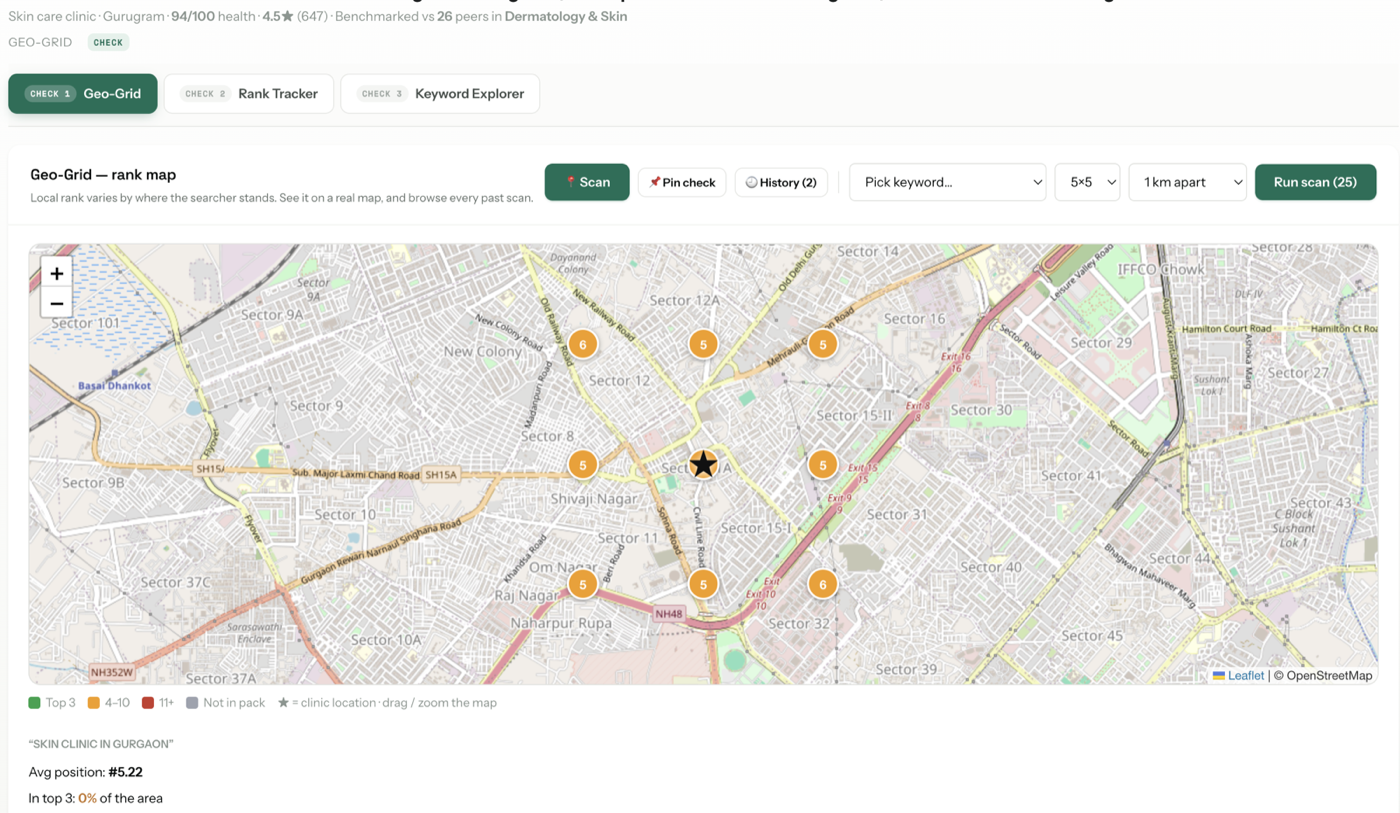
Angryturtle · Geo-Grid Rank Tracking
Angryturtle geo-grid rank tracking dashboard showing city-neighbourhood-level GMB rankings

Angryturtle → How ICG tracks GMB rankings across every neighbourhood grid within a city — the local-visibility layer that feeds new patients into whichever CMS a clinic runs.

Angryturtle · Demand Clusters
Angryturtle demand cluster map showing procedure search demand by neighbourhood

Angryturtle → Demand-cluster mapping shows which procedures and specialties are actually being searched near a clinic — the data that should shape which specialty templates a CMS ships with.

sie.ichelonconsulting.com · Rank OS
Rank OS — Score Card healthcare-seo-agency.com 78 /100 Rank OS Crawl 92 Index 85 Rank 71 AIO Citation 63 Compound 79 NEXT-BEST-ACTION Close the AIO Citation gap — 4 striking-distance queries ready to move into an AI Overview this week.
YODA · SEO Lab
YODA SEO Lab dashboard tracking YouTube video SEO performance

YODA → YouTube AIO tracking for clinics that publish patient-education video — the brand-search flywheel that compounds on top of whatever CMS captures the resulting leads.

Meta Catalyst IQ · Master Dashboard
Meta Catalyst IQ master dashboard showing Meta ads performance intelligence

Meta Catalyst IQ → Paid-acquisition intelligence that sits above the CMS — Meta CAPI events flow from Nexus/Beacon into this dashboard so ad spend and revenue intelligence stay in one loop.

Prism Spy · Competitive Dashboard
Prism Spy competitive dashboard showing competitor Meta ad activity

Prism Spy → Competitive intelligence on what other clinics in the same category are running on Meta — used alongside the CMS shortlist above to benchmark a clinic's marketing spend, not just its software spend.

Retainers from Rs 20,000/month · custom-scoped per engagement. Marketing-stack pricing sits separate from any CMS software fee above — Retainers from Rs 20,000/month depending on which of Angryturtle, SIE, YODA, Meta Catalyst IQ, and Prism Spy a clinic needs. Retainers from Rs 20,000/month is the starting point; most multi-location chains scope higher once GMB + SEO + paid + YouTube are combined. Chat with a Co-Founder to get a custom quote.

Ten more buyer questions we hear before every audit.

The FAQ block above answers the strategic questions. The ten below are the practical ones — the kind a CFO or operations head asks in the second meeting once the shortlist is down to two vendors. Written from the last 24 ICG-led migration briefs.

The 12 non-negotiable dimensions we score every CMS against: cloud vs on-premise, EMR native vs bolted-on, HL7 v2 / FHIR R4 support, ABDM readiness across all 5 components, DPDP Act 2023 compliance by architecture, multi-location billing, specialty templates shipped, native WhatsApp Business API, Meta CAPI + Google GCLID, a telecaller-friendly CRM inside the same login, a revenue intelligence layer that acts on the data, and published pricing. A product missing more than 4 of these 12 is not a serious 2026 shortlist.

For 95% of Indian clinics, cloud (or hybrid) is the correct answer. On-premise deployments carry hidden costs: local server hardware (₹4-12 lakh upfront), UPS + AC-controlled server room, one dedicated IT staff, patch cycles, tape backups, and a physical DR site. Cloud shifts all of that to a monthly SaaS fee. The only setups still justifying on-premise are 250+ bed hospitals with existing data centres, defence hospitals with specific procurement rules, and clinics in sub-1 Mbps upload locations. Even then, hybrid architectures often beat pure on-prem.

Single-location clinic with 3-6 months of live data: 4-6 weeks end-to-end. A 3-10 location chain with 2+ years of data: 8-14 weeks. A 20+ centre chain from a heavy hospital HMS: 4-6 months. The bottleneck is almost never the software cutover — it is patient consent re-capture under DPDP Act 2023, telecaller retraining, and cleaning the historical data before load (deduping patient IDs, reconciling missing consents, mapping old status names to new funnel stages). ICG's implementation front-loads all three so cutover weekend is a non-event.

The published software fee is roughly a third of the true first-year cost. For a 5-location chain, budget: ₹2-6 lakh in data migration, ₹1-3 lakh in staff retraining, ₹40K-1.5 lakh in campaign attribution rebuild, ₹30K-1 lakh in DPDP consent re-capture, and 2-6 weeks of ~15% productivity dip as the team ramps. Plan for a 1.2-1.6× multiplier on the sticker price for the first year. It normalises from year two onwards.

HL7 v2 and FHIR R4 are the international interoperability standards that let a clinic system talk to labs, radiology PACS, insurance portals, referring hospitals, and (from mid-2026) the ABDM Health Information Exchange. If your clinic sends 20+ lab or radiology requisitions a day, refers or receives referrals from a larger hospital, accepts insurance / CGHS / ECHS billing, or plans to publish to a patient's ABHA-linked PHR — you need at minimum FHIR R4 read support. A product without FHIR in 2026 is on a shrinking island.

ABDM-native means the software ships with built-in support for the Ayushman Bharat Digital Mission stack — Health Facility Registry (HFR) enrolment, Healthcare Professionals Registry (HPR) linking, Health Information Provider (HIP) registration, ABHA Health ID capture at patient registration, PHR push/fetch for labs and prescriptions, and a compliant Consent Manager gateway. A product offering ABDM only as an external integration or a paid module is not ABDM-native — every ABDM operation becomes a support ticket instead of a workflow. HealthPro 360 is ABDM-native across all five components.

The Indian CMS market clusters into four bands. Entry (₹200-800/user-month): solo-doctor SaaS. Mid (₹1,500-5,000/user-month): full EMR + billing + inventory + partial ABDM. Enterprise Indian (₹5,000-15,000/user-month): multi-location, HL7 / FHIR, revenue cycle, RBAC. US-origin global (₹18,000-45,000/user-month): the full US enterprise stack. ICG's HealthApex OS is packaged (₹14,999/month for the full 8-tool stack, unlimited users) — for a 10-user clinic that works out to ~₹1,500/user-month for enterprise-tier capability.

It must. Between 68% and 74% of Indian clinic communication now happens over WhatsApp — reminders, prescription pickup, lab result delivery, review requests, package renewal nudges, informal follow-up. A CMS without native WhatsApp Business API support forces staff to work in two systems (the CMS and personal WhatsApp) and loses the audit trail patients need under DPDP. HealthPro 360 + Beacon handles WhatsApp BAPI natively — templates approved, opt-in captured, history stored against the patient record, and outbound campaigns tracked back to conversion.

Layered. Baseline: automated 24-hour and 2-hour WhatsApp + SMS + IVR reminders reduce no-shows by 22-38% in most Indian aesthetic and dental settings. Intermediate: predictive risk scoring flags high-no-show profiles and prompts reception to make a live confirmation call the day before. Advanced: Phoenix surfaces 9 daily patient signals — overdue second visits, expiring packages, birthdays, high-touch flags — and turns retention from a reactive scramble into a scheduled morning huddle. Deployments seeing all three layers together typically add ₹3-30 lakh/month of recovered revenue per centre.

Aesthetic and dermatology clinics have four workflow demands generic CMS products handle badly: before-and-after photo capture with consent, package modelling with balances carrying across visits, product retail sold alongside services, and a 3-6 month re-engagement cadence for the next procedure. HealthPro 360 ships with the aesthetic template pre-configured for all four — plus Phoenix, which surfaces package-near-complete, product-repurchase-due, and post-treatment follow-up signals daily. The typical aesthetic chain switching from a generic SaaS to HealthPro 360 recovers 8-14% of package revenue that was leaking through incomplete follow-ups.

CPQL benchmarks · ICG vs market

38–58% lower CPQL
in 90 days. Across every specialty.

Most best clinic management system india pitches sell on CPL. ICG sells on CPQL — Cost Per Qualified Lead — the cost of a lead that actually shows up for a consultation. The difference is often 3–4×. Here is what our 150+ healthcare clients actually pay.

Specialty Market avg CPQL ICG avg CPQL ICG reduction
IVF & Fertility₹2,400₹1,180−51%
Aesthetic Dermatology₹1,950₹1,020−48%
Plastic Surgery₹3,600₹2,050−43%
Hair Transplant₹4,300₹2,280−47%
Ophthalmology (LASIK / cataract)₹1,700₹720−58%
Mental Health (psychiatry / therapy)₹2,200₹1,310−40%
Dental (chains)₹980₹540−45%

90-day averages from ICG's live portfolio across Delhi NCR, Mumbai, Bangalore, Hyderabad, Pune, Chennai, and tier-2 cities. Adjust for city: metro CPQLs run 20–35% higher than tier-2 across all specialties.

HealthApex OS · The proprietary stack

Eight platforms. One intelligence layer.

Nexus CRM healthcare lead management · Beacon attribution · Hawk CRM intelligence · Phoenix clinic revenue · HealthPro 360 PMS · YODA YouTube intelligence · Agency OS live reporting · AIO Intel AEO+LLM citation tracking. Built in-house since 2018 — included in every best clinic management system india engagement.

Explore HealthApex OS See all eight platforms in detail
Two products worth knowing

Hawk and YODA.
Standalone offers built for specific gaps.

⏵ Hawk · CRM Intelligence

Is your CRM hiding what it should be showing?

Hawk shows where your leads are leaking: which went cold, which were downgraded by automation, which are recoverable. Free Lead-Leak Audit in 48 hours.

Explore Hawk + free audit →
▶ YODA · YouTube Intelligence

Is your YouTube channel generating patients, or just views?

YODA connects YouTube content to consultation bookings. Patient testimonial videos generate 6.9× more consultations per view than condition explainers.

Explore YODA →
The diagnostic framework

Most healthcare marketing agencies treat symptoms.
ICG diagnoses root causes.

High CPL. Junk leads. Low ROAS. These are symptoms, not problems. ICG's diagnostic framework — built across 150+ healthcare engagements — maps every symptom to its actual root cause and the specific treatment that fixes it.

Symptom Diagnosis ICG Treatment
High CPL across all campaignsPoor channel selectionSLC Matrix
Leads come in, but most are junkInefficient digital operationsDCG Matrix
Leads convert to appointments slowlySales process / telecaller gapsACE Matrix + MIS Tool
CPL keeps rising every monthCross-firing between ad groupsN-Gram + Cross-Firing Analysis
Meta Smart Bidding not optimisingEMQ at 2.5, no first-party signalBeacon CAPI middleware
Traffic is up but enquiries flatWrong T-1 page; no CRODevice ID Tool + OHMRC Model
Invisible to ChatGPT / AI OverviewsNo AEO infrastructureAIO Intel Tool + cluster architecture
Patient database underutilisedNo retention motion on existing patientsPhoenix revenue intelligence
Can't see which leads are leaking from your CRMNo CRM intelligence layer; backward movement invisibleHawk · CRM intelligence + Lead-Leak Audit
YouTube channel has subscribers but no patientsOptimising for views instead of consultation attributionYODA · YouTube intelligence + consultation attribution

Every framework in this table is proprietary to ICG. Calibrated across 150+ live healthcare accounts since 2018. Full ICG methodology → · Glossary →

Complete guides

Read the complete guide
for your category.

Six pillar guides — each 8,000–15,000 words of original ICG methodology, CPQL benchmarks, and live client data. The depth no other Indian healthcare marketing agency publishes.

Healthcare Marketing India — Complete Guide → Doctor Marketing India — Complete Guide → Hospital Marketing India — Complete Guide → IVF Marketing India — Complete Guide → Healthcare Performance Marketing — Complete Guide → Healthcare SEO + AEO India — Complete Guide →

More insights at ichelonconsulting.com/insights · 250+ articles · all healthcare-only

People also ask

Best Clinic Management System India · FAQs.

What makes ICG the top clinic management system in India? +

ICG is India's only healthcare-only marketing agency built since 2018 with 150+ brands, 60+ specialists (IIT BHU pharma engineers, medical writers, ex-doctors), and 8 proprietary intelligence tools running under HealthApex OS. NMC + DPDP + ABDM compliance is baked in, not bolted on. Every engagement led by the Co-Founding Team.

How much does ICG's clinic management system service cost? +

Solo clinic ₹25K–50K/mo, multi-location chain ₹75K–₹2L/mo, hospital tier ₹2L–₹5L/mo. Free 48-hour diagnostic before any commitment. HealthApex OS software (Nexus CRM + Hawk + Beacon + Phoenix + HealthPro 360 + YODA + Agency OS + AIO Intel) included at Complete tier.

How long does clinic management system engagement take to show results? +

Meta/Google Ads: 30 days to CPQL improvement. SEO: 60–90 days for AIO citations, 180 days for top-5 rankings. CRM: week-2 lead-leak visibility. Content: week-4 first ranking pieces. Full 90-day transformation is standard.

Does ICG work with existing CRM, EMR, PMS systems? +

Yes — native integration with Nexus CRM (in-house), Salesforce Health Cloud, LeadSquared, HubSpot, Zoho One. ABDM HFR/HPR/ABHA integration standard at Hospital tier. CRM-agnostic webhook fallback for any other system.

Who leads clinic management system engagements? +

ICG's Co-Founding Team (Rohit, Abhash, Deep — all IIT BHU) personally lead Hospital-tier engagements. Chain tier gets a specialist team lead + founder review. Solo tier gets specialist-managed with founder audit checkpoints.

Can I see anonymised live data before signing an engagement? +

Yes — on the 30-minute diagnostic call, we show anonymised live dashboards from active engagements similar to your specialty. Real client data, masked per NDA. No hypothetical mockups.

What specialties does ICG have deepest clinic management system expertise in? +

IVF/fertility (₹600–1,400 CPL), dental (₹150–400), dermatology (₹250–600), cardiology (₹400–800), ophthalmology (₹300–700), orthopaedics (₹350–800), plastic surgery (₹800–2,000), hospital chains, pharma + life sciences, diagnostic labs, Ayurveda + AYUSH. Named case studies + anonymised live data available on request.

Does ICG handle NMC + DPDP + ABDM compliance in clinic management system? +

Yes — all three are baked into every deliverable. NMC Section 6 pre-scanning on all creative. DPDP consent workflow in all forms. ABDM HFR/HPR/ABHA integration standard on hospital-tier builds. Zero UCPMP violations in 8 years across pharma engagements.

The ICG technology stack

Nine tools. One compounding system. HealthApex OS
Built in-house. Deployed in every engagement.

ICG's results are reproducible because they are built on proprietary infrastructure — not agency intuition or generic tools. These nine HealthApex OS platforms are what power every ICG engagement.

Healthcare CRM

Nexus CRM

Healthcare CRM & Lead Management

ICG's healthcare-specific CRM and lead management system. Specialty-configured funnel stages for IVF, dental, aesthetic, ortho, hospital OPD. 1-click CAPI + GCLID via Beacon. Hawk intelligence built in. DPDP-compliant by architecture. Deployed across 300+ healthcare centres.

  • Specialty-specific funnel stages, not generic SaaS pipeline
  • 1-click CAPI + GCLID via Beacon attribution
  • Telecaller leaderboard + adherence scoring native
  • DPDP Act 2023 compliant by architecture
Explore Nexus CRM →
Business Layer

Hawk

CRM Intelligence & Lead-Ops MIS

Sits as the business intelligence layer above your CRM — Nexus, Salesforce, LeadSquared, HubSpot, Zoho, or any custom CRM. Shows where leads are leaking, which effort is wasted, and which good leads were quietly downgraded by automation — not by a human decision.

  • Sits above your existing LMS — no replacement
  • 83% of effort goes to dead leads — surfaced Day 1
  • ~75% qualified-lead downgrades by automation
  • Free Lead-Leak Audit in 48 hours
Explore Hawk + free audit →
Attribution Core

Beacon

Attribution Engine & CAPI Middleware

Sits at the centre of every ICG attribution architecture. CAPI middleware connecting Meta Ads, Google Ads, WhatsApp and IVR to your CRM. Lifts Event Match Quality from 2.5 to 6+, reducing CPM 30–40% from the same budget.

  • Server-side CAPI — bypasses iOS privacy changes
  • EMQ 2.5 → 6+ across portfolio
  • 30–40% CPM reduction from EMQ lift alone
  • Multi-touch: ad → consultation → revenue
Explore Beacon →
Practice Management

HealthPro 360

PMS with built-in revenue intelligence layer

The only PMS that tracks cross-sell and up-sell opportunities within your existing patient base. 12 modules covering OPD, IPD, Pharmacy, Labs, Billing, Inventory, Patient Portal, Smart Scheduling, RBAC, AES-256 encrypted storage.

  • Only PMS with built-in Revenue Intelligence
  • Cross-sell signal tracking within existing patients
  • 12 modules: OPD, IPD, Pharmacy, Labs, Billing+
  • Audit trails + RBAC + AES-256 encryption
Explore HealthPro 360 →
Revenue Layer

Phoenix

Revenue intelligence built over your existing PMS

If you already have a PMS — Akhil Systems, Practo, or any other — Phoenix builds the business intelligence layer on top of it without replacement. Currently live across 46 centres for a national chain.

  • Works over your existing PMS — no migration
  • Daily action queue: Prevent Loss / Maintain / Grow
  • Catches unbilled services, collection gaps, lapsing patients
  • CPQL variance ₹620–₹3,800 → ₹680–₹1,420
Explore Phoenix →
YouTube Intelligence

YODA

YouTube analytics that measures patients, not views

The only YouTube intelligence platform built for healthcare business outcomes. Connects video performance to actual consultation bookings — not views, not subscribers. Patient testimonial videos generate 6.9× more consultations per view than condition explainers.

  • Consultation attribution per video — not views
  • Demand-gap: what patients search that your channel misses
  • 50+ doctor channels tracked across India
  • AIO readiness scoring: which videos AI tools cite
Explore YODA →
Governance & Transparency

Agency OS

Full transparency. Instant diagnosis. Zero surprises.

ICG's centralised governance platform — every client sees everything in real time, and ICG's team sees every problem the moment it surfaces. 30+ real-time alert systems fire the moment a metric drifts outside its performance envelope.

  • GSC, GA4, Google Ads, Meta Ads, IVR — one live view
  • 30+ real-time alert systems per account
  • CPQL drift alert at >15% week-on-week change
  • Client login: full transparency on your account
Explore Agency OS →
AEO & LLM Intelligence

AIO Intel

AI Overview + LLM citation tracking, healthcare-tuned

Knows the moment ChatGPT, Perplexity, Google AI Overviews and Gemini cite your brand in patient answers — and which content drove the citation. Bot-aware dashboard with GA4-registered custom dims (AIO source, AIO referrer) and IndexNow + GSC API integration.

  • Live tracking across ChatGPT / Perplexity / Google AIO / Gemini
  • Bot-aware: knows human vs scraper traffic
  • Custom GA4 dims register AIO source + referrer
  • IndexNow + GSC API: content surfaced to LLMs within hours
View AIO Intel dashboard →
Competitor Intelligence

Prism Spy

Every Meta + Google ad your competitors run, watched daily

Tracks 75+ Indian healthcare brands, 2,150+ active ads, ₹50Cr+ aggregate ad spend visibility per month. Surfaces what's working, what's been killed, what offers are emerging. Powers every ICG Meta Ads brief, Performance Marketing diagnostic, and IVF / derm / dental specialty campaign with real competitive intelligence.

  • 75+ brands tracked across 30+ healthcare specialties
  • 2,150+ active ads · daily refresh
  • Activity Feed: every spend / hook / pause logged
  • Offers Intelligence: 250+ offers in market tracked
Explore Prism Spy →
GBP Intelligence Platform

Angryturtle

Every Google Business Profile scored, tracked, protected, and grown from one command centre

ICG's proprietary Google Business Profile intelligence platform. Scores every listing across 7 dimensions, tracks rank on a live geo-grid across your actual service area, audits NAP + citations, monitors 531 suspension-risk factors continuously, and drafts Google Posts on cadence. Currently managing 143 healthcare listings with 0 suspensions and 4.76★ portfolio average across 28,137 reviews.

  • 143 listings under management · 0 suspensions · 4.76★
  • 7-dimension Health Score + 5-factor Rank OS per listing
  • Geo-grid rank tracking + NAP + Citation audit + Profile Shield
  • NMC + NABH + ART Act + DPDP compliance built into every content + review workflow
Explore Angryturtle →

Every ICG engagement runs on some combination of these ten HealthApex OS tools. The diagnostic determines which combination is right for your practice.

Explore HealthApex OS → See the full stack live on your account — free 30-min audit
The team behind your account

Every diagnostic is led by a founder.
You'll know their names before the engagement begins.

ICG was built by three IIT BHU engineers who entered healthcare marketing with a specific intent: to build the tools that didn't exist and run the campaigns that most agencies couldn't. When you book a diagnostic, Rohit or Abhash leads it personally. Not an account manager. Not a senior executive. The people who built what you're evaluating.

The ICG team — 60+ healthcare marketing specialists at Gurgaon HQ

60+ specialists.
One growth engine.

Performance marketers, analysts, AI engineers, content strategists, and operations specialists — all healthcare-only. Headquartered in Gurgaon since 2018.

Rohit Gupta — Leader, ICG

Rohit Gupta

Business & Growth Lead & Director

IIT BHU · IIM Rohtak

Rohit's first question in every diagnostic: "When you ask your agency why patients aren't booking — what do they say?" He says the answer tells him more than any dashboard.

Full profile →
Abhash Kumar — Leader, ICG

Abhash Kumar

Strategy & Analytics Lead & Director

IIT BHU · IIM Bangalore

Abhash built Beacon because most agencies couldn't answer one question: "Which of my campaigns generated that consultation?" He decided the problem was solvable in code. It was.

Full profile →
Deep Das — Leader, ICG

Deep Das

Technology & AI Lead & Director

IIT BHU

Deep built the 4-Bot patient lifecycle system after watching a client lose 60+ qualified leads in one week to a 6-hour WhatsApp response window. He decided the problem was solvable in code. It was.

Full profile →
Selected ICG clients

Healthcare brands ICG
has worked with.

A representative slice of the 300+ healthcare brands ICG has delivered for across India. Full client list available under NDA during a Brand and Growth Diagnostic.

Read full client case studies →

HealthApex OS Pricing · All-Inclusive · Billed Annually
₹2,999 – 3,999/month
Single Tool
Hawk CRM intelligence overlay (₹2,999), Nexus CRM / HealthPro 360 / Phoenix alone (₹3,999 each).
₹4,999 – 11,999/month
Bundled Suite
Nexus + Hawk ₹4,999. HealthPro 360 + Patient Portal ₹7,999. Operations Suite (HealthPro + Phoenix + Portal) ₹11,999.
₹14,999/month
Complete HealthApex OS ★
All 8 tools: Nexus + Hawk + Beacon + Phoenix + HealthPro 360 + YODA + Agency OS + AIO Intel. Best value. Full integration.

Transparent. Billed annually. No hidden integration fees. Most Indian clinics save 60-80% vs Salesforce Health Cloud (₹3L+/month) or a 5-vendor multi-tool stack. Complete HealthApex OS at ₹14,999/month is 40-60% cheaper than maintaining a multi-vendor stack — plus you get unified data, one compliance officer, one founder-led engagement. Enterprise tier (hospital networks, multi-brand, custom modules): ₹50,000 – ₹3,00,000/month, founder-led.

Book the free 30-min diagnostic →

Best Clinic Management System India FAQ.

Most CMS lists default to either the cheap solo-doctor Indian SaaS tier or leading US-origin EHR platforms (enterprise CRM tier, global enterprise EHR tier, US industry-standard EHR tier, US cloud-first PMS+EHR tier). The first group lacks multi-location scale + revenue intelligence. The second group costs 10-30× more, isn't ABDM-native, and still lacks revenue intelligence. ICG's HealthPro 360 + Phoenix is the only Indian-built system priced like SaaS (₹14,999/mo for all 8 tools) with the capability stack of US enterprise + the revenue intelligence layer that recovers ₹3-30L/month from existing patients.

Enterprise CRM tier: ₹2-5 lakh/month (₹24-60L/year all-in). Global enterprise EHR tier: ₹3-8 lakh/month for hospital deployments. US industry-standard EHR tier: ₹5-10 lakh/month with ₹2-10cr implementation cost. US cloud-first PMS+EHR tier: ₹1-3 lakh/month. US-origin enterprise EMR tier: ₹50K-3L/month. These are the categories Indian clinic chains keep asking about — they're popular globally but rarely pay back for Indian clinics doing ₹5-50cr revenue.

Three reasons. (1) Cost: ₹14,999/mo for all 8 HealthApex OS tools vs ₹1-10L/mo for the giants — 10-30× lower. (2) Capability: only Indian-built system with Phoenix revenue intelligence layer (9 patient signals, ₹3-30L/month recovered per centre). (3) Fit: ABDM-native (HFR + HPR + ABHA + Consent Manager), DPDP-compliant by architecture, WhatsApp BAPI + Meta CAPI as first-class features. The giants are mature but expensive — none of them surface revenue from existing patients.

Range: ₹2,000/month (basic solo-doctor Indian SaaS tier) to ₹10 lakh/month (US industry-standard EHR tier for large hospital networks). ICG's HealthApex OS transparent pricing: Hawk alone ₹2,999/mo, single tool (Nexus CRM / HealthPro 360 / Phoenix) ₹3,999/mo each, Nexus + Hawk ₹4,999/mo, HealthPro 360 + Patient Portal ₹7,999/mo, Operations Suite ₹11,999/mo, Complete HealthApex OS ₹14,999/mo. Enterprise ₹50K-3L/mo. All billed annually.

Varies. HealthPro 360 is DPDP-compliant by architecture (8 requirements built in). The generic Indian clinic software category (solo-doctor SaaS, affordable cloud PMS, hospital-focused HMS, doctor-focused EMR tiers) has partial compliance varying by version. International products (enterprise CRM tier, global enterprise EHR tier, US industry-standard EHR tier, US cloud-first PMS+EHR tier, US-origin enterprise EMR tier) face DPDP Section 16 (data localisation) burden — Indian-server hosting requires custom architecture work. Always request a DPDP Data Processing Agreement before signing.

HealthPro 360 ships with ABDM as a first-class feature (HFR + HPR + HIP registration, ABHA Health ID, PHR push/fetch, Consent Manager). The affordable cloud PMS tier has basic ABDM. Solo-doctor Indian SaaS, hospital-focused HMS, and doctor-focused EMR tiers vary by version. International products (enterprise CRM tier, global enterprise EHR tier, US industry-standard EHR tier, US cloud-first PMS+EHR tier, US-origin enterprise EMR tier) require third-party integration.

The layer that surfaces which patients to call today and why — based on patterns in existing PMS data. Most CMS products (cheap or expensive) record operations but don't act on the data. ICG's Phoenix surfaces 9 daily signals: overdue 2nd visits, expiring packages, lapsed renewals, low-conversion first-timers, product re-purchase due, package near complete, post-treatment follow-up, amount due, birthday + high-touch. Median Phoenix deployment recovers ₹3-30L/month per centre. Live across 46 centres. No product across the enterprise CRM, global EHR, US industry-standard EHR, solo-doctor SaaS, or affordable cloud PMS categories has this.

HealthPro 360 + Phoenix is purpose-built for chains: per-centre targets, configurable signal thresholds, unified patient records across locations, network-wide ranking by CPQL / revenue vs target / review score. Live across 46 centres for a national chain. The enterprise CRM / global EHR / US industry-standard EHR tiers handle multi-location but at 10-30× cost. Enterprise Indian HMS tiers handle operations but lack revenue intelligence.

SaaS (solo-doctor Indian SaaS tier, doctor-focused EMR tier): 1-2 weeks. Standard PMS (affordable cloud PMS tier): 3-6 months. Enterprise Indian (hospital-focused HMS tier, US-origin enterprise EMR tier): 4-9 months. Global giants (enterprise CRM tier 6-12 months, global enterprise EHR tier 9-18 months, US industry-standard EHR tier 12-24 months). HealthPro 360: 4-8 weeks with the structured ICG implementation framework. Phoenix overlay (without replacing existing PMS): 2 weeks.

Need help choosing?
Book a free 48-hour CMS audit with ICG.

ICG's Co-Founding Team Rohit + Hanuman personally help Indian clinics evaluate the right CMS — based on specialty, scale, budget, and revenue intelligence opportunity. Written findings within 48 hours. No commitment.

You might also need

Adjacent services healthcare brands often bundle with Best Clinic Management System India.

Service
All 39 ICG services →
Service
By specialty →
Service
Anonymised case studies →
· editorial standards · book a free audit
Chat with a Co-Founder