CPQL (Cost Per Qualified Lead)
ICG's primary campaign performance metric. The cost of generating a lead actually qualified for a healthcare consultation — right indication, right geography, intent to schedule. In most healthcare ad accounts, only 20–40% of leads are qualified, making CPQL 2.5–5× higher than CPL. ICG's average CPQL reduction across 150+ healthcare clients is 38–58% in the first 90 days.
See in context →
SLC Matrix (Service × Location × Channel)
ICG's proprietary framework for identifying the highest-efficiency advertising channel combinations for healthcare brands. Maps each service against each location against each channel to determine optimal budget allocation. Produces four outputs: CPQL Channel-wise, CAC Service-wise, CPQL Service-wise, and CAC Channel-wise. Run monthly for every ICG client.
See in context →
DCG Matrix (Diagnosis, Cost Wastage Minimisation, Growth)
ICG's 3×3 campaign management framework. For Google Ads: 5 diagnosis models (N-Gram Analysis, Weighted Avg Quality Score, First-Party Data, Cross Firing Analysis, Cluster Analysis), 3 cost wastage strategies, 3 growth strategies. For Meta Ads: 5 diagnosis, 3 cost wastage, 4 growth models. Each intervention is tagged as AI (AI Utilisation), AU (Automation), or AN (Analytics).
See in context →
EMQ (Event Match Quality)
Meta's 0–10 score measuring how accurately your CRM conversion data matches Facebook user profiles. Healthcare industry average: 2.5. At EMQ 2.5, Meta's Smart Bidding cannot optimise effectively because it cannot tell which ad spend produced which patient. ICG's Beacon platform raises EMQ to 6.0–8.0, typically reducing Meta CPL 15–25%.
See in context →
MMT Framework (Maximize, Maintain, Trend)
ICG's SEO keyword management system. Every keyword on a client site is classified into one of three states: MAXIMIZE (top performers with room to grow — amplify), MAINTAIN (stable rankings — protect), or TREND (rising or falling — act before crisis). Run weekly via GSC-based scripts. Output is a prioritised action list, not a ranking report.
See in context →
T-1 Page
The last page a patient visits immediately before converting on a healthcare website. Identified through ICG's Device ID Tool using cross-session, cross-device attribution. Typically the highest-ROI page for CRO investment — small friction reductions on the T-1 page have disproportionate impact on overall funnel conversion. ICG T-1 interventions typically lift conversion 35–90% with zero additional ad spend.
See in context →
AEO (Answer Engine Optimisation)
Structuring healthcare content so AI systems (ChatGPT, Perplexity, Google AI Overviews, Gemini) can accurately extract and cite it. Requires FAQ schema, named medical author authority markup, cluster-based content architecture, and LLM citation monitoring. Fundamentally different from traditional SEO. 67% of Indian patients now consult AI before booking a clinic — making AEO the first-contact touchpoint, not the fourth.
See in context →
OHMRC Model (Objective, Hypothesis, Method, Result, Conclusion)
ICG's CRO methodology for healthcare landing page optimisation. Every A/B test on a T-1 page or high-traffic service page follows the OHMRC structure: define the page's Objective, state a falsifiable Hypothesis for why it currently fails, design the Method (what specifically changes), measure the Result, document the Conclusion. Makes evidence-based CRO repeatable across an entire portfolio.
See in context →
ACE Matrix (Acknowledge, Connect, Explain)
ICG's healthcare telecaller training framework for objection handling. Used in Sales Consulting engagements and embedded in ICG's AI Lead Conversion Bot. When a patient says "let me think about it," the ACE response is: Acknowledge the importance of the decision; Connect to similar patients who took comparable time; Explain by asking once for the specific unspoken concern. ACE-trained teams routinely lift appointment-booking rates 40–65% in the first month.
See in context →
Beacon
ICG's CAPI middleware platform. Raises Meta Event Match Quality from the healthcare-industry-average 2.5 to 6.0–8.0 by translating CRM status names to Meta-standard event names, adding the 13 identity fields most CAPI setups omit, and deduplicating events across channels. Result: Smart Bidding can optimise correctly and CPL typically drops 15–25%.
See in context →
Agency OS
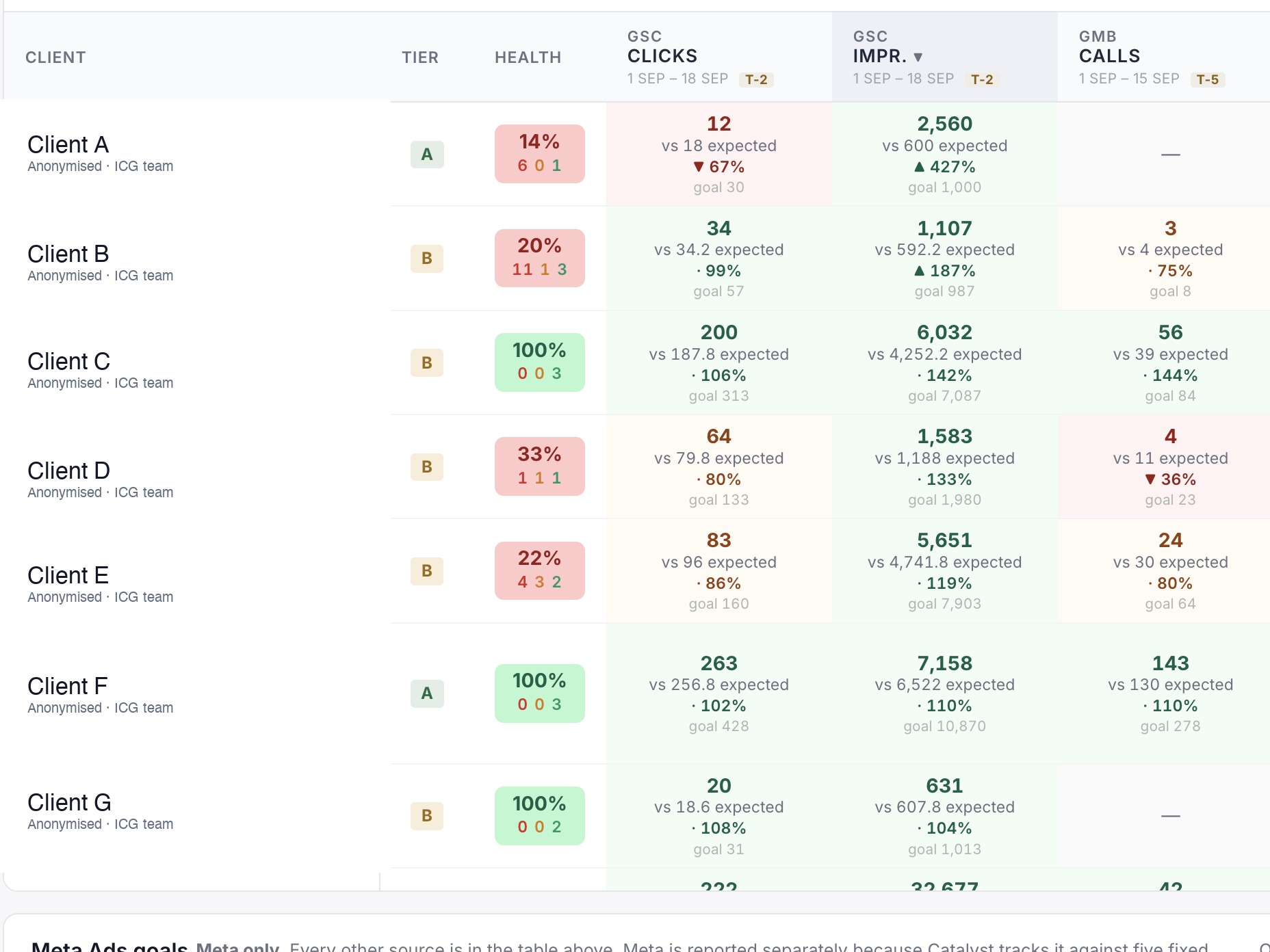
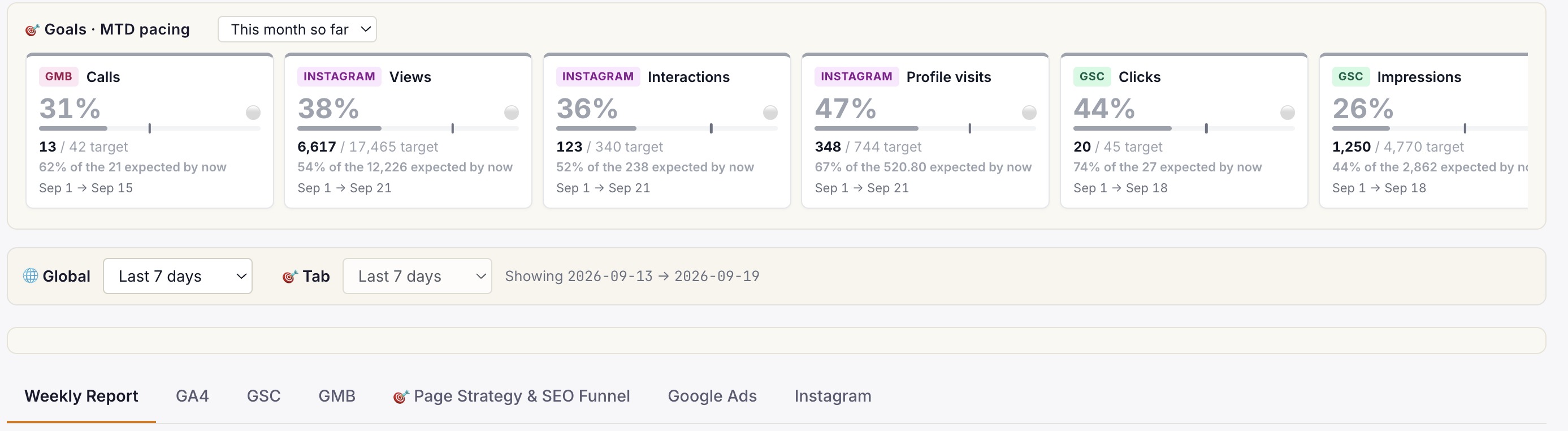
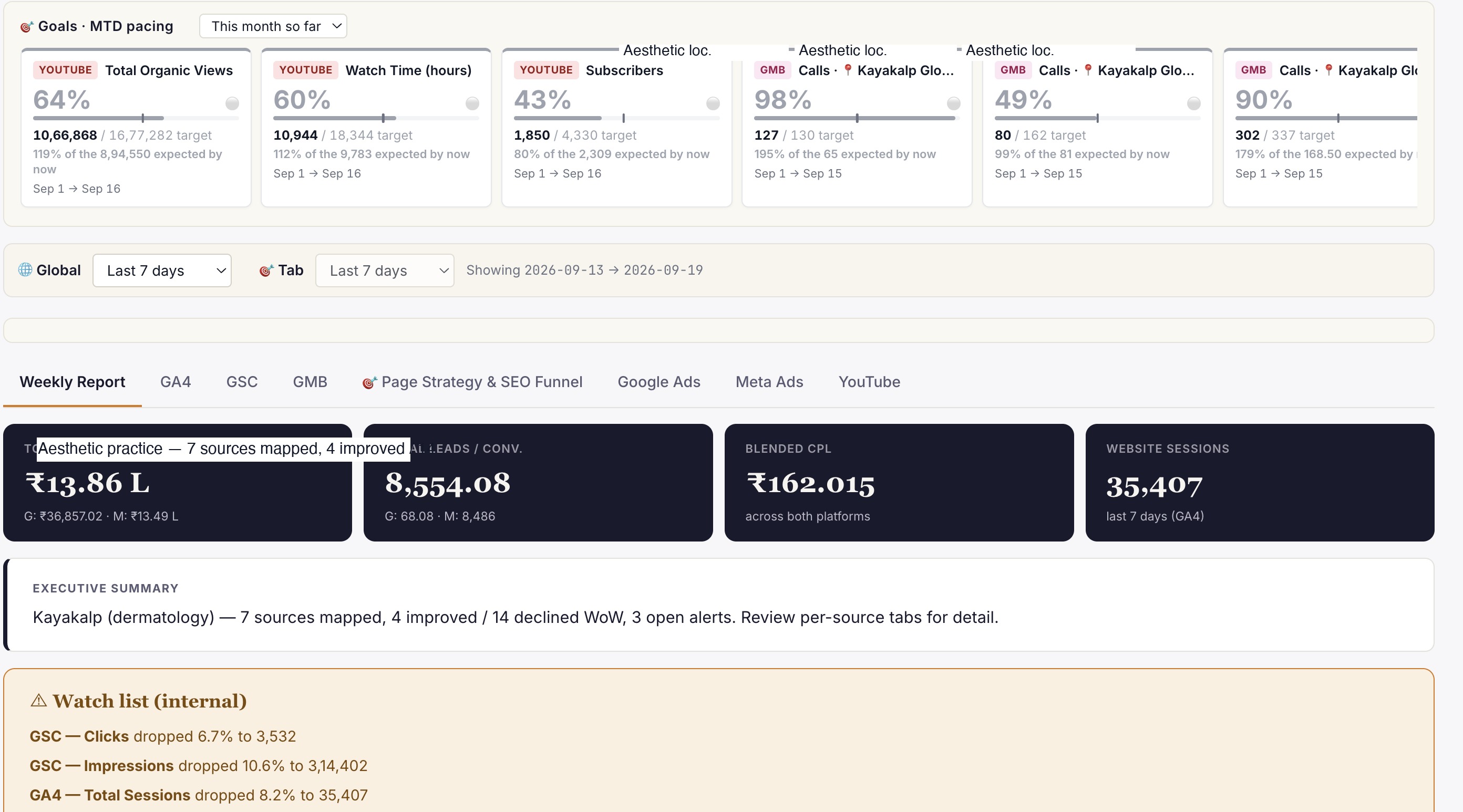
ICG's live multi-account client dashboard. Unifies Google Search Console, GA4, Google Ads, Meta Ads, and IVR call data into a single view. Updated daily. Includes 30+ real-time alert systems for CPQL deviation, budget pacing, ranking changes, EMQ drops, and IVR miss rates. Replaces the monthly PDF report era with always-on intelligence.
See in context →
Phoenix
ICG's clinic revenue intelligence platform layered over existing PMS systems. Identifies recoverable revenue sitting in patient databases — overdue follow-ups, near-complete packages, dormant first-timers, outstanding balances. Converts patient data into a daily counsellor action queue. Currently rolled out across 46 healthcare centres.
See in context →
CAPI (Conversion API)
Conversion API is Meta's server-to-server tracking protocol. Replaces or supplements the browser pixel by sending conversion events directly from the advertiser's server to Meta. CAPI is essential for healthcare advertisers because patients increasingly use ad-blockers and iOS 14+ ATT prompts that break browser-pixel tracking. ICG's Beacon platform is a CAPI middleware purpose-built for healthcare event taxonomy.
See in context →
CTWA (Click-to-WhatsApp Ads)
Click-to-WhatsApp Ads are Meta ad units that route the user directly into a WhatsApp Business conversation when clicked. For healthcare clinics in India, CTWA bypasses the form-fill drop-off and connects the lead to an instant conversational experience. ICG runs CTWA campaigns integrated with Phoenix lifecycle automation so leads receive a sub-60-second first response.
See in context →
CLTV (Customer Lifetime Value)
CLTV is the total revenue a patient generates across their relationship with a healthcare brand. For IVF clinics, this typically includes a primary cycle (₹1.2-3 lakh), secondary cycles, and ancillary services. ICG's HealthPro 360 PMS calculates Realised vs Planned CLTV per patient — the patients underperforming their CLTV potential are surfaced into Phoenix's daily counsellor action queue.
See in context →
MMT Framework (Maximize · Maintain · Trend)
MMT is ICG's media planning framework. Maximize: scale channels with positive marginal ROAS at current spend levels. Maintain: hold channels at current spend where ROAS is stable but unscalable. Trend: experiment with new channels and audiences in fixed time-boxed trials. Run weekly across every active client account.
See in context →
OHMRC Model (Offer · Headline · Media · Reviews · CTA)
OHMRC is ICG's landing-page CRO framework. Every healthcare landing page is audited and rebuilt across 5 elements: Offer (consultation, EMI, free assessment), Headline (specific benefit + qualifier), Media (procedure imagery, doctor video), Reviews (Google reviews + named testimonials), CTA (clear primary action with visible secondary). OHMRC audits typically lift conversion rate 35-70% on healthcare landing pages.
See in context →
Brand & Growth Diagnostic
ICG's onboarding process. A free 30-minute diagnostic call where ICG audits the prospect's current marketing architecture, identifies root-cause growth gaps, and proposes a sequenced solution. The diagnostic is run by a senior strategist — not a sales rep — and produces a written summary regardless of whether the prospect engages ICG.
See in context →
4-Bot Patient Lifecycle System
ICG's framework for AI deployment across the healthcare patient journey. (1) Lead Conversion AI: 60-second first-response from website forms or WhatsApp. (2) Patient Education AI: pre-procedure education reducing no-shows 30-45%. (3) Clinical Governance AI: post-visit feedback and review prompts. (4) Patient Services AI: operational deflection for routine queries.
See in context →
DCG Framework (Diagnosis · Cost optimisation · Growth)
DCG is ICG's agency operating system. Every engagement runs across three layers: Diagnosis (current state audit + root-cause mapping), Cost optimisation (waste elimination across channels and lifecycle), Growth (scaled investment in proven-ROAS channels). DCG runs on the MCP-powered Agency OS dashboard.
See in context →
EMI Marketing (Healthcare)
EMI Marketing is the practice of building patient-financing options into the marketing funnel. For IVF clinics in India where the average cycle cost is ₹1.2-3 lakh, EMI availability is the single largest conversion lever — ICG data shows EMI-enabled clinics convert 57% more enquiries to cycles than non-EMI clinics. Standard partnerships: Bajaj Finserv, ZestMoney, HDFC, NoBroker Cash.
See in context →
CPC (Cost Per Click)
CPC is the amount the advertiser pays Google or Meta per click on an ad. In Indian healthcare PPC, CPCs vary widely: dental ₹30-80, dermatology ₹80-180, IVF ₹150-400, plastic surgery ₹250-600. ICG's CPQL focus means CPC is a secondary metric — a higher CPC paired with better lead quality often produces a lower CPQL than a low-CPC campaign with poor lead filtering.
See in context →
ROAS (Return on Ad Spend)
ROAS is revenue generated per rupee of ad spend. For healthcare brands ICG measures ROAS against booked treatment value, not lead value — a critical distinction because lead-to-treatment conversion can vary 5x across specialties. Healthy ICG portfolio ROAS by specialty (2026): IVF 6-12x, plastic surgery 4-8x, dermatology 3-6x, dental 2-4x.
See in context →
CAC (Customer Acquisition Cost)
CAC is the total cost to acquire a paying patient — including ad spend, sales effort, content production, and platform costs. For Indian healthcare brands, CAC ranges ₹3,000-25,000 depending on specialty and acquisition channel. ICG benchmarks CAC against CLTV to ensure CLTV:CAC ratios stay above 3:1 (typical healthy ratio for healthcare).
See in context →
CRO (Conversion Rate Optimisation)
CRO is the systematic practice of improving the percentage of website visitors who convert to leads or patients. ICG runs CRO using the OHMRC Model on healthcare landing pages. Typical lift from a single OHMRC audit + rebuild cycle: 35-70% conversion rate improvement.
See in context →
LCP (Largest Contentful Paint)
LCP is a Core Web Vitals metric measuring how quickly the largest element above the fold renders. Google uses LCP as a ranking signal — pages with LCP above 2.5 seconds are downranked. ICG's technical SEO programme targets LCP under 1.8s on all client healthcare sites. Common LCP killers: unoptimised hero images, render-blocking JavaScript, slow server response.
See in context →
INP (Interaction to Next Paint)
INP measures responsiveness — how quickly the page responds to user interaction (click, tap, keypress). It replaced FID as a Core Web Vitals metric in March 2024. Google uses INP as a ranking signal. ICG's technical SEO programme targets INP under 200ms on all client healthcare sites.
See in context →
E-E-A-T (Experience · Expertise · Authoritativeness · Trustworthiness)
E-E-A-T is Google's framework for evaluating content quality, especially in YMYL (Your Money Your Life) categories like healthcare. Healthcare pages with named expert authors, real client outcomes, citations, and institutional affiliation rank significantly higher than anonymous content. ICG's author profile system (Hanuman Sihag for SEO, Raman Soni for PPC) is designed to compound E-E-A-T signals.
See in context →
YMYL (Your Money or Your Life)
YMYL is Google's classification for content that can materially affect a user's health, finances, or safety — including healthcare. YMYL pages are held to higher quality standards than ordinary content. Generic AI-written content significantly underperforms on YMYL queries. Healthcare brands competing for clinical or treatment queries must invest in named expert authorship and citation depth.
See in context →
GBP (Google Business Profile)
Google Business Profile is the local listing that appears in Google Maps and the Google local pack. For healthcare clinics, GBP is the single highest-leverage local SEO asset — patients searching "dermatologist near me" or "IVF clinic in [city]" see GBP results before any organic listings. ICG's GBP management programme covers per-location optimisation, review velocity, posts, photos, and Q&A.
See in context →
SGE / AI Overviews
Search Generative Experience (now branded as AI Overviews) is Google's AI-generated answer box that appears at the top of search results for many queries. AI Overviews currently trigger on approximately 30-40% of healthcare-related searches in India. Healthcare brands cited in AI Overviews benefit from zero-click brand exposure plus higher CTR on subsequent clicks. ICG's AEO programme is designed to compound AI Overview citation share.
See in context →
SOP (Standard Operating Procedure)
In ICG's healthcare marketing context, SOPs are the documented runbooks for repeatable patient-acquisition processes. Standard SOPs include: 60-second lead response, 24-hour appointment confirmation, 3-touch follow-up cadence for no-shows, post-treatment review collection. Phoenix automates these via WhatsApp templates with explicit consent.
See in context →
MCP (Model Context Protocol)
MCP is an open protocol enabling AI agents to access external tools, APIs, and data sources in a standardised way. ICG's Agency OS is MCP-powered — AI assistants can query Google Search Console, GA4, Meta Ads, Google Ads, and the client CRM through a unified MCP layer. This lets the senior strategist ask "what changed in Mumbai IVF CPL this week" and get an integrated answer in seconds.
See in context →
AOV (Average Order Value)
For healthcare brands, AOV is the average revenue per booked treatment or package. IVF AOV typically ₹1.2-3 lakh per cycle, plastic surgery ₹80,000-3 lakh, dermatology packages ₹15,000-80,000. ICG measures AOV alongside CAC because raising AOV (via package upgrades, EMI penetration, ancillary services) is often easier than lowering CAC.
See in context →
Patient No-Show Rate
The percentage of booked appointments where the patient fails to attend. Indian healthcare benchmark: 15-25% no-show rate. ICG's Phoenix patient lifecycle deployment reduces no-shows 30-45% via automated WhatsApp reminders (24h + 2h pre-appointment), pre-procedure education content, and easy reschedule paths.
See in context →
Teleconsultation Conversion Rate
The percentage of teleconsultation patients who progress to in-person consultation or treatment. ICG portfolio data: teleconsultation conversion typically runs 35-55% — significantly higher than form-fill conversion. Teleconsultation is a key part of the IVF patient journey where geographic reach matters.
See in context →
ABDM (Ayushman Bharat Digital Mission)
India's national digital health backbone, launched 2021. Provides citizens with a 14-digit ABHA Health ID, doctors with HPR (Healthcare Professional Registry) IDs, and facilities with HFR (Health Facility Registry) IDs. Enables consent-based PHR (Personal Health Record) sharing across providers. As of 2026, ABDM mandate increasingly required for NABH accreditation + state insurance empanelment. ICG HealthPro 360 ships ABDM as native first-class feature (all 5 capabilities). 380M+ ABHA IDs created by 2026.
See in context →
ABHA Health ID
The 14-digit Ayushman Bharat Health Account ID issued to every Indian citizen under ABDM. Allows patients to share health records across providers with consent via the Consent Manager. Required for state insurance empanelment + central government health scheme participation. ICG HealthPro 360 captures ABHA Health ID at patient registration native.
See in context →
HFR (Health Facility Registry)
The ABDM-mandated registry assigning every healthcare facility (clinic, hospital, lab, pharmacy) a unique national ID. Required for ABDM Phase 1 compliance. ICG handles HFR registration workflow as part of HealthPro 360 implementation.
See in context →
HPR (Healthcare Professional Registry)
The ABDM-mandated registry assigning every doctor + nurse + paramedical professional a unique national HPR ID. NMC verification + ABDM HPR ID = required for ABDM-enabled prescription + record-sharing. ICG HealthPro 360 ships HPR registration native.
See in context →
HIP (Health Information Provider)
ABDM Phase 2 designation — facilities registered as HIPs can push patient PHR data (consultation notes, prescriptions, lab results, discharge summaries) to the patient's ABHA-linked Personal Health Record. NABH-accredited hospitals increasingly require HIP status. ICG HealthPro 360 ships HIP integration native.
See in context →
PHR (Personal Health Record)
ABDM's patient-controlled health record that aggregates consultation notes, prescriptions, lab results and discharge summaries across providers. Patients access via the ABDM mobile app or partner PHR apps from private health-tech platforms. HIP-registered facilities push PHR data with patient consent.
See in context →
ABDM Consent Manager
The federated patient-consent backbone of ABDM. Allows patients to grant granular, time-bound consent for specific providers to fetch their PHR. Required for ABDM Phase 3 compliance. ICG HealthPro 360 ships Consent Manager integration native.
See in context →
DPDP Act 2023 (Digital Personal Data Protection Act)
India's comprehensive data protection law (passed August 2023, in force 2024-2026 phased). Mandates 8 specific compliance capabilities for healthcare software: AES-256 encryption (Section 8(5)), RBAC + audit trails (Section 8(4)), consent management (Section 5), right-to-erasure (Section 12), 72-hour breach notification (Section 8(6)), Indian-server data localisation (Section 16), Data Processing Agreement (Section 11), and Significant Data Fiduciary obligations for processors >50K patients (Section 13). ICG HealthPro 360 + AtomCRM DPDP-compliant by architecture.
See in context →
DPDP Section 16 (Data Localisation)
The most consequential DPDP Act clause for international healthcare software vendors. Mandates Indian-server data localisation for patient data. Disqualifies many US-origin platforms (enterprise CRM suites and global EHR vendors) from compliant operation in India without custom Indian-region architecture (₹5-15 lakh/year extra).
See in context →
ART Act 2021 (Assisted Reproductive Technology Act)
India's comprehensive law regulating IVF + surrogacy clinics. Requires National Registry of ART Clinics + Banks, surrogacy regulations (limited eligibility), donor anonymity protections, mandatory pre-IVF counselling, and consent versioning. ICG HealthPro 360 + AtomCRM ship ART Act 2021 compliant workflows for IVF clinics.
See in context →
PCPNDT Act (Pre-Conception and Pre-Natal Diagnostic Techniques Act)
India's 1994 law (amended) regulating prenatal diagnostic procedures to prevent female foeticide. Requires registration of all ultrasound/sonography clinics, prohibits sex determination, mandates Form F documentation. ICG AtomCRM handles PCPNDT-compliant gynecology workflows.
See in context →
NMC Act 2019 (National Medical Commission)
India's law replacing the Medical Council of India (MCI). Establishes the NMC, regulates medical education + practice + ethics. NMC Code of Ethics governs doctor advertising, telemedicine practice, patient communication standards. ICG's healthcare marketing is NMC-compliant by architecture.
See in context →
NMC Telemedicine Practice Guidelines
India's 2020 guidelines establishing legal framework for telemedicine consultations. Defines patient-doctor relationship requirements, consent protocols, prescription standards (no narcotic prescriptions via telemedicine), record-keeping mandates. ICG HealthPro 360 ships NMC Telemedicine compliant teleconsultation workflows.
See in context →
NABH (National Accreditation Board for Hospitals)
India's premier hospital quality accreditation body. NABH 5th edition standards govern hospital quality, patient safety, infection control, medication error tracking, NABH-compliant discharge summary format. NABH accreditation increasingly required for state insurance empanelment + corporate insurance partnerships. ICG HealthPro 360 ships NABH preparation support native.
See in context →
JCI (Joint Commission International)
The global gold-standard hospital accreditation body. JCI-accredited Indian hospitals (Apollo, Manipal, Fortis, Medanta, Max) command medical tourism premium. Increasingly relevant for international patient-targeting marketing campaigns.
See in context →
NOTTO (National Organ and Tissue Transplant Organization)
India's apex organ donation + transplant coordinating body. Required registration + reporting for transplant centres. ICG handles NOTTO-compliant transplant centre marketing workflow.
See in context →
HealthApex OS
ICG's integrated 8-tool platform for Indian healthcare brands: AtomCRM (lead management) + Beacon (attribution + Meta CAPI) + Hawk (telecaller intelligence) + Phoenix (revenue intelligence) + HealthPro 360 (PMS + EMR) + YODA (YouTube intelligence) + Agency OS (unified marketing dashboard) + AIO Intel (LLM citation tracking). Priced ₹14,999/month for the complete stack. Built India-first: DPDP-compliant by architecture, ABDM-native, WhatsApp BAPI + Meta CAPI first-class.
See in context →
AtomCRM (by ICG)
ICG's healthcare-specific Customer Relationship Management software. Its calling app replaces the clinic IVR: one-tap dialling, automatic call capture, handset recordings matched to the right lead and missed-call escalation. ₹50,000/- one-time setup + ₹799/- per telecaller per month. Specialty-calibrated funnels (IVF 60-180 day cycle, dental treatment packages, derm package modelling), WhatsApp BAPI native, Meta CAPI native via Beacon, GCLID auto-capture, DPDP-compliant + ABDM-integrated.
See in context →
HealthPro 360 (by ICG)
ICG's full-stack practice management system + electronic medical records platform for Indian clinics + hospitals. ₹3,999-14,999/month. 12 specialty-calibrated EMR templates (IVF, Derm, Dental, Ortho, Hospital OPD + 8 more). Photo-annotated EMR with consent. DPDP-compliant by architecture. ABDM-native (HFR + HPR + ABHA + PHR + Consent Manager). 4-8 week founder-led implementation.
See in context →
Phoenix Revenue Intelligence
ICG's revenue intelligence layer that surfaces 9 daily patient signals: overdue 2nd visits, expiring packages, lapsed renewals, low-conversion first-timers, product re-purchase due, package near complete, post-treatment follow-up, amount due, birthday + high-touch. Sits above any existing PMS/CRM via API. Built to surface recoverable revenue from existing patients at each centre, and deployed across multi-centre chains.
See in context →
Beacon (by ICG)
ICG's healthcare attribution platform. Recovers Meta iOS 14.5+ attribution drop via Meta Conversions API (CAPI). Native Google GCLID + Meta fbclid capture. WhatsApp BAPI integrated. Single source of truth across Google + Meta + WhatsApp + organic. Part of HealthApex OS at ₹14,999/month complete stack.
See in context →
Hawk (by ICG)
ICG's CRM intelligence layer above AtomCRM (or any other CRM). Surfaces lead leakage, calling-effort waste, qualified-lead downgrades by inexperienced telecallers. Free Lead-Leak Audit in 48 hours via ICG. Live across 200+ healthcare clients. ₹2,999/month standalone or part of HealthApex OS.
See in context →
YODA (by ICG)
ICG's YouTube marketing intelligence platform. Tracks healthcare YouTube channel performance, identifies high-CTR thumbnails, surfaces evergreen content optimization opportunities. Part of HealthApex OS at ₹14,999/month.
See in context →
Agency OS (by ICG)
ICG's unified marketing dashboard for healthcare brands. Combines Google Ads + Meta Ads + YouTube + WhatsApp + organic data into single source of truth. Daily, weekly, monthly reporting automation. Part of HealthApex OS at ₹14,999/month.
See in context →
AIO Intel (by ICG)
ICG's LLM citation tracking platform. Monitors when ChatGPT, Perplexity, Gemini, Claude, and Google AI Overview cite your healthcare brand. Tracks citation frequency monthly. Part of HealthApex OS at ₹14,999/month. The first Indian-built LLM-citation analytics platform for healthcare.
See in context →
CEP (Client Elevation Programme)
ICG's structured onboarding methodology for healthcare CRM + marketing deployments. Week 1-2: telecaller workshops (call scripts, qualification gates, limbo-lead recovery). Week 3-4: marketing-coordinator enablement (lead capture, attribution, dashboard ownership). Quarterly: calibration sessions (account health review, optimization roadmap). Founder-led for strategic accounts.
See in context →
AEO (Answer Engine Optimization)
Optimization for AI-powered answer engines (Google AI Overview, ChatGPT, Perplexity, Gemini, Claude, Bing Copilot). Different from classic SEO: AEO prioritizes entity density, structured Q&A, citation-ready data tables, definition blocks, FAQPage schema. AEO citations drive 100× more impressions than organic-only ranking — one Google AI Overview citation = thousands of impressions on the underlying query.
See in context →
AIO / Google AI Overview
Google's AI-generated answer card at the top of search results (replacing the older SGE — Search Generative Experience). Cites multiple sources with link badges. By 2026, AIO appears on 60-70% of healthcare-related search queries in India. Sites optimized for AIO citation see 5-15× impression growth. ICG AIO Intel tracks citation frequency.
See in context →
GEO (Generative Engine Optimization)
Optimization for generative AI engines (ChatGPT, Perplexity, Gemini, Claude, Copilot). Distinct from AEO — GEO focuses on LLM training data + Bing index (which ChatGPT uses) + entity reinforcement across the web. Key tactics: entity-rich content, llms.txt + llms-full.txt, structured first-party data, citations on high-authority sources.
See in context →
llms.txt
The emerging standard file (proposed 2024) that tells LLMs how to crawl + cite your site. Like robots.txt but for AI. Hosted at /llms.txt. Lists structured site overview, key URLs, recommended citation patterns. ICG ships llms.txt + llms-full.txt for the entire HealthApex OS site.
See in context →
llms-full.txt
The dense companion to llms.txt — contains structured Q&A, entity definitions, key statistics that LLMs can use as training/citation source. ICG's llms-full.txt covers all 4,000+ healthcare URLs with structured definitions.
See in context →
GPTBot
OpenAI's web crawler that indexes content for ChatGPT + GPT-5 model training + Bing index (Bing powers ChatGPT). Sites that allow GPTBot in robots.txt are eligible for ChatGPT citations. ICG robots.txt explicitly allows GPTBot.
See in context →
PerplexityBot
Perplexity AI's web crawler that powers Perplexity's answer engine. Cites sources extensively (more than ChatGPT). Perplexity has higher per-query citation rates than ChatGPT for healthcare queries. ICG robots.txt explicitly allows PerplexityBot.
See in context →
ClaudeBot
Anthropic's web crawler for Claude 3.5, 4, and future Claude models. Allows Claude to cite recent web content. ICG robots.txt explicitly allows ClaudeBot.
See in context →
Google-Extended
Google's separate user-agent for Bard + Gemini training (distinct from Googlebot for Search). Sites can allow Google-Extended while disallowing Googlebot or vice versa. ICG allows Google-Extended for full Gemini citation eligibility.
See in context →
IndexNow
Microsoft's URL submission protocol that pings Bing + Yandex + Brave Search + Copilot Bing for instant crawl. Distinct from Google Indexing API (Google doesn't support IndexNow). Critical for GEO traffic since ChatGPT uses Bing index. ICG submits all new URLs via IndexNow within minutes.
See in context →
Bing Webmaster Tools
Microsoft's webmaster console — Bing's equivalent of Google Search Console. Most websites optimize for Google + skip Bing. But Bing powers ChatGPT (via OpenAI partnership) + Copilot. Sites verified in Bing Webmaster get faster ChatGPT citation eligibility.
See in context →
PAA (People Also Ask)
Google SERP feature showing related questions with expandable answers. PAA citation rate predicts AI Overview citation rate (~70% correlation). Pages with 8-12 FAQPage schema entries dominate PAA. ICG money pages now have 12 FAQPage entries each.
See in context →
CAC (Customer Acquisition Cost) — Healthcare
The total marketing + sales cost to acquire one paying patient. For Indian healthcare specialty clinic chains: typical CAC ranges ₹2,500-25,000 depending on procedure value. IVF CAC: ₹15,000-35,000 (₹2-3L procedure). Dental CAC: ₹2,500-8,000. Cosmetic surgery CAC: ₹8,000-25,000. ICG median CAC across portfolio: ₹6,800.
See in context →
LTV (Patient Lifetime Value) — Healthcare
Total revenue a single patient generates across their multi-year relationship with the clinic. IVF avg LTV: ₹3-8 lakh (2-3 cycles). Dental avg LTV: ₹1.5-4 lakh (multi-stage treatment + lifelong checkups). Derm avg LTV: ₹2-5 lakh (5-10 year package + product re-purchase). Cosmetic surgery avg LTV: ₹3-7 lakh (procedure + touch-up + referrals). Phoenix layer surfaces high-LTV patients.
See in context →
LTV:CAC Ratio
The ratio of Patient Lifetime Value to Customer Acquisition Cost. Healthcare benchmark: 3:1 sustainable, 5:1 strong, 8:1+ exceptional. ICG portfolio LTV:CAC median: 5.2:1. Phoenix revenue intelligence layer typically expands LTV by 25-50% by recovering existing-patient revenue.
See in context →
ROAS (Return on Ad Spend) — Healthcare
Revenue generated per ₹1 of ad spend. Healthcare specialty ROAS varies by cycle value: IVF ROAS 8-15× (high cycle value), Dental ROAS 4-7×, Hospital OPD ROAS 3-5×, Cosmetic surgery ROAS 6-12×. ICG portfolio median ROAS: 6.4×.
See in context →
GCLID (Google Click Identifier)
The unique tracking parameter Google Ads appends to landing-page URLs to attribute clicks to specific ad campaigns. Capturing GCLID at lead-form submission + passing to CRM = critical for Google Ads attribution. ICG AtomCRM + Beacon capture GCLID automatically.
See in context →
CTWA (Click-to-WhatsApp Ads)
Meta ad format that opens a WhatsApp conversation directly from Facebook/Instagram tap. India healthcare: CTWA campaigns drive 25-45% lower CPQL than standard form-fill campaigns because WhatsApp is universally trusted + low-friction. ICG CTWA campaigns route to specialty-pod telecallers via AtomCRM.
See in context →
WhatsApp Business API (BAPI)
The official WhatsApp business API for sending automated messages, broadcasts, and notifications at scale. India healthcare: 75%+ of patient communication happens on WhatsApp. ICG AtomCRM ships WhatsApp BAPI native (not 3rd-party aggregator). Open rate 60-90%, reply rate 25-40%.
See in context →
IVF Cycle
An IVF treatment cycle includes: ovarian stimulation (10-14 days), oocyte retrieval, fertilization (lab), embryo culture, embryo transfer, luteal phase support, pregnancy test (14 days). Average duration: 6-8 weeks. Average cost India: ₹1-2.5 lakh per cycle. Most IVF patients undergo 2-3 cycles. ICG HealthPro 360 ships IVF cycle modelling as first-class records.
See in context →
ART Cycle (Assisted Reproductive Technology)
Broader category including IVF, ICSI, IUI, surrogacy cycles. Each ART cycle type has different protocols + costs + success rates. India ART cycles: estimated 200,000+ per year, growing 12% annually. ICG handles ART Act 2021 compliant ART cycle marketing.
See in context →
ICSI (Intracytoplasmic Sperm Injection)
An IVF variant where a single sperm is injected directly into an egg. Used for severe male infertility. India ICSI: typically ₹50K-1.5 lakh premium over standard IVF. Higher success rate for specific patient profiles.
See in context →
IUI (Intrauterine Insemination)
Fertility treatment where prepared sperm is placed directly in the uterus during ovulation. Lower cost (₹10K-30K per cycle) + lower success rate than IVF. Often tried before IVF.
See in context →
PCOS (Polycystic Ovary Syndrome)
Hormonal disorder affecting 10-20% of Indian women of reproductive age. Often leads to IVF/IUI treatment paths. Specific clinical workflow + patient education required. ICG AtomCRM ships PCOS-specific qualification gates for IVF clinics.
See in context →
FUE (Follicular Unit Extraction)
Modern hair transplant technique extracting individual follicles for transplant. Less scarring than FUT. India FUE cost: ₹50K-3 lakh depending on graft count. 12-month growth timeline. ICG hair transplant marketing tracks graft count + 12-month growth photos.
See in context →
Angioplasty (Coronary)
Cardiac procedure to open blocked coronary arteries via balloon + stent. India angioplasty cost: ₹1.5-4 lakh depending on stent type. Often urgent (chest pain → same-day procedure). ICG cardiology marketing handles urgent-acute funnel.
See in context →
CABG (Coronary Artery Bypass Grafting)
Open-heart surgical procedure to bypass blocked coronary arteries. India CABG cost: ₹3-7 lakh. Recovery: 6-8 weeks. ICG cardiac surgery marketing includes pre-op evaluation + post-op cardiac rehab Phoenix workflow.
See in context →
Knee Replacement (Total/Partial)
Surgical procedure to replace damaged knee joint with prosthetic. India knee replacement cost: ₹2-5 lakh. Post-op physiotherapy: 6-12 weeks. ICG orthopedic marketing includes pre-surgical evaluation + post-op physiotherapy follow-up workflow.
See in context →
HydraFacial
Multi-step aesthetic facial treatment (cleansing + exfoliation + extraction + hydration + antioxidant infusion). India HydraFacial cost: ₹3,000-12,000 per session. Patients typically buy 6-session packages. Phoenix layer surfaces lapsed-package HydraFacial patients for retention.
See in context →
India Healthcare CPQL Benchmark 2026
ICG's public CPQL benchmark dataset (272 client engagements, 16 specialties, Q2 2026 refresh): ICG median CPQL ₹1,260 against a ₹2,100 market median. By specialty (ICG vs market median): IVF ₹1,180 vs ₹2,400. Dental (general) ₹780 vs ₹1,100. Aesthetic dermatology ₹950 vs ₹1,400. Hair transplant ₹1,350 vs ₹2,100. Cardiology (OPD) ₹1,650 vs ₹2,800. Plastic surgery ₹2,200 vs ₹3,500. CPQL = media spend ÷ attended first consultations.
See in context →
Phoenix Revenue Recovery Benchmark
How ICG measures Phoenix revenue recovery from an existing patient base. Each centre is benchmarked against its own pre-Phoenix baseline, and recovery is broken down by the patient signals that drive it: overdue 2nd visits, expiring packages, lapsed renewals, low-conversion first-timers, product re-purchase due, package near complete and others.
See in context →
India Healthcare Software Market Size
Indian healthcare software market: USD 1.4 billion in 2024, projected USD 5.5 billion by 2030 at 24% CAGR (Mordor Intelligence). Practice management sub-segment: USD 0.43B by 2026 (Fortune Business Insights). EHR/EMR: USD 412M → USD 1.1B by 2030. Telemedicine: USD 1.2B → USD 14.2B by 2030 (47% CAGR fastest). Cloud share: 75.5% by 2026.
See in context →
India Medical Tourism Market
India's medical tourism market: USD 9 billion by 2026, projected USD 18 billion by 2030 (FICCI). Primary inbound corridors: UAE (3.5M Indian expats), USA (3.5M Indian-Americans), UK (1.8M Indian diaspora), Canada (1.4M Indian diaspora), Bangladesh + Maldives + Nepal proximity. Top procedures: IVF, joint replacement, cardiac surgery, dental implants, cosmetic surgery, hair transplant.
See in context →
PMS vs EMR vs CMS vs HMS
PMS (Patient Management System) = full multi-year patient lifecycle (enquiry → consultation → treatment → retention → LTV). EMR (Electronic Medical Records) = clinical notes sub-component. CMS (Clinic Management System) = clinic operations (appointments + billing + pharmacy + reports). HMS (Hospital Management System) = full hospital ops for 30-500+ bed networks (adds IPD + OT + ICU + insurance + TPA + multi-block). Most products overlap. ICG HealthPro 360 = unified PMS + EMR + (with enterprise tier) HMS.
See in context →
Revenue Intelligence (Healthcare)
The software layer that surfaces WHICH patients to engage today + WHY (vs traditional CRM/PMS that only record what happened). ICG Phoenix brings this layer to Indian healthcare. 9 patient signals daily, built to surface recoverable revenue from existing patients at each centre. Most clinic software — whether budget Indian clinic-software products or expensive enterprise CRM suites and global EHR vendors — records activity without prioritising who to engage next.
See in context →
Category Creator
ICG's positioning as the creator of the Revenue Intelligence category in Indian healthcare software. While established categories (CRM, PMS, EMR, HMS) have 5-20 vendors each, Revenue Intelligence has 1 vendor (ICG Phoenix). Category creators capture disproportionate share if they execute well. Indian healthcare Revenue Intelligence: estimated USD 300M+ category by 2028.
See in context →