


NMC 2026 Code of Ethics: 8 Sections & Penalties for Doctors
NMC 2026 Ethics Code decoded: advertising, telemedicine, referrals and social media rules doctors must follow. Penalties + compliance checklist inside.
No pitch. Written root-cause diagnosis. AI-powered, healthcare only.
Direct answer
NMC 2026 Ethics Code decoded: advertising, telemedicine, referrals and social media rules doctors must follow. Penalties + compliance checklist inside.
TL;DR
The National Medical Commission's Code of Medical Ethics is not new. But enforcement is. Between 2023 and 2026, the NMC has escalated its review of social media behaviour, advertising practices, and patient-relationship protocols in ways that many practising doctors have not tracked.
ICG works with 150+ healthcare brands. Every single engagement begins with a compliance audit — and the most common finding is not deliberate violation. It is uninformed drift. Doctors post something on Instagram that felt educational. A clinic runs Google Ads with language that felt moderate. A testimonial video goes up that seemed like patient-led content. Each one carries regulatory exposure under the NMC's 2026 framework.
This guide walks through the entire Code — section by section — with specific attention to what changed, what is enforced, and what ICG's founder-led diagnostic process catches before it becomes a problem.
What Is the NMC Code of Medical Ethics?
The National Medical Commission Act, 2019 empowered the NMC to frame and enforce a Code of Medical Ethics for all registered medical practitioners in India. The current operative code consolidates provisions from the earlier Indian Medical Council (Professional Conduct, Etiquette and Ethics) Regulations, 2002 and subsequent amendments.
The code governs:
- Patient relationships and informed consent
- Professional conduct and collegial duties
- Advertising and self-promotion
- Fee structures and financial transparency
- Use of technology in clinical practice
- Continuing Medical Education (CME) requirements
The NMC's Registered Medical Practitioner (RMP) portal at nmc.org.in is the authoritative source. Any doctor in doubt should cross-reference directly there.
Section 1: Duties of Physicians — The Foundation
Section 1.1 — Patient welfare above all else
The code opens by stating that the primary obligation of every registered practitioner is the welfare of the patient. This is not merely aspirational language — it has operational consequences. A doctor who recommends a procedure primarily because it is revenue-generating, without genuine clinical indication, is in breach of this section.
For clinic marketing, the implication is significant. ICG advises all clients to ensure that any performance-marketing campaign is aligned with genuine clinical capability. Running Google Ads for a procedure you rarely perform, in order to generate volume, creates both a clinical and a regulatory risk.
Section 1.3 — Non-discrimination
Doctors must not refuse treatment on grounds of race, religion, caste, nationality, or ability to pay in emergency situations. In marketing terms: any content that implicitly signals a "premium-only" positioning must be balanced with clear clinical protocols for emergency care.
Section 1.5 — Patient autonomy and informed consent
Patients have the right to full information about their condition, treatment options, and associated risks. Informed consent must be documented, not verbal. This section has gained enforcement momentum in the context of elective procedures — particularly cosmetic surgery, IVF, and bariatric surgery — where the gap between patient expectation and clinical outcome is widest.
ICG's pre-publication compliance check requires that any content describing a procedure includes: (a) a statement that individual results vary, and (b) a recommendation that patients consult their treating doctor for personalised assessment.
Section 2: Professional Competence
Section 2.1 — Scope of practice
Doctors must practice only within their qualification and competence. A practitioner with MBBS + MD Dermatology performing orthopaedic procedures is in clear breach. For marketing: never advertise services beyond your registered qualification and documented clinical experience.
Section 2.3 — Referral obligations
When a patient's condition requires expertise beyond your scope, you are required to refer. ICG includes this principle explicitly in the content frameworks it builds for specialist clinics — framing referrals not as lost business but as the mark of a trustworthy practitioner.
Section 6: Medical Advertising — The Section Doctors Fear Most
Section 6 is where most enforcement action originates. It deserves full attention.
What Section 6 prohibits (explicitly):
- Advertising of any kind that solicits patients
- Using titles, degrees, or affiliations not officially recognised
- Claiming to be a "specialist" without the requisite post-graduate qualification in that specialty
- Publishing testimonials from patients
- Using before-and-after imagery of identifiable patients
- Claiming superiority over other practitioners or institutions
- Misleading claims about treatment outcomes
What Section 6 does NOT prohibit (the educational carve-out):
The NMC distinguishes between advertising (prohibited) and education (permitted). A doctor publishing a YouTube video explaining how diabetes affects kidney function is not advertising. A doctor publishing a YouTube video saying "I have cured 200 diabetes patients — come to me" is advertising.
The test ICG applies before publishing any doctor content:
| Question | If YES → Educational | If YES → Advertising |
|---|---|---|
| Does this content help patients understand a condition? | ✓ | |
| Does this content directly or indirectly solicit a consultation? | ✓ | |
| Does this content name the doctor as superior? | ✓ | |
| Does this content reference verified clinical outcomes for a specific patient? | ✓ | |
| Does this content explain treatment options without naming the doctor's preference? | ✓ |
The testimonial question:
Patient testimonials are explicitly prohibited under Section 6. However, the NMC does not prohibit a patient from voluntarily posting their own experience on a public platform (Google Maps, doctor-directory platforms). The doctor's obligation is: (a) not to solicit such posts, and (b) not to share or amplify content that constitutes a testimonial of treatment outcome.
ICG advises clients to train their front-desk teams on this distinction. Asking a patient "would you mind sharing your experience on Google?" is widely practised. However, asking "could you mention that Dr X's treatment worked well for you?" creates regulatory exposure.
Before-and-after imagery:
The prohibition is specific to identifiable patients. A skin clinic may use stock imagery showing a condition. It may not use a patient's before-and-after photograph — even with written consent — because the consent framework under NMC does not permit a patient to waive the advertising prohibition. (Note: DPDP Act 2023 adds an additional consent layer — see the DPDP guide.)
Section 7: Professional Conduct

Section 7.1 — Fee transparency
Doctors are required to inform patients of fees before undertaking treatment. In the context of elective procedures, this means clear written estimates. For marketing, this principle supports ICG's recommendation that clinics always publish indicative price ranges on their websites — both because it is good practice and because hidden pricing erodes trust.
Section 7.4 — Dichotomy (kickbacks)
Receiving or paying commission for patient referrals is prohibited. This is widely known but inconsistently practised. For ICG's clients in the corporate health-screening space, this is a live issue: structuring corporate camp arrangements as "educational partnerships" rather than referral-fee arrangements is the compliant path.
Section 8: Continuing Medical Education (CME)
Registered practitioners must fulfil CME requirements as prescribed by the NMC. As of 2026, the NMC's online credit portal tracks CME points for every RMP. Failure to maintain required credits affects registration renewal.
For ICG clients, CME creates a content opportunity: doctors with active publication records, conference presentations, and verified CPD hours carry demonstrably higher credibility in patient-facing content. ICG's author bio templates are structured to highlight these credentials specifically.
Key Changes and Enforcement Trends 2023-2026
The following shifts are notable for practising doctors and their marketing teams:
1. Social media is now explicitly within Section 6 scope The NMC clarified in 2023 that social media posts constitute "advertising" when they solicit patients. WhatsApp broadcast messages to patient lists without documented DPDP consent are now a dual violation — NMC Section 6 and DPDP Act 2023.
2. Influencer partnerships involving doctors are under scrutiny A dermatologist co-creating "skincare education" content with a beauty influencer — where the influencer tags the clinic in the caption — has been flagged in at least two state medical council reviews. The principle: if the content functions as advertising, it is advertising, regardless of format.
3. Online reviews: doctors cannot solicit, but they can respond The NMC issued informal guidance (not yet formal regulation) clarifying that responding to Google reviews — even negative ones — is not prohibited, provided the response does not contain advertising content. ICG's review-response templates are structured around this guidance.
4. Telemedicine-specific advertising rules Telemedicine Practise Guidelines (2020, updated 2022) add a layer specific to online consultations: advertising for telemedicine services must not imply the same diagnostic capability as in-person consultation.
ICG's 12-Point Pre-Publication Compliance Checklist
Before any content goes live for an ICG client, the following check runs:
- Does the content solicit patients, directly or indirectly? — If yes, revise
- Does it make any claim about treatment outcomes for specific patients? — If yes, remove
- Does it include patient imagery (identifiable)? — If yes, remove
- Does it include a patient testimonial? — If yes, remove
- Does it claim the doctor is "best" or "top" without verifiable basis? — If yes, revise
- Does it reference a Schedule J condition with a specific drug name? — If yes, remove drug reference
- Does it include a DPDP consent hook for any data collection? — If not, add
- Does it cite NMC/government source for any regulatory claim? — If not, add link
- Does it include "individual results vary" qualifier for any statistical claim? — If not, add
- Is the author byline a named, qualified practitioner? — If not, assign correct attribution
- Is the content on a Schedule J condition framed as "service" not "drug treatment"? — Check
- Does the compliance footnote appear at the bottom? — Must be present
This checklist is the operational core of what ICG calls "right diagnosis before right strategy". We do it RIGHT — meaning compliance is not an afterthought. It is built into the production process.
What Happens When Doctors Get It Wrong?
The NMC and State Medical Councils have a graduated response:
- Warning notice: Issued for first-time, low-severity violations (typically non-harmful social media posts)
- Show cause notice: Issued for repeated or more serious violations
- Registration suspension: Typically 30-90 days; career-damaging for any practitioner
- Registration cancellation: Reserved for serious misconduct or repeated offences
- FIR/criminal referral: In cases involving fraud, patient harm, or DPDP violations involving patient data
ICG's zero formal complaint record across 150+ engagements since 2018 is a direct result of building compliance into every campaign from brief to publication.
Working With a Compliance-Disciplined Agency
Doctors building a practice in 2026 face a genuine tension: they need visibility to grow, but visibility carries regulatory risk if managed incorrectly. The answer is not to avoid marketing. It is to market through a framework that treats compliance as infrastructure, not inspection.
ICG works with clients on long-term engagements — typically 18-24 months, scaling from ₹20,000/month with a Starter team to ₹3,00,000+/month as the practice grows. The compliance audit runs in month 1. The content framework is built around it. Every piece of content is produced within it.
Rohit Gupta built ICG's compliance practice from IIT BHU pharmaceutical engineering and IIM Bangalore management foundations — applying the same standards to doctor marketing that pharma companies apply to drug promotion. It is the same rigour. Applied to a different channel.
Read next on ICG
Social Media Compliance for Doctors Under NMC 2026: What Actually Triggers Action
Social media is where most NMC complaints originate in 2026 - not print, not TV, not hoardings. The Ethics and Medical Registration Board reviews Instagram Reels, YouTube Shorts and LinkedIn posts weekly, and the majority of Section 6 violations we help clinic groups audit trace back to a single reel or before-and-after carousel that went viral for the wrong reasons.
The pattern is consistent across cardiology, dermatology, IVF and aesthetic specialties. Doctors post content that would be unremarkable for a lifestyle brand, but the NMC reads it as solicitation, guarantee of cure, or self-promotion beyond the permitted informational limit.
The Five Social Media Formats That Draw the Most Complaints
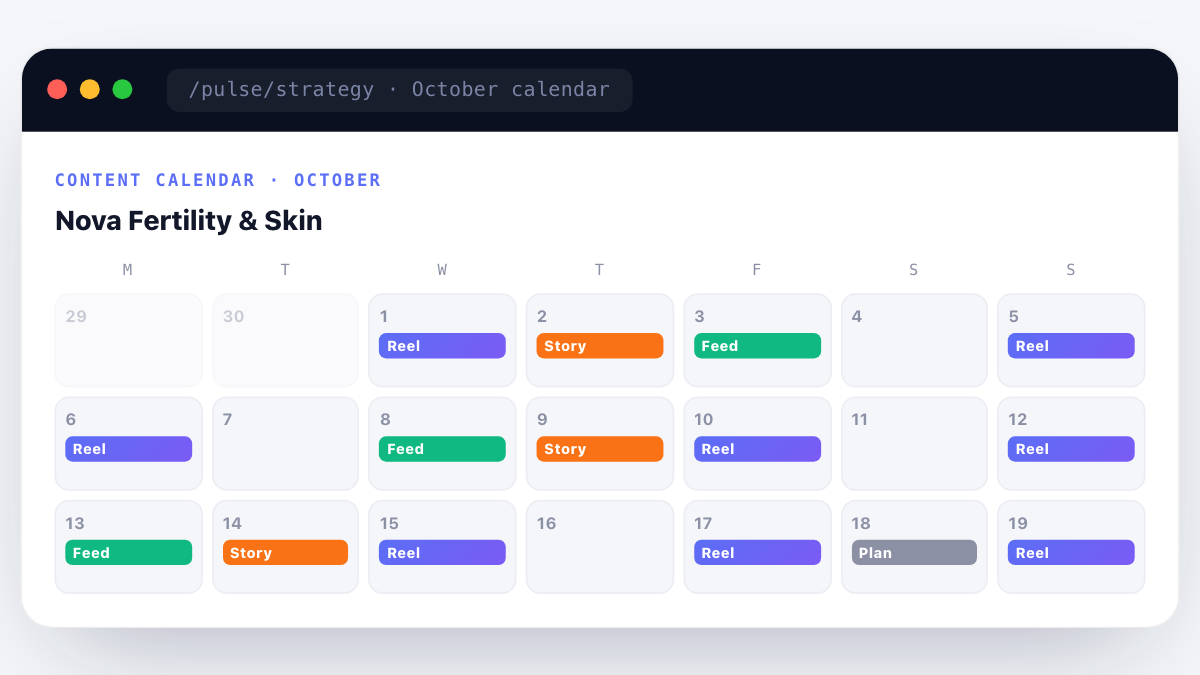 Prism Pulse content calendar showing the month ahead with Reel, Feed and Story slots colour-coded per day for a healthcare Instagram account" width="1200" height="675" loading="lazy" decoding="async" style="width:100%;height:auto;display:block;">
- Before-and-after carousels without written patient consent referenced in the post description, even with faces blurred.
- Reels showing surgical footage set to trending audio, treated as sensationalism regardless of educational intent.
- Success-rate claims in captions ("98% pregnancy rate", "zero complications") - Section 6 prohibits any comparative or quantified outcome claim in public-facing content.
- Doctor-tagged testimonial reels where a patient names the physician and recommends the clinic, which the 2026 clarification treats as solicitation, not testimonial.
- Paid influencer partnerships where the doctor appears as an expert endorser - dual violation of Section 6 and Section 7.
What a Compliant Social Media System Looks Like
Compliant healthcare social content is possible, it just needs a pre-publication review layer. Every clinic we onboard through the Client Elevation Programme runs each reel, carousel and caption through a two-person check: one clinical (the doctor or medical director) and one compliance (our editor working from the NMC 2026 rulebook). The same workflow is embedded in Meta Catalyst IQ for paid ads and Prism Pulse for organic Instagram measurement, so creative goes live only after both sign-offs are logged.
For doctors running their own YouTube channels, YODA applies the same guardrails to long-form and Shorts: no outcome claims in thumbnails, no patient-identifying footage without documented consent, no comparative language against other hospitals. That is the difference between a channel that compounds authority for five years and one that gets a show-cause notice in month three.
Can Doctors Use Before/After Photos, Patient Testimonials, or Reviews Under NMC 2026?
Short answer: before-and-after images are off-limits in any promotional slot, patient testimonials draw disciplinary action under the NMC's advertising clauses, and even Google reviews can pull a clinic into an SMC hearing if those reviews were incentivised, scripted, or collected on-premise with pressure.
Before/after photos — the "clinical documentation" defence rarely holds
Aesthetic, dental, IVF, hair-restoration, and bariatric practices lean on visual proof. The NMC's problem isn't that the images exist — it's the moment they surface on a website, an Instagram grid, a Meta ad, or a directory listing. That's when the material becomes advertising, and advertising outcomes is barred.
Layer the DPDP Act on top and it tightens further. Consent for a clinical record and consent for marketing use are two different purposes; one signature on an intake form does not cover both. Clinics in Delhi and Bengaluru have started pulling entire before/after libraries after legal reviews caught the gap. If you must show outcomes, use anonymised percentage data drawn from your own EMR.
Testimonials and video reviews — where written consent does not save you
The testimonial prohibition catches more than most doctors realise. A 45-second patient Reel praising a surgeon counts. A "case study" video with a named patient counts. A paid healthcare influencer who also happens to be a patient counts. Two things clinics can still publish without triggering complaints: accreditation (NABH, JCI) and outcome benchmarks that do not identify any individual.
Google reviews and the "solicited review" risk
Passive reviews are fine. Trouble starts when clinics (a) put a QR code at reception asking for a Google review before discharge, (b) offer any incentive for a review — a discount, a free consult, a gift — or (c) script the review through staff who "help" patients type it out.
| Tactic | Under NMC 2026 |
|---|---|
| Before/after in a Meta ad | Not allowed |
| Anonymised outcome data | Allowed |
| Passive Google review | Allowed |
| Incentivised Google review | Not allowed |
| Patient testimonial Reel | Not allowed |
| NABH / JCI accreditation display | Allowed |
Clinics switching from testimonial-led to outcome-led creative usually see CPQL rise ₹80-140 on paid social in the first month, then settle back inside the ₹300-650 healthcare benchmark once the creative is rebuilt properly. ICG's 70/30 model — 70% strategy and compliance-safe creative build in month one, 30% ongoing optimisation — is designed around exactly this kind of forced pivot.
Related FAQ
Q: Can we reshare a five-star Google review as an Instagram post?
No. The moment a review moves from a passive public listing to your own promotional feed, it becomes a testimonial you have endorsed. Aggregate ratings ("4.8 average across 900+ reviews") sit safer than any single quote.
Q: What about anonymised outcome data — say, "94% patient satisfaction across 2,300 procedures"?
Allowed, provided the number is auditable from your own EMR or a third-party survey, no individual is identifiable, and the claim does not guarantee outcomes. ABDM-linked practices have an edge here — the health-record architecture already forces the consent granularity you need for defensible marketing claims.
Book a free 30-minute Brand & Growth Diagnostic.
It's a working session, not a sales pitch — you leave with a written root-cause analysis you can act on, whether or not you engage ICG.
Questions readers ask
about this topic.
The three platforms
behind every ICG engagement.
Beacon
CAPI middleware that fixes Event Match Quality, translates CRM statuses to Meta-standard events, dedups across channels.
Agency OS
Live client dashboard. GSC, GA4, Google Ads, Meta Ads, IVR calls in one view. Login anytime, not monthly.
Phoenix
Clinic revenue intelligence over your PMS. Daily action queue: Prevent Loss, Maintain & Engage, Grow Revenue. Multi-centre rollout.
Or book a free 30-min audit to see all three in action on your account.
Healthcare brands
that already run on ICG.
A representative slice of the 150+ healthcare brands ICG has delivered for across India. Most engagements remain under NDA.


What ICG clients say · on video.
"Scale up of organic channels and business consulting. ICG has absolute domain authority in their field."
"Working with ICG transformed how we acquire IVF patients in Gurgaon. They understand the fertility journey from inquiry to consult..."
"What Ichelon accomplished — they got all my ideas and worked over 3-4 months to create an amazing, super-customised website."
Need help operationalising this?
Every ICG service is healthcare-only, NMC + DPDP-aware, and built around the patient-research patterns that drive Indian healthcare growth in 2026.
Every practice welcome — packages from ₹20,000/mo.
Goals-Driven engagements · Performance-Linked Payout Models available


More from
ICG.
Five trends shaping Indian healthcare marketing through 2027: AI-first patient research, Conversions API adoption, ABDM discovery, the AEO w...
Healthcare AIO is the discipline of getting your clinic or hospital cited inside Google AI Overviews, ChatGPT and Perplexity answers — not j...
Conversational-search advertising places brand messages inside AI chat answers — ChatGPT, Perplexity, Copilot — rather than beside a results...
Stop guessing.
Book a Diagnostic.
30 minutes. Free. With the AI-powered healthcare-only marketing agency 150+ brands already run on. No slides, no pitch, no hard close.


