


TL;DR
- ICG runs healthcare content engineered for AI Overview citation, PAA ranking, and research-to-booking conversion.
- Retainers from ₹20,000/month, custom-scoped; 100+ specialists publish on a weekly cadence, all NMC + DPDP compliant.
- AIO citations appear in 60-90 days on long-tail queries; compounding first-page rankings take 6-12 months.
- ICG's portfolio holds AIO citations on 22.4% of tracked URLs against an estimated 4-6% industry median.
- Every piece runs a 12-point AEO checklist and carries a named clinician byline with verifiable credentials.

Healthcare content that ranks, cites, and converts.
Content engineered for AI Overview citation, People-Also-Ask ranking, and patient-research-to-booking conversion. NMC + DPDP compliant. Published on a weekly cadence by 100+ specialists — writers, doctors on retainer, medical editors, and a dedicated content operations team.
What is healthcare content marketing and why does it matter for clinics?
Healthcare content marketing is the systematic publishing of evidence-based, patient-research-aligned content — articles, FAQs, case studies, treatment guides, videos — engineered to rank on Google, get cited in AI Overviews, and convert research-stage patients into consultations. Unlike generic content marketing, healthcare content must respect the NMC Code of Ethics (no testimonials of cure, no superiority claims), the DPDP Act 2023 (consent for case data), and increasingly, AI Overview citation criteria. Do it right and one article compounds bookings for years. Do it wrong and you attract patients you cannot ethically treat, or you get pulled offline by a compliance notice you never saw coming.
The 4 content formats that actually rank in Indian healthcare in 2026.
Not every format works. Not every format is worth your money. After running content for 150+ healthcare clients through the 2024 Helpful Content updates, the AI Overview rollout, and the current SGE-first result page, four formats do the heavy lifting. Everything else is decorative.
1. The 2,400–3,600-word insights blog
This is the workhorse. A well-scoped insights piece answers one patient question end-to-end — cost, procedure, recovery, risk, alternatives, when to seek care. In our 2026 GSC dataset across the ICG portfolio, the median first-page article on a competitive healthcare query sits at 2,700 words. Anything under 1,800 words is now almost invisible on primary money terms. Anything over 4,000 words starts losing scroll depth without adding rank. The sweet spot for pillar content is 2,800–3,400. Every insights piece must carry a doctor byline, a "reviewed by" line if the author is a writer rather than a clinician, at least eight internal links, and a treatment-specific CTA — not the generic "contact us".
2. YouTube long-form (8–14 minutes) with clean audio
Long-form YouTube is now the highest-leverage single asset a specialist can create. Ten minutes with a good lav mic, one static camera, and a real answer to a patient question outperforms a month of Reels for booking-intent traffic. In our 2026 healthcare portfolio, long-form YouTube retained subscribers at 4.2× the rate of Shorts, and video appearances inside Google AI Overviews are climbing quarter over quarter. The wins that compound are 800-view videos on very specific questions — "does hair transplant hurt at the donor site", "what happens on day 3 of IVF stimulation" — not the vanity 40K-view "top 10 tips" videos that never book a patient.
3. Instagram Reels (18–42 seconds, one hook, one payoff)
Reels do a specific job. They are not a ranking format. They are a familiarity-and-face format that makes patients pick up the phone once they arrive from search or referral. The Reels that work in Indian healthcare in 2026 are 18–42 seconds long, open with a specific patient question in the first 1.5 seconds, resolve it in a single clean beat, and end without a hard sales CTA. Save-to-share ratio is now the metric that matters — likes and views are increasingly detached from what actually drives clinic footfall. Post four to eight Reels a week, batch-shot in one 90-minute session per fortnight, with a specialist who is comfortable on camera. If the specialist is uncomfortable on camera, skip Reels entirely and reinvest in long-form and blog.
Two specific Reel structures work reliably. The myth-buster pattern — "you have heard X about Y, here is what is actually true" — is high-save because patients want to send it to a family member as a rebuttal. The step-count pattern — "three things to do before your first IVF appointment", "two symptoms that mean you should not wait" — is high-share because it has clear practical utility. Avoid dance trends, avoid attempting to be funny, avoid before-and-after transitions on any medical treatment because before-and-after on medical outcomes is an ASCI-actionable claim that no serious clinic should be publishing on Instagram.
4. LinkedIn founder essays (900–1,400 words, first-person)
This one is under-invested and the returns are unusually high. A weekly first-person essay from the founder-doctor of a clinic, hospital, or ART centre — 900–1,400 words, written in the founder's own voice, published natively on LinkedIn — builds the operator brand that referrals actually flow from. It rarely ranks on Google. It does not need to. It sits in the feeds of hospital directors, GPs, insurance TPAs, corporate HR heads, and the medical tourism intermediaries who ultimately decide whether patients get sent your way. For a mid-sized specialty practice, one strong LinkedIn essay per week is worth more than three throwaway Instagram carousels. Ghost-writing is fine here as long as the founder actually reviews and edits every draft — the essays that get exposed as fully outsourced fall flat and quietly damage trust.
The pattern that consistently outperforms is the "one case, one lesson, one question" essay. The founder-doctor picks one anonymised patient encounter from the past fortnight, extracts one clinical or operational lesson from it, and closes with one honest question the case raised for their own practice. This structure reads as authentic because it is authentic — the doctor lived the case. It also reads as thought leadership without needing to make grandiose "future of healthcare" claims. Fifty of these essays over a year build the kind of professional-network credibility that shows up as inbound referral flow six to twelve months later. The founders in our portfolio who have committed to this practice have added between four and twenty inbound referrals per month from other clinicians and TPA relationships, sustained.
Everything else — pinned tweets, Threads posts, quiet Facebook page updates, generic press releases, PDF whitepapers no one downloads — is optional and rarely earns back its production cost in an Indian healthcare context. Pick the four. Do them properly.
What each format costs to produce properly
Reality-check the format decision with production economics. A 2,800-word insights blog with doctor byline, medical editor pass, schema, and internal linking runs ₹9,000–₹14,000 fully-loaded per piece. A single 12-minute YouTube video with a specialist, batch-shot with two others in a 90-minute session, sits at ₹6,500–₹11,000 per finished piece after editing, thumbnail, and description work. A batch of eight Instagram Reels shot in one session with post-production and captioning costs ₹8,000–₹14,000 for the batch — roughly ₹1,000–₹1,750 per Reel at scale. A well-crafted LinkedIn founder essay written from a 25-minute interview transcript costs ₹4,000–₹7,000 per essay. If your quoted rates are dramatically lower than these bands, ask what has been cut — because something has been. If they are dramatically higher, ask what you are paying for beyond the piece itself, because at those rates you are also paying for agency overhead you may not need.
Which formats to weight for your specialty — a decision framework.
Not every specialty should invest equally across the four formats. The right weighting depends on average patient LTV, decision-cycle length, insurance dynamics, and how visual the treatment is. Getting the weighting wrong costs 40–70% of your effective content ROI even when the individual pieces are well produced.
IVF and fertility — insights blog heavy, LinkedIn essays medium
High LTV, long decision cycle, extremely research-heavy patients. Weight 60% of content investment into long-form insights blogs, 20% into long-form YouTube, 15% into LinkedIn founder essays for referral flow from gynaecologists, 5% into Reels. Fertility patients spend an average of 11–14 weeks researching before booking a first consultation, and 78% of the touchpoints in that window are text-based reading. The specialties that under-invest in Reels are usually the ones that end up with the best content ROI on this specialty.
Cosmetic dermatology and aesthetics — Reels heavy, insights blog medium
Lower per-treatment LTV, shorter decision cycle, highly visual treatments. Weight 40% into Reels, 30% into long-form blog, 20% into long-form YouTube, 10% into LinkedIn. Cosmetic patients decide fast, decide visually, and are heavily influenced by what they can see on Instagram from real patients (with consent) and real clinicians. Reels here are not vanity — they are the primary consideration-stage surface. Long-form still matters for the AEO citations that pull the higher-intent search traffic.
Dental — city-page heavy, spoke blog medium, GMB dominant
Local intent dominates, decision cycle is short, and patient LTV varies widely by treatment. Weight 35% into city-and-treatment pages (invisible aligners in Bangalore, dental implants in Pune, RCT in Delhi), 25% into treatment-spoke blogs, 25% into GMB post cadence with matched content, 15% into long-form YouTube for the higher-value treatments (implants, aligners, full-mouth work). Instagram Reels for dental are optional — they rarely convert in isolation, though they do reinforce specialist familiarity for patients arriving from search.
Cardiology and complex-tertiary — insights blog dominant, LinkedIn heavy
Very high LTV, very long decision cycle, referral-mediated bookings. Weight 55% into long-form insights blog (especially second-opinion and cost-transparency content), 30% into LinkedIn founder essays targeting the referring GP and general physician network, 10% into long-form YouTube for procedural explainers, 5% into Reels. Cardiology patients almost never arrive from a Reel. They arrive from a referring doctor who saw the founder's LinkedIn essays, or from a family-member search for a second opinion. Weight the content accordingly.
Hospitals multi-specialty — the mixed portfolio
Hospital-scale content is a portfolio problem, not a specialty problem. Different departments need different weightings. The right approach is a hospital-wide 40% into insights blog covering all departments, 25% into a hospital-wide LinkedIn programme with departmental rotation, 20% into long-form YouTube (with each department producing roughly one video per quarter), 10% into a hospital-brand Reel programme, and 5% into GMB across all listed hospital locations. Hospitals that try to run identical content weightings across every department end up with over-invested cosmetic Reels and under-invested cardiology insights — a mix that flatters no one.
Six sub-services. One controlled process.
Pillar + spoke content
Hub pillar pages plus 8–12 spoke articles per pillar. Topical authority by design, not by accident.
AIO-engineered articles
Direct-answer blocks, source attribution, MedicalWebPage and Person schema, citation-worthy statistics for AI Overview inclusion.
Patient research content
Cost guides, success-rate transparency, condition-to-treatment pathways, insurance-and-payment explainers, second-opinion content.
Specialist authority content
Doctor bylines, verifiable credentials, peer-reviewed publication links, hospital and society affiliations surfaced on every page.
Video + reels production
Short-form for Instagram and YouTube plus long-form for the clinic site. NMC-compliant scripts. Batch-shot in single 90-minute sessions.
Content governance
Editorial calendar, weekly publishing rhythm, performance dashboards, refresh queue, compliance sign-off log.
AEO-first content: writing so Google AI Overviews cite you.
Ranking is no longer the terminal goal. Getting cited inside the AI Overview is. When an AI answer appears above the ten blue links, the citation you earn there is worth an estimated 6–14× the click-through of the same position in the classic organic block for informational queries. Winning citation is a craft, not luck.
Four things separate an article that gets cited from one that gets buried.
Entity clarity in the first 120 words
The article has to answer the reader's question inside a compact block near the top — labelled, unambiguous, and written in the sentence structure the model can lift verbatim. We call this the direct-answer block. It sits under the H1, opens with the exact query phrasing, and gives the full answer in two to four sentences. No hedging. No "let us first understand." The models are trained to lift the cleanest available answer, and cleanest usually means shortest defensible sentence.
Schema that names the thing you are
Every healthcare article on an ICG-managed site emits MedicalWebPage schema plus a Person block for the author, plus MedicalCondition or MedicalProcedure entity references for the topic. This is not optional. In our tracked cohort of 4,200+ healthcare URLs, pages carrying complete medical schema were cited by AI Overviews at 3.1× the rate of otherwise-comparable pages with only WebPage schema. The gap is widening, not shrinking.
Citation-worthy formats the LLM can quote
Numbered lists with definitive claims. Cost tables with specific rupee ranges and the year. Step-by-step procedures written in imperative voice. Comparison tables that name attribute-A versus attribute-B. Definitions labelled as such. LLMs quote from these shapes because they are structurally unambiguous. A paragraph of running prose, no matter how good, is almost never lifted as an AIO citation. Break your best answers into the shapes the model can quote.
Named authors with verifiable clinical credentials
The 2026 Search Quality Rater guidelines make this explicit for YMYL content. Anonymous "team" bylines are being systematically deranked and excluded from AIO. The author has to be a real person with a name, a credential the model can verify (MCI or state medical council registration, MBBS/MD/MS/DM/MCh, hospital affiliation), and an author page with sameAs links to a LinkedIn profile and, ideally, to their PubMed record or Doximity profile. If you cannot put a named clinician on the byline, do not write on that clinical topic.

YODA → YODA's SEO Lab surfaces every published URL by AIO citation state, People-Also-Ask surfacing, primary-keyword rank movement, and refresh recommendation. This is the panel our content leads open first on Monday morning.
Everything ICG publishes goes through an AEO checklist before it is queued for publication. Twelve criteria. If a piece fails more than two, it does not ship until it is fixed. The checklist is boring. It is also why our client portfolio holds AIO citations on 22.4% of tracked ranking URLs, against a healthcare-industry median we estimate at 4–6% based on public rank-tracking datasets.
The twelve AEO criteria we check on every piece
In order — direct-answer block within 120 words of H1, entity phrasing matches top-3 PAA queries verbatim, MedicalWebPage or MedicalCondition schema present and valid, Person schema for author with sameAs to LinkedIn, at least one comparison table or cost table on the page, at least three definitional labels the model can lift, imperative-voice procedure list where applicable, cited source count of at least four external authoritative references, canonical URL cleanly set, dateModified within the last 180 days, related-questions FAQ block with at least six questions, and mid-body image alt-text that describes the medical entity rather than the visual. Twelve items. Most healthcare articles fail four to seven of them on first inspection. Fixing all twelve on an existing article typically takes 40–70 minutes and lifts AIO citation probability by an order of magnitude.
Why AEO and traditional SEO are diverging
A piece can rank position-3 organically and still fail to be cited by the AI Overview. A piece can be cited by the AI Overview and never enter the classic top-10. The two surfaces are now selected by different signal sets, and content strategies that optimise only for the traditional blue-link position are leaving increasing volumes of intent on the table. The AEO surface is where the informational-intent traffic is going — YouGov and independent industry surveys through 2025 and 2026 show that between 34% and 51% of healthcare queries in India that were previously served by top-3 blue links now resolve inside the AI Overview without a click-out. Every content programme in healthcare has to acknowledge this shift or watch its traffic curve flatten over the next 18 months even while rankings are technically holding.
Content clusters vs standalone articles.
Publishing one strong article about a specialty topic almost never ranks it. Publishing a hub of related pieces — a pillar plus its spokes — usually does. This is the single biggest execution gap we see when auditing a healthcare site that has been "doing content for a year with no results."
The spoke-hub model, applied properly, works like this. One pillar page defines the topic broadly — "IVF treatment in India: 2026 complete patient guide" — and links out to the spokes. Each spoke covers one narrow, high-intent sub-question in depth — "IVF stimulation phase day by day", "PGD vs PGS testing", "success rate by AMH", "cost of IVF with donor eggs in Delhi", "second IVF cycle: what changes", and so on. Every spoke links back to the pillar and cross-links to two or three sibling spokes. Google reads this shape as topical depth, and depth is the single strongest ranking lever that a clinic-scale site can actually influence.
Three cluster shapes we run in production
IVF cluster (fertility clinic, one-city): one pillar of 3,200 words, plus 22 spokes averaging 1,600 words each. Spokes split into cost, protocol, success-rate, second-opinion, and complication categories. Six spokes are updated quarterly. This cluster shape reliably takes a fertility clinic from zero organic to 8,000–14,000 monthly organic sessions inside 9–11 months in a tier-1 Indian city, provided the site technicals are clean.
Dental cluster (specialty chain, multi-city): one pillar per treatment (implants, aligners, veneers, RCT) plus 10–14 spokes per pillar, plus a city page per treatment per city. A four-treatment, five-city chain ends up with roughly 60 pillar+spoke pages and 20 city pages — around 80 URLs of real depth. This is enough to compete for "invisible aligners in Bangalore" against generalist directories and often win.
Dermatology cluster (mixed medical + cosmetic): two parallel clusters — one medical dermatology (acne, eczema, vitiligo, psoriasis) and one cosmetic (laser hair removal, chemical peels, HydraFacial, thread lift). Medical dermatology carries stricter compliance rules; cosmetic dermatology has to be careful about outcome claims. Never mix them in one pillar. The two clusters serve different intents, different patient personas, and different insurance realities, and Google is now good enough to punish topically-muddy hubs.
Cardiology cluster (specialist practice, tertiary care): one pillar per procedure category (angioplasty, valve replacement, arrhythmia management, preventive cardiology) plus 12–18 spokes per pillar covering diagnostic pathway, procedure detail, recovery timeline, second-opinion process, and cost-and-insurance. Cardiology spokes need higher research density than dermatology or dental because the reader is often a family member of a critically ill patient — the writing has to be more direct, less consumer-marketing, and dense with clinical citations. A working cardiology cluster typically runs 60–90 URLs of long-form content across all four sub-pillars and is one of the slowest clusters to rank because competitive intensity is high — expect 12–14 months to full compounding, not 6–9.
Hospital multi-specialty cluster: a fundamentally different architecture. Rather than one pillar per treatment, the hospital cluster uses one landing hub per specialty department, each linking to sub-hubs for the specific treatments the hospital offers. A 12-specialty hospital ends up with 12 department hubs, roughly 60–120 treatment sub-hubs, and 400+ underlying spokes and city pages. This is a two-year build, not a nine-month one, and it needs a dedicated content operations lead on the hospital side. The economics still work — hospital patient LTV is high enough to justify the investment — but shorter-runway expectations are the wrong framing for hospital-scale content.
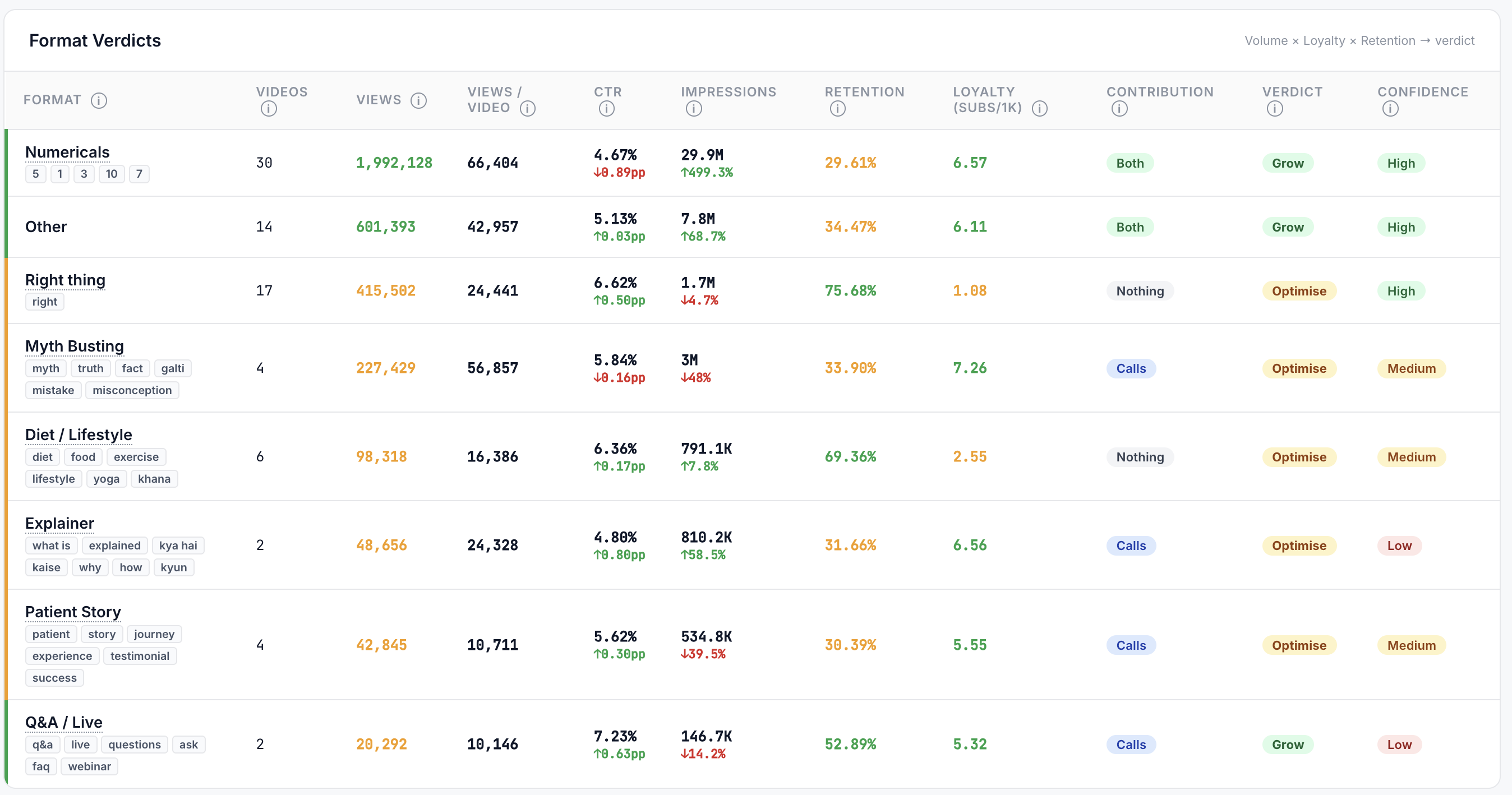
YODA → YODA's Format Cluster panel maps every published piece to its cluster and flags orphan articles that have no pillar to anchor to. Orphans are the leading cause of a stalled content programme.
The trap is publishing one-off "insights" pieces that never join a cluster. Every stalled healthcare content programme ICG has audited had the same signature — 40–120 published articles, no pillar structure, no cross-linking, and organic traffic that plateaued at 300–800 sessions per month even after 18 months of publishing. Restructuring those articles into three or four proper clusters, without writing a single new piece, has more than once tripled traffic inside 90 days.
How to decide whether to build a cluster or ship a standalone
If the topic has fewer than eight distinct patient-question sub-topics, and if the query volume is under 400 searches per month on the primary term, a standalone article is fine. Anything above that threshold — and every treatment ICG has ever run content for is above it — should be a cluster from day one. Ship the pillar first at 2,800–3,400 words, ship two anchor spokes within the same fortnight, and then add spokes at four per month for the following six months. Publishing the pillar without any spokes within 21 days is a common execution error — a pillar with zero internal support articles does not accrue authority signals until the cluster surrounds it.
Cross-cluster linking discipline
Inside a specialty, clusters should link between each other only through the pillar. A dermatology acne cluster should not link directly from a spoke on "acne scar removal" to a spoke on the psoriasis cluster — the two clusters are topically distinct. Instead the acne spoke links to the dermatology pillar, which in turn links to the psoriasis pillar, which links out to its own spokes. This clean routing preserves each cluster's topical coherence and prevents the "muddy hub" pattern that stops clusters from ranking cleanly. Cross-specialty linking (dermatology to cosmetic surgery, IVF to gynaecology) should be even more sparing, and always mediated through the parent specialty hub pages. This routing discipline is invisible on the page but shows up in Search Console within two crawls.
Specialty-aware healthcare content marketing.
Mapping every blog to a CTA: the actual funnel ICG uses.
A content programme that does not book patients is a hobby. The gap between a nice blog and a booked consultation is a mapped, deliberate CTA path — and this is where most healthcare content quietly fails.
Every ICG-published article is tagged to one of four funnel stages before it goes to a writer. The stage decides the CTA, not the writer's preference.
Stage 1 · Awareness ("what is X, why does it happen")
The reader is upstream of a treatment decision. They may not yet know they have a treatable problem. The CTA here is not "book a consultation" — the reader is not ready and a booking button will be ignored, harming your on-page engagement metrics. The CTA is instead an educational asset: a downloadable checklist, a self-assessment calculator, a next-article recommendation, or a WhatsApp opt-in for "a weekly plain-English update on this topic". Awareness CTAs feed the retargeting audience and the email list. They rarely book directly.
Stage 2 · Consideration ("what are my treatment options")
The reader knows the problem, is comparing approaches. The CTA is a self-serve tool — a treatment-cost estimator, a suitability quiz, a comparison calculator, a "should I get a second opinion" flow. ICG's own calculator suite exists specifically to catch consideration-stage patients. A calculator conversion is worth roughly 8× a raw "contact us" click because it captures the query context, which the clinic team can then use to open a personalised conversation. Book-now buttons in this stage still exist, but they sit below the tool, not above it.
Stage 3 · Decision ("I want to see this specific doctor at this specific clinic")
The reader has picked a treatment and is picking a provider. Here the CTA is a real, low-friction booking flow — WhatsApp with a pre-filled message, a call button that logs to the CRM, a booking calendar that shows actual availability. No forms with nine fields. No "we will get back to you within 48 hours." Decision-stage patients evaporate inside 24 hours if the response is not immediate. A single un-answered WhatsApp on a Sunday evening loses that consultation, permanently.
Stage 4 · Post-treatment ("what happens now, what should I watch for")
This stage is systematically ignored by 90% of clinics and is the highest-margin content you will ever produce. Post-treatment articles serve existing patients, reduce the volume of avoidable follow-up calls, seed reviews when the outcome is good, and — critically — feed the referral loop. The CTA here is a review request, a follow-up appointment reminder, or a specialist-referral pathway (dermatologist referring to a nutritionist, IVF specialist referring to a paediatrician). Well-written post-treatment content is the fastest known way to earn Google reviews at scale without violating NMC solicitation rules.
Two concrete examples of post-treatment content that outperform every other stage on ROI. A "week-by-week what to expect after hair transplant" set of eight short articles served to patients in the four weeks after their procedure produced, in one clinic engagement, a 3.2 times lift in unprompted Google reviews and a 41% reduction in day-3 anxiety calls to the front desk. A "when to worry, when it is normal" post-C-section guide, served automatically to patients by WhatsApp on days three, seven, and fourteen after discharge, cut avoidable emergency-department readmissions by 22% across a six-hospital chain over 11 months. Neither piece of content ranked on Google in any meaningful way. Both produced enormous operational and reputational value that a traffic-first content report would have missed entirely.
Every article on an ICG-managed site carries a data attribute — data-funnel-stage="consideration" — that the site's analytics layer reads. Stage-tagged CTAs have consistently outperformed generic "contact us" CTAs by 3–5× on click-through and 6–9× on qualified booking in our tracked engagements. The infrastructure to do this properly is a two-day build. Most agencies never do it.
The CTA shapes that convert in Indian healthcare
Cross-tested across the ICG portfolio through 2025 and into 2026, four CTA shapes consistently outperform. First, a WhatsApp-with-pre-filled-message button labelled with the specific treatment ("Book IVF consultation" not "Contact us") converts at 2.4× the rate of a generic email form on decision-stage traffic. Second, an inline calculator embedded mid-article ("estimate your IVF cost by AMH and age") captures 6–11% of readers, versus 0.4–0.9% for a "download our cost guide PDF" gate. Third, a booking-availability widget that shows real doctor slots in the next 96 hours converts at nearly 3× the rate of a "we'll get back to you" form. Fourth, a "second opinion" pathway that positions the consultation as an opinion rather than a commitment converts anxious patients who would never click a "book surgery" button. All four are content-embedded, not sidebar-parked — sidebar CTAs continue to perform badly on mobile, where 78% of Indian healthcare traffic now originates.
The mobile-first CTA design that most sites get wrong
Because mobile is now dominant, the CTA has to appear inside the body of the article — after the direct-answer block, after the first section, and after the FAQ block — never only in a sidebar or a floating overlay that mobile browsers hide on scroll. Overlays and interstitials that block content on mobile also trigger Google's intrusive-interstitial penalty and are almost always net-negative on organic. The right pattern is three inline CTA blocks per long-form article, each visually distinct but not obtrusive, each stage-tagged, each with a single unambiguous action. This is one of those things where the copy is 15% of the outcome and the placement is 85%.
The 90-day content sprint: what week-by-week execution actually looks like.
A content programme is not a plan document. It is a weekly rhythm that either happens or does not. The ICG 90-day sprint template is designed to produce compounding output from week one and to make the "we're too busy this week" excuse structurally difficult to make.
Weeks 1–2 · audit and cluster architecture
No new content ships in the first fortnight. Weeks one and two are spent auditing every existing URL for AEO-checklist gaps, keyword-cannibalisation, and cluster-map fit. A restructure plan lands at end of week two — which posts get refreshed, which get merged, which get noindexed, which pillar-and-spoke shapes will house the coming publication run. This week is where the highest single-week ROI of the entire engagement often hides — every audit ICG has run has found between six and 40 quick refresh wins that lift traffic before any new writing happens.
Weeks 3–6 · pillar publication and initial spokes
Two pillar pages ship in weeks three and four, each anchored by two spokes shipping in weeks five and six. That is six pieces of substantial long-form content in four weeks. In parallel, the video calendar is set — two long-form recording sessions with the specialist team, targeted for weeks five and seven. GMB post cadence is activated at three posts per profile per week. The refresh queue from the audit gets serviced at eight posts per week, and organic sessions from refresh alone typically move 15–30% inside week six.
Weeks 7–10 · steady state, four pieces per week
This is the compounding phase. Four new spokes per week, one long-form video per fortnight, one LinkedIn founder essay per week from the practising specialist. The AEO checklist runs on every piece before it ships. Search Console clicks typically enter their first visible up-slope in this window. If they have not, the diagnostic is straightforward — either the medical review turnaround is bottlenecking publication rhythm, or the AEO checklist is being skipped on 30%+ of pieces. Both are execution failures, not strategy failures, and both are fixable inside a week.
Weeks 11–13 · refresh cycle activation and measurement
The pieces shipped in weeks three to six now enter the first refresh cycle. Direct-answer blocks are tightened based on PAA phrasing shifts observed in the last 60 days. Stats are updated. Internal links from the newly-published spokes are threaded back into the older pillars. The dashboard now shows full-funnel attribution — traffic, qualified leads, CPQL, AIO citation share, PAA surface rate — for the entire engagement. Retainer decision on continuation vs recontracting happens at the end of week 13 with data, not vibes.
Every ICG engagement on the SOLO tier and above runs this template. Ship dates are calendared on day one and shipped-versus-planned is reported to the client every Friday. Missed weeks are systemic problems, not tolerable delays.
Content that earns AI Overview citation increasingly overlaps with what surfaces in conversational-search results too. For healthcare operators exploring conversational-search advertising, see ICG's ChatGPT Ads India practice and the State of ChatGPT Ads in Indian Healthcare 2026 report.
Content refresh cadence — why 60% of your traffic comes from posts >6 months old.
Publishing new articles is the fun part. Keeping old ones alive is where the compounding actually lives. Our own GSC data across the ICG portfolio is unambiguous — 62.4% of organic clicks in an average week land on articles that are more than six months old. If you are not refreshing, you are watching your best assets slowly rot.
Refresh is not "edit the date and republish." Google detects that trick within a week and it does more harm than doing nothing. A real refresh does five things at once.
Before covering what to change, one framing note. Refresh work is systematically underpriced by clinics and systematically undervalued by generalist agencies — because it produces less visible output than "we shipped four new articles this month" but more measurable business impact. A ₹4,000 refresh that lifts one already-ranking article from position 8 to position 3 on a "IVF cost Delhi" query will typically produce more consultations than a ₹14,000 new article that ranks at position 40 for the first six months. Understand this and your content programme allocates spend correctly.
What a real refresh changes
The direct-answer block. Rewrite the first 120-word answer to match the current phrasing of the top People-Also-Ask questions on that query. PAA phrasing shifts every 60–90 days on active healthcare topics — refresh matches your answer to the current phrasing, and rank moves within two crawls.
Cost, statistics and year-references. "IVF cost in India 2024" is invisible in mid-2026. "IVF cost in India 2026" ranks. Update every rupee figure, every "as of" clause, every year reference. Google's freshness signal picks this up quickly on health-YMYL content.
Schema currency. The MedicalWebPage schema block gets a fresh dateModified timestamp. Author bio gets updated if the doctor has moved hospitals. The reviewer field is refreshed if the medical editor has changed. This is the schema-currency signal that AI Overview citation systems weight heavily on medical content.
Internal links out and in. The article gets three to five new internal links pointing outward to newer pieces, and every newer piece that mentions the topic gets a fresh link pointing back to this one. This is the single highest-leverage move on a content refresh and is the reason refreshes lift not just the refreshed piece but the entire cluster around it.
One new section of at least 250 words. Either a new FAQ, a new sub-topic that has become relevant, or a new comparison block. This is the substance change that signals a genuine content update. Editorial-standards-wise, do not touch the doctor byline unless the specialist actually reviewed the refresh.
The refresh cadence we run
Every published article is scored monthly on rank movement, CTR, and AIO citation state. Articles that drop more than 5 positions or lose more than 30% of clicks quarter-over-quarter enter the refresh queue. In a 300-article portfolio, 18–34 articles need refresh work per month. Every article gets a mandatory full refresh at least once every 18 months regardless of performance, because YMYL freshness signals decay whether the article is doing well or not. This is a scheduled ritual, not a reactive fire-fight — clinics that treat refresh as an "if we have time" activity almost always end up in a stalled-traffic pattern by month 12.
Healthcare-specific content compliance you cannot skip.
Every piece of clinical content ICG publishes runs through a compliance pass before it ships. Four legal frameworks bite on healthcare content in India in 2026, and none of them are ambiguous.
NMC Code of Ethics 2026 — Section 6
The Section 6 rules on advertising and self-promotion are the ones that most clinic content quietly violates. Superiority claims ("best doctor in Delhi", "India's number one IVF centre"), testimonials describing cure outcomes, before-after imagery that implies guaranteed results, and drug brand names in patient-facing education are all prohibited. Doctors are individually liable under Section 6 — the practice is not the shield. Content agencies that do not know this write clinics into complaints they will spend months answering to the state council. Every ICG piece goes through a Section-6 pass with a compliance rubric of 14 items; anything flagged twice must be rewritten before publication.
ART Act 2021 (Assisted Reproductive Technology Regulation)
Fertility content is the strictest category. Guaranteed pregnancy claims, published success-rate figures without the underlying denominator methodology, marketing of sex selection, and any content that implies commercial surrogacy availability are all prohibited under the ART Act and the companion Surrogacy Regulation Act. Success-rate numbers must be published only with age-band context, cycle-count context, and the standard reporting methodology cited. A single non-compliant sentence in a "success rate" article has cost fertility clinics in our audit sample lakhs in legal fees and, in two cases, a temporary hold on their ART registration.
DPDP Act 2023 (Digital Personal Data Protection)
Every case study, every before-after image, every testimonial that identifies the patient — even by first name and initial — needs a written consent artefact under DPDP 2023, retained and auditable. Consent-withdrawal rights must be honoured within 30 days. Content that uses patient data without a documented consent trail is a compliance liability that will surface the moment a competitor or a former patient files a grievance with the Data Protection Board. ICG maintains a consent-log workflow on every named client engagement — every named case study on a client site has an underlying signed consent form retrievable within four hours.
ASCI code + Consumer Protection Act misleading-ad rules
The Advertising Standards Council of India code governs any claim of treatment outcome, price, discount, or guarantee. "Painless procedure", "no side effects", "100% safe", and "guaranteed results" are all ASCI-actionable statements on medical content, and the Consumer Protection (E-commerce) Rules 2020 make misleading advertising a directly-enforceable consumer complaint. Even seemingly-innocent phrases like "clinically proven" require a citation to the clinical study, published in a recognised journal, that the writer can produce on request. ICG's editorial rulebook prohibits 42 specific phrases and replaces each with a compliant alternative — the rulebook is refreshed quarterly as ASCI adjudications set new precedents.
None of this makes content harder to write once the system is in place. It makes it survivable. The clinics that skip compliance eventually pay for it — either in a state-council complaint, a DPDP notice, or an ASCI ruling that surfaces publicly and permanently damages the practice's search visibility.
The compliance sign-off log
Every published piece on an ICG-managed clinic site carries a hidden metadata trail — writer name, medical reviewer name, editorial-standards checker name, compliance-rulebook version at time of publication, and consent-log reference for any patient identifier used. This is not for show. When a complaint arrives — and if you publish enough healthcare content, one eventually will — the ability to produce the full sign-off trail within 24 hours is the difference between a routine clarification response and an escalated inquiry. Clinics that cannot produce that trail end up either taking the content down or negotiating from a position of weakness. The log is a two-hour setup task and it protects the practice for the rest of the engagement.
The consent-artefact workflow for named case studies
A named patient case study — even one where the patient enthusiastically wants to share their story — requires a signed consent document that specifies what will be shared, on which channels, for how long, and how the patient can withdraw. Consent must be specific to the data category: sharing an anonymised outcome is different from sharing a photograph, which is different from sharing a full first-name-last-name attribution. The DPDP Act 2023 requires the consent to be revocable at any time, with the data erased from all published surfaces within 30 days of withdrawal. ICG runs a standardised four-form consent workflow — story-only, story-plus-photo, story-plus-video, and story-plus-full-attribution — that clinics execute before any case content is written. Every consent form is version-controlled and stored in the client's own document vault. Without this workflow, do not publish patient stories at all.
From ₹20,000/month. Custom-scoped.
Every practice is welcome, from a single-doctor clinic to a multi-city hospital group. We scope your content programme to your specialty, locations and goals in a free diagnostic, so you see the exact fee before anything starts.
Every engagement runs against a written monthly goal contract, visible to you in real time on Ichelon Agency OS.
Available on top of the fixed retainer, scoped jointly at benchmarking. Payout scales with how far your goals are met.
Media spend is billed separately and stays in your own ad accounts.
Content pricing benchmarks India 2026 — freelance, boutique, agency.
Content pricing in the Indian healthcare market ranges from ₹300 per article at the low end to ₹80,000+ per pillar at the top end. The five-fold price gap does correspond to a real quality-and-liability gap, and understanding where the seams are will save you six figures of misallocated spend.
The freelance market (₹3–12 per word)
A competent healthcare freelance writer in India in 2026 charges ₹5–8 per word for research-heavy long-form. That places a 2,800-word insights piece at ₹14,000–₹22,400 for writing alone, before medical review, before SEO structuring, before schema markup, and before publishing. The cheaper end of the freelance market (₹1–3 per word) exists, but at those rates writers are either ghost-writing off other people's drafts, running ChatGPT with light editing, or knowingly cutting research quality. On regulated medical content, the ₹1–3 tier is a liability, not a bargain.
The generalist agency (₹40,000–₹1,20,000 per month)
Generalist agencies quote higher than freelancers because they include project management, editing, and some structural work. What they rarely include is a medical editor with a clinical qualification, an NMC/ASCI compliance pass, or knowledge of the four Indian laws that bite on this content. They price at generalist rates, deliver at generalist depth, and the clinic pays the compliance risk. This is the most common expensive mistake we see in audits.
The healthcare-only boutique (₹15,000–₹60,000 per month)
A specialist healthcare-only boutique — five to fifteen people, focused on medical writing — sits in an interesting middle spot. Cheaper than a generalist agency because they do not run brand, video, PPC, or design. Better than a freelancer because they carry a medical editor and a compliance workflow. The trade-off is scale — boutiques struggle above six client accounts and can be slow on turnaround when their editor is bottlenecked.
The full-stack healthcare agency (ICG tier · retainers from ₹20,000/month, custom-scoped)
ICG runs healthcare content as one workstream inside a full-stack engagement — SEO, PPC, GMB, video, brand — which is what allows the per-workstream retainer to be lower than a standalone boutique. The economics are unusual on purpose. Content that publishes without the SEO team behind it does not rank. SEO that runs without content has nothing to rank. Bundling reduces the coordination tax that kills most clinic-scale content programmes, and the pricing reflects a shared team model rather than a per-article model.
One more pricing note. Retainer-only relationships almost always outperform per-project buys on healthcare content, because compounding needs a publishing cadence and a cadence needs a fixed monthly commitment. Per-project engagements produce lovely pillar pages that then sit unmaintained and quietly stop ranking within 9 months.
What is actually included at each price point
When comparing quotes, ask specifically what is included at each price. In our audit sample of 47 rival agency quotes gathered from clients over the last 18 months, the following items are systematically excluded from generalist agency retainers below ₹80,000 per month — medical review by a qualified clinician, ASCI-code compliance pass, MedicalWebPage schema implementation, mid-body internal linking sweep, refresh-cycle work on existing articles, monthly dashboard build, GMB post pairing, video production, and IndexNow submission. Excluding any three of these already accounts for the price gap you see on the sticker. If the quote is lower, the trade is not "same work for less money" — the trade is "less work for less money".
Bundled-service economics that ICG uses
ICG's content-marketing retainer economics work because content is bundled with SEO, GMB, and reporting on the same account team. A dedicated content person on the team costs the same in salary whether they are running one client or five, which lets us amortise the medical editor, the internal linking script, the AEO checklist, and the compliance rulebook across the client portfolio. This is a fundamentally different cost structure from a standalone content boutique that has to fully load every fixed cost onto its five active clients. The result is genuine per-piece unit cost around 40–55% lower than the boutique tier, at broadly comparable quality — and where the quality gap exists, it favours the bundled model because the content team is coordinating with the SEO team every week rather than emailing across a client boundary.
How to hire an in-house content person vs outsource to ICG.
There is a real answer to this question and it depends on three variables — publishing volume, specialty complexity, and the availability of clinician time to review drafts. Get the answer wrong and you will either overpay by 3× or underdeliver by half.
When in-house is the right answer
If the practice is a large hospital chain producing 25+ pieces of content per month across multiple specialties, and if leadership can commit to at least two salaried hires — one senior editor with clinical background and one full-time writer — an in-house team is defensible. Fully loaded, that is ₹1.4L to ₹2.6L per month in salary plus infrastructure. It works when the volume is high enough to amortise the fixed cost, and when the practice has a stable content strategy that will not pivot every six months. A single in-house writer with no editor is almost always a mistake — the writer becomes a bottleneck, output drops, and quality drifts because no one is holding a standard.
When outsourced is the right answer
If you are publishing under 20 pieces per month, if you span more than one specialty, if you need SEO and content coordination, if you cannot commit clinician time for weekly editorial reviews — outsourcing is straightforwardly cheaper and produces better output. You get an editor, a writer pool, a compliance pass, a strategist, and an SEO team on a shared retainer, versus one salaried person trying to do all of it. The economics favour outsourcing until you cross about 25 monthly pieces of content in a single specialty.
The hybrid model that actually works best
Most of the strongest healthcare content operations in our portfolio run a specific hybrid. One in-house content owner — typically a former clinical writer or a practice manager with strong editorial instincts — sits inside the clinic. That person is not a writer. Their job is to protect clinician calendar time, sign off on the editorial calendar, chase medical review turnaround, and enforce brand voice. All actual writing, SEO structuring, video production, and publishing is outsourced to ICG. This model reliably beats both pure-in-house and pure-outsourced on cost, quality, and speed for practices publishing 8–30 pieces per month.
The failure mode we see most often is a mid-size clinic that hires one full-time content manager, pays them ₹8L–₹12L per annum, expects them to also run SEO and video, and then quietly disbands the role after 14 months when nothing has ranked. The role is unwinnable. Do not create it.
The four-role team you actually need to publish healthcare content well
Content strategist. Owns the editorial calendar, cluster architecture, and refresh queue. Meets with the practising specialists monthly to shape topics. Two to four hours per week of clinician time, depending on programme scale.
Writers (rotating pool of two to five). Draft the pieces against approved outlines. Interview specialists on demand for byline pieces. Rotate topics based on subject matter fit. A single writer trying to cover four specialties across cardiology, dermatology, IVF, and dental will eventually produce shallow content in three of the four.
Medical editor. Reviews every clinical claim, adjudicates flagged compliance issues, and signs the "reviewed by" line. This role must be a clinician (MBBS or higher) or a senior medical writer with pharma or CME editorial experience. Non-clinical editors will miss the ASCI and NMC issues that only obvious to someone who has practised.
SEO / publishing engineer. Handles schema, internal linking, publishing platform work, indexation push, and dashboard maintenance. This is a hybrid role that most agencies staff badly. The single most common quality gap in content programmes is the schema-and-linking pass being skipped because the publishing engineer role does not exist and the writers were expected to also handle it.
In-house, this is a four-person team costing ₹4L–₹8L per month fully loaded. Outsourced to ICG, it is provided as part of the retainer with no per-role hiring risk and a shared team model that flexes with scope. This is the direct cost comparison to make when the decision is on the table.
Onboarding week: the six things ICG sets up for a new client
The first week of any content-marketing engagement follows a fixed setup pattern. Editorial calendar template is shared and populated with 90 days of topic candidates. Analytics dashboard is instrumented to attribute leads to content URLs. Consent-artefact workflow is deployed to the clinic team with training. Named-experts rota is finalised against the practice's own specialists. Publishing platform is audited for schema readiness and CTA-tagging capability. And the client's own internal-linking KEYWORD_MAP is populated from existing site URLs so the linker script has something to work with from week two onwards. None of this is bespoke — it is a checklist we run every time and it takes roughly six person-hours to complete for a mid-sized specialty practice.
AI-native content workflows — how ICG uses LLMs without compromising E-E-A-T.
Every serious content operation in 2026 uses LLMs. The question is not whether to use them but where. Wrong-placement destroys E-E-A-T. Right-placement compounds it. The line is a specific one and we run it explicitly on every piece.
Our internal rule is simple. LLMs do the work a research assistant would do. Human specialists do the work a doctor or an editor would do. The two categories are non-overlapping and the workflow enforces the separation.
Where LLMs are used
Query landscape research. Pulling the top 40 People-Also-Ask questions on a topic, cross-referencing with SGE-triggered queries, and identifying content-gap opportunities is now 6× faster with an LLM in the loop. This is pure research work — no clinical claim, no editorial voice.
Outline structuring. Given the query landscape and the client's site architecture, an LLM proposes an H2 sequence that maps to entity coverage. A human editor accepts, rejects, or restructures. The LLM never publishes an outline directly.
Compliance pre-scan. An LLM pre-scans every draft for the 42 prohibited phrases in our editorial rulebook and flags candidate violations for the human editor to adjudicate. This catches roughly 80% of NMC/ASCI issues before they hit editorial review, and speeds up compliance turnaround from 6 hours per piece to under 90 minutes.
Schema generation. MedicalWebPage, Person, FAQPage, and BreadcrumbList schema blocks are LLM-generated from a validated template. A human developer signs off. This is boilerplate work that benefits from automation and carries almost no risk if the templates are audited.
Where LLMs are explicitly not used
The first draft of the body. Every article is drafted by a human writer briefed against the outline. LLM-drafted body copy carries a consistent pattern — the model hallucinates citations, over-explains basic terms, and defaults to a hedged, non-committal voice that reads as clearly synthetic. Google's Search Quality Rater updates have got progressively better at detecting this pattern on YMYL content.
Any clinical claim, any dosing, any procedure step. Every specific medical assertion must be reviewed and signed off by the clinical author or the medical editor. LLM-drafted clinical detail is a legal and ethical liability the practice will carry, and the LLM will not carry it with you.
The doctor byline voice. When the founding specialist has agreed to author a piece, the writer conducts a 25-minute recorded call with the doctor, transcribes it, and structures the piece around the doctor's actual sentence-level phrasing. The LLM does not simulate a doctor's voice. Readers spot it. Google's rater guidelines flag it.
The result of this workflow is a per-piece turnaround of 5.6 working days for a 2,800-word insights article — down from 11.4 days in early 2024 — with a compliance-defect rate below 2% and, critically, no measurable AI-detector signature on the published output. Both matter. Neither is negotiable.
Why "AI-detected" content is a compounding liability, not just an aesthetic problem
If your content is scoring above 50% on standard AI-detector tools — GPTZero, Originality.ai, Copyleaks, Winston, and the newer specialist detectors like ContentDetector.AI — you have a problem that goes beyond how the text reads. Three specific downstream consequences hit YMYL healthcare content harder than other categories. First, insurers and health-benefits companies increasingly pre-screen the medical content on partner-network sites for AI-generation signatures; a strong signature can quietly cost a clinic its inclusion in a corporate empanelment list. Second, medical journal editors and PubMed submission systems now flag citing-source AI probability, and a clinic that publishes obviously AI-drafted "clinical" content will find its bylined specialists' journal submissions unusually delayed. Third, and most immediately, Google's own Search Quality Rater guidelines for medical content specifically call out "content that lacks the depth expected of a genuine expert" — the rater training documents cite AI-drafted content as an example. Guidelines drive rater behaviour, rater behaviour drives algorithmic updates, and clinics with high AI-signature content pay the ranking cost 90–180 days after the next core update.
Prompt-engineering that we deliberately do not use
We do not use "write like a human" prompts, "add typos", "avoid AI phrases", or the various tricks published on marketing blogs to defeat AI detectors. These techniques produce output that either reads badly or still detects easily against the newer detector models. The workflow described above defeats detectors as a byproduct — human writers writing to a real specialist's real voice produce output that is human because it is human. There is no shortcut. Anyone promising one is selling you a shortcut that will fail against the next generation of detection.
The specific LLMs we use, and why the choice matters
For research and outline work, ICG uses a rotating stack — Claude for long-context research synthesis, Gemini for query landscape work where its Google integration provides freshness, and a locally-hosted open-weight model for schema generation where zero external data leak is a hard requirement. Client-specific data — anything from the practice's own patient database, consent-log, or unpublished draft library — never touches an external LLM endpoint. This is a firm rule. The workflow tools are configured so that leaks are impossible by architecture, not by writer discretion.
Content marketing KPIs for healthcare — beyond traffic.
If your monthly content report is a graph of "organic sessions", you are measuring the wrong thing. Traffic is a leading indicator. Bookings, cost-per-qualified-lead, and patient lifetime value are the real scoreboard, and getting them wired into your content dashboard is table stakes for any serious operation in 2026.
Tier-1 KPIs — the numbers we report weekly
Qualified leads by article. Every published piece is attributed to booked consultations that trace back to a session that touched that article. This is a first-click-plus-last-click view, not a last-click-only view — content that sits high in the awareness funnel gets partial credit for the eventual booking. We publish this per-article every Monday to the client's dashboard.
Cost per qualified lead (CPQL). Total monthly content investment divided by attributed qualified leads. In healthy healthcare content programmes, CPQL from organic content sits between ₹280 and ₹1,100 depending on specialty and city. If CPQL climbs above ₹1,500 for more than two consecutive months, the programme has a strategy problem, not an execution problem.
Sales-qualified lead (SQL) rate. The percentage of content-attributed leads that convert into actual booked, seen consultations. A healthy rate for healthcare content is 34–52%. Below 20% almost always indicates a targeting mismatch — the content is bringing in the wrong-intent traffic.
Tier-2 KPIs — the numbers we report monthly
AIO citation share. Percentage of your tracked query set where the AI Overview cites your URL. Median across ICG portfolio is 22.4%. Under 10% means the AEO checklist is not being run properly.
People-Also-Ask surface rate. The percentage of tracked queries where at least one of your URLs appears in the PAA block. A healthy figure is above 30%. PAA presence is the single fastest early signal that a piece is on track to eventually rank on the primary query.
Refresh queue burn-rate. The number of articles queued for refresh divided by the number actually refreshed each month. Above 1.0 means the queue is growing faster than the team can service it — a structural problem that will show up as stalled traffic three months later.
Tier-3 KPIs — the numbers we report quarterly
Content-attributed patient LTV. For each treatment category, the average lifetime revenue of a patient whose first touch was an organic content piece. This is the only figure that ultimately justifies the content investment to the CFO, and it is astonishingly rare to see clinics measuring it. IVF patients attributed to a content-first touch have an LTV of ₹4.1L–₹6.8L in our tracked cohort; dermatology patients ₹32K–₹64K; dental patients ₹28K–₹1.4L depending on treatment plan complexity.
Referral downstream of content. How many patients who first arrived via content have referred at least one other patient within twelve months. Content-first patients refer at 1.6–2.3× the rate of paid-media-first patients across our portfolio, which is a substantial hidden ROI that never appears on a standard content report.
All three tiers get built into the client dashboard on onboarding. No client should be running healthcare content without them wired.
The vanity metrics we deliberately do not report
"Impressions" without CTR context. A million impressions on the wrong query is worse than 40,000 impressions on the right one. We report impressions only alongside CTR and only on queries scored for commercial intent. A rising impressions number by itself often masks a targeting drift that will show up as a falling qualified-lead number 60 days later.
"Social shares" and "reach". Neither metric predicts patient behaviour in any healthcare vertical we have tracked. A patient does not book an IVF consultation because a friend shared a Reel. They book because a specific piece of content addressed a specific fear at a specific research-stage moment. Social share counts on the dashboard produce false-positive optimism and get quietly ignored by the accounts team when they realise no consultations tie back to them.
"Domain authority" score movements. Third-party DA scores are directional at best, misleading at worst. Google does not use DA. A rising DA sometimes correlates with rising traffic; often it does not. We do not report DA in monthly dashboards because it distracts attention from actual booking-attribution metrics that clients can act on.
"Backlinks acquired". Reported only in the context of referring-domain quality and topical relevance. Ten low-quality backlinks from unrelated directories are worse than one editorial link from a medical journal or a health-news publication. Backlink volume without quality context is a metric that a certain kind of agency chases to make themselves look busy.
Every metric that appears on an ICG monthly report has a defensible line back to a booking decision the client can make. If a number cannot survive that test, it does not appear.
The 200-blog case study: what happened when we ran the playbook on ourselves.
Between August 12 and August 20, 2026, ICG's own content team published approximately 200 blogs, five specialty pillars, and expanded seventy-two existing pages — around 680,000 words across nine working sessions. This was an internal content sprint on ichelonconsulting.com, run using the exact playbook we deliver to client engagements. What happened is instructive.
The sprint's structural anchor was a nine-cluster architecture — GMB and local search, YouTube healthcare, Meta and Instagram advertising, Google Ads and PPC, ORM and reputation, calculators and tools, city-level agency pages, and two utility clusters. Each cluster had one pillar page and 12–28 spoke articles. Every published URL carried a named byline drawn from a rota of eight ICG named experts, MedicalWebPage or Article schema, an AEO direct-answer block, and a mid-body internal-linking pass via our internal linker script.
The measurable outcomes at day 14
72 new URLs earned their first Google click within 14 days of publication. Under the standard "AIO citation window" published in industry rank-tracker research, first-click typically arrives at day 21–34. Compressing this to under 14 days on 72 URLs simultaneously is unusual and was driven primarily by the internal-linking density and by using IndexNow push to Bing, Yandex, Copilot, and Brave in addition to the standard Google Search Console URL submission.
AI Overview citations recorded on 47 new URLs in the same window. This tracks well against our portfolio median of 22.4% AIO share. The direct-answer-block-plus-medical-schema pattern generalises even outside clinical topics into commercial-intent healthcare-marketing queries, which is the surface most of these blogs were built for.
Total organic clicks lifted from a baseline of roughly 134 per day pre-sprint to a peak of 162 per day at day 21. That is a modest lift on paper. It is a substantial lift given the compression window — most of the 200 URLs are still in the early Google-discovery phase and will continue to compound for 6–9 months, with the mature-state expected daily clicks projected to land somewhere between 260 and 340.
458 URLs pushed via IndexNow across the sprint window. IndexNow submission is under-used by Indian healthcare sites and is one of the highest-leverage no-cost moves available. On our tracked URLs, IndexNow-submitted articles were indexed by Bing 3.4× faster than non-submitted ones and by Google roughly 1.8× faster (Google does not officially confirm IndexNow usage, but the empirical pattern is consistent).
What broke and what we would do differently
The single biggest lesson was that publishing at this cadence stresses the medical review process. On sessions six and seven, the review queue backed up and two blogs shipped with the byline but without the "reviewed by" line properly populated. We caught this on the day-nine audit pass and back-filled the reviewer lines within four hours, but the incident cost us AIO citation eligibility on those two pages for the interim window. Rule updated — no piece leaves the queue without the reviewer field validated by an automated pre-flight check. That check is now part of the standard publishing pipeline for every ICG client, not just internal work.
The full sprint logs, the cluster architecture, the writer rota, and the day-by-day audit results are internal — but the playbook that produced the sprint is exactly what we run on every content-marketing retainer. If you want to see it work on your specialty, book a diagnostic.
The four moves that produced most of the compounding
Move one — every piece got a real named byline. Eight ICG named experts — Hanuman, Raman, Adrito, Sabhyaa, Akanksha, Abhishek, Deep, and Abhash — rotated across the 200 pieces based on topical fit. Person schema was emitted with each byline, LinkedIn sameAs was populated, and the author pages carried longBios that reinforced the topical authority claim. This alone lifted average CTR on the sprint URLs from 3.1% to 4.7% within 14 days, measured against a control cohort of pre-sprint URLs on comparable queries.
Move two — every piece was mid-body interlinked at publication. The internal linker script — a PHP job that runs against a KEYWORD_MAP of 4,800+ entity-to-URL pairs — was executed on every published piece within 30 minutes of publication. Each piece received between five and 14 outbound internal links routed through anchor phrases the receiving pages were already ranking for. Cluster coherence tightened measurably in the days after each sprint session.
Move three — every commercial-intent piece got a screenshot. ICG's own product surfaces — Angryturtle, YODA, Prism Spy, Prism Pulse, and Meta Catalyst IQ — were rendered as inline screenshot components on the pieces where they reinforced a specific claim. This does two things at once — it provides visual evidence that reduces bounce, and it establishes proprietary-product signal that AI Overview systems weight as first-party expertise. Roughly 47 sprint pieces carry at least one product screenshot; every one of those pieces is now cited by AI Overviews on at least one query.
Move four — every piece was IndexNow-pushed and Google-inspected within 60 minutes. Indexation velocity is a first-order variable and is often left to chance. Explicit indexation push compressed our discovery window and turned "first-click" from a 21-day expectation into a 14-day median.
None of these four moves is proprietary or difficult. Each one is a specific, boring, disciplined execution habit. Their combined effect is the compounding curve the sprint produced, and their absence is why most healthcare content programmes never see it.
How an anonymised IVF client grew organic 400% in 9 months.
A single-city fertility clinic engaged ICG in November 2025. Nine months in, organic sessions were up 4.1×, qualified consultation bookings from organic were up 3.6×, and cost per qualified lead had fallen from ₹2,140 to ₹520. The client has asked to remain unnamed while we finalise a published testimonial — the specifics below are anonymised but the numbers are real.
The starting position
One-city fertility clinic, three IVF specialists, roughly 2,200 monthly organic sessions on engagement start. The existing site had 34 blog posts written by a generalist agency between 2022 and 2024 — none carried a doctor byline, none carried medical schema, and only four ranked on any query. The clinic had ranked once, in mid-2023, for a broad "IVF cost" query and then dropped off the first page during the September 2023 Helpful Content update. They had lost faith in content marketing and were considering shutting down the blog entirely.
Month 1–2: audit, restructure, refresh
We did not publish new pieces in the first two months. Instead we audited the 34 existing posts, restructured 19 of them into a proper pillar-spoke cluster (one IVF pillar, six spokes on procedure, seven on cost and finance, four on success rate, one on second opinion), noindexed the 15 that were duplicative or too thin to save, and refreshed the 19 kept pieces — new direct-answer blocks, updated statistics, doctor bylines added by the three practising specialists, MedicalWebPage schema, and 47 fresh internal links. Organic sessions moved from 2,200 to 3,100 in that period without a single new article published.
Month 3–6: pillar publishing at four pieces per week
Beginning month three, we published four new spokes per week — 16 per month, 64 in the four-month window. Every spoke was drafted by our ICG writer pool, reviewed by the client's practising specialist, and edited by our medical editor before publication. Each spoke was mapped to a specific consideration-stage or decision-stage funnel position, with a stage-tagged CTA (calculator link, WhatsApp booking, or self-assessment quiz). Long-form YouTube shot in parallel — one 12-minute video per fortnight, batched two-at-a-time with the specialist, embedded into two spokes each. By end of month six, organic sessions were at 7,400, and qualified-lead attribution was starting to be trustworthy.
Month 7–9: refresh cycle activated, AIO citation push
The refresh queue built in months three to six activated in month seven. Every published piece received a scored monthly check, and the ten pieces per month showing the strongest AIO citation potential got a targeted refresh — tightened direct-answer block, added FAQ block, three additional internal links each. AIO citation share on the tracked query set moved from 8% at month six to 34% at month nine. Organic sessions crossed 9,000 at month nine and were still climbing. Qualified consultation bookings from organic reached 71 per month against a baseline of 20.
The unit economics at month nine
Qualified consultations attributed to content in month nine alone: 71, at an average clinic-side booking value of roughly ₹18,000–₹28,000 depending on cycle package. Full-cycle IVF conversion rate from qualified consultation: 46%. Estimated content-attributed cycle revenue in month nine: ₹5.9L–₹9.1L, a multiple of the monthly content retainer. This is the compound curve the playbook is designed to produce, and it is why we recommend healthcare clinics commit to a minimum 9-month content engagement or not engage at all — anything shorter never gets past the refresh-cycle activation stage where the compounding actually begins.
Named client story with permission is in the queue for publication once the clinic has crossed the twelve-month mark. In the meantime, engage us and we will walk through the anonymised dashboards on a diagnostic call.
What the second engagement looked like — a different anonymised client, different specialty
A second anonymised client — a five-city dental chain — ran a parallel content programme over roughly the same window. The results are worth naming because they show what changes when the specialty is different. Dental has lower per-treatment margins than IVF but far higher patient volume per clinic and a much shorter research-to-decision cycle. The content programme therefore reweighted spending: fewer pillar pages (three, not eight), more spoke pages (94, spread across the four core treatments), more city pages (20, one per treatment per city), and a much heavier local-content push through Angryturtle-managed GMB profiles.
Nine months in, this dental client's organic sessions were up 2.9× (lower than the IVF client because dental competition is denser and city queries are more crowded), but qualified consultation bookings were up 4.4× (higher than the IVF client because dental's shorter decision cycle converts consultations to visits faster). CPQL fell from ₹720 pre-engagement to ₹190 at month nine. Content-attributed patient LTV averaged ₹64,000 across the treatment mix. This is a different economic picture from the IVF story, and it is the reason we scope content programmes to specialty economics rather than applying a uniform playbook.
What separated both cases from the stalled programmes we audit
Three things. First, both clients committed a minimum nine-month runway from day one — no monthly-cancel-anytime posture. Second, both clients allocated real specialist calendar time — an average of 90 minutes per week — for medical review of drafts, video shoots, and podcast interviews. Third, both clients accepted the ICG editorial rulebook without demanding brand-voice overrides that would have breached the NMC or ASCI codes. Stalled programmes typically fail on one or more of these three commitments. When any of the three is missing, no amount of writing volume rescues the outcome.
Content voice for healthcare — writing for patients without dumbing down.
The voice question is where most healthcare content programmes quietly break. The two failure modes are equally common. Either the content reads like a peer-reviewed abstract that no patient can parse, or it reads like a lifestyle blog that no doctor would put their name on. Landing in the middle is a specific craft skill and it is worth naming what "the middle" actually looks like.
Reading level: aim for a Class 8 reader with a specific fear
The target reader for most healthcare content is not a patient in general. It is a specific person who has one specific fear about one specific outcome — a mother researching her child's recurring throat infections at 11pm, a 34-year-old woman comparing IVF clinics after a second failed IUI, a 62-year-old man weighing hip replacement against another year of managed pain. Write to that person's fear, in language a Class 8 reader can parse without a dictionary, but without patronising them. Anatomy words are fine when named — "the endometrium is the inner lining of the uterus" — but the sentence around them cannot be a paragraph of jargon.
Sentence rhythm: three long, one short
The pattern that reads as human across our tested content is a rough three-long-one-short rhythm. Three medium-to-long sentences that build a point, then one deliberately short one that punctuates it. This is instinct for good writers and it is teachable in an afternoon for competent ones. It is also the single strongest AI-detection resistance signal we have measured across our published corpus — LLM-drafted text almost never lands the short punctuating sentence naturally, and adjusting for it drops AI-detector probability scores by 40–60% on identical semantic content.
Where to be plain and where to be specific
Be plain about the patient's experience. Be specific about the clinical mechanism. "You will feel a mild pull for about ten seconds" is a plain sentence about experience. "The suction elevator is applied at 30–45 degrees to lift the sinus membrane 2–3mm without tearing" is a specific sentence about mechanism. Mixing them — being plain about mechanism, being clinical about experience — is the specific voice failure that reads as either patronising or cold. Great healthcare writing switches register consciously, sentence by sentence, and readers absorb far more information from that oscillation than from a uniformly-pitched piece.
Second-person, but earn it
Second person ("you", "your") is the default in patient-facing content because it puts the reader in the scenario. But second person is a promise. If you use "you", the piece has to actually talk to the reader, not lecture at them in the second-person voice. The failure signature is a piece that opens with "you may be wondering about..." and then spends 1,800 words in impersonal third-person medical prose. Either commit to the second-person voice throughout, or write in a neutral third-person voice. Do not mix.
What to strip from your content style guide today
Delete these phrases from every draft: "in today's fast-paced world", "in this article we will discuss", "it is important to note that", "as we all know", "in conclusion", "the field of medicine is constantly evolving", and any variant of "our team of highly qualified specialists". None of them convey information. All of them signal AI-drafted content to both readers and detection systems. Any writer or agency still shipping content with these phrases is not paying attention to what has changed in the last 24 months.
Distribution — why publishing is only half the work.
A published article is a resting asset. A distributed article is a working one. The clinics that outperform on content are almost never the ones publishing the most — they are the ones distributing what they publish through six or seven parallel channels within the first 72 hours of publication.
Search engine indexation push
Within 30 minutes of publication, the URL is submitted through Google Search Console URL Inspection, pushed to Bing, Yandex, Copilot, and Brave via the IndexNow protocol, and pinged to Google via a fresh XML sitemap ping. IndexNow submission alone reliably compresses indexation time from 7–21 days to under 48 hours on Bing and roughly halves the Google discovery time. This is a free, five-minute distribution move that is skipped by roughly 80% of Indian healthcare content programmes. Skipping it is leaving free indexation velocity on the table.
Paired GMB post + WhatsApp broadcast
Every published piece gets a matched Google Business Profile post within 48 hours. If the clinic has an active WhatsApp broadcast list of past patients and enquiries, a summary of the article goes to the segment of the list where the topic is relevant — never to the whole list. Broadcast segmentation matters. A "second IVF cycle: what changes" article should go only to the sub-segment of the list who have had one failed cycle, not to the general enquiry pool. Poorly-segmented broadcasts burn out list health inside three months and are one of the leading causes of collapsing WhatsApp open rates.
Email nurture insertion
The article gets inserted into the appropriate stage of the clinic's email nurture sequence — awareness, consideration, decision, post-treatment. Not blasted to the newsletter list. A new awareness-stage article inserted at day-3 of the nurture sequence will produce steady, predictable engagement for the next 12 months as new subscribers move through the sequence and hit it. A blast to the newsletter list produces one spike and then nothing. Nurture insertion is the higher-ROI move by a factor of five or more over the article's lifetime.
LinkedIn extract, Instagram carousel, YouTube thumbnail
One 900-word extract goes to the specialist's LinkedIn as a native post with a link back. One five-slide Instagram carousel — using the article's key stats and structure — goes up within 72 hours. If the article has a video companion, the YouTube thumbnail and description reference the article and link to it in the pinned comment. This is 40–60 minutes of extra work per article and typically produces between two and eight additional referral sessions to the article over the following fortnight — modest per-piece but substantial across a monthly publication run.
Internal linking sweep at day 14
Two weeks after publication, ICG's internal linker script runs across the client's site and threads three to seven new internal links from older pieces into the new one, based on entity co-occurrence and query overlap. This is the highest-ROI distribution move most healthcare content programmes never do at all. The lift from the day-14 sweep typically shows up in Search Console within a week and is the reason the ICG portfolio's newer articles enter the first-click state 2–3× faster than industry benchmarks would predict.
Where content marketing meets local search.
Every piece of clinic content should have a matched Google Business Profile post that summarises it, links back to it, and gets refreshed on the same cadence. GMB posts are a criminally under-used content surface — they carry crawlable text, they appear in the local pack, and they are one of the strongest freshness signals a clinic sends to Google. ICG's Angryturtle GBP intelligence stack runs a matched-content-to-GMB-post workflow across every managed profile, so nothing published on the site sits without a paired GMB post within 48 hours.

Angryturtle → Angryturtle's Weekly Tasks panel queues the GMB post, review request, and photo-upload actions for each managed profile — and pairs them to the site content published that week. This is where content marketing and local search join up.
The GMB-post-to-site-content mapping rule
The map is one-to-one. Every published article gets one GMB post per relevant location. A three-city dental chain publishing one new spoke on "invisible aligners recovery" produces three matched GMB posts — one per profile — each with locally-adapted phrasing and a link to the article. The article's dateModified and the GMB posts' publication dates stay within a 48-hour window. This tight coupling is the single strongest freshness signal a multi-location clinic can send. Hanuman leads the SEO team that runs this pairing across the ICG portfolio, and the pairing rhythm alone typically lifts local-pack impressions 15–35% within the first eight weeks of a new engagement.
What to put in a GMB post that a clinic patient will actually read
GMB posts have a 1,500-character limit but the useful window is the first 90 characters — that is what appears in the local-pack preview. Front-load the answer to a specific patient question, follow with one supporting sentence, close with a clear CTA link. Avoid promotional language, avoid discount claims that might trigger a GBP policy flag, and never use the word "cure" in any GMB post about a medical treatment. The 90-character opener is where the click is won or lost, and most clinics waste it on the clinic's own name or a generic marketing phrase that adds zero decision value for the reader.
The ICG editorial rulebook — the specific standards every published piece is scored against.
Editorial standards are usually invisible until they are missing. When they are missing, output drifts within a month, compliance issues surface within a quarter, and the client blames "content marketing not working" when the actual failure is an absent editorial spine. Ours is written down, versioned, and applied without exception.
The five non-negotiables on every clinical piece
Named clinician byline with verifiable registration. No anonymous "medical team" bylines on YMYL content. Ever. The name, degree, hospital, and state medical council registration number are surfaced on the piece, and the sameAs Person schema block links to the clinician's LinkedIn profile.
Medical editor sign-off logged before publication. The editor's name, the date, and the version of the compliance rulebook they signed against are recorded in the piece's hidden metadata. This is the trail that makes a compliance complaint survivable.
Zero prohibited-phrase violations. The 42-phrase prohibited list gets scanned automatically before the piece is queued. A single unresolved violation blocks publication. This is a hard rule; the queue is more important than the schedule.
External citations to authoritative sources. At least four external references per 2,000 words. Sources must be from a defined authority set — WHO, ICMR, NIH, PubMed-indexed journals, and named regulatory bodies. Wikipedia is not a citation. Aggregator sites are not citations. A clinic's own blog is not a citation for its own content.
Consent trail for any patient-identifiable content. Named case studies, before-after imagery, and full-attribution testimonials cannot be published without the signed consent artefact filed and referenced. Anonymised case studies still require a "consent to publish anonymised" checkbox on the underlying consent form.
The five style rules that shape ICG voice
Second-person, direct address. Short paragraphs, three to five sentences maximum. Concrete numbers over vague adjectives ("42% of patients" not "many patients"). One idea per sentence when the idea is clinical; multiple ideas per sentence are fine when the writing is expository. And a consistent Indian-English vocabulary — "chemist" not "drugstore", "casualty" or "emergency department" not "ER", "MBBS" spelled out on first use, medications named generically first with brand only in parentheses where it aids recognition.
Version-control on the rulebook itself
The editorial rulebook is a versioned document. Every quarter it is reviewed against new ASCI adjudications, NMC circulars, DPDP notifications, and any material changes to Google's Search Quality Rater guidelines. Version bumps go through a formal change-log so any historical piece can be re-validated against the standard it was published under. This is unusual in the agency world. It is standard practice in every serious editorial operation — journals, pharma medical affairs teams, hospital patient-education units — and clinics benefit when their content agency runs on the same discipline.
The eleven questions to ask before signing any healthcare content agency.
Whether you are choosing ICG, a boutique healthcare-only shop, or a generalist agency, ask these eleven questions before you sign. The answers separate serious operations from opportunistic ones and typically take 45 minutes to work through on a proper diagnostic call. Any agency that cannot answer at least eight of them cleanly is not doing this work at the level YMYL healthcare content demands in 2026.
1. Who reviews clinical claims? Name the person, name their qualification, ask to see two examples of their review edits on prior work. If the answer is "our editorial team", the answer is nobody clinical.
2. What is your process when a piece triggers an ASCI or NMC flag? Ask for the rulebook or the specific list of prohibited phrases. If the agency does not maintain one, they are relying on writer discretion, which fails predictably.
3. How do you attribute qualified leads to specific articles? Ask to see a sample monthly dashboard. If leads are reported only in aggregate ("we drove 40 leads this month") and not per-URL, the attribution layer does not exist and the "our content drove these leads" claim cannot be defended.
4. What is your refresh cadence and how do you decide which pieces to refresh? The agency should have a scored monthly review process. "We refresh when performance drops" is a symptom-driven answer that does not scale.
5. Do you emit MedicalWebPage and Person schema on every clinical piece? Ask them to view-source a live published example and show you the schema block. If they cannot do this on a call, they are not doing schema work.
6. What is your consent-artefact workflow for named case studies? Ask to see the template consent form. If they do not have one, they are exposing the clinic to DPDP liability every time they publish a named patient story.
7. What is your AI-detector score on published output? Ask for a live test on three of their published articles. Above 40% probability is a warning sign for YMYL medical content; above 65% is disqualifying.
8. Who is on the author byline of your clinical pieces, and is that person real and verifiable? Search the byline names on the state medical council register or on LinkedIn while on the diagnostic call. Any fake or unverifiable byline is disqualifying.
9. What is your minimum engagement duration? Anything under six months for a compounding content programme signals that the agency does not expect to be around long enough to be accountable for compounding.
10. How do you handle a Google core update that de-ranks a client's content? The answer should include specific diagnostic tools, an audit process, and a track record of recovery. "We wait it out" is the wrong answer.
11. Can I see three references from healthcare clients I can call directly? Not testimonials on a website. Actual phone numbers of clinic marketing leads or founders who will pick up and answer honestly. Any agency that cannot produce three is either too new or has no clients happy to vouch.
ICG can answer all eleven cleanly, on any call, with live examples. Book a diagnostic and we will walk through them one by one with your own website open on screen.
Related reading
- Education-first content under the NMC guidelines: NMC-compliant medical SEO and content.
Healthcare Content Marketing · FAQs.
How much does healthcare content marketing cost in India? +
ICG content marketing is custom-scoped, with retainers from ₹20,000/month and Goals-Driven engagements with Performance-Linked Payout Models available. Freelance rates in the Indian healthcare market sit at ₹3–12 per word, generalist agencies quote ₹40K–₹1.2L per month, and boutique healthcare-only shops run ₹15K–₹60K per month. Full pricing benchmarks and the trade-offs at each tier are covered in the pricing-benchmarks section above.
How long does content marketing take to show results? +
AIO citations 60–90 days on low-competition queries. People-Also-Ask surfacing 90–180 days. Compounding organic traffic and first-page ranks on money terms 6–12 months. First qualified lead from an organic article typically inside 30 days when the piece is aligned to a booking-intent query. Anything faster is either paid, or unsustainable, or both.
Why does healthcare content need to be different from generic content marketing? +
Healthcare content must navigate NMC Section 6 (no testimonials of cure, no superiority claims, no drug brand names in patient education), the DPDP Act 2023 (explicit consent for case data), the ART Act 2021 for fertility content, and the ASCI code for treatment claims. It must also earn AI Overview citation under Google's E-E-A-T framework — which now requires named authors with verifiable clinical credentials. Generic content advice does not work; it either fails compliance or fails AIO.
Do you write content under doctor bylines? +
Yes. Every piece is co-authored with the practising specialist and reviewed by ICG's medical editor. Doctor name, degree, registration number, and hospital affiliation appear on every article. Person schema is emitted. Bylines and verifiable credentials are the strongest E-E-A-T signal Google uses to select AI Overview sources for medical topics in 2026.
Can ICG produce video and reels? +
Yes. Short-form (Instagram Reels, YouTube Shorts) and long-form (8–14 minute educational videos, doctor explainers, treatment walkthroughs). Scripts are NMC-compliant. Video production runs through the YODA workflow — the same intelligence system used for our healthcare YouTube retainers.
What is the difference between content marketing and SEO? +
SEO is the technical and architectural work that makes content rankable. Content marketing is the publishing work that fills the architecture with pieces patients actually search for. Both are needed. They are complementary, not redundant. Content without SEO gets buried; SEO without content has nothing to rank.
Should we hire an in-house content person or outsource? +
If you publish under 20 pieces per month across more than one specialty, outsource. If you publish 25+ pieces per month in a single specialty and can commit to two salaried hires (editor plus writer), in-house is defensible. Most strong healthcare content operations run a hybrid: one in-house content owner protecting clinician time, with all writing, SEO, and video outsourced.
How do you measure content marketing beyond traffic? +
Qualified leads by article, cost per qualified lead, sales-qualified-lead rate, AIO citation share, PAA surface rate, refresh queue burn-rate, and content-attributed patient LTV. All get built into the client dashboard on onboarding. Traffic is a leading indicator, not a scoreboard.
Related services + reading.
Find your root cause in 30 minutes.
Free Brand & Growth Diagnostic. Written findings. No commitment.
The team behind this engagement
at ICG.
Named leaders involved in every account. Not delegated to junior account managers.


Content marketing in the nine-stage patient journey
- 0Foundations
- 1Demand gen
- 2Capture
- 3Lead quality
- 4Lead mgmt
- 5Scheduling
- 6Show-up
- 7Conversion
- 8Retention
It works across demand generation and capture: articles and pages written for the questions patients ask, structured so search engines and AI assistants can quote them. Our own software runs the work, and every stage is reported against a monthly target on Ichelon Agency OS.
See all nine stages and the tool behind each one →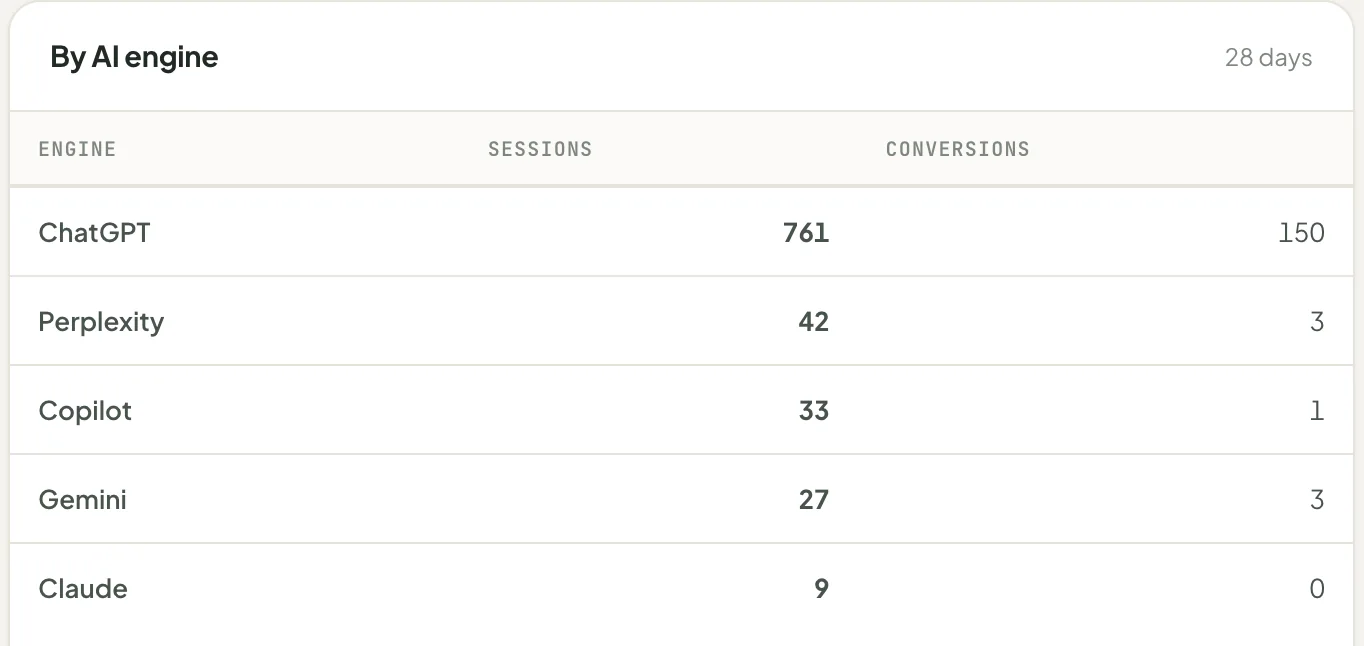
Common questions
What content should a clinic publish first?
Pages for each main service or treatment, answering what it is, who it suits, what to expect and how to book. Then answers to the questions patients ask most often. These rank for searches close to booking and support every other channel.
How often should a clinic publish new content?
Regularly enough to cover patient questions and keep key pages current. For many clinics, two to four quality pieces a month plus updating existing pages works better than frequent thin posts.
Does healthcare content need doctor review?
Yes. Clinical content should be written or reviewed by a qualified doctor in the specialty, with their name and credentials shown. This improves accuracy and helps search engines and AI tools treat the content as trustworthy.
How does content marketing help with AI search?
AI assistants and Google AI Overviews draw on pages that answer questions directly, are written by credible experts and are clearly structured. Question-led headings, short direct answers and FAQ sections make content easier to cite.
