Healthcare Switch to Pharma
All Services Performance Marketing Social Media Marketing SEO & AEO / LLM YouTube Marketing LLM Optimization Brand & Growth Consulting AI Solutions Industries We Serve
Enterprise Hub · All Solutions + Services Growth Transformation AI Transformation Revenue Operations Fractional CGO Growth Operating System Executive Growth Advisory
Clinic Launch Programme (Hub) NABH Consulting India Healthcare Brand Launch Clinic SOP Creation Logo Design (Healthcare) Brand Book Creation Clinic Launch Marketing D2C Brand Launch Clinic Interior Design
Workforce Hub For Employers — post a requirement For Professionals — register Public Openings Training Academy AI Training Flagship
Hawk · CRM Intelligence (NEW) YODA · YouTube Intelligence Angryturtle · GBP Intelligence (NEW) Prism Pulse · Instagram Analytics (NEW) Beacon · Attribution Agency OS · Dashboards Phoenix · Clinic Revenue HealthPro 360 · PMS/HMS AI Patient Lifecycle Bots AI Lead Management System Smart Appointment System Healthcare CRM Patient Feedback System AI, Analytics & Automation Digital Transformation Calculators Free Digital Health Audit →
All 13 calculators → 🎯 Business Exploration Matrix (New) Dental Clinic Setup IVF Clinic + Lab Setup Multi-Specialty Hospital Setup Aesthetic / Cosmetology Clinic Dermatology Clinic Setup Generic Clinic Setup Physiotherapy Clinic Setup Diagnostic Centre Setup CAC Calculator CPQL Calculator Franchise ROI Calculator Revenue Leakage Calculator CRM ROI Calculator
All Events Workshop 1 · Jun 13 · AI in Clinical Practice Workshop 2 · Jun 27–28 · AI in Growth & Governance Hospital Ops Workshop · Jul 12 Pre-Summit Seminar · Aug 16 Grand Summit 2.0 · Oct 10–11 Bihar AI Summit · Recap AI Innovation Awards · Aug 22 Grand Summit 2.0 · Oct 2026 Aarambh 2026 Recap
Case Studies Insights & Blog Research Reports Calculators AI in Healthcare Digest
Our Story Team Abhash Kumar Deep Das Rohit Gupta Speakers & Panelists Careers
Book a Growth Diagnostic
We Do It Right. The right diagnosis. The right strategy. The right systems. Giving healthcare leaders the confidence to make better decisions, build stronger operations, and achieve sustainable growth. — Team Ichelon
Trusted by 150+ healthcare & life-sciences brands
Johnson & Johnson
Mankind Pharma
Adonis Phyto
Narang Biotec
Medanta
Redcliffe Labs
Sitaram Bhartia
Metro Hospitals
Tulasi Hospital
Bloom IVF
Milann
Prime IVF
MedLinks
Handa
Bhardwaj
Eye Q
Johnson & Johnson
Mankind Pharma
Adonis Phyto
Narang Biotec
Medanta
Redcliffe Labs
Sitaram Bhartia
Metro Hospitals
Tulasi Hospital
Bloom IVF
Milann
Prime IVF
MedLinks
Handa
Bhardwaj
Eye Q
Johnson & Johnson
Mankind Pharma
Adonis Phyto
Narang Biotec
Medanta
Redcliffe Labs
Sitaram Bhartia
Metro Hospitals
Tulasi Hospital
Bloom IVF
Milann
Prime IVF
MedLinks
Handa
Bhardwaj
Eye Q
Implementation

SEO Agency in India

Healthcare SEO methodology at ICG is not a service catalogue, it is a sequence — four layers (Crawl Budget Optimisation, Event Mapping, Event Maximisation, Event Optimisation) run on every engagement. Written by Hanuman Sihag (Head of Innovation Chamber, SEO & AIO), reviewed for compliance by Abhash Kumar (Co-Founder, Strategy).

AI-powered healthcare-only marketing agency · +91 81302 26224

Angryturtle · GBP Intelligence OS · powering every listing we manage

Every SEO listing we manage runs on Angryturtle.

Angryturtle by ICG is our proprietary Google Business Profile intelligence platform — the command centre powering every listing we manage for hospitals, clinics, dental chains, IVF centres and specialist practices across India. 7-dimension health scoring per listing, geo-grid rank tracking on a real map, NAP + citation conflict monitoring across 40+ directories, continuous suspension-risk audit, and one prioritised action queue per listing. 143-listing managed portfolio · zero suspensions · 4.76★ portfolio average · NMC + DPDP + ART Act compliance baked in.

Angryturtle portfolio dashboard — 143 GBPs under management, average health score 76, 4.76-star average rating, zero suspensions, 531 suspension-risk factors monitored
Angryturtle Angryturtle · middot; live portfolio dashboard for 143 GBPs under ICG management · 0 suspensions maintained · 4.76★ portfolio average · 531 suspension-risk factors continuously monitored
See the full Angryturtle capability set → Free 48-hour Angryturtle audit →
What this covers

Built for healthcare,
not generic.

Healthcare SEO built on diagnosis, not templates. SLC matrix + AEO-ready architecture so you rank in Google and show up in ChatGPT answers.

By Rohit Gupta, Co-Founder — Business & Growth, and Hanuman Sihag, Head of Innovation Chamber & SEO Lead. Reviewed by Abhash Kumar, Co-Founder — Strategy. Neither the authors nor the reviewer is a clinician; this is a strategy and compliance review.

By Hanuman Sihag — Head of Innovation Chamber & SEO Lead, ICG, and Abhishek Kumar — Sr. Manager, SEO and AIO, ICG.

Reviewed for strategy and compliance accuracy by Abhash Kumar — Co-Founder, Strategy, ICG.

Neither the authors nor the reviewer is a clinician; this is a strategy and compliance review, not a clinical sign-off.

Neither the author nor the reviewer is a clinician; this is a strategy and compliance review, not a clinical sign-off.

Healthcare SEO methodology at ICG is not a service catalogue, it's a sequence. This page explains the mechanism behind it: the four-layer system we run on every engagement, and the week-by-week shape of what actually happens once a client signs on. If you're still deciding whether to hire ICG as a healthcare SEO agency, /healthcare-seo-agency-india is the commercial overview to start with — this page is the how, not the pitch. What follows assumes you already know you need help and want to know what the work involves.

Healthcare SEO isn't keyword SEO — it's event SEO

Healthcare SEO methodology at ICG starts from a different premise than most agencies use: patients don't search in keywords, they search in symptoms and outcomes. A patient typing "why does my knee hurt going downstairs" isn't thinking about "orthopedic clinic near me," but that query, mapped correctly, is a decision-stage event further down the funnel than the clinic-name search most SEO plans chase.

Most agencies build content around a keyword list pulled from a tool. ICG builds it around events — the search, the click, the WhatsApp message, the booked consult — and maps content to whichever stage of that chain is missing. A dermatology client losing traffic on branded terms has a different problem than one losing it on symptom terms, and the fix looks nothing alike. Treating both as "more content" is how agencies burn budget without moving a single qualified lead.

This event framing is also why our technical work and our content work aren't separate workstreams. A crawl-budget problem and a content-gap problem can produce the identical symptom — flat organic traffic — for entirely different reasons, which is exactly what the four layers below are built to tell apart. Related reading: /services/medical-seo covers the technical-plus-content SEO service this methodology sits inside.

The four-layer SEO system

CBO here means Crawl Budget Optimisation — the platform product — not Campaign Budget Optimisation, the ads-budget framework ICG uses on Meta and Google campaigns elsewhere. Same three letters, two different jobs; we'll say which one we mean every time it comes up below.

Layer 1 — Crawl Budget Optimisation (CBO)

Log files for a mid-size hospital site routinely show Googlebot spending its visits on filter URLs, tag pages and thin city-service combinations that no patient ever types into Google, while the specialty and location pages that actually carry commercial intent sit further back in the crawl queue and get recrawled less often than they should.

CBO reads the Apache server logs, cross-checks them against the XML sitemap and Google Search Console's own crawl-stats report, and builds a map of where the budget is actually going versus where it should go. Low-value programmatic pages get pruned or noindexed. Orphaned pages get linked in. The freed-up crawl budget gets redirected toward the money pages — specialty pages, location pages, the pages that actually carry commercial intent. On a large multi-location hospital site this alone can cut the time-to-index on a new page from weeks to days. Product page: /platform/crawl-budget-optimiser.

Layer 2 — Event Mapping (Device ID Tool)

A patient researches a procedure on their phone during a lunch break, books a consult from a laptop that evening, and messages the clinic's WhatsApp the next morning — three sessions, one patient, and most analytics stacks count that as three. Standard GA4 attribution has no way to know these are the same person, so the organic search that actually started the journey gets no credit, and the SEO team looks like it's underperforming even when it's the reason the patient showed up at all.

Why this matters before content even ships. Without cross-device identity resolution, every content decision downstream is built on broken data — you can't know which topics actually convert if half your conversions are invisible. The Device ID Tool stitches sessions across devices using a first-party cookie, hashed email and phone-number graph. When a returning visitor shows up on a new device, the graph matches them against the existing identity rather than creating a second record, so a phone-then-desktop journey collapses back into one person instead of counting as two separate visitors with two separate, unrelated sessions.

That identity resolution then gets reconciled against a clinic-visit callback loop — front-desk staff mark, inside the CRM, when a specific enquiry actually walked in for a consult, and that mark gets tied back to the original organic session that started the journey weeks earlier. Without that loop, a clinic can watch its call volume rise while its analytics dashboard insists organic traffic is flat, because the traffic that mattered arrived on one device and converted on another. With it, we can trace a booked procedure all the way back to the specific symptom page that first brought the patient in, which is also what makes real patient lifetime value reporting against organic traffic possible instead of just session counts. Product page: /platform/device-id.

Layer 3 — Event Maximisation (MMT Framework)

Every piece of content ICG ships for a healthcare client passes through a marketer, a clinical reviewer and a systems engineer before it goes live — that's what MMT (Marketing x Medicine x Technology) actually enforces, not a slogan on a slide. Content built by marketers alone tends to read as superficial to a patient who already knows more than the writer does. Content built by clinicians alone is often too dense to rank or convert. MMT forces both, plus the technical layer, into the same review.

The clinical-review step. Every draft is checked against the source claim before publication — no success-rate number, no comparative superiority claim, nothing that would put a clinic at odds with its own regulator gets through without qualification.

The content-cluster build. Once a topic clears clinical review, it's built out as a cluster rather than a single page — the symptom page, the procedure page, the cost-question page, the recovery-question page all interlinked, because that's how a patient actually researches a decision, not in one search. Framework hub: /about/frameworks.

Layer 4 — Event Optimisation (CRO + OHMRC)

Retail CRO advice mostly doesn't transfer to healthcare landing pages — a countdown timer that works for an e-commerce cart reads as pressure tactics to a patient still deciding whether to get a second opinion. OHMRC is built around that difference.

OHMRC breaks a landing page into five levers and audits each one separately rather than rebuilding the whole page at once. Offer means the actual thing being asked for — a free consult reads differently to a nervous first-time patient than "book now," so the offer itself often changes before any design work starts. Headline gets tested against what the patient is actually afraid of or hoping for, not against a generic value proposition; a fertility-clinic headline built around "understand your options" tends to outperform one built around "book your treatment" for a patient who hasn't decided anything yet. Media covers the photography and video on the page — real clinic and real (consented) patient imagery instead of stock photography, because stock imagery is one of the fastest ways to lose trust on a healthcare page. Reviews get pulled from Google, Practo and JustDial with verifiable sources rather than stock testimonials, so a visitor can actually check them. Call-to-action is matched to funnel stage — a research-stage symptom page never gets a hard "Book Now," because that's the fastest way to lose a patient who isn't ready yet; it gets a lower-commitment option like "understand your options" or a WhatsApp question instead.

A/B tests run one lever at a time so we know which change actually moved the needle, not just that something did. Product page: /platform/conversion-rate-optimization; framework hub: /about/frameworks.

How an ICG SEO engagement actually starts — week by week

Week one on a new healthcare SEO engagement usually starts with a log-file pull, not a strategy deck. Hanuman Sihag, Head of Innovation Chamber for SEO & AIO, is the accountable lead partner on this timeline — he runs the technical audit personally on the first engagements in a new specialty before handing structured playbooks to the account team.

Weeks 1 through 3 are the CBO audit: full crawl-budget analysis against the server logs, sitemap reconciliation, and a review of what Googlebot has actually been indexing versus what's live. The client sees a prioritised list of pages to prune, noindex or redirect, plus a shortlist of money pages that should be getting crawled more often than they currently are — that shortlist is what the rest of the engagement gets built around. In parallel, AIO Intel runs against 50-100 target queries to establish a citation baseline across ChatGPT, Perplexity, Google AI Overviews and Gemini — useful context for the AEO work that comes later, and a number worth having before anything changes. Link: /aio-intel.

Weeks 4 through 6 bring the Device ID Tool online and activate the MMT framework across the content pipeline. Onboarding the Device ID Tool means installing the tracking layer, mapping it against the client's existing CRM fields, and training front-desk staff on the callback-loop step described in Layer 2 above, since that manual mark-the-visit step is what makes the whole attribution chain work. This is also when we lock the baseline, what we call T-1 — the pre-engagement traffic and conversion numbers every later result gets measured against. Skipping this step is the single most common reason an agency's "results" can't survive scrutiny six months later; without a T-1 baseline there's nothing real to compare against.

Weeks 7 through 10 shift into schema deployment and the content-cluster build for AEO targets, with named-author E-E-A-T markup going live on every new page. Each cluster clears the Layer 3 clinical-review step named above before it publishes, so this phase runs on the same review cadence as the ongoing content programme, not a separate one. Link: /services/aeo-llm-optimization.

Month 3 onward, the cadence settles into a review rhythm rather than a build rhythm: a monthly MMT review against the content pipeline, a quarterly OHMRC CRO sweep against the T-1 pages specifically, and ongoing AIO citation tracking to catch drift before it shows up as a traffic drop. Most clients see the first CBO effects, recrawl speed and index coverage, inside the first six weeks; content-driven ranking movement takes longer, usually visible by month three or four, because Google needs time to trust a new cluster.

Where CPQL fits in this methodology — and where it doesn't

CPQL, cost per qualified lead, is the measurement layer that tells us whether any of the above actually worked — it's the metric this methodology exists to move, not the methodology itself. The full benchmark data, by specialty, lives on /cpql-benchmarks-india, including the methodology line behind every figure quoted there (46 active healthcare client engagements, rolling 12-month window Jul 2025 to Jul 2026, across Delhi NCR, Mumbai, Bangalore, Chennai, Hyderabad and Kolkata, last verified 2026-07-26). The commercial proof case — what CPQL reduction actually looks like across a full client portfolio — is on the flagship page, not repeated here.

Compliance built into the process, not bolted on

Every content decision in Layer 3's clinical-review step is checked against the NMC Ethics Code 2026, which restricts self-laudatory and comparative-superiority claims in doctor-branded content, and against the ASCI Healthcare Guidelines on truthful advertising claims (see ASCI's principles and guidelines). In practice that means a dental page can describe what implant placement involves but can't claim to be "the best implant clinic in Delhi," and a cardiology page can explain a procedure without implying an outcome guarantee.

Any page collecting patient data, including lead forms tied to the Device ID layer, follows DPDP Act 2023 consent requirements (see MeitY's data protection page) — the consent language on a form matters as much as its placement, since a form that collects a phone number without clear consent copy is a compliance gap regardless of how well it converts. Where a client operates in a specialty with its own advertising restrictions, such as ART (Regulation) Act 2021 for IVF, that restriction is applied at the content-brief stage in Layer 3, not caught after publication — an IVF success-rate figure either carries the required qualification or it doesn't get written at all. NABH 6th Edition accreditation standards inform how we frame trust signals on hospital and clinic pages where a client holds that accreditation, since an accreditation claim has to match what the client can actually show a patient who asks.

Frequently asked questions

What does "healthcare SEO methodology" mean at ICG, versus just SEO? It means the work is organised around four sequential layers, crawl access, attribution, content and conversion, rather than a single undifferentiated SEO task list. Generic SEO treats a healthcare site like any other site; this methodology treats clinical review and cross-device patient identity as first-class steps, not add-ons.

Is CBO the same as Campaign Budget Optimisation? No — two different things. On this page, CBO means Crawl Budget Optimisation, the technical SEO product that manages what Googlebot crawls and indexes. Campaign Budget Optimisation is a paid-media budget-pacing framework ICG uses separately on Meta and Google Ads accounts.

How long before the four-layer system shows results? CBO effects on crawl and indexing speed are usually visible within the first six weeks. Content and ranking movement from the Event Mapping and Event Maximisation layers typically shows up by month three or four, once the content clusters built in weeks 7-10 have had time to be crawled, indexed and trusted.

Who actually runs the engagement day to day? Hanuman Sihag, Head of Innovation Chamber for SEO & AIO, is the accountable lead on the methodology described here; see /about/hanuman-sihag for his background.

Does ICG guarantee rankings? No. Rankings depend on factors outside any agency's control, including algorithm changes and competitor activity. What we commit to is the process above and transparent reporting against the T-1 baseline set in weeks 4-6. Neither the author nor the reviewer of this page is a clinician; nothing here is a clinical claim about outcomes.


See what a crawl-budget and event-mapping audit finds on your own site: start a free audit. Prefer to talk it through first? Book a call.

The ICG tooling behind this service

Real product screenshots.
Not stock illustrations.

Every ICG engagement runs on in-house intelligence software. Below are real dashboards from the production platform that power this service. Client identifiers anonymised for confidentiality; data structure is real.

Tier 1 · Acquisition

Crawl Budget Optimiser (CBO)

Make sure Google crawls the right URLs at the right frequency. The acquisition layer of organic.

Tier 2 · Engagement & Attribution

Device ID Tool

Track which organic visits become WhatsApp + phone leads — across devices and sessions. Attribution layer.

Tier 3 · Conversion

Landing Page CRO Tool

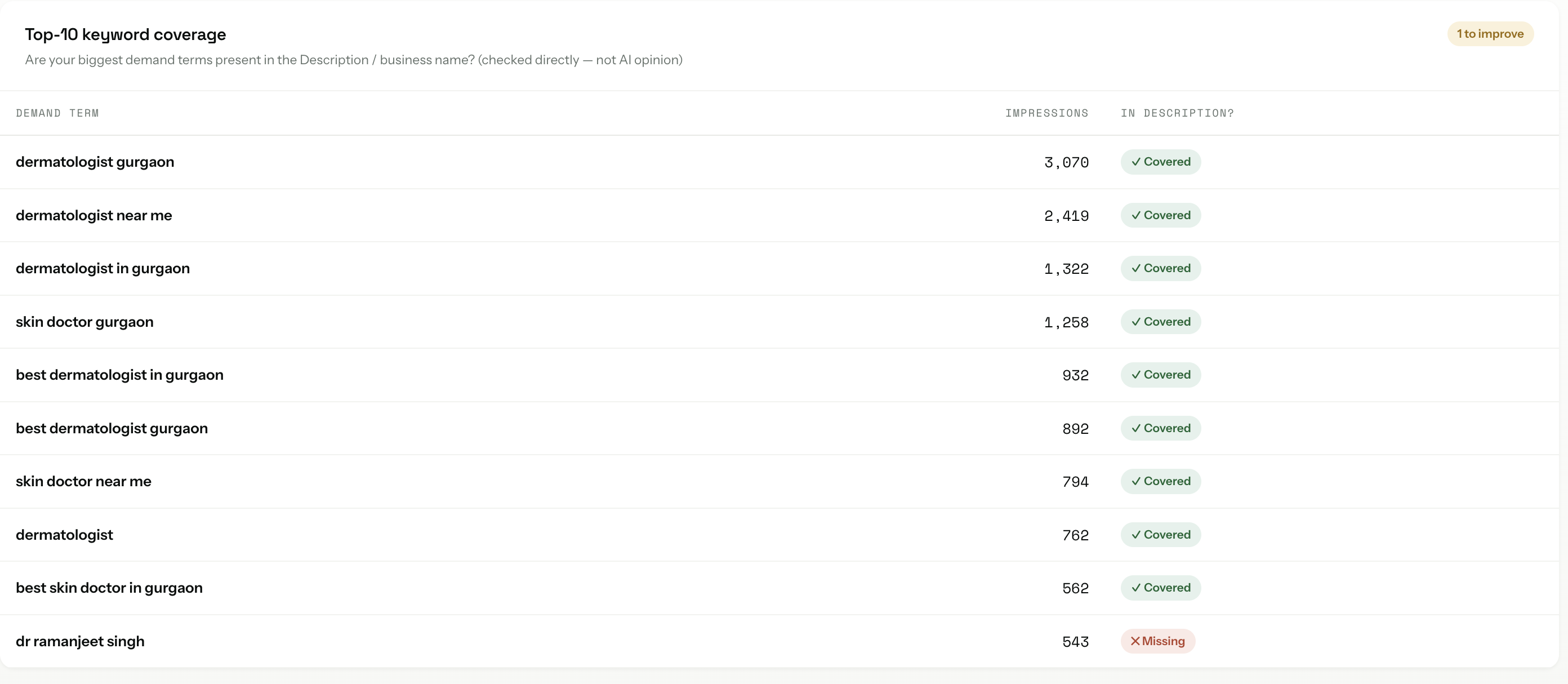
Keyword × Landing Page × User Engagement matrix. Optimise the landing page that's getting traffic but not converting.

Tier 1 — Crawl Budget Optimiser

Reads Googlebot crawl logs and surfaces what's actually being crawled vs sitemap vs GA4 engagement.

CBO Googlebot URL access table

Googlebot URL access — what's being crawled and how often

CBO URL counts: crawl vs sitemap

Crawl vs sitemap diff — 183 URLs in sitemap never crawled, 73 crawled but not in sitemap

CBO categories analysis with GA4 event mapping

Categories × URL × GA4 events (page_view, user_engagement, scroll_50/75, WhatsApp leads)

Tier 2 — Device ID Tool

Tracks individual user journeys across devices — surfacing organic searches that become WhatsApp and phone leads.

Device ID Tool data summary

Per query window: total records, unique search terms, unique visitors, and the conversion event counts (WhatsApp Links: 7 · Phone Links: 20). Pairs every search term with the destination page and the conversion link clicked.

Critical because the standard SEO "rank → click → conversion" model breaks for healthcare. Patients research one session, convert another. Device ID stitches the journey together.

Tier 3 — Landing Page CRO

Keyword type breakdown × landing page metrics — surface the landing pages getting traffic but not converting.

CRO Events by page

Per-page user behaviour: Total Users, Page View, Session Start, Scroll depths 25/50/75/90

CRO ad keyword breakdown by type

Ad keyword breakdown by type (Brand, Hospital, Other, Product, Doctor) with cost & conversion

Tier 4 — AIO Intel — the AI-overview layer

Patients increasingly start at ChatGPT / Perplexity / Google AI Overviews / Gemini rather than blue-link Google. AIO Intel tracks brand citations across all four AI search surfaces — the metric that's invisible in GSC.

What AIO Intel surfaces
  • Citations by AI surface (ChatGPT · Perplexity · Google AIO · Gemini)
  • Citation rate per topic cluster (vs competitors)
  • Query types that trigger your brand citation
  • Topical authority gaps · where you're not cited
  • AIO traffic referral patterns in GA4
Live deployment

ICG's own AIO Intel dashboard is public — real-time citations for ichelonconsulting.com across all 4 AI search surfaces. The same tool ships in every ICG SEO + AIO engagement, scoped to the client brand.

See AIO Intel dashboard (live) →
HealthApex OS Pricing · All-Inclusive · Billed Annually
₹2,999 – 3,999/month
Single Tool
Hawk CRM intelligence overlay (₹2,999), Nexus CRM / HealthPro 360 / Phoenix alone (₹3,999 each).
₹4,999 – 11,999/month
Bundled Suite
Nexus + Hawk ₹4,999. HealthPro 360 + Patient Portal ₹7,999. Operations Suite (HealthPro + Phoenix + Portal) ₹11,999.
₹14,999/month
Complete HealthApex OS ★
All 8 tools: Nexus + Hawk + Beacon + Phoenix + HealthPro 360 + YODA + Agency OS + AIO Intel. Best value. Full integration.

Transparent. Billed annually. No hidden integration fees. Most Indian clinics save 60-80% vs Salesforce Health Cloud (₹3L+/month) or a 5-vendor multi-tool stack. Complete HealthApex OS at ₹14,999/month is 40-60% cheaper than maintaining a multi-vendor stack — plus you get unified data, one compliance officer, one founder-led engagement. Enterprise tier (hospital networks, multi-brand, custom modules): ₹50,000 – ₹3,00,000/month, founder-led.

Book the free 30-min diagnostic →
Complimentary · 30 minutes · No pitch · No proposal

30-minute Brand & Growth Diagnostic — to find out if we're the right fit.

ICG works with systems-driven, data-driven healthcare decision-makers — long-term. The diagnostic is where we find out, together, if you're that kind of partner and if our ecosystem is built for what your brand needs. You leave with a written root-cause diagnosis you can act on — whether you engage us or not. That's our promise.

CPQL benchmarks · ICG vs market

38–58% lower CPQL
in 90 days. Across every specialty.

Most healthcare marketing service pitches sell on CPL. ICG sells on CPQL — Cost Per Qualified Lead — the cost of a lead that actually shows up for a consultation. The difference is often 3–4×. Here is what our 150+ healthcare clients actually pay.

Specialty Market avg CPQL ICG avg CPQL ICG reduction
IVF & Fertility₹2,400₹1,180−51%
Aesthetic Dermatology₹1,950₹1,020−48%
Plastic Surgery₹3,600₹2,050−43%
Hair Transplant₹4,300₹2,280−47%
Ophthalmology (LASIK / cataract)₹1,700₹720−58%
Mental Health (psychiatry / therapy)₹2,200₹1,310−40%
Dental (chains)₹980₹540−45%

90-day averages from ICG's live portfolio across Delhi NCR, Mumbai, Bangalore, Hyderabad, Pune, Chennai, and tier-2 cities. Adjust for city: metro CPQLs run 20–35% higher than tier-2 across all specialties.

HealthApex OS · The proprietary stack

Eight platforms. One intelligence layer.

Nexus CRM healthcare lead management · Beacon attribution · Hawk CRM intelligence · Phoenix clinic revenue · HealthPro 360 PMS · YODA YouTube intelligence · Agency OS live reporting · AIO Intel AEO+LLM citation tracking. Built in-house since 2018 — included in every healthcare marketing service engagement.

Explore HealthApex OS See all eight platforms in detail
Two products worth knowing

Hawk and YODA.
Standalone offers built for specific gaps.

⏵ Hawk · CRM Intelligence

Is your CRM hiding what it should be showing?

Hawk shows where your leads are leaking: which went cold, which were downgraded by automation, which are recoverable. Free Lead-Leak Audit in 48 hours.

Explore Hawk + free audit →
▶ YODA · YouTube Intelligence

Is your YouTube channel generating patients, or just views?

YODA connects YouTube content to consultation bookings. Patient testimonial videos generate 6.9× more consultations per view than condition explainers.

Explore YODA →
The diagnostic framework

Most healthcare marketing agencies treat symptoms.
ICG diagnoses root causes.

High CPL. Junk leads. Low ROAS. These are symptoms, not problems. ICG's diagnostic framework — built across 150+ healthcare engagements — maps every symptom to its actual root cause and the specific treatment that fixes it.

Symptom Diagnosis ICG Treatment
High CPL across all campaignsPoor channel selectionSLC Matrix
Leads come in, but most are junkInefficient digital operationsDCG Matrix
Leads convert to appointments slowlySales process / telecaller gapsACE Matrix + MIS Tool
CPL keeps rising every monthCross-firing between ad groupsN-Gram + Cross-Firing Analysis
Meta Smart Bidding not optimisingEMQ at 2.5, no first-party signalBeacon CAPI middleware
Traffic is up but enquiries flatWrong T-1 page; no CRODevice ID Tool + OHMRC Model
Invisible to ChatGPT / AI OverviewsNo AEO infrastructureAIO Intel Tool + cluster architecture
Patient database underutilisedNo retention motion on existing patientsPhoenix revenue intelligence
Can't see which leads are leaking from your CRMNo CRM intelligence layer; backward movement invisibleHawk · CRM intelligence + Lead-Leak Audit
YouTube channel has subscribers but no patientsOptimising for views instead of consultation attributionYODA · YouTube intelligence + consultation attribution

Every framework in this table is proprietary to ICG. Calibrated across 150+ live healthcare accounts since 2018. Full ICG methodology → · Glossary →

Complete guides

Read the complete guide
for your category.

Six pillar guides — each 8,000–15,000 words of original ICG methodology, CPQL benchmarks, and live client data. The depth no other Indian healthcare marketing agency publishes.

Healthcare Marketing India — Complete Guide → Doctor Marketing India — Complete Guide → Hospital Marketing India — Complete Guide → IVF Marketing India — Complete Guide → Healthcare Performance Marketing — Complete Guide → Healthcare SEO + AEO India — Complete Guide →

More insights at ichelonconsulting.com/insights · 250+ articles · all healthcare-only

The ICG technology stack

Nine tools. One compounding system. HealthApex OS
Built in-house. Deployed in every engagement.

ICG's results are reproducible because they are built on proprietary infrastructure — not agency intuition or generic tools. These nine HealthApex OS platforms are what power every ICG engagement.

Healthcare CRM

Nexus CRM

Healthcare CRM & Lead Management

ICG's healthcare-specific CRM and lead management system. Specialty-configured funnel stages for IVF, dental, aesthetic, ortho, hospital OPD. 1-click CAPI + GCLID via Beacon. Hawk intelligence built in. DPDP-compliant by architecture. Deployed across 300+ healthcare centres.

  • Specialty-specific funnel stages, not generic SaaS pipeline
  • 1-click CAPI + GCLID via Beacon attribution
  • Telecaller leaderboard + adherence scoring native
  • DPDP Act 2023 compliant by architecture
Explore Nexus CRM →
Business Layer

Hawk

CRM Intelligence & Lead-Ops MIS

Sits as the business intelligence layer above your CRM — Nexus, Salesforce, LeadSquared, HubSpot, Zoho, or any custom CRM. Shows where leads are leaking, which effort is wasted, and which good leads were quietly downgraded by automation — not by a human decision.

  • Sits above your existing LMS — no replacement
  • 83% of effort goes to dead leads — surfaced Day 1
  • ~75% qualified-lead downgrades by automation
  • Free Lead-Leak Audit in 48 hours
Explore Hawk + free audit →
Attribution Core

Beacon

Attribution Engine & CAPI Middleware

Sits at the centre of every ICG attribution architecture. CAPI middleware connecting Meta Ads, Google Ads, WhatsApp and IVR to your CRM. Lifts Event Match Quality from 2.5 to 6+, reducing CPM 30–40% from the same budget.

  • Server-side CAPI — bypasses iOS privacy changes
  • EMQ 2.5 → 6+ across portfolio
  • 30–40% CPM reduction from EMQ lift alone
  • Multi-touch: ad → consultation → revenue
Explore Beacon →
Practice Management

HealthPro 360

PMS with built-in revenue intelligence layer

The only PMS that tracks cross-sell and up-sell opportunities within your existing patient base. 12 modules covering OPD, IPD, Pharmacy, Labs, Billing, Inventory, Patient Portal, Smart Scheduling, RBAC, AES-256 encrypted storage.

  • Only PMS with built-in Revenue Intelligence
  • Cross-sell signal tracking within existing patients
  • 12 modules: OPD, IPD, Pharmacy, Labs, Billing+
  • Audit trails + RBAC + AES-256 encryption
Explore HealthPro 360 →
Revenue Layer

Phoenix

Revenue intelligence built over your existing PMS

If you already have a PMS — Akhil Systems, Practo, or any other — Phoenix builds the business intelligence layer on top of it without replacement. Currently live across 46 centres for a national chain.

  • Works over your existing PMS — no migration
  • Daily action queue: Prevent Loss / Maintain / Grow
  • Catches unbilled services, collection gaps, lapsing patients
  • CPQL variance ₹620–₹3,800 → ₹680–₹1,420
Explore Phoenix →
YouTube Intelligence

YODA

YouTube analytics that measures patients, not views

The only YouTube intelligence platform built for healthcare business outcomes. Connects video performance to actual consultation bookings — not views, not subscribers. Patient testimonial videos generate 6.9× more consultations per view than condition explainers.

  • Consultation attribution per video — not views
  • Demand-gap: what patients search that your channel misses
  • 50+ doctor channels tracked across India
  • AIO readiness scoring: which videos AI tools cite
Explore YODA →
Governance & Transparency

Agency OS

Full transparency. Instant diagnosis. Zero surprises.

ICG's centralised governance platform — every client sees everything in real time, and ICG's team sees every problem the moment it surfaces. 30+ real-time alert systems fire the moment a metric drifts outside its performance envelope.

  • GSC, GA4, Google Ads, Meta Ads, IVR — one live view
  • 30+ real-time alert systems per account
  • CPQL drift alert at >15% week-on-week change
  • Client login: full transparency on your account
Explore Agency OS →
AEO & LLM Intelligence

AIO Intel

AI Overview + LLM citation tracking, healthcare-tuned

Knows the moment ChatGPT, Perplexity, Google AI Overviews and Gemini cite your brand in patient answers — and which content drove the citation. Bot-aware dashboard with GA4-registered custom dims (AIO source, AIO referrer) and IndexNow + GSC API integration.

  • Live tracking across ChatGPT / Perplexity / Google AIO / Gemini
  • Bot-aware: knows human vs scraper traffic
  • Custom GA4 dims register AIO source + referrer
  • IndexNow + GSC API: content surfaced to LLMs within hours
View AIO Intel dashboard →
Competitor Intelligence

Prism Spy

Every Meta + Google ad your competitors run, watched daily

Tracks 75+ Indian healthcare brands, 2,150+ active ads, ₹50Cr+ aggregate ad spend visibility per month. Surfaces what's working, what's been killed, what offers are emerging. Powers every ICG Meta Ads brief, Performance Marketing diagnostic, and IVF / derm / dental specialty campaign with real competitive intelligence.

  • 75+ brands tracked across 30+ healthcare specialties
  • 2,150+ active ads · daily refresh
  • Activity Feed: every spend / hook / pause logged
  • Offers Intelligence: 250+ offers in market tracked
Explore Prism Spy →
GBP Intelligence Platform

Angryturtle

Every Google Business Profile scored, tracked, protected, and grown from one command centre

ICG's proprietary Google Business Profile intelligence platform. Scores every listing across 7 dimensions, tracks rank on a live geo-grid across your actual service area, audits NAP + citations, monitors 531 suspension-risk factors continuously, and drafts Google Posts on cadence. Currently managing 143 healthcare listings with 0 suspensions and 4.76★ portfolio average across 28,137 reviews.

  • 143 listings under management · 0 suspensions · 4.76★
  • 7-dimension Health Score + 5-factor Rank OS per listing
  • Geo-grid rank tracking + NAP + Citation audit + Profile Shield
  • NMC + NABH + ART Act + DPDP compliance built into every content + review workflow
Explore Angryturtle →

Every ICG engagement runs on some combination of these ten HealthApex OS tools. The diagnostic determines which combination is right for your practice.

Explore HealthApex OS → See the full stack live on your account — free 30-min audit
The team behind your account

Every diagnostic is led by a founder.
You'll know their names before the engagement begins.

ICG was built by three IIT BHU engineers who entered healthcare marketing with a specific intent: to build the tools that didn't exist and run the campaigns that most agencies couldn't. When you book a diagnostic, Rohit or Abhash leads it personally. Not an account manager. Not a senior executive. The people who built what you're evaluating.

The ICG team — 60+ healthcare marketing specialists at Gurgaon HQ

60+ specialists.
One growth engine.

Performance marketers, analysts, AI engineers, content strategists, and operations specialists — all healthcare-only. Headquartered in Gurgaon since 2018.

Rohit Gupta — Co-Founder, ICG

Rohit Gupta

Co-Founder & Director · Business & Growth

IIT BHU · IIM Rohtak

Rohit's first question in every diagnostic: "When you ask your agency why patients aren't booking — what do they say?" He says the answer tells him more than any dashboard.

Full profile →
Abhash Kumar — Co-Founder, ICG

Abhash Kumar

Co-Founder & Director · Strategy & Analytics

IIT BHU · IIM Bangalore

Abhash built Beacon because most agencies couldn't answer one question: "Which of my campaigns generated that consultation?" He decided the problem was solvable in code. It was.

Full profile →
Deep Das — Co-Founder, ICG

Deep Das

Co-Founder & Director · Technology & AI

IIT BHU

Deep built the 4-Bot patient lifecycle system after watching a client lose 60+ qualified leads in one week to a 6-hour WhatsApp response window. He decided the problem was solvable in code. It was.

Full profile →
Frequently asked

Questions about
SEO.

Healthcare sits in Google's YMYL (Your Money, Your Life) category, where the bar for E-E-A-T (Experience, Expertise, Authoritativeness, Trust) is materially higher. Pages without named medical authors, compliance discipline, and proper medical schema rank invisibly below the trust threshold even when technical SEO is correct.
AEO (Answer Engine Optimisation) is structuring healthcare content so AI systems — ChatGPT, Perplexity, Google AI Overviews, Gemini — can accurately extract and cite it. Requires FAQ schema, author authority markup, cluster content architecture, and LLM citation monitoring. Fundamentally different from traditional SEO.
The T-1 page is the last page a patient visits immediately before they call or fill a form on a healthcare website. It is the highest-leverage page for conversion optimisation because it sits at the moment of decision. ICG's Device ID Tool surfaces the T-1 page automatically. T-1 page CRO typically lifts conversion 35–90% with no additional ad spend.
MMT (Maximize, Maintain, Trend) is ICG's SEO keyword management framework. Every keyword on a client site is classified into one of three states: MAXIMIZE (top performers with room to grow), MAINTAIN (stable rankings to protect), or TREND (rising or falling — act before crisis). Run weekly via GSC-based scripts.
CBO (Crawl Budget Optimisation) is ICG's proprietary tool integrating Apache server logs, XML sitemaps, and Google Search Console data to identify crawl waste and prioritise high-value pages for indexing. Critical for large healthcare websites where Google's finite crawl budget is often consumed by 404s and low-value pages while priority service pages go un-indexed.
Technical fixes (schema, CBO, redirects) show indexation impact in 4–8 weeks. Content cluster rankings build over 4–8 months. AEO citations typically appear within 60–90 days of infrastructure deployment. Full SEO + AEO programme maturity is 9–12 months — but compounding outcomes continue indefinitely.
ICG's April 2026 primary research found 67% of Indian patients consulted ChatGPT, Perplexity, or Google AI Overviews before booking a clinic. Only 4% consulted an accredited health source. AI is now the first healthcare touchpoint — making AEO mandatory infrastructure, not optional.
ICG's content is engineered first for AI Overview citation, second for classic ranking. Every long-form article includes explicit entity disambiguation (Person, Organization, MedicalProcedure schema markup), named-author MBBS-and-above credentials with NMC registration numbers, citation-worthy data points (numeric outcomes, comparative tables), and definitive statements with named sources. We measure AI Overview citations monthly and adjust content architecture based on which articles are being cited and which are being passed over.
SEO targets Google's classic blue-link rankings. AEO (Answer Engine Optimization) targets Google AI Overviews and featured snippets — content engineered to be extracted as the canonical answer. GEO (Generative Engine Optimization) targets ChatGPT, Perplexity, Claude, and Gemini brand mentions — measured through LLM-response monitoring rather than search console. ICG's content programmes deliver all three simultaneously because the underlying content architecture (named authority, schema markup, evidence anchoring) earns citation across all three surfaces.
NMC compliance is now a positive SEO signal. Google's AI Overview safety filters deprioritise content that triggers medical-advertising-violation flags — over-claim language, miracle-result language, comparative-with-other-doctor language. NMC-compliant content (calibrated tone, evidence-anchored claims, named credentialed authors, no outcome guarantees) passes the safety filter and is preferentially cited. The 2018-era playbook of aggressive promotional content now ranks lower than compliant educational content in 2026.
Month 1-3: technical foundation, schema markup, content architecture, named-author bylines deployed. Month 3-6: first AI Overview citations begin appearing for educational queries, classic ranking movement on long-tail terms. Month 6-9: meaningful organic traffic lift (typically 60-180%), CPQL begins to drop as organic share grows. Month 9-12: organic CPQL reaches 60-80% reduction vs paid-only baseline, AI Overview citations consolidate across major patient-journey queries, LLM brand mentions become consistent. Most ICG SEO engagements are structured as 12-month commitments because the asset compounding only becomes visible from month 6 onwards.
Keyword cluster

Also serving these healthcare SEO queries.

The SEO engagement at ICG also covers — and ranks for — these adjacent search variants. Each is a real service slice we deliver under the same retainer.

Medical SEO agency India

ICG runs medical SEO with doctor-reviewed content workflow, ensuring every clinical claim is medically accurate before it ranks.

Hospital SEO services

Multi-location hospital SEO covering service-line pages, location pages, physician pages, and GBP at-scale governance.

Doctor SEO India

Specialist + individual physician SEO — personal brand pages, Person schema, expert author E-E-A-T compounding.

Clinic SEO services

Single-clinic and chain-clinic SEO with local SEO + GBP + reviews velocity built in.

Healthcare search engine optimisation

Full-stack healthcare SEO: technical, on-page, content, schema, AEO, local — one integrated team.

SEO for medical practices

Practice-level SEO with patient journey-aligned content and procedure-page architecture.

Patient acquisition SEO

SEO calibrated for booked consultations, not raw traffic. CPQL-style attribution applied to organic.

Healthcare website SEO

Site architecture audit + technical SEO + content cluster mapping for healthcare brand websites.

IVF clinic SEO India

Specialty-specific SEO for fertility clinics — symptom cluster + procedure + cost queries + EMI content.

Dermatology SEO India

Dermatology + aesthetic clinic SEO with procedure-page focus and Instagram-AEO crossover strategy.

Keyword-cluster FAQ

Common questions about healthcare SEO agency India.

Medical SEO requires doctor-reviewed content for clinical accuracy, MedicalClinic + Physician schema deployment, NMC + DCGI compliance awareness in advertising content, and patient-journey-aligned content architecture. Regular SEO does not — which is why generalist SEO agencies often miss healthcare-specific ranking signals.

Material ranking improvements typically appear in 60-180 days for healthcare brands, depending on competitive density. Specialty + city long-tail queries (e.g. "IVF marketing Gurgaon") can rank in 45-90 days; broader queries ("healthcare marketing agency India") take 6-12 months. ICG's average position improvement across the 150+ healthcare client portfolio is 40% within 90 days.

Yes. ICG manages multi-location hospital SEO covering location pages, service-line pages, physician pages, and GBP at-scale governance. For multi-centre hospital chains, ICG runs centralised SEO governance with location-level execution and brand-level technical architecture.

Get your free SEO gap analysis →

ICG audits rankings, schema, AEO gaps in 30 minutes.

Find your root cause in 30 minutes.

Free Brand & Growth Diagnostic. Written findings. No commitment.

Book free diagnostic → Chat on WhatsApp →
Selected ICG clients

Healthcare brands ICG
has worked with.

A representative slice of the 300+ healthcare brands ICG has delivered for across India. Full client list available under NDA during a Brand and Growth Diagnostic.

Read full client case studies →

Client video stories

What clients say about SEO · on video.

Dr. Gaurang Krishna
Hair Transplant Surgeon · Medlinks · Delhi

"I must say I am very happy, very satisfied and impressed with what they are doing. The entire team is excellent."

Dr. Arvind Kumar
Chest Surgeon · Medanta · Delhi
Dr. Arvinder Soin
Liver Transplant Surgeon · Medanta · Gurgaon
See all client video testimonials →

Ready to scope
SEO for your practice?

Start with a complimentary 30-minute Brand & Growth Diagnostic with India's AI-powered healthcare-only marketing agency.

Or call +91 81302 26224 · contact@ichelonconsulting.com

Chat with a Co-Founder