


Healthcare YouTube marketing, run on YODA — ICG's YouTube AIO and brand-search intelligence platform.
Most agencies treat YouTube as a content channel — upload, hope, move on. ICG treats it as a search and demand-generation system, and YODA is the platform that runs it. Five modules work together on every healthcare video account: the AIO Engine (are your videos cited inside AI answers), Search Demand Clusters (what your specialty audience is actually asking), the Brand Search Trend flywheel (are views turning into people searching your name), the YouTube SEO Lab (on-page video optimisation), and Monthly Reporting (one dashboard, every month). Retainers from Rs 20,000/month, custom-scoped per engagement.
TL;DR
- YODA is ICG's proprietary YouTube and brand-search intelligence platform — five modules, one dashboard, run on every healthcare video account.
- The AIO Engine tracks whether a channel's videos are cited inside Google AI Overviews and AI answer engines — the video equivalent of AI Share of Voice.
- The Brand Search Trend flywheel is the centrepiece metric: it proves whether video views are converting into branded search volume, the real signal a viewer is becoming a lead.
- Search Demand Clusters and the YouTube SEO Lab keep production and on-page optimisation grounded in measured demand, not guesswork.
- Retainers from Rs 20,000/month · Custom-scoped per engagement — production optional, strategy and optimisation always included.
Patients research on YouTube before they ever type a Google query.
A patient deciding between three dermatologists, or trying to understand what a root canal actually involves before booking a consult, increasingly starts on YouTube — not a search bar. They watch a procedure explainer, a before-and-after story, a doctor answering the exact question they're too embarrassed to ask in a waiting room. By the time they do type a Google query, they've often already formed an opinion about who they trust. A clinic with no video presence isn't just missing a channel — it's missing the moment a huge share of the decision actually gets made.
Most healthcare businesses that do try YouTube treat it like a portfolio — upload a few videos, check views once, forget it exists. That's the gap YODA was built to close. It's not a production shop bolted onto an SEO retainer; it's a measurement and demand-intelligence layer that decides what to publish, checks whether it's being found and cited, and — critically — tracks whether it's actually driving the metric that matters: people searching your name after watching.
The shift that makes this urgent right now is the same one reshaping written search: AI answer engines increasingly cite video content directly. Google AI Overviews surface YouTube results inline for a meaningful share of "how does X work" and "what to expect from Y procedure" queries. A channel with no structured, SEO Lab-optimised video library isn't just invisible on YouTube search — it's invisible in the newest layer of Google's own answer surface too, at exactly the moment competitors with an early video head start are getting cited there instead.
It's also healthcare-specific in ways a generalist video-marketing agency isn't built for. Every script gets checked against NMC and ASCI claim-language rules before filming. Pharma-adjacent content gets a UCPMP pass. And the content calendar itself is built from Search Demand Clusters — real, measured query volume by specialty and city — rather than a content calendar borrowed from a consumer-brand playbook that has no idea what "before-and-after" claims are legally allowed to show in an Indian healthcare context.
Five modules. One dashboard. Every healthcare YouTube account runs on the same system.
YODA is the platform ICG's video strategists open before touching any client's channel. Five modules feed one composite view: the AIO Engine, Search Demand Clusters, the Brand Search Trend flywheel, the YouTube SEO Lab, and Monthly Reporting. Nothing gets published without passing through at least two of these — a demand cluster to justify the topic, and an SEO Lab pass before it ships.
Read that dashboard the way ICG strategists do: cluster coverage at 18 of 26 means eight measured demand topics have no video against them yet — the next sprint's content calendar writes itself from that gap alone. Brand Search Trend up 22% is the number that actually matters to a clinic owner, because it means the video library is doing more than accumulating views — it's putting the clinic's name into more searchers' heads, measurably.
The flywheel chart is the one clients ask to see first in every monthly review, and for good reason — it's the closest thing to proof that video is generating real intent rather than passive views. YODA overlays branded-search volume against publish batches specifically so a strategist can see the lag: a batch of videos published in April doesn't move branded search until May or June, once enough of the audience has actually watched and remembered. That lag is normal and expected — a straight-line chart with no delay would actually be suspicious, because real memory and intent formation takes weeks, not days.
Cited inside AI answers, and found on YouTube's own search — the two surfaces that matter most now.
The AIO Engine runs a weekly panel of specialty-and-city queries against Google AI Overviews and AI answer engines, checking whether the channel's videos are referenced or embedded in the response. It's built on the same logic as the AI Share of Voice tracking ICG runs for written content on SIE — a presence-rate percentage, tracked over time, that answers a question no view-count or subscriber metric can: is this channel actually being surfaced when an AI system answers the exact question this content was built to answer.
The YouTube SEO Lab works one level below the AIO Engine, on the mechanics that make citation possible in the first place: every video's title is tested against search-intent phrasing (not just clickbait), descriptions are structured with a clear answer in the first two lines because that's what both YouTube's own search and AI extraction favour, chapters are added so long-form videos can be indexed at the segment level, and transcripts are quality-checked for accuracy since a garbled auto-transcript actively hurts a video's chance of being cited cleanly by an AI system reading it as a source. Every video gets a 0-100 SEO Lab score before it's scheduled, and nothing under a set threshold ships without a revision pass.
Search Demand Clusters feed both modules upstream — a content calendar built from measured query clusters (grouped by specialty, city, and buyer-journey stage, the same intent-based grouping SIE uses for written-content clusters) means every video published already has a defined target audience and a defined question it's answering, rather than being a general-purpose brand video hoping to rank for something. Cluster coverage — how many of the mapped demand topics have a published video against them — is the single number that drives the next quarter's production schedule.
YODA doesn't run alone. It's one-third of the system.
YODA is the third leg of ICG's Search Intelligence Trifecta — three proprietary platforms run together on every healthcare client, feeding one account-level view rather than three disconnected tools.
SIE — Search Intelligence Engine
Runs the Rank OS 5-stage diagnostic for written content and AI Share of Voice for organic search. A branded-search spike YODA's flywheel detects after a video release often shows up in SIE's Brand signal within the same reporting window.
See SIE →Angryturtle — GBP Intelligence
Owns Google Business Profile intelligence — visibility, reviews, and risk monitoring across every location. A viewer who watches a video and searches the clinic's name often lands directly on the GBP listing Angryturtle is optimising.
See Angryturtle →YODA — YouTube & Brand-Search Intelligence
This platform — video SEO, AI-answer citation tracking, and the Brand Search Trend flywheel that proves views are converting into real search intent.
See the Trifecta →In practice this means a client on all three retainers gets a single monthly review, not three separate reports to reconcile. If a video published on YODA drives a branded-search spike, SIE's Rank Tracker often shows a rank improvement on the branded query within the same window, and Angryturtle shows a bump in GBP profile views from that same searcher completing the journey. Reading the three signals together — rather than crediting whichever platform happens to report last — is what a real Trifecta account review looks like.
Every script is checked before it's filmed, not after it's published.
Healthcare video carries more compliance risk than written content — a claim spoken on camera by a doctor is harder to walk back than a sentence quietly edited on a page. Every YODA-scheduled script is checked against NMC Section 6 doctor and clinic promotion boundaries and ASCI Chapter III healthcare advertising claim standards before filming begins, not after the video is live. Pharma-adjacent scripts get a DCGI/UCPMP 2024 pass. Viewer data captured through video CTAs, description-link forms, or comment-driven lead capture is logged DPDP 2023-compliant. AYUSH guideline checks apply for Ayurveda, yoga, and wellness-specialty clients, and NABH-related content routes through the same review layer used across ICG's NABH consulting work.
Before-and-after content gets particular scrutiny given how easily it crosses from marketing into a claim a regulator could challenge — YODA's checklist flags any before-and-after sequence for a compliance review pass before it ships, checking framing, disclaimers, and whether results language stays within what ASCI and NMC actually permit for the specialty in question.
What the first quarter on YODA actually looks like.
| Weeks | Focus |
|---|---|
| 1-2 | Channel audit · Search Demand Cluster map built for the client's specialty and service cities · AIO Engine query panel constructed |
| 3-4 | YouTube SEO Lab pass on existing library (title, description, chapter, transcript fixes) · first new-video scripts drafted and compliance-checked |
| 5-8 | First publish batch goes live against the highest-priority demand clusters · Brand Search Trend baseline established |
| 9-12 | Second publish batch · AIO Engine and Brand Search Trend re-measured against baseline · Monthly Reporting dashboard reviewed with client · next-quarter cluster priorities set |
Ninety days is enough to see the flywheel start turning — a baseline Brand Search Trend number, two publish batches against measured demand clusters, and an early AIO Engine read. It is not enough to see the flywheel's full compounding effect, which typically needs two to three quarters of consistent publishing before branded search growth clearly separates from normal seasonal noise.
One retainer, scoped to the account. No SaaS tiers, no hidden platform fee.
Custom-scoped per engagement based on publish cadence, the number of specialty demand clusters tracked, and whether video production is bundled in or run by the client's own in-house team. YODA itself is never sold as a separate SaaS licence — it's the platform ICG's strategists work from inside every YouTube retainer, the same way SIE and Angryturtle back their respective retainers.
The retainer covers strategy, Search Demand Cluster mapping, AIO Engine tracking, YouTube SEO Lab optimisation on every video, and monthly reporting as standard. Production — filming, editing, thumbnail design — is scoped separately for clients who want ICG to handle it end to end, or excluded entirely for clients whose in-house or existing production partner just needs a strategy and optimisation layer added on top. Either way, retainers start from Rs 20,000/month, custom-scoped per engagement, with no separate platform licence fee for YODA itself.
How the flywheel showed up in practice.
Multi-chair dental chain, South India
Search Demand Clusters showed a large, uncovered "dental implant cost" and "root canal pain" cluster the chain had never made a single video against, despite it being one of the highest-volume question sets in their specialty. A six-video batch answering those two clusters directly moved Brand Search Trend up 41% over 90 days, with the AIO Engine picking up citation on three of the six videos within the same window.
Single-location IVF centre, Delhi NCR
The centre had a YouTube channel with 40+ videos and almost no structure — no chapters, thin descriptions, inconsistent titling. A full YouTube SEO Lab pass on the existing library, with no new filming required, lifted average watch time and moved four videos from page-two YouTube search results to page-one for their target queries within six weeks, before a single new video was even published.
Regional hospital group, three specialties
Splitting the AIO Engine panel by specialty (oncology, cardiology, orthopaedics) revealed cardiology was already at a 45% AI-citation presence rate while oncology sat at 6% — a gap invisible in an aggregated channel-wide number. Reallocating the next quarter's production budget toward oncology-specific demand clusters closed that gap to 24% within 90 days.
Who this is built for, and who it isn't.
A good fit if you're
- A healthcare business willing to commit to a sustained publish cadence, not a one-off video
- Looking for a measurable link between video content and real booking-intent search behaviour
- Already running (or ready to start) a written-content or GBP programme the Trifecta can connect to
- Comfortable with claim-language review adding a short compliance pass before filming
Probably not a fit if you're
- Looking for a single viral video or campaign rather than a sustained channel-authority build
- Wanting patient-facing clinical instructional content rather than marketing and discovery content
- Not able to commit to at least a quarter of consistent publishing — the flywheel needs the runway
- Expecting YODA sold as a standalone software licence rather than the platform behind a managed retainer
Retainers from Rs 20,000/month, custom-scoped per engagement — the conversation that decides fit is usually a 20-minute call, not a long sales process.
Powered by our Trifecta · Angryturtle + SIE + YODA
Every YODA-powered YouTube retainer runs alongside the other two legs of the Search Intelligence Trifecta. The live product screens below show the actual AIO Lab, SEO Lab, and topic-cluster tooling YODA runs on a healthcare video account, the SIE diagnostics that read the branded-search signal a video release creates, and the Angryturtle GBP layer a viewer lands on once a video sends them searching for the clinic's name.
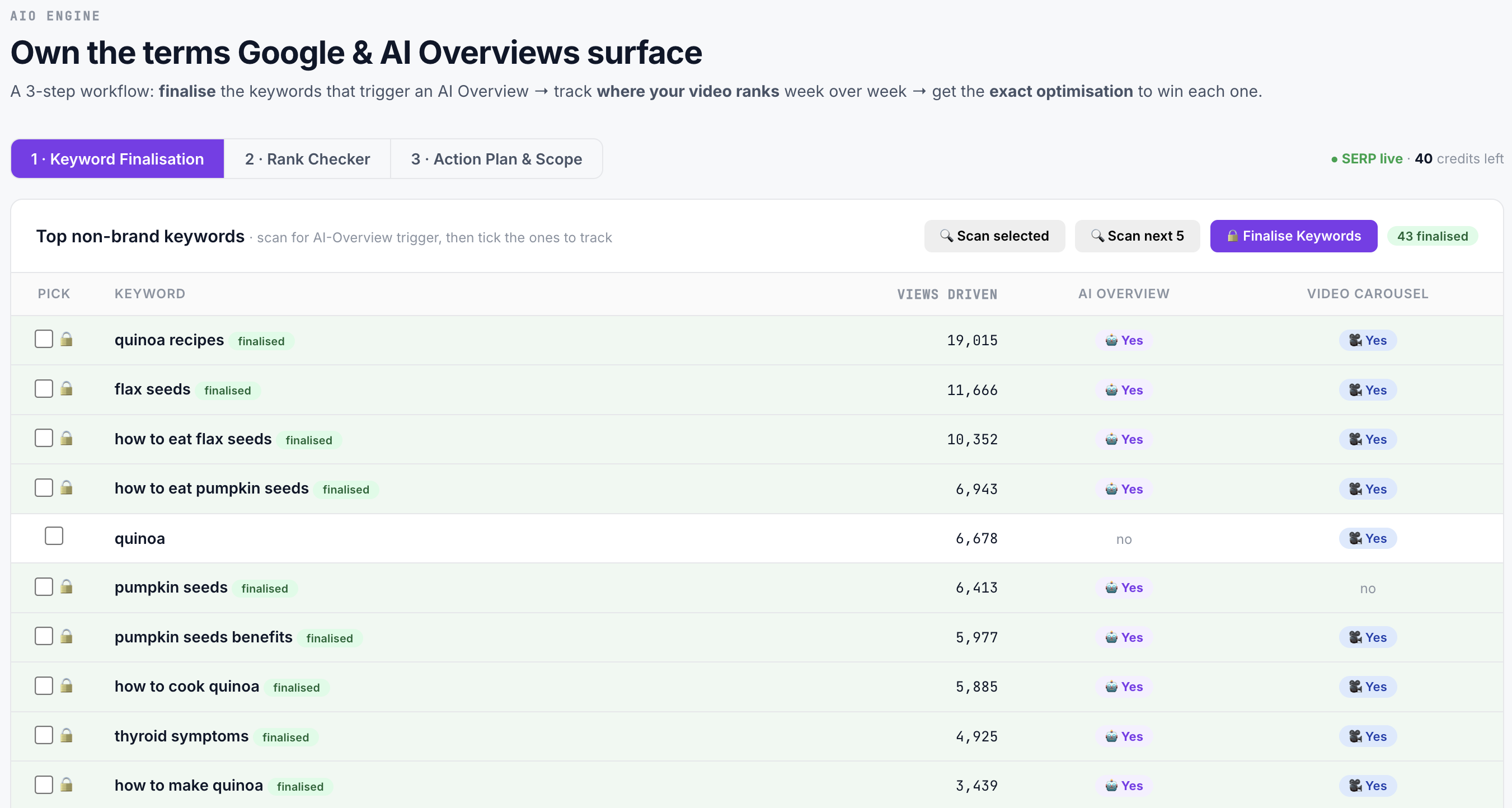
YODA → How YODA locks the specialty query panel the AIO Engine tracks weekly for AI Overview citation.
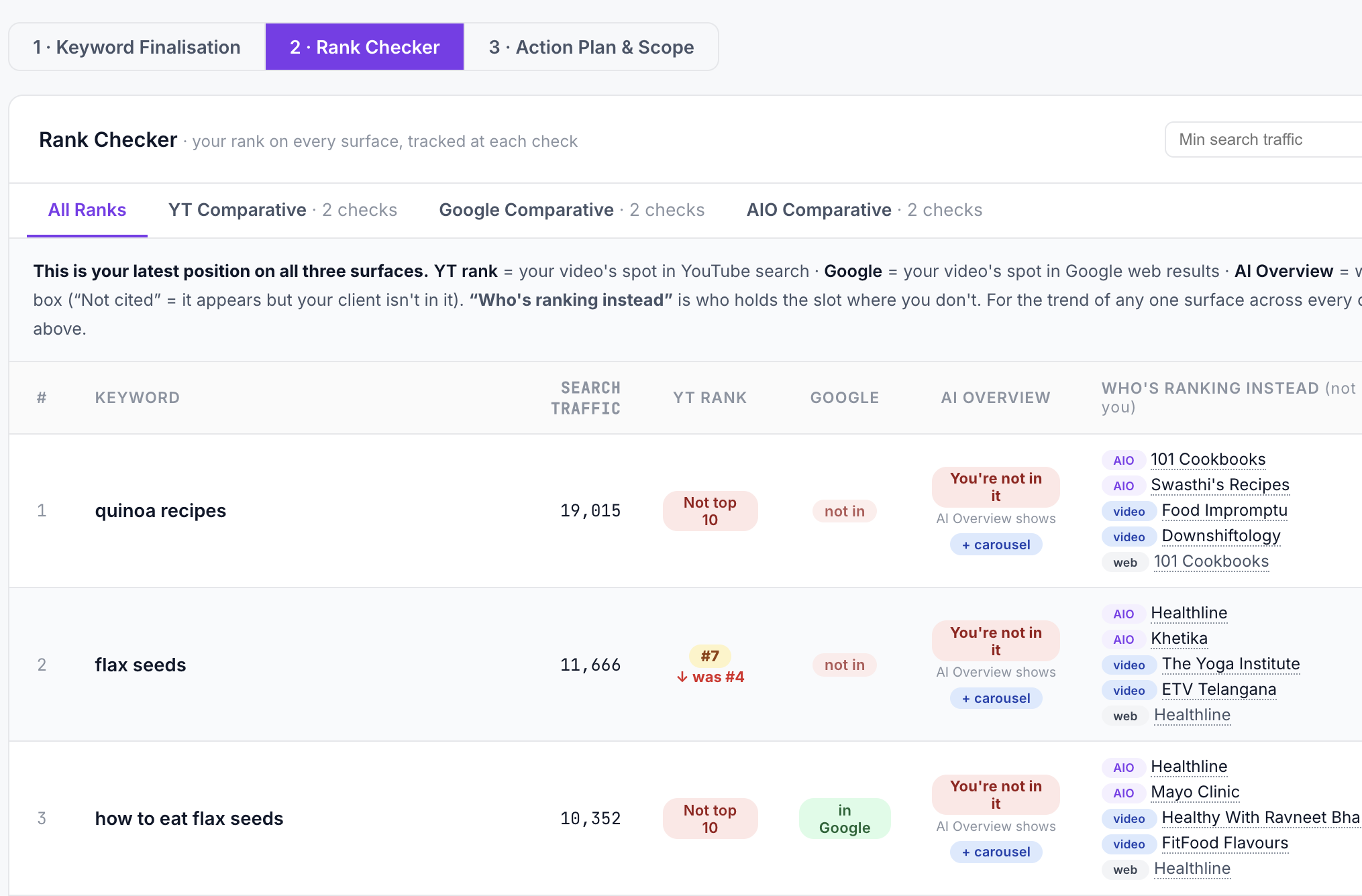
YODA → Checking whether a channel's videos are ranking and being cited for the tracked specialty queries.

YODA → The on-page optimisation scorecard every video passes through before it's scheduled to publish.

YODA → Search Demand Clusters mapped by specialty and city, the same view that drives the quarterly production calendar.
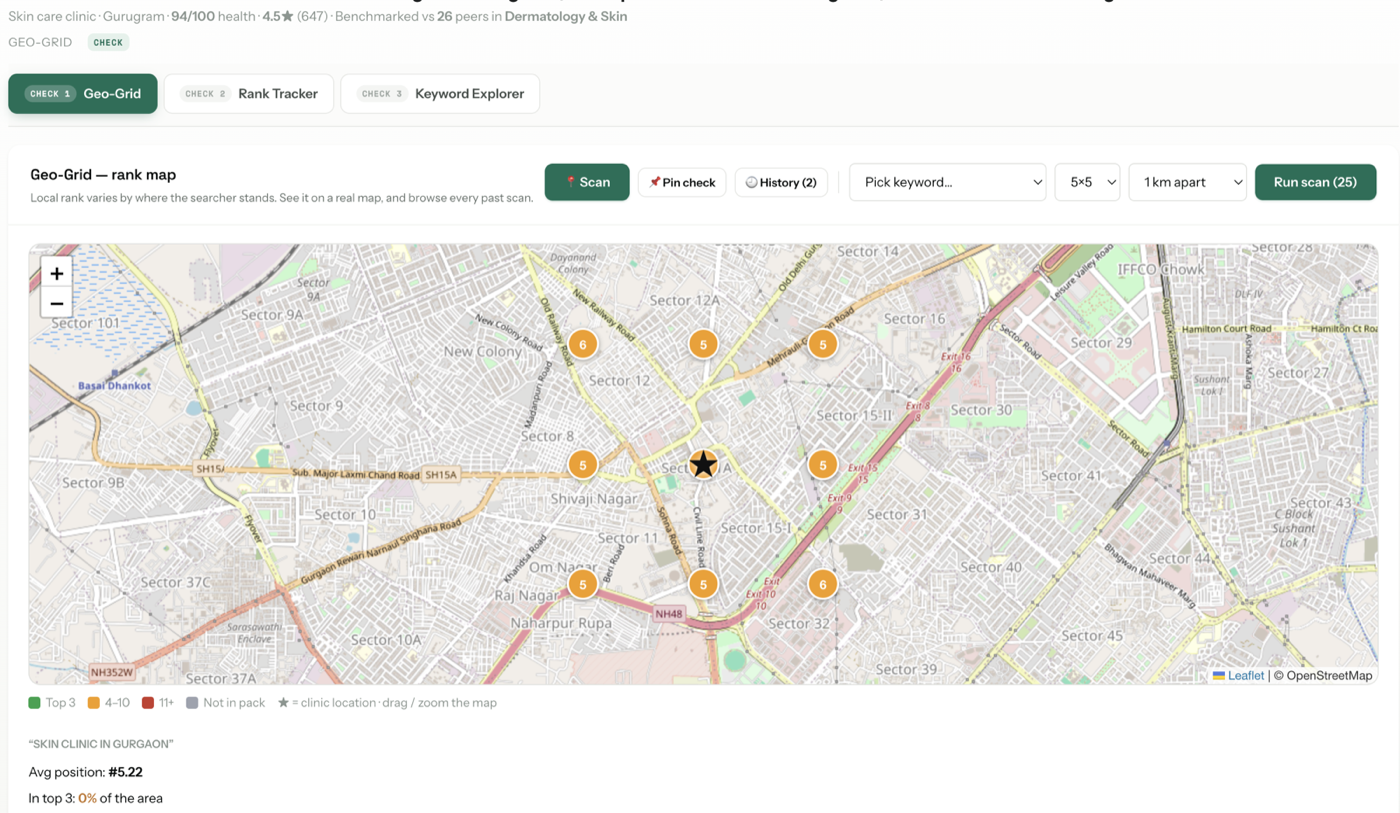
Angryturtle → The GBP layer a viewer lands on once a YODA video sends them searching for the clinic's name across the city.
Common questions about YODA and healthcare YouTube marketing.
What is YODA?
YODA is ICG's proprietary YouTube and brand-search intelligence platform, running five modules — AIO Engine, Search Demand Clusters, Brand Search Trend flywheel, YouTube SEO Lab, and Monthly Reporting — on every healthcare video account.
How is YODA different from a generic YouTube SEO checklist?
A generic checklist optimises one video against generic keyword tools built for e-commerce. YODA clusters demand by medical specialty and city, checks scripts against NMC and ASCI rules before filming, and tracks whether video views convert into branded search — a metric no generic tool reports.
What is the AIO Engine inside YODA?
It tracks whether a channel's videos are surfaced inside Google AI Overviews and cited by AI answer engines, using a weekly specialty-query panel and a presence-rate percentage — the video equivalent of AI Share of Voice on SIE.
What are Search Demand Clusters?
Groups of video-answerable questions a specialty and city actually generate, ranked by priority and coverage, so a content calendar is built against measured demand rather than guesses.
What is the Brand Search Trend flywheel?
The metric that tracks branded search volume against video publish dates — proof that a viewer watched, remembered, and later searched the clinic's name directly, the clearest line YODA draws between a view and real booking intent.
What is the YouTube SEO Lab?
The on-page optimisation module — title, thumbnail, description, chapter, and transcript work — scoring every video against a healthcare-specific checklist before it's scheduled to publish.
How does Monthly Reporting work?
It rolls all four other modules into one dashboard every month, so a client sees the same four comparable numbers month over month rather than a differently formatted report each time.
How does YODA fit with SIE and Angryturtle?
YODA, SIE, and Angryturtle form the Search Intelligence Trifecta, run together on every client — YODA owns YouTube and brand-search intelligence, SIE owns organic and AI-search intelligence, Angryturtle owns Google Business Profile intelligence.
What compliance checks does YODA run?
Scripts are checked against NMC Section 6 and ASCI Chapter III before filming, pharma-adjacent content gets a UCPMP 2024 pass, viewer data is logged DPDP 2023-compliant, and AYUSH checks apply for Ayurveda and wellness clients.
How much does the YODA-powered YouTube service cost?
Retainers from Rs 20,000/month, custom-scoped per engagement based on publish cadence, cluster count, and whether production is bundled in.
How long before YouTube marketing shows measurable movement?
Views and on-platform ranking typically move in 30-60 days. The Brand Search Trend flywheel — the metric correlated with bookings — usually needs 90 days of consistent publishing to show a reliable trend.
Who is this service not a fit for?
A clinic wanting a single viral video rather than sustained channel-authority building, or wanting patient-facing clinical instructional content rather than marketing and discovery content.

