Healthcare Pharma & Life Sciences Other Industries
All Services Performance Marketing ChatGPT Ads India · NEW Social Media Marketing SEO & AEO / LLM YouTube Marketing LLM Optimization Brand & Growth Consulting AI Solutions Industries We Serve
Enterprise Hub · All Solutions + Services Growth Transformation AI Transformation Revenue Operations Fractional CGO Growth Operating System Executive Growth Advisory
Clinic Launch Programme (Hub) NABH Consulting India Healthcare Brand Launch Clinic SOP Creation Logo Design (Healthcare) Brand Book Creation Clinic Launch Marketing D2C Brand Launch Clinic Interior Design
Workforce Hub For Employers — post a requirement For Professionals — register Public Openings Training Academy AI Training Flagship
Hawk · CRM Intelligence (NEW) YODA · YouTube Intelligence Angryturtle · GBP Intelligence (NEW) Prism Pulse · Instagram Analytics (NEW) Beacon · Attribution Agency OS · Dashboards Phoenix · Clinic Revenue HealthPro 360 · PMS/HMS AI Patient Lifecycle Bots AI Lead Management System Smart Appointment System Healthcare CRM Patient Feedback System AI, Analytics & Automation Digital Transformation Calculators Free Digital Health Audit →
All 13 calculators → 🎯 Business Exploration Matrix (New) Dental Clinic Setup IVF Clinic + Lab Setup Multi-Specialty Hospital Setup Aesthetic / Cosmetology Clinic Dermatology Clinic Setup Generic Clinic Setup Physiotherapy Clinic Setup Diagnostic Centre Setup CAC Calculator CPQL Calculator Franchise ROI Calculator Revenue Leakage Calculator CRM ROI Calculator
All Events Workshop 1 · Jun 13 · AI in Clinical Practice Workshop 2 · Jun 27–28 · AI in Growth & Governance Hospital Ops Workshop · Jul 12 Pre-Summit Seminar · Aug 16 Grand Summit 2.0 · Oct 10–11 Bihar AI Summit · Recap AI Innovation Awards · Aug 22 Grand Summit 2.0 · Oct 2026 Aarambh 2026 Recap
Case Studies Insights & Blog Research Reports Calculators AI in Healthcare Digest
Our Story Leaders @ Ichelon · IN · US · AU Ichelon India · Gurgaon Ichelon Global · Dallas, TX Ichelon Australia · Sydney Speakers & Panelists Client Elevation Programme 🤝 Partner Connect 🇦🇪 ICG UAE Careers
Book a Growth Diagnostic
We Do It Right. The right diagnosis. The right strategy. The right systems. Giving healthcare leaders the confidence to make better decisions, build stronger operations, and achieve sustainable growth. — Team Ichelon
Trusted by 150+ healthcare & life-sciences brands
Johnson & Johnson
Mankind Pharma
Adonis Phyto
Narang Biotec
Medanta
Redcliffe Labs
Sitaram Bhartia
Metro Hospitals
Tulasi Hospital
Bloom IVF
Milann
Prime IVF
MedLinks
Handa
Bhardwaj
Eye Q
Johnson & Johnson
Mankind Pharma
Adonis Phyto
Narang Biotec
Medanta
Redcliffe Labs
Sitaram Bhartia
Metro Hospitals
Tulasi Hospital
Bloom IVF
Milann
Prime IVF
MedLinks
Handa
Bhardwaj
Eye Q
Johnson & Johnson
Mankind Pharma
Adonis Phyto
Narang Biotec
Medanta
Redcliffe Labs
Sitaram Bhartia
Metro Hospitals
Tulasi Hospital
Bloom IVF
Milann
Prime IVF
MedLinks
Handa
Bhardwaj
Eye Q

TL;DR

  • Diagnostic lab marketing needs five channels: referring doctors, home-collection, D2C panels, price transparency, and TPA distribution.
  • Referring-doctor networks drive 40-65% of lab revenue but get near-zero marketing budget at most labs.
  • Google Ads, SEO + Google Business Profile, and WhatsApp deliver 80%+ of digitally-acquired lab revenue.
  • ICG runs 4 pricing tiers from ₹49,999/mo (standalone lab) to ₹5L+/mo (enterprise imaging + lab combined).
  • A 32-branch chain client grew digital revenue share from under 4% to 19% in 9 months with ICG's playbook.
Backed by App\Support\NamedExperts::get(). --}}
Rohit Gupta — Business & Growth Lead, Ichelon Consulting Group
By Rohit Gupta · Business & Growth Lead, Ichelon Consulting Group
LinkedIn
Diagnostic Lab Marketing · India · 2026 Playbook

Diagnostic Lab
Marketing Agency in India.

By Rohit Gupta, Co-Founder — Business & Growth, Ichelon Consulting Group. Reviewed by Raman Soni, Head of Performance Marketing. Updated August 2026.

India's diagnostic lab market is projected to grow from USD 20.5B (2024) to USD 37B by 2032 — a compounding 7.6% CAGR driven by preventive-health uptake, insurance TPA growth, and home-collection normalising as a consumer channel. National lab chains are already spending 8–15% of revenue on marketing, but almost none of them are being served by an SEO-first, healthcare-native agency that understands referring-doctor economics, collection-boy routing, and NABL/DPDP-aware creative. That gap is what this page — and ICG's diagnostic-lab practice — exists to close.

This playbook is written for three buyers: (1) the lab owner running a standalone path lab in a metro or tier-2 city who is losing walk-ins to national aggregators, (2) the marketing head at a regional chain with 20–150 collection centres who needs a scalable acquisition system that works across a hub-and-spoke footprint, and (3) the franchise-development lead evaluating agencies for expansion beyond 5 branches. Every section below maps to a decision you are making this quarter.

Why diagnostic lab marketing is different

Five dynamics that make diagnostic lab marketing
unlike any other healthcare vertical.

Most healthcare agencies treat a diagnostic lab like a specialty clinic — run some Google Ads, spin up a GMB profile, hope Instagram lifts brand. That approach caps at ₹15–25 lakh in monthly revenue and then plateaus, because diagnostic labs actually operate as a five-channel business with five distinct buyer archetypes. Ignore any of them and the funnel starves.

01 · Referring doctor networks are 40–65% of lab revenue

Every standalone path lab and every chain-branch derives 40–65% of test volume from a network of referring GPs, physicians, gynaecologists, paediatricians, and consultants. This is a B2B relationship that lives in prescription pads, sample-collection SOPs, and quarterly reagent-supply conversations — not in Google Ads. Yet most lab marketing budgets allocate zero rupees to it. ICG builds a formal Referring-Doctor Acquisition (RDA) programme for every diagnostic client — identified in the "Referring doctor acquisition" section below — because it is the single highest-ROI channel in the lab category.

02 · Home-collection is a logistics business marketed as a lab

Home-collection now accounts for 25–40% of urban lab revenue and 55–70% of new-customer acquisition in the tier-1 metros. But home-collection marketing is not test-panel marketing — it is a routing problem. The customer books at 10 PM, expects a phlebotomist between 6–8 AM, wants an SMS on the way, WhatsApp when the sample is picked up, and the report emailed by 6 PM. Every marketing message must promise something the operations team can deliver in that specific PIN code. ICG's home-collection campaigns are geo-fenced to actual phlebotomist coverage — not to city-level radius — because the alternative is a 22% no-show rate and 1-star Google reviews that undo six months of paid-media spend.

03 · D2C test-panel marketing is priced against national aggregators

The moment a customer searches "full body checkup near me" in Delhi, Mumbai, or Bangalore, they see 4–7 national lab chains and aggregator apps offering the same 80–90 parameter panel at ₹899–₹1,499. If your standalone or regional lab lists at ₹2,400 with no positioning around accreditation, TAT (turn-around-time), pathologist sign-off, or home-collection convenience, you lose the click. ICG builds test-panel comparison landing pages that hold the price differential by leading with NABL/CAP status, MD Pathology sign-off, and same-day report TAT — not by trying to price-match the national chains (which is a losing race).

04 · Price transparency is now the default consumer expectation

A patient searching for a specific test — say, HbA1c or vitamin D or thyroid profile — expects the price to be visible on the search-results snippet, on the GMB profile, and on the landing page in under 8 seconds. Labs that hide pricing behind "call for quote" forms lose 60–75% of intent traffic to national aggregators that show ₹ranges upfront. This is a design decision that most healthcare marketing agencies get wrong because they are trained on clinic-side "consult first, then price" psychology. Diagnostic labs are the opposite: publish prices, get the click, deliver the sample.

05 · Insurance TPA relationships are a distribution channel

Every empanelled TPA (Third-Party Administrator) relationship — Medi Assist, Family Health Plan, Health India, Vidal Health, Paramount, etc. — is a distribution channel that most labs treat purely as a reimbursement backend. It is actually a marketing channel: TPAs maintain preferred-lab lists for cashless outpatient services, corporate health-check contracts get routed through TPA panels, and IRDAI-mandated health-check programmes are increasingly TPA-directed. ICG builds a "TPA readiness" page for every lab client that surfaces every empanelled TPA and specific covered test panels — a page that ranks for "cashless diagnostic lab [city]" queries that national aggregators do not chase.

The market opportunity

USD 20.5B today → USD 37B by 2032.
Where the growth actually sits.

Aggregate market growth numbers are useful for board decks — they are useless for allocating a ₹3–12 lakh/month marketing budget. Below is the segmentation ICG uses when it prices an engagement and when it decides which channels to weight.

Segment Growth driver Primary channels CPQL band
Preventive full-body panels (D2C)Insurance renewals, corporate wellness, self-pay wellnessGoogle Ads, SEO, GMB₹120–₹380
Doctor-referred routine pathologyGP + specialist prescribing patternsReferring-doctor programme, CME₹40–₹150 (per referrer)
Molecular / genomic / advanced testsOncology, IVF, rare-disease, genomicsSpecialist SEO, KOL content₹800–₹3,500
Home-collection (metro)Convenience shift, senior-care, post-COVID habitMeta Ads, GMB, WhatsApp₹90–₹280
Corporate health-check contractsHR-driven annual health-checks, wellness policiesLinkedIn ABM, direct sales₹1,800–₹6,500 (per contract lead)
Franchise / collection-centre expansionChain growth model, tier-2/3 penetrationFranchise landing pages, Google Ads₹2,200–₹5,800 (per franchise lead)

Source: ICG internal benchmark from diagnostic-lab audits (2024–2026, n=11 engagements + 34 competitive audits). CPQL = cost per qualified lead. Market context sourced from IMARC, Fortune Business Insights, and NABL published lab-count data.

The 3 channels that actually work

Google Ads · SEO & GMB · WhatsApp.
Everything else is secondary.

Every diagnostic lab in ICG's portfolio derives 80%+ of digitally-acquired revenue from three channels: Google Ads (D2C test intent), SEO plus Google Business Profile (test-name + city queries), and WhatsApp (booking, sample-status, report delivery, and remarketing). Meta and Instagram matter for home-collection remarketing, YouTube matters for referring-doctor education, LinkedIn matters for corporate contracts — but if the three core channels are not built right first, the secondary channels will not carry the funnel.

Channel 01 · Google Ads for D2C test intent

Search + Performance Max, segmented by test cluster

Query clusters that actually convert: "full body checkup [city]," "[specific test] price [city]" (HbA1c, thyroid, vitamin D, LFT, KFT, CBC), "home blood test [city]," "cashless diagnostic lab [city]," "NABL lab near me." Each cluster gets its own campaign with cluster-specific landing pages — not a single generic "book a test" page.

Bidding structure: Manual CPC for the top 20–30 head terms with tROAS on Performance Max for long-tail test-name queries. Aggregators bid tROAS across everything — you win the head terms by paying per click on intent that converts within 72 hours.

Negatives that save budget: "government hospital," "free," "aiims" (unless you are near AIIMS), "cost calculator," "insurance TPA form" (informational intent). ICG's diagnostic-lab negative-keyword library runs 400+ terms.

Channel 02 · SEO + Google Business Profile

Test-name + city + GMB radius stacking

Content architecture: One landing page per test-name-plus-city combination for the top 40 tests × each collection-centre city. That is 800–1,600 pages for a mid-size chain. Every page carries price, TAT, sample requirement, fasting requirement, NABL status, pathologist name, and a "book now / WhatsApp" CTA above the fold.

GMB optimisation: Every collection centre gets its own GMB profile (not a shared corporate one) with weekly Posts, monthly Q&A refresh, review-generation SOP running every phlebotomist, and photo uploads at 15+ per centre. Radius stacking works: 4–7 GMBs within a 3km grid capture more queries than 1 super-optimised centre.

Schema markup: MedicalTest schema on every test page + LocalBusiness schema on every GMB-linked landing page + FAQPage on every parent test page. This is where standalone labs beat national aggregators — the aggregators are so large they cannot deploy per-test schema at scale.

Channel 03 · WhatsApp as the primary conversion surface

Booking + status + report + repeat

Why WhatsApp wins for labs: 68% of D2C lab bookings in India happen through WhatsApp when the option is offered on the landing page — because the customer wants to ask "will you cover [my PIN code] tomorrow morning?" before committing. Phone calls to lab call-centres drop 40% when WhatsApp is added as a primary CTA.

WhatsApp Business API workflow: Booking confirmation, phlebotomist ETA, sample-picked-up confirmation, sample-received-at-lab confirmation, report-ready-with-link. Every touchpoint is a template message routed through Meta's WABA. Cost per message: ₹0.40–₹0.90 depending on template category.

Remarketing on WhatsApp: 6-monthly HbA1c reminder to diabetic patients, annual full-body-checkup reminder to preventive-health customers, thyroid-recheck reminder to hypothyroid patients. This is where lab LTV is built — the first test is a lead cost, the fourth test is where the customer pays back.

Referring doctor acquisition

The underlooked lever.
B2B2C flywheel that carries 40–65% of lab revenue.

Every diagnostic chain that has crossed ₹100 crore in revenue — whether national or regional — has done so on the back of a referring-doctor programme. The programme is invisible from the outside because it does not run in Google Ads or on Meta; it runs through sales representatives visiting clinics, quarterly CME dinners, prescription-pad co-branding, and reagent-supply conversations. But it is measurable, it is scalable, and it is the single highest-ROI channel in the diagnostic-lab category. ICG builds a formal Referring-Doctor Acquisition (RDA) programme for every diagnostic-lab client. The framework has four tiers.

Tier 01 · Referring-doctor map

Every GP + specialist within 5km of every collection centre

Baseline: build a database of every registered GP, physician, gynaecologist, paediatrician, endocrinologist, cardiologist, and consulting specialist within a 5km radius of every collection centre. For a chain with 60 centres, this is a 4,000–7,000-doctor list. Data sources: NMC/state medical council registries, practo public listings, hospital OPD schedules, LinkedIn medical profiles.

Each doctor gets a status flag: referring today · referred in past 12 months · never referred · competitor loyal. This map is the substrate of every RDA activity that follows.

Tier 02 · Referring-doctor sales ops

Rep coverage + sample TAT + report readability

Every referring-doctor programme has three operational levers: (1) rep coverage frequency (a GP visited monthly refers 2.3× more than one visited quarterly), (2) sample TAT (a lab that reports before 6 PM the same day gets 40% more repeat referrals than one that reports next-morning), and (3) report readability (colour-coded, comment-annotated reports get 60% more sticky referrals than raw parameter dumps).

ICG audits each of these three levers when we start a lab engagement and rebuilds whichever is weakest. Sales ops is not "marketing" in the digital-agency sense — but it is where the marketing budget compounds.

Tier 03 · Doctor-facing content ecosystem

CME microsites, diagnostic algorithm guides, panel-choice content

Referring doctors want three things from a lab's marketing: (1) test-panel guidance for common presentations (fever workup, chest-pain workup, PCOS workup, thyroid workup), (2) turn-around-time transparency by test category, and (3) sample-collection SOP clarity (fasting rules, tube colour, sample volume, transport). ICG builds a "For Doctors" microsite for every diagnostic-lab client with 40–80 pages covering these — and this microsite ranks for doctor-facing queries that patient-side aggregators do not chase.

Monthly diagnostic algorithm updates (e.g., "Updated PCOS workup panel: what to order after the initial screen") sent to the RDA doctor list build the CME loop that keeps referrals sticky.

Tier 04 · Referring-doctor loyalty economics

Compliant recognition, not commissions

Commission-based referrals are prohibited under the NMC Code of Ethics — both for the referring doctor and the lab paying the commission. A well-run RDA programme runs on recognition rather than commission: doctor-profile pages on the lab's website, joint CME sponsorships, publication support for interesting-case reports the lab helped diagnose, and rep-driven relationship maintenance.

ICG builds the compliant recognition framework so lab clients never sit near the NMC line. Every top-tier chain that has faced regulatory scrutiny in the last decade has done so because someone in sales ops crossed the commission line — the marketing framework has to design that risk out.

Franchise + hub-and-spoke marketing

Chain expansion.
Marketing that scales beyond 10 branches.

Most standalone labs hit a growth wall at 3–5 branches because their marketing was built around one location. Crossing 10 branches requires a hub-and-spoke marketing architecture: a central processing lab (hub) that markets accreditation, technology, and pathologist credentials, and a network of collection centres (spokes) that market local convenience, home-collection, and per-centre reviews. Franchise expansion adds a third layer: a franchise-development marketing engine that recruits investor-partners.

The hub marketing brief

The central processing lab is where accreditation lives (NABL, CAP if applicable, ICMR notification if the lab does molecular tests), where MD pathologists sign reports, and where quality-control history sits. Its marketing job is credibility — not booking. The hub website carries the pathologist roster, the equipment inventory (Roche, Siemens, Beckman Coulter analysers), the EQAS participation record, and the case-study content that convinces referring doctors and TPA panels that this lab meets institutional standards.

The spoke marketing brief

Each collection centre is a hyperlocal business. Its marketing job is discoverability + convenience — a GMB profile that ranks for "blood test near me" in that PIN code, a landing page that shows the exact address with a map, opening hours, WhatsApp-a-phlebotomist button, and home-collection radius. The spoke does not repeat the hub's accreditation content in detail — it links to it — because search intent at the spoke level is transactional, not evaluative.

The franchise-development engine

If the chain is franchising, a third marketing surface exists: franchise-partner acquisition. This engine runs on: (1) a franchise landing page with unit economics, ROI timelines, initial capex, and territory availability, (2) Google Ads on "diagnostic lab franchise India," "path lab business," "collection centre franchise cost," (3) LinkedIn ABM targeting healthcare investors, retiring bank employees, and multi-brand franchise operators, and (4) a franchise-enquiry WhatsApp workflow that qualifies the enquirer before scheduling a franchise-development call.

Franchise leads are 15–40× more valuable than test leads (a franchise contract is a ₹15–60 lakh investment relationship, not a ₹1,499 D2C transaction), so this engine gets its own budget line, its own CRM stage, and its own SLA.

Compliance framework · hospital

Compliance is where most agencies fail.

Hospital advertising sits at the intersection of NMC (per specialist), NABH (institutional), and IRDAI (insurance claims). Multi-specialty hospitals need per-department compliance workflow.

Primary law
NABH standards + NMC Section 6 (per empanelled specialist)

No comparative "better outcomes than" claims without published outcome data. Insurance-empanelment claims must match live TPA lists.

Penalty for violation
Enforcement bite

NABH accreditation suspension + insurance-empanelment revocation

ICG approach
Compliance-first workflow

Every ad + landing page + email routed through a compliance checkpoint before publishing. Zero enforcement actions across 150+ healthcare clients since 2018.

Frameworks ICG operates under

NMC Ethics Code 2026 · DPDP Act 2023 · ART (Regulation) Act 2021 · NABH 6th Edition · Dental Council of India · Schedule J (drug advertising) · UCPMP 2024 · ASCI Healthcare Guidelines

Compliance interpretations current as of September 2026. Enforcement bulletins tracked weekly by ICG's compliance research desk. See our editorial standards for how we source and update these.

ICG for diagnostic labs

Four service tiers.
Priced against lab-network size and channel scope.

Tier 01 · Standalone lab · ₹49,999/mo

1–3 branches · GMB + SEO + WhatsApp

For standalone path labs or 1–3 branch operators. Includes: GMB optimisation for every branch, 40 test-name landing pages for the top 3 city-level test queries, WhatsApp Business API setup, review-generation SOP for phlebotomist team, and monthly reporting. RDA programme is Tier 02 add-on if the lab has >40 referring doctors already mapped.

Tier 02 · Regional chain · ₹74,999–₹99,999/mo

5–25 branches · add Google Ads + RDA + hub content

Adds Google Ads across all city footprints (₹2–6 lakh/mo media, managed separately), 300–600 test-name-plus-city landing pages, RDA programme with per-city referring-doctor map, hub-lab accreditation content build, home-collection routing content, and TPA-empanelment content set. Monthly business-review call with the marketing head.

Tier 03 · National / franchising chain · ₹1.5–4L/mo

40+ branches or active franchise expansion

Adds franchise-development marketing engine, LinkedIn ABM for corporate contract acquisition, specialist-test SEO (molecular, genomic, oncology), YouTube channel for referring-doctor education (YODA product on top of retainer), and multi-city Google Ads across 8+ metros with tROAS + Performance Max structure. Weekly ops call with the CMO.

Tier 04 · Enterprise / imaging + lab combined · ₹5L+/mo

Custom · combined imaging-centre + lab marketing

For groups running lab + imaging + diagnostic-clinic footprints together. Custom-scoped engagement including the imaging-centre marketing playbook, dedicated content pod, dedicated performance-media pod, and quarterly on-site strategy days. Typical scope: ₹5–12L/mo retainer + ₹8–30L/mo media.

For diagnostic labs exploring conversational-search advertising alongside D2C test-panel campaigns, see our ChatGPT Ads India practice and the State of ChatGPT Ads in Indian Healthcare 2026 report.

CPQL benchmarks · ICG vs market

38–58% lower CPQL
in 90 days. Across every specialty.

Most diagnostic lab marketing agency india pitches sell on CPL. ICG sells on CPQL — Cost Per Qualified Lead — the cost of a lead that actually shows up for a consultation. The difference is often 3–4×. Here is what our 150+ healthcare clients actually pay.

Specialty Market avg CPQL ICG avg CPQL ICG reduction
IVF & Fertility₹2,400₹1,180−51%
Aesthetic Dermatology₹1,950₹1,020−48%
Plastic Surgery₹3,600₹2,050−43%
Hair Transplant₹4,300₹2,280−47%
Ophthalmology (LASIK / cataract)₹1,700₹720−58%
Mental Health (psychiatry / therapy)₹2,200₹1,310−40%
Dental (chains)₹980₹540−45%

90-day averages from ICG's live portfolio across Delhi NCR, Mumbai, Bangalore, Hyderabad, Pune, Chennai, and tier-2 cities. Adjust for city: metro CPQLs run 20–35% higher than tier-2 across all specialties.

HealthApex OS · The proprietary stack

Eight platforms. One intelligence layer.

Nexus CRM healthcare lead management · Beacon attribution · Hawk CRM intelligence · Phoenix clinic revenue · HealthPro 360 PMS · YODA YouTube intelligence · Agency OS live reporting · AIO Intel AEO+LLM citation tracking. Built in-house since 2018 — included in every diagnostic lab marketing agency india engagement.

Explore HealthApex OS See all eight platforms in detail
Two products worth knowing

Hawk and YODA.
Standalone offers built for specific gaps.

⏵ Hawk · CRM Intelligence

Is your CRM hiding what it should be showing?

Hawk shows where your leads are leaking: which went cold, which were downgraded by automation, which are recoverable. Free Lead-Leak Audit in 48 hours.

Explore Hawk + free audit →
▶ YODA · YouTube Intelligence

Is your YouTube channel generating patients, or just views?

YODA connects YouTube content to consultation bookings. Patient testimonial videos generate 6.9× more consultations per view than condition explainers.

Explore YODA →
The diagnostic framework

Most healthcare marketing agencies treat symptoms.
ICG diagnoses root causes.

High CPL. Junk leads. Low ROAS. These are symptoms, not problems. ICG's diagnostic framework — built across 150+ healthcare engagements — maps every symptom to its actual root cause and the specific treatment that fixes it.

Symptom Diagnosis ICG Treatment
High CPL across all campaignsPoor channel selectionSLC Matrix
Leads come in, but most are junkInefficient digital operationsDCG Matrix
Leads convert to appointments slowlySales process / telecaller gapsACE Matrix + MIS Tool
CPL keeps rising every monthCross-firing between ad groupsN-Gram + Cross-Firing Analysis
Meta Smart Bidding not optimisingEMQ at 2.5, no first-party signalBeacon CAPI middleware
Traffic is up but enquiries flatWrong T-1 page; no CRODevice ID Tool + OHMRC Model
Invisible to ChatGPT / AI OverviewsNo AEO infrastructureAIO Intel Tool + cluster architecture
Patient database underutilisedNo retention motion on existing patientsPhoenix revenue intelligence
Can't see which leads are leaking from your CRMNo CRM intelligence layer; backward movement invisibleHawk · CRM intelligence + Lead-Leak Audit
YouTube channel has subscribers but no patientsOptimising for views instead of consultation attributionYODA · YouTube intelligence + consultation attribution

Every framework in this table is proprietary to ICG. Calibrated across 150+ live healthcare accounts since 2018. Full ICG methodology → · Glossary →

Complete guides

Read the complete guide
for your category.

Six pillar guides — each 8,000–15,000 words of original ICG methodology, CPQL benchmarks, and live client data. The depth no other Indian healthcare marketing agency publishes.

Healthcare Marketing India — Complete Guide → Doctor Marketing India — Complete Guide → Hospital Marketing India — Complete Guide → IVF Marketing India — Complete Guide → Healthcare Performance Marketing — Complete Guide → Healthcare SEO + AEO India — Complete Guide →

More insights at ichelonconsulting.com/insights · 250+ articles · all healthcare-only

Case study snapshots

Anonymised engagement outcomes
from ICG's diagnostic-lab portfolio.

Regional path-lab chain · 32 branches · North India

Situation: ₹28 crore ARR chain built through referring-doctor network over 18 years. Digital revenue <4% of total. Home-collection existed but not marketed. National aggregators eating into walk-in volume in 4 flagship centres.

Diagnosis: zero test-name-plus-city SEO pages, GMB profiles unclaimed for 21 branches, no WhatsApp workflow, RDA programme running informally without a doctor map.

Intervention: claimed and rebuilt all 32 GMBs, published 480 test-name-plus-city pages, formalised the RDA programme with a 2,800-doctor map, launched Google Ads across all 5 city footprints, deployed WhatsApp Business API.

Result: digital revenue share climbed from <4% to 19% at month 9. Home-collection bookings grew 4.1×. RDA re-mapping surfaced 340 previously-unreferred doctors within 5km of existing branches, of which 92 activated in the first 6 months. (ICG internal data, 2026.)

Standalone lab · MD Pathology-led · Bangalore

Situation: 1 flagship lab + 4 collection centres. Owner-pathologist wanted to grow to 15 centres in 3 years but marketing was purely word-of-mouth. No website, no GMB posts, no test pages.

Intervention: hub website with pathologist-led credibility architecture, 5 GMB rebuilds, 120 test-name-plus-Bangalore-area landing pages, franchise-development landing page, Google Ads on preventive-checkup queries.

Result: franchise-enquiry pipeline built from zero to 14 qualified partner leads/mo by month 6. 3 franchise agreements signed within 9 months. D2C test bookings grew from ~180/mo to 720/mo at month 7. (ICG internal data, 2026.)

YouTube Marketing · ICG YODA Intelligence

Hospital marketing on YouTube: 12-25 specialty funnels run in parallel.

Multi-specialty hospitals serve 12-25 specialty audiences simultaneously. Each has its own CPQL economics, language preference, and content format. ICG's YODA tool segments per-specialty performance + reallocates content investment monthly based on actual consult attribution.

Aggregated lifetime views
180M+
Specialties analysed
9
Consult attribution
Per-video
Read the State of Doctor YouTube India 2026 (flagship) → Explore ICG's YouTube Marketing service →
Frequently asked

About diagnostic lab marketing
agencies in India.

A clinic markets one clinical decision (consult a doctor). A diagnostic lab markets five: doctor referral choice, D2C test-panel choice, home-collection convenience, insurance TPA fit, and price. Every lab marketing plan must cover all five — a clinic-style plan will cap at ~₹15–25 lakh/mo of lab revenue and then stop scaling because the referring-doctor and TPA channels never got built.

A well-run chain today runs at 18–30% digitally-attributed revenue (D2C bookings, home-collection, digital-first walk-ins), 40–55% referring-doctor-attributed, and 15–30% TPA/corporate-contract attributed. Anything below 12% digital in a metro chain in 2026 signals under-investment in Google Ads + SEO + WhatsApp.

ICG's portfolio CPQL bands: preventive full-body panel ₹120–₹380, specific-test D2C ₹90–₹280, home-collection ₹90–₹280, molecular/advanced ₹800–₹3,500, corporate-contract lead ₹1,800–₹6,500. If your current CPQL is more than 1.6× the top of these bands, the campaign is unstructured (not the market).

GMB + test-name-plus-city pages start ranking in 60–120 days for tier-2 cities and 90–180 days for tier-1 metros. National aggregators dominate head terms (“full body checkup [metro]”) — the SEO wins live in the long-tail test-plus-city combinations where the aggregators do not deploy per-test pages at the necessary depth.

Yes. Home-collection is a different product with different economics, different customer psychology, and different failure modes (no-show, PIN-code coverage gaps, phlebotomist rating). ICG builds a separate home-collection landing surface for every lab client — and geo-fences the paid-media targeting to actual phlebotomist coverage rather than city-level radius.

The NMC Code of Ethics prohibits commission-based referrals for both the referring doctor and the receiving diagnostic entity. ICG's RDA framework runs on recognition, CME sponsorship, publication support, and rep-driven relationship maintenance — not commissions. Every RDA programme we run is designed to stay well inside the NMC line and to survive audit.

Yes, on three dimensions: (1) MD-pathologist sign-off visibility (aggregators struggle to surface which specific pathologist signed a report), (2) sample-to-report TAT transparency by test (aggregators quote generic TAT bands), and (3) hyperlocal collection convenience (aggregators cannot beat a lab located 800m from the customer). Standalone labs lose when they try to price-match — they win when they position on trust dimensions the aggregator cannot deploy at scale.

WhatsApp is the primary conversion + retention surface for labs in India in 2026. 68% of D2C bookings prefer WhatsApp over phone or web-form when offered as a landing-page CTA. Beyond booking, WhatsApp Business API carries phlebotomist ETA, sample-status, report delivery, and recurring-test reminders — the reminder workflow is where lab customer LTV compounds.

Standalone lab: ₹49,999/mo (Tier 01). Regional chain (5–25 branches): ₹74,999–₹99,999/mo (Tier 02). National / franchising chain: ₹1.5–4L/mo (Tier 03). Enterprise combined lab + imaging: ₹5L+/mo (Tier 04, custom-scoped). Media budget sits on top of retainer — typical media spend ₹2–30L/mo depending on chain size.

Campaign structure is city-first, then test-cluster-second, then match-type-third. That means one campaign per city, ad groups per test cluster within the campaign, and match-type separation (exact + phrase) within each ad group. Performance Max runs alongside as a discovery layer. Attribution runs to WhatsApp click, call click, and form submit — not just clicks — because lab bookings hit the WhatsApp button 3–4× more than the form.

A franchise-development marketing engine is a separate track from D2C marketing. It runs on: a franchise landing page with unit economics, Google Ads on "diagnostic lab franchise India" and "collection centre franchise cost" queries, LinkedIn ABM against healthcare investors and multi-brand franchise operators, and a WhatsApp qualification workflow. Franchise leads are 15–40× more valuable than test leads, so this engine has its own budget line.

Both. Imaging (MRI, CT, PET-CT, USG, mammography) has different buyer psychology, different price bands (₹2K–₹40K per scan vs ₹200–₹4K per test), and a different referring-doctor mix (radiology-heavy referrers rather than GP-heavy). See the imaging-centre marketing playbook for that side of the practice. Enterprise engagements combine both.

The ICG technology stack

Nine tools. One compounding system. HealthApex OS
Built in-house. Deployed in every engagement.

ICG's results are reproducible because they are built on proprietary infrastructure — not agency intuition or generic tools. These nine HealthApex OS platforms are what power every ICG engagement.

Healthcare CRM

Nexus CRM

Healthcare CRM & Lead Management

ICG's healthcare-specific CRM and lead management system. Specialty-configured funnel stages for IVF, dental, aesthetic, ortho, hospital OPD. 1-click CAPI + GCLID via Beacon. Hawk intelligence built in. DPDP-compliant by architecture. Deployed across 300+ healthcare centres.

  • Specialty-specific funnel stages, not generic SaaS pipeline
  • 1-click CAPI + GCLID via Beacon attribution
  • Telecaller leaderboard + adherence scoring native
  • DPDP Act 2023 compliant by architecture
Explore Nexus CRM →
Business Layer

Hawk

CRM Intelligence & Lead-Ops MIS

Sits as the business intelligence layer above your CRM — Nexus, Salesforce, LeadSquared, HubSpot, Zoho, or any custom CRM. Shows where leads are leaking, which effort is wasted, and which good leads were quietly downgraded by automation — not by a human decision.

  • Sits above your existing LMS — no replacement
  • 83% of effort goes to dead leads — surfaced Day 1
  • ~75% qualified-lead downgrades by automation
  • Free Lead-Leak Audit in 48 hours
Explore Hawk + free audit →
Attribution Core

Beacon

Attribution Engine & CAPI Middleware

Sits at the centre of every ICG attribution architecture. CAPI middleware connecting Meta Ads, Google Ads, WhatsApp and IVR to your CRM. Lifts Event Match Quality from 2.5 to 6+, reducing CPM 30–40% from the same budget.

  • Server-side CAPI — bypasses iOS privacy changes
  • EMQ 2.5 → 6+ across portfolio
  • 30–40% CPM reduction from EMQ lift alone
  • Multi-touch: ad → consultation → revenue
Explore Beacon →
Practice Management

HealthPro 360

PMS with built-in revenue intelligence layer

The only PMS that tracks cross-sell and up-sell opportunities within your existing patient base. 12 modules covering OPD, IPD, Pharmacy, Labs, Billing, Inventory, Patient Portal, Smart Scheduling, RBAC, AES-256 encrypted storage.

  • Only PMS with built-in Revenue Intelligence
  • Cross-sell signal tracking within existing patients
  • 12 modules: OPD, IPD, Pharmacy, Labs, Billing+
  • Audit trails + RBAC + AES-256 encryption
Explore HealthPro 360 →
Revenue Layer

Phoenix

Revenue intelligence built over your existing PMS

If you already have a PMS — Akhil Systems, Practo, or any other — Phoenix builds the business intelligence layer on top of it without replacement. Currently live across 46 centres for a national chain.

  • Works over your existing PMS — no migration
  • Daily action queue: Prevent Loss / Maintain / Grow
  • Catches unbilled services, collection gaps, lapsing patients
  • CPQL variance ₹620–₹3,800 → ₹680–₹1,420
Explore Phoenix →
YouTube Intelligence

YODA

YouTube analytics that measures patients, not views

The only YouTube intelligence platform built for healthcare business outcomes. Connects video performance to actual consultation bookings — not views, not subscribers. Patient testimonial videos generate 6.9× more consultations per view than condition explainers.

  • Consultation attribution per video — not views
  • Demand-gap: what patients search that your channel misses
  • 50+ doctor channels tracked across India
  • AIO readiness scoring: which videos AI tools cite
Explore YODA →
Governance & Transparency

Agency OS

Full transparency. Instant diagnosis. Zero surprises.

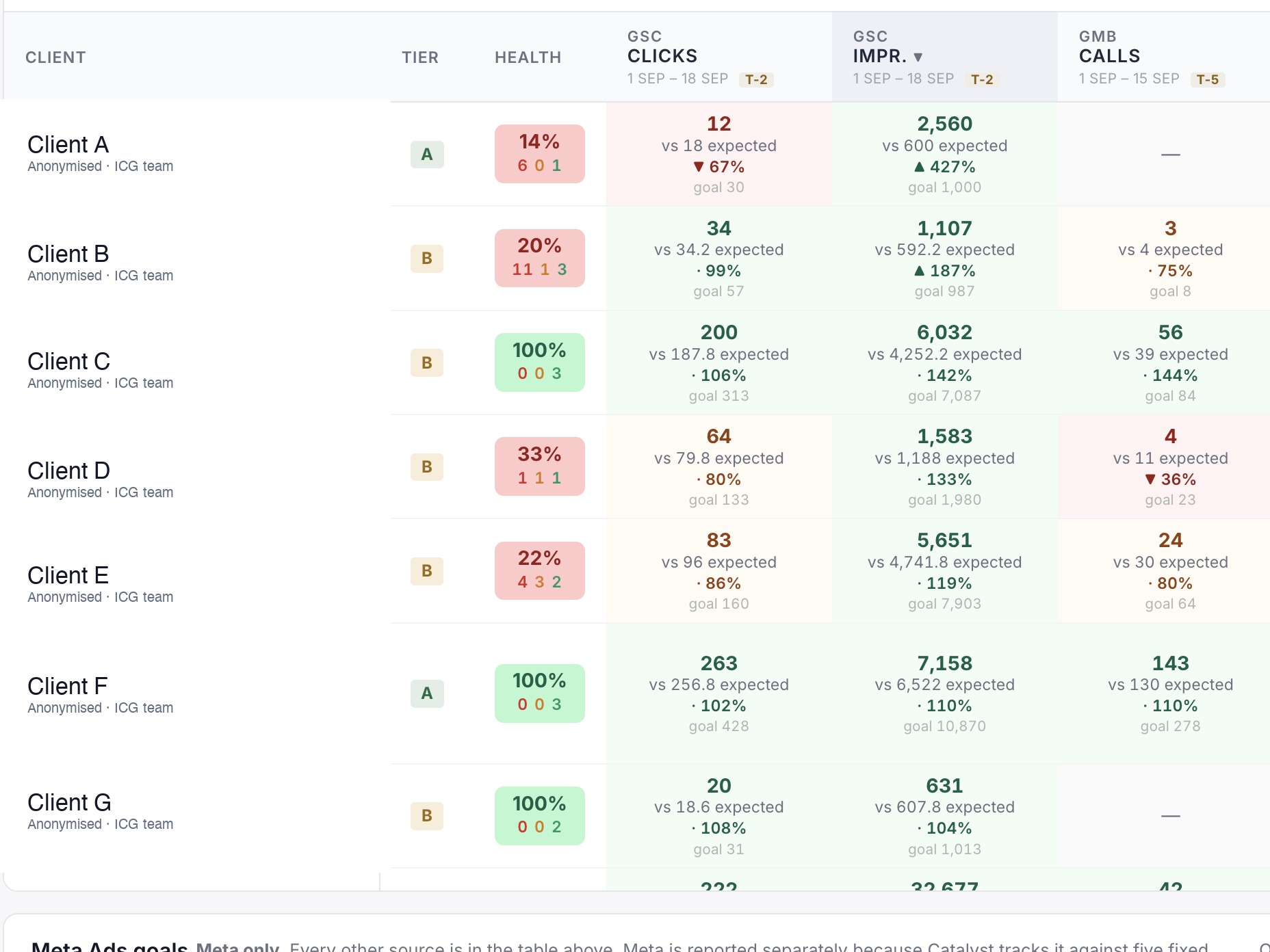
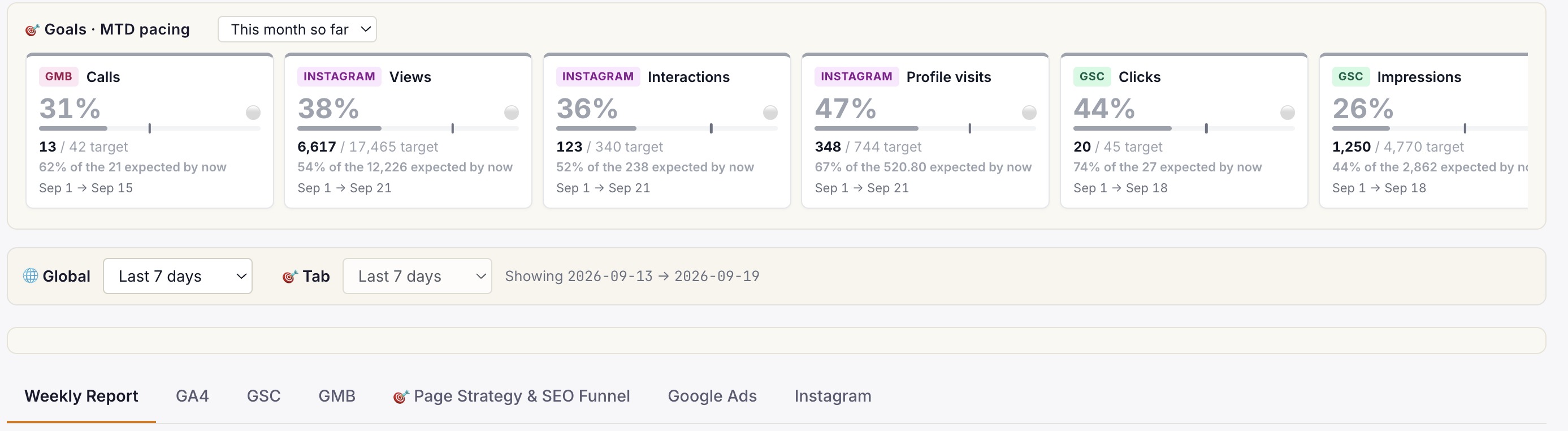
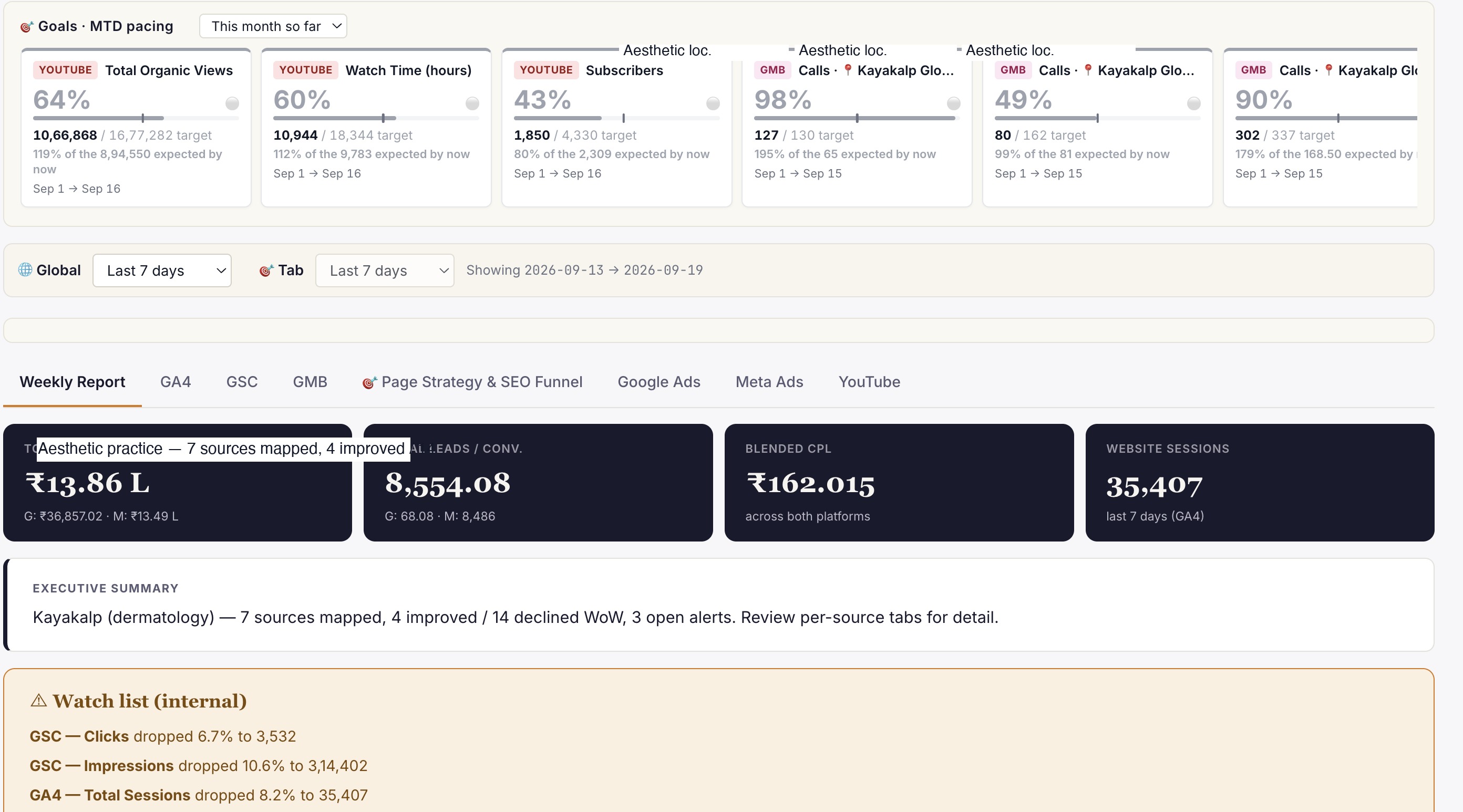
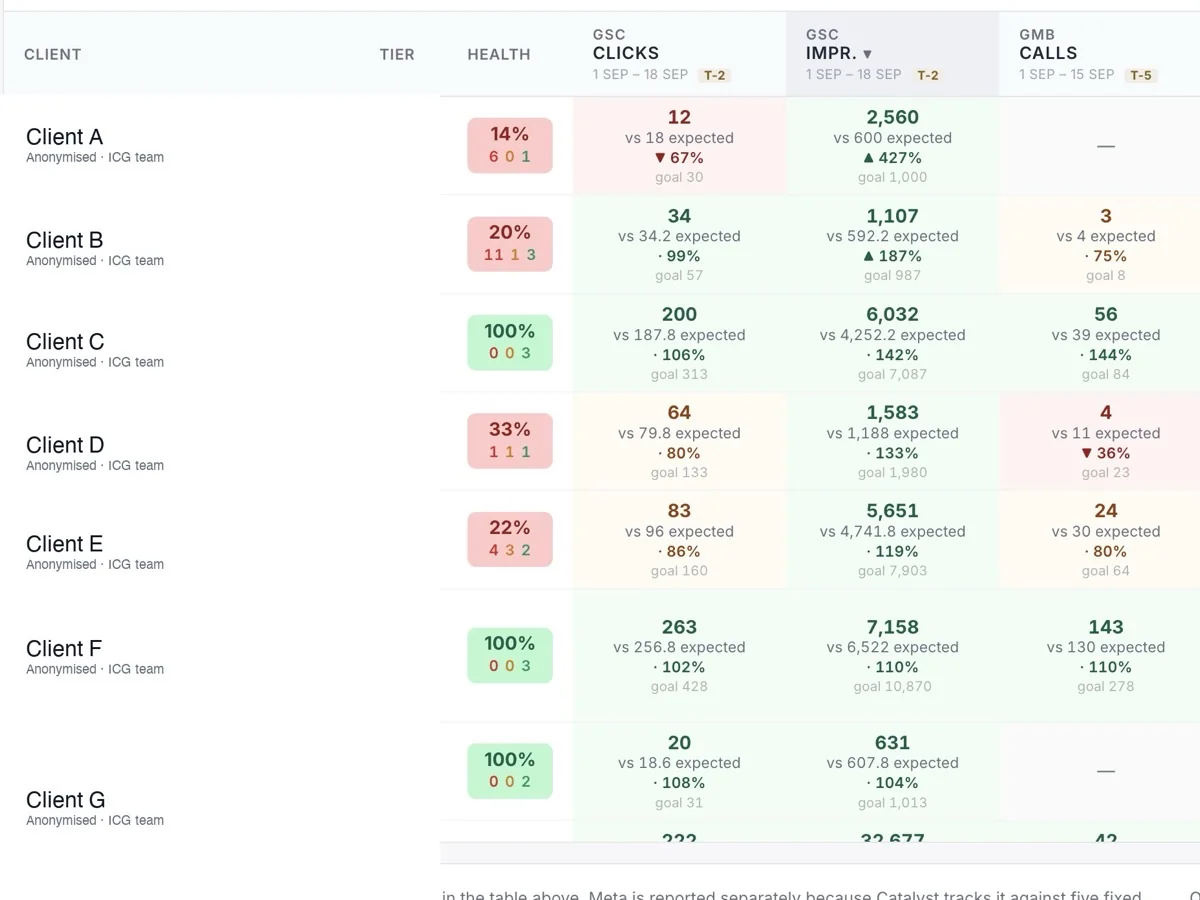
ICG's centralised governance platform — every client sees everything in real time, and ICG's team sees every problem the moment it surfaces. 30+ real-time alert systems fire the moment a metric drifts outside its performance envelope.

  • GSC, GA4, Google Ads, Meta Ads, IVR — one live view
  • 30+ real-time alert systems per account
  • CPQL drift alert at >15% week-on-week change
  • Client login: full transparency on your account
Explore Agency OS →
AEO & LLM Intelligence

AIO Intel

AI Overview + LLM citation tracking, healthcare-tuned

Knows the moment ChatGPT, Perplexity, Google AI Overviews and Gemini cite your brand in patient answers — and which content drove the citation. Bot-aware dashboard with GA4-registered custom dims (AIO source, AIO referrer) and IndexNow + GSC API integration.

  • Live tracking across ChatGPT / Perplexity / Google AIO / Gemini
  • Bot-aware: knows human vs scraper traffic
  • Custom GA4 dims register AIO source + referrer
  • IndexNow + GSC API: content surfaced to LLMs within hours
View AIO Intel dashboard →
Competitor Intelligence

Prism Spy

Every Meta + Google ad your competitors run, watched daily

Tracks 75+ Indian healthcare brands, 2,150+ active ads, ₹50Cr+ aggregate ad spend visibility per month. Surfaces what's working, what's been killed, what offers are emerging. Powers every ICG Meta Ads brief, Performance Marketing diagnostic, and IVF / derm / dental specialty campaign with real competitive intelligence.

  • 75+ brands tracked across 30+ healthcare specialties
  • 2,150+ active ads · daily refresh
  • Activity Feed: every spend / hook / pause logged
  • Offers Intelligence: 250+ offers in market tracked
Explore Prism Spy →
GBP Intelligence Platform

Angryturtle

Every Google Business Profile scored, tracked, protected, and grown from one command centre

ICG's proprietary Google Business Profile intelligence platform. Scores every listing across 7 dimensions, tracks rank on a live geo-grid across your actual service area, audits NAP + citations, monitors 531 suspension-risk factors continuously, and drafts Google Posts on cadence. Currently managing 143 healthcare listings with 0 suspensions and 4.76★ portfolio average across 28,137 reviews.

  • 143 listings under management · 0 suspensions · 4.76★
  • 7-dimension Health Score + 5-factor Rank OS per listing
  • Geo-grid rank tracking + NAP + Citation audit + Profile Shield
  • NMC + NABH + ART Act + DPDP compliance built into every content + review workflow
Explore Angryturtle →

Every ICG engagement runs on some combination of these ten HealthApex OS tools. The diagnostic determines which combination is right for your practice.

Explore HealthApex OS → See the full stack live on your account — free 30-min audit
The team behind your account

Every diagnostic is led by a founder.
You'll know their names before the engagement begins.

ICG was built by three IIT BHU engineers who entered healthcare marketing with a specific intent: to build the tools that didn't exist and run the campaigns that most agencies couldn't. When you book a diagnostic, Rohit or Abhash leads it personally. Not an account manager. Not a senior executive. The people who built what you're evaluating.

The ICG team — 60+ healthcare marketing specialists at Gurgaon HQ

60+ specialists.
One growth engine.

Performance marketers, analysts, AI engineers, content strategists, and operations specialists — all healthcare-only. Headquartered in Gurgaon since 2018.

Rohit Gupta — Leader, ICG

Rohit Gupta

Business & Growth Lead & Director

IIT BHU · IIM Rohtak

Rohit's first question in every diagnostic: "When you ask your agency why patients aren't booking — what do they say?" He says the answer tells him more than any dashboard.

Full profile →
Abhash Kumar — Leader, ICG

Abhash Kumar

Strategy & Analytics Lead & Director

IIT BHU · IIM Bangalore

Abhash built Beacon because most agencies couldn't answer one question: "Which of my campaigns generated that consultation?" He decided the problem was solvable in code. It was.

Full profile →
Deep Das — Leader, ICG

Deep Das

Technology & AI Lead & Director

IIT BHU

Deep built the 4-Bot patient lifecycle system after watching a client lose 60+ qualified leads in one week to a 6-hour WhatsApp response window. He decided the problem was solvable in code. It was.

Full profile →
HealthApex OS Pricing · All-Inclusive · Billed Annually
₹2,999 – 3,999/month
Single Tool
Hawk CRM intelligence overlay (₹2,999), Nexus CRM / HealthPro 360 / Phoenix alone (₹3,999 each).
₹4,999 – 11,999/month
Bundled Suite
Nexus + Hawk ₹4,999. HealthPro 360 + Patient Portal ₹7,999. Operations Suite (HealthPro + Phoenix + Portal) ₹11,999.
₹14,999/month
Complete HealthApex OS ★
All 8 tools: Nexus + Hawk + Beacon + Phoenix + HealthPro 360 + YODA + Agency OS + AIO Intel. Best value. Full integration.

Transparent. Billed annually. No hidden integration fees. Most Indian clinics save 60-80% vs Salesforce Health Cloud (₹3L+/month) or a 5-vendor multi-tool stack. Complete HealthApex OS at ₹14,999/month is 40-60% cheaper than maintaining a multi-vendor stack — plus you get unified data, one compliance officer, one founder-led engagement. Enterprise tier (hospital networks, multi-brand, custom modules): ₹50,000 – ₹3,00,000/month, founder-led.

Book the free 30-min diagnostic →
Selected ICG clients

Healthcare brands ICG
has worked with.

A representative slice of the 300+ healthcare brands ICG has delivered for across India. Full client list available under NDA during a Brand and Growth Diagnostic.

Read full client case studies →

Sources & methodology
View sources cited on this page
  • IMARC Group — India Diagnostic Labs Market Report 2024–2032
  • Fortune Business Insights — India Diagnostic Services Market 2024
  • NABL Directory of Accredited Medical Laboratories
  • NMC Code of Ethics — Regulation 6 (Advertising restrictions)
  • IRDAI Health Insurance Regulations 2016 — TPA empanelment guidelines
  • DPDP Act 2023 — Patient data consent requirements
  • ICG portfolio data (n=11 diagnostic-lab engagements + 34 competitive audits, 2024–2026)

Ready to build a
diagnostic-lab marketing engine?

Start with a complimentary 30-minute Diagnostic-Lab Growth Diagnostic from ICG. For standalone path labs, regional chains, national aggregators, and franchise-development teams across India.

Chat with a Co-Founder