


Combined Local SEO plus YouTube stack for an Indian dermatology or aesthetic clinic: how Angryturtle and YODA fit together for skin, hair, and cosmetic dermatology practices in 2026
A dermatology-specific playbook for running Local SEO (Angryturtle) and YouTube (YODA) as a single stack — including how derma queries split between the Google Map and YouTube search, the ASCI and NMC compliance guardrails that apply to both surfaces, and a 90-day combined playbook for a skin, hair, or aesthetic dermatology practice.
No pitch. Written root-cause diagnosis. AI-powered, healthcare only.
Direct answer
A dermatology-specific playbook for running Local SEO (Angryturtle) and YouTube (YODA) as a single stack — including how derma queries split between the Google Map and YouTube search, the ASCI and NMC compliance guardrails that apply to both surfaces, and a 90-day combined playbo...
TL;DR

Dermatology in India — clinical dermatology, aesthetic dermatology, trichology, and cosmetic dermatology — is the specialty where the combined Local SEO plus YouTube stack produces the widest gap between clinics that run both surfaces and clinics that pick only one. The reason is structural. Derma queries split almost exactly down the middle between locality-driven bookings that live on the Google Map and visual-evidence-driven research that lives on YouTube, and neither half is optional in a modern patient consideration cycle. This is a specialty deep-dive on how a dermatology or aesthetic practice runs Angryturtle for Local SEO and YODA for YouTube as one integrated stack, what the ASCI and NMC compliance perimeter looks like when both surfaces are in play, and the 90-day combined playbook we implement for a typical dermatology client.
Why dermatology is the most two-surface specialty in Indian healthcare
A patient searching for a dentist typically wants to know "is there a good dentist near me who takes my insurance." A patient searching for a dermatologist wants to know that too — but the dermatology patient also wants to see what the treatment actually looks like, what recovery looks like, what the physician's aesthetic sensibility is, and what real outcomes from similar patients look like. That second bundle of questions is almost impossible to answer on a Google Business Profile alone. It needs video.
Similarly, a patient watching a compelling dermatology YouTube channel can develop full trust in the physician's knowledge and personality. But they still need the practical answers — is this clinic accessible from where I live, when do they open, what do reviews from real patients say — before they book. That practical layer is not something a YouTube channel can carry. It needs the Google Business Profile.
The compound is stronger in derma than in almost any other Indian healthcare specialty because both halves of the split are heavy. The visual-evidence half is heavier than in, say, endocrinology, because derma outcomes are inherently visual. The locality half is heavier than in, say, oncology, because derma is typically a repeat-visit specialty — patients want a clinic they can visit every 4 to 12 weeks conveniently. Both weights being high is what produces the compound.
How dermatology queries actually split between the Map and YouTube
Working across dozens of dermatology profiles inside Angryturtle and dozens of dermatology channels inside YODA has surfaced a stable split pattern for the query universe a dermatology practice competes in.
Google Map and Local Pack queries. "Dermatologist in [neighbourhood]," "skin clinic near me," "hair transplant clinic [city]," "PRP treatment [locality]," "acne treatment doctor [suburb]," "cosmetic dermatologist Bangalore," "trichologist Mumbai." These queries are transactional, locality-anchored, and won on the Google Business Profile. They convert to bookings at the highest rate of any dermatology query type — typically 8 to 18 percent of Local Pack clicks convert to a booking-adjacent action (WhatsApp click, call, direction request).
YouTube search queries. "Microneedling before and after Indian skin," "PRP for hair loss real results," "how to remove pigmentation on face permanently," "acne scar treatment options in India," "hair transplant Indian donor area recovery," "chemical peel at home vs clinic," "melasma treatment for Indian skin." These queries are informational, visual, and won on the YouTube channel. They convert to bookings at much lower per-click rates but they seed the consideration cycle that eventually produces the Local Pack booking 30 to 90 days later.
Overlap queries. "Dr [Name] dermatologist reviews," "Clinic X hair transplant results," "[Clinic name] acne treatment before after." These are branded consolidation queries at the end of the cycle. They convert to bookings at very high rates — often 25 to 40 percent — because the patient is already at the decision stage. They exist at all only when the upstream YouTube and Local SEO work has been done.
The three query types are not competing with each other. They are three sequential layers of the same patient journey, and a dermatology practice needs a strategy for all three.
ASCI and NMC guardrails that apply to both surfaces
Dermatology, and aesthetic dermatology in particular, sits inside a specific compliance perimeter in India that both Angryturtle and YODA enforce. Getting this wrong on either surface produces both regulatory risk and, increasingly, discoverability penalties as Google's algorithms deprioritise content that violates advertising standards.
Advertising Standards Council of India (ASCI) Guidelines 2022. Prohibit unsubstantiated superiority claims — no "best dermatologist in India," no "most experienced hair transplant surgeon," no "no.1 skin clinic" without documented substantiation. Prohibit before-and-after claims that misrepresent typical outcomes — before-and-after content in videos and in Google Business Profile photos must reflect typical results, not selected outliers. Prohibit fear-based advertising — no "your hair fall will get worse if you don't act now" framings. Both Angryturtle and YODA flag these language patterns for human review before publication.
National Medical Commission (NMC) Ethics Code 2026. Restricts self-promotion. A dermatologist's public content must be primarily educational, not promotional. Individual physicians may not solicit patients through unsubstantiated claims. Patient testimonials require explicit consent, must not be presented as clinical evidence, and must include appropriate disclaimers. Both surfaces enforce testimonial handling — Angryturtle on review replies and Q&A; YODA on video testimonial content and comment replies.
Skin whitening and skin lightening content. ASCI specifically flags skin whitening claims. Any Google Business Profile services list, description, video title, or video content that promises skin whitening or lightening is a flag risk. The industry-standard alternative language ("skin brightening," "tone evening," "pigmentation reduction") is compliant when accompanied by realistic expectation setting. Both platforms enforce the language check.
Cosmetic dermatology procedure claims. Botulinum toxin, filler, and other injectable content must not claim permanent results, must not include prescription-only drug names in promotional framings, and must include appropriate consultation-only messaging. Video content demonstrating these procedures faces additional YouTube Community Guidelines that YODA's compliance filter cross-references before publication.
Digital Personal Data Protection (DPDP) Act 2023. Patient identifying content — faces, medical records, treatment specifics tied to identifiable individuals — requires explicit consent for both platforms. A video shoot in the clinic that captures a real patient's face by accident cannot be published without consent. A Google Business Profile photo that shows a patient in the waiting area faces the same rule.
The 90-day combined playbook for a typical dermatology clinic
The playbook below is what ICG executes for a typical dermatology or aesthetic clinic starting the combined Angryturtle + YODA engagement. It assumes a single-location clinic with 1 to 3 dermatologists, an existing Google Business Profile in some state of neglect, and either no YouTube channel or a stagnant channel with fewer than 20 videos.
Days 1 to 14: baseline and stabilisation. Angryturtle onboarding — profile audit, sie" style="color:inherit;text-decoration:underline;text-decoration-color:rgba(42,126,200,.5);text-underline-offset:2px">Rank OS baseline score, category audit, services list rebuild, description rewrite to full 750 characters with ASCI-compliant language, initial 30 photos uploaded across interior/exterior/team/procedure categories. YODA onboarding — channel connection or channel setup, 12-month historical data pull if the channel exists, content cluster analysis, format classification, first Diagnostics report. Compliance perimeter mapped for the specific practice — which specific claims can and cannot be made based on the practice's actual credentials and documentation.

Days 15 to 30: publish cadence begins. Angryturtle — 4 Google Posts published, first 2 weekly Q&A entries added (seeded from Ask Maps question bank for dermatology), review-request workflow activated with the clinic's WhatsApp system, first batch of 3 to 5 fresh reviews collected. YODA — first 2 video briefs produced (one Explainer format, one Myth-vs-Fact format), both scripted with the compliance perimeter enforced, first video published with SEO Lab-optimised title, description, tags, chapters, and thumbnail A/B variants queued.


Days 31 to 60: momentum and integration. Angryturtle — Rank OS focus rotates to whichever dimension has moved least. Weekly 4 Posts, weekly 6 to 10 new photos, weekly Q&A additions, weekly review replies. YODA — publishing cadence stabilises at 1 to 2 videos per week. Optimisation writebacks applied to legacy videos — title rewrites, description upgrades, chapter insertions, tag refinements. First Audience Voice output surfaces recurring patient questions from YouTube comments; those questions get added to the Angryturtle Q&A queue. First Angryturtle review corpus themes get surfaced to YODA as video topic candidates.
Days 61 to 90: cross-surface leverage. The compound signals begin to appear. Branded search volume shows a measurable lift. New videos get embedded on corresponding clinic service pages and linked from the Google Business Profile URL fields. Ad-Spend Picks module in YODA identifies 1 to 2 organic Winner videos for modest paid promotion (₹8,000 to ₹15,000 per video). First AI Overview citations begin to appear for informational queries the videos are targeting. Rank OS score typically moves from the 45 to 60 band at day 1 into the 68 to 78 band by day 90.
Beyond day 90. The rhythm sustains. Every 30 days, the Decision Engine consolidates the top 5 actions across both platforms. Every 90 days, a strategic refresh — competitor Intel deep dive, content cluster gap analysis, format mix rebalance.
What a dermatology practice can realistically expect from 90 days of the combined stack
Documented outcomes vary by starting condition, but the pattern across dozens of dermatology engagements is consistent enough to describe. A clinic starting at Rank OS 45 to 55 typically finishes 90 days in the 68 to 78 band. Direction requests on the Google Business Profile typically double or triple. WhatsApp clicks from the profile typically double. Review corpus typically grows by 15 to 40 fresh reviews depending on the clinic's visit volume.
On the YouTube side, a channel starting from zero or from a low base typically publishes 12 to 18 videos in the first 90 days, reaches 500 to 2,000 subscribers depending on specialty niche and content quality, and begins earning organic view velocity on 2 to 4 videos that emerge as early Winners. Cross-surface signals — branded search volume, direction requests attributable to video-referred patients, YouTube subscribers who become website visitors — begin to appear reliably around day 60 to 70.
What does not happen in 90 days is dominance. Dominance in a competitive metro dermatology market typically requires 9 to 15 months of sustained combined execution. Day 90 is the point at which the compound trajectory is clearly measurable and the momentum is self-reinforcing.
The tool ICG uses to run this at scale: Angryturtle
ICG runs local SEO and GBP intelligence for 150+ Indian healthcare brands using Angryturtle — our own AI-native GBP intelligence and management OS. The platform scores every profile 0-100 via a proprietary Rank OS model with five weighted dimensions (Relevance, Review Health, Freshness, Entity Authority, AIO Readiness), publishes edits, Posts, media, and review replies directly to Google, and includes Ask Maps AIO Readiness scoring for Google AI Overviews and ChatGPT visibility.
Available in two shapes: self-serve at ₹999/- per month for solo owners with 1-2 profiles, and ICG's managed service from ₹25,000/- per month where our healthcare specialists execute inside the same platform. Both are anchored in the Healthcare Local SEO Agency India pillar page which has full scope, methodology and pricing.
Book a demo on WhatsApp → or start a free trial at angryturtle.ai →
The platform ICG uses to run this at scale: YODA
ICG runs healthcare YouTube marketing for clinics, hospitals, and specialty groups using YODA — our AI-native healthcare YouTube marketing platform. YODA sits on top of a channel's data and does four things no dashboard does: it separates organic from paid views at every step (so a promoted video can never masquerade as organic growth), it gives decisions not dashboards (every video gets a state + next action), it writes back to YouTube directly (improved titles, tags, descriptions, chapters applied straight to the platform), and it tracks the three rank races — YouTube search, Google web, and Google AI Overview citations.
YODA runs the full 6-step workflow — Overview, Diagnostics, Strategy, Optimisation, Reputation (ORM), and Competitor Intel — with 40+ analysis modules organised under those steps. ICG's managed YouTube service uses YODA end-to-end. See the Healthcare YouTube Marketing pillar guide for the full scope, or the Healthcare YouTube Marketing Agency service page for engagement details.
Book a YODA demo on WhatsApp → or request a free healthcare YouTube channel audit →
Related reading
- YouTube marketing for dermatologists in India
- Combined stack pillar — Local SEO plus YouTube for Indian healthcare
- Why Google Maps and YouTube compound for clinics in India
- Weekly cadence for Local SEO plus YouTube with a single team
- Combined stack for an IVF clinic — playbook
FAQ
Does the combined stack work equally well for clinical dermatology and aesthetic dermatology? Both work, but the emphasis shifts. Clinical dermatology (acne, eczema, psoriasis, medical conditions) leans more heavily on YouTube educational content because patients want to understand conditions before choosing a provider. Aesthetic dermatology (fillers, botox, laser, cosmetic procedures) leans more heavily on Google Business Profile photos and video before-after content because the visual result is the primary decision driver.
Can a solo dermatologist realistically produce 1 to 2 videos a week? Yes, provided the production model is right. Batch shooting once a month with 4 to 8 videos captured in a single 3-hour session is the model most solo dermatologists find sustainable. YODA's Content Planner supplies the briefs; a producer edits the footage into weekly publishable videos.
How do we handle patient before-and-after content without violating ASCI or NMC? Consent is the first gate — explicit, written, and documented. Compliance framing is the second — the content must present typical outcomes with appropriate disclaimers, not selected outliers. Substantiation is the third — the specific claim being made ("acne cleared in 8 weeks") must be documentable in the patient's clinical record. Both Angryturtle and YODA include compliance review before before-and-after content publishes.
Is skin whitening content ever safe to publish on either surface? No. ASCI treats skin whitening claims as a specific violation category, and Google's own healthcare content policies discourage skin whitening promotion. Compliant alternative content addresses pigmentation, melasma, uneven tone, and skin health rather than lightening or whitening as an outcome.
Which specific videos should a dermatology channel start with? Three starter categories work reliably. Condition explainers (acne, hair fall, melasma) that answer the most-Googled questions. Myth-vs-fact videos that address common misconceptions. Behind-the-scenes procedure explainers that show what a treatment actually looks like without patient identification. Each starter video should map to a specific patient question that also appears in the clinic's Q&A intake.
Does the combined stack work for a dermatology chain with multiple locations? Yes. Angryturtle supports multi-location portfolios with per-location Rank OS scoring and centralised operations. YODA supports a single brand channel with location-specific playlists and locality-tagged videos that feed each location's Local Pack. The typical chain playbook uses one central YouTube channel and per-location Google Business Profiles.
What is the smallest realistic monthly budget for the combined stack at a solo dermatology clinic? Angryturtle self-serve at ₹999/- per month plus in-house video production (dermatologist's own time plus a freelance editor at ₹8,000 to ₹15,000 per month) puts the floor around ₹10,000 to ₹18,000 per month. This is enough to build both surfaces steadily, though slower than a managed engagement.
How do we integrate the combined stack with paid Meta or Google ad campaigns? Paid campaigns run in parallel and are attributed separately. Both YODA and Angryturtle enforce organic-versus-paid separation so a promoted campaign never contaminates the organic diagnostic. Paid budget is typically allocated to accelerating organic Winners identified by YODA's Ad-Spend Picks or by promoting seasonal content on the Google Business Profile.
What is the highest-risk failure mode specific to dermatology? Publishing before-and-after content without documented consent. This is the single mistake most likely to produce both regulatory action and platform-level content removal. Both platforms enforce consent verification before before-and-after content publishes; workflow discipline inside the clinic is the other half of the safeguard.
Does the combined stack help a dermatology clinic attract international patients? Not directly, and this is not something ICG optimises for. The combined stack focuses on the India-resident patient acquisition motion. International patient marketing is a distinct discipline with different regulatory perimeters and platform choices.
Book a free 30-minute Brand & Growth Diagnostic.
It's a working session, not a sales pitch — you leave with a written root-cause analysis you can act on, whether or not you engage ICG.
The three platforms
behind every ICG engagement.
Beacon
CAPI middleware that fixes Event Match Quality, translates CRM statuses to Meta-standard events, dedups across channels.
Agency OS
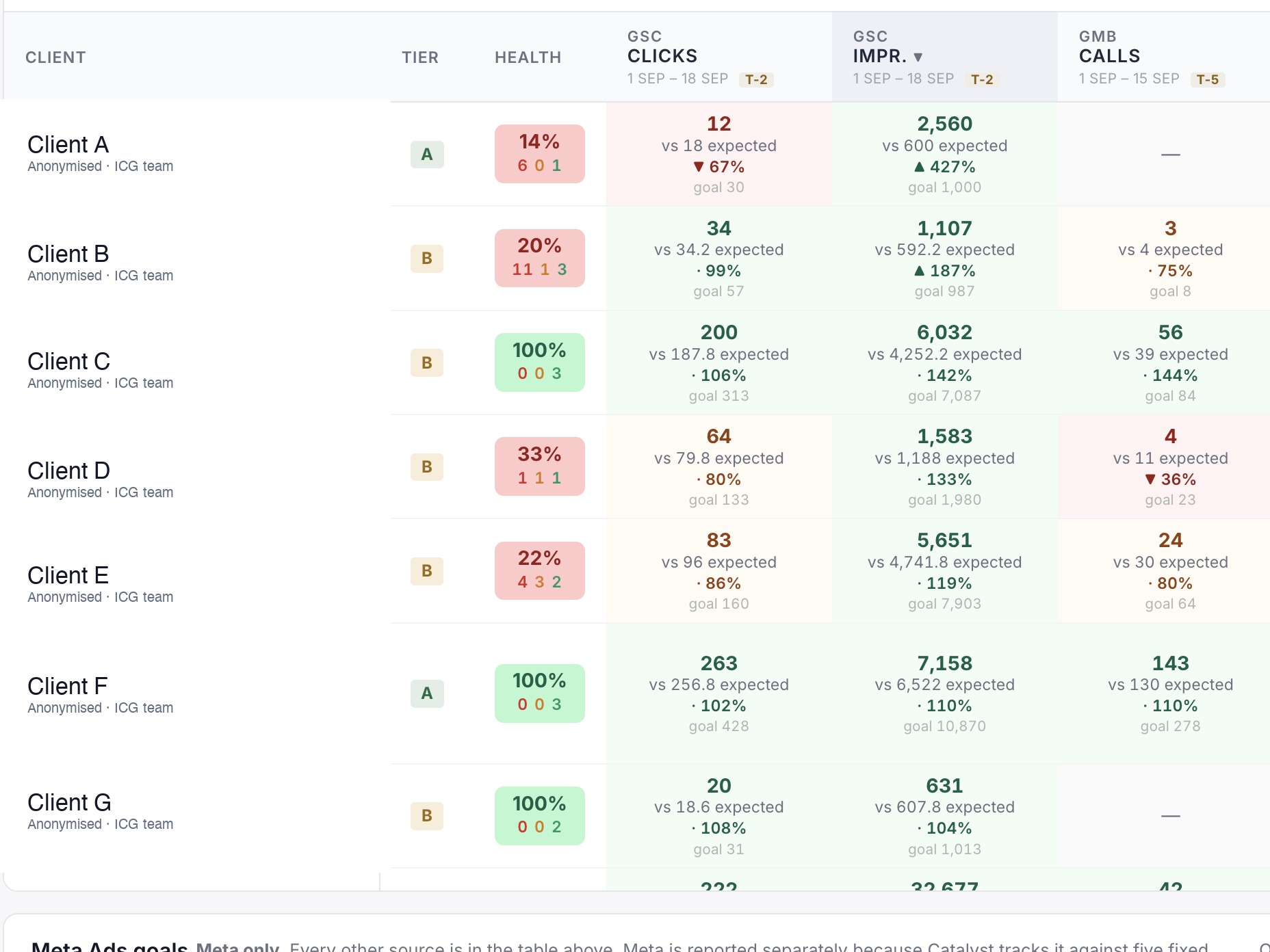
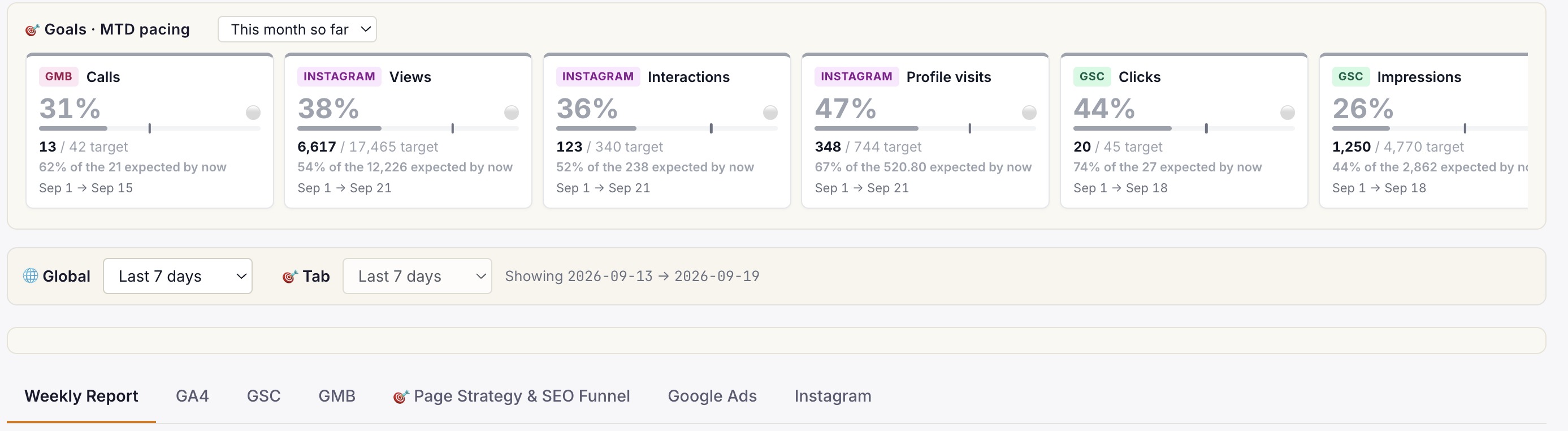
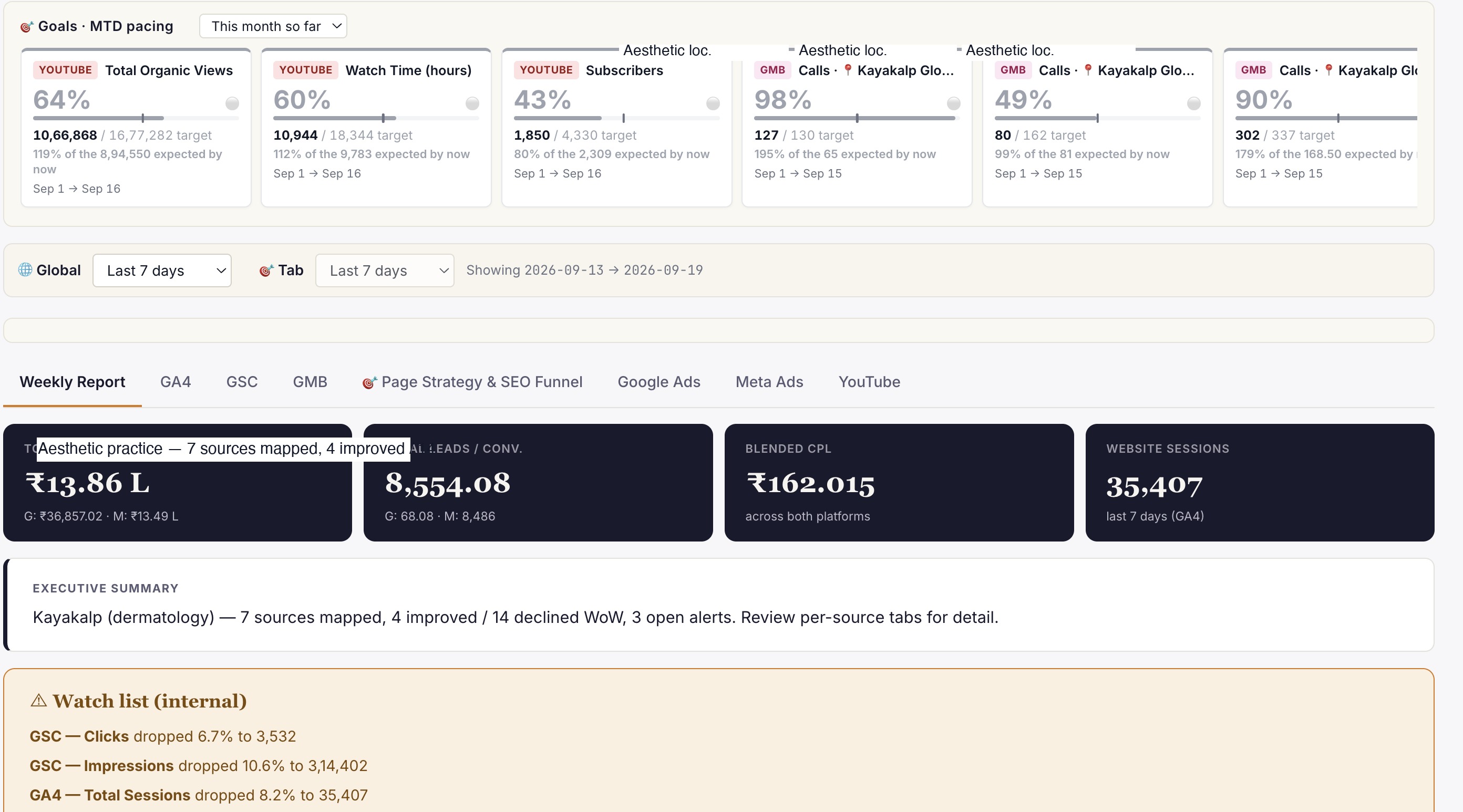
Live client dashboard. GSC, GA4, Google Ads, Meta Ads, IVR calls in one view. Login anytime, not monthly.
Phoenix
Clinic revenue intelligence over your PMS. Daily action queue: Prevent Loss, Maintain & Engage, Grow Revenue. Multi-centre rollout.
Or book a free 30-min audit to see all three in action on your account.
Healthcare brands
that already run on ICG.
A representative slice of the 150+ healthcare brands ICG has delivered for across India. Most engagements remain under NDA.


What ICG clients say · on video.
"Scale up of organic channels and business consulting. ICG has absolute domain authority in their field."
"What Ichelon accomplished — they got all my ideas and worked over 3-4 months to create an amazing, super-customised website."
"Working with ICG felt like working with an in-house growth team that happens to specialise in healthcare."
The intelligence stack behind this playbook.
Every ICG engagement runs on the Search Intelligence Trifecta — Angryturtle for GMB, SIE for search and AI Overview, YODA for YouTube. Live product screens below.
Need help operationalising this?
Every ICG service is healthcare-only, NMC + DPDP-aware, and built around the patient-research patterns that drive Indian healthcare growth in 2026.
Every practice welcome — packages from ₹20,000/mo.
Goals-Driven engagements · Performance-Linked Payout Models available
More from
ICG.
Five trends shaping Indian healthcare marketing through 2027: AI-first patient research, Conversions API adoption, ABDM discovery, the AEO w...
Healthcare AIO is the discipline of getting your clinic or hospital cited inside Google AI Overviews, ChatGPT and Perplexity answers — not j...
Conversational-search advertising places brand messages inside AI chat answers — ChatGPT, Perplexity, Copilot — rather than beside a results...
Stop guessing.
Book a Diagnostic.
30 minutes. Free. With the AI-powered healthcare-only marketing agency 150+ brands already run on. No slides, no pitch, no hard close.


