


SIE — the search intelligence engine ICG runs behind every healthcare ranking decision.
SIE is ICG's command centre for search visibility — the same diagnostic dashboard our strategists open every Monday before touching a client account. It runs a 5-stage Rank OS score across Discoverability, Indexability, Authority, Engagement, and Adoption; tracks rank on three columns that actually disagree with each other (Google Search Console average, true SERP position, and AI Overview presence); and forecasts goal achievement against targets that are locked with a password the day an engagement starts, so nobody moves the goalposts six months in.
TL;DR
- SIE is ICG's proprietary command-centre platform — not a resold SEO tool — running the same Rank OS diagnostic across every client account.
- The Rank OS 5-stage score (Discoverability, Indexability, Authority, Engagement, Adoption) gives every domain a 0-100 composite plus a per-stage breakdown so the team knows exactly what to fix first.
- The Rank Tracker shows GSC average position, true SERP position, and AI Overview citation status side by side — three numbers that routinely tell three different stories.
- AI Share of Voice tracks how often a client is cited inside AI Overviews, ChatGPT, and Perplexity answers for their specialty — a leading indicator neither GSC nor GA4 report on their own.
- Goals & Forecasting locks agreed targets behind a client-only password on day one, then recalculates a live forecast weekly against current velocity — honest tracking, not moving goalposts.
Rank trackers tell you where you sit. They don't tell you why — or what to fix next.
Most healthcare marketing teams run on a rank tracker, a Search Console export, and a monthly PDF. That gets you a number, not a diagnosis. A clinic ranking #6 for "best dermatologist near me" could be stuck there because the page isn't indexed properly, because a competitor built more topical authority, because engagement signals are weak, or because the query now triggers an AI Overview that cites someone else entirely — and each of those problems needs a completely different fix. Treating them all as "improve SEO" wastes months.
SIE was built inside ICG to close that gap. Every healthcare account we run — SEO retainer, YouTube retainer, GMB retainer — feeds into the same SIE instance, scored on the same 5-stage framework, so a strategist opens one dashboard and sees the full picture: is this a discoverability problem, an authority problem, or an AI-visibility problem. The diagnostic decides the sprint, not a gut feeling.
It is also healthcare-specific in ways a generic SEO suite isn't. Claim language in content modules gets checked against NMC Section 6 and ASCI Chapter III before it ships. Pharma-adjacent pages get a DCGI/UCPMP 2024 pass. Reviewer and patient-adjacent data captured anywhere in the pipeline is logged DPDP 2023-compliant. A generalist SEO tool has no idea any of these rules exist — SIE was built by a team that lives inside them daily.
There's a second, quieter reason SIE exists: consistency across a team. When five different strategists each run their own preferred rank tracker and their own mental model of "what good looks like," a client's monthly report becomes a matter of which strategist wrote it that month. SIE forces one shared vocabulary — Discoverability, Indexability, Authority, Engagement, Adoption — across every account, every strategist, every report. A client moving from one ICG account lead to another (holidays, internal reshuffles, growth) sees the same dashboard, the same stage names, the same scoring logic. Nothing gets reinvented mid-engagement.
And it exists because search itself changed faster than most agency tooling did. Three years ago, "rank tracking" meant one number per keyword. Today a single query can surface a classic ten-blue-links result, a local pack, a featured snippet, an AI Overview citing three sources, or some combination that shifts week to week depending on the searcher's device and location. A tool built for 2019-era SEO simply has no column for "was this cited inside an AI Overview" — it wasn't a question anyone was asking when that tool was designed. SIE was built after that shift, not before it, so the AI-answer layer isn't a bolt-on feature; it's load-bearing in the schema from day one.
Where SIE · Search Intelligence Engine sits in the patient journey
- 0Foundations
- 1Demand gen
- 2Capture
- 3Lead quality
- 4Lead mgmt
- 5Scheduling
- 6Show-up
- 7Conversion
- 8Retention
SIE · Search Intelligence Engine runs the Demand capture stage of the nine-stage patient journey. Ties AI-engine traffic and search rankings to real leads, and scores each website on six ranking signals.
Five stages. One composite score. A different fix at every stage.
Rank OS is the scoring framework at the centre of SIE. Every tracked domain gets a 0-100 score on each of five stages, plus a single weighted composite. The stages are sequential in a real sense — a page failing Discoverability will never reach a meaningful Engagement score no matter how good the content is, so SIE always surfaces the earliest broken stage first.
Read that score card the way ICG strategists do: Discoverability and Indexability are healthy, which means the crawl and index layer isn't the bottleneck. Authority at 58 and Adoption at 62 are the two stages dragging the composite down — so the next quarter's sprint is built around topical link building, content-cluster depth, and structured-data work that improves AI-citation eligibility, not more page-level tweaks that won't move the needle.
Each stage score is built from a fixed set of sub-checks, not a single opaque number. Discoverability rolls up robots.txt correctness, XML sitemap coverage and freshness, internal-link depth (how many clicks from the homepage a page sits), and crawl-budget efficiency reported through server-log analysis where a client's hosting allows it. Indexability rolls up canonical-tag consistency, duplicate-content clustering, thin-content flags (pages under a content-depth threshold for their query intent), and index-coverage-report anomalies pulled directly from Search Console. Authority rolls up referring-domain count and relevance, topical-cluster depth against competitor coverage, and E-E-A-T markers — author credentials, cited sources, reviewer sign-off where medical content requires it. Engagement rolls up click-through rate against the expected CTR curve for that ranking position, average session duration, scroll depth, and conversion-path completion rate. Adoption — the newest and fastest-changing stage — rolls up AI Overview citation rate, structured-data validation pass rate, and answer-format readiness (does the page's structure make it easy for an AI system to extract a clean, quotable answer).
The composite score is deliberately not a simple average of the five. Discoverability and Indexability are weighted as gating stages early in an engagement — a domain scoring 95 on Authority but 20 on Indexability is not actually a strong domain, because most of that authority is trapped behind pages Google can't reliably serve. As an account matures and the gating stages stabilise above a healthy threshold, the weighting shifts to reward Authority, Engagement, and Adoption movement more heavily, since those are the stages that separate a top-3 result from a top-10 result once the basics are solid. This weighting shift is one reason two accounts with the same raw composite score can be in very different places strategically — SIE's internal notes flag which weighting regime an account is in so a strategist reading the number understands what it actually represents.
Inside SIE: the Search Intelligence Engine
SIE runs the Demand generation and Demand capture stages: it ties AI-engine traffic and Google rankings to real leads. Locations and searches are hidden in these screens. See all nine stages and the tool behind each one →
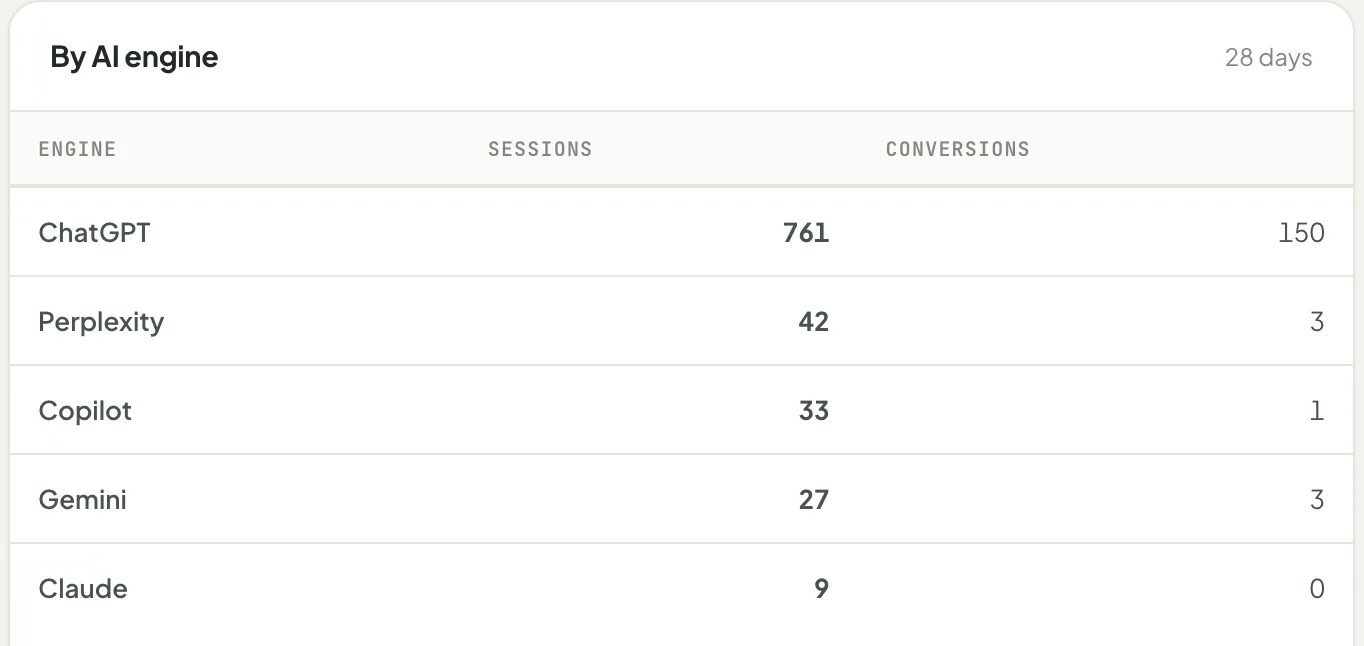
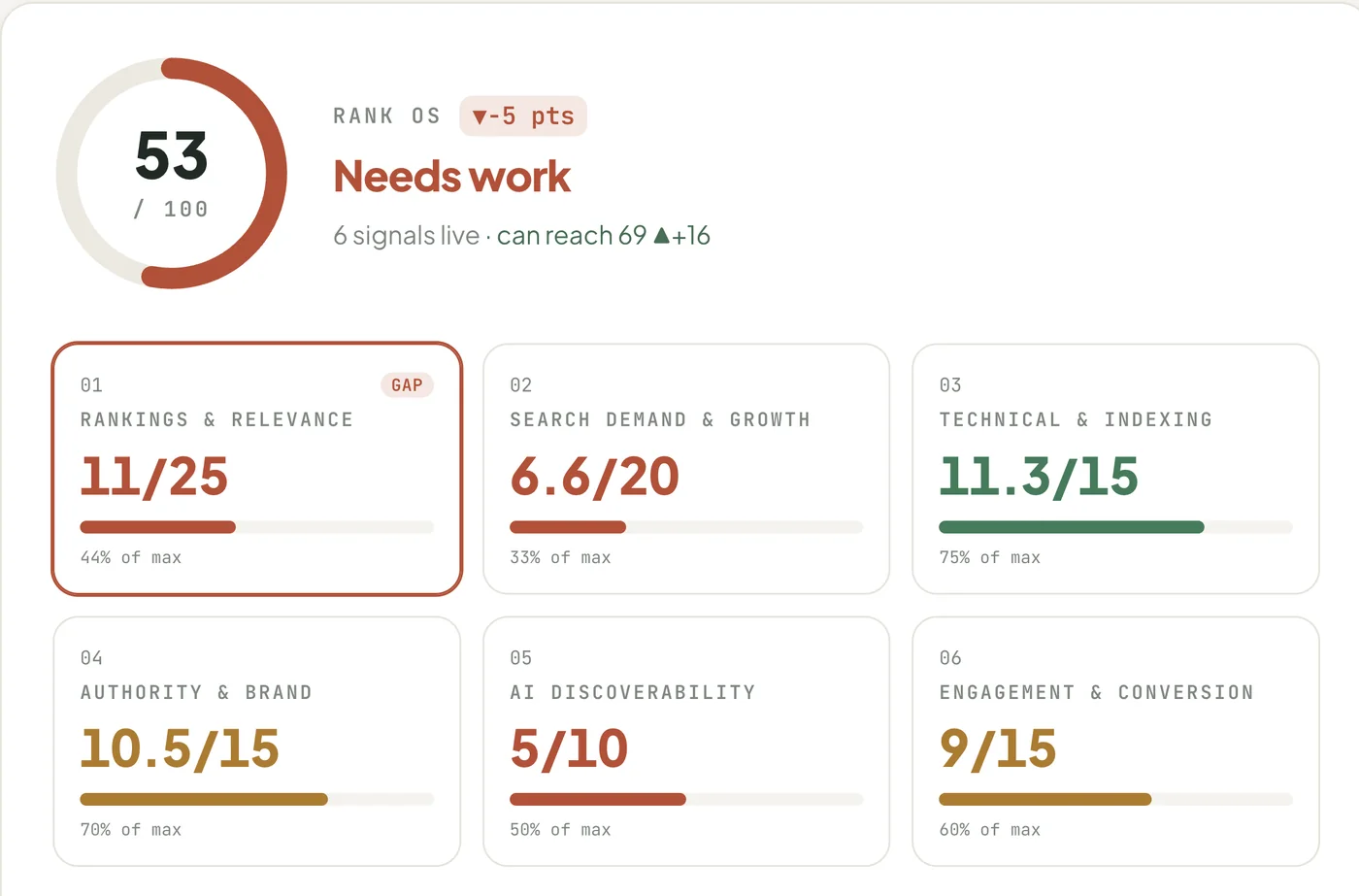
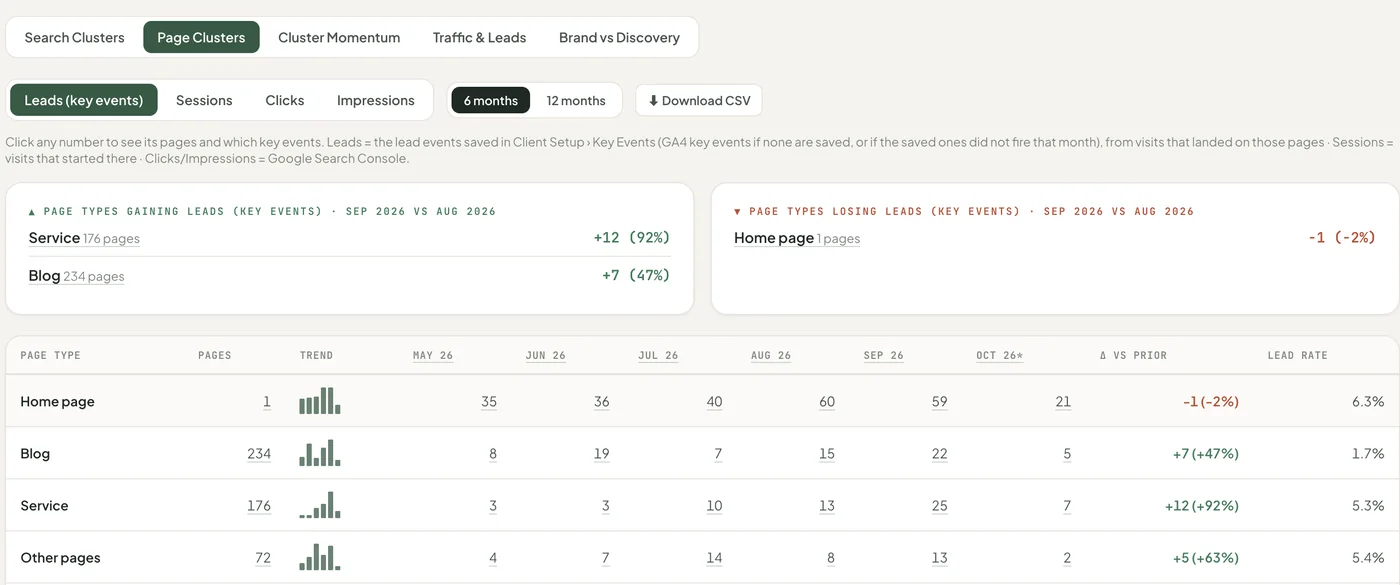
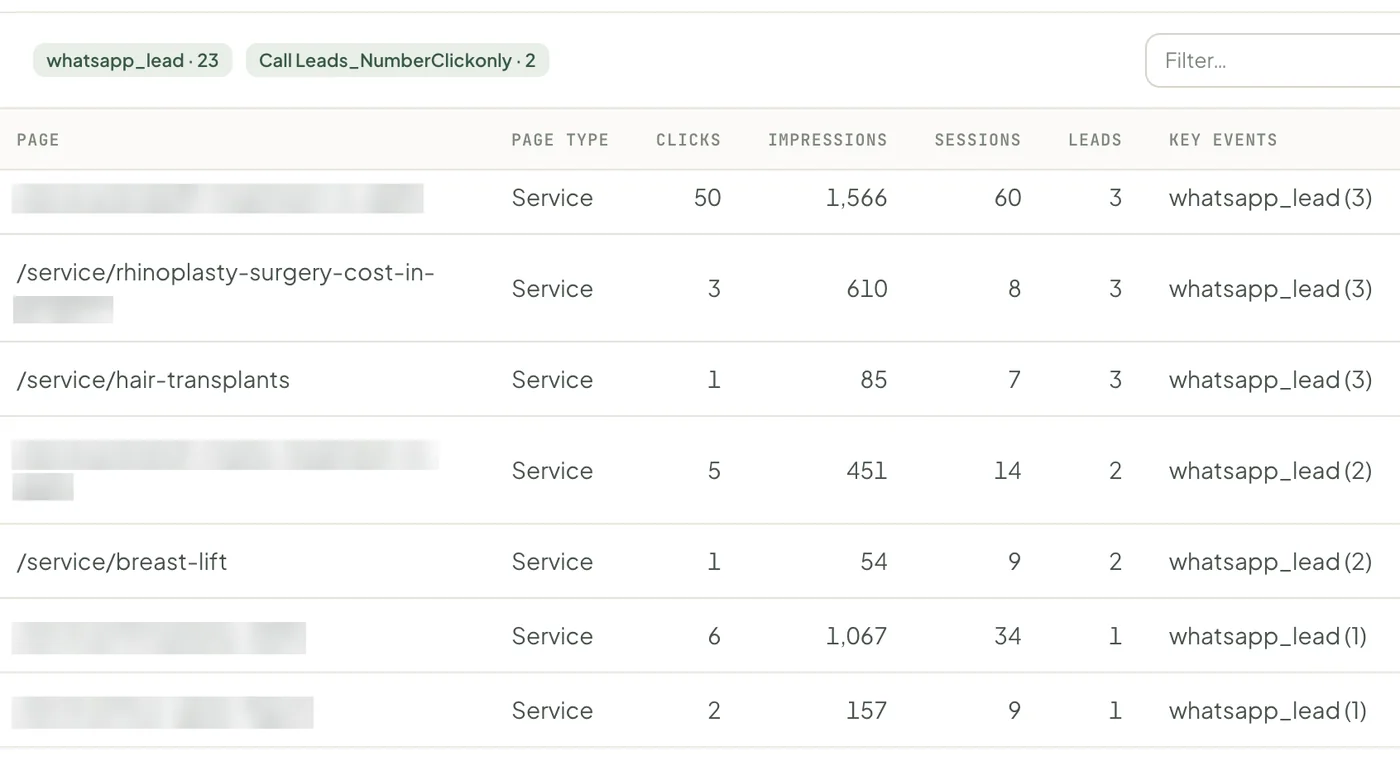
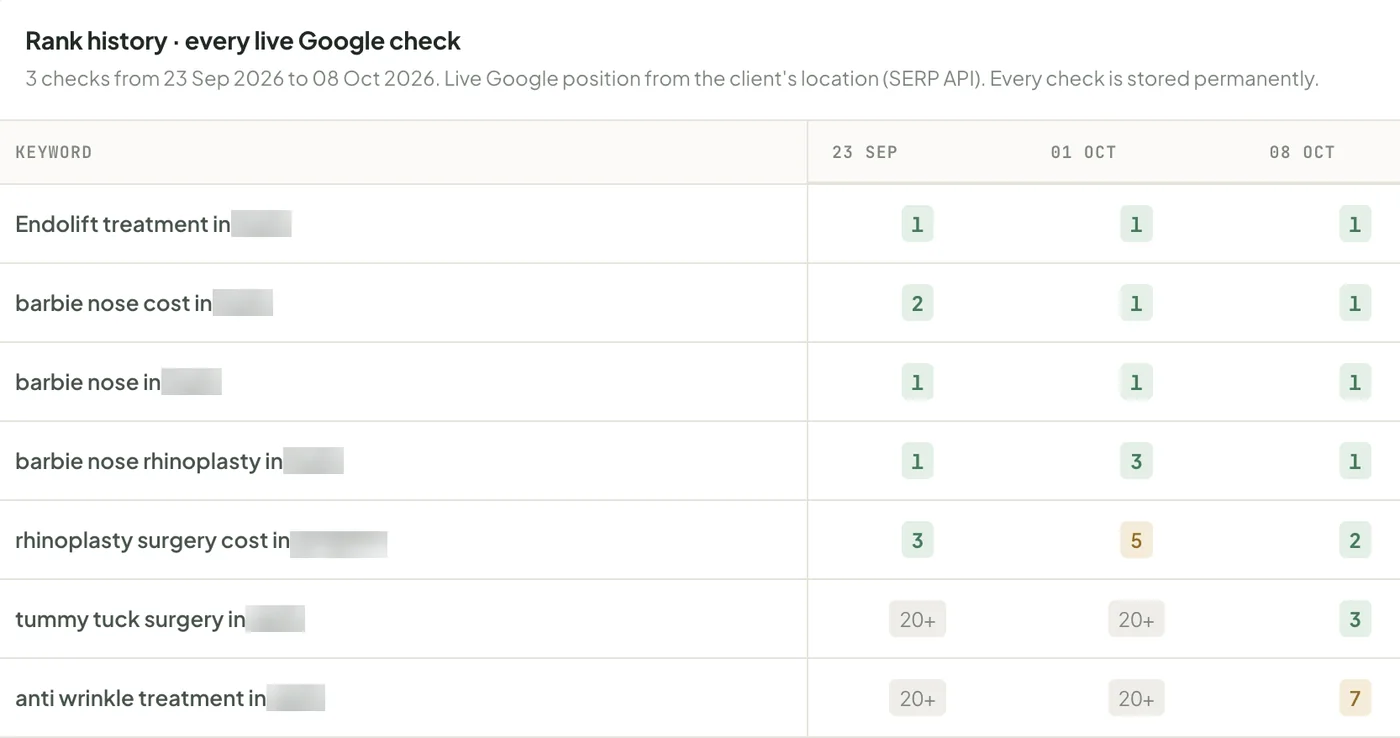
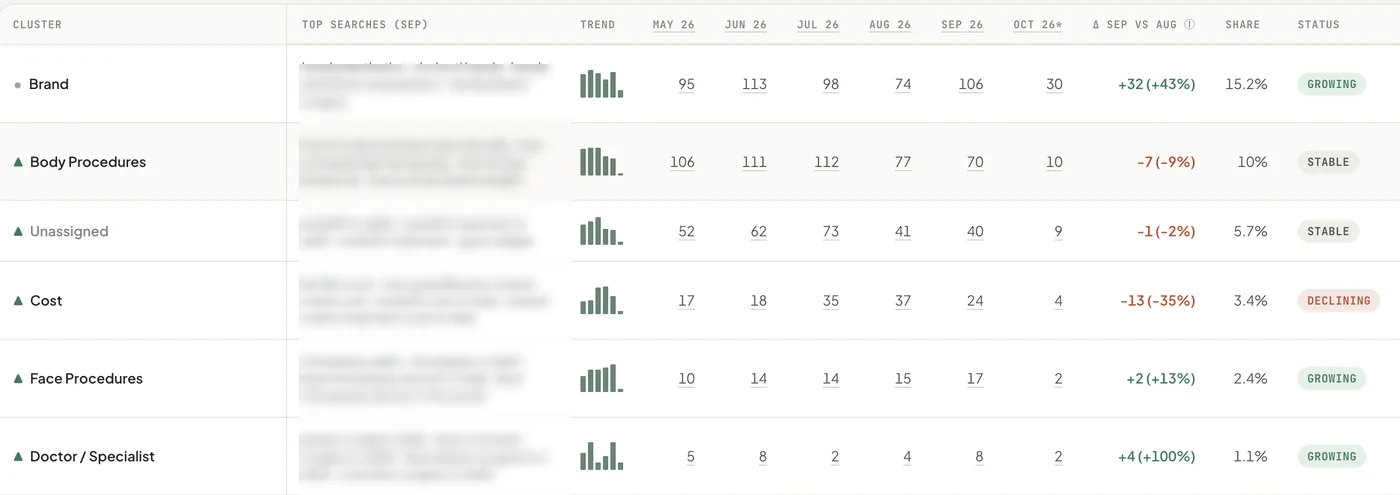
Authority, Social, Brand, and Technical — every Rank OS stage rolls up from these four.
Underneath the 5-stage score sit four signal groups SIE monitors continuously. Each is reported on its own tab so a client can see exactly which lever moved when a stage score changes — not just that "Authority went up," but that it went up because of 14 new referring domains in the dermatology cluster specifically.
Authority
Referring domains, topical link relevance, E-E-A-T signal strength (author credentials, citations, reviewer sign-off), and domain-level trust indicators.
Social
Share velocity and mention volume across Instagram, LinkedIn, and YouTube — early signal that content is resonating before it shows in search data.
Brand
Branded search volume trend and sentiment — a rising branded-search line is one of the strongest leading indicators SIE tracks for real-world awareness.
Technical
Core Web Vitals, crawl-error rate, structured-data coverage, mobile-usability flags — the plumbing that determines whether the other three signals even get a fair chance.
The four signals aren't reported in isolation — SIE cross-references them so a strategist can spot cause and effect instead of coincidence. A Brand signal spike (branded search volume up 40% after a PR push or a well-performing YouTube video) that isn't followed by an Authority signal increase within a few weeks usually means the awareness isn't converting into the kind of durable link and mention activity that compounds — worth flagging back to the content or PR team. Conversely, an Authority signal increase (new referring domains) that doesn't move the Technical signal's crawl-efficiency number might mean the new links point to pages Google is struggling to crawl properly, which caps how much value those links can pass through. Reading the four signals together, rather than as four separate report tabs nobody cross-checks, is most of what separates a useful diagnostic from a vanity dashboard.
Social and Brand signals matter more for healthcare than most industries because so much of the specialty-selection journey happens off the SERP entirely — a patient sees a reel, follows a doctor's Instagram for months, then finally searches the clinic's name directly once they're ready to book. That branded-search spike, weeks after the social content ran, is the signal a pure keyword-rank tool would completely miss, because the rank tracker only watches non-branded queries. SIE watches both, and stitches the timeline together so a client can see the actual path from social exposure to branded search to booking enquiry, rather than crediting the conversion entirely to whichever channel happened to be last-touch.
Three columns. Three different truths about where you actually stand.
Ask most agencies "where do we rank" and they'll pull a Search Console average. That number is real, but it's an average across devices, locations, and time — it can say position 4 for a query that a real searcher in Bengaluru sees at position 9 on mobile. SIE's Rank Tracker runs three columns side by side for every tracked query, and the gaps between them are frequently the most useful thing on the dashboard.
Notice the pattern in a table like this: queries where GSC average and true SERP diverge sharply (position 6.1 average vs 11 true) usually mean volatile rank across devices or locations — a stability problem, not a ranking-power problem. Queries where an AI Overview fires but the client isn't cited are the highest-priority Adoption-stage fixes, because ranking well on the traditional SERP no longer guarantees the click when an AI summary answers the question first.
The true-SERP capture runs on a scheduled scrape from real device profiles — desktop and mobile, from Indian IPs mapped to the client's actual service cities where geo-targeting matters (a "best dermatologist" query in Koramangala and the same query in Whitefield can return meaningfully different local-pack results even within the same city). This is the piece a pure Search-Console-only setup structurally can't provide: GSC reports what happened, averaged across every device and location a query was seen from, several days in arrears. True SERP shows what a specific searcher, in a specific place, on a specific device, sees right now. For healthcare specifically — where a huge share of demand is hyper-local ("near me," a named neighbourhood, a named suburb) — that gap between averaged and actual is often the difference between a client believing they're doing fine and a client understanding exactly why the phone isn't ringing from three of their five service areas.
The AI Overview column runs its own check independently of the true-SERP scrape, because an AI Overview's presence and content can differ from the organic results directly below it — Google sometimes cites sources that don't rank organically for the same query at all, drawing instead from a broader crawl index. SIE records whether an AI Overview is present, extracts the list of cited domains where visible, and flags whether the client appears in that list. Over time this builds a query-level history: which queries have carried an AI Overview consistently for months (usually informational, "what is" and "how does" style queries) versus which flip in and out (usually commercial, "best," "cost," and "near me" queries where Google is still testing coverage) — intelligence that shapes which content gets prioritised for Adoption-stage work first.
GSC can't tell you if ChatGPT is citing you. This can.
AI Share of Voice runs a fixed panel of specialty-and-city queries weekly against AI Overviews, ChatGPT, and Perplexity, and records two things for each: did an AI answer fire at all, and was the client's brand or content cited inside it. The result rolls up into a single presence-rate percentage — the closest thing to a "rank #1" metric that exists for the AI-answer era, because there usually is no ranked list to check.
Building the 42-query panel is itself a diagnostic exercise, not a default list. It's constructed from the client's actual highest-value commercial and informational queries — the ones a real prospective patient or referring doctor would ask an AI assistant while deciding where to go — weighted toward the specialty and cities the client actually serves rather than generic industry terms. A single-location Bengaluru dermatology clinic and a five-city IVF chain will end up with almost no overlap in their panels, because the questions their respective audiences actually ask are different in both substance and geography. The panel is reviewed and refreshed quarterly as new query patterns emerge — AI-answer query behaviour shifts faster than traditional search behaviour did, so a panel built a year ago is likely missing entire categories of question that didn't exist as a common search pattern when it was assembled.
Presence rate alone doesn't tell the whole story either, which is why SIE also tracks citation position within the answer — being the first source cited in an AI Overview carries meaningfully more weight than being the fourth of four, in the same way position 1 and position 8 on a traditional SERP aren't equivalent even though both technically "rank." Where the citing engine exposes source order (AI Overviews generally do; conversational answers in ChatGPT and Perplexity less consistently), SIE records it and factors it into the Adoption-stage score, so two accounts with identical raw presence-rate percentages can still show meaningfully different Adoption scores if one is consistently cited first and the other consistently cited last.
Topic clusters, momentum, and striking distance — authority scored where it actually lives.
Page-level rank tracking misses the bigger pattern: an entire specialty gaining or losing ground. SIE's Authority module groups every ranking keyword into its topic cluster and tracks the cluster's average position and traffic trend month over month, then flags "striking distance" clusters — those sitting at positions 4-15, where a focused content or link push has the highest odds of unlocking page-one placement fast.
| Cluster | Keywords | Avg position | 90-day trend | Status |
|---|---|---|---|---|
| Hair transplant | 142 | 5.1 | +3.4 | Improving |
| PRP therapy | 58 | 9.7 | -2.1 | Decaying |
| Root canal treatment | 94 | 6.8 | +0.6 | Improving |
| Dental implants cost | 67 | 11.2 | +1.9 | Striking distance |
| IVF success rate | 81 | 13.4 | +0.2 | Striking distance |
| Skin whitening / brightening | 39 | 15.9 | -0.8 | Decaying |
Six clusters, six different sprint decisions. Hair transplant and root canal are improving on their own momentum — leave them running and reinvest attention elsewhere. Dental implants and IVF success rate sit in striking distance, the two highest-leverage sprints for the next 60 days. PRP therapy and skin whitening are decaying and need a diagnosis before any content is added — usually a competitor authority push or a stale on-page target that needs a rewrite, not just more words.
Clusters are built by grouping keywords on shared search intent and shared ranking pages, not just shared words — "hair transplant cost," "FUE vs FUT hair transplant," and "hair transplant recovery time" all sit in the same cluster because they're typically served by an overlapping set of pages and reflect stages of the same buyer journey, even though none of the three phrases contain each other as substrings. This intent-based grouping is what makes the striking-distance flag genuinely actionable rather than a keyword list sorted by position — a client sees "this entire buyer-journey stage is one step from breaking through" instead of forty disconnected keyword rows that each look individually unremarkable.
Momentum itself is calculated as a trailing 90-day slope on the cluster's traffic-weighted average position, not a simple this-month-vs-last-month snapshot — a single volatile week (common around algorithm updates) shouldn't flip a cluster's status from improving to decaying and back. SIE also separates momentum caused by ICG's own work from momentum caused by external factors (a competitor losing a penalty, a seasonal demand shift, an algorithm update reshuffling the whole vertical) wherever the pattern is distinguishable — a cluster that improved because ten competitors simultaneously dropped after a core update tells a very different story than a cluster that improved because of a specific content and link sprint, even though both look identical as a simple "+3.4 positions" number on the surface.
Targets locked behind a password on day one. No moving the goalposts.
Every ICG engagement starts with an agreed ranking and traffic target for a defined period — usually 90 or 180 days. That target is entered into SIE and locked behind a password only the client and their ICG account lead hold. It is not editable by the strategist running the account. Every week, SIE recalculates a live forecast using current velocity across the 5 Rank OS stages and flags the account as on-track, ahead of forecast, or at-risk — against the original number, not a revised one.
This exists because it's easy for any agency, ICG included, to quietly redefine "success" partway through an engagement once the original number looks hard to hit. Locking the target removes that temptation structurally rather than relying on goodwill. When a forecast shows at-risk, the account team escalates it in the monthly review with the actual number next to the actual target — not a softened version of either.
The forecast model itself runs off current velocity across the 5 Rank OS stages rather than a flat straight-line projection from the starting point, because ranking movement is rarely linear — Discoverability and Indexability fixes tend to produce a fast early lift, Authority and Adoption gains compound more slowly and often show a delayed effect several weeks after the underlying work ships (content needs to be crawled, evaluated, and re-scored; links need time to be discovered and weighted; AI systems re-crawl and re-evaluate citation eligibility on their own schedule, not the client's). A forecast built on a flat line would show false confidence in month one and false alarm in month two as the real, lumpier trajectory unfolds. SIE's model accounts for this shape explicitly, which is part of why the on-track / ahead / at-risk flag is more reliable than eyeballing a raw traffic chart against a target line.
When an account does show at-risk, the forecast view doesn't just flag the shortfall — it attributes it to the specific Rank OS stage most responsible, because "we're behind" and "we're behind because Authority-stage link velocity slowed after our outreach contact left the client's PR agency" call for completely different conversations in a monthly review. That attribution is what turns a forecast dashboard from a scoreboard into a working diagnostic the account team can actually act on before the next review, rather than a number that just confirms bad news a month after the fact.
The plumbing that makes everything above it possible.
None of the diagnostic above matters if the technical foundation is broken — an unindexed page can't have an Authority score worth discussing. SIE's technical layer runs continuous checks across crawl-budget efficiency, canonical and redirect-chain health, Core Web Vitals (LCP, INP, CLS), structured-data coverage and validation (MedicalOrganization, FAQPage, Article, LocalBusiness schema as relevant per page type), XML sitemap accuracy, and mobile-usability flags. Every issue surfaces as a ticket in the Discoverability or Indexability stage score, with severity and estimated impact attached — so a technical fix is never guesswork about whether it's worth prioritising.
Multi-location healthcare sites carry a specific set of technical risks a single-site generic SEO tool tends to under-weight: near-duplicate location pages that differ only in city name and phone number, canonical confusion between a chain's main domain and individual location subdomains or subfolders, and internal-link structures that bury newer locations several clicks deep from the homepage while older, established locations soak up most of the crawl budget. SIE's crawl-budget module specifically flags location pages that haven't been crawled in an unusually long window relative to the rest of the site, which is often the earliest warning sign that a new city launch isn't getting indexed at the pace the business expansion needs.
Structured-data validation runs beyond a simple pass/fail on Google's own testing tools — SIE checks whether the markup actually matches what a page visibly displays (a MedicalOrganization schema claiming services the page text doesn't mention is a mismatch risk, not a win) and whether FAQPage markup is genuinely eligible under current guidelines rather than stuffed with questions that don't appear as visible content. This matters more for healthcare than most verticals because structured-data misuse in a regulated industry carries reputational as well as ranking risk — a clinic doesn't want AI Overviews or rich results surfacing a claim the page itself doesn't actually support.
Built for a regulated industry, not retrofitted for one.
SIE's content-authority modules run claim language against India's healthcare-advertising rules before anything ships: NMC Section 6 for doctor and clinic promotion boundaries, ASCI Chapter III for healthcare advertising claim standards, DCGI/UCPMP 2024 for any pharma-adjacent content, DPDP 2023 for how reviewer and patient-adjacent data is captured and stored anywhere in the pipeline, and AYUSH guideline checks for Ayurveda, yoga, and wellness-specialty clients. NABH-related content additionally routes through the same review layer used across ICG's NABH consulting work.
What the first quarter on SIE actually looks like.
| Phase | Days | Focus |
|---|---|---|
| Baseline | 1-14 | Full Rank OS audit across all 5 stages · query panel built for AI Share of Voice · goal targets set and password-locked |
| Foundation | 15-45 | Discoverability + Indexability fixes (fastest wins) · technical SEO ticket queue cleared by priority · cluster mapping complete |
| Authority push | 46-75 | Striking-distance clusters targeted with content + link work · Adoption-stage structured-data and citation-readiness fixes shipped |
| Review & recalibrate | 76-90 | Forecast reviewed against locked target · Rank OS composite re-scored · next-quarter sprint plan built from the new weakest stage |
How the diagnostic changed the sprint, in practice.
Multi-specialty hospital group, North India
Rank OS baseline showed a strong Discoverability score (91) but a weak Authority score (46) — the site was fully crawlable and indexed but had almost no topical depth per specialty. Instead of the generic "publish more blogs" plan, SIE's cluster view showed exactly three specialties (oncology, cardiology, orthopaedics) carrying 70% of search demand with the thinnest content. Authority-focused sprint on those three clusters over 4 months moved the composite Rank OS score from 58 to 74, with the two striking-distance clusters converting to page-one placements.
Single-specialty dermatology clinic, Bengaluru
AI Share of Voice panel showed a 12% presence rate at baseline despite decent traditional rankings — most of the clinic's target queries were triggering AI Overviews that cited competitors exclusively. Adoption-stage work (structured FAQ schema, clearer answer-first paragraph structure, author credential markup) lifted presence rate to 41% in 90 days, with AI-Overview-driven consult enquiries becoming a measurable channel for the first time.
IVF chain, metro cities
GSC average position looked stable at 4.2 for the core "IVF centre near me" cluster, masking a true-SERP reality of 9-14 across three of the five cities served. The Rank Tracker's GSC-vs-true-SERP gap flagged a local-relevance problem, not a content problem — city-specific landing depth and citation work closed the gap to 5.8 true SERP average within one quarter, without touching the core content that GSC had suggested was already fine.
SIE is bundled into every ICG search retainer.
Custom-scoped per engagement, based on tracked-query volume, number of topic clusters, city/location count, and the depth of technical SEO work the account needs. SIE is not sold as a standalone SaaS subscription — it is the instrumentation layer every ICG healthcare SEO, YouTube, and GMB retainer runs on, so the strategist assigned to an account is looking at the same diagnostic the client sees.
SIE doesn't run alone — three platforms, one account view.
SIE owns organic and AI-search intelligence. Alongside it, Angryturtle owns Google Business Profile intelligence and YODA owns YouTube and brand-search intelligence. All three feed the same client-facing dashboard, so an account lead sees GBP health, video-search demand, and organic authority as one connected picture rather than three separate vendor logins.
Angryturtle
GBP intelligence — 143 healthcare listings managed, 4.76★ portfolio average, 531 risk factors monitored, 0 suspensions.
See Angryturtle →YODA
YouTube + brand-search intelligence — AIO Engine, Search Demand Clusters, Brand Search Trend, YouTube SEO Lab.
See YODA →Search Intelligence Trifecta
How SIE, Angryturtle, and YODA roll up into one account-level view for every ICG healthcare client.
See the Trifecta →Common questions about SIE.
What is SIE?
SIE — Search Intelligence Engine — is ICG's proprietary command centre for search visibility. It runs a 5-stage diagnostic (Discoverability, Indexability, Authority, Engagement, Adoption) across every healthcare client account, tracks rank on GSC data, true SERP position, and AI Overview presence side by side, and forecasts goal achievement against password-locked targets set at the start of an engagement.
How is SIE different from generic SEO dashboards?
Generic dashboards show rank and traffic. SIE separates GSC-reported average position from true SERP position, tracks AI Overview presence and citation status per query, and scores authority at the topic-cluster level so a clinic sees whether a whole specialty is gaining or losing ground, not just one URL.
What are the 5 stages of the Rank OS diagnostic?
Discoverability, Indexability, Authority, Engagement, and Adoption — each scored 0-100 and rolled into a single Rank OS composite. SIE always surfaces the earliest broken stage first, since later stages can't recover until earlier ones are fixed.
What are the 4 signals SIE tracks?
Authority, Social, Brand, and Technical. Each feeds the Rank OS score and is reported separately so a client sees exactly which lever moved a result.
What is AI Share of Voice?
A weekly panel of specialty-and-city queries checked against AI Overviews, ChatGPT, and Perplexity, tracking whether an AI answer fires and whether the client is cited — rolled into a single presence-rate percentage.
How does the Rank Tracker differ from a normal rank checker?
Three columns per query — GSC average, true SERP position, and AI Overview presence with a citation flag — because these three numbers frequently disagree and each points to a different fix.
What is cluster momentum?
Every ranking keyword grouped into its topic cluster, with the cluster's average position and traffic trend tracked month over month, plus a flag for clusters sitting in striking distance (positions 4-15).
How does Goals & Forecasting work?
Targets are agreed and locked behind a password on day one of the engagement. SIE recalculates a live forecast weekly against current velocity and flags on-track, ahead, or at-risk status against the original locked number.
Does SIE replace an SEO team?
No — it's the instrumentation layer ICG's SEO team works from, bundled into every healthcare SEO, YouTube, and GMB retainer, not a self-serve tool sold standalone.
What compliance layers does SIE account for?
NMC Section 6, ASCI Chapter III, DCGI/UCPMP 2024 for pharma-adjacent content, DPDP 2023 for data handling, and AYUSH guidelines where relevant to the client's specialty.
How much does SIE cost?
Not sold standalone. Included in ICG retainers from Rs 20,000/month, custom-scoped per engagement.
How does SIE fit with Angryturtle and YODA?
Together they form the Search Intelligence Trifecta — SIE owns organic and AI-search intelligence, Angryturtle owns GBP intelligence, YODA owns YouTube and brand-search intelligence, all rolling up into one account view.

More questions answered
How does the Goals & Forecasting module work?
At the start of an engagement, ICG and the client agree ranking and traffic targets for a set period. Those targets are locked behind a password only the client and their ICG account lead can view, so forecasts can be compared honestly against the original commitment rather than a moving goalpost. SIE recalculates the forecast weekly using current velocity and flags whether the account is on-track, ahead, or at-risk.
Does SIE replace the need for an SEO team?
No — SIE is the instrumentation layer ICG's SEO team works from, not a self-serve tool sold standalone. It is bundled into every ICG healthcare SEO, YouTube, and GMB retainer so the strategist assigned to an account is working from the same diagnostic the client sees, rather than a black box.
How long before SIE shows measurable movement?
The first 90 days establish the baseline Rank OS score, fix Discoverability and Indexability issues (usually the fastest wins), and set the locked forecast targets. Authority and Adoption-stage movement — the signals that drive durable ranking and AI-citation gains — typically show in the 90-180 day window, consistent with how Google and AI answer engines re-crawl and re-evaluate authority.
