


Angryturtle Rank OS explained: how the 0-100 local SEO score works, what each dimension measures, and how to move it
Rank OS is Angryturtle's proprietary 0-100 rank-probability score for a Google Business Profile. It composites five weighted dimensions — Relevance 25, Review Health 25, Freshness 20, Entity Authority 15 and AIO Readiness 15 — into a single number that tells a healthcare business
No pitch. Written root-cause diagnosis. AI-powered, healthcare only.
Direct answer
Rank OS is Angryturtle's proprietary 0-100 rank-probability score for a Google Business Profile. It composites five weighted dimensions — Relevance 25, Review Health 25, Freshness 20, Entity Authority 15 and AIO Readiness 15 — into a single number that tells a healthcare business
TL;DR
Rank OS is Angryturtle's proprietary 0-100 rank-probability score for a Google Business Profile. It composites five weighted dimensions — Relevance (25), Review Health (25), Freshness (20), Entity Authority (15) and AIO Readiness (15) — into a single number that tells a healthcare business or agency where the profile currently sits and what the highest-value fixes are to move it. It is the interface that separates ICG's approach from every generic local SEO tool: instead of a dashboard of 40 metrics, the user sees one score, five diagnostic breakdowns, and a ranked list of actions with expected point-lift for each. This is how ICG runs healthcare local SEO for 150+ brands — every profile scored on the same model, every recommendation traceable to a specific point on sie" style="color:inherit;text-decoration:underline;text-decoration-color:rgba(42,126,200,.5);text-underline-offset:2px">Rank OS, every action executed inside the same tool that measured the gap.
 angryturtle/05-demand-clusters.png" alt="Angryturtle Demand Clusters —
Why a scoring model matters (and why most tools don't have one)
Most local SEO tools deliver metrics. A dashboard shows the profile's category, review count, rating, number of citations, freshness of last post. The operator's job is to synthesise those metrics into a diagnosis of what's wrong and a plan for what to fix. The synthesis step is where competent local SEO happens and where most agencies fail at scale.
At small scale, a senior local SEO analyst can hold the mental model of "what good looks like" and manually score the profile against it. At 10-plus client accounts, the synthesis breaks down. The analyst runs out of time, defaults to executing whatever the tool surfaces most prominently, and misses the diagnosis of what actually matters for each specific profile. Recommendations get rationed rather than prioritised.
A scoring model solves this by encoding the synthesis into the tool. Every profile gets diagnosed the same way, prioritised the same way, and the operator's job becomes execution — not repeated diagnosis. For an agency running 50+ healthcare accounts, this is the difference between a scale that produces consistent client outcomes and a scale that produces consistent client churn.
Angryturtle's Rank OS is the encoding. It reflects what a senior local SEO analyst would score if they had time to look at every profile carefully — but it does it in the tool, automatically, on every profile, every week.
The five dimensions of Rank OS
Relevance (25 points) — how well the profile matches the queries that matter
The largest single dimension. Relevance reads whether the profile is structured to rank for the queries a healthcare business actually needs to rank for.
Sub-signals inside Relevance:
Primary category match. Does the primary GBP category align with the query cluster driving the most impressions to the profile? A cardiology hospital with primary category set to "Hospital" loses to competitors with "Cardiology Hospital" as primary; Rank OS reads the impression data to detect this mismatch and flags it as a high-lift action.
Secondary category coverage. How many of the 9 secondary category slots are used, and how well the chosen categories cover the specialties the business actually offers. A hospital using 3 of 9 secondary slots leaves ranking authority for 6 specialty query clusters on the table.
Services list depth. GBP allows 30 services. Most healthcare profiles use 4-8. Rank OS scores services list depth as a percentage of the 30-slot maximum, weighted for the specificity of service names (a service named "Interventional Cardiology and Angioplasty" scores higher than one named "Cardiology").
Description utilisation. 750 characters allowed; scoring reflects both length utilisation and keyword coverage of the profile's core specialty terms in natural prose (not stuffed).
Attributes and Q&A. Health-and-safety attributes, accessibility attributes, service-availability attributes, populated Questions & Answers. Each is a discrete ranking signal that most profiles leave empty.
Highest-lift Relevance moves for most healthcare profiles: category correction (if primary is wrong), full services list build-out (going from 5 to 30 services), and description rewrite to the full 750-character limit with natural keyword coverage. A single well-executed round of these three lifts typical Rank OS Relevance by 10-15 points on its own.
Review Health (25 points) — rating, volume, velocity, response rate
The second-largest dimension, and the one with the most operational depth.
Sub-signals:
Rating. Average star rating across the review corpus. Below 4.0 penalises Rank OS heavily; 4.0-4.4 is competitive; 4.5+ is dominant. The scoring curve is steep — 4.6 significantly outscores 4.4, but 4.8 versus 4.9 barely differs.
Volume. Total review count. Higher volume signals age and legitimacy. Scoring is relative to the competitive local set — a hospital with 400 reviews in a market where the local leader has 2,000 scores lower than the same hospital in a market where the leader has 300.
Velocity. New reviews per month over the trailing 90 days. Zero-velocity profiles (no new reviews in 3+ months) get penalised heavily because Google's algorithm reads inactivity as a decay signal. Healthy velocity is 5-15 new reviews per month for a typical clinic, 20-50+ per month for a hospital.
Response rate. Percentage of reviews the business responds to. 100% response rate is the standard for a competent operation; below 80% signals unmanaged reviews and hurts Rank OS.
Highest-lift Review Health moves: initiating a review-request campaign (Angryturtle's built-in QR/link kit sends compliant review requests to consented patients), catching up on unresponded reviews (Angryturtle's AI drafts replies in the brand voice with NMC-safe framing), and improving negative-review response quality (which affects prospective patients reading the reviews before they book).
Freshness (20 points) — Posts, photos, edits within a 21-day window
Google's local algorithm applies a freshness decay curve that begins accelerating at roughly 21 days of profile inactivity. Rank OS reads freshness across three sub-signals:
Post cadence. Number and recency of Google Posts. A profile that publishes 2-3 posts per week maintains freshness; a profile with the last post 30+ days ago is penalised.
Photo additions. New photos uploaded within the trailing 90 days. Facility photos, staff photos, equipment photos, event photos — all count. A profile that hasn't uploaded new photos in 6 months shows a stale pattern.
Profile edits. Any change to profile fields — hours, services, description, attributes — signals active management. A profile with no edits in 6 months signals abandonment.
Highest-lift Freshness moves: scheduling a Post cadence (Angryturtle's Content Studio drafts and publishes on schedule), adding recent photos (bulk upload if the operations team can gather them), and confirming holiday hours before the next festival.
Entity Authority (15 points) — NAP consistency plus citation coverage
The trust-graph signal. Rank OS reads two sub-signals:
NAP consistency. Name, address, phone identical across every directory Google trusts as a reference. Inconsistencies (variations in address format, phone number format, business name) each cost small increments; compounded across 30-50 directories the effect is meaningful.
Citation coverage. Presence in the healthcare-relevant directory list (doctor-directory platforms, local business directories, IndiaMART Healthcare, HealthEnclave, insurance-panel directories, medical associations). Scoring is against the standard healthcare directory set (roughly 40-50 directories relevant to Indian healthcare).
Highest-lift Entity Authority moves: fixing NAP inconsistencies across the top-tier directories (doctor-directory platforms and Google are the highest priorities), then building citations against the healthcare-directory list in batches of 4-6 per month.
AIO Readiness (15 points) — AI-answer visibility
The newest dimension and the one competitors are ignoring. Rank OS reads whether the profile is a citable answer to natural-language patient queries.
Sub-signals:
Ask Maps question coverage. The percentage of the per-listing question bank that the profile can be considered answerable to based on its current fields. A cardiology hospital where the question "does this hospital do structural heart procedures" isn't answerable from any profile field scores lower than one where the answer is in Services and Description.
Attribute completeness. Health-and-safety attributes, accessibility attributes, service-availability attributes that AI systems draw from when answering healthcare queries.
Q&A activity. Google Business Profile Questions & Answers section populated by the business with common patient questions and clear answers.
Highest-lift AIO Readiness moves: seed the Ask Maps question bank with specialty-specific patient queries (Angryturtle provides starter question banks per specialty), populate the profile fields needed to answer each question, add Q&A entries for the top 10-20 patient questions.
How Rank OS gets calculated
Each dimension is scored 0-100 individually, then multiplied by its weight (25/25/20/15/15) to compute its contribution to the overall Rank OS score. The overall score sums the weighted contributions.
Example calculation for a hospital profile: - Relevance: 80/100 × 25% weight = 20 points - Review Health: 84/100 × 25% = 21 points - Freshness: 60/100 × 20% = 12 points - Entity Authority: 53/100 × 15% = 8 points - AIO Readiness: 87/100 × 15% = 13 points - Total Rank OS: 74/100
The score is transparent — every dimension's sub-signal breakdown is visible to the operator, and every action's expected point-lift is calculated from the model. There is no black box.
Rank OS weight tuning
The 25/25/20/15/15 weights are Angryturtle's default calibration based on ICG's healthcare-portfolio data on which signals actually correlate with ranking outcomes. Different verticals or different geographic markets may warrant different weights, and Angryturtle allows agency admins to tune the weights per client engagement or per account portfolio.
Practical examples of weight tuning:
Multi-specialty hospital in a high-competition metro: default weights work well; the hospital needs balanced execution across all five dimensions.
Solo aesthetic dermatology clinic in a metro: raise Review Health weight to 30, lower Entity Authority to 10 (fewer relevant citations exist for aesthetic-only), keep others default. Aesthetic dermatology is a review-driven vertical where volume and rating are the most important signals.
Tier-2 city hospital with low search competition: raise Freshness weight to 25, lower Relevance to 20. Category correctness matters less when competition is thin; consistent activity matters more.
New GBP profile (< 6 months old): raise Entity Authority to 25 to prioritise citation building, lower Freshness to 15 (new profile freshness is less important than establishing trust graph).
Angryturtle's UI exposes the weight tuning in agency admin settings; the tuning takes effect immediately and re-scores every profile in the portfolio against the new weights.
The action list — where scoring becomes execution
The 0-100 score answers "where are we." The action list answers "what should we do next." Every action inside Angryturtle carries:
- The specific dimension it affects (Relevance, Review Health, Freshness, Entity Authority, AIO Readiness)
- The specific sub-signal within that dimension it moves
- The expected point-lift on Rank OS if executed
- The estimated effort (typically small — most actions are single-field edits or short content pieces)
- The one-click execution path when the action is publishable directly (edits, Posts, replies) or the specific task assignment when it requires external work (photo gathering, verification steps)
For a typical mid-Rank-OS profile (score 55-70), the top 5-8 actions can lift the score by 15-25 points inside 4-6 weeks of execution. For a low-Rank-OS profile (score below 50), the top 10-15 actions can lift by 30-40 points in 6-10 weeks.
What Rank OS is not
Rank OS is a rank-probability model, not a rank-guarantee. A profile at Rank OS 90 has all the signals a top-ranking local business has, but the actual local pack ranking depends on the searcher's proximity, the competitive set at any moment, and Google's algorithm state on the day of the search. A Rank OS 90 profile in a saturated Mumbai catchment might rank #2 in the local pack; the same score in a less competitive Ahmedabad catchment might rank #1 consistently.
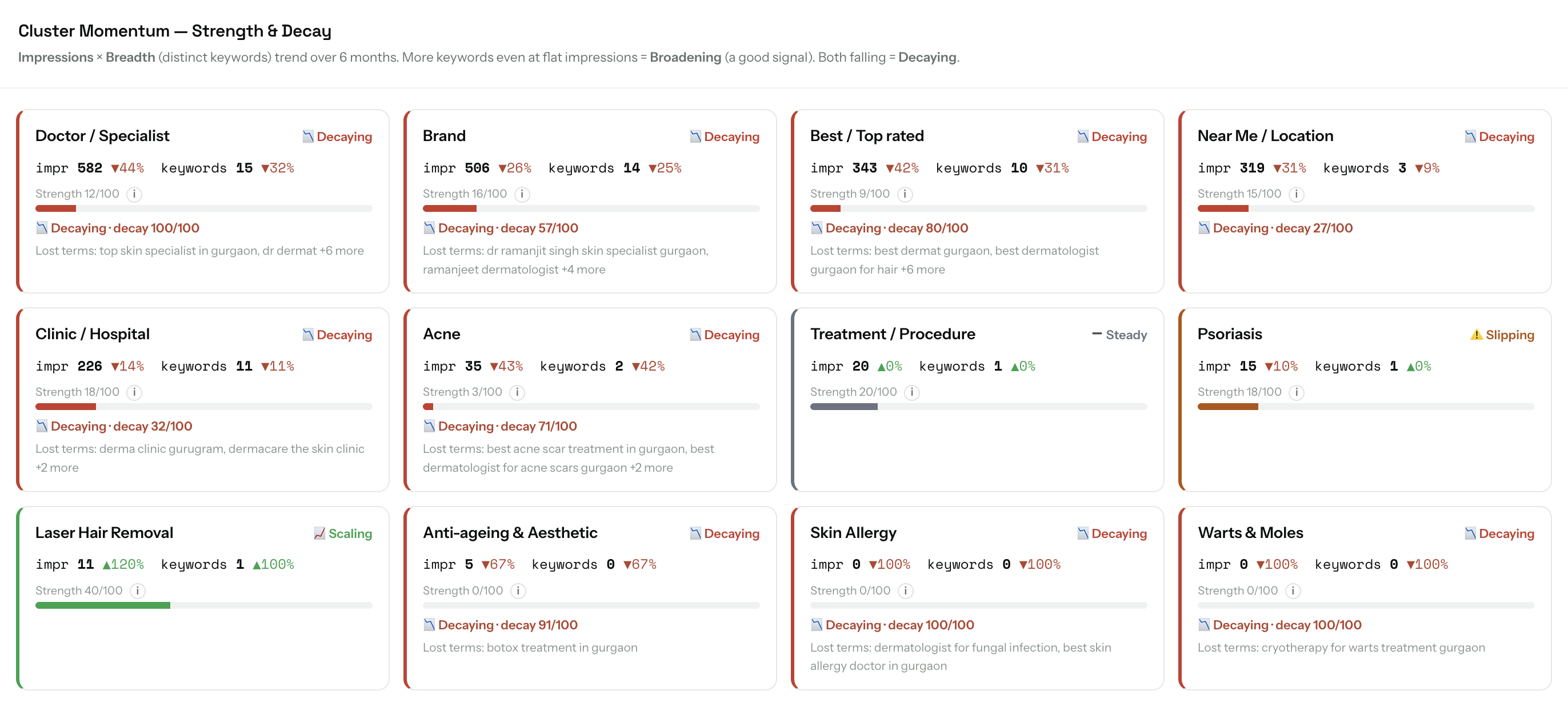
Rank OS is also not a substitute for competitive intelligence. A hospital may execute perfectly against Rank OS and still lose ranking to a competitor who took a specific action Rank OS didn't score (a new specialty department opened, a strategic new location added, a review-collection campaign in another language). Angryturtle's Competitors module and Cluster Momentum reads competitive movements; Rank OS scores the profile's absolute strength.
Rank OS is also not the whole SEO picture. Website SEO (organic search ranking, technical SEO, content SEO, link building) is a separate discipline that Rank OS doesn't touch. A healthcare brand needs both — healthcare local SEO for Google Business Profile and the map pack, and healthcare SEO more broadly for website organic ranking.
How ICG uses Rank OS with healthcare clients
Every ICG healthcare client sees their Rank OS score at engagement kick-off, along with the specific breakdown across dimensions and the ranked action list. The kick-off conversation with the client's marketing head or hospital CEO is short — the score tells the story in one number, the dimension breakdown shows where the profile is strong and weak, and the action list shows what will change over the next 90 days.
Monthly reporting to the client shows Rank OS trajectory — the score change since last month, the dimensions that moved most, the actions completed that month with their point contribution, and the actions queued for the next month. The client's team can see exactly what changed and exactly what's next, which converts to trust in the retainer and higher renewal rates.
Across the 150+ client portfolio, ICG's typical Rank OS trajectory is +15 to +25 points across the first 90 days of engagement, +30 to +40 across 12 months, plateau at 85-92 depending on the local competitive intensity. Very few profiles exceed 92 sustainably; ranking above that requires signals that only a small number of businesses in any given catchment naturally have (dominant volume of highly-rated reviews, densely populated healthcare-directory citation profile, sustained content operation over multiple years).
Related reading

- Healthcare local SEO agency India — the pillar page for ICG's local SEO service powered by Angryturtle
- How to rank a hospital on Google Maps in India — the six controllable signals in operational detail
- GBP optimization for multi-specialty hospitals — the department-level playbook
- Angryturtle vs generalist local SEO tools for healthcare — comparison against the generalist local SEO tool most agencies use
FAQ
What is a good Rank OS score? 70+ is competitive in most healthcare local markets. 80+ is dominant. 90+ is exceptional and requires sustained operations across all five dimensions. Below 60 signals a profile that needs immediate attention; the specific dimensions weakest in the score point to the priority.
How often does Rank OS update? Continuously. Every profile edit, every new review, every Post published, every citation added updates the score immediately. The score visible in Angryturtle at any moment reflects the current state of every underlying signal.
Can Rank OS predict local pack ranking exactly? No. Rank OS is a rank-probability model — it scores the profile's absolute strength across the signals Google's algorithm uses. Actual ranking depends on the searcher's location, the competitive set at any moment, and Google's algorithm state. Two profiles with identical Rank OS scores may rank differently in different catchments.
Are the Rank OS weights the same for every business? Default weights are 25/25/20/15/15 (Relevance/Reviews/Freshness/Entity/AIO). Weights are tunable per agency and per client engagement. Angryturtle's UI exposes weight tuning in agency admin settings for operators who want to calibrate for specific vertical or market patterns.
How does Rank OS handle competitive changes? The Cluster Momentum and Competitors modules read the competitive set continuously. When a new competitor opens or an existing competitor changes strategy (new specialty added, review campaign, category change), Angryturtle's Competitors view surfaces the change. Rank OS itself scores the profile's absolute strength; competitive context is delivered separately.
What's the fastest way to raise a low Rank OS score? For most profiles below Rank OS 60, the fastest gains come from three moves: primary category correction (if wrong), full services list build-out to 30 slots, and full 750-character description rewrite. These three typically lift Rank OS 12-20 points in the first 2-4 weeks. After that, Review Health and Entity Authority moves compound the gains.
Does Rank OS work for non-healthcare businesses? Yes. The scoring model is generic across verticals; the sub-signal weighting is what varies. Angryturtle's default healthcare weighting is what ICG uses; agencies serving other verticals can tune the weights or use Angryturtle's alternative vertical presets (real estate, hospitality, education, retail, banks).
Can a client see their Rank OS score directly? Yes, via Angryturtle's client portal (read-only view of the score, dimensions, and completed actions). Agency users see the full operator view with action queue and edit capabilities.

How is Rank OS different from Google's own local ranking signals? Google doesn't publish a single local ranking score. Rank OS is Angryturtle's model of what Google's ranking algorithm rewards, built from ICG's healthcare-portfolio data on which signals actually correlate with ranking outcomes. It's a reverse-engineered model, transparent and tunable, not Google's internal calculation.
Does Rank OS work for very new GBP profiles? Yes, but with different weighting emphasis. New profiles score lower on Entity Authority (few citations exist yet) and Review Health (few reviews yet). Rank OS reflects this correctly — a new profile at 45 isn't failing; it's at the natural starting score for a new business. The score trajectory over the first 6 months matters more than the absolute value.
Can I export Rank OS scores for reporting outside Angryturtle? Yes. Every score and its dimension breakdown exports to PDF (via Angryturtle's reporting module) and to CSV (via the Agency OS API). White-label reporting is standard on the Agency and Enterprise tiers.
How is Rank OS updated when Google changes its algorithm? Angryturtle's ICG team monitors Google's local ranking algorithm changes and updates the Rank OS model accordingly. Weight recalibrations happen roughly quarterly based on portfolio data on what's correlating with ranking outcomes in the current algorithm state. Users on the Agency and Enterprise tiers see release notes documenting each recalibration.
Book a free 30-minute Brand & Growth Diagnostic.
It's a working session, not a sales pitch — you leave with a written root-cause analysis you can act on, whether or not you engage ICG.
The three platforms
behind every ICG engagement.
Beacon
CAPI middleware that fixes Event Match Quality, translates CRM statuses to Meta-standard events, dedups across channels.
Agency OS
Live client dashboard. GSC, GA4, Google Ads, Meta Ads, IVR calls in one view. Login anytime, not monthly.
Phoenix
Clinic revenue intelligence over your PMS. Daily action queue: Prevent Loss, Maintain & Engage, Grow Revenue. Multi-centre rollout.
Or book a free 30-min audit to see all three in action on your account.
Healthcare brands
that already run on ICG.
A representative slice of the 150+ healthcare brands ICG has delivered for across India. Most engagements remain under NDA.


What ICG clients say · on video.
"Scale up of organic channels and business consulting. ICG has absolute domain authority in their field."
"Working with ICG transformed how we acquire IVF patients in Gurgaon. They understand the fertility journey from inquiry to consult..."
"What Ichelon accomplished — they got all my ideas and worked over 3-4 months to create an amazing, super-customised website."
The intelligence stack behind this playbook.
Every ICG engagement runs on the Search Intelligence Trifecta — Angryturtle for GMB, SIE for search and AI Overview, YODA for YouTube. Live product screens below.
Need help operationalising this?
Every ICG service is healthcare-only, NMC + DPDP-aware, and built around the patient-research patterns that drive Indian healthcare growth in 2026.
Every practice welcome — packages from ₹20,000/mo.
Goals-Driven engagements · Performance-Linked Payout Models available



More from
ICG.
Five trends shaping Indian healthcare marketing through 2027: AI-first patient research, Conversions API adoption, ABDM discovery, the AEO w...
Healthcare AIO is the discipline of getting your clinic or hospital cited inside Google AI Overviews, ChatGPT and Perplexity answers — not j...
Conversational-search advertising places brand messages inside AI chat answers — ChatGPT, Perplexity, Copilot — rather than beside a results...
Stop guessing.
Book a Diagnostic.
30 minutes. Free. With the AI-powered healthcare-only marketing agency 150+ brands already run on. No slides, no pitch, no hard close.


