


ICG's technology ecosystem explained: Beacon, Hawk, YODA, Agency OS, and Pharos
A walkthrough of the five in-house platforms ICG built to run healthcare marketing at scale — Beacon (patient education + chatbot AI), Hawk (Meta telecaller BI), YODA (YouTube intelligence), Agency OS (internal operations), and Pharos (revenue intelligence). What each product does, who it is built for, how it sits inside a client engagement, and why we built it instead of buying.
No pitch. Written root-cause diagnosis. AI-powered, healthcare only.
Direct answer
A walkthrough of the five in-house platforms ICG built to run healthcare marketing at scale — Beacon (patient education + chatbot AI), Hawk (Meta telecaller BI), YODA (YouTube intelligence), Agency OS (internal operations), and Pharos (revenue intelligence). What each product doe...
TL;DR
ICG runs healthcare marketing for clinics, hospitals, and specialty groups — from small independent practices to multi-city chains and pharma brands. Somewhere between year one and year two of the agency, it became clear that the off-the-shelf marketing stack was not built for how Indian healthcare buyers actually behave. Patients call before they book. WhatsApp is the primary conversion surface. Compliance around what a clinic can and cannot claim is stricter than any other B2C category. AI Overviews are eating a share of search traffic that no vendor dashboard reports on cleanly. And the sales cycle for a serious procedure — IVF, oncology, cardiac, joint replacement — takes weeks, not days.
So we built. Five platforms now sit inside every serious ICG engagement: Beacon for patient education and chatbot AI, Hawk for Meta ads and telecaller performance intelligence, YODA for YouTube marketing, Agency OS for the internal operations that keep the agency itself running, and Pharos for revenue intelligence across the entire client portfolio. Each was built because a specific decision was being made badly with the tools available at the time. This piece is the honest walkthrough — what each does, who it serves, how it sits inside an engagement, and where the boundaries between them lie.
Why we built instead of bought
Two questions get asked in every early ICG conversation. First — why not a general-purpose marketing CRM plus a stack of AI wrappers plus a WhatsApp CRM plus a YouTube analytics tool plus a call-tracking product? Second — do we really need five separate platforms?
The answer to the first is that the general-purpose tools do not understand three specific things about Indian healthcare. They do not understand the NMC advertising code, the DPDP Act's definition of patient data, or the ART Act's prohibition on unsubstantiated fertility success claims — so the AI content those tools generate has to be manually re-checked for compliance every time. They do not understand that WhatsApp is not a channel, it is the transaction — a lead that reached WhatsApp is a lead worth 8-12x a raw form fill. And they do not understand that Google AI Overview citations are a separate ranking surface with separate rules, not a variant of organic search.
 yoda/02-aio-lab-rank-checker.png" alt="YODA AIO Lab Rank Checker — daily monitoring of AI Overview citation status for every tracked healthcare query" loading="lazy" decoding="async" style="width:100%;height:auto;display:block;">
The answer to the second is that the five platforms serve five different buyers inside a healthcare organisation. Beacon serves the front-desk and patient-education workflow. Hawk serves the media buyer and the telecaller manager. YODA serves the content team. Agency OS serves the agency itself. Pharos serves the CFO and the founder. Collapsing them into one confused UI would be worse for every user.
What follows is each product on its own terms — what it does, who it is for, what tier it sits in, and where the honest limits are.
Beacon — patient education and chatbot AI
 Meta Catalyst IQ Creative Scoring Matrix ranking every Meta ad creative by hook strength, proof density, offer clarity and CTA — with money-wastage column in rupees" width="1200" height="675" loading="lazy" decoding="async" style="width:100%;height:auto;display:block;">
Beacon is the AI layer patients interact with. It sits on a clinic's website, WhatsApp Business number, and — for large hospitals — inside the mobile app. Its job is to answer the questions patients ask before they book: what does the procedure involve, how long does recovery take, what does it cost, does insurance cover it, which doctor should I see, when is the earliest available slot.
Every answer Beacon gives is drawn from a knowledge base the clinic team curates and approves. It does not free-associate from a general medical corpus. That constraint is deliberate — for a healthcare deployment, an AI that invents plausible-sounding medical facts is worse than useful, it is dangerous. Beacon's knowledge base is versioned, dated, and reviewed by the clinical team on a defined cadence.
The primary buyer is a clinic founder or hospital marketing head who is losing consultations because after-hours enquiries go unanswered. Beacon runs 24×7 and books consults directly to the practice management system when the enquiry is booking-ready. When the enquiry needs a human — a clinical judgement call, an edge case Beacon has been explicitly told to hand off, a compliance-sensitive question — the handoff goes to the front desk or a nominated doctor with the full conversation transcript.
The compliance perimeter is deliberate. Beacon does not diagnose. It does not prescribe. It does not make outcome claims. It does not use patient testimonials as clinical evidence. Every response is stamped against the NMC Ethics Code, DPDP Act 2023 data-handling rules, and — for fertility clinics — the ART Act and PC-PNDT Act perimeters. The system logs every conversation with timestamps and consent state.
Beacon sits in the Growth and Elevation tiers of an ICG engagement. It is not a bolt-on product a clinic can buy independently — it works because it is calibrated to the specific clinic's services, doctors, protocols, and tone.
The reason we built Beacon instead of using a generic chatbot vendor is that the generic vendors do not enforce a compliance perimeter — they answer whatever the LLM says. For a category where the wrong answer can create legal liability, that risk was not acceptable.
Hawk — Meta ads and telecaller intelligence
Hawk is the platform that connects Meta ad performance to what actually happens on the phone after a lead comes in. For every Indian healthcare clinic running Meta ads, the honest picture of ROI lives inside the telecaller function — how many leads got called back within 15 minutes, how many got voicemail, how many were qualified, how many were disqualified as spam or wrong-intent, how many got scheduled, how many showed up, how many paid.
Meta's own reporting stops at "lead submitted." Every metric downstream of that is invisible unless someone builds a bridge. Hawk is that bridge.
The primary buyer is the head of marketing at a clinic or hospital chain running ₹1.5 lakh to ₹15 lakh a month of Meta ad spend. That buyer needs to know which ad set is producing consult-qualified leads versus which is producing form-fillers who never pick up. Meta's dashboards cannot answer that question. Hawk can.
What Hawk does specifically — it ingests Meta lead form submissions in real time, pushes them into the telecaller queue with priority rules the clinic sets, tracks every dial attempt and every call outcome, correlates outcome back to the ad set and creative that produced the lead, and produces a per-campaign CPQL (Cost Per Qualified Lead) that is the honest number the CFO cares about. It also produces a per-telecaller performance report — call answer rate, average handling time, disposition mix, conversion rate — that the operations lead uses to coach the team.
The reason it was built is that ICG's early telecaller reports were spreadsheets that took a manager three hours a day to maintain. Ad reports were another spreadsheet. Connecting the two took a data analyst. Hawk collapsed all of that into one live view, and immediately every ICG-run Meta campaign started making better decisions about which ad set to scale and which to kill.
Hawk sits in every ICG engagement that runs Meta ads — Foundation tier onwards. The tier gate is not budget-based; it is capability-based. If a clinic is running Meta ads, they get Hawk.
Where Hawk stops is measurement of the walk-in journey. Once a patient is scheduled and shows up, the practice management system takes over — Hawk hands off cleanly at that boundary.
YODA — YouTube marketing intelligence
YODA is the platform ICG uses to run healthcare YouTube marketing end-to-end. It is not a YouTube analytics tool — it is the intelligence and decision layer that sits on top of a channel's data and produces the specific next actions a marketing team executes.
YODA does four things no dashboard does. It separates organic from paid views at every step — a promoted video's inflated view count can never masquerade as organic growth, because paid is subtracted before any state or decision is assigned. It gives decisions, not dashboards — every video gets a state (Winning, Sleeping, Retention Weak, Compliance Flagged, Sunset) and a next action; every keyword gets a rank and a plan. It writes back to YouTube directly — improved titles, tags, descriptions, chapters, thumbnails, all applied to the platform via API from within YODA. And it tracks three rank surfaces separately — YouTube search, Google web organic, and Google AI Overview citations — because these are three different races with three different rulebooks.
The workflow is six steps, running left to right, each consuming the outputs of the step before it. Overview and Setup connects sources and sets benchmarks. Diagnostics runs the deep analysis across content clusters, formats, traffic surfaces, retention curves, funnel behaviour, geography, and audience cohorts. Strategy consumes Diagnostics and produces trending topic picks, a content planner, ad-spend recommendations, and a prioritised action plan. Optimisation runs the SEO Lab, AI Overview readiness engine, distribution rules, thumbnail A/B tests, and the impact tracker — this is where writebacks happen. Reputation (ORM) handles audience voice, comment sentiment, and audience profile. Competitor Intel runs peer analysis and feeds the Decision Engine that produces the weekly top-5 actions. Forty-plus analysis modules organise underneath these six steps.
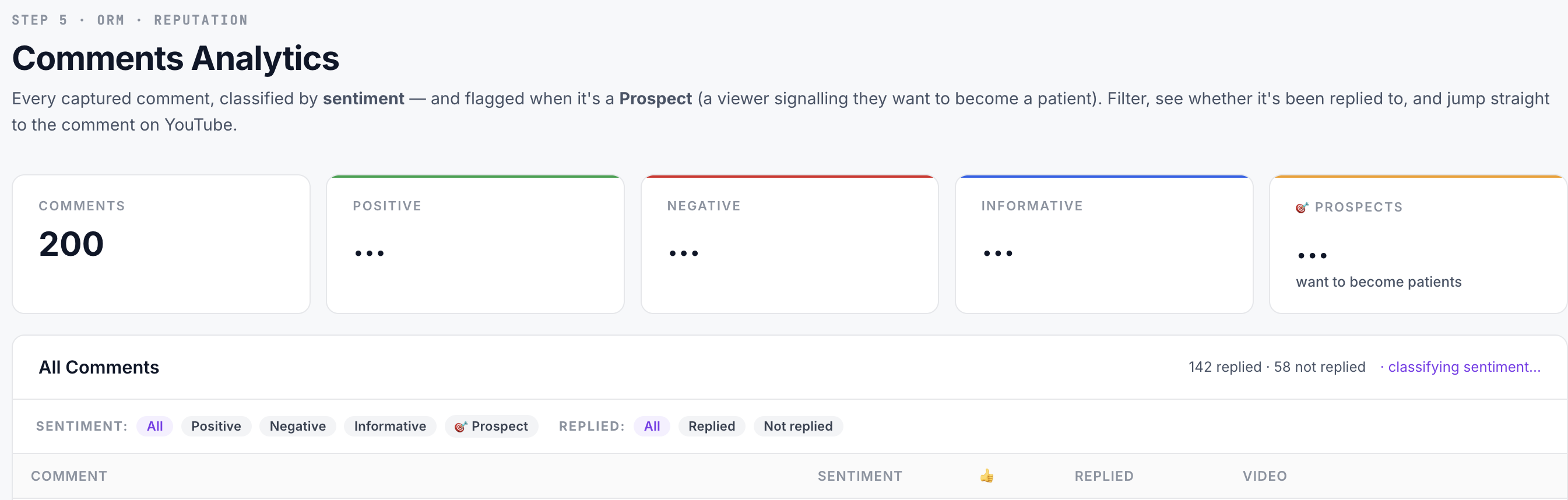

The primary buyer is a healthcare marketing lead running a clinic or hospital YouTube channel that has plateaued — the videos are being made, someone is editing thumbnails, uploads are happening, but consult bookings from the channel are flat or falling. YODA's job is to figure out why and produce the specific fixes.
YODA sits in the Growth and Elevation tiers. A clinic running YouTube on its own without ICG's managed service can license YODA independently — the platform is designed to be operated in-house after onboarding. When the clinic prefers execution to be handled by ICG's YouTube team, the managed service uses the same YODA platform.
The reason we built YODA is that no existing YouTube tool understands healthcare. vidIQ and TubeBuddy are generic creator tools; Morningfame is a small-creator coaching product; Social Blade is a stats aggregator. None of them separates organic from paid at every metric, none tracks Google AI Overview citations, and none applies India healthcare compliance rules to the writebacks it suggests.
For the full YODA walkthrough see the 6-step workflow guide and the Healthcare YouTube pillar.
Agency OS — the internal operations platform that runs ICG itself
Agency OS is different from the other four in one specific way — it is not something a client interacts with. It is the platform ICG's own team uses to run the agency. It exists in this ecosystem list because for the honest picture of how ICG delivers, Agency OS is the layer that makes the other four platforms and the human team actually cohere.
What Agency OS does — it holds every active client engagement's scope, tier, deliverable cadence, review milestone, compliance obligation, and status. Every content brief lives here before it gets picked up by a writer. Every ad campaign spec, every YouTube publish plan, every SEO deliverable, every design job. Every internal review — content compliance review, creative review, senior review — flows through here. Every client-facing report is generated from here.
The primary buyers are ICG's own account leads, delivery leads, and the founders. The client sees the outputs — reports, deliverables, communication — but does not log in themselves.
Why does it belong in the ecosystem walkthrough at all? Because Beacon, Hawk, YODA, and Pharos would not work at their current quality if the operational spine holding the delivery team was a mess of Google Sheets and Notion boards. Agency OS enforces the same discipline the client-facing platforms enforce on client data — everything versioned, everything logged, every decision traceable to a person and a timestamp.
Agency OS is not licensed to clients. It is not on the pricing sheet. It exists because when we tried to run a serious healthcare agency without it, the compliance and quality gaps that emerged inside a large delivery team were unacceptable.
Pharos — revenue intelligence across the portfolio
Pharos is the newest of the five and the one that only starts making sense once a clinic or hospital chain is running enough of the full ICG stack to have real longitudinal data. It is a revenue-intelligence platform — it takes ad spend, organic lead flow, telecaller conversion rates from Hawk, YouTube consult flow from YODA, Beacon's chatbot-booked consults, and — critically — actual revenue closed inside the practice management system, and it produces the CFO-grade view of what marketing is truly returning.
What Pharos measures is not "ROI on Meta ads" or "cost per lead." It measures the marginal revenue contribution of each spend line and each channel to booked, delivered, and paid procedures over a 90-day and 180-day window. It handles the two things that make healthcare marketing measurement hard — long sales cycles (a serious procedure can take 3-6 weeks from first click to paid deposit) and multi-touch attribution (a patient sees a YouTube video, then a Google Ad, then reads a blog, then WhatsApps, then calls, then walks in).
The primary buyer is the CFO or founder of a healthcare business spending ₹5 lakh a month or more on marketing. That buyer wants to know whether the ₹5 lakh is producing a defensible return, which channels are truly contributing, and where the next rupee should go. General attribution products cannot answer this because they do not have visibility into the practice management system's paid-procedure data. Pharos does — because it is deployed inside the same engagement that includes Hawk, YODA, and Beacon.
Pharos sits in the Elevation tier — the top ICG engagement tier, typically for hospital chains, multi-city clinic groups, and mature specialty practices. It requires 60-90 days of stable data before its numbers become defensible.
The reason we built Pharos is that every serious healthcare founder was asking the same question after 3-6 months of working with us — "how do I know this is working?" The traditional agency answer is a monthly dashboard with impressions, leads, and cost per lead. That answer does not survive a CFO conversation. Pharos was built so the answer to that question is the same answer the CFO would give if they were running the numbers themselves.
How the five fit together inside a single engagement
The five platforms are not independent — they share data, and their combined value is materially greater than the sum. A concrete example. A large fertility chain runs Meta ads (Hawk manages performance + telecaller data), runs a YouTube channel (YODA runs it), has Beacon on WhatsApp handling after-hours enquiries, and — because they are in the Elevation tier — has Pharos correlating all of it against actual IVF cycle revenue.
When Pharos flags that YouTube consults are converting to paid cycles at 2.4x the rate of Meta lead-form consults, that insight flows into next-cycle YODA Strategy (double down on the video formats that are producing those consults) and Hawk (reduce Meta budget on the ad sets producing low-quality lead-form fills, reallocate to remarketing the YouTube audience). Beacon's conversation logs surface the specific patient questions coming through WhatsApp, and those become the topic list for next quarter's YouTube content plan.
None of the five decisions in that loop would happen in a standard agency-plus-off-the-shelf-tools setup. The insight would either not be captured (no revenue attribution), not be actionable (no writeback capability), or not be trusted (no organic/paid separation to defend the number).
Agency OS is what makes sure the human loop closes — the strategy recommendations from Pharos get turned into specific tasks on specific team members' plates with specific due dates. That is the layer that is easiest to hand-wave away when describing an agency's work, and the layer that most reliably breaks when it is missing.
Which platforms a clinic can license independently versus which are bundled
Two of the five are available as standalone platform licences — YODA and (separately) Angryturtle, which is ICG's AI-native healthcare-first Google Business Profile operating system covered in a separate ecosystem note. Clinics that want the platform without ICG's managed service can license these directly.
Three of the five — Beacon, Hawk, Pharos — are only available inside an ICG managed engagement. This is not a commercial decision; it is a calibration one. Beacon's knowledge base has to be assembled and reviewed by ICG's content team against the clinic's specific protocols. Hawk requires ad-buying and telecaller operations coordination that only makes sense if ICG is running the ad campaigns. Pharos requires the full portfolio of data that only exists when ICG is running the marketing stack — trying to run Pharos on data collected by another agency's tools would produce noise.
For a clinic evaluating where to start, the honest answer is that the value of the ecosystem is not in owning all five — it is in the specific problem the clinic is trying to solve today. A clinic losing YouTube consults starts with YODA. A clinic losing Meta ad ROI starts with a Hawk-anchored Foundation engagement. A hospital chain trying to defend a ₹40-lakh-a-month marketing spend to a CFO ends up in Elevation with Pharos.
What is deliberately not in the ecosystem and why
ICG does not build a practice management system. There are ten good ones in the Indian market — clinic EMRs, hospital information systems, lab and diagnostic suites, and others — and rebuilding what those teams have spent years on would be a waste of effort. Every ICG platform integrates with the client's chosen PMS rather than replacing it.
ICG does not build an EMR. Same reason.
ICG does not build a general marketing automation platform. General-purpose marketing automation and customer-engagement platforms already exist. Where ICG's stack meets the general marketing automation layer, we integrate rather than replace.
The line for what to build versus buy is a specific one — build if the off-the-shelf tool systematically produces worse decisions for Indian healthcare because it does not understand the compliance perimeter, the WhatsApp-primary funnel, or the AI Overview surface. Buy if the tool solves a horizontal problem that is not category-specific.
What happens when a client stops working with ICG
A fair question. Every client has a documented data export path. Beacon's knowledge base and conversation logs are exportable. Hawk's lead flow and telecaller data are exportable. YODA's analysis history and writeback log are exportable — and because YODA's writebacks live natively on YouTube, everything applied to the channel stays on the channel regardless of platform access. Pharos's attribution model is documented and its methodology reproducible.
No data hostage-taking. The reason it matters to state this is that in Indian B2B software the exit path is often left deliberately vague; that vagueness is what makes founders reluctant to consolidate on any single vendor. ICG's answer is that the reason to stay is the quality of the ongoing decisions, not the friction of leaving.
The platform ICG uses to run this at scale: YODA
ICG runs healthcare YouTube marketing for clinics, hospitals, and specialty groups using YODA — our AI-native healthcare YouTube marketing platform. YODA sits on top of a channel's data and does four things no dashboard does: it separates organic from paid views at every step (so a promoted video can never masquerade as organic growth), it gives decisions not dashboards (every video gets a state + next action), it writes back to YouTube directly (improved titles, tags, descriptions, chapters applied straight to the platform), and it tracks the three rank races — YouTube search, Google web, and Google AI Overview citations.
YODA runs the full 6-step workflow — Overview, Diagnostics, Strategy, Optimisation, Reputation (ORM), and Competitor Intel — with 40+ analysis modules organised under those steps. ICG's managed YouTube service uses YODA end-to-end. See the Healthcare YouTube Marketing pillar guide for the full scope, or the Healthcare YouTube Marketing Agency service page for engagement details.
Book a YODA demo on WhatsApp → or request a free healthcare YouTube channel audit →
Related reading
- Healthcare YouTube marketing pillar guide 2026
- YODA 6-step workflow explained for healthcare marketing agencies
- Angryturtle Rank OS scoring methodology explained
- Healthcare local SEO agency India
- Healthcare YouTube marketing agency service page
FAQ
Do I have to buy all five platforms to work with ICG? No. Every engagement is scoped to the specific problem. A Foundation tier engagement might use only Hawk. A Growth tier engagement uses Hawk and YODA. Elevation adds Beacon and Pharos. Very few clients start with all four client-facing platforms on day one.
Can I license YODA without hiring ICG for the managed service? Yes. YODA is designed to be operated in-house after onboarding. The initial calibration takes 45-90 minutes of setup plus 24-72 hours of data processing. From there a healthcare marketing team can run the 6-step workflow themselves. ICG's managed service is available when the clinic prefers to hand execution to a specialist team.
Why is Angryturtle not in this list? Angryturtle is a separately-branded and separately-licensed product — ICG's AI-native healthcare-first Google Business Profile operating system. It has its own product ecosystem, pricing (starting ₹999/-), and buyer profile. Because it can be bought entirely independently of the ICG agency relationship, it is documented in its own ecosystem note rather than bundled here. See Angryturtle Rank OS methodology.
How is compliance handled across all five platforms? Every AI-generated output — Beacon's answers, YODA's title and description rewrites, Hawk's ad copy recommendations, Pharos's report language — passes through a compliance filter calibrated to the NMC Ethics Code, DPDP Act 2023, PC-PNDT Act 1994, ART Act 2021, and ASCI 2022 guidelines. Anything the filter flags is held for human review before it goes live.
Where does the data live? On ICG-managed infrastructure in India-region cloud. Data residency for personal patient data (DPDP-defined) is India-only by default. No client data is shared across engagements. Pharos's cross-portfolio views use anonymised benchmarks only.
How long before Pharos starts producing defensible numbers? 60-90 days minimum. Pharos correlates spend to booked-and-paid procedures, and Indian healthcare procedures often have a 3-6 week sales cycle. Trying to produce Pharos-quality attribution numbers on 30 days of data would produce noise. The honest first Pharos report lands at the 90-day mark of a full engagement.
Can Beacon run on WhatsApp only, without a website deployment? Yes. Many small clinics deploy Beacon on WhatsApp only because that is where 80%+ of their patient enquiries already live. The website deployment is optional and typically follows once the clinic has confirmed conversion lift on WhatsApp.
What is the difference between Hawk and a standard call-tracking tool from a cloud telephony provider? Standard call-tracking captures the call metadata. Hawk captures the call metadata and correlates it back to the specific Meta ad set, creative, and audience that produced the lead, and forward to the qualified consult and — where Pharos is deployed — the paid procedure. The lens is the connected funnel, not the call in isolation.
Which platform should a new clinic start with? Almost always the one that solves the specific bleeding problem. Losing WhatsApp enquiries after hours — Beacon. Meta ad spend rising with no ROI proof — Hawk. YouTube channel plateaued — YODA. CFO asking for proof that marketing works — Pharos, but only after 60-90 days of a full-stack engagement.
Do the platforms integrate with our existing practice management system? Yes. ICG has active integrations with the major Indian PMS vendors and generic API integrations for the smaller ones. The integration path is documented per PMS. In cases where the PMS has no API, Hawk and Pharos can operate on a scheduled data export instead.
Book a free 30-minute Brand & Growth Diagnostic.
It's a working session, not a sales pitch — you leave with a written root-cause analysis you can act on, whether or not you engage ICG.
The three platforms
behind every ICG engagement.
Beacon
CAPI middleware that fixes Event Match Quality, translates CRM statuses to Meta-standard events, dedups across channels.
Agency OS
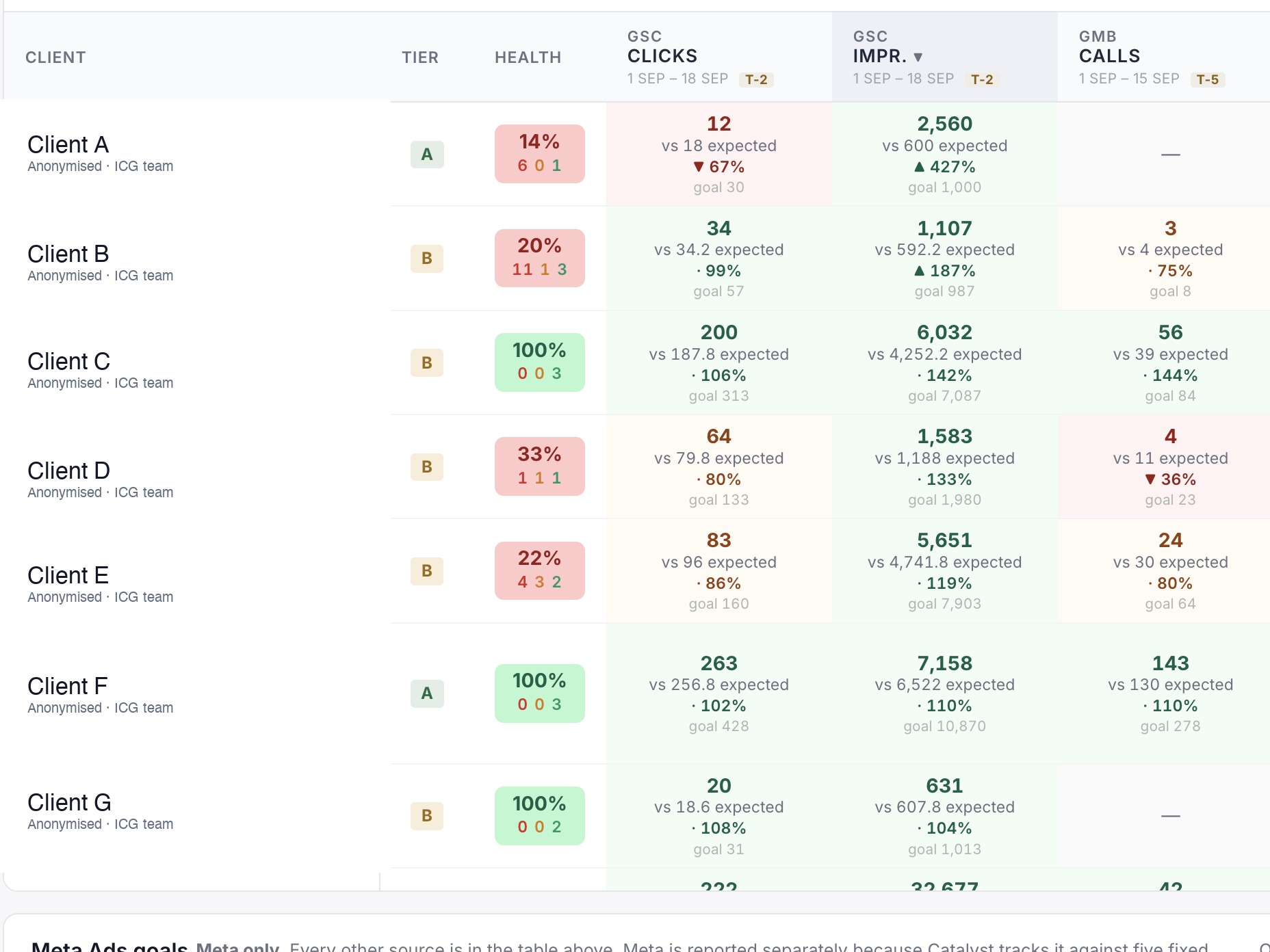
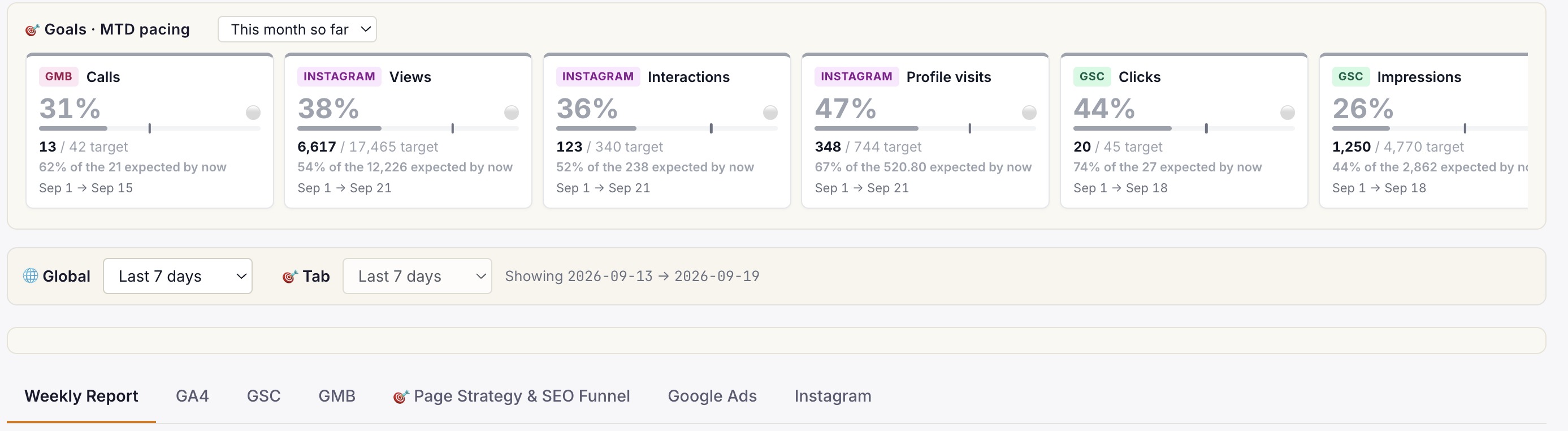
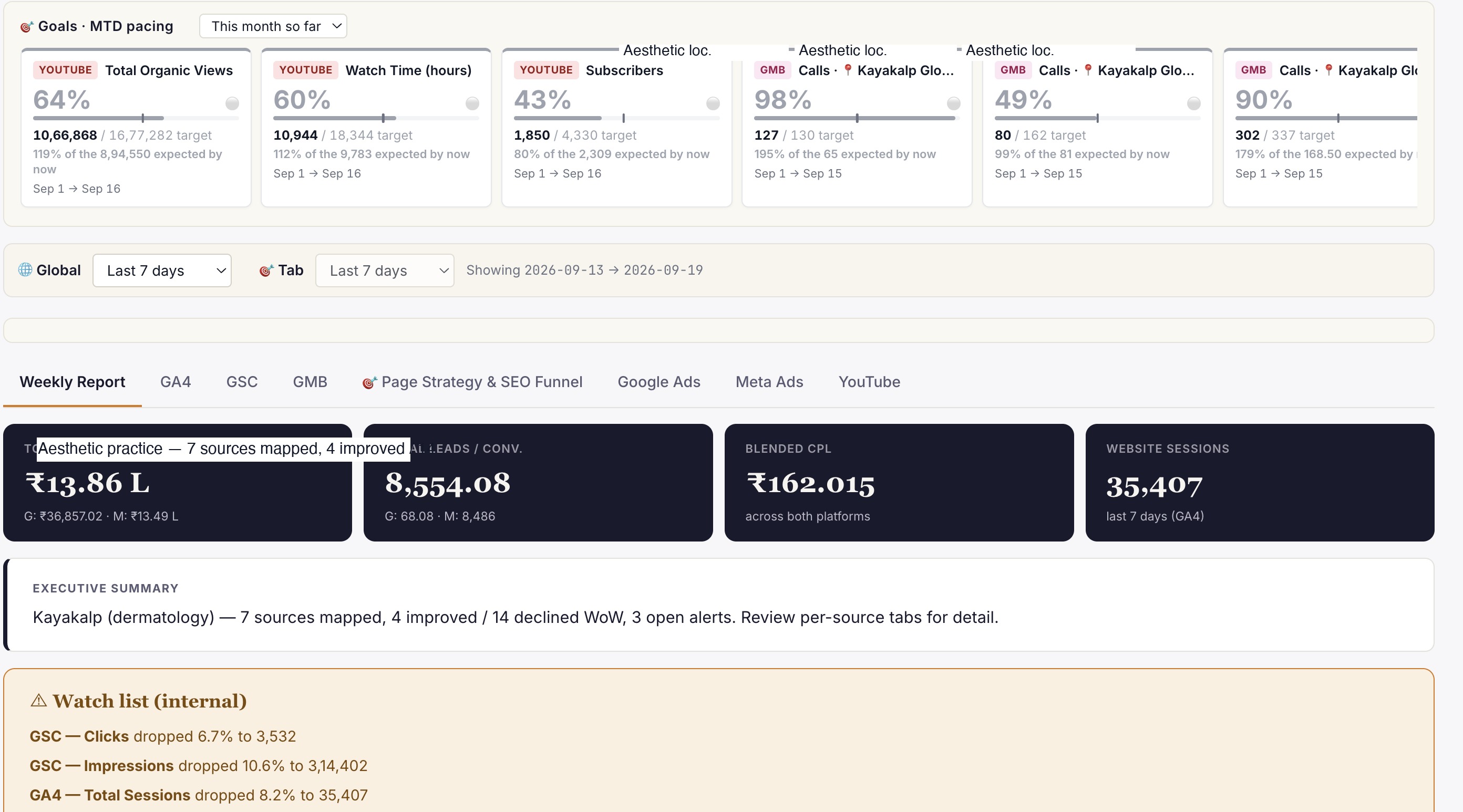
Live client dashboard. GSC, GA4, Google Ads, Meta Ads, IVR calls in one view. Login anytime, not monthly.
Phoenix
Clinic revenue intelligence over your PMS. Daily action queue: Prevent Loss, Maintain & Engage, Grow Revenue. Multi-centre rollout.
Or book a free 30-min audit to see all three in action on your account.
Healthcare brands
that already run on ICG.
A representative slice of the 150+ healthcare brands ICG has delivered for across India. Most engagements remain under NDA.


What ICG clients say · on video.
"Scale up of organic channels and business consulting. ICG has absolute domain authority in their field."
"Working with ICG transformed how we acquire IVF patients in Gurgaon. They understand the fertility journey from inquiry to consult..."
"What Ichelon accomplished — they got all my ideas and worked over 3-4 months to create an amazing, super-customised website."
Need help operationalising this?
Every ICG service is healthcare-only, NMC + DPDP-aware, and built around the patient-research patterns that drive Indian healthcare growth in 2026.
Every practice welcome — packages from ₹20,000/mo.
Goals-Driven engagements · Performance-Linked Payout Models available
More from
ICG.
Five trends shaping Indian healthcare marketing through 2027: AI-first patient research, Conversions API adoption, ABDM discovery, the AEO w...
Healthcare AIO is the discipline of getting your clinic or hospital cited inside Google AI Overviews, ChatGPT and Perplexity answers — not j...
Conversational-search advertising places brand messages inside AI chat answers — ChatGPT, Perplexity, Copilot — rather than beside a results...
Stop guessing.
Book a Diagnostic.
30 minutes. Free. With the AI-powered healthcare-only marketing agency 150+ brands already run on. No slides, no pitch, no hard close.


