


Local SEO plus YouTube combined stack for Indian healthcare in 2026: why running Angryturtle and YODA together covers all five discovery surfaces
A pillar-length walkthrough of why an Indian clinic that runs Local SEO (Google Business Profile via Angryturtle) and YouTube (video channel via YODA) in a single combined stack captures compound outcomes neither surface produces alone — including the five discovery surfaces a healthcare patient actually crosses, the specific mechanics of surface-to-surface hand-off, and a weekly combined cadence a marketing team can execute.
No pitch. Written root-cause diagnosis. AI-powered, healthcare only.
Direct answer
A pillar-length walkthrough of why an Indian clinic that runs Local SEO (Google Business Profile via Angryturtle) and YouTube (video channel via YODA) in a single combined stack captures compound outcomes neither surface produces alone — including the five discovery surfaces a he...
TL;DR

The most common mistake in Indian healthcare marketing in 2026 is treating Local SEO and YouTube as two separate line items on a budget rather than as two halves of one discovery system. A clinic that invests in a Google Business Profile alone shows up when a patient types "dermatologist near me" — and stops showing up the moment that same patient shifts to "how does microneedling actually work" or "what does PCOS look like on ultrasound." A clinic that invests in YouTube alone earns trust with patients who watch educational videos — and never surfaces on the Google Map when those same patients pull out their phones a week later to book a consult. Neither surface is redundant. Each one owns a different question in the patient journey, and running both together is what closes the loop.
This is a pillar-length explanation of why the combined stack — Google Business Profile operations through Angryturtle and healthcare YouTube channel operations through YODA — produces compound outcomes for Indian clinics, hospitals, and specialty groups. It documents the five discovery surfaces every commercially useful healthcare search crosses in 2026, which surface each platform actually feeds, how the two surface sets connect, and what a weekly combined operating rhythm looks like for a marketing team running both.
The five discovery surfaces a healthcare patient crosses in 2026
An Indian healthcare patient in 2026 no longer performs one search. Across a 30 to 180 day consideration cycle, the same patient touches multiple discovery surfaces, and the surface they touch depends entirely on where they are in the cycle. Understanding which surface owns which question is the beginning of thinking about the combined stack correctly.
The five surfaces are the Google Local Pack (the 3-pack of businesses that appears at the top of a locality-scoped Google search), the Google Map (the interactive map view a patient opens when browsing local providers), the Google web results (the classical organic listings for informational and commercial queries), Google AI Overview citations (the AI-generated answer block that now appears above web results for a growing share of queries), and YouTube search results (queries typed directly into YouTube or triggered from the YouTube app on a phone).
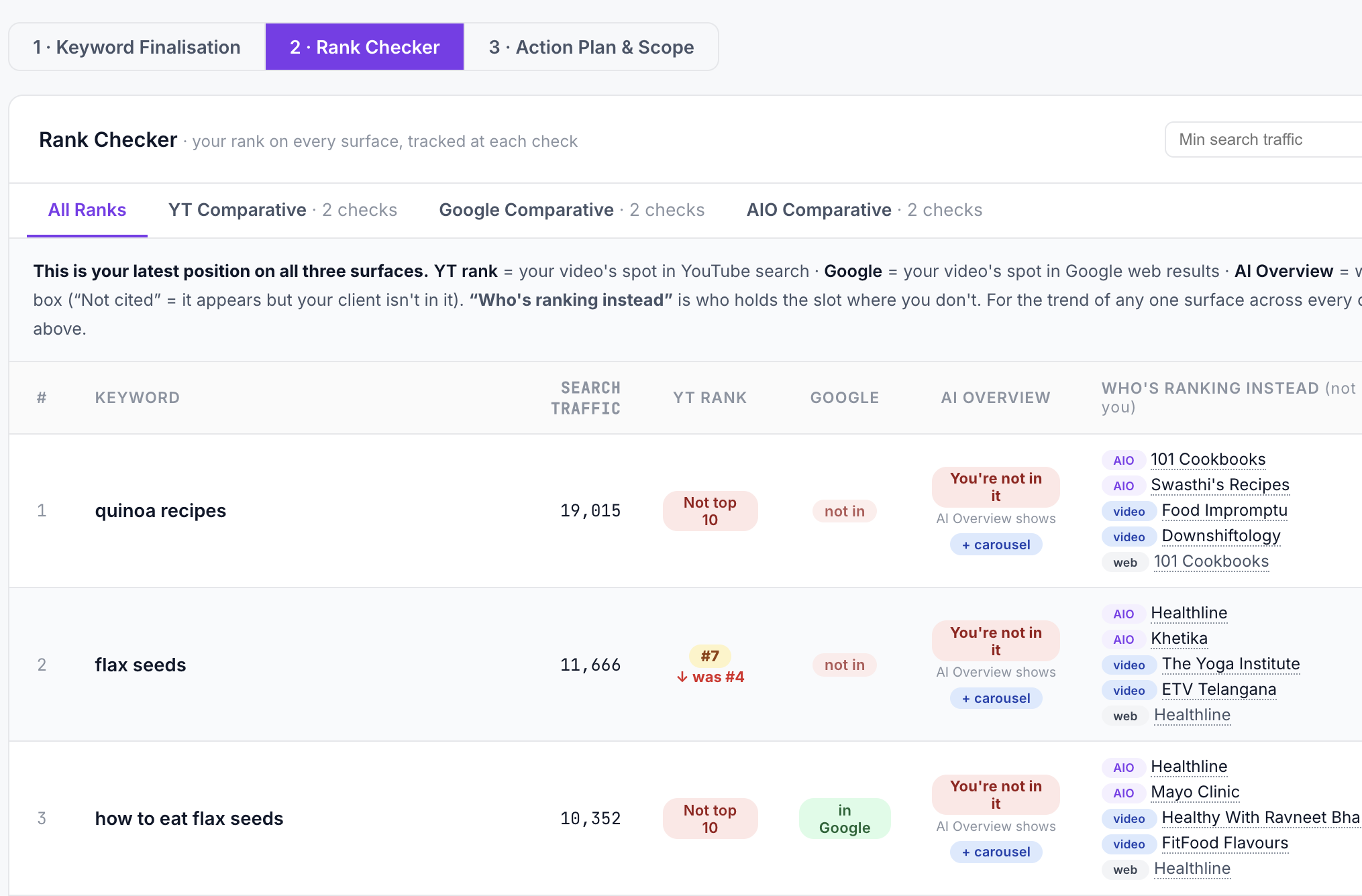
Two surfaces — the Local Pack and the Map — are almost entirely GBP-signal driven. Two more — Google web results and AI Overview citations — are hybrid, drawing from both the clinic's website and its YouTube content. The fifth — YouTube search — is exclusively YouTube-signal driven. A single-platform clinic can, at best, cover three of the five surfaces and never dominate more than two.
What a Google Business Profile actually feeds — and where it stops
A well-run Google Business Profile earns rankings on the Google Local Pack and the Google Map for locality-anchored queries — searches that either explicitly include a city or neighbourhood name, or searches Google can infer as local from the user's current location. "Dermatologist in Indiranagar," "IVF centre near Andheri West," "dental clinic Gurgaon Sector 45" — these are queries the Local Pack owns, and the Google Business Profile is what wins them.
A GBP also feeds a small share of Google web results — the knowledge panel for branded searches and occasional AI Overview citations for queries that map to profile attributes. But the moment a query shifts from locality-anchored to informational — "what causes hair fall in monsoon" or "microneedling recovery time" — the profile is silent. Google does not surface profile-side signals for informational intent.
This is the natural ceiling of Local SEO in isolation. It captures the patient at the moment they've already decided they need a provider in their locality — the bottom of the funnel. It does not capture the patient during the weeks or months of informational research that precede that decision.
What a YouTube channel actually feeds — and why it reaches further than most operators realise
A well-run healthcare YouTube channel earns rankings on YouTube search — direct queries typed into the YouTube app or YouTube.com — and on YouTube's Suggested and Browse surfaces, which represent about 40 to 50 percent of a mature channel's watch time. That much most marketing teams understand.
What most teams underestimate is how far YouTube content reaches into Google web results and Google AI Overview citations. A YouTube video that ranks for a specific informational query — "PCOS lifestyle management," "root canal recovery," "hair transplant before after Indian" — also appears in Google web results for the same query, often above competing website content, because Google prioritises video results for queries where video is the better format. The same video, when structured with clear chapters and descriptive metadata, becomes a citable source for Google AI Overview answers on the same query. This is the leverage layer of a YouTube channel that clinics operating in isolation on YouTube almost always miss.
YouTube also feeds a signal into the GBP itself. When a patient watches a clinic's videos and then searches for that clinic by name, the co-occurrence of watch behaviour and branded search is a positive relevance signal Google factors into the profile's ranking on non-branded local queries — a surface-to-surface hand-off neither platform alone can capture.
The five-surface coverage matrix
The right way to picture the combined stack is a coverage matrix. Along one axis are the five discovery surfaces. Along the other axis are the two platforms — Google Business Profile via Angryturtle, and YouTube channel via YODA. Every cell in the matrix answers the question "which platform feeds this surface, and how strongly."
Google Local Pack — Angryturtle: primary driver. YODA: secondary signal via co-occurrence of branded video watches and branded search. Combined coverage: strong when both are active.
Google Map — Angryturtle: primary driver. YODA: minimal direct feed. Combined coverage: dominated by Angryturtle; YODA does not change the picture materially.
Google web results — Angryturtle: knowledge panel and small share of informational citations. YODA: strong driver for informational queries where video is the preferred format. Combined coverage: neither alone is sufficient; combined is where a clinic starts appearing across both commercial and informational web queries.
Google AI Overview citations — Angryturtle: contributes profile-side entity signals and review corpus. YODA: contributes structured video answers with chapter timestamps that AI Overview citations increasingly favour. Combined coverage: this is the surface where the compound effect is largest — AI Overviews cite fewer sources per query than any other surface, and a clinic with both a strong profile and a strong channel is materially more likely to be one of the sources cited.
YouTube search — Angryturtle: no direct feed. YODA: primary driver. Combined coverage: dominated by YODA; Angryturtle does not change the picture.
The matrix makes the trap of single-surface investment concrete. A clinic that runs only Local SEO is invisible on YouTube search, weak on Google web results for informational queries, and weakly represented in AI Overview citations. A clinic that runs only YouTube is invisible on the Local Pack, invisible on the Map, and weakly represented in AI Overview citations because its entity signals are not consolidated in a profile. Neither posture is defensible against a competitor running both.
Why the two surface sets are not substitutes for each other
A common budget-time argument inside clinics is "we already have a strong Google Business Profile, so we don't need to invest in YouTube." Or the mirror argument: "our YouTube channel is doing well, so Local SEO doesn't matter as much." Both arguments treat the two surface sets as substitutes. They are not.
The surface sets are not substitutes because they answer different patient questions at different stages of the journey. A patient asking "what causes recurring UTIs" is at the top of the funnel, doing informational research. The Local Pack cannot answer that question, and no amount of profile investment will change that. A patient asking "urologist in Whitefield" is at the bottom of the funnel, ready to book. YouTube cannot answer that question directly, and no amount of video investment will pull that patient to a video-first destination when they are ready to book.
The surface sets are complementary because most consideration cycles cross both. A patient who watches three of the clinic's YouTube videos over a month, then searches "urologist in Whitefield" a week later, is a patient the clinic acquired because both surfaces were operating. Take either surface away and the acquisition either does not happen or happens for a competitor.
The compound effect in measurable terms
The compound effect of running both surfaces is not a marketing abstraction. It shows up in observable metrics the marketing team can pull each month — branded search volume (typically 40 to 90 percent lift within 6 to 9 months of adding the second surface), Google Business Profile direction requests (a second layer emerges from patients who discovered the clinic via video and then searched by name), YouTube average session watch time (website-referred traffic arrives more qualified than YouTube's own recommendation traffic), and consult booking attribution (patients unprompted citing both surfaces during intake at materially higher rates than either surface alone would produce).
What the combined weekly cadence actually looks like
A marketing team running both surfaces in an integrated cadence operates on a weekly rhythm that alternates focus without treating the two surfaces as separate work streams. The rhythm below is what most Angryturtle-plus-YODA clinics settle into by month three of the combined engagement.
Monday morning. Combined dashboard review. Angryturtle sie" style="color:inherit;text-decoration:underline;text-decoration-color:rgba(42,126,200,.5);text-underline-offset:2px">Rank OS score for the week, YODA weekly Decision Engine output, delta on each. Identify the single dimension across both platforms that moved most, and the single lowest-scoring dimension that needs focus this week.

Monday afternoon. Content planning session. YODA's content planner suggests 1 to 2 videos for the week. Every video brief is checked for two things — does it answer a question that also appears in the Angryturtle Ask Maps question bank, and does it link back to a clinic service page that in turn links to the Google Business Profile. This is the first surface-to-surface hand-off the combined stack captures.

Tuesday and Wednesday. Video production and Google Business Profile weekly content cadence run in parallel. GBP Posts, photo uploads, and Q&A refreshes happen against the Angryturtle-recommended focus dimension. Video shoot and post-production happen against the YODA-recommended topic.
Thursday. Cross-surface integration. The week's new video gets embedded on the corresponding service page on the website. The service page's URL is added to the Google Business Profile via the appropriate URL field or Post link. The video's topic gets added as a proactive owner Q&A on the profile.
Friday. Reputation loop. Review replies pending in Angryturtle are cleared. YouTube comments pending in YODA's Reputation module are cleared. Themes surfaced in either — cost questions, availability questions, procedure questions — feed back into next week's content planning.
The rhythm is deliberately compact. A trained two-person team (a marketing coordinator plus a content producer) can execute the full weekly cadence in roughly 22 to 28 hours combined. The key insight is that the two platforms feed each other continuously — YODA's Audience Voice module surfaces patient questions that become Angryturtle Q&A entries; Angryturtle's review corpus surfaces language that shapes YODA video scripts; both platforms' geo signals confirm which localities to prioritise in the next cycle.
The most common single-surface failure modes we see
Working with 150+ Indian healthcare brands has surfaced a small set of predictable failure modes when a clinic invests in only one surface for extended periods. Documenting them helps a marketing team recognise which one is currently active at their clinic.
Failure mode one: strong profile, no channel. Local Pack rankings are healthy but branded search plateaus and the clinic never breaks into non-locality queries. Fix — start the YouTube channel with a 90-day publishing commitment; expect the compounding effect on branded search around month four.
Failure mode two: strong channel, weak profile. YouTube views and subscribers are strong but the Google Business Profile barely ranks in the Local Pack. Patients who researched via YouTube are booking with better-profiled competitors. Fix — Rank OS-driven weekly Local SEO cadence; the Local Pack curve moves noticeably by week 8 to 12.
Failure mode three: both surfaces, no integration. The clinic has a healthy profile and a healthy channel, but they run in different teams with no shared calendar or question bank. Content duplicates. Cross-surface hand-off opportunities are missed. Fix — integrated weekly cadence; single dashboard view across both platforms.
The tool ICG uses to run this at scale: Angryturtle
ICG runs local SEO and GBP intelligence for 150+ Indian healthcare brands using Angryturtle — our own AI-native GBP intelligence and management OS. The platform scores every profile 0-100 via a proprietary Rank OS model with five weighted dimensions (Relevance, Review Health, Freshness, Entity Authority, AIO Readiness), publishes edits, Posts, media, and review replies directly to Google, and includes Ask Maps AIO Readiness scoring for Google AI Overviews and ChatGPT visibility.
Available in two shapes: self-serve at ₹999/- per month for solo owners with 1-2 profiles, and ICG's managed service from ₹25,000/- per month where our healthcare specialists execute inside the same platform. Both are anchored in the Healthcare Local SEO Agency India pillar page which has full scope, methodology and pricing.
Book a demo on WhatsApp → or start a free trial at angryturtle.ai →
The platform ICG uses to run this at scale: YODA
ICG runs healthcare YouTube marketing for clinics, hospitals, and specialty groups using YODA — our AI-native healthcare YouTube marketing platform. YODA sits on top of a channel's data and does four things no dashboard does: it separates organic from paid views at every step (so a promoted video can never masquerade as organic growth), it gives decisions not dashboards (every video gets a state + next action), it writes back to YouTube directly (improved titles, tags, descriptions, chapters applied straight to the platform), and it tracks the three rank races — YouTube search, Google web, and Google AI Overview citations.
YODA runs the full 6-step workflow — Overview, Diagnostics, Strategy, Optimisation, Reputation (ORM), and Competitor Intel — with 40+ analysis modules organised under those steps. ICG's managed YouTube service uses YODA end-to-end. See the Healthcare YouTube Marketing pillar guide for the full scope, or the Healthcare YouTube Marketing Agency service page for engagement details.
Book a YODA demo on WhatsApp → or request a free healthcare YouTube channel audit →
Related reading
- Why Google Maps and YouTube compound for Indian clinics
- Weekly cadence for Local SEO plus YouTube with a single team
- Combined stack vs single-service ROI comparison
- Healthcare YouTube marketing pillar guide 2026
- Healthcare Local SEO Agency India pillar page
FAQ
Do we need to run both platforms from day one, or can we sequence them? Sequencing is fine and is often what smaller clinics do. The usual sequence is Angryturtle first (because it produces booking-adjacent outcomes fastest), then YODA once the profile is stable and the clinic can commit to a weekly publishing cadence. Committing to both from day one is the fastest path but requires either an in-house team of two people or a managed engagement.
What is the smallest clinic size where the combined stack makes sense? A solo practice with a single physician can run both. The self-serve Angryturtle tier at ₹999/- per month makes Local SEO affordable, and a YouTube channel produced by the physician themselves is a legitimate starting point. The economics work provided the physician is willing to record 1 to 2 videos per week for at least 6 months to give the channel time to build.
Which platform typically produces measurable booking impact first? Local SEO typically produces measurable booking impact first — often inside 30 to 60 days if the profile fundamentals were poor and the Rank OS-driven weekly work fixes them. YouTube impact usually shows up more gradually, becoming measurable around month 3 to 4 and material around month 6.
Is there a size at which one platform stops helping and the other takes over? No. The two platforms compound at every scale from solo clinic to large multi-location hospital. What changes is the size of each investment and the depth of each cadence, not whether the platforms are needed.
How do we know if the compound effect is actually happening at our clinic? Three signals to watch. Branded search volume trending up month over month at a rate faster than either platform alone would explain. Direction requests on the Google Business Profile showing a lift after new videos publish on the corresponding topic. Consult booking conversations increasingly citing both surfaces — patients naming both the map listing and the YouTube channel unprompted.
Can we run only one platform and outsource the other? Yes, and this is a common shape. Many clinics run Angryturtle self-serve in-house and hire ICG to run YODA-managed YouTube, or the reverse. The combined stack works regardless of who executes which surface, provided the two workflows share the same content calendar and question bank.
What happens if we pause one platform for a quarter? The paused platform's surfaces gradually decay. Local Pack ranking loses ground within 4 to 6 weeks if Angryturtle-driven weekly cadence pauses. YouTube channel growth flattens within 2 to 3 weeks if YODA-driven publishing pauses. The unpaused platform continues to work but the compound effect on branded search and cross-surface hand-off attenuates.
How does compliance work across both platforms? Both platforms enforce the same India-specific compliance perimeter — NMC's 2026 advertising guidelines, DPDP Act 2023, PC-PNDT Act 1994, ART Act 2021, and ASCI Guidelines 2022. Angryturtle enforces on profile content and replies; YODA enforces on video titles, descriptions, chapters, and comment replies. Anything that trips the rulebook is flagged for human review before publication.
How does the pricing work for the combined engagement? Two paths. DIY — Angryturtle self-serve at ₹999/- per month plus in-house YouTube production. DFY — ICG-managed Angryturtle from ₹25,000/- per month plus ICG-managed YouTube (YODA) from ₹75,000/- per month depending on channel maturity. Combined managed engagements typically range ₹1,25,000/- to ₹3,50,000/- per month for the two surfaces together.
Book a free SEO diagnostic.
Hanuman Sihag's team runs a live crawl, checks technical health, cannibalisation, schema coverage and content gaps. 60 minutes, prioritised fix list.
The three platforms
behind every ICG engagement.
Beacon
CAPI middleware that fixes Event Match Quality, translates CRM statuses to Meta-standard events, dedups across channels.
Agency OS
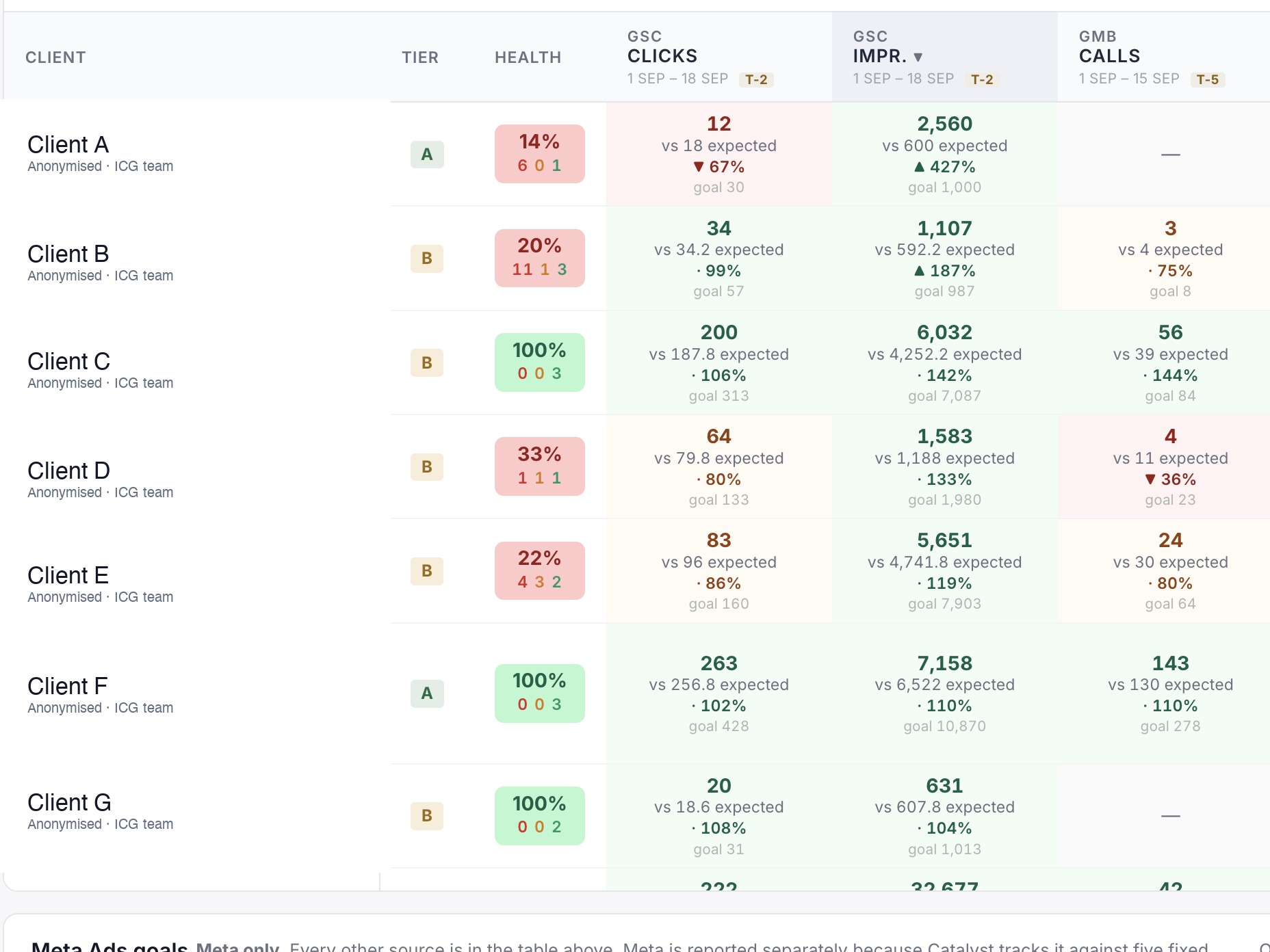
Live client dashboard. GSC, GA4, Google Ads, Meta Ads, IVR calls in one view. Login anytime, not monthly.
Phoenix
Clinic revenue intelligence over your PMS. Daily action queue: Prevent Loss, Maintain & Engage, Grow Revenue. Multi-centre rollout.
Or book a free 30-min audit to see all three in action on your account.
Healthcare brands
that already run on ICG.
A representative slice of the 150+ healthcare brands ICG has delivered for across India. Most engagements remain under NDA.


What ICG clients say · on video.
"Scale up of organic channels and business consulting. ICG has absolute domain authority in their field."
"Working with ICG transformed how we acquire IVF patients in Gurgaon. They understand the fertility journey from inquiry to consult..."
"What Ichelon accomplished — they got all my ideas and worked over 3-4 months to create an amazing, super-customised website."
The intelligence stack behind this playbook.
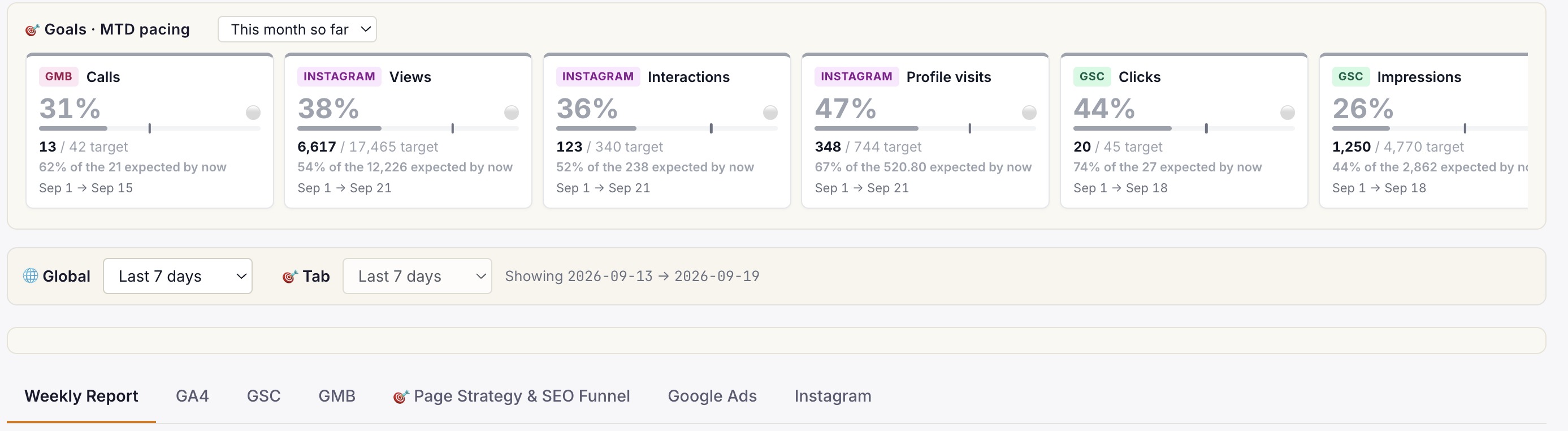
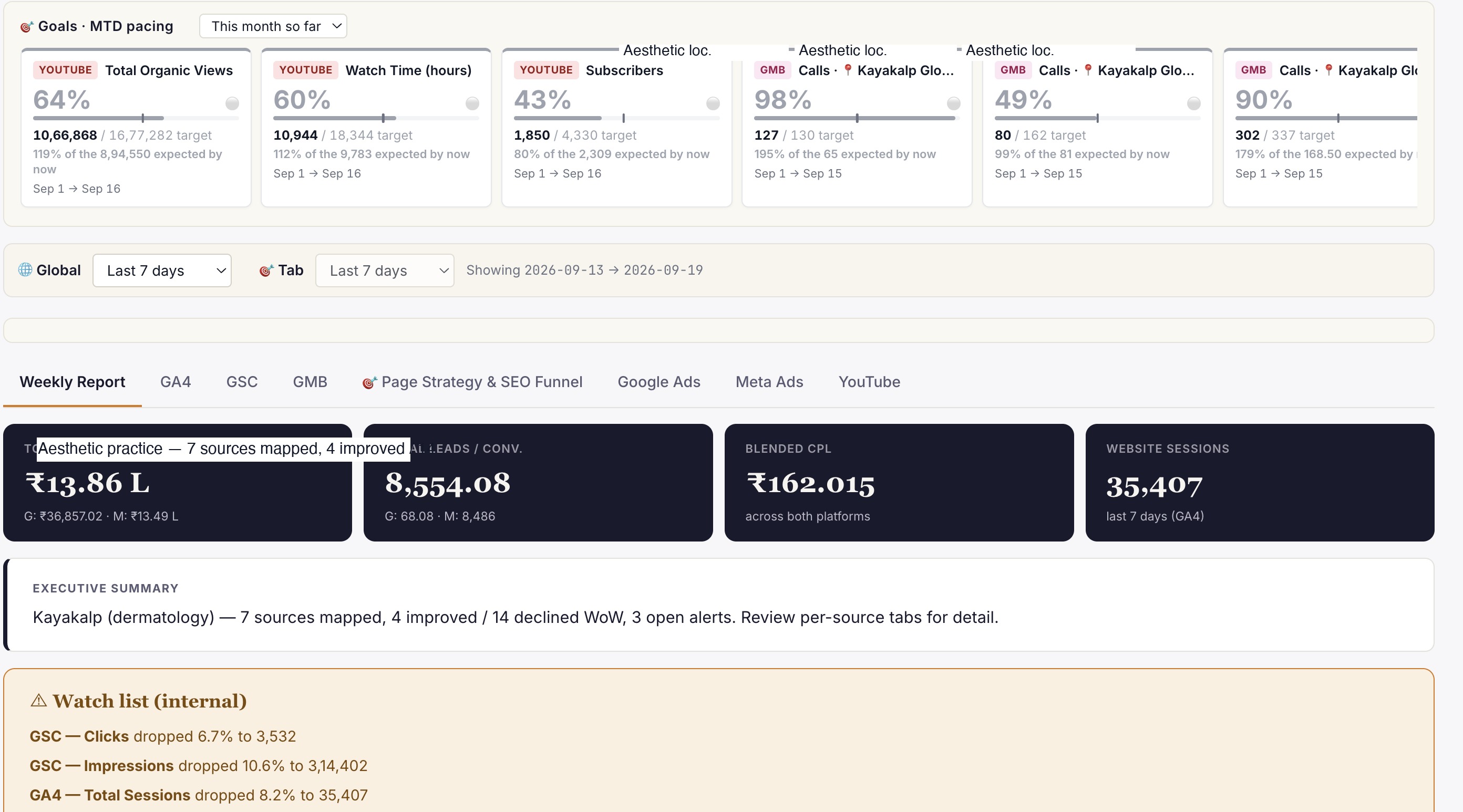
Every ICG engagement runs on the Search Intelligence Trifecta — Angryturtle for GMB, SIE for search and AI Overview, YODA for YouTube. Live product screens below.
Need help operationalising this?
Every ICG service is healthcare-only, NMC + DPDP-aware, and built around the patient-research patterns that drive Indian healthcare growth in 2026.
Every practice welcome — packages from ₹20,000/mo.
Goals-Driven engagements · Performance-Linked Payout Models available
More from
ICG.
Five trends shaping Indian healthcare marketing through 2027: AI-first patient research, Conversions API adoption, ABDM discovery, the AEO w...
Healthcare AIO is the discipline of getting your clinic or hospital cited inside Google AI Overviews, ChatGPT and Perplexity answers — not j...
Conversational-search advertising places brand messages inside AI chat answers — ChatGPT, Perplexity, Copilot — rather than beside a results...
Stop guessing.
Book a Diagnostic.
30 minutes. Free. With the AI-powered healthcare-only marketing agency 150+ brands already run on. No slides, no pitch, no hard close.


