


AI Overview optimisation for IVF clinics in India — the 2026 playbook for cycle-length, success-rate and cost queries that patients type before they call
IVF is one of the highest-fire AIO categories in Indian healthcare. Here is the query taxonomy, the PC-PNDT and ART Act boundary, and the YODA AIO Lab methodology.
No pitch. Written root-cause diagnosis. AI-powered, healthcare only.
Direct answer
IVF is one of the highest-fire AIO categories in Indian healthcare. Here is the query taxonomy, the PC-PNDT and ART Act boundary, and the YODA AIO Lab methodology.
TL;DR

AI Overview optimisation for Indian IVF clinics is the practice of structuring cycle-length, success-rate, cost, protocol, and eligibility content so Google's generative answer panel cites the clinic's page as an authoritative source. IVF fires AIO on more than 70 percent of informational and comparison queries in our tracking, sits inside a strict PC-PNDT and ART Act compliance perimeter, and is the single highest-lift AIO category in Indian healthcare through 2026.
Patients searching for IVF in India ask specific, high-anxiety questions before they ever pick up a phone — how long is a full IVF cycle, what is the success rate at age 38, why does one clinic charge ₹1.4 lakh and another ₹3.2 lakh, is ICSI different from IVF, what does an antagonist protocol mean. Each of these questions now triggers an AI Overview panel on Indian SERPs at rates between 65 and 88 percent by query type. The clinic whose page gets cited inside that panel earns a brand impression on every one of those searches, even from users who never click through. The clinic whose page is not cited effectively does not exist for that search session. This post walks through the IVF-specific query taxonomy, the PC-PNDT Act 1994 and ART Act 2021 compliance boundary that shapes how the content must be written, the schema stack that maps to each query type, and the exact YODA AIO Lab workflow ICG runs across IVF client portfolios.
Why IVF fires AIO more than any other Indian healthcare vertical
Three structural reasons. First, IVF is question-heavy — patients researching fertility treatment have twenty to forty distinct informational questions they need answered before they can even begin to shortlist a clinic. Google sees a large question-form query cluster, and question-form queries fire AIO at the highest rates. Second, IVF is comparison-heavy — patients compare IVF vs IUI, ICSI vs conventional IVF, agonist vs antagonist protocols, fresh vs frozen embryo transfer. Comparison queries fire AIO at 60 to 80 percent. Third, IVF pricing varies widely and opaquely, so cost queries dominate — and cost queries fire AIO at 35 to 50 percent because Google can synthesise a range from multiple sources.
The combined effect: an IVF clinic's content stack has a higher proportion of AIO-eligible query types than almost any other specialty. If the content is structured for citation, the panel exposure compounds fast. If it is not, the clinic loses informational share to competitors who structured better.
The IVF query taxonomy that fires AIO in India
Across ICG's IVF client portfolios, this is the observed AIO fire rate by query cluster. Numbers are Q2 2026, weekly-refreshed inside YODA's AIO Lab.
| Query cluster | Example query | AIO fire rate | Highest-lift schema |
|---|---|---|---|
| Success rate by age | "IVF success rate at age 38 India" | 85-92% | MedicalProcedure + FAQPage |
| Cycle timeline | "how long does an IVF cycle take" | 78-88% | HowTo + FAQPage |
| Cost breakdown | "IVF cost breakdown India 2026" | 65-80% | MedicalProcedure + Table markup |
| Protocol comparison | "agonist vs antagonist protocol IVF" | 60-75% | MedicalProcedure + FAQPage |
| IVF vs IUI | "IVF vs IUI which is better" | 72-84% | MedicalProcedure + FAQPage |
| ICSI eligibility | "when is ICSI recommended over IVF" | 68-80% | MedicalProcedure |
| Frozen embryo transfer | "fresh vs frozen embryo transfer success rate" | 70-82% | MedicalProcedure + FAQPage |
| Egg donor eligibility | "egg donor age limit India ART Act" | 55-70% | MedicalCondition + legal reference |
| Local commercial | "IVF clinic Bandra" | Under 20% | LocalBusiness / MedicalClinic |
| Brand | "[Clinic name] IVF Delhi" | Under 5% | Organization |
The pattern is clear. Everything informational — success rate, cycle timeline, protocol explainer, comparison — fires AIO heavily. Everything commercial and brand-locality does not. The correct IVF content stack for 2026 mirrors this split — informational hub pages structured for AIO citation, commercial money pages structured for classic organic conversion.
PC-PNDT and ART Act compliance shapes what you can write
Indian IVF content sits inside two hard compliance perimeters. The Pre-Conception and Pre-Natal Diagnostic Techniques Act 1994 (PC-PNDT) prohibits any communication of sex-determination or sex-selection intent — clinics cannot promote family-balancing, sex-selective embryo transfer, or PGS-for-gender content. The Assisted Reproductive Technology Regulation Act 2021 (ART Act) regulates donor consent, commissioning-couple eligibility, clinic registration, and specific claim types around success rates.
What this means for AIO optimisation: the definition-first opening paragraph and any FAQ answers cannot make claims that violate either Act. A page claiming "select the gender of your baby with IVF" not only violates PC-PNDT — it will also fail Google's trust filter on YMYL content and lose all AIO citation eligibility. A page claiming "100% IVF success rate" violates ASCI and again fails the trust filter. Compliance-clean writing is not just legally necessary — it is a hard prerequisite for AIO citation. The two disciplines converge.
Practical rule set for IVF AIO content: quote success rates as ranges rather than absolutes ("30 to 50 percent per cycle depending on age and protocol" not "our clinic delivers 65% success"). Reference the ART Act clause governing donor age limits rather than paraphrasing them. Include an "Editorial disclosure — regulated content under PC-PNDT and ART Act" line at the bottom of the page. Add reviewedBy schema pointing to the clinic's registered ART consultant.
The schema stack for IVF AIO pages
The IVF AIO schema stack is layered — no single schema type carries the citation on its own. The base combination we deploy on every IVF hub page:
- MedicalProcedure — canonical entity for IVF, ICSI, IUI, embryo transfer with bodyLocation, howPerformed, preparation, followup properties filled.
- FAQPage — 8 to 12 substantive Q/A pairs mirroring the People Also Ask block on the primary target query.
- Person schema for the reviewing ART consultant with jobTitle, degree, memberOf (Indian Fertility Society, National ART Registry), and sameAs to a verifiable profile.
- Organization / MedicalBusiness for the clinic itself with ART Act registration number where displayable.
The four layers together carry more citation weight than any one of them alone. FAQPage is the highest single-schema lever — most IVF AIO panels cite pages with FAQPage schema when the query is question-form. But MedicalProcedure carries the definition and canonical-entity signal that unlocks the citation in the first place, and Person schema on a credentialed reviewer is what tips the YMYL trust filter into acceptance.
The definition-first opening paragraph for IVF pages
The single highest-leverage change on any underperforming IVF page is the opening paragraph rewrite. The pattern: 40 to 60 words, bolded, containing the canonical procedure name, its mechanism, the typical India success range with the age caveat, and the compliance framing.
Weak opening: "Looking to start your parenthood journey? Our clinic offers world-class IVF treatment with unmatched success rates. Read on to learn why couples across India trust us for their fertility needs."
Strong opening: "In vitro fertilisation (IVF) is an assisted reproductive technology in which eggs are retrieved from the ovaries and fertilised with sperm in a laboratory. The resulting embryos are cultured for 3 to 5 days and transferred back to the uterus. In India, IVF success rates range from 30 to 50 percent per cycle, varying by maternal age, ovarian reserve, protocol, and clinic quality."
The second opening is a clean pull-quote for the AIO panel and it stays inside the ART Act perimeter by quoting a range rather than claiming a specific figure. It is also more useful to the reader making a real decision.
The YODA AIO Lab workflow ICG runs for IVF clients
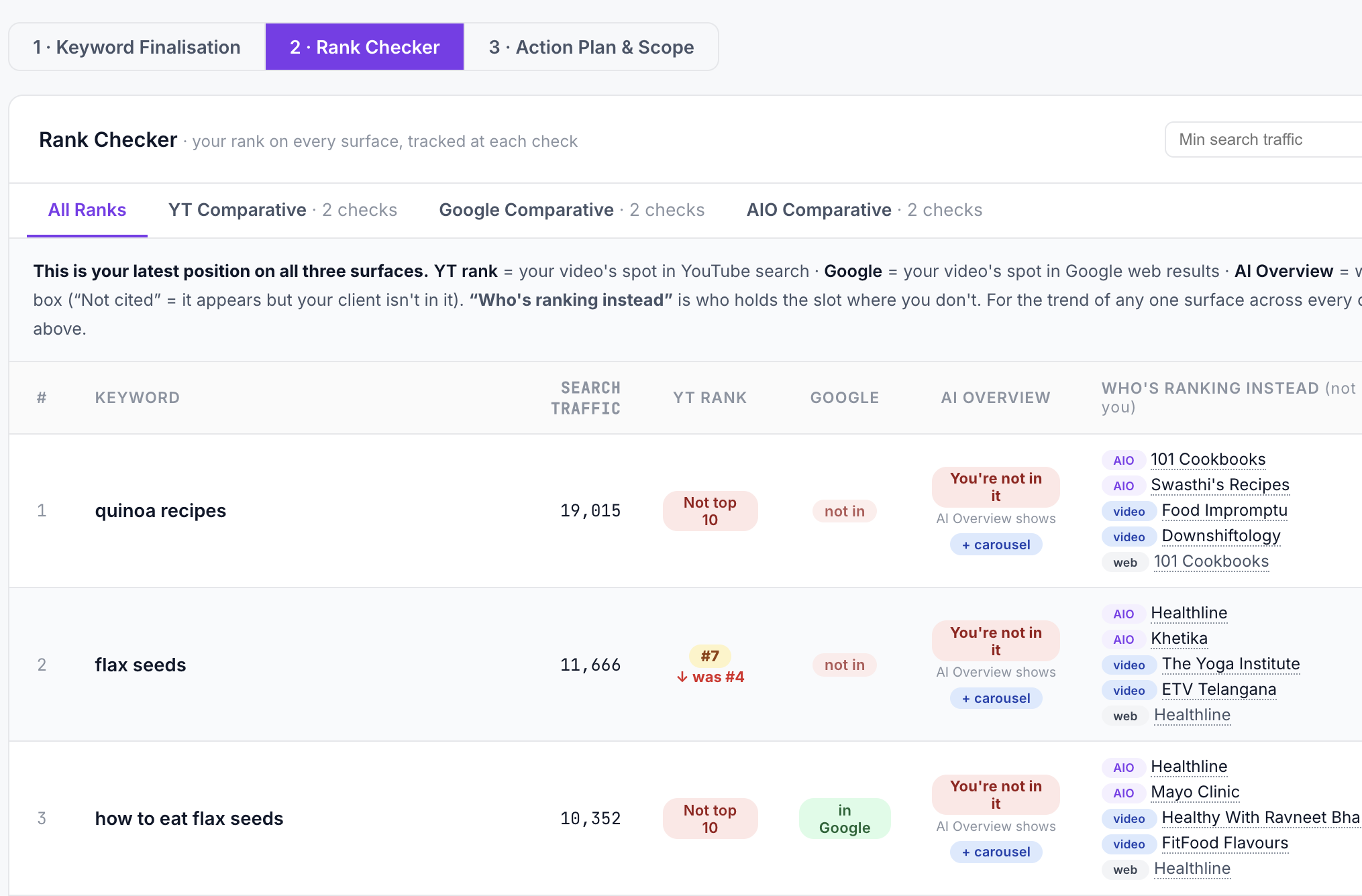
YODA — ICG's AI-native healthcare YouTube and content platform — runs a dedicated AIO Lab workflow for IVF portfolios. The steps we execute across every IVF client:
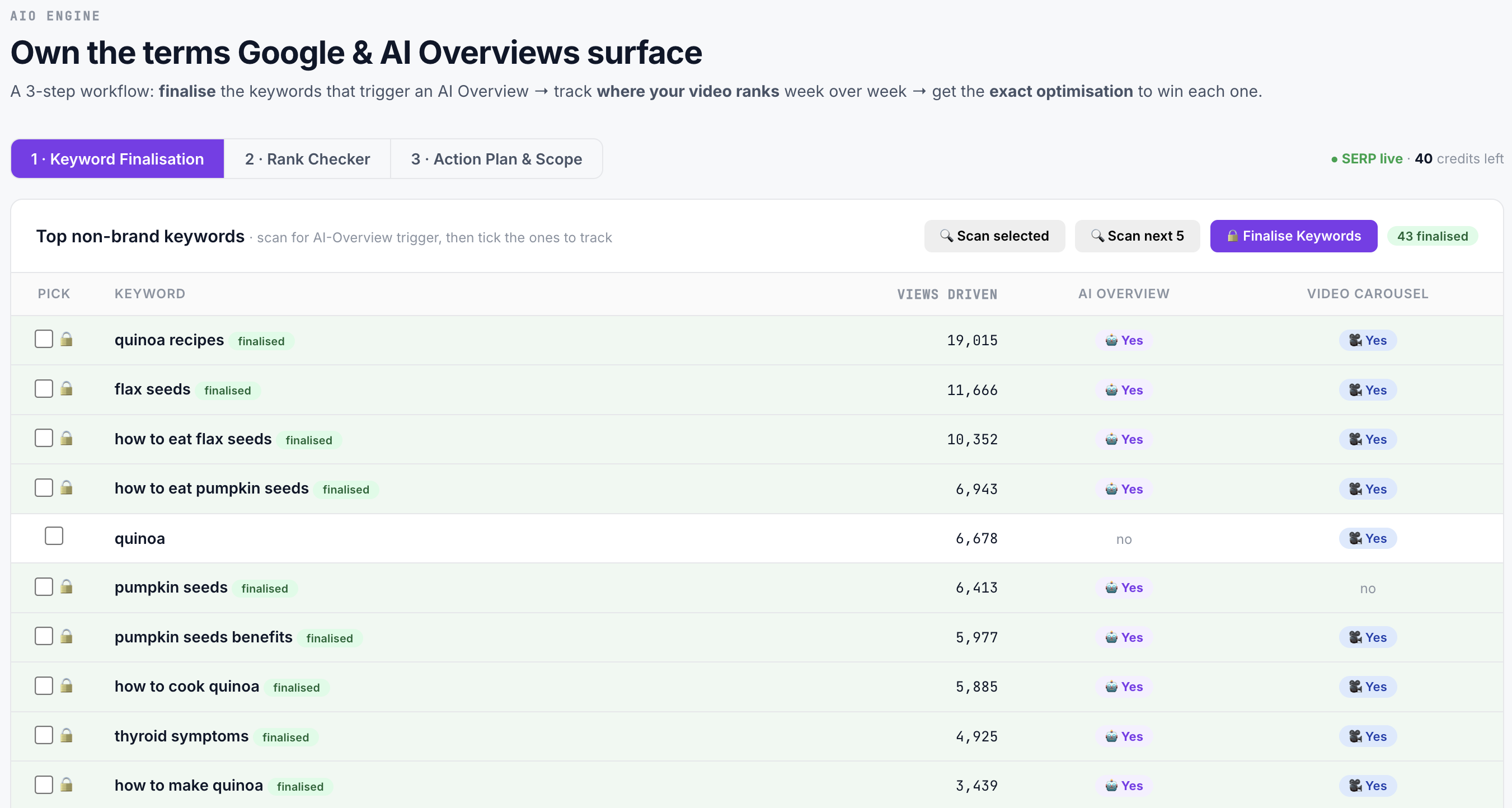
- Keyword finalisation. Cluster the 80 to 150 IVF query variants relevant to the clinic's service mix into 8 to 12 semantic groups (success rate, cost, cycle timeline, ICSI, protocol, egg donor, PGT, FET, PCOS-related). Prioritise groups by combined AIO fire rate and organic opportunity.
- Weekly rank capture. Automated incognito capture from an Indian IP on 5 to 7 variants per group across three rank races — organic, AI Overview citation, and YouTube search where a video answer exists.
- Comparative deltas. Track week-on-week movement per query, flag citation gains and losses, and correlate against structural changes on the underlying page (opening rewrite, schema deployment, byline update).
- Structural replication. When a page moves from "not cited" to "cited" after a specific change, replicate the change across adjacent pages in the same semantic group.
- Compliance sweep. Every four weeks, run a PC-PNDT and ART Act compliance audit across all live pages to catch any drift that could downgrade the trust filter.
Meta Catalyst IQ — the paid IVF surface that runs alongside AIO
Organic and AIO citation compound over months. IVF booking windows are shorter than that — a couple who decides to start IVF this quarter needs to book a consultation within weeks, not months. Meta Catalyst IQ is ICG's Meta ads performance engine and runs the paid side of the IVF conversion stack. Portfolio IVF CPL sits at ₹632 blended against a market range of ₹650 to ₹2,200 in the top quartile, delivered across 23+ active accounts, ₹9.1Cr+ optimised monthly spend, and a typical 38 to 58 percent CPL reduction inside the first 90 days of account handover. The paid engine handles the short-window intake demand while the AIO and organic content builds the informational authority that lowers paid CPL over time. Book a 30-minute Meta Catalyst IQ walkthrough on WhatsApp.
FAQ — AI Overview optimisation for IVF clinics
How long before an IVF page starts getting cited in AIO after publishing?
Median time-to-cite for a well-structured IVF page that lands organic top 5 within its first 30 days is 21 to 45 days from publish. Pages that land top 10 but not top 5 typically cite within 45 to 75 days. Pages that never break top 20 organic rarely earn AIO citation because the eligibility pool is drawn from the organic ranking pool. Classic on-page SEO and topical authority remain the foundation.

Can a small single-clinic IVF centre out-cite a large hospital chain?
Yes, more often than most clinic owners assume. AIO selection favours structural clarity — definition-first opening, MedicalProcedure and FAQPage schema, credentialed reviewing consultant byline — over pure backlink authority. A single-clinic centre with a properly structured hub page can and does out-cite chain hospitals whose IVF pages are marketing brochures. Our portfolio has multiple such examples on comparison and cost queries.
Does PC-PNDT restrict what I can write about PGT-A?
PC-PNDT restricts sex-determination and sex-selection communication. PGT-A (preimplantation genetic testing for aneuploidy) is medically legitimate and can be written about, but the framing must be strictly about chromosomal abnormalities and embryo viability — never about sex selection. The ART Act 2021 further regulates the clinical context in which PGT-A can be offered. Content that stays inside both perimeters is compliance-clean and AIO-eligible.
Should success rate be quoted as a specific number or a range?
Range. ASCI and ART Act both make specific success-rate claims risky, and AIO's trust filter downgrades pages carrying unsubstantiated absolutes. Quoting a range with the underlying variables ("30 to 50 percent per cycle depending on maternal age, ovarian reserve, and protocol") is both compliance-safe and citation-friendly. AIO panels quote ranges verbatim more often than they quote specific clinic-level claims.
Does adding a reviewedBy consultant byline actually help?
Yes, materially. Person schema with jobTitle, degree, memberOf (Indian Fertility Society, National ART Registry) plus an on-page byline is one of the most reliable ways to tip the YMYL trust filter into acceptance. Our IVF pages with credentialed reviewedBy bylines earn AIO citation at roughly 1.6 to 1.9 times the rate of otherwise-identical pages without. On YMYL content the signal is heavy.
Which IVF query types should be prioritised first for AIO?
Success rate by age, cycle timeline, and cost breakdown are the three highest-fire clusters and the fastest to earn citation. Protocol comparison and IVF vs IUI comparison follow. Egg donor eligibility and ART Act-adjacent queries are lower-fire but higher-authority signal — they are worth building even when volume is low because they anchor the page's regulatory credibility.
How do I track which of my IVF pages are being cited?
Google Search Console does not report AIO citation as a distinct metric. Manual incognito capture from an Indian IP on 5 to 7 variants per target query is the baseline. Portfolio-scale tracking runs inside YODA's AIO Lab, with weekly rank capture across all three rank races. Third-party tools like SE Ranking and seoClarity have been rolling out AIO tracking beta features through 2026 but coverage on Indian SERPs varies.
Related reading

- How to appear in Google AI Overview for healthcare queries in India — the 2026 playbook
- Google AI Overview vs organic position #1 for Indian healthcare — CTR economics and budget allocation
- The eight AI Overview ranking signals for Indian healthcare
- FAQPage schema for healthcare AIO — implementation guide
- Definition-first content structure — the AIO citation pattern
Compliance and regulatory reference — India's National Medical Commission for practitioner conduct standards and the Digital Personal Data Protection Act 2023 for patient data handling. PC-PNDT and ART Act texts sit on the Ministry of Health and Family Welfare website. All IVF marketing communication must stay inside both perimeters — the AIO trust filter enforces the same standard as the regulator, in the sense that pages carrying unsubstantiated superlatives or non-compliant claims are downgraded from citation eligibility.
Book a free IVF clinic growth diagnostic.
Raman Soni walks through your current channel mix, CPQL vs cost-per-cycle, and where the 90-day patient journey is leaking.
The three platforms
behind every ICG engagement.
Beacon
CAPI middleware that fixes Event Match Quality, translates CRM statuses to Meta-standard events, dedups across channels.
Agency OS
Live client dashboard. GSC, GA4, Google Ads, Meta Ads, IVR calls in one view. Login anytime, not monthly.
Phoenix
Clinic revenue intelligence over your PMS. Daily action queue: Prevent Loss, Maintain & Engage, Grow Revenue. Multi-centre rollout.
Or book a free 30-min audit to see all three in action on your account.
Healthcare brands
that already run on ICG.
A representative slice of the 150+ healthcare brands ICG has delivered for across India. Most engagements remain under NDA.


What ICG clients say · on video.
"Working with ICG transformed how we acquire IVF patients in Gurgaon. They understand the fertility journey from inquiry to consult..."
"ICG built our IVF marketing system from the ground up. The team understands healthcare specifics, not just generic digital marketi..."
The intelligence stack behind this playbook.
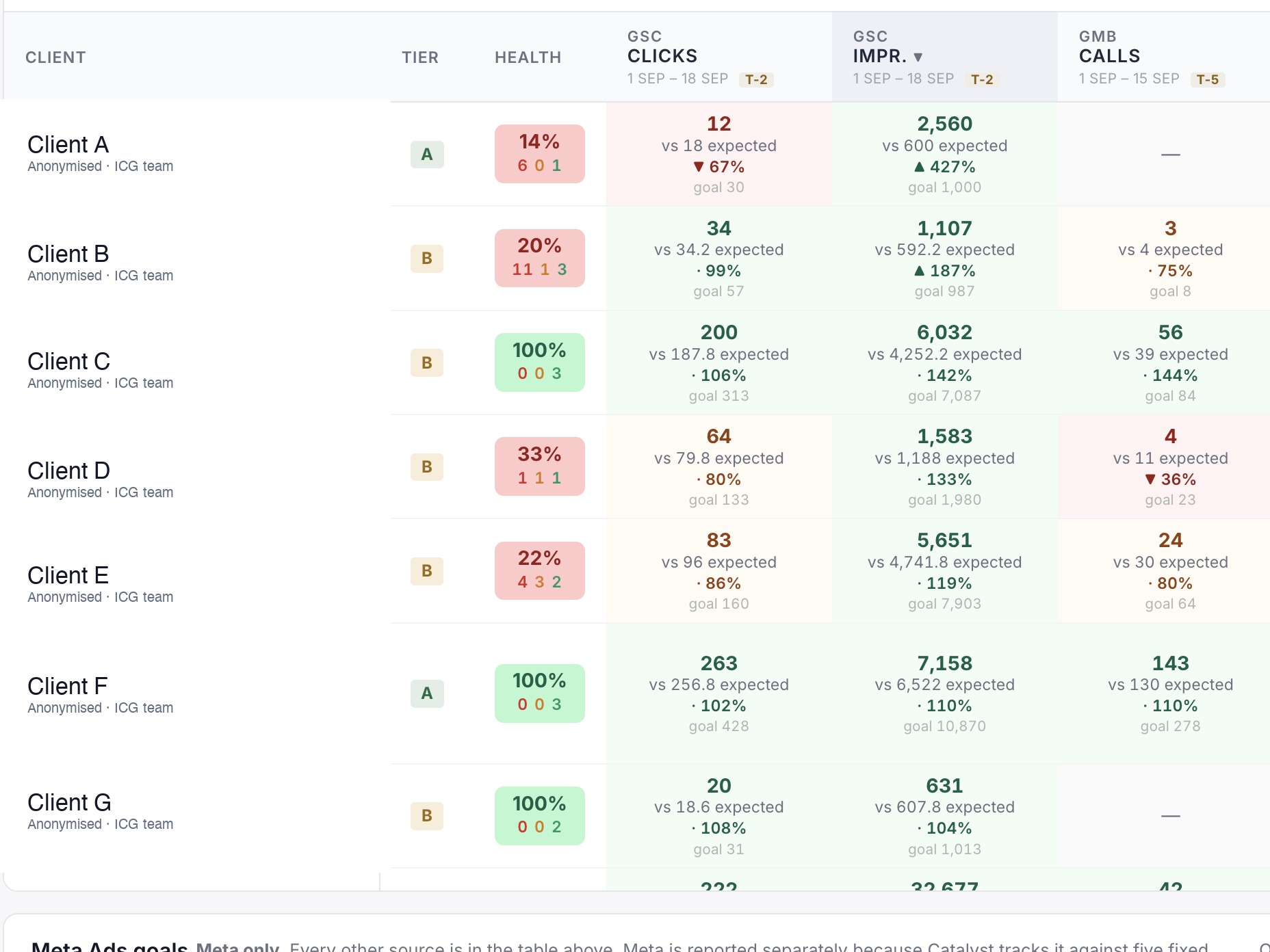
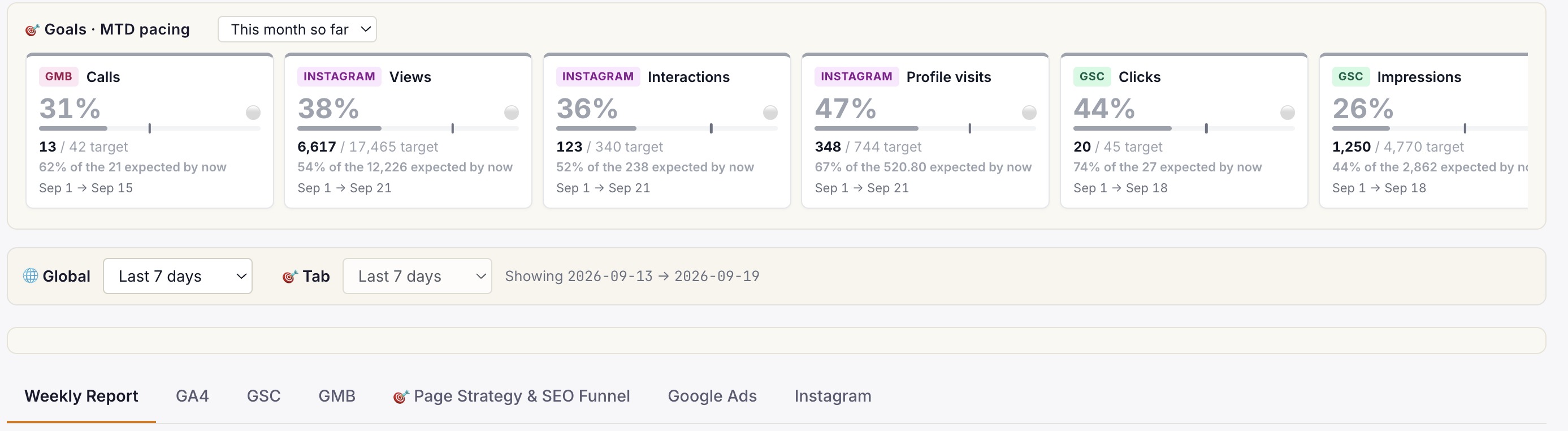
Every ICG engagement runs on the Search Intelligence Trifecta — Angryturtle for GMB, SIE for search and AI Overview, YODA for YouTube. Live product screens below.
Need help operationalising this?
Every ICG service is healthcare-only, NMC + DPDP-aware, and built around the patient-research patterns that drive Indian healthcare growth in 2026.
Every practice welcome — packages from ₹20,000/mo.
Goals-Driven engagements · Performance-Linked Payout Models available
More from
ICG.
Five trends shaping Indian healthcare marketing through 2027: AI-first patient research, Conversions API adoption, ABDM discovery, the AEO w...
Healthcare AIO is the discipline of getting your clinic or hospital cited inside Google AI Overviews, ChatGPT and Perplexity answers — not j...
Conversational-search advertising places brand messages inside AI chat answers — ChatGPT, Perplexity, Copilot — rather than beside a results...
Stop guessing.
Book a Diagnostic.
30 minutes. Free. With the AI-powered healthcare-only marketing agency 150+ brands already run on. No slides, no pitch, no hard close.


