


Google AI Overview vs organic position #1 for Indian healthcare — which surface actually wins the click, and where should your budget go in 2026?
AIO citation and organic rank #1 are not the same win. Here is the CTR split, the query types that favour each, and how ICG allocates budget across both surfaces.
No pitch. Written root-cause diagnosis. AI-powered, healthcare only.
Direct answer
AIO citation and organic rank #1 are not the same win. Here is the CTR split, the query types that favour each, and how ICG allocates budget across both surfaces.
TL;DR

Google AI Overview (AIO) citation and traditional organic position #1 are two separate wins on the same search results page. AIO citation places your brand name and one or two sentences of your page inside the generative answer panel above the blue links; organic #1 places your listing at the top of the classic ten-blue-link stack below it. In Indian healthcare through 2026, the two surfaces resolve different intents, deliver different click-through economics, and demand different content structures.
Since AI Overview rolled into Indian SERPs through late 2025 and 2026, healthcare marketing teams have started asking a specific question: if we can only prioritise one surface, which one? Should we push harder for the AIO citation and accept some organic slippage? Or should we defend the organic #1 slot on money-terms and treat AIO as a nice-to-have? This post walks through what each surface actually delivers for Indian healthcare queries, the CTR economics we track across 40+ pages in the ICG portfolio, the query types that favour each, and how we allocate a healthcare content budget across both. The short answer up front — for most Indian healthcare clients in 2026, the correct allocation sits around 65 percent organic and 35 percent AIO, shifting further toward AIO as query eligibility broadens through the year.
What organic position #1 still delivers in 2026
Organic #1 on a commercial-intent Indian healthcare query where no AIO panel fires still commands the click-through share it always has — roughly 27 to 34 percent of clicks on the page, dropping to around 15 percent when a Featured Snippet sits above it, and dropping further when an AIO panel occupies the top slot. On pure commercial queries — "IVF consultation Mumbai", "root canal Delhi price", "book skin doctor Bangalore" — AIO rarely fires at all because Google reads the query as transactional. On those queries, organic #1 remains the highest-value real estate on the page.
What organic #1 no longer delivers at the volume it once did is total dominance on informational-adjacent queries. A query such as "IVF success rate at age 38" now fires an AI Overview in most of our tracking. The organic #1 result still ranks and still gets clicks, but the click volume compresses because a subset of users get their answer inside the AIO panel and never scroll further. For those users, the AIO citation — not organic #1 — is the brand touchpoint that registers.
What AIO citation delivers that organic #1 cannot
AIO citation delivers two things a classic organic listing does not. First, it places your brand name inside the answer paragraph itself — not just in a link below the answer. For users who read the AIO panel and leave without clicking, that in-panel brand mention is the entire memory trace of your brand from that session. It is a real impression that Google Search Console still under-reports and that most analytics stacks cannot yet see.
Second, AIO citation gives you a durable pull-quote. If your page is the one being quoted verbatim inside the panel — one or two of your own sentences appearing as the answer — you have earned the position of authoritative source for that query for the duration Google keeps that citation active, which our tracking shows is usually 14 to 60 days per refresh cycle.
The CTR split we observe across query types
The click-through share on an Indian healthcare SERP depends heavily on what else is on the page. From ICG portfolio tracking through Q2 2026, this is the observed CTR distribution by query type:
| Query type | AIO fire rate | Organic #1 CTR (AIO absent) | Organic #1 CTR (AIO present) | AIO in-panel citation value |
|---|---|---|---|---|
| Pure commercial ("book X in Y") | Under 10% | 27-34% | N/A | Low — click still wins |
| Cost / price ("root canal cost Delhi") | 35-50% | 22-28% | 11-15% | High — cost tables get pulled |
| Definition ("what is IVF") | 75-90% | 18-24% | 6-9% | Very high — definitions get quoted |
| Comparison ("IVF vs IUI") | 60-80% | 20-26% | 8-12% | Very high — tables get pulled |
| Symptom / condition ("PCOS symptoms") | 70-85% | 22-28% | 10-14% | High — YMYL trust matters |
| How-to ("how to prepare for IVF") | 55-75% | 24-30% | 10-14% | High — step-lists get pulled |
| Brand ("Apollo IVF Delhi") | Under 5% | 50-70% | N/A | Not applicable |
| Local ("dermatologist near me") | 10-25% | 20-26% | 15-20% | Moderate — Maps takes precedence |
Two patterns fall out of the table. Pure commercial and brand queries are still owned by organic — AIO does not compete meaningfully. Definition, comparison, symptom, and how-to queries are where AIO is quietly consuming the informational click share, and where in-panel citation becomes the primary brand-exposure lever.
The content structure that wins each surface
Organic #1 and AIO citation reward different structural signals. Organic #1 rewards backlink authority, topical breadth, user-signal quality (dwell, pogo-sticking), page speed, and mobile experience — the classic on-page and off-page stack. AIO citation rewards definition-first openings, entity clarity that maps to canonical medical terms, FAQPage and MedicalCondition schema, credentialed named-author bylines, recency signals, and the absence of ASCI red flags that downgrade the panel trust filter.
A page can win one and lose the other. Marketing brochure pages heavy on superlatives ("India's best IVF clinic") sometimes rank organic #1 on backlink strength alone but never get AIO cited because the trust filter flags the language. Conversely, a plainly-written explainer page with clean schema and a credentialed byline gets AIO cited from organic position 6 while never breaking the top 3. The choice of which structure to prioritise per page is a strategic call and depends on what the query type actually rewards.
Which surface to prioritise per page
The rule ICG uses when scoping any Indian healthcare page:
- Classify the primary target query by intent — pure commercial, brand, local, definition, comparison, symptom, or how-to.
- Check the current SERP for AIO fire rate using incognito capture from an Indian IP on 5-7 variant queries.
- If AIO fires on more than 40 percent of the variant queries, treat AIO citation as a primary KPI and structure the page definition-first with FAQPage schema and clean pull-quote paragraphs.
- If AIO fires on less than 40 percent, treat organic ranking as the primary KPI and structure the page for depth, internal linking, and conversion — the classic commercial money-page pattern.
- Track both surfaces every 14 days and re-scope the KPI as AIO fire rates shift, which they will through 2026 as Google broadens eligibility.
The 40 percent threshold is empirical and holds across our portfolio. Below that, the AIO surface simply does not generate enough brand-exposure to justify optimising for it over the classic conversion structure. Above it, the informational click share is compressed enough that the AIO citation becomes the higher-value win.
What happens when you optimise only for organic (and skip AIO)
Two things happen. On definition, comparison, and symptom queries where AIO fires, you steadily lose click-share as more users complete their answer inside the panel. Your organic ranking does not fall — you simply capture a smaller slice of a shrinking click pool. Impressions in Search Console rise, clicks flatten or decline, and CTR looks like a leak.
The second thing that happens is a compounding brand-visibility gap. Competitors who structured for AIO citation get their brand name inside the answer panel on the highest-intent informational queries in your specialty. Users see their brand as the authority on those queries even when they never click through. Six months later, when the same users search a commercial intent variant, they type in the competitor's brand name directly. The competitor's branded search volume rises. Your branded search volume flattens. The lag between AIO citation and branded search lift is three to six months in our tracking — long enough that most teams do not connect the two until the branded gap is already wide.
What happens when you optimise only for AIO (and skip organic)
You get cited in panels. You do not get clicks. AIO citation without a solid organic ranking is almost impossible in the first place, because the AIO eligibility pool is drawn from the organic ranking pool — a page that ranks 47th organic will almost never surface in the panel. And on the queries where AIO does not fire (all pure commercial and brand queries), you have no conversion surface at all.
The realistic scenario is not "AIO instead of organic" but "AIO in addition to organic". The pages that consistently win both surfaces are the ones structured for AIO citation while retaining conversion depth for organic — a definition-first opening, mid-body explainer sections, a table or two, an FAQ block with schema, and a bottom section that handles the commercial conversion for the users who did click through.
How YODA's AIO Lab tracks both surfaces together
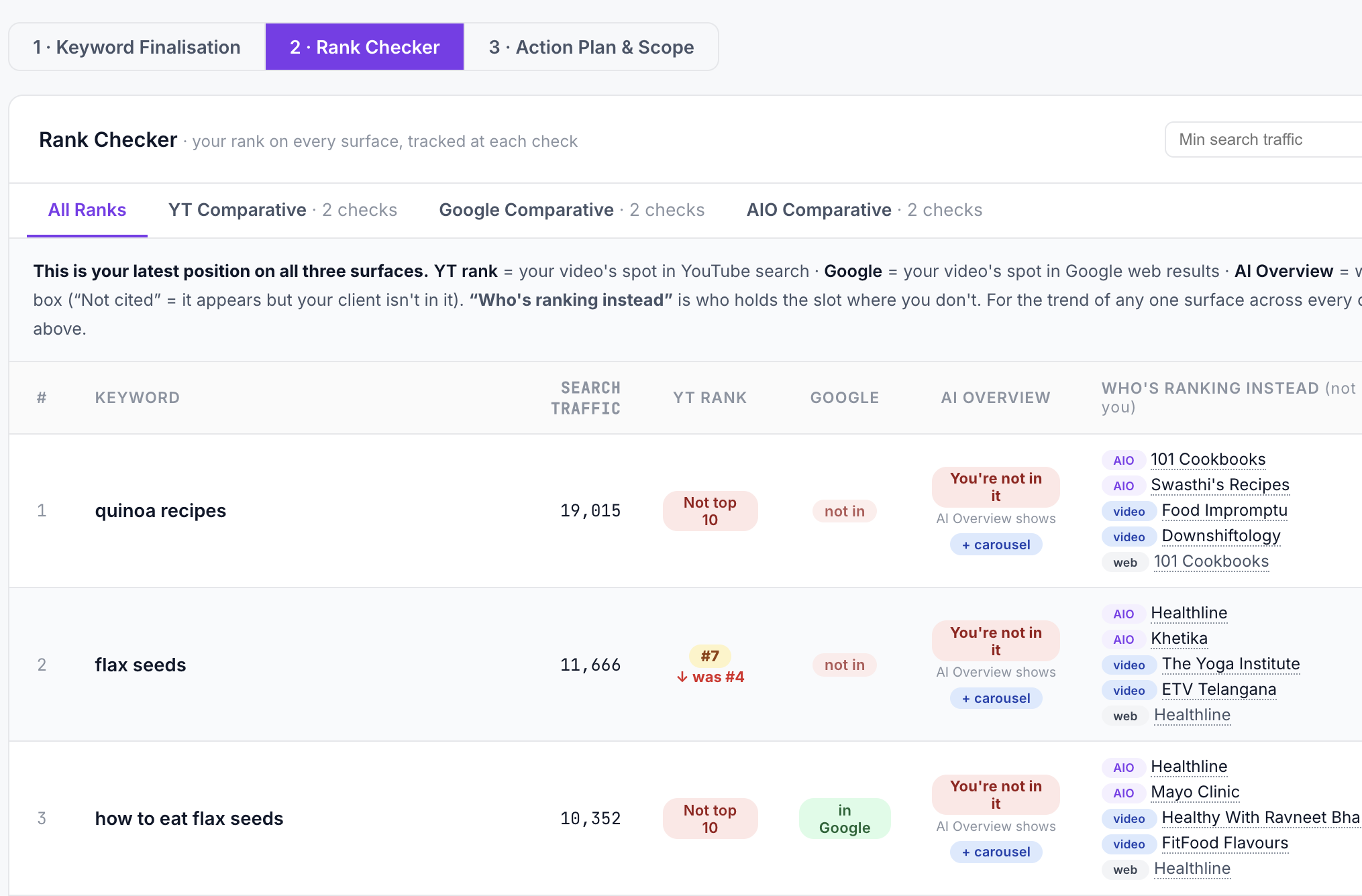
YODA — ICG's AI-native healthcare YouTube and content platform — runs three rank races per tracked keyword: YouTube search rank, Google web organic rank, and AI Overview citation. The AIO Lab module inside YODA covers keyword finalisation, rank checking across all three surfaces on a weekly cadence, and comparative deltas versus the prior week. When a page moves from "organic #5, not cited" to "organic #5, cited in AIO" after a definition-first rewrite, the lab surfaces the structural change and flags it so we can replicate the pattern on adjacent pages. When a page moves from "organic #2, cited" to "organic #2, not cited" — meaning the panel refreshed and dropped the citation — the lab traces the delta so we know what to defend.
The reason the two surfaces need to be tracked together is exactly the pattern the CTR table shows — losing one while holding the other looks fine on any single-surface dashboard and shows up as a leak only when both are visible on the same view.
Meta Catalyst IQ — the paid surface that complements both
Not every high-intent healthcare query is worth waiting 45 to 60 days to earn a citation on. For time-sensitive intake windows — IVF cycle bookings, aesthetic seasonal offers, dental aligner launches — paid Meta ads compress the acquisition window from months to days. Meta Catalyst IQ is ICG's Meta ads performance engine — 23+ active accounts, ₹9.1Cr+ optimised monthly spend, a portfolio blended CPL of ₹1,581 against a market benchmark near ₹3,200, and a 38 to 58 percent CPL reduction typically delivered inside 90 days. It runs alongside the AIO and organic content stack so that the informational demand your content earns organically gets a paid conversion path underneath it. Book a 30-minute Meta Catalyst IQ walkthrough on WhatsApp.
FAQ — AI Overview vs organic #1 for Indian healthcare

If AIO cites my page, does my organic ranking still matter?
Yes, materially. The AIO citation pool is drawn from the organic ranking pool — pages ranking outside the top 20 organic almost never get cited, and pages ranking top 5 organic are meaningfully more likely to be cited than pages ranking 6 to 10. Organic ranking is the foundation on which AIO citation is built. A page cannot earn AIO citation without first earning organic visibility for the same query cluster.
Does an AIO citation reduce clicks to my organic listing?
Usually yes on informational queries and usually no on commercial queries. When AIO answers the whole informational question, click-through to the organic listings below it compresses across the board — including your own listing. On commercial queries where AIO adds context but the user still needs to book, click-through holds. Which is why the KPI split we recommend follows query intent rather than a uniform site-wide policy.
Can I optimise for AIO without hurting my organic ranking?
Yes, and in most cases the AIO-optimisation changes lift organic ranking too. Definition-first openings improve topical clarity, FAQPage schema improves rich-result eligibility, credentialed bylines improve E-E-A-T signals, and removing ASCI superlatives improves the broader page-level trust score. The one place friction shows up is when a heavily conversion-optimised page has its hero rewritten as a plain definition — CRO can dip briefly. The workaround is to keep the CTA-heavy hero and add the definition paragraph immediately after it.
How do I know if AIO is firing on my target queries?
Manual incognito capture from an Indian IP on 5-7 variant queries per topic is the baseline. Tools that automate the capture at scale include YODA's AIO Lab (portfolio-wide, weekly), and third-party platforms like SE Ranking, seoClarity, and Semrush have rolled out AIO tracking through 2026. Google Search Console still does not report AIO citations as a distinct metric, so all tracking today is scripted external capture rather than first-party reporting.
Which healthcare specialties get the most AIO fire in India?
IVF, dermatology, dental, cardiology explainer content, and paediatrics symptom queries fire AIO most consistently in our tracking. Specialty-specific procedure explainer queries — "how is IVF done", "what causes acne", "do dental aligners work" — fire AIO at 70+ percent. Local booking queries fire AIO at under 25 percent because Google routes them to Maps and local pack rather than the generative panel.
What is the fastest way to earn AIO citation on a page that already ranks organic top 5?
Three changes usually do the work. Rewrite the opening paragraph as a strict 40-60 word definition, add FAQPage schema with 5-7 substantive Q/A pairs that mirror the People Also Ask block for the query, and add a Person schema byline with credentials and MCI registration where the author is a doctor. Our tracked median time-to-cite after these three changes is 14 to 21 days for pages already ranking top 5 organic.
Does paid search cannibalise AIO or organic?
Not meaningfully in either direction. Paid ads sit above AIO on the SERP for commercial queries but do not appear on most informational queries where AIO fires. The three surfaces — paid, AIO, organic — occupy different intent zones and different SERP real estate. The correct portfolio strategy is to allocate paid to commercial intent (Meta Catalyst IQ on paid social, Google Ads on search intent), organic to durable commercial money terms, and AIO to informational authority-building — with the three feeding each other over a 90 to 180 day horizon.
Related reading

- How to appear in Google AI Overview for healthcare queries in India — the 2026 playbook
- The eight AI Overview ranking signals for Indian healthcare
- AIO SEO for hospitals in India — the 2026 guide
- FAQPage schema for healthcare AIO — implementation guide
- Definition-first content structure — the AIO citation pattern
Compliance reference frameworks — India's National Medical Commission for practitioner conduct standards and the Advertising Standards Council of India for healthcare advertising rules governing superlatives, before-after imagery, and unsubstantiated claims. Both frameworks shape the trust perimeter AIO panels enforce when selecting which pages to cite.
Book a free 30-minute Brand & Growth Diagnostic.
It's a working session, not a sales pitch — you leave with a written root-cause analysis you can act on, whether or not you engage ICG.
The three platforms
behind every ICG engagement.
Beacon
CAPI middleware that fixes Event Match Quality, translates CRM statuses to Meta-standard events, dedups across channels.
Agency OS
Live client dashboard. GSC, GA4, Google Ads, Meta Ads, IVR calls in one view. Login anytime, not monthly.
Phoenix
Clinic revenue intelligence over your PMS. Daily action queue: Prevent Loss, Maintain & Engage, Grow Revenue. Multi-centre rollout.
Or book a free 30-min audit to see all three in action on your account.
Healthcare brands
that already run on ICG.
A representative slice of the 150+ healthcare brands ICG has delivered for across India. Most engagements remain under NDA.


What ICG clients say · on video.
"Scale up of organic channels and business consulting. ICG has absolute domain authority in their field."
"Working with ICG transformed how we acquire IVF patients in Gurgaon. They understand the fertility journey from inquiry to consult..."
"What Ichelon accomplished — they got all my ideas and worked over 3-4 months to create an amazing, super-customised website."
The intelligence stack behind this playbook.
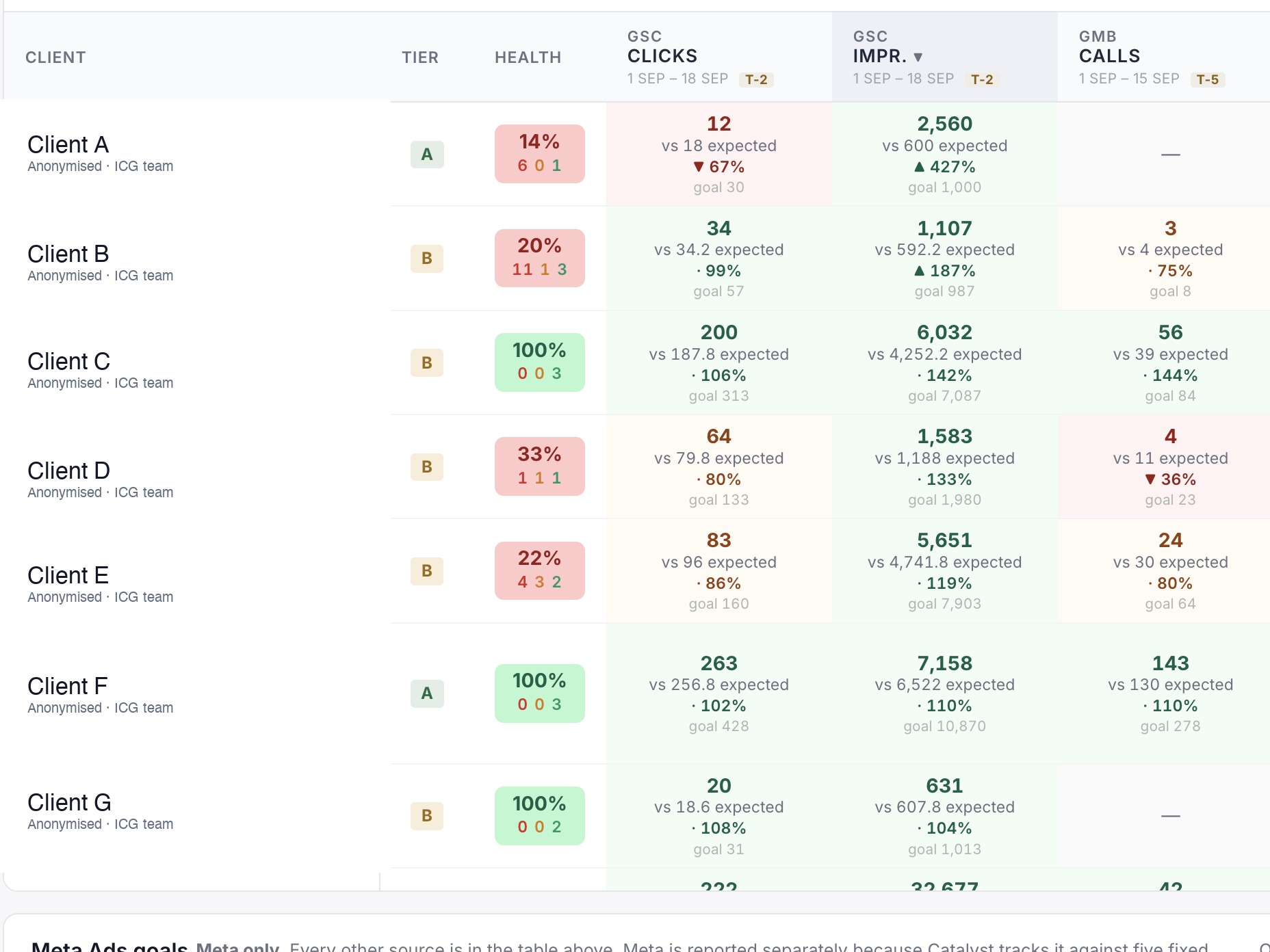
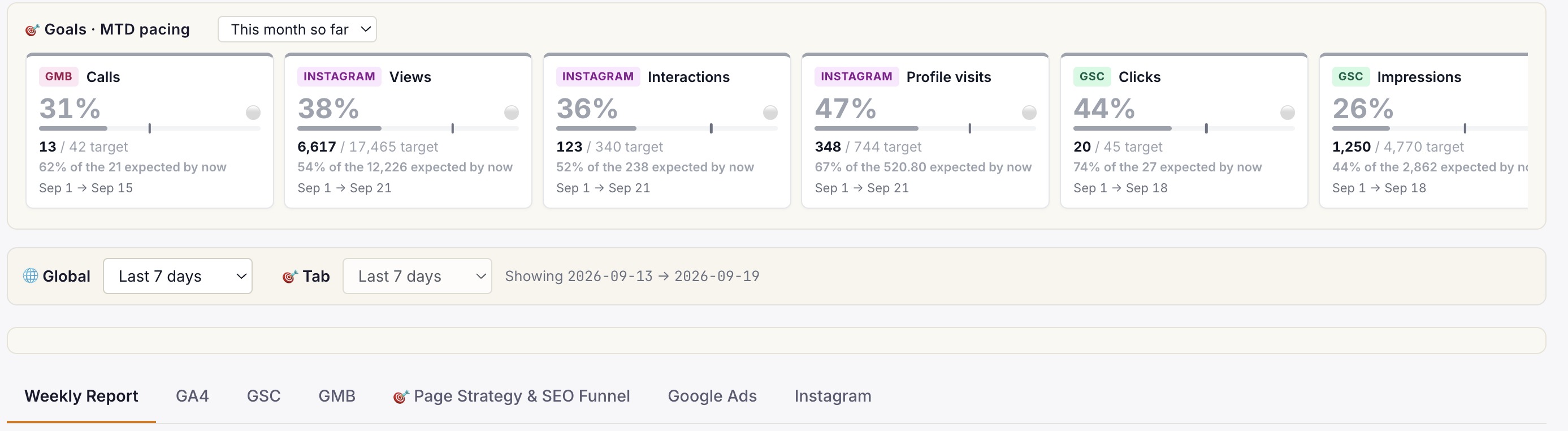
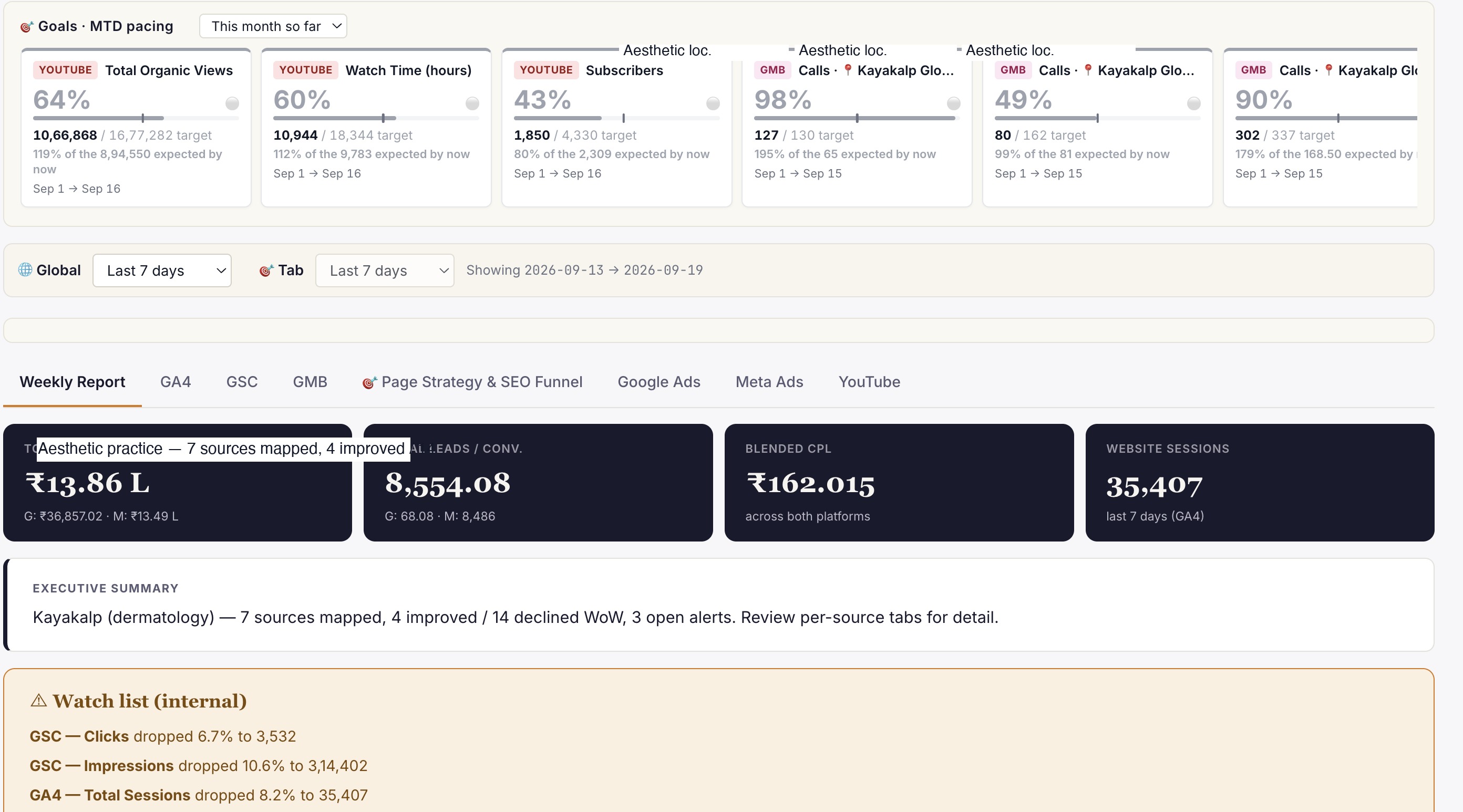
Every ICG engagement runs on the Search Intelligence Trifecta — Angryturtle for GMB, SIE for search and AI Overview, YODA for YouTube. Live product screens below.
Need help operationalising this?
Every ICG service is healthcare-only, NMC + DPDP-aware, and built around the patient-research patterns that drive Indian healthcare growth in 2026.
Every practice welcome — packages from ₹20,000/mo.
Goals-Driven engagements · Performance-Linked Payout Models available
More from
ICG.
Five trends shaping Indian healthcare marketing through 2027: AI-first patient research, Conversions API adoption, ABDM discovery, the AEO w...
Healthcare AIO is the discipline of getting your clinic or hospital cited inside Google AI Overviews, ChatGPT and Perplexity answers — not j...
Conversational-search advertising places brand messages inside AI chat answers — ChatGPT, Perplexity, Copilot — rather than beside a results...
Stop guessing.
Book a Diagnostic.
30 minutes. Free. With the AI-powered healthcare-only marketing agency 150+ brands already run on. No slides, no pitch, no hard close.


