


The eight AI Overview ranking signals for healthcare in India — what actually drives Google generative citation across YMYL medical queries in 2026
A close read of the eight signals ICG has observed drive AI Overview citation across 40+ Indian healthcare pages. Definition-first content, credentialed authorship, and schema-to-query fit dominate. Backlinks matter far less than in classic organic.
No pitch. Written root-cause diagnosis. AI-powered, healthcare only.
Direct answer
A close read of the eight signals ICG has observed drive AI Overview citation across 40+ Indian healthcare pages. Definition-first content, credentialed authorship, and schema-to-query fit dominate. Backlinks matter far less than in classic organic.
TL;DR

AI Overview ranking signals are the structural, semantic, and trust-graph properties that determine which pages Google's generative answer surface cites when responding to a query. For healthcare queries in India, eight signals dominate: definition-first opening, entity clarity, credentialed authorship, schema-to-query fit, structured pull-quotes, recency, source anchoring, and absence of ASCI-violating language. Backlink authority — the classic organic signal — matters far less at citation stage than at eligibility stage.
Marketers who have spent their careers ranking healthcare pages in classic organic Google routinely misdiagnose why their pages fail to earn AI Overview citation. They assume the answer is "more backlinks" or "higher domain authority" — the reflex of a search world where the top organic result was almost always the top cited source in any panel. AI Overview breaks that reflex. The AIO panel draws from the organic ranking pool, so classic SEO still governs eligibility, but the selection of which eligible pages get cited follows a different logic. This post breaks down the eight signals ICG has observed dominate that selection logic for Indian healthcare queries, in rough order of impact.
Signal one — eligibility versus citation as two different scoring stages
Before walking through the eight citation signals, one framing matters. AIO has two decision stages. Stage one is eligibility: is this page in the organic top-N for the query? Classic SEO — backlinks, technical health, topical authority, user signals — governs this stage. If a page does not clear organic top-10 or thereabouts for the query, it is not in the AIO retrieval pool at all. Stage two is citation: given the eligible pool, which pages does the LLM quote and link? Citation is where the eight signals below live.
Confusing the two stages leads to bad recommendations. "Build more backlinks to appear in AI Overview" is a stage-one prescription. "Rewrite the opening paragraph as a definition and add FAQPage schema" is a stage-two prescription. Most healthcare pages that fail AIO citation clear stage one comfortably and fail stage two. The right diagnosis is almost always structural.
Signal two — the definition-first opening paragraph
The single most consistent pattern across cited healthcare pages in AIO is the definition-first opening. First paragraph, 40 to 60 words, tight definition of the topic, ideally with the primary entity bolded. Every citation-earning page ICG has audited leads with a self-contained definition the LLM can pull as a verbatim quote.
The failure mode is the marketing intro — a paragraph that opens with a question, a value proposition, or a hook aimed at the reader's emotional attention. That opening is unquotable because it contains no self-contained factual claim the LLM can lift. The rewrite is mechanical: move the definition to the first paragraph, put the hook and CTA lower on the page. Nothing about SEO tradition prevents this; it is purely an editorial habit.
Signal three — entity clarity and canonical naming
AIO resolves entities before it retrieves candidate sources. If the query is "PCOS symptoms", the panel first identifies PCOS as the canonical entity (Polycystic Ovary Syndrome, mapped to Wikidata Q736907, MeSH D011085, SNOMED 237049001), then looks for pages that reference the entity clearly. Pages using colloquial or ambiguous names ("hormonal problems in women") struggle to be retrieved for the canonical query.
Entity clarity is not about keyword density. It is about ensuring the primary entity is named with its canonical form at least once in the opening paragraph, H1, and meta title. Secondary references can use the colloquial form. Cross-linking to internal entity pages (glossary, condition library) further strengthens the entity graph the LLM uses for retrieval.
Signal four — credentialed authorship and E-E-A-T
Healthcare is a YMYL vertical. Google's quality raters weight E-E-A-T (Experience, Expertise, Authoritativeness, Trustworthiness) heavily on YMYL, and the AIO trust filter mirrors that weighting. A page authored by a named consultant with visible credentials — Person schema, hasCredential, memberOf pointing to NMC or State Medical Council, sameAs to LinkedIn and MCI registry — carries materially more citation weight than an unattributed page of equivalent content depth.
The failure mode is the anonymous marketing page. Content teams often publish under a company byline ("The Marketing Team") or unattributed. That pattern was tolerable in classic organic and is punitive in AIO. Fix: every substantive healthcare content page carries a named consultant byline with Person schema, cross-linked to the consultant's bio page. ICG's named-experts byline component exists for this exact reason.
Signal five — schema-to-query fit
Schema matters, but not uniformly. Schema type must match query intent. FAQPage schema on a question-form informational page carries high citation lift. FAQPage schema on a marketing pricing page (where the "answers" are actually CTAs) trips the trust filter and hurts broader rankings. The table below summarises the schema-to-intent map ICG uses.
| Query intent | Best-fit schema | Why it works |
|---|---|---|
| What is X (definition) | MedicalCondition / MedicalProcedure + FAQPage | Definition-first pattern maps naturally |
| How to X (procedural) | HowTo | Step schema mirrors the answer format AIO wants |
| Cost / price of X | MedicalProcedure with cost + FAQPage | Cost-schema field is directly citable |
| Symptoms of X | MedicalCondition with signOrSymptom | Structured symptom list is directly quotable |
| Doctor for X near me | Physician + LocalBusiness | Local intent + entity graph both needed |
| Video: how X works | VideoObject with transcript | AIO surfaces video previews for procedural intent |
| Voice / speakable query | Speakable spec sections | Explicit signal for Assistant / Nest surfaces |
Schema is a claim. Adding schema does not fake authority; it structurally signals what the page contains. Adding wrong schema (marking a marketing page as MedicalCondition, for example) is worse than adding no schema at all.
Signal six — structured pull-quotes throughout the body
AIO citations are almost always short verbatim quotes from the cited page, 1 to 3 sentences long. Pages that give the LLM lots of clean pull-quotes get cited more. Pages that bury facts in long, complex, comma-heavy sentences get retrieved but not cited. The editorial move is to write every substantive claim as a self-contained short sentence at the start of a paragraph, then elaborate below.
Tables and numbered lists dramatically improve pull-quote density because each row or step is self-contained. This is why FAQ blocks convert to citation so well — each Q/A pair is a clean pull-quote by construction. Applying the same discipline to normal body prose (short lead sentence, then elaboration) lifts citation odds without changing overall page structure.
Signal seven — recency and dateModified signals
Healthcare content ages fast. Guidelines change, drugs get approved or withdrawn, procedural best practice evolves. AIO downweights stale medical content aggressively. Pages carrying a visible "last reviewed on [date]" plus a dateModified field in schema within the last 12 months get cited over otherwise-equivalent pages without the recency signal.
The failure mode is treating publish date as freshness. A page published in 2019 with a 2019 dateModified and no visible review date is treated as five years old regardless of underlying content quality. The rewrite is a simple content-refresh discipline: every clinical page reviewed at least annually, review date visible on-page, dateModified schema updated on save.
Signal eight — source anchoring to Tier-1 authorities
AIO's trust filter looks for pages that cite authoritative sources for their factual claims. At least one outbound link to a Tier-1 authority — mohfw.gov.in, ICMR, NMC, WHO, NIH, PubMed, or a peer-reviewed journal — signals editorial rigour and lifts citation odds. The failure mode is the closed-loop page that cites only the brand's own other pages and never anchors to external evidence.
The compliance-adjacent win: outbound authority links are also what NMC and ASCI expect on any efficacy or clinical claim. Compliance-safe writing and AIO-friendly writing converge on this signal too. Anchor everything; opinions are cheap and evidence is trusted.
Signal nine — absence of ASCI red flags in the trust-parsed layer
The AIO trust filter downgrades pages carrying unsubstantiated superlatives — "best", "leading", "#1", "top-ranked", "100% success", "guaranteed". Not because the filter enforces Indian ASCI rules specifically, but because those language patterns correlate with lower editorial quality across the wider web that the trust filter was trained on. On Indian healthcare pages the alignment is exact: ASCI-violating language is also AIO-downgrading language.
The fix is a search-and-replace pass across the H1, meta title, lede, and any bolded claim on the page. Reframe superlatives as substantiated statements ("selected by 150+ Indian healthcare brands" is verifiable and citable; "India's leading GBP OS" is neither). This one edit alone has moved several pages from zero citations to steady citation in the ICG portfolio.
The eight-signal checklist in priority order for a fast audit
- Definition-first opening paragraph — highest impact, easiest fix.
- Absence of ASCI red flags — very high impact, purely editorial fix.
- Credentialed byline with Person schema — high impact, cross-page consistency required.
- Schema-to-query fit — high impact, moderate technical work.
- Structured pull-quotes / tables / lists in body — moderate impact, editorial habit.
- Recency signal (visible date + dateModified) — moderate impact, ongoing maintenance.
- Source anchoring to Tier-1 authorities — moderate impact, editorial habit.
- Entity clarity with canonical naming — foundational, usually needs a taxonomy pass across the site.
How YODA's AIO Lab tracks signal drift across a portfolio
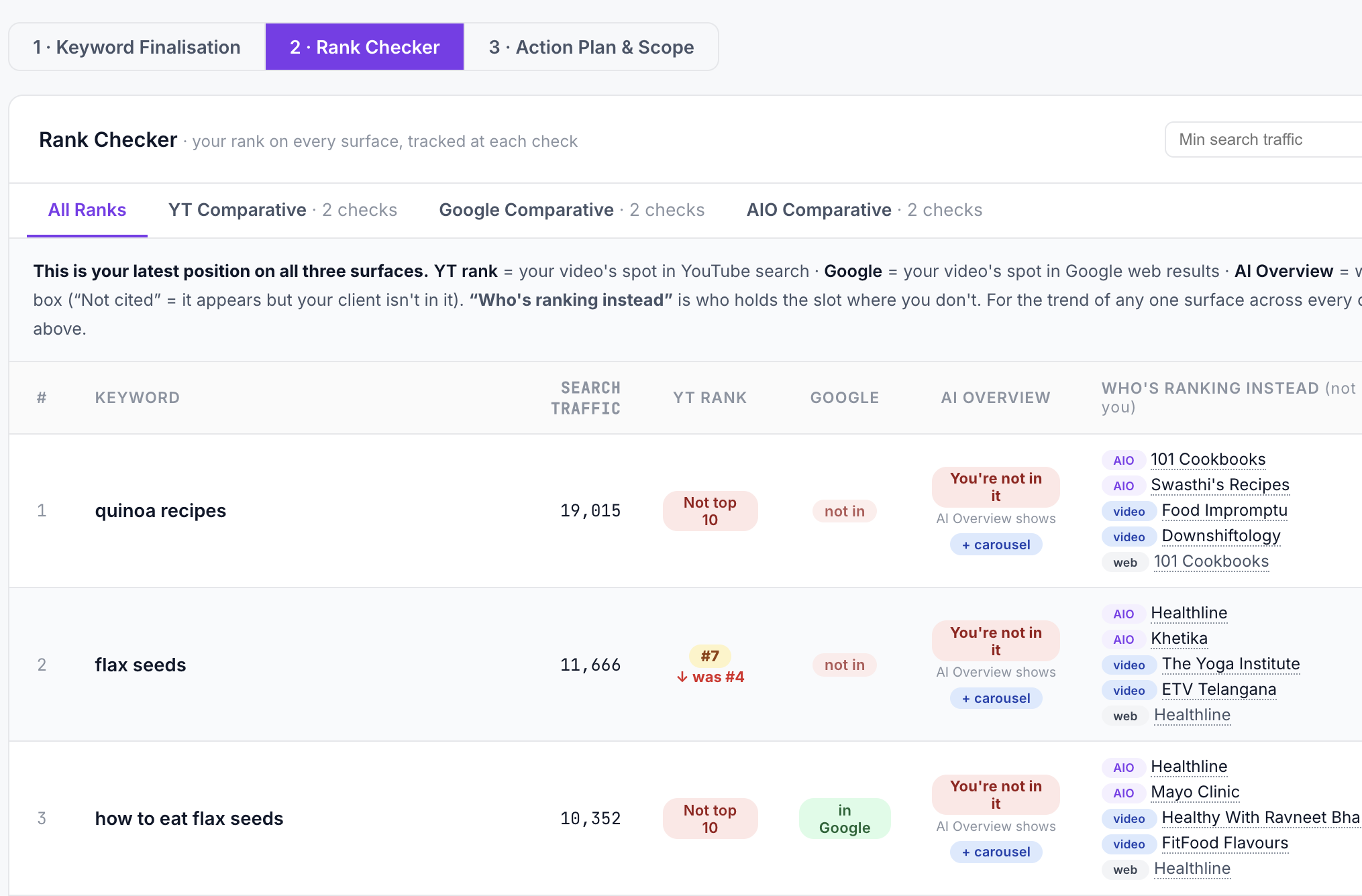
Signals do not stay stable. Google refines the AIO trust filter, competitor pages upgrade their schema, new sources enter the eligible pool. YODA's AIO Lab tracks these shifts across a client's query set weekly — which sources are being cited, which of your pages lost citation, which competitor moved in. For ICG portfolio brands, this refresh feeds directly into the following week's content refresh queue. Angryturtle's Ask Maps AIO runs the same signal tracking on the Maps AIO surface, where the eight signals apply with slightly different weightings (GBP profile trust signals matter more, on-page schema matters less).
FAQ — AI Overview ranking signals for Indian healthcare

How much do backlinks matter to AIO citation?
They matter to eligibility (getting into the organic top-10 pool AIO retrieves from), but they do not directly drive citation once inside the pool. A page with fewer backlinks but stronger structural signals will out-cite a page with more backlinks but weaker signals, provided both clear eligibility.
Which single signal has the highest citation lift?
Definition-first opening paragraph, consistently across the ICG portfolio. It is also the easiest fix — a 15-minute edit on most pages. The second is removing ASCI red flags from the H1 and lede.
Does Google publish AIO ranking signals?
No. Google has published high-level principles about the Search Generative Experience but has not published a signals list. The eight signals in this post are inferred from empirical observation across the ICG portfolio and audit of AIO-cited pages across Indian healthcare queries.
Do we need to update our content constantly to maintain AIO citation?
Not constantly, but annually at minimum for clinical content. Recency signals decay after 12 months. A simple review-and-refresh cadence (touch every clinical page once a year, update dateModified, add a "last reviewed" line) sustains citation without requiring wholesale rewrites.
Are these signals the same for global healthcare queries, or specific to India?
The eight signals are broadly the same. The India-specific overlay is (a) heavier ASCI trust-filter alignment on Indian queries, (b) NMC-anchored credentials carry weight for Indian doctor citation, (c) India-context sources (ICMR, MOHFW) work as Tier-1 anchoring for India-specific claims where WHO or NIH would be Tier-1 for global claims.
Can we cheat these signals with black-hat tactics?
Attempts we have observed — fake bylines with invented credentials, schema stuffing, fake FAQ blocks — trigger the trust filter and demote broader rankings. AIO citation is not gameable in the way that backlink-based algorithms were in the 2010s. The signals reward substance because the LLM verifies against the underlying content pattern, not just declarative markup.
How do we prioritise fixing signals across a 100-page site?
Rank pages by combined organic traffic and commercial value. On the top 20 pages, run the eight-signal checklist. Fix the top three signals per page (usually definition-first, ASCI cleanup, byline). Move to the next 20. Full corpus takes 4-6 months of steady editorial work.
Related reading
- How to appear in Google AI Overview for healthcare queries in India
- AIO SEO for hospitals in India — the 2026 guide
- Definition-first content structure for AIO citation
- FAQPage schema for healthcare AIO — implementation guide
- AI Overview citation for individual doctors in India
Reference frameworks — India's National Medical Commission for Ethics Code 2026, the Advertising Standards Council of India for advertising rules, and DPDP Act 2023 for patient data. Meta advertising context at Meta Business Help.
Book a free 30-minute Brand & Growth Diagnostic.
It's a working session, not a sales pitch — you leave with a written root-cause analysis you can act on, whether or not you engage ICG.
The three platforms
behind every ICG engagement.
Beacon
CAPI middleware that fixes Event Match Quality, translates CRM statuses to Meta-standard events, dedups across channels.
Agency OS
Live client dashboard. GSC, GA4, Google Ads, Meta Ads, IVR calls in one view. Login anytime, not monthly.
Phoenix
Clinic revenue intelligence over your PMS. Daily action queue: Prevent Loss, Maintain & Engage, Grow Revenue. Multi-centre rollout.
Or book a free 30-min audit to see all three in action on your account.
Healthcare brands
that already run on ICG.
A representative slice of the 150+ healthcare brands ICG has delivered for across India. Most engagements remain under NDA.


What ICG clients say · on video.
"Scale up of organic channels and business consulting. ICG has absolute domain authority in their field."
"Working with ICG transformed how we acquire IVF patients in Gurgaon. They understand the fertility journey from inquiry to consult..."
"What Ichelon accomplished — they got all my ideas and worked over 3-4 months to create an amazing, super-customised website."
The intelligence stack behind this playbook.
Every ICG engagement runs on the Search Intelligence Trifecta — Angryturtle for GMB, SIE for search and AI Overview, YODA for YouTube. Live product screens below.
Need help operationalising this?
Every ICG service is healthcare-only, NMC + DPDP-aware, and built around the patient-research patterns that drive Indian healthcare growth in 2026.
Every practice welcome — packages from ₹20,000/mo.
Goals-Driven engagements · Performance-Linked Payout Models available



More from
ICG.
Five trends shaping Indian healthcare marketing through 2027: AI-first patient research, Conversions API adoption, ABDM discovery, the AEO w...
Healthcare AIO is the discipline of getting your clinic or hospital cited inside Google AI Overviews, ChatGPT and Perplexity answers — not j...
Conversational-search advertising places brand messages inside AI chat answers — ChatGPT, Perplexity, Copilot — rather than beside a results...
Stop guessing.
Book a Diagnostic.
30 minutes. Free. With the AI-powered healthcare-only marketing agency 150+ brands already run on. No slides, no pitch, no hard close.


