


YouTube thumbnail CTR for healthcare (2026): doctor and clinic thumbnail design that wins the click
Thumbnail design for healthcare YouTube videos — face vs text vs graphic, colour psychology, compliance guardrails (no patient photos without consent, no before-after without disclaimer), CTR benchmarks per specialty, and a 5-test A/B framework. What YODA's thumbnail lab actually tests for Indian doctors, clinics and hospital YouTube channels.
No pitch. Written root-cause diagnosis. AI-powered, healthcare only.
Direct answer
Thumbnail design for healthcare YouTube videos — face vs text vs graphic, colour psychology, compliance guardrails (no patient photos without consent, no before-after without disclaimer), CTR benchmarks per specialty, and a 5-test A/B framework. What YODA's thumbnail lab actually...
TL;DR

YouTube thumbnail CTR for healthcare content — the click-through rate of a doctor's or clinic's video thumbnail against its impressions — is the single most leveraged variable in whether that video ever reaches the audience it was made for. A doubled thumbnail CTR doubles the traffic without a single change to the video itself; a halved thumbnail CTR halves it just as fast. And thumbnails in healthcare are harder than in most verticals, because the visual choices most creators reach for by default — before-after transformation shots, patient face reveals, dramatic emotional imagery — carry NMC's 2026 advertising guidelines, ASCI Guidelines 2022 and DPDP Act 2023 exposure that lifestyle or entertainment thumbnails do not. Getting thumbnails right is therefore a design problem, a marketing problem and a compliance problem in one — and it is the visible half of any serious healthcare YouTube marketing programme, connecting to the wider ICG healthcare marketing pillar. This piece covers the design decisions, the benchmarks, the compliance envelope and the 5-test A/B framework YODA's thumbnail lab uses on Indian healthcare channels.
Why thumbnails matter more in healthcare than most verticals
Healthcare viewers are typically in one of three mindsets when a thumbnail appears in front of them: actively searching (they typed a symptom, condition or treatment query and are scanning results), passively browsing (a suggested-video panel while watching adjacent content), or research-phase drift (they are trying to understand a diagnosis or a proposed treatment path). All three mindsets are cognitively loaded — the viewer is thinking about health, sometimes worried, often filtering hard for trustworthiness cues before clicking.
The thumbnail is the trust filter. In under a second a viewer decides whether the video looks credible, whether the doctor looks like someone they'd see, whether the topic matches their query, and whether the visual style feels appropriate for a medical topic. Thumbnails that fail any of these tests get skipped no matter how good the underlying content is.
This is why CTR benchmarks for healthcare thumbnails tend to run tighter than in entertainment or lifestyle — the audience is smaller, more filtered, more decisive. A 2% CTR that would be acceptable in a lifestyle channel is a red flag in healthcare; a 7% CTR that would be modest for a comedy channel is genuinely strong for medical content.
The three thumbnail archetypes for healthcare
Most healthcare thumbnails resolve into one of three visual archetypes — face-forward, text-forward, or graphic-forward — with hybrids in between. Each has different strengths and different failure modes.
Face-forward thumbnails
The doctor's face fills 40-60% of the thumbnail, usually with an expressive but professional facial cue (thoughtful, warm, engaged — not shocked or exaggerated in the entertainment-YouTube style), often paired with a short text overlay and a supporting element (a small diagram or an object relevant to the topic).
Works well for: Explainer content where the doctor is the authority the viewer is coming to see; Q&A content where the doctor-as-answerer is the value; Testimonial framing videos where the doctor is presenting a patient story.
Fails when: the face is generic or looks stock (no personality read), the expression looks artificial, the lighting is flat, or the framing crowds the text overlay into unreadability.
CTR range for healthcare in India: 5-11% when well-executed.
Text-forward thumbnails
3-6 words of large, high-contrast text dominate the thumbnail, framed as a question, a myth-vs-fact statement, or a specific promise. A supporting graphic or icon sits behind or beside the text. The doctor's face is either small or absent.
Works well for: Mythbuster content (the myth stated as thumbnail text), Q&A content (the question as thumbnail text), and long-tail search-driven content where the search-query language should appear on the thumbnail directly.
Fails when: the text is too long to read at thumbnail sizes (Studio mobile size is small — anything over 6 words risks illegibility), the contrast is weak against the background, or the phrasing sounds clickbait-y in a way that trips healthcare-viewer trust filters.
CTR range for healthcare in India: 4-9% when well-executed; can peak higher on strong myth-vs-fact hooks.
Graphic-forward thumbnails
A medical diagram, anatomical illustration, before-after graphic (with heavy compliance caveats — see below), procedure schematic, or data-visualisation graphic dominates the thumbnail. Text is minimal, face is minimal or absent.
Works well for: deep-explainer content where a diagram is the substance (e.g., "what happens during angioplasty"), procedure-comparison content (implant vs bridge), and technical education content where the visual is the value proposition.
Fails when: the graphic is unreadable at thumbnail sizes, when the graphic looks clinical to the point of intimidating a lay viewer, or when compliance rules restrict the use of the graphic type (before-after imagery being the most common problem area).
CTR range for healthcare in India: 3-7% when well-executed; niche but effective for the right topics.
Colour psychology for healthcare thumbnails
Colour choices in healthcare thumbnails carry heavier signalling load than in most verticals. Broad patterns ICG observes across the healthcare channels YODA monitors:
Deep blues and teals: read as clinical, calm, trustworthy. Good default for hospital brand thumbnails and specialty channels wanting authority signalling. Overuse can feel cold.
Warm greens: health, growth, calm, wellness. Works for dermatology, wellness, integrative medicine.
Bold reds and oranges: attention-grabbing but risky in healthcare — reads as urgent or alarmist. Use sparingly on genuinely urgent topics (emergency care, symptom-recognition) and avoid for elective or lifestyle procedures.
Soft neutrals with a single accent: professional, editorial, magazine-style. Works for premium-positioned clinics and hospitals wanting to signal a higher-end brand.
Yellow and gold accents: attention without alarm. Good for text overlays and Mythbuster call-out badges.
Whatever the base palette, high contrast between the text and the background is non-negotiable — YouTube thumbnails are viewed at small sizes on mobile screens under variable lighting, and low contrast reads as unprofessional even when the design is otherwise strong.
Compliance guardrails for healthcare thumbnails
Healthcare thumbnails sit inside a stricter compliance envelope than the video content itself, because the thumbnail is the first advertising-adjacent surface any viewer sees. The core rules:
Patient photos require explicit written consent. Under NMC's 2026 advertising guidelines and DPDP Act 2023, using a real patient's face in a thumbnail requires the patient's informed, specific, written consent — for the use, the platform, and the ongoing publication. Consent given for one video does not automatically extend to a thumbnail crop of that video used in a different context.
Before-after imagery requires disclaimers. ASCI Guidelines 2022 require that any before-after imagery in advertising be substantiated, representative and accompanied by a disclaimer that results vary by patient. In a YouTube thumbnail context, fitting a legible disclaimer inside a thumbnail is often physically difficult — which is why many well-run healthcare channels avoid before-after thumbnails entirely and use them only inside video content where disclaimer text can be shown on-screen.
No sex-determination language or imagery for fertility content. PC-PNDT Act 1994 restricts any content that could be construed as promoting or enabling sex-determination. Thumbnails for fertility content must be entirely clear of any gender-baby imagery or language that could implicate this.
No unsubstantiated success-rate or comparative claims in thumbnail text. "Highest success rate", "best in India", "guaranteed results" — all violate ASCI substantiation rules and NMC restrictions on doctor advertising. Thumbnail text must be defensible if challenged.
No stock imagery misrepresenting the clinic. Stock photos of surgical teams, hospital corridors, or patient interactions used to imply the clinic's facilities carry misrepresentation risk under consumer protection frameworks even before the ASCI question.
Doctor images must use the doctor's real photo, not enhanced. Beyond ethical concerns, misleading likeness can implicate NMC provisions on doctor advertising.
CTR benchmarks per specialty in India
Rough organic-only CTR ranges ICG sees across Indian healthcare YouTube channels — ranges rather than fixed numbers because search-driven and browse-driven CTRs vary widely inside a single channel:
Dermatology: 4-9% organic CTR range. Strong performers on face-forward and Mythbuster thumbnails.
IVF and fertility: 3-8% organic CTR. Higher on Explainer and Testimonial (compliance-permitting) framings.
Dentistry: 4-10% organic CTR. Text-forward Mythbuster and Q&A thumbnails often peak in this specialty.
Orthopaedics: 3-7% organic CTR. Graphic-forward procedure explainers benchmark well; face-forward for the senior surgeon works when the surgeon is well-known.
Cardiology: 3-6% organic CTR. Trust-signalling design (deep blues, senior doctor faces) tends to lead.
Gynaecology and obstetrics: 4-8% organic CTR. Warmer palettes, thoughtful expressions, Mythbuster thumbnails all show well.
Oncology: 3-6% organic CTR. Editorial, restrained, information-forward design outperforms attention-grabby styles because viewers are cognitively loaded.
Aesthetic and plastic surgery: 4-9% organic CTR. Compliance restrictions on before-after imagery push these channels toward face-forward and graphic-forward alternatives.
Benchmarks are directional. The useful comparison is the channel's own trend over time as thumbnails are iterated.
The 5-test A/B thumbnail framework
The YODA thumbnail lab runs five distinct tests on any promotion-candidate video before locking a final thumbnail:
Test one — archetype test. Face-forward vs text-forward vs graphic-forward variant of the same core concept. Establishes which archetype the audience is responding to for this specific topic.
Test two — expression test (face-forward only). Same face, same text, same background — variant expressions (thoughtful, warm, engaged, direct-eye-contact). Establishes the doctor's highest-CTR expression for the topic.
Test three — text hook test. Same visual, same colours — variant text hooks (question vs statement vs myth-vs-fact). Establishes the framing that pulls clicks best for the topic.
Test four — colour and contrast test. Same visual, same text — variant colour palettes and contrast ratios. Establishes the palette that reads best against the specific search or browse surfaces this video appears in.
Test five — compliance-safe variant lock. The winning combination from tests one to four is re-checked against the compliance guardrails (patient consent, ASCI substantiation, PC-PNDT/DPDP considerations). If any issue surfaces, the second-best variant that clears compliance becomes the ship candidate.
Tests run inside YouTube Studio's built-in A/B tool where available, or via third-party tools for channels with the volume to justify it. Each test needs enough impressions to be statistically meaningful — for most healthcare channels this means a 7-14 day test window per variant pair.
What YODA's thumbnail lab tests differently
Three things YODA's thumbnail lab does that generic thumbnail A/B tools do not:
Compliance pre-check on every variant. Before any thumbnail is added to the test pool, it passes through a compliance-envelope check against NMC, ASCI, DPDP, PC-PNDT and ART Act rules relevant to the specialty. Variants that fail are surfaced with the specific rule and the fix.
Organic-CTR read separated from paid-CTR read. Consistent with the broader promoted-vs-organic separation principle across YODA, thumbnail test results are reported with organic CTR and paid-campaign CTR as separate figures — never blended.
Writeback to YouTube directly. When a winning variant is confirmed, YODA writes the thumbnail change (along with title, description, tags, chapters if optimising simultaneously) back to YouTube via API — no manual copy-paste from tool to Studio.
The result is that thumbnail iteration becomes a continuous, compliance-safe, decisions-first workflow rather than a manual quarterly cleanup effort.
The platform ICG uses to run this at scale: YODA
ICG runs healthcare YouTube marketing for clinics, hospitals, and specialty groups using YODA — our AI-native healthcare YouTube marketing platform. YODA sits on top of a channel's data and does four things no dashboard does: it separates organic from paid views at every step (so a promoted video can never masquerade as organic growth), it gives decisions not dashboards (every video gets a state + next action), it writes back to YouTube directly (improved titles, tags, descriptions, chapters applied straight to the platform), and it tracks the three rank races — YouTube search, Google web, and Google AI Overview citations.
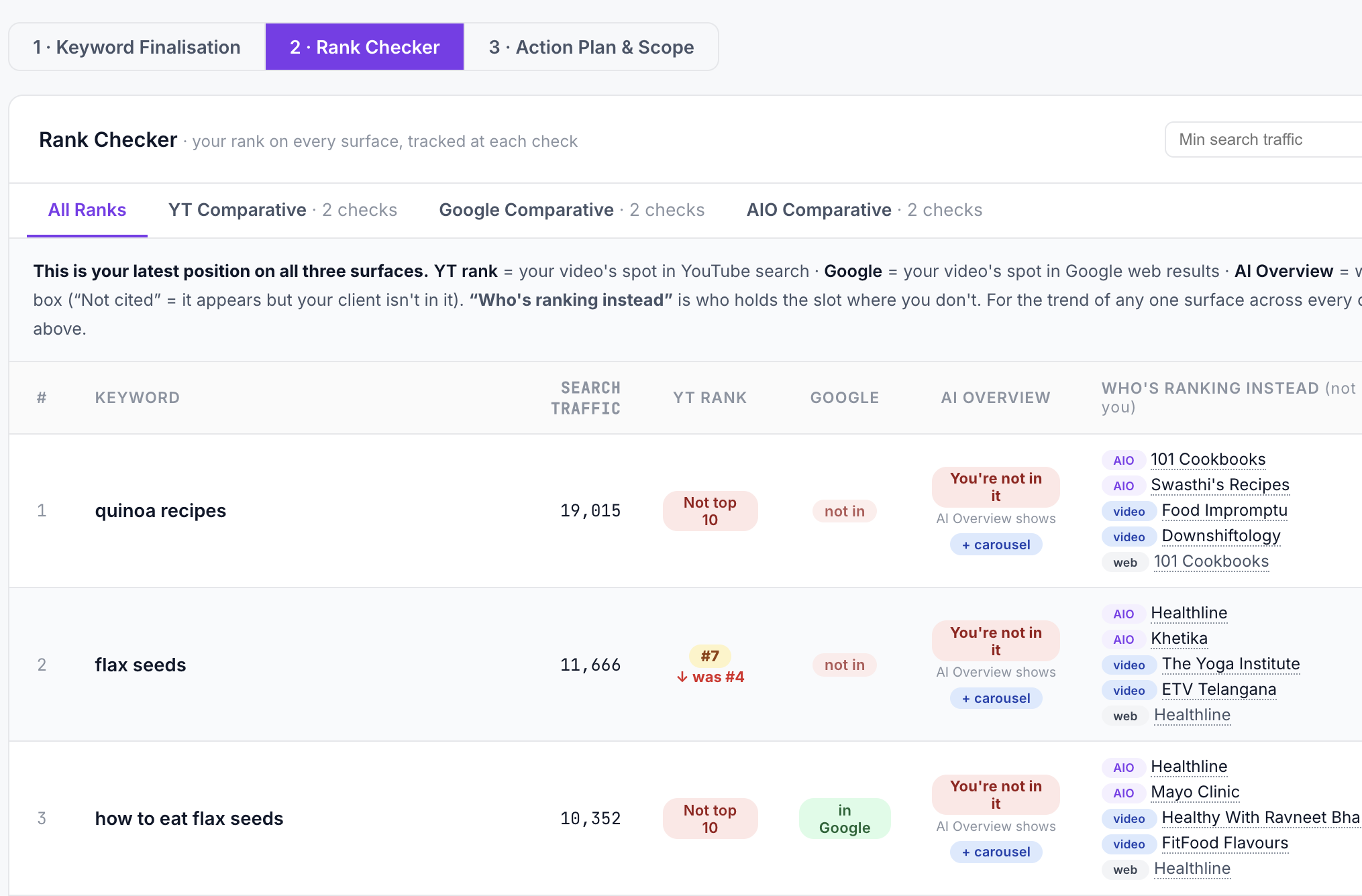
YODA runs the full 6-step workflow — Overview, Diagnostics, Strategy, Optimisation, Reputation (ORM), and Competitor Intel — with 40+ analysis modules organised under those steps. ICG's managed YouTube service uses YODA end-to-end. See the Healthcare YouTube Marketing pillar guide for the full scope, or the Healthcare YouTube Marketing Agency service page for engagement details.
Book a YODA demo on WhatsApp → or request a free healthcare YouTube channel audit →
Related reading
- Which video deserves ad budget — where thumbnail CTR fits into the promotion decision
- Explainer vs mythbuster vs testimonial video formats — the format choice that determines thumbnail archetype
- Vanity metrics in healthcare video marketing — the metric hygiene layer that CTR sits inside
- Healthcare YouTube marketing pillar guide — the pillar reference
- Healthcare YouTube Marketing Agency service page — engagement scope
FAQ
Can I use before-after photos in healthcare thumbnails at all? Rarely and carefully. ASCI Guidelines 2022 require substantiation and a "results vary" disclaimer, which is physically hard to fit legibly inside a YouTube thumbnail. Most well-run healthcare channels avoid before-after thumbnails entirely and reserve that imagery for inside the video where full disclaimers can be shown.
Do I need patient consent for patient photos in thumbnails? Yes — explicit written informed consent for the specific use, per DPDP Act 2023 and NMC's 2026 advertising guidelines. Consent for the video's internal content does not automatically extend to thumbnail use unless the consent form explicitly covers it. Best practice is to include thumbnail usage in the consent workflow.
Is a doctor's face required on every healthcare thumbnail? No. Text-forward and graphic-forward thumbnails work well for Mythbuster, Q&A and deep-explainer content. Face-forward is useful when the doctor's personality or authority is the specific pull; it is not mandatory.
What thumbnail size should I design for? YouTube's recommended size is 1280x720 pixels, 16:9 aspect ratio. Design to be legible at the smallest display size (mobile Suggested cards, roughly 250x140 pixels) — if it works at that size, it works everywhere.
How much text should a healthcare thumbnail have? 2-6 words maximum, chosen for high visual impact at small sizes. Long phrases become illegible mobile-side and reduce click-through rather than helping it.
Should thumbnails match the video's opening frame? Not necessarily. A thumbnail can be a purpose-designed graphic rather than a video still — often better because a purpose-designed thumbnail can carry text overlay, colour treatment and framing that a raw video still cannot.
How do I test thumbnails without hurting my organic reach? YouTube Studio's built-in A/B test rotates thumbnails against organic impressions and reports the winner based on both CTR and average view duration — so a variant that gets clicks but hurts retention loses. External tools have similar mechanisms. Either way, the test itself does not damage organic reach; it optimises it.
How often should thumbnails be refreshed on existing videos? For evergreen videos, review CTR every 90-180 days and refresh if organic CTR has drifted below channel median. For new uploads, run the 5-test framework within the first 30 days and lock the winner.
Does colour choice really change CTR that much? Yes — colour and contrast changes can shift CTR 30-100% in controlled A/B tests on the same underlying video. The palette is not a cosmetic choice; it is a click-conversion variable.
What's the biggest thumbnail mistake healthcare channels make? Uploading whatever YouTube auto-generated as a thumbnail without designing intentionally. Auto-generated thumbnails are almost never the highest-CTR option because they are picked without consideration of text overlay, expression, colour or the compliance envelope. Every video deserves a designed thumbnail.
Book a free 30-minute Brand & Growth Diagnostic.
It's a working session, not a sales pitch — you leave with a written root-cause analysis you can act on, whether or not you engage ICG.
The three platforms
behind every ICG engagement.
Beacon
CAPI middleware that fixes Event Match Quality, translates CRM statuses to Meta-standard events, dedups across channels.
Agency OS
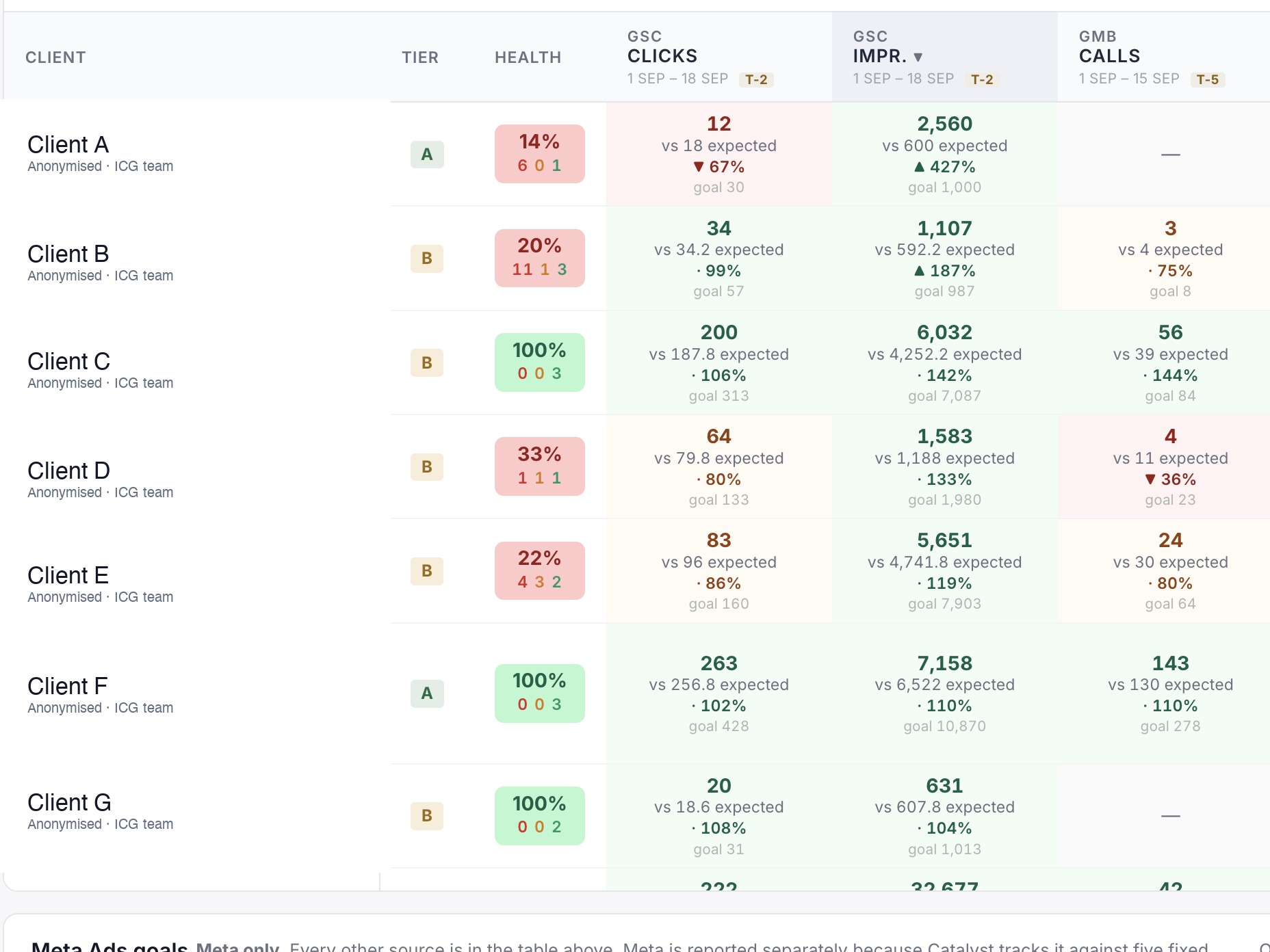
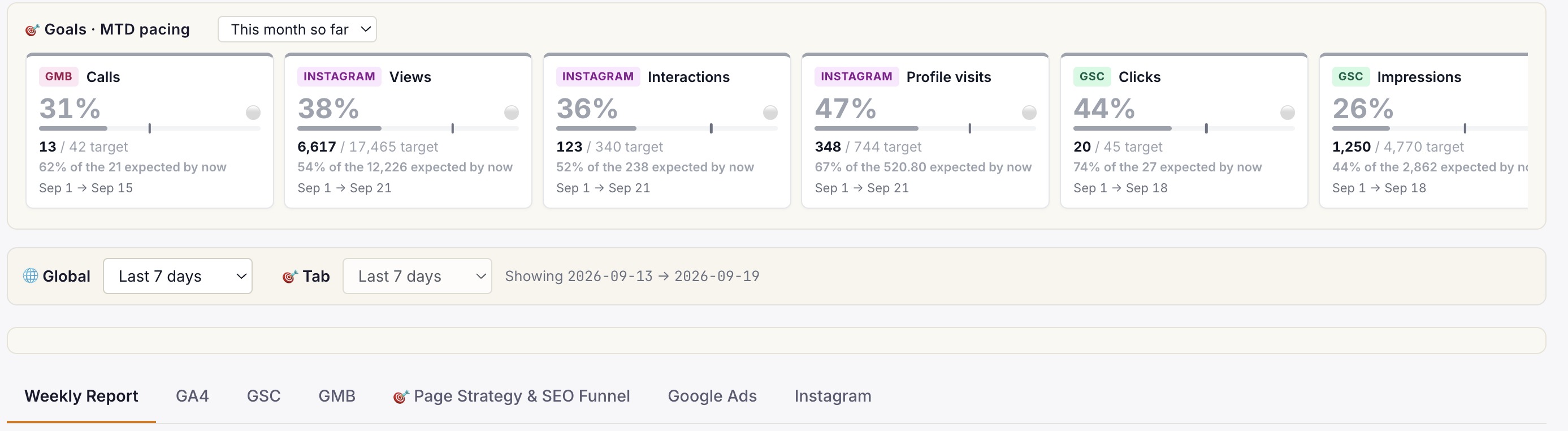
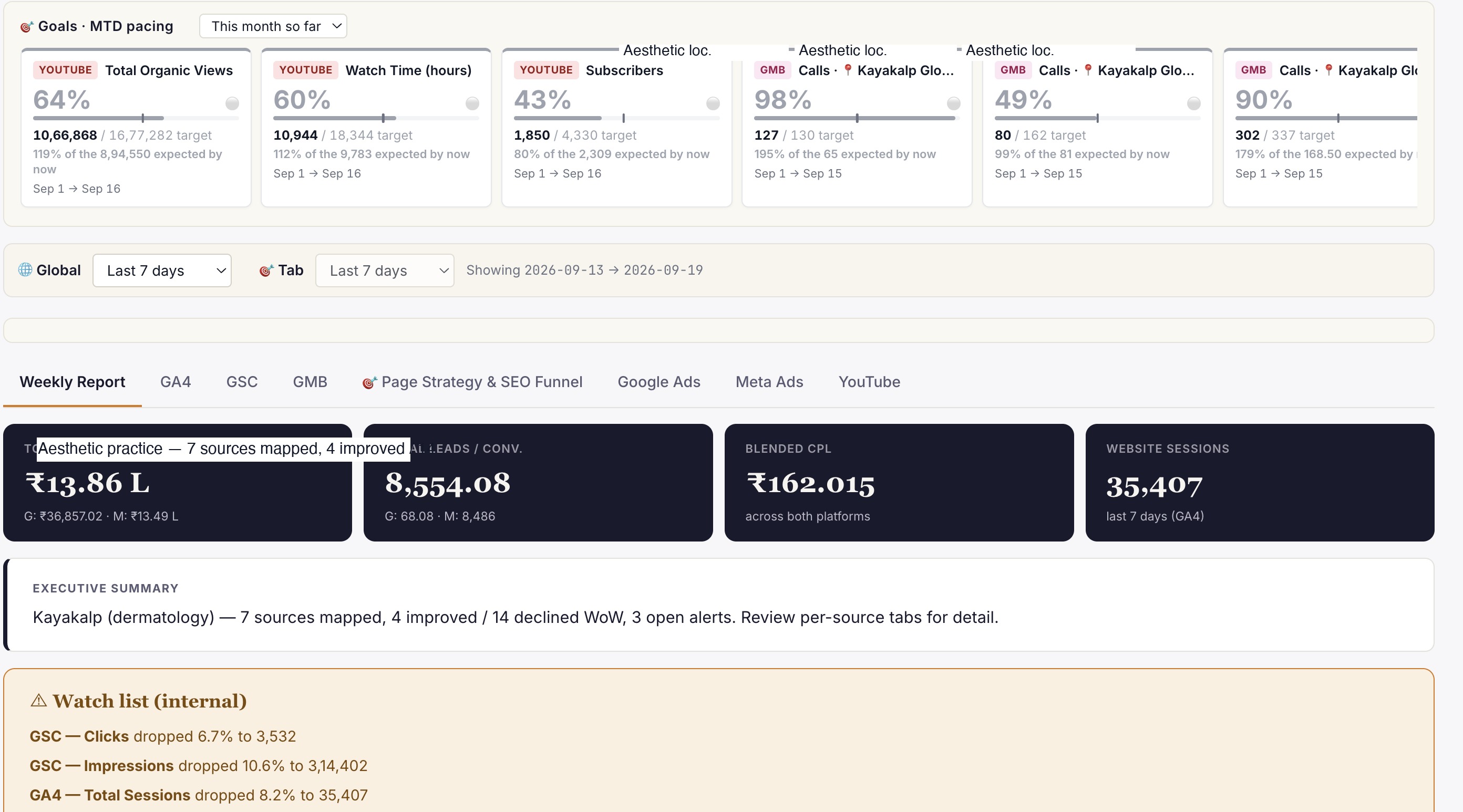
Live client dashboard. GSC, GA4, Google Ads, Meta Ads, IVR calls in one view. Login anytime, not monthly.
Phoenix
Clinic revenue intelligence over your PMS. Daily action queue: Prevent Loss, Maintain & Engage, Grow Revenue. Multi-centre rollout.
Or book a free 30-min audit to see all three in action on your account.
Healthcare brands
that already run on ICG.
A representative slice of the 150+ healthcare brands ICG has delivered for across India. Most engagements remain under NDA.


What ICG clients say · on video.
"Scale up of organic channels and business consulting. ICG has absolute domain authority in their field."
"Working with ICG transformed how we acquire IVF patients in Gurgaon. They understand the fertility journey from inquiry to consult..."
"What Ichelon accomplished — they got all my ideas and worked over 3-4 months to create an amazing, super-customised website."
Need help operationalising this?
Every ICG service is healthcare-only, NMC + DPDP-aware, and built around the patient-research patterns that drive Indian healthcare growth in 2026.
Every practice welcome — packages from ₹20,000/mo.
Goals-Driven engagements · Performance-Linked Payout Models available
More from
ICG.
Five trends shaping Indian healthcare marketing through 2027: AI-first patient research, Conversions API adoption, ABDM discovery, the AEO w...
Healthcare AIO is the discipline of getting your clinic or hospital cited inside Google AI Overviews, ChatGPT and Perplexity answers — not j...
Conversational-search advertising places brand messages inside AI chat answers — ChatGPT, Perplexity, Copilot — rather than beside a results...
Stop guessing.
Book a Diagnostic.
30 minutes. Free. With the AI-powered healthcare-only marketing agency 150+ brands already run on. No slides, no pitch, no hard close.


