


Which video deserves ad budget? Healthcare YouTube promotion framework (2026)
Not every healthcare video should get YouTube Ads spend behind it. A framework for picking which existing videos to promote — organic CTR proof, retention curve shape, subscriber conversion rate, comment sentiment — plus an ad-budget allocation model built for Indian clinics and hospitals running healthcare YouTube marketing at scale.
No pitch. Written root-cause diagnosis. AI-powered, healthcare only.
Direct answer
Not every healthcare video should get YouTube Ads spend behind it. A framework for picking which existing videos to promote — organic CTR proof, retention curve shape, subscriber conversion rate, comment sentiment — plus an ad-budget allocation model built for Indian clinics and...
TL;DR

Not every healthcare video deserves YouTube Ads budget behind it, and treating ad spend as a rising-tide-lifts-all-boats decision is one of the most reliable ways to burn a hospital or clinic's monthly video marketing budget without generating additional qualified patient enquiries. The right question is not "should we run ads on YouTube" but "which specific existing videos in our library have earned amplification, and how much do they deserve". Answering that requires reading four organic signals on every video before a single rupee of ad spend moves — organic click-through rate, retention curve shape, subscriber conversion rate, and comment sentiment. Videos that clear the bar on all four are candidates for promotion; videos that miss on any of the four are not, no matter how much the marketing team likes them or how prominently they feature the doctor. If you run healthcare YouTube marketing in-house or evaluate agencies for it, this framework is what a rigorous promotion decision looks like — and it is what the wider ICG healthcare marketing pillar hooks into for cross-channel attribution.
Why ad spend decisions need organic proof first
YouTube Ads work as amplifiers. They take a signal that already exists — an organic hint that the video works for some audience on some surface — and multiply the reach of that signal. If the underlying organic signal is weak or absent, ad spend does not create signal; it delivers impressions to a paid audience who watches once and never returns. The video's total view count rises, and nothing compounds.
The metaphor ICG uses internally: promotion is a lever, not an engine. The engine has to already be running organically, however modestly. Applying a lever to a stationary engine does not make it move. Applying a lever to a slowly moving engine produces meaningful acceleration.
The four organic signals below are how ICG (and YODA's Strategy step) decides whether the engine is running before deploying the lever.
Signal one: organic click-through rate (CTR)
Organic CTR is the percentage of impressions on the video (in Search, Suggested, Browse) that convert to plays, calculated from organic impressions only. YouTube reports impressions CTR at the video level in Studio → Analytics → Reach.
Why it matters: CTR is the earliest and cleanest signal that the video's title and thumbnail combination works against the search or algorithmic distribution context it is getting served in. A high organic CTR means the packaging is winning the click contest against surrounding videos on the same search or recommendation surface. A low organic CTR means the packaging is losing that contest — and running ads behind a video with weak organic CTR is running ads behind a video that even relevant, targeted audiences do not want to click.
Benchmark ranges for healthcare: Search-driven CTR tends to run 4-9% for well-packaged medical content; Suggested-driven CTR tends to run 3-6%. Sub-3% organic CTR is a packaging problem the video needs to solve before promotion is worth considering. 6%+ organic CTR is a strong candidate signal.
Decision rule: if organic CTR is below the channel median, do not promote — instead run an A/B test on the thumbnail and title (see the healthcare thumbnail CTR guide) and re-check in 30 days.
Signal two: retention curve shape
The retention curve shows what percentage of viewers are still watching at each moment of the video. Studio displays it as a line graph running 0-100% along video duration. The shape matters more than any single number.
Healthy shapes: a rapid drop in the first 15 seconds (natural — some viewers realise the video is not for them), followed by a gentle plateau across the body of the video, with a manageable drop at the end. Retention above 40% at the video's midpoint is a strong signal for healthcare long-form.
Unhealthy shapes: a cliff drop below 30% in the first 30 seconds (the hook is not working); a slow bleed across the whole video where retention falls linearly (pacing is losing viewers); a spike-drop-spike pattern (the video has editing or content problems creating attention loss).
Why it matters for promotion: paid views on a video with a cliff-retention curve are wasted impressions. YouTube's algorithm reads retention on paid views the same way it reads organic — a cliff-retention paid audience does not build watch-history signal that helps the video, does not convert to subscribers, and does not create the second-order Suggested lift that well-retained paid campaigns can produce.
Decision rule: if the retention curve shows a cliff in the first 30 seconds, fix the hook (re-edit the intro, re-shoot the first 15 seconds) before promoting. If retention is healthy through midpoint, the video is a valid promotion candidate.
Signal three: subscriber conversion rate
Subscriber conversion is new subscribers gained per 1,000 organic views. This measures whether viewers who watch the video are choosing to opt into more content from the channel — the strongest available signal that the video created enough trust or affinity to earn an ongoing relationship.
Why it matters for promotion: a video with strong subscriber conversion is a video that turns cold audience into owned audience. Paid amplification on that video compounds — the paid views generate new subs who then watch subsequent uploads organically, feeding the channel's long-run growth. Paid amplification on a video with near-zero subscriber conversion is a one-time transaction — the money buys views, the views buy nothing.
Benchmark ranges for healthcare: highly variable by specialty and format. Explainer content on niche procedures often converts 5-15 subscribers per 1,000 organic views for a strong upload; Q&A content converts at 2-8; Testimonial content converts at 1-5. Channel median is the useful benchmark, not absolute numbers.
Decision rule: promote videos whose subscriber conversion is at or above the channel's median. Do not promote videos whose subscriber conversion is materially below median — the underlying trust-building mechanic is not working.
Signal four: comment sentiment and intent density
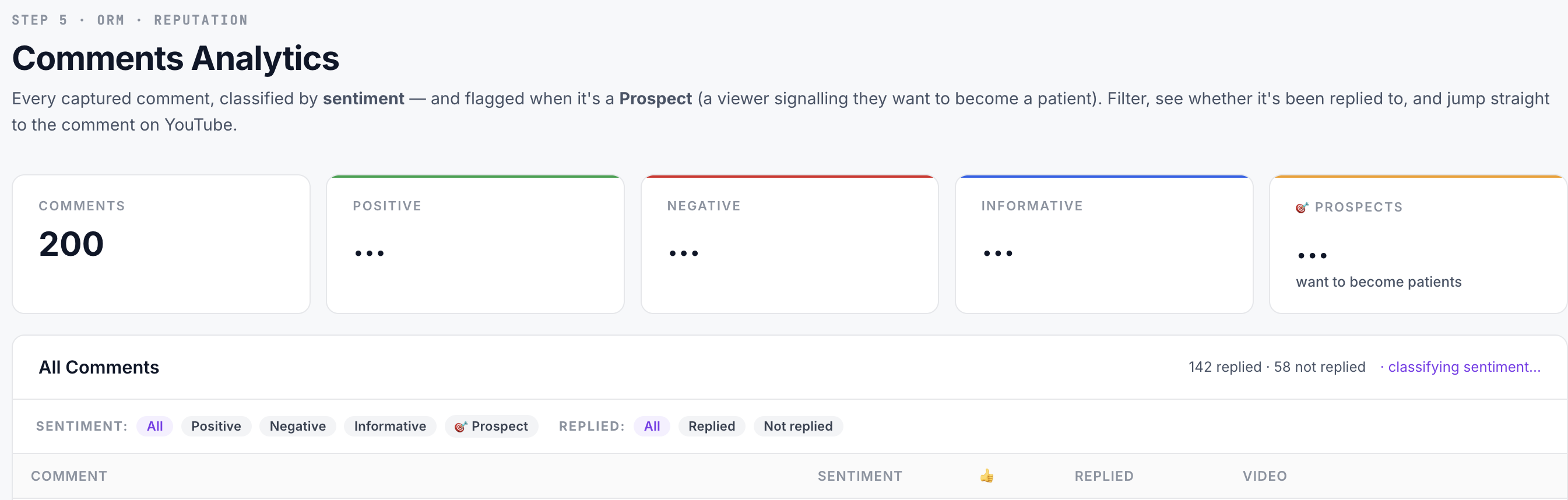
Comments on healthcare videos are the highest-signal, lowest-noise indicator of whether the video is reaching the right audience with the right intent. YODA's Reputation step classifies every comment across four buckets: patient question, praise, unrelated, and objection.
Patient question comments ("does this apply to my case, I have X condition", "what is the cost at your clinic", "do you consult on WhatsApp") are the highest-value comment class — they indicate viewers who are ready to engage further. Patient-question density above 2-3% of view count is a strong signal.
Praise comments without specific engagement ("great video sir") are weaker but positive — they indicate audience-fit even without intent.
Unrelated comments (spam, tangential chat, "first" comments) indicate the video is reaching a wrong audience.
Objection comments that dispute the content or the doctor need editorial reading — sometimes they indicate the video is over-claiming or has a genuine accuracy problem worth addressing.
Decision rule: promote videos with a healthy patient-question and praise ratio, low unrelated ratio, and no significant objection cluster. If objections cluster around a specific claim in the video, fix the claim before promoting to avoid amplifying a compliance or accuracy risk.
The composite promotion score
YODA compresses the four signals into a composite Promotion Score per video, weighted roughly as CTR 25%, retention shape 30%, subscriber conversion 25%, comment sentiment 20% — then flags videos above the promotion threshold as "candidates for ad spend" and videos below as "not yet".
The weighting is not arbitrary. Retention gets the highest weight because it predicts whether paid delivery will build second-order algorithmic lift; CTR is next because it predicts whether ads on the same surfaces will earn efficient clicks; subscriber conversion tests whether audience compounds; comment sentiment guards against amplifying a video that has audience-fit or compliance problems.
A team without YODA can approximate this composite manually using Studio's Analytics tables — the four signals are all visible; the only work is pulling them together into a decision framework and re-running the read every 30 days as new data arrives.
The ad-budget allocation model
Once the shortlist of promotion candidates is set, the second decision is how to allocate spend across the shortlist. The model ICG uses for a typical Indian healthcare monthly YouTube Ads budget (usually ₹30,000-₹5,00,000/month depending on channel scale):
Tier one — top 20% by promotion score: 50-60% of budget. These are the videos with the strongest organic engine — every rupee spent here amplifies a working asset.
Tier two — next 30% by promotion score: 25-35% of budget. Working but not top-tier — worth defending and building further with modest spend.
Tier three — experimental spend on new uploads: 10-20% of budget. Reserved for testing whether a specific new upload deserves promotion sooner than the 30-day organic read window would normally allow.
Zero spend: everything below the promotion threshold. The money is genuinely better spent elsewhere.
Within tiers, further split by targeting sophistication — Search-based campaigns for videos with strong Search organic CTR, In-Stream for videos with strong retention, Discovery for videos with strong subscriber conversion. The targeting choice tracks the organic signal that qualified the video for promotion.
What changes after 30-90 days of promotion
Every 30 days, re-read the four signals with the paid views subtracted (see the promoted vs viral distinction for how to do this cleanly). What you are looking for:
Organic views growing while paid runs. This is the compounding signal — the ad spend is generating watch-history and audience-signal that is lifting organic distribution. The video is becoming a compounding asset.
Organic views flat while paid runs. The video is not compounding — paid is delivering impressions but not building organic lift. Consider ending the promotion.
Organic views dropping while paid runs. This is unusual and usually indicates the paid audience is misaligned enough that YouTube's algorithm is de-prioritising the video's organic distribution. Stop the campaign immediately and diagnose targeting.
Subscriber conversion holding up on organic-only slice. The paid campaign is not diluting the video's subscriber conversion rate — audience quality is being preserved.
The video's Promotion Score gets recomputed after each 30-day window and its tier assignment adjusts.
The compliance perimeter around promotion decisions
Paid amplification of a healthcare video shifts the video from editorial content to advertising in the eyes of both the NMC's 2026 advertising guidelines and ASCI Guidelines 2022. Two implications:
Any claim made in the video needs to be defensible to ASCI substantiation standards. Success-rate claims, comparative claims, and outcome promises are all higher-risk in paid contexts than in organic contexts because the reach is directly bought.
Testimonial-format videos being promoted need especially careful compliance review — NMC restrictions on testimonials as clinical evidence apply, and DPDP consent should be re-verified before paid distribution.
ICG's standard promotion pipeline includes a compliance review step for any video before it is greenlit for ad spend. It is a five-minute check for most videos and a much longer conversation for Testimonial and Mythbuster formats where claim substantiation matters most.
The platform ICG uses to run this at scale: YODA
ICG runs healthcare YouTube marketing for clinics, hospitals, and specialty groups using YODA — our AI-native healthcare YouTube marketing platform. YODA sits on top of a channel's data and does four things no dashboard does: it separates organic from paid views at every step (so a promoted video can never masquerade as organic growth), it gives decisions not dashboards (every video gets a state + next action), it writes back to YouTube directly (improved titles, tags, descriptions, chapters applied straight to the platform), and it tracks the three rank races — YouTube search, Google web, and Google AI Overview citations.
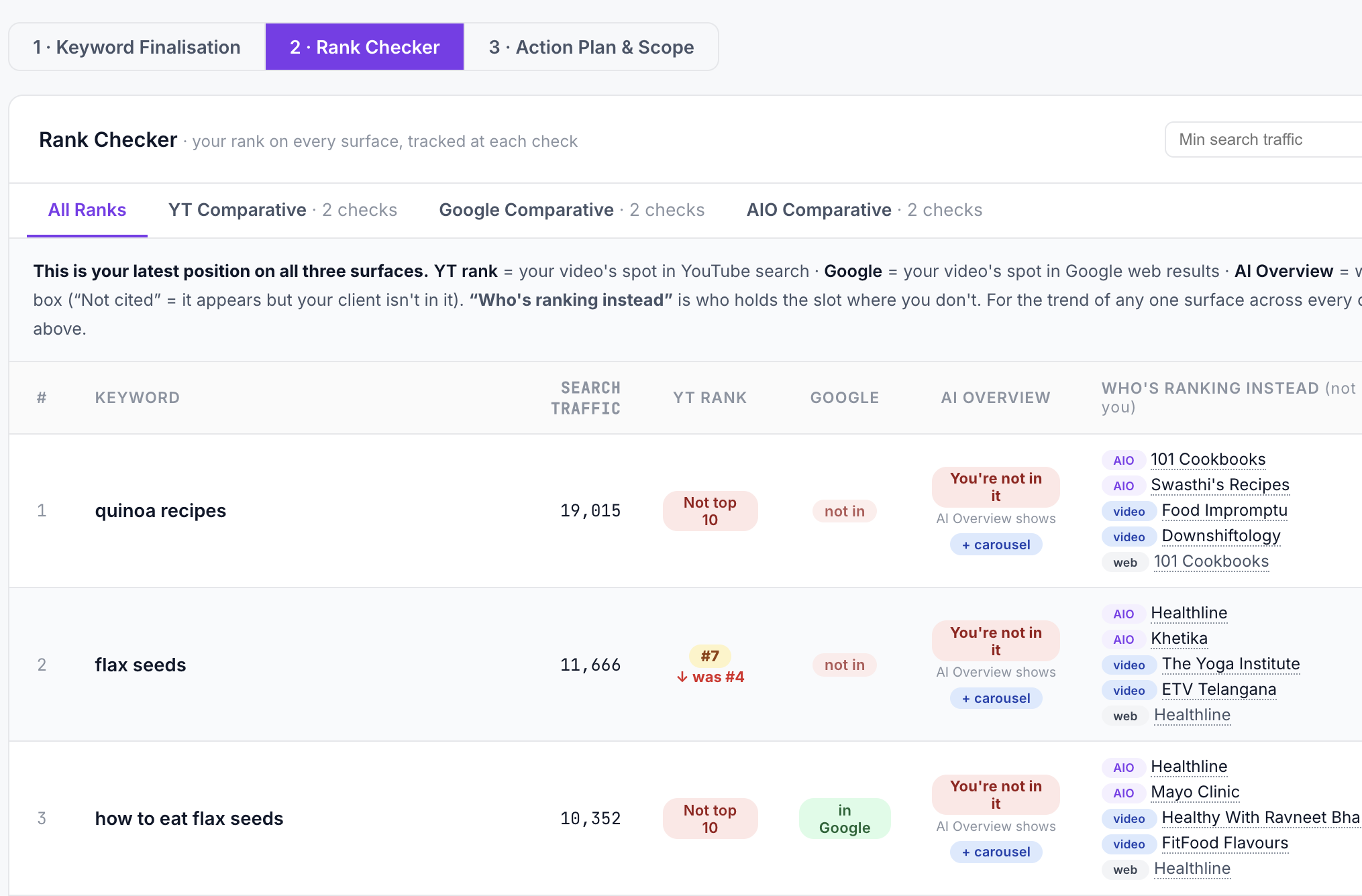
YODA runs the full 6-step workflow — Overview, Diagnostics, Strategy, Optimisation, Reputation (ORM), and Competitor Intel — with 40+ analysis modules organised under those steps. ICG's managed YouTube service uses YODA end-to-end. See the Healthcare YouTube Marketing pillar guide for the full scope, or the Healthcare YouTube Marketing Agency service page for engagement details.
Book a YODA demo on WhatsApp → or request a free healthcare YouTube channel audit →
Related reading
- Promoted vs viral video for healthcare clinics — the paid vs organic distinction this framework depends on
- Vanity metrics in healthcare video marketing — the metric hygiene layer beneath this decision
- YouTube thumbnail CTR for healthcare — improving CTR before promoting
- Healthcare YouTube marketing pillar guide — the pillar reference
- Healthcare YouTube Marketing Agency service page — engagement scope
FAQ
How much monthly ad spend does a healthcare YouTube channel actually need? Depends entirely on the channel's promotion-worthy video count and specialty economics. A small dermatology channel with 3-5 promotion-worthy videos might benefit from ₹30,000-₹80,000/month; a multi-specialty hospital chain might deploy ₹2-5 lakh/month across 15-25 promotion-worthy videos. Start from the shortlist, not the budget.
Should new uploads get ad spend from day one? Usually no. New uploads deserve a 14-30 day organic read window before promotion because you need the four signals to decide whether the video is a promotion candidate at all. The exception is time-sensitive launch content (World Cancer Day awareness, campaign-tied videos) where the launch window is the value.
What's the fastest way to lift a video's CTR before promoting? Test 3-5 thumbnail variants and 2-3 title variants inside YouTube Studio's built-in A/B test or via a third-party tool. Best-performing combination becomes the packaging you promote against. See the thumbnail CTR guide for the detailed test framework.
Is retargeting worth it for healthcare video? Sometimes. Retargeting viewers who watched 50%+ of a Testimonial or Explainer with a follow-up CTA-heavy piece can lift conversion. Retargeting viewers who watched under 10% is usually wasted spend — the audience did not engage enough to warrant re-approach.
Do YouTube Shorts follow the same promotion framework? Broadly yes with adjustments. The retention read is different (Shorts are shorter so cliff-retention is normal), CTR reads differently in the Shorts feed vs long-form surfaces, and subscriber conversion on Shorts tends to run lower per view but at much higher view volumes. Promote Shorts that show strong loop-through (viewers watching the Short more than once) and high comment-question density.
Can I run YouTube Ads without touching Google Ads directly? Technically yes — the setup lives in Google Ads → Video Campaigns. There is no separate YouTube Ads platform. Any agency running healthcare YouTube ads is running them through Google Ads.
How do I attribute enquiries specifically to promoted vs organic views? UTM tagging inside the video description, unique WhatsApp deep links per campaign, and an intake question that captures the touchpoint. YODA's enquiry-attribution module handles the mapping; a spreadsheet-based approach works if the volume is modest.
What's the biggest promotion mistake healthcare teams make? Promoting videos the founder-doctor personally likes rather than videos the four organic signals qualify. Ego-driven promotion decisions burn budget without moving the enquiry needle. Signal-driven promotion decisions do the opposite.
How often should the promotion shortlist be rebuilt? Monthly. The organic engine on any specific video changes as the algorithm's treatment of the video evolves, as the channel adds subscribers, and as competitor content shifts search rankings. A monthly re-scoring cycle keeps the shortlist honest.
Does ICG's managed service always follow this framework? Yes. Every ICG healthcare YouTube retainer report includes the promotion shortlist, the promotion score per candidate video, the budget allocation decisions, and the 30-day re-read of any promotion already in flight. Signal-driven ad decisions are a core discipline of the delivery model.
Book a free 30-minute Brand & Growth Diagnostic.
It's a working session, not a sales pitch — you leave with a written root-cause analysis you can act on, whether or not you engage ICG.
The three platforms
behind every ICG engagement.
Beacon
CAPI middleware that fixes Event Match Quality, translates CRM statuses to Meta-standard events, dedups across channels.
Agency OS
Live client dashboard. GSC, GA4, Google Ads, Meta Ads, IVR calls in one view. Login anytime, not monthly.
Phoenix
Clinic revenue intelligence over your PMS. Daily action queue: Prevent Loss, Maintain & Engage, Grow Revenue. Multi-centre rollout.
Or book a free 30-min audit to see all three in action on your account.
Healthcare brands
that already run on ICG.
A representative slice of the 150+ healthcare brands ICG has delivered for across India. Most engagements remain under NDA.


What ICG clients say · on video.
"Scale up of organic channels and business consulting. ICG has absolute domain authority in their field."
"Working with ICG transformed how we acquire IVF patients in Gurgaon. They understand the fertility journey from inquiry to consult..."
"What Ichelon accomplished — they got all my ideas and worked over 3-4 months to create an amazing, super-customised website."
The intelligence stack behind this playbook.
Every ICG engagement runs on the Search Intelligence Trifecta — Angryturtle for GMB, SIE for search and AI Overview, YODA for YouTube. Live product screens below.
Need help operationalising this?
Every ICG service is healthcare-only, NMC + DPDP-aware, and built around the patient-research patterns that drive Indian healthcare growth in 2026.
Every practice welcome — packages from ₹20,000/mo.
Goals-Driven engagements · Performance-Linked Payout Models available



More from
ICG.
Five trends shaping Indian healthcare marketing through 2027: AI-first patient research, Conversions API adoption, ABDM discovery, the AEO w...
Healthcare AIO is the discipline of getting your clinic or hospital cited inside Google AI Overviews, ChatGPT and Perplexity answers — not j...
Conversational-search advertising places brand messages inside AI chat answers — ChatGPT, Perplexity, Copilot — rather than beside a results...
Stop guessing.
Book a Diagnostic.
30 minutes. Free. With the AI-powered healthcare-only marketing agency 150+ brands already run on. No slides, no pitch, no hard close.


