


Explainer vs myth-vs-fact vs testimonial vs Q&A: healthcare video formats that convert patients (2026)
Four format archetypes for healthcare video content — Explainer, Myth-vs-Fact, Testimonial, and Q&A. Which converts patients best per specialty, production complexity and cost per format, and the compliance issues per format (especially testimonial under NMC and PC-PNDT). A production planning guide for Indian clinics.
No pitch. Written root-cause diagnosis. AI-powered, healthcare only.
Direct answer
Four format archetypes for healthcare video content — Explainer, Myth-vs-Fact, Testimonial, and Q&A. Which converts patients best per specialty, production complexity and cost per format, and the compliance issues per format (especially testimonial under NMC and PC-PNDT). A produ...
TL;DR

Healthcare video formats — Explainer, Myth-vs-Fact, Testimonial and Q&A — are the four archetypes that cover the vast majority of clinic and hospital content that actually converts on YouTube. Each format solves a different patient-decision problem, each has a different production cost and complexity profile, each carries different compliance risk under Indian healthcare rules, and each converts differently by specialty. Choosing the wrong format for a topic is one of the most expensive mistakes a healthcare marketing team can make — a testimonial where an explainer was needed, or a mythbuster where a Q&A would have compounded better in search, leaves conversion on the table and sometimes creates NMC's 2026 advertising guidelines or ASCI Guidelines 2022 exposure. If you are planning a healthcare YouTube channel or evaluating healthcare YouTube marketing agencies, understanding what each format does, what it costs and what it risks is the starting point for a production plan that actually returns qualified patient enquiries — the outcome the wider ICG healthcare marketing pillar is built to drive.
Why format is not content type
A quick vocabulary note that matters because most teams get it wrong. Content type is the runtime bucket — long-form (over 60 seconds, usually 3-15 minutes) versus Shorts (under 60 seconds). Format is the editorial archetype — Explainer, Mythbuster, Testimonial, Q&A, and their subvariants. These two dimensions are independent — an Explainer can be either a Short or a long-form; a Mythbuster can be either; a Testimonial can be either; a Q&A can be either.
YODA's Diagnostics step distinguishes these two dimensions on every video in the channel because the two carry different implications. Content type predicts distribution surface (Shorts feed vs long-form search vs Suggested); format predicts the patient-decision job the video is doing. Optimising them together requires reading them separately.
Format one: the Explainer
The Explainer is the workhorse of a healthcare channel. A doctor (or occasionally a well-trained clinical educator) walks through a procedure, condition, treatment option, recovery expectation, or preparation instruction in structured, sequential fashion. The video answers "what is X and how does it work" in enough depth that a searching patient leaves with a genuine understanding.
Patient-decision job: education phase of the journey. Someone who has heard of a condition or a procedure and wants to understand it before deciding whether to consult, which specialist to consult, or what to ask.
Best-fit specialties: IVF (cycle explanation, IUI vs IVF, blastocyst culture), dermatology (procedure explanations for PRP, Botox, laser), dentistry (root canal, implants, aligners), orthopaedics (joint replacement basics), cardiology (bypass vs angioplasty), ophthalmology (LASIK, cataract), and any specialty with a well-defined procedure catalogue.
Production complexity: medium. Requires a scripted structure, whiteboard or animation aids for clarity, decent audio and lighting. Doctor camera-comfort is a variable — some doctors deliver perfectly on the first take, others need coaching and multiple retakes.
Rough production cost per episode in India: ₹15,000-₹60,000 depending on animation load, editing complexity, and doctor time cost. Higher end for medical-illustration-heavy explainers.
Conversion signal: steady. Explainers tend to drive Search-heavy organic traffic and compound over 6-18 months. Patient enquiries from explainer views typically ask clarifying questions ("does this apply to my case", "what's the cost at your clinic") — decision-ready or close to it.
Compliance perimeter: low-to-medium. As long as the doctor stays within evidence-based clinical information and avoids success-rate claims, comparative claims, or personalised medical advice framed as a substitute for consultation, Explainers sit safely inside NMC and ASCI guidelines. Fertility Explainers must avoid PC-PNDT violations (no sex-determination content) and ART Act 2021 success-rate substantiation problems.
Format two: the Myth-vs-Fact
The Mythbuster picks a common misconception patients hold about a condition, treatment or specialty and refutes it directly with evidence. The video structure is almost always "you've heard X, the reality is Y, here's why" repeated across 3-5 myths in a single video, or with a single myth explored in depth.
Patient-decision job: reassurance and objection-handling. Someone who has a fear or misconception blocking them from consulting or from committing to a treatment.
Best-fit specialties: IVF (myths about success rates, embryo quality, egg freezing), dermatology (myths about hair fall causes, PRP effectiveness, skin whitening), dentistry (root canal pain myths, implants, aligners vs braces), gynaecology (contraception myths, PCOS myths), oncology (chemotherapy myths, screening myths), plastic surgery (recovery myths, safety myths).
Production complexity: medium-low. Simpler structure than Explainer — usually doctor on camera without heavy animation, myth-and-fact cards as B-roll, tight edits. Scriptable in a repeatable template.
Rough production cost per episode: ₹10,000-₹30,000. Lowest complexity of the four formats when done well.
Conversion signal: high when the myth is a real conversion-blocker for the specialty. A dermatology mythbuster addressing "does PRP really work for hair fall" hits patients who are on the fence about booking. A cardiology mythbuster addressing "is angioplasty safer than bypass" hits patients in the second-opinion phase.
Compliance perimeter: medium. Every myth-refutation carries an implicit or explicit factual claim, and ASCI Guidelines 2022 require substantiation. Language like "the truth is X" or "the reality is Y" must be defensible with clinical evidence. "Fastest recovery" or "most effective" without substantiation is an ASCI risk. For fertility content the PC-PNDT and ART Act rules apply the same as with Explainers.
Format three: the Testimonial
The Testimonial features a patient (with consent) describing their experience with a specific treatment, procedure or clinic. This is the highest-conversion format when done well and the highest-risk format when done poorly.
Patient-decision job: social proof and outcome expectation-setting at the bottom of the funnel. Someone who is close to booking and wants to see a peer experience before committing.
Best-fit specialties: IVF (patient journey narratives), transplant surgery (recipient stories), oncology (survivor narratives — with heavy sensitivity around outcomes), aesthetic surgery, dental cosmetic, orthopaedic joint replacement (patient walking after knee replacement), IVF baby moments. Highest conversion impact in specialties where the outcome is emotionally significant.
Production complexity: high. Requires patient consent workflow, multiple interview sessions, careful editing to preserve narrative arc, occasional need for anonymisation, and often a doctor-explanation cutaway. The consent workflow alone is significant admin.
Rough production cost per episode: ₹30,000-₹1,50,000 depending on production values, location, editing depth, and whether documentary-style or interview-style. Highest cost per episode of the four formats.
Conversion signal: the strongest of the four when the compliance envelope is respected — patients who watch a testimonial video and reach out are often ready to book after one consult.
Compliance perimeter: high. This is the format that carries the most regulatory exposure and requires the most careful handling. Key points from NMC's 2026 advertising guidelines as applied to testimonial content:
Patient testimonials cannot be presented as clinical evidence of a treatment's effectiveness. Explicit, informed, written consent is required — and best practice is a re-consent step immediately before publication, not just at the time of filming. The video should not make comparative claims about the clinic or doctor. The patient's outcome cannot be presented as a promise or expectation for future patients.
Under DPDP Act 2023, the patient's data (name, image, medical condition) is personal data, and consent must comply with DPDP's specific-purpose consent standard. Under PC-PNDT Act 1994, fertility testimonials cannot reference sex selection in any way, including inadvertent phrasing about "trying for a boy" or "trying for a girl". Under ART Act 2021, fertility testimonials cannot make unsubstantiated success-rate claims implicit or explicit.
For high-emotional-stakes specialties (oncology, transplant, IVF), Testimonials require additional editorial care so as not to unintentionally set unrealistic expectations for viewers whose case is materially different.
Format four: the Q&A
The Q&A takes real patient questions — sourced from consultation records, comments on prior videos, WhatsApp enquiries, or FAQ tickets — and answers them in short-form, batched or single-question formats.
Patient-decision job: long-tail information gathering. Someone with a specific narrow question that is not big enough to be its own Explainer but is important enough that a satisfying answer builds trust.
Best-fit specialties: universal. Every healthcare specialty has a long tail of specific patient questions that make ideal Q&A content — timing, cost expectations, insurance queries, recovery specifics, contraindications, preparation instructions.
Production complexity: low. Doctor-to-camera, 1-3 minute answers, minimal editing, no heavy graphics required. Ideal for batch production — 10-15 Q&As in a single filming session.
Rough production cost per episode: ₹3,000-₹15,000 per episode when produced in batches. Lowest cost per episode of the four formats.
Conversion signal: moderate individually, compounding as a corpus. Q&A videos rarely go big on their own, but a well-tagged Q&A library becomes a search-visibility asset — every long-tail question a patient searches has a chance of surfacing the clinic's answer, and enquiries from Q&A-driven views are typically well-qualified because the viewer's specific concern has already been addressed.
Compliance perimeter: low. The Q&A format is factually oriented, doctor-driven, and rarely makes claims that trigger ASCI substantiation issues. Standard NMC and DPDP considerations still apply — no personalised medical advice framed as a substitute for consultation, no patient case details without consent — but the format's baseline risk is the lowest of the four.
Which format converts best per specialty
Cross-specialty patterns ICG sees across the healthcare channels YODA monitors, understanding that these are patterns rather than rules and every channel needs its own diagnostic:
IVF and fertility: Explainer builds trust, Mythbuster overcomes fear, Testimonial closes — but Testimonial carries the highest compliance burden of any specialty because of ART Act 2021 and PC-PNDT overlap. Q&A works as a long-tail library.
Dermatology and hair: Mythbuster tends to lead because of the strong misconception density in the specialty; Explainer supports; Testimonial converts for aesthetic procedures with lower regulatory friction than fertility.
Dentistry: Explainer leads, especially for procedure content; Testimonial converts for cosmetic and implant patients. Q&A batches work well for aligners and cost queries.
Orthopaedics: Explainer for procedure understanding, Testimonial for joint-replacement recovery narratives (very high conversion). Q&A for recovery specifics.
Oncology: Explainer and Mythbuster for education and reassurance; Testimonial requires the highest editorial and consent care of any specialty and is often better as short segment inside a longer Explainer than as a standalone.
Cardiology: Explainer for procedure comparison, Q&A for post-procedure recovery questions, Testimonial for elective procedures (angioplasty, valve) where the outcome is clearly positive.
Production planning: the mix that usually works
A healthcare channel starting a serious 12-month YouTube programme typically benefits from a mix roughly along these lines, adjusted per specialty:
40-50% Explainer content (search compounds, education-phase capture, safe compliance)
20-30% Q&A content (long-tail search coverage, low cost per episode, patient-question sourced)
15-25% Mythbuster content (objection-handling, mid-funnel conversion lift)
10-20% Testimonial content (bottom-funnel conversion, highest production and compliance overhead — dose carefully)
The exact split is driven by the channel's stage. Newer channels bias toward Explainer and Q&A to build a search-driven library first. Established channels with strong search traction add more Testimonial and Mythbuster to lift conversion on already-warm audiences.
The platform ICG uses to run this at scale: YODA
ICG runs healthcare YouTube marketing for clinics, hospitals, and specialty groups using YODA — our AI-native healthcare YouTube marketing platform. YODA sits on top of a channel's data and does four things no dashboard does: it separates organic from paid views at every step (so a promoted video can never masquerade as organic growth), it gives decisions not dashboards (every video gets a state + next action), it writes back to YouTube directly (improved titles, tags, descriptions, chapters applied straight to the platform), and it tracks the three rank races — YouTube search, Google web, and Google AI Overview citations.
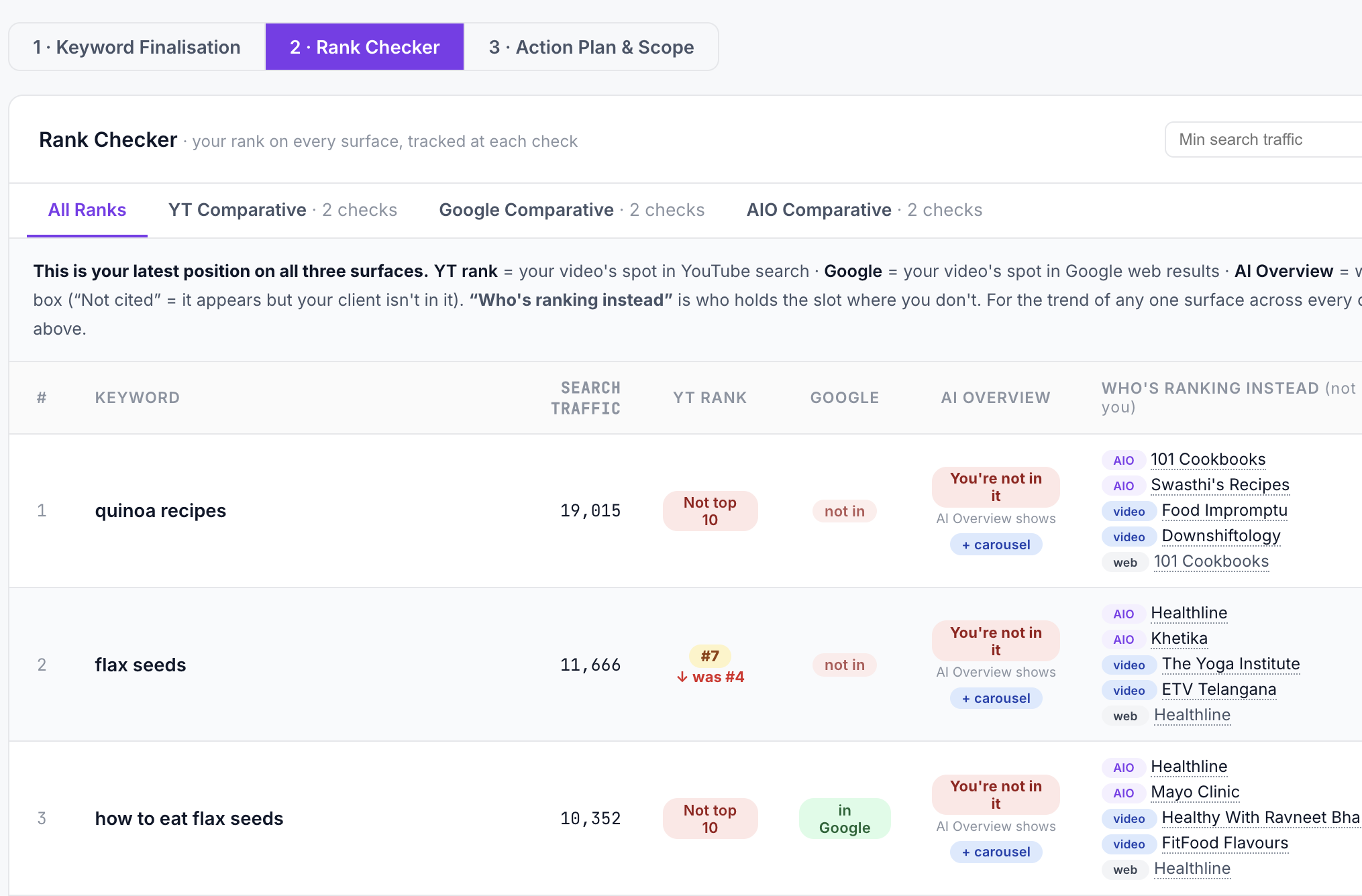
YODA runs the full 6-step workflow — Overview, Diagnostics, Strategy, Optimisation, Reputation (ORM), and Competitor Intel — with 40+ analysis modules organised under those steps. ICG's managed YouTube service uses YODA end-to-end. See the Healthcare YouTube Marketing pillar guide for the full scope, or the Healthcare YouTube Marketing Agency service page for engagement details.
Book a YODA demo on WhatsApp → or request a free healthcare YouTube channel audit →
Related reading
- Healthcare YouTube marketing pillar guide — the pillar reference for Indian healthcare video
- Which video deserves ad budget — the promotion decision framework
- YouTube thumbnail CTR for healthcare — the thumbnail layer that decides whether these formats get watched
- How a doctor's YouTube channel generates consultations — enquiry mechanics per format
- Healthcare YouTube Marketing Agency service page — engagement scope
FAQ
Which format has the highest conversion for a new IVF clinic channel? Long term, Testimonial has the highest per-view conversion — but IVF Testimonial is also the highest-compliance-risk format under PC-PNDT and ART Act. Most new IVF channels build 6-9 months of Explainer and Mythbuster first, then add carefully-produced Testimonials with full consent and compliance review.
Can a doctor produce Mythbuster content about a competitor's treatment approach? Carefully and rarely. ASCI restricts comparative claims and NMC restricts disparaging fellow professionals. Mythbusters should refute misconceptions patients hold, not attack alternative treatment philosophies practised by other clinics. Focus on the myth, not the competitor.
Is a patient testimonial legal on YouTube in India? Yes, with informed written consent under NMC's 2026 advertising guidelines and DPDP Act 2023, and provided the testimonial does not present a personal outcome as evidence of the treatment's effectiveness for future patients. Best practice is a documented consent workflow with re-consent before publication.
How long should an Explainer video be? Long enough to actually answer the topic in a way a searching patient finds useful — typically 4-9 minutes for procedure Explainers, 2-4 minutes for condition Explainers, 90 seconds for Shorts-format Explainers. Length should be dictated by content need, not by a template.
Should we make Shorts or long-form first? Depends on the channel's existing traction. A channel with no search authority yet benefits from long-form Explainers building search visibility. A channel with search traction can layer Shorts for reach amplification. YODA's Diagnostics step suggests the mix based on where the channel is.
Can Q&A content be sourced from patient consultations without consent? No specific patient case details, no. Generic patient questions ("how often should I get a skin check") are fine because they are not identifiable. Any question that includes identifiable details requires the patient's consent to use, and even then the details should usually be anonymised in the video.
What's the minimum production quality that actually works for healthcare? Clear audio, reasonable lighting, doctor visible from at least the chest up, no distracting background clutter. Video that is not visually or aurally comfortable to watch will lose retention regardless of content quality. Production quality does not need to be broadcast-level, but it does need to clear the "comfortable to watch" bar.
How does format choice affect thumbnail design? Explainer thumbnails work best with clear procedure labels and diagram elements; Mythbuster thumbnails benefit from a myth-and-fact contrast graphic; Testimonial thumbnails need the patient's face (with consent) and a hint at the story; Q&A thumbnails work as text-forward cards with the question phrased conversationally.
Do all four formats need to be part of every healthcare channel? Most successful healthcare channels use at least three. Testimonial is the most optional — for specialties where the compliance overhead is too high relative to the conversion lift, skipping Testimonial and doubling down on the other three is a reasonable strategy.
How does YODA decide what format to make next? YODA's Strategy step reads the channel's search-query surface, the competitor coverage gap, the audience-question density in the comment corpus, and the enquiry-attribution history, then proposes the next 4-8 video topics tagged with format archetype. The team approves, YODA sends the plan into production tracking, and the writeback layer preps the metadata scaffolding for each upload.
Book a free 30-minute Brand & Growth Diagnostic.
It's a working session, not a sales pitch — you leave with a written root-cause analysis you can act on, whether or not you engage ICG.
The three platforms
behind every ICG engagement.
Beacon
CAPI middleware that fixes Event Match Quality, translates CRM statuses to Meta-standard events, dedups across channels.
Agency OS
Live client dashboard. GSC, GA4, Google Ads, Meta Ads, IVR calls in one view. Login anytime, not monthly.
Phoenix
Clinic revenue intelligence over your PMS. Daily action queue: Prevent Loss, Maintain & Engage, Grow Revenue. Multi-centre rollout.
Or book a free 30-min audit to see all three in action on your account.
Healthcare brands
that already run on ICG.
A representative slice of the 150+ healthcare brands ICG has delivered for across India. Most engagements remain under NDA.


What ICG clients say · on video.
"Scale up of organic channels and business consulting. ICG has absolute domain authority in their field."
"Working with ICG transformed how we acquire IVF patients in Gurgaon. They understand the fertility journey from inquiry to consult..."
"What Ichelon accomplished — they got all my ideas and worked over 3-4 months to create an amazing, super-customised website."
Need help operationalising this?
Every ICG service is healthcare-only, NMC + DPDP-aware, and built around the patient-research patterns that drive Indian healthcare growth in 2026.
Every practice welcome — packages from ₹20,000/mo.
Goals-Driven engagements · Performance-Linked Payout Models available



More from
ICG.
Five trends shaping Indian healthcare marketing through 2027: AI-first patient research, Conversions API adoption, ABDM discovery, the AEO w...
Healthcare AIO is the discipline of getting your clinic or hospital cited inside Google AI Overviews, ChatGPT and Perplexity answers — not j...
Conversational-search advertising places brand messages inside AI chat answers — ChatGPT, Perplexity, Copilot — rather than beside a results...
Stop guessing.
Book a Diagnostic.
30 minutes. Free. With the AI-powered healthcare-only marketing agency 150+ brands already run on. No slides, no pitch, no hard close.


