


Vanity metrics in healthcare video marketing (2026): why "views went up" is the most dangerous metric for clinics
Vanity metrics — starting with the raw view count — are the most misleading number in healthcare video marketing. What views hide: paid-view injection, weak retention, wrong audience, zero patient intent. What actually matters for Indian clinics and hospitals: qualified consults, patient enquiries, booking rate. An ICG audit-style walkthrough.
No pitch. Written root-cause diagnosis. AI-powered, healthcare only.
Direct answer
Vanity metrics — starting with the raw view count — are the most misleading number in healthcare video marketing. What views hide: paid-view injection, weak retention, wrong audience, zero patient intent. What actually matters for Indian clinics and hospitals: qualified consults,...
TL;DR

Vanity metrics in healthcare video marketing — starting with the raw view count on a doctor's YouTube video — are the single most dangerous number a clinic owner or hospital marketing director can celebrate in a monthly review. The view count is the metric agencies default to because it is easy to explain and easy to make go up; it is also the metric that hides paid-view injection, poor retention, irrelevant audiences and zero patient intent behind a big-looking headline. For any Indian healthcare buyer who has ever asked "our views doubled — did we actually get more patients?" and struggled to answer with data, the mismatch between views and business outcomes is the reason. This piece walks through what views actually hide, what metrics survive scrutiny, and how ICG audits a healthcare channel end-to-end. If you are evaluating healthcare marketing agencies or thinking about ICG's healthcare YouTube marketing service, understanding the vanity-metric trap changes what you ask for in a monthly report.
Why "views went up" is the wrong thing to celebrate
A view is a single moment of attention — the viewer clicked play, or in some counting rules watched for a few seconds. That is all. The view count on its own does not say who watched, why they clicked, whether they finished, whether they subscribed, whether they reached out, or whether the watch was paid for through YouTube Ads. It says nothing about whether the person watching is a potential patient stakeholder, a doctor curious about a colleague's channel, a competitor doing intel, a student, an international viewer with no ability to travel to the clinic, or an ad-network click on a device that was not really watching.
In healthcare specifically, this is worse than in most industries because the audience filter matters more. A dermatology clinic in Delhi is not helped by 40,000 views from Bangladesh, Pakistan and rural regions the clinic cannot serve. A hospital cardiology service line is not helped by 200,000 views if 90% of them dropped off in the first 15 seconds and the average watch time was 22 seconds. The view number went up. Nothing else did.
Views are input-side; patient enquiries are output-side. The two are correlated only when the input is filtered, retained and converted. Every step of that filter is where the vanity metric hides real weakness.
What views hide: paid-view injection
The first thing views hide is whether they were paid for. YouTube counts a paid-promotion view (via YouTube Ads TrueView, in-stream, or discovery ads) inside the total view count on the video the same way it counts an organic search-driven view. The dashboard shows one number. The two are not the same thing.
Paid views prove that the ad campaign delivered impressions and the creative was compelling enough to hold attention past the skip threshold. Paid views do not prove the video is organically discoverable, that the title and thumbnail work in search or suggested, that the content is being watched by people who found it themselves, or that the channel will keep getting views after the ad budget is turned off.
The healthcare pattern is common — a monthly report shows "views up 340%" without disclosing that ₹80,000 was spent on YouTube Ads that month. Organic views may have been flat or down. The clinic is paying for the appearance of growth without any of the underlying signal. This is why the very first rule inside YODA's diagnostics is to subtract paid views everywhere before any judgement is made. A video with 10,000 total views but 9,200 paid is not the same asset as a video with 10,000 total views and zero ad spend behind it, even though the dashboard shows the same headline number.
What views hide: engagement quality
The second thing views hide is whether people actually watched. A view fires early in the play — depending on the counting rule, in the first few seconds. What happens after that is the retention curve, and the retention curve is where content quality lives.
Healthcare videos routinely show one of two collapse patterns: a cliff at 5-10 seconds (the hook did not work and the viewer bounced immediately), or a slow bleed across the middle where the pacing loses the audience. Average view duration on healthcare content on YouTube in India runs anywhere from 45 seconds on short-form to 3-4 minutes on genuinely well-crafted long-form; the raw view number tells you none of this.
Average view duration, average percentage viewed, and the shape of the retention curve are the three numbers to ask for. A 5-minute video with 90-second average watch is not a working video, no matter what the view count says. A 12-minute video where 55% of viewers reach the end is doing something right that the view count alone will not celebrate. Retention is where the video's craft either survives or collapses, and it is invisible in the "views went up" headline.
What views hide: audience relevance
The third thing views hide is who watched. YouTube's audience geography, age, gender and device data — visible inside the Studio's Audience tab — are the audience-relevance signal. Views that come from a market the clinic cannot serve are worthless as patient-acquisition signal, regardless of how they look on the dashboard.
An IVF centre in Mumbai serving Indian patients does not benefit from views from West Africa, Southeast Asia or the Middle East unless there is a genuine medical tourism funnel behind it. A single-city dermatology clinic in Bangalore does not benefit from views spread evenly across all Indian states — the relevant audience is Bangalore-adjacent, and geography data tells you whether the audience is right.
Audience age and gender matter too. A gynaecology channel targeted at women aged 25-45 that is drawing a majority-male, majority-under-25 audience is not building a patient pipeline; something in the content or the promotion is drawing the wrong crowd. The view count went up, but the audience-market fit went down. This gap is invisible unless someone opens the Audience tab and asks "who is watching, and are they the buyer?"
What views hide: intent
The fourth thing views hide is why the viewer clicked. Intent is the hardest of the four hidden variables and the most valuable when it can be inferred. In the YouTube context, intent is inferred from the traffic source (Search vs Suggested vs Browse vs Direct vs External vs Notifications) and the query cluster driving the video's impressions.
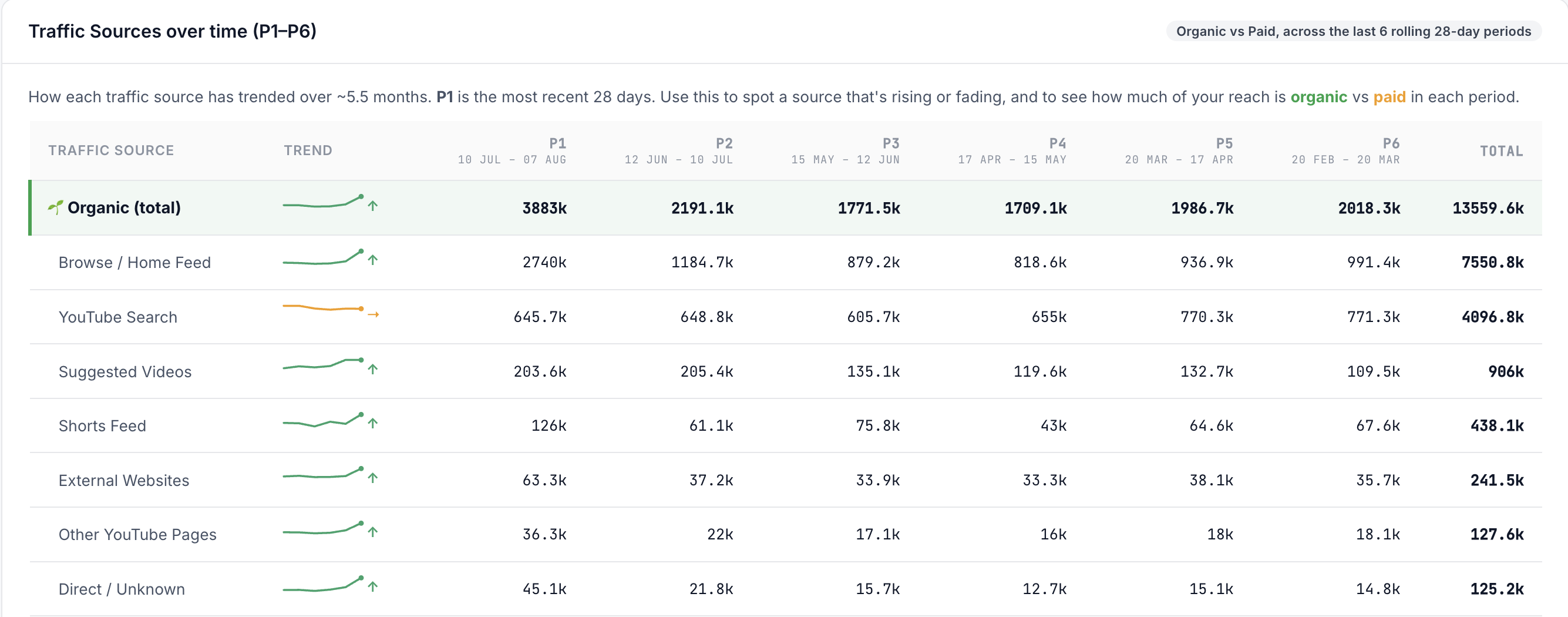
A view from a Search query like "best dermatologist for hair fall in delhi" carries very different intent from a view from Suggested video (someone was watching an unrelated video, and YouTube's algorithm suggested this one), which carries different intent again from a Notification-driven view (existing subscriber watching a new upload). All three are counted equally in the view number. Only the Search view carries meaningful patient-intent signal, and even then only if the query is a real patient query rather than a curiosity or research query.
The traffic-source split for a healthcare video should be diagnosed before any conclusion is drawn about whether the video is "working". Most healthcare channels ICG audits show a heavy Suggested and Browse skew — the algorithm is pushing the content in front of adjacent viewers who did not go looking for it. This is fine for reach; it is misleading if the reader reads "views up" as "patient enquiries up".
What actually matters: the four metrics that survive scrutiny
Once views are treated as an input rather than an outcome, four metrics survive scrutiny for a healthcare channel:
1. Qualified consultation enquiries attributable to the channel. Not raw enquiries. Qualified means the caller or WhatsApp lead named the video, named a specific procedure discussed in a video, mentioned the doctor by name in a way that maps to channel content, or came in via a UTM-tagged link in a description. This requires an intake question ("how did you hear about us?") and a UTM discipline in every video description.
2. Booking rate on enquiries. Video-driven enquiries convert to bookings at different rates than paid-search enquiries. Tracking that conversion rate over time is the real signal of whether the video content is attracting patients who are decision-ready or patients who are still researching.
3. Subscriber conversion rate per 1,000 views. This measures whether the video is building the channel's owned audience. A high-view video with near-zero subscriber conversion is a video the algorithm pushed to a wrong audience; a lower-view video with strong subscriber conversion is a video that found real fans of the doctor's work.
4. Comment sentiment and question density. Comments that ask specific questions ("does the clinic treat hair transplant for women?", "what is the cost of PRP?") are patient-intent signals. Comments that are generic praise or unrelated chat are audience-fit misses. YODA's Reputation/ORM step does this classification automatically; without a tool, it can be done manually on a monthly basis for the top 10 videos.
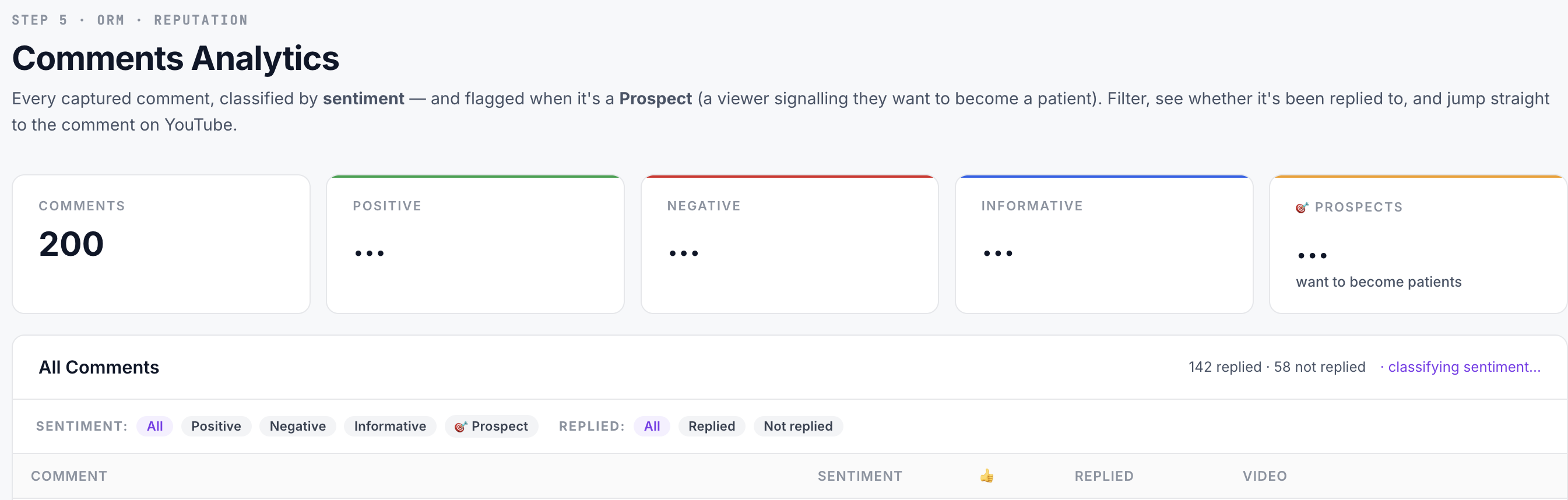
These four metrics move independently of the view count. It is entirely normal for a well-audited channel to show views flat month-on-month while qualified enquiries doubled, because the content shifted toward higher-intent formats and the audience filter tightened.
The real audit: how ICG diagnoses a healthcare channel
The audit ICG runs at engagement start on a healthcare YouTube channel follows a fixed sequence, all executed inside YODA's Diagnostics step and covering the six-step workflow (Overview, Diagnostics, Strategy, Optimisation, Reputation, Competitor Intel).
Step one — subtract paid views. Every video's view count is split into paid and organic. All subsequent analysis uses organic-only numbers. This is non-negotiable and it is the reason most agency reports look worse when re-read through YODA's lens.
Step two — plot the retention curves. Every video with more than a threshold number of organic views gets its retention curve pulled. Videos are clustered by curve shape — cliff at 5s, slow bleed, healthy plateau, spike at the CTA — and each cluster gets a diagnosis and a next-action.
Step three — plot traffic source distribution. Every video is scored on where its views come from. A search-heavy distribution is a promotion decision (the video is discoverable — do more of what's working). A suggested-heavy distribution is an algorithm gift, not a search moat.
Step four — audience geography and demographics vs the clinic's serviceable catchment. Every video is scored for audience relevance against the clinic's real geographic and demographic patient base.
Step five — enquiry attribution mapping. UTM links in descriptions, intake question on the phone/WhatsApp funnel, subscriber-conversion tagging in the CRM. Every enquiry attributable to video gets tagged to the specific video that drove it.
Step six — comment corpus reading. Every comment across the last 90 days is read for intent (patient question vs praise vs unrelated vs objection) and geography (is the commenter in the serviceable catchment). The signal from comments is often the earliest indicator of a video's real-world traction.
Six passes. Every video comes out of the audit with a state — kill it, keep it as-is, re-optimise the metadata, re-shoot the intro, promote it — and every keyword cluster comes out with a next-action.
The compliance perimeter around video metrics
A vanity-metric audit is also where compliance risk shows up. Two frameworks matter — the National Medical Commission (NMC) Ethics Code 2026 and the ASCI Guidelines 2022. Both restrict how healthcare providers can advertise and both restrict comparative or unsubstantiated claims.
Videos that use "views" or "reach" as social-proof language ("watched by over 1 lakh patients") flirt with ASCI's substantiation rule if the number is inflated by paid views, non-patient viewers or geography outside the clinic's catchment. Testimonial-format videos need explicit patient consent under NMC and cannot be presented as clinical evidence. Comment threads that make treatment claims on the clinic's behalf need moderation. Any promotion budget that inflates a view number to signal "authority" enters ASCI risk if the number is presented in marketing collateral.
Compliance is not the reason to move off vanity metrics, but it is a good tiebreaker when a marketing team argues that "views is what stakeholders understand".
The platform ICG uses to run this at scale: YODA
ICG runs healthcare YouTube marketing for clinics, hospitals, and specialty groups using YODA — our AI-native healthcare YouTube marketing platform. YODA sits on top of a channel's data and does four things no dashboard does: it separates organic from paid views at every step (so a promoted video can never masquerade as organic growth), it gives decisions not dashboards (every video gets a state + next action), it writes back to YouTube directly (improved titles, tags, descriptions, chapters applied straight to the platform), and it tracks the three rank races — YouTube search, Google web, and Google AI Overview citations.
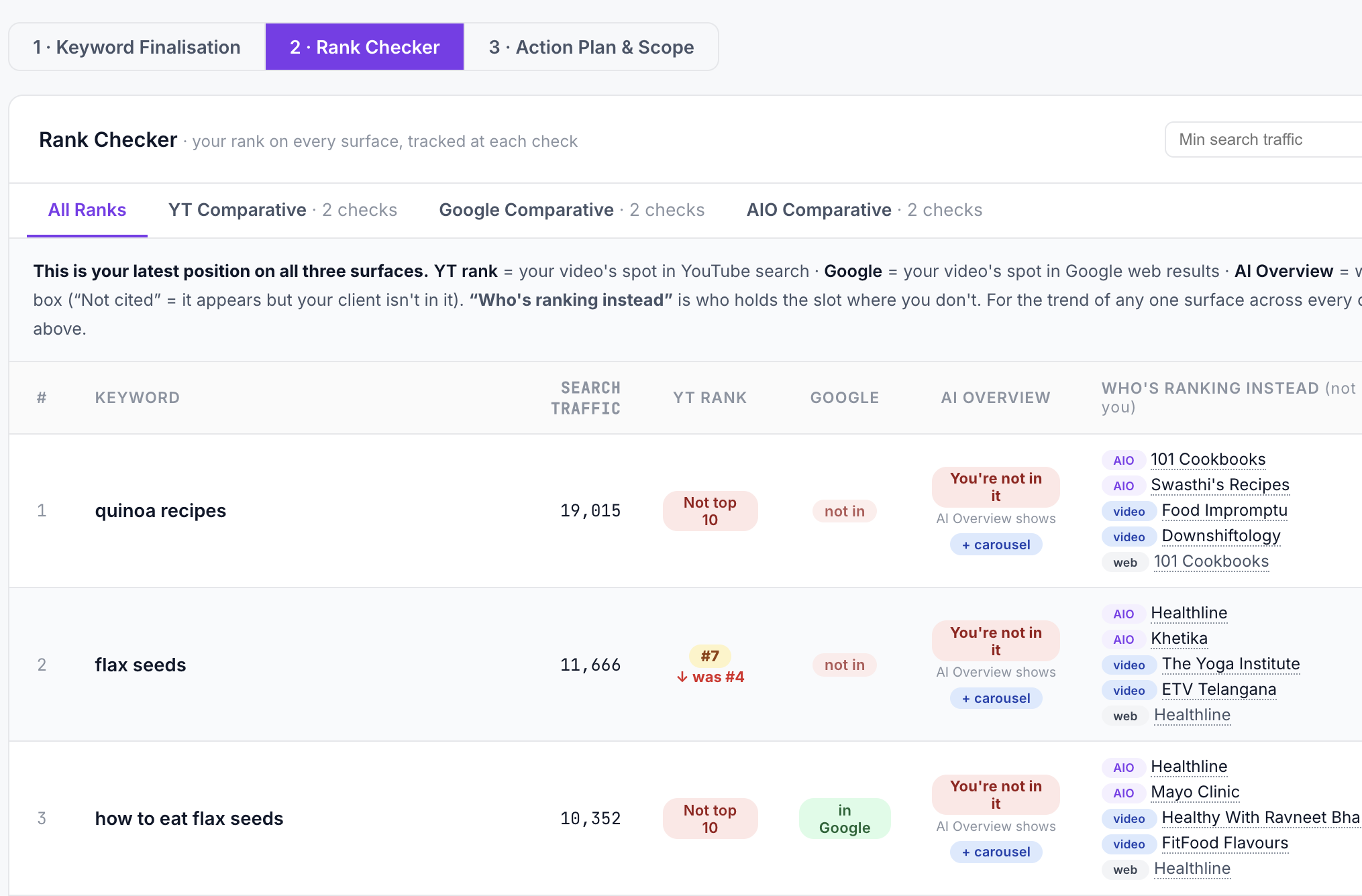
YODA runs the full 6-step workflow — Overview, Diagnostics, Strategy, Optimisation, Reputation (ORM), and Competitor Intel — with 40+ analysis modules organised under those steps. ICG's managed YouTube service uses YODA end-to-end. See the Healthcare YouTube Marketing pillar guide for the full scope, or the Healthcare YouTube Marketing Agency service page for engagement details.
Book a YODA demo on WhatsApp → or request a free healthcare YouTube channel audit →
Related reading
- Healthcare YouTube marketing pillar guide — the full-scope reference for Indian healthcare video
- Promoted vs viral video for healthcare clinics — the core distinction that vanity metrics violate
- YouTube views vs revenue for healthcare — the money-side counterpart to this audit
- How a doctor's YouTube channel generates consultations — the enquiry-attribution mechanics in depth
- Healthcare YouTube Marketing Agency service page — engagement details and pricing
FAQ
Are views ever a useful metric on a healthcare channel? Yes — as an input signal, not an outcome. Organic views (paid subtracted) tell you the algorithm is distributing the content. That is a necessary condition for enquiries but never a sufficient one. Views without a retention curve, an audience-fit read and an enquiry attribution are not evidence of anything a clinic owner should celebrate.
Why is a promoted view counted the same as an organic view? Because YouTube's counting rules treat both as "the play started". The dashboard does not visually separate them. This is why any serious healthcare audit begins with paid subtraction — YODA does it automatically, a spreadsheet-based audit does it manually by cross-referencing Ads spend against video-level view deltas in the same period.
What is a good average view duration for a healthcare long-form video? There is no universal benchmark. What matters is direction — the retention curve for the same doctor talking on the same topic should improve as the channel matures, hooks tighten, and pacing gets crisper. Absolute numbers depend on video length, format (explainer vs mythbuster vs testimonial), specialty and audience.
How do I know if my views are coming from the right cities? Open YouTube Studio → Analytics → Audience tab → Geography. Compare the top cities to your clinic's serviceable catchment. If your Delhi single-clinic content is drawing 60% of views from outside Delhi NCR, the audience-fit is wrong regardless of how the total view number looks.
How do I attribute an enquiry to a specific video? Two mechanics. First, add a UTM-tagged link in every video description pointing to a landing page or a WhatsApp deep link — track UTM in the CRM. Second, add "how did you hear about us?" as an intake question with a "YouTube video" option in the enquiry form and phone script; log the video name when the caller can name it.
My monthly agency report says "views up 200%" — what should I ask for? Ask for the paid vs organic split of that 200%. Ask for the retention curve on the top three videos. Ask for the traffic source distribution. Ask for the audience geography read against the clinic catchment. Ask for the qualified enquiry count attributable to video and the enquiry-to-booking conversion rate on those enquiries. If the agency cannot answer any of these, the "views up 200%" number is vanity.
Should I stop running YouTube Ads because they inflate the view count? No — paid promotion has a real role for a subset of videos (see our which video deserves ad budget guide). The problem is not paid views existing; the problem is paid views being aggregated with organic views without disclosure. Run ads with clarity about which videos are being promoted and why, and report paid vs organic separately.
Does comment sentiment matter more than view count? For patient-intent signal, yes. Comments that ask specific medical or logistical questions ("is this treatment covered under insurance", "does the doctor consult in Hindi") are much stronger indicators of patient interest than raw view counts. Comment corpus reading is the cheapest, highest-signal audit tactic on any healthcare channel.
How often should this audit be re-run? Monthly at minimum for an active channel; every 90 days for a channel in maintenance mode. The point is not the frequency — the point is that the four metrics that survive scrutiny should be the report headline every time, and views should be relegated to a supporting input signal, never the celebration.
What's the fastest way to shift a healthcare team off vanity metrics? Rebuild the monthly dashboard with qualified consultation enquiries at the top, booking rate second, subscriber conversion per 1,000 organic views third, and comment-intent count fourth. Views appear in an appendix section with paid vs organic separation. Once decision-makers see the outcome metrics first, the vanity-metric conversation dies within one or two review cycles.
Book a free 30-minute Brand & Growth Diagnostic.
It's a working session, not a sales pitch — you leave with a written root-cause analysis you can act on, whether or not you engage ICG.
The three platforms
behind every ICG engagement.
Beacon
CAPI middleware that fixes Event Match Quality, translates CRM statuses to Meta-standard events, dedups across channels.
Agency OS
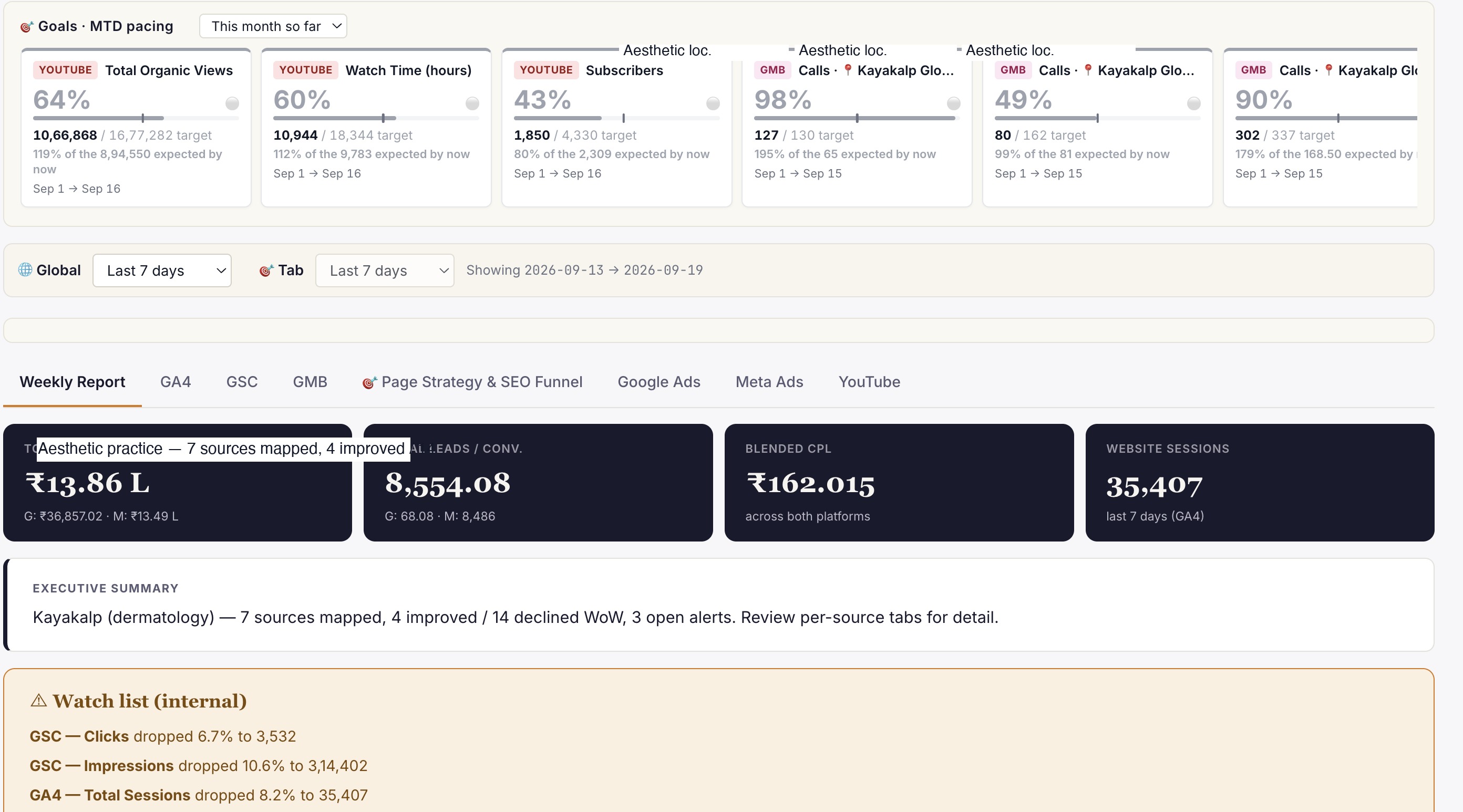
Live client dashboard. GSC, GA4, Google Ads, Meta Ads, IVR calls in one view. Login anytime, not monthly.
Phoenix
Clinic revenue intelligence over your PMS. Daily action queue: Prevent Loss, Maintain & Engage, Grow Revenue. Multi-centre rollout.
Or book a free 30-min audit to see all three in action on your account.
Healthcare brands
that already run on ICG.
A representative slice of the 150+ healthcare brands ICG has delivered for across India. Most engagements remain under NDA.


What ICG clients say · on video.
"Scale up of organic channels and business consulting. ICG has absolute domain authority in their field."
"Working with ICG transformed how we acquire IVF patients in Gurgaon. They understand the fertility journey from inquiry to consult..."
"What Ichelon accomplished — they got all my ideas and worked over 3-4 months to create an amazing, super-customised website."
Need help operationalising this?
Every ICG service is healthcare-only, NMC + DPDP-aware, and built around the patient-research patterns that drive Indian healthcare growth in 2026.
Every practice welcome — packages from ₹20,000/mo.
Goals-Driven engagements · Performance-Linked Payout Models available


More from
ICG.
Five trends shaping Indian healthcare marketing through 2027: AI-first patient research, Conversions API adoption, ABDM discovery, the AEO w...
Healthcare AIO is the discipline of getting your clinic or hospital cited inside Google AI Overviews, ChatGPT and Perplexity answers — not j...
Conversational-search advertising places brand messages inside AI chat answers — ChatGPT, Perplexity, Copilot — rather than beside a results...
Stop guessing.
Book a Diagnostic.
30 minutes. Free. With the AI-powered healthcare-only marketing agency 150+ brands already run on. No slides, no pitch, no hard close.


