


YouTube marketing for IVF clinics in Bangalore (2026): fertility channel playbook for the IT-worker 34-38 first-cycle patient inside PC-PNDT, ART Act 2021, Karnataka Medical Council and NMC compliance
How IVF clinics in Bangalore should run YouTube — English-heavy channel with Kannada for outer-city catchment; the IT-professional 34-38 first-cycle age band that watches 12-20 videos per shortlisted clinic before booking; couple co-viewing content behaviour; higher PGT-A add-on adoption from data-driven decision framing; the six-framework compliance perimeter (Karnataka Medical Council + NMC + ASCI + PC-PNDT + ART Act 2021 + DPDP 2023) with heightened emphasis on data-density in success rate claims; LTV maths per Bangalore fertility patient (₹2L-5L); and the YODA 6-step workflow adapted for a Bangalore IVF channel serving research-heavy tech couples.
No pitch. Written root-cause diagnosis. AI-powered, healthcare only.
Direct answer
How IVF clinics in Bangalore should run YouTube — English-heavy channel with Kannada for outer-city catchment; the IT-professional 34-38 first-cycle age band that watches 12-20 videos per shortlisted clinic before booking; couple co-viewing content behaviour; higher PGT-A add-on...
TL;DR

Bangalore is the most research-heavy IVF market in India. A Bangalore couple watches an average of 12 to 20 videos per shortlisted clinic before booking a first consult — the highest pre-consult research load of any Indian metro — and often watches those videos together, with both partners contributing to the shortlist decision. The reason sits in the demographic: the IT-worker cohort systematically delays motherhood into the 34 to 38 age band, arrives at IVF with a data-driven decision framework loaded, and demands the clinical depth and citation-density a generalist channel does not produce. This guide is ICG's playbook for how a Bangalore IVF clinic should run YouTube inside the Karnataka Medical Council, PC-PNDT Act 1994, ART Act 2021, NMC's 2026 advertising guidelines, ASCI, and DPDP 2023 compliance perimeter — how to build data-dense content that satisfies a tech-couple's research standard without crossing the ART Act 2021 line on success-rate framing, and how the YODA 6-step workflow adapts to a channel where couples co-consume and add-on adoption runs higher than any other Indian city.
Why Bangalore is a distinctive market for IVF YouTube
Bangalore IVF demand concentrates around the IT corridors — Whitefield, Electronic City, Marathahalli, Sarjapur, and the central-north cluster around Indiranagar and Jayanagar. The patient is the tech professional or tech-adjacent spouse, typically first cycle at age 34 to 38 — older than the Mumbai or Delhi first-cycle median — with the elevated diminished-ovarian-reserve considerations that age band brings. This is why PGT-A adoption runs higher in Bangalore than in either metro: the older first-cycle age combined with an analytical decision framework makes the additional screening feel like a rational investment rather than an upsell.
Language mix is comparatively simple. English is the working default across the IT corridors and central clusters, with Kannada as necessary secondary for outer-city catchment (Hoskote, Kanakapura, parts of Yelahanka) and for local Karnataka couples who prefer clinical detail in the language they think in. Hindi has a role for the transplant Bangalore population but is a distant third. Tamil and Telugu matter at the margin.
Bangalore couples are also the most YouTube-first of the three metros — they open YouTube before Google for fertility research, compare specialists across channels rather than text-based listing pages, and treat a well-structured YouTube channel as the primary credibility signal about the clinic. Timing is steadier than Delhi or Mumbai — tech pay cycles are even, so the annual peak is muted with a slight September-to-January uptick rather than a pronounced surge.
The 3-races math for IVF in Bangalore
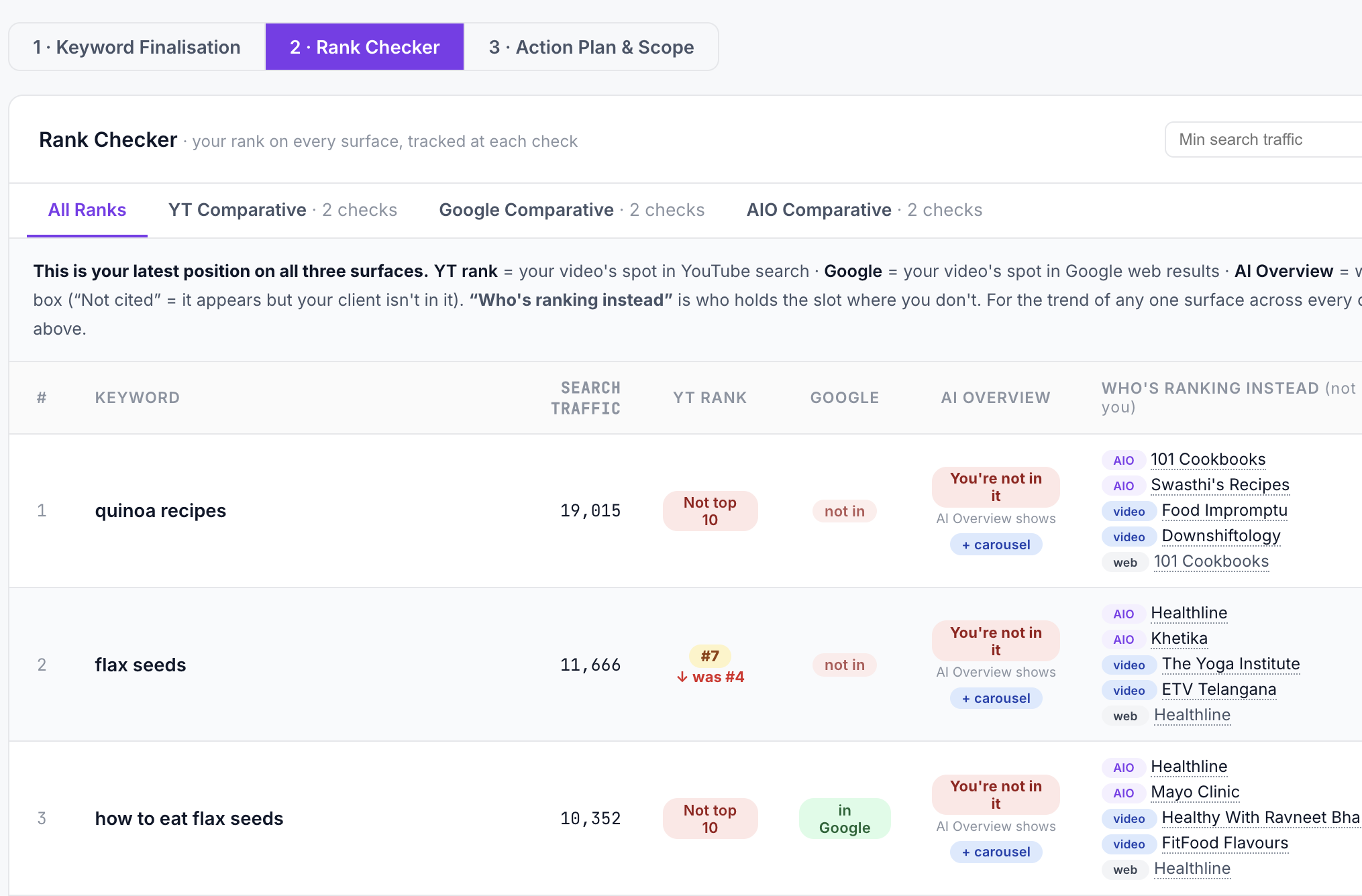
YODA's framing is that a fertility video's ranking lives in three separate places, and Bangalore is the market where Race 1 (YouTube search) does the heaviest lifting because the audience opens YouTube first.
Race 1 — YouTube search. A Bangalore couple opens YouTube and types "IVF cost Bangalore," "PGT-A explained," "IVF success rate age 36," "diminished ovarian reserve IVF." YouTube weighs title-query match, watch duration, and channel authority on the fertility topic cluster. Winning Bangalore titles are English, precisely worded, and clinical in tone — "PGT-A in IVF: What the Data Actually Says for Women 34-40 (India 2026)" ranks and converts far better than a generic explainer title because the target patient is scanning for depth signals.

Race 2 — Google web. Bangalore users still Google fertility queries in volume, and Google returns video carousels for "IVF cost in Bangalore," "PGT-A explained," and long-tail informational queries. Bangalore clinics that embed their YouTube videos on their treatment landing pages — with proper VideoObject schema markup and dense descriptions — capture the video carousel with a lower content investment than clinics competing purely on YouTube.
Race 3 — Google AI Overview. AI Overviews generate for a large share of the data-adjacent queries the Bangalore audience runs — "IVF success rate by age India," "PGT-A accuracy," "how many IVF cycles before success." Videos with structured intros, on-screen citations, clean chapter markers, and factual density inside the first 60 seconds get cited disproportionately. A Bangalore clinic that engineers 10 to 14 AI-Overview-ready data-dense videos in the first 90 days on YODA typically sees Overview appearances compound faster than in less analytical markets.
Compliance perimeter for IVF content in Bangalore
Fertility marketing in Bangalore operates inside a six-framework perimeter, and the specific tension for a Bangalore channel is that the audience wants numeric density in success-rate discussion while the ART Act 2021 sets strict limits on how success rates can be presented. Getting this tension right is what separates a Bangalore channel that compounds from one that trips regulatory attention.
Karnataka Medical Council governs the professional conduct of the fertility specialist appearing on camera and enforces advertising restrictions on registered practitioners.
PC-PNDT Act 1994 (federal) prohibits any sex-determination-adjacent content absolutely — no reference to sex selection, no framing that indirectly suggests the clinic offers it, no ultrasound demonstration that could be misread.
ART Act 2021 (federal) requires clinic registration under the National Registry and restricts success-rate advertising. This is the framework Bangalore channels must be most disciplined about. Every success-rate mention needs an age band, a defined protocol context, and a cycle-count denominator — and for a tech-couple audience, the compliant framing actually reads as more trustworthy than a naked percentage. "In women aged 35 to 39, on antagonist protocol with PGT-A, over our last 240 cycles, we recorded a 38 percent live-birth rate per embryo transfer" is defensible and precisely the kind of data-dense framing the Bangalore audience credits. "42 percent success rate" reads as marketing to a tech couple used to calibrated numbers with denominators. Wherever cycle stimulation is discussed, multiple pregnancy risk and OHSS risk must be named in the same video.
NMC's 2026 advertising guidelines restricts patient testimonial framing. DPDP 2023 makes every on-camera patient appearance personal data — signed consent covering channels, retention, and withdrawal is non-negotiable. ASCI Guidelines 2022 prohibit "best" and unsubstantiated superlative claims — particularly problematic in a market where the audience actively researches comparative claims and will call out unsubstantiated ones in comments.
Content archetypes that convert IVF patients in Bangalore
Doctor credentials, deep and data-forward. Bangalore patients research training, published work, cycle volume, and sub-specialisation in fine detail. A 3 to 4 minute credential-anchored intro per specialist — training institutions, years in fertility, cycle count per year, sub-specialisations (PGT-A, ICSI, donor programs), ART Act 2021 registration — becomes the highest-CTR asset because tech couples pause to fact-check claims and reward accuracy with continued watch time.
Protocol data-density explainer. Bangalore patients want to understand not just what each protocol is but which is indicated for their age band and diagnostic profile, with the numeric trade-offs. A short explainer per protocol with age-band indication data (in compliant ART Act 2021 framing) shortens the first consult by 20 to 30 minutes because the couple arrives already understanding the landscape.
PGT-A explainer archetype, foregrounded. Because PGT-A adoption is higher in Bangalore than in Mumbai or Delhi, a dedicated PGT-A sub-cluster is a channel priority. Explainer on what PGT-A screens for, when it is clinically indicated, what accuracy the test has (with published-literature citation, not clinic marketing claims), the additional cost, and the realistic outcome delta for the couple's specific age band.
Realistic success rate maths by age. Short videos per age band (30-34, 35-37, 38-40, 41+) with age-band IVF outcome data framed inside ART Act 2021 constraints. Bangalore couples in the 34-38 band actively research what their age means for cycle count expectation, and honest data-dense framing converts better than vague optimism.
Couple co-viewing archetype. Bangalore couples often watch together on a laptop rather than each partner solo on a phone. Video pacing, on-screen text, and speaker framing that support co-viewing (rather than solo-mobile) noticeably improve completion rates on longer explainers.
Real budget expectations for IVF YouTube in Bangalore
A Bangalore IVF YouTube engagement has to be budgeted against per-patient LTV. A cycle in Bangalore runs ₹1.6L to ₹2.8L on antagonist protocol without add-ons. ICSI adds ₹35,000 to ₹70,000. PGT-A adds ₹85,000 to ₹1.5L and is adopted more frequently than in other metros. Donor egg cycles run ₹2.8L to ₹4L. Cryostorage runs ₹25,000 to ₹65,000 per year. Most patients go through 1 to 3 cycles, with higher PGT-A adoption reducing average cycle count for the successful cohort. LTV per Bangalore fertility patient runs ₹2L to ₹5L, with PGT-adopted and donor cases toward the upper end.
Chain tier — ₹80,000/- to ₹1.5L/- per month. Fits single-location centres and small chains up to 3 locations. Includes YODA access, monthly plan for 6 to 8 videos, script support with six-framework compliance review and data-density discipline in success-rate framing, SEO writebacks across the three ranking surfaces, thumbnail A/B tests, and comment moderation calibrated for the higher engagement Bangalore channels see. Suits clinics doing ₹2.2Cr/- to ₹12Cr/- annual fertility revenue.
Hospital tier — ₹1.5L/- to ₹3.75L/- per month. Fits multi-location chains, hospital-group fertility departments, and PGT-A-forward programs. Includes multi-channel management if the group runs separate English and Kannada channels, deeper IT-corridor competitor intelligence, paid-media integration, and quarterly compliance training including ART Act 2021 success-rate discipline.
Below ₹80,000/- per month, the compliance overhead of a Bangalore IVF channel eats the budget. Start with Angryturtle self-serve at ₹999/- for local SEO.
YODA 6-step workflow for a Bangalore IVF channel
Step 1 — Overview. Connect the Bangalore channel, calibrate against the Indian IVF specialty benchmark band, separate historical paid promotion from organic. For Bangalore specifically, expect longer average view durations on data-dense content (7 to 10 minutes on protocol explainers) reflecting the higher research load Bangalore couples carry.
Step 2 — Diagnostics. Cluster the library by topical group (IVF basics, ICSI, PGT-A, donor egg, embryo freezing, diminished ovarian reserve, secondary infertility, male fertility, age and fertility) and by format archetype. The Bangalore audience-profile module usually shows an unusually tight age concentration in the 34-38 first-cycle band and a distinct couple-co-viewing signal in the session-duration data.
Step 3 — Strategy. Produce a rolling 90-day content plan that reinforces the winning clusters (typically PGT-A, protocol explainer, age-specific data), front-loads AI-Overview-ready videos, and identifies 2 to 3 organic Winners per month for modest paid boost. For Bangalore, Strategy plans a steadier year-round cadence with a mild September-to-January uptick rather than a Delhi-style pronounced surge.
Step 4 — Optimisation. Rewrite titles for AI Overview citation readiness with the data-density framing the Bangalore audience prefers, insert structured chapter timestamps, update descriptions with substantiated context, and queue thumbnail A/B tests. YODA's writeback applies changes directly to YouTube.
Step 5 — Reputation (ORM). Bangalore comment threads are unusually substantive — tech couples ask sharp follow-up questions and will call out imprecise claims. Never reply with clinical advice, never quote success rates in reply text, route detailed questions to a WhatsApp consult booking. Well-informed compliant replies materially compound channel authority in Bangalore's comment culture.
Step 6 — Competitor Intel. Track 6 to 10 peer Bangalore channels across the IT-corridor and central clusters. Identify content gaps (particularly around PGT-A, diminished ovarian reserve, and age-specific data) where competitors earn traffic and the clinic is silent, then close them without direct comparative framing.
The platform ICG uses to run this at scale: YODA

ICG runs healthcare YouTube marketing for clinics, hospitals, and specialty groups using YODA — our AI-native healthcare YouTube marketing platform. YODA sits on top of a channel's data and does four things no dashboard does: it separates organic from paid views at every step (so a promoted video can never masquerade as organic growth), it gives decisions not dashboards (every video gets a state + next action), it writes back to YouTube directly (improved titles, tags, descriptions, chapters applied straight to the platform), and it tracks the three rank races — YouTube search, Google web, and Google AI Overview citations.
YODA runs the full 6-step workflow — Overview, Diagnostics, Strategy, Optimisation, Reputation (ORM), and Competitor Intel — with 40+ analysis modules organised under those steps. ICG's managed YouTube service uses YODA end-to-end. See the Healthcare YouTube Marketing pillar guide for the full scope, or the Healthcare YouTube Marketing Agency service page for engagement details.
Book a YODA demo on WhatsApp → or request a free healthcare YouTube channel audit →
Related reading
- YouTube marketing for IVF clinics in India (parent guide)
- Local SEO for doctors and clinics in Bangalore 2026
- YODA 6-step workflow explained for healthcare marketing agencies
- Top 15 IVF marketing agencies in India
- Healthcare YouTube marketing agency service page
FAQ
Why do Bangalore couples watch so many more videos before booking an IVF consult than couples in other metros? Two structural reasons. The IT-professional cohort brings an analytical decision framework to a high-stakes clinical choice and treats video content as primary evidence rather than marketing. And Bangalore couples typically co-view — both partners contribute to the shortlist decision, naturally doubling the per-clinic video count.
How do we present success-rate data with the depth the Bangalore audience wants without violating ART Act 2021? Always with age band, defined protocol context, and cycle-count denominator. The compliant framing reads as more credible to a tech couple than a naked percentage. YODA logs every success-rate mention against source data before publication.
Why is PGT-A adoption higher in Bangalore than in Mumbai or Delhi? The 34-38 first-cycle age band brings elevated aneuploidy-risk considerations that make PGT-A clinically indicated more often, and the tech-analytical decision framework makes the additional screening feel like a rational investment. A channel that treats PGT-A as a first-class cluster captures the demand faster.
Do we need Kannada content or is English enough for the Bangalore audience? English is the working default for the IT corridors and central clusters, but Kannada wins with outer-city catchment (Hoskote, Kanakapura, parts of Yelahanka) and with local Karnataka couples. A 10 to 20 percent Kannada allocation typically emerges from YODA's language-mix report after 6 months.
What is the couple co-viewing signal and how do we design videos for it? Longer session durations from the same IP suggest both partners are watching together on a laptop rather than solo on a phone. Design implication: on-screen text sized for laptop-across-the-room viewing, pacing that allows pause-and-discuss moments, and speaker framing that presumes two people rather than one.
How do we handle Bangalore's substantive comment threads without regulatory exposure? Never provide clinical advice in a comment reply. Never quote a success-rate figure. Acknowledge, reference the video's framing, route detailed follow-up to a WhatsApp consult booking. YODA's moderation surfaces every comment warranting a considered reply and pre-filters escalations.
What booked-cycle uplift does a Chain-tier Bangalore engagement produce by month 6? Typically 4 to 8 booked cycles per month attributable to YouTube by month 6 to 8, at a fully-loaded cost per booked cycle of ₹8,000/- to ₹13,000/-. Higher PGT-A adoption in the booked cohort lifts per-cycle net contribution above the raw cycle count.
Clinical tone or warmer patient-facing tone for a Bangalore audience? Clinical tone with warmth, not the other way around. A tech couple wants to believe the specialist is competent first and empathetic second — reversing that balance reads as marketing polish rather than clinical seriousness.
Book a free IVF clinic growth diagnostic.
Raman Soni walks through your current channel mix, CPQL vs cost-per-cycle, and where the 90-day patient journey is leaking.
The three platforms
behind every ICG engagement.
Beacon
CAPI middleware that fixes Event Match Quality, translates CRM statuses to Meta-standard events, dedups across channels.
Agency OS
Live client dashboard. GSC, GA4, Google Ads, Meta Ads, IVR calls in one view. Login anytime, not monthly.
Phoenix
Clinic revenue intelligence over your PMS. Daily action queue: Prevent Loss, Maintain & Engage, Grow Revenue. Multi-centre rollout.
Or book a free 30-min audit to see all three in action on your account.
Healthcare brands
that already run on ICG.
A representative slice of the 150+ healthcare brands ICG has delivered for across India. Most engagements remain under NDA.


What ICG clients say · on video.
"Working with ICG transformed how we acquire IVF patients in Gurgaon. They understand the fertility journey from inquiry to consult..."
"ICG built our IVF marketing system from the ground up. The team understands healthcare specifics, not just generic digital marketi..."
Need help operationalising this?
Every ICG service is healthcare-only, NMC + DPDP-aware, and built around the patient-research patterns that drive Indian healthcare growth in 2026.
Every practice welcome — packages from ₹20,000/mo.
Goals-Driven engagements · Performance-Linked Payout Models available



More from
ICG.
Five trends shaping Indian healthcare marketing through 2027: AI-first patient research, Conversions API adoption, ABDM discovery, the AEO w...
Healthcare AIO is the discipline of getting your clinic or hospital cited inside Google AI Overviews, ChatGPT and Perplexity answers — not j...
Conversational-search advertising places brand messages inside AI chat answers — ChatGPT, Perplexity, Copilot — rather than beside a results...
Stop guessing.
Book a Diagnostic.
30 minutes. Free. With the AI-powered healthcare-only marketing agency 150+ brands already run on. No slides, no pitch, no hard close.


