


YouTube marketing for IVF clinics in India (2026): fertility channel playbook for ICSI, PGT, donor egg, and embryo freezing inside PC-PNDT, ART Act 2021, and NMC compliance
How IVF clinics in India should run YouTube — fertility content archetypes across ICSI, PGT, donor egg, embryo freezing, and IVF success-rate queries; the four-framework compliance perimeter (PC-PNDT + ART Act 2021 + NMC + ASCI); the 6-12 month couple consideration cycle; LTV maths per cycle (₹1.2-3L × 2-3 cycles = ₹6-15L per patient); and the YODA 6-step workflow adapted for a fertility channel that compounds over months.
No pitch. Written root-cause diagnosis. AI-powered, healthcare only.
Direct answer
How IVF clinics in India should run YouTube — fertility content archetypes across ICSI, PGT, donor egg, embryo freezing, and IVF success-rate queries; the four-framework compliance perimeter (PC-PNDT + ART Act 2021 + NMC + ASCI); the 6-12 month couple consideration cycle; LTV mat...
TL;DR

IVF is the most compounding YouTube specialty in Indian healthcare and simultaneously the most punishing to get wrong. It compounds because a fertility patient couple typically watches 15 to 40 videos across a 6 to 12 month consideration cycle before booking a first consultation, and the clinic that is present through that arc earns disproportionate trust. It is punishing because fertility marketing sits inside the tightest compliance perimeter in Indian healthcare — PC-PNDT Act 1994, ART Act 2021, NMC's 2026 advertising guidelines, and ASCI Guidelines 2022 all apply simultaneously, and a single unsubstantiated success-rate claim can trigger regulatory scrutiny against the clinic and the treating specialist. This guide is ICG's playbook for how a fertility clinic in India should actually run YouTube — content archetypes across the specialty queries that matter, how the YODA 6-step workflow is adapted for the long fertility consideration cycle, and the LTV maths that explain why YouTube is the highest-return marketing channel a fertility clinic can build.
Why IVF YouTube is different from every other healthcare specialty
Fertility marketing operates on a timeline no other specialty faces. A couple who first search "why is it taking so long to conceive" today may not book their first fertility consult for 6-12 months, and may not commit to an IVF cycle for another 3-6 months after the first consult. The consideration arc is measured in seasons, not weeks. Meta and Google ads are calibrated for short-window conversions and produce meaningfully worse LTV economics for fertility than they do for aesthetic derma or dental. YouTube is the exact opposite — the medium is built for long attention arcs, and a fertility channel that publishes consistently across the consideration window is present at every stage a couple moves through.
Query volumes are large and split across informational, emotional, and clinical clusters. Informational queries include "IVF success rate India," "how much does IVF cost," "ICSI vs IVF difference," "what is PGT-A." Emotional queries include "should we try IVF," "IVF failed what next," "IVF at age 40 chances." Clinical queries include "embryo freezing process," "donor egg IVF explained," "IVF stimulation injections side effects." A well-built fertility channel covers all three clusters because a couple moves through all three as they progress from research to consult to cycle commitment.
The LTV maths are extraordinary. A single IVF cycle in India runs ₹1.2L/- to ₹3L/- depending on protocol complexity, city, and add-ons like PGT or donor egg. Most patients who commit to IVF go through 2-3 cycles before successful outcome or program exit. Add-ons — embryo freezing at ₹30,000/- to ₹80,000/- per year for storage, PGT-A at ₹80,000/- to ₹1.5L/- per cycle, donor programs at ₹1.5L/- to ₹3.5L/- — layer on top. Total LTV per fertility patient couple runs ₹6L/- to ₹15L/-, with some complex cases reaching ₹20L/-+. Against these numbers, a fertility YouTube channel that delivers 4-6 booked consults per month at a fully-loaded cost of ₹8,000/- per consult is producing 30x return over the patient lifecycle.
The three ranking races a fertility channel has to win
YODA's framing is that a video's ranking lives in three separate places. For fertility, each race has its own high-intent query pattern.
Race 1 — YouTube search. A user opens YouTube and searches "IVF success rate" or "IVF process step by step" or "ICSI vs IVF difference." YouTube's ranking weighs title-query match, watch time, and channel authority in the fertility topic cluster. The winning title pattern is neutral, informational, credential-anchored, and free of unsubstantiated claims — "IVF Process Step by Step: Fertility Specialist Explains (India 2026)" ranks better and is compliance-safe compared to "IVF Success Guaranteed" which would violate ASCI and ART Act 2021 restrictions simultaneously.

Race 2 — Google web search. When a user Googles "IVF cost in India" or "what is PGT-A" and Google returns a video carousel, this is the race where fertility videos surface inside standard Google results. Description density, chapter timestamps, and the video's embed on the fertility clinic's website all shape the ranking here. Fertility clinics that embed their YouTube videos on their treatment landing pages get materially better Race-2 visibility.
Race 3 — Google AI Overview citations. This is the highest-leverage surface for fertility because Google generates AI Overviews for a large share of fertility informational queries — "is IVF painful," "what age is too late for IVF," "what is the success rate of IVF over 40." When the Overview generates, it often cites a video source for the "show me the process" component. Fertility videos with structured intros, factual density, sourced claims, and clear chapter markers get cited disproportionately.
A fertility channel optimising for only YouTube search leaves the majority of long-tail informational demand on the table. YODA's Race-2 and Race-3 tracking is the difference between an average fertility channel and a compounding one.
The PC-PNDT, ART Act 2021, NMC, and ASCI compliance perimeter fertility content must sit inside
Fertility marketing in India is regulated by more overlapping laws than any other healthcare specialty. Every fertility video has to be designed inside a four-framework perimeter, and getting any one of them wrong triggers material regulatory risk against the clinic and the treating fertility specialist.
PC-PNDT Act 1994. The Pre-Conception and Pre-Natal Diagnostic Techniques Act prohibits sex-determination-adjacent advertising and applies to any fertility clinic that operates ultrasound equipment. Fertility content must never suggest sex-selection is an offered service, must never reference sex determination in any context, and must include the required PC-PNDT disclosure where applicable to the clinic's registration category.
ART Act 2021. The Assisted Reproductive Technology (Regulation) Act 2021 regulates donor programs, requires clinic registration under the National Registry, and — critically for marketing — restricts advertising claims about outcomes and success rates. The government notification is available at indiacode.nic.in. Any success-rate claim in a video must be substantiated with clinic-specific data, must be presented as a specific percentage tied to a defined age band and cycle protocol, and must not be presented as generalisable guarantee.
NMC's 2026 advertising guidelines. The National Medical Commission restricts doctors from soliciting patient testimonials and from presenting patient stories as clinical evidence. For fertility this is particularly sensitive because success stories are the emotionally most powerful content — and also the format most likely to violate NMC restrictions if the treating fertility specialist appears alongside the testimonial in a way that reads as clinical endorsement.
ASCI Guidelines 2022. Prohibits unsubstantiated superlative claims ("best IVF clinic," "highest success rate," "guaranteed pregnancy") and comparative advertising without evidence. In fertility, ASCI restrictions overlap with ART Act restrictions on outcome claims — meaning a violation typically trips both frameworks simultaneously.
Practically, every fertility video needs a documented compliance review before publication, every claim needs a substantiation source, every patient appearance needs signed consent under DPDP Act 2023, and every success-rate figure needs the specific age-band and protocol context that makes it defensible. This is slower and more careful than the way most generalist YouTube agencies work. It is also the only way to build a fertility channel that survives multi-year growth without a regulatory incident.
Content format archetypes that work for fertility channels
Explainer. The fertility specialist explains a procedure or concept — how IVF stimulation works, what happens during egg retrieval, how PGT-A screens embryos, what donor egg IVF involves. Explainers are the workhorse and should be 45-55% of a fertility channel because they rank strongly on the informational queries that dominate fertility search demand.
Q&A. The specialist answers real questions from patients and viewers — sourced from consult transcripts, YouTube comments, and Ask Maps queries. Q&A is particularly powerful for fertility because the emotional and clinical questions couples ask are consistent across markets. Should be 15-20% of the channel.
Myth-vs-Fact. The specialist addresses common misconceptions ("IVF babies are less healthy," "IVF only works for younger women," "IVF is only for infertility"). Myth-vs-Fact videos consistently outperform Explainers on retention because of the curiosity-gap framing. Should be 10-15% of the channel.
Journey / testimonial (compliance-safe). Real patient couples narrate their fertility journey, with signed consent, with the treating specialist not framing the story as clinical evidence, and with careful editing that avoids implicit success-rate claims. Journey format is emotionally the most powerful fertility content and converts cold viewers into consults at higher rates than any other format — but only when the compliance framing is disciplined. Should be 10-15% of the channel maximum.
Educational deep-dive. Longer 15-25 minute videos that treat a single topic (embryo freezing, donor egg IVF, endometriosis and fertility) with the depth a couple in mid-consideration is actually looking for. Should be 10% of the channel — low volume, high consult-conversion quality.
The YODA 6-step workflow adapted for a fertility channel
Step 1 — Overview. Connect the channel, calibrate against the IVF specialty benchmark band (fertility channels typically average 5-8 minute view duration on Explainer content and 3-5% CTR on target queries — longer than derma because fertility viewers are in a deeper research mode), separate any paid promotion history from organic history.
Step 2 — Diagnostics. Cluster videos by topical group (IVF basics, ICSI, PGT, donor egg, embryo freezing, secondary infertility, male fertility) and by format archetype. Identify which clusters are earning long-arc watch time — a signal that couples in mid-consideration are engaging — and which need retention fixes at the intro hook.
Step 3 — Strategy. Produce a rolling 90-day content plan that reinforces the winning clusters, adds Race-3 AI Overview citation-ready videos for informational queries where the clinic is not yet cited, and identifies ad-spend picks on 2-3 organic Winners per month. For fertility, Strategy has to think about the 6-12 month arc — planning content that will still be relevant when a couple who watched it in month 1 books a consult in month 8.
Step 4 — Optimisation. Rewrite titles for AI Overview citation readiness. Insert structured chapter timestamps. Update descriptions with substantiated context that satisfies both search-engine and compliance requirements. Queue thumbnail A/B tests.
Step 5 — Reputation (ORM). Fertility comments are emotionally sensitive and often disclose personal history. YODA's comment moderation surfaces every comment that requires a considered, compliance-safe reply. Never reply with clinical advice. Never quote success rates in reply text. Always route detailed questions to a WhatsApp consult booking.
Step 6 — Competitor Intel. Track 5-8 peer fertility channels — a mix of independent fertility specialists, mid-sized IVF chains, and 1-2 aspirational large chains. Identify content gaps in topical clusters where competitors are earning traffic and the clinic is silent.
Sample 90-day channel build plan for a Bengaluru fertility clinic
Days 1-15. YODA setup, historical data pull, first Diagnostics output. Compliance audit of any existing library — any video that violates PC-PNDT, ART Act 2021, or NMC restrictions gets pulled or re-edited before new publications go up. Baseline Rank OS scoring on the top 40 target fertility queries across YouTube search, Google web, and AI Overview surfaces. Shoot planning for the fertility specialist including intro pieces, credibility segments, and clinic-and-lab tour footage.
Days 16-45. Publish 6-8 new videos across the topical clusters — starting with 2-3 IVF Basics Explainer videos, 2 Q&A videos on the highest-volume patient questions, and 1 Myth-vs-Fact video on a common IVF misconception. Apply Optimisation writebacks to existing library. Launch first thumbnail A/B tests. Start compliance-safe comment reply cadence.
Days 46-90. Publish another 8-10 videos calibrated by day-45 retention and CTR data. Introduce first Journey-format testimonial with full signed-consent compliance framing. Start ad-spend picks on 2 organic Winners at ₹10,000-20,000/- per boost. First measurable consult-booking uplift typically shows up in weeks 10-14 — later than derma because fertility consideration cycles are longer.
By day 90, a well-run fertility channel typically has 16-20 videos published, 1,200-3,500 new subscribers, and — critically — a measurable increase in the fraction of first-consult attendees who mention "found you on YouTube" during intake.
Which ICG retainer tier fits a fertility YouTube engagement
Chain tier — ₹75,000/- to ₹1.5L/- per month. Fits single-location fertility clinics and small IVF chains (up to 3 locations). Includes YODA platform access, monthly content plan for 6-8 videos, script support with compliance review, SEO writebacks, thumbnail A/B tests, comment moderation inside the four-framework compliance perimeter, and one strategy review per month. Suits clinics doing ₹2Cr/- to ₹15Cr/- annual fertility revenue where adding 4-8 booked cycles per month materially moves the P&L.
Hospital tier — ₹1.5L/- to ₹4L/- per month. Fits multi-location IVF chains, fertility departments within larger hospital groups, and specialised IVF brands with 4+ locations or high-end donor and PGT programs. Includes everything in Chain tier plus multi-channel management if the group runs separate channels per city, deeper Competitor Intel across a larger peer set, integration with paid-media planning through the Ad-Spend Picks module, and quarterly compliance training for the clinic's internal marketing team.
Below ₹75,000/- per month, ICG's honest recommendation is that fertility marketing at this budget level should not attempt a full channel build — the compliance overhead alone eats the budget. Fertility clinics starting from a small marketing base should first invest in local SEO and GBP through Angryturtle self-serve at ₹999/-, and add YouTube once the marketing spend allows a Chain-tier engagement.
Angryturtle plus YODA together for a fertility clinic — full local plus YouTube coverage
A fertility couple in the consideration cycle typically touches Google Maps ("IVF clinic near me," "fertility specialist Bengaluru") and YouTube ("IVF success rate," "how much does IVF cost") multiple times across the 6-12 month arc. The clinic that owns both surfaces has a compounding advantage over the clinic that is only present on one.
Angryturtle runs GBP intelligence, review operations, Google Posts, and Ask Maps AIO Readiness for the fertility clinic's Google Business Profile — with PC-PNDT, ART Act 2021, and NMC compliance-aware templates for reviews and Ask Maps answers. YODA runs the YouTube channel end-to-end inside the same compliance perimeter. A couple typing "IVF clinic Bengaluru" sees the clinic in the map pack; the same couple later searches "IVF success rate India" on YouTube and sees the clinic's specialist explaining the topic honestly. Both surfaces reinforce each other, and both convert into WhatsApp consult bookings.
The platform ICG uses to run this at scale: YODA
ICG runs healthcare YouTube marketing for clinics, hospitals, and specialty groups using YODA — our AI-native healthcare YouTube marketing platform. YODA sits on top of a channel's data and does four things no dashboard does: it separates organic from paid views at every step (so a promoted video can never masquerade as organic growth), it gives decisions not dashboards (every video gets a state + next action), it writes back to YouTube directly (improved titles, tags, descriptions, chapters applied straight to the platform), and it tracks the three rank races — YouTube search, Google web, and Google AI Overview citations.
YODA runs the full 6-step workflow — Overview, Diagnostics, Strategy, Optimisation, Reputation (ORM), and Competitor Intel — with 40+ analysis modules organised under those steps. ICG's managed YouTube service uses YODA end-to-end. See the Healthcare YouTube Marketing pillar guide for the full scope, or the Healthcare YouTube Marketing Agency service page for engagement details.
Book a YODA demo on WhatsApp → or request a free healthcare YouTube channel audit →
Related reading
- Healthcare YouTube marketing pillar guide 2026
- YODA 6-step workflow explained for healthcare marketing agencies
- IVF video-consultation conversion impact
- YouTube vs Meta vs Google ROI for IVF clinics in India 2026
- Healthcare YouTube marketing agency service page
FAQ
How long before a fertility YouTube channel starts producing booked consults? First measurable consult attribution from organic YouTube typically appears at weeks 10-14 for a channel publishing on a disciplined weekly cadence. Compounding starts around month 6-8 as the video library becomes deep enough that new videos benefit from Suggested traffic and the earliest videos accumulate long-arc watch history from couples deep in the consideration cycle.
Can we quote our clinic's IVF success rate in videos? Only with the specific ART Act 2021 substantiation framing — a specific percentage tied to a defined age band and cycle protocol, sourced to clinic-specific data, presented as a specific figure and never as a generalisable guarantee. YODA's compliance filter reviews every success-rate mention before publication.
How do we handle patient testimonial videos inside NMC and DPDP restrictions? Signed consent under DPDP Act 2023 that covers the specific channels, retention period, and withdrawal mechanism. Editorial framing that presents the story as personal experience rather than clinical evidence. The treating specialist must not appear on-screen with the testimonial in a way that reads as clinical endorsement. YODA reviews every Journey-format script and cut against these guardrails.
What content clusters should a new fertility channel prioritise first? Start with IVF Basics (explaining the process step by step), Age and Fertility (the highest-volume search cluster), and Cost and Financial Planning (the second-highest). Add PGT, donor egg, and embryo freezing as the channel matures and audience-profile Diagnostics confirms couple interest in the deeper clinical topics.
What is the LTV per fertility patient couple from a well-run YouTube funnel? ₹6L/- to ₹15L/- typically, with complex cases involving PGT, donor programs, and multi-year freezing storage reaching ₹20L/-+. Fertility has the highest per-patient LTV of any healthcare specialty ICG markets on YouTube.
How does YouTube fertility marketing compare to Meta and Google ads for CPQL? Meta and Google produce faster surface conversions but shallower lifetime value because they capture patients late in the consideration cycle. YouTube produces slower initial conversions but materially higher LTV because it captures patients earlier and builds trust across the 6-12 month arc.
Should we run our fertility channel in the specialist's name or the clinic's name? Both. The credential-carrying fertility specialist as the on-camera face and personal brand, with the clinic as the affiliation visible in bumpers, descriptions, and pinned comments. NMC restrictions favour this framing (educational content authored by a specialist) over promotional-of-doctor framing.
How much paid promotion should a fertility channel run alongside organic content? Modest amounts on identified organic Winners — ₹10,000/- to ₹20,000/- per boost on 2-3 videos per month. Blanket paid promotion produces a paid-inflates-organic distortion YODA's paid-vs-organic separation is designed to prevent, and also risks ASCI attention on the higher-spend videos.
Do we need separate videos for donor egg IVF and standard IVF or can one channel cover both? One channel, separate content clusters. Donor egg IVF is a distinct topical cluster with its own query pattern, audience concerns, and ART Act 2021 registration and consent implications. YODA's topical clustering handles this separation automatically.
What does the compliance review flow look like inside ICG's YouTube service? Every video script, every title, every description, every thumbnail overlay, and every comment reply passes through a compliance filter — automated where possible, human where the risk warrants it. The four frameworks (PC-PNDT + ART Act 2021 + NMC + ASCI) are encoded as review rulesets. Nothing is published without a clean review pass logged in the YODA audit trail.
Book a free IVF clinic growth diagnostic.
Raman Soni walks through your current channel mix, CPQL vs cost-per-cycle, and where the 90-day patient journey is leaking.
The three platforms
behind every ICG engagement.
Beacon
CAPI middleware that fixes Event Match Quality, translates CRM statuses to Meta-standard events, dedups across channels.
Agency OS
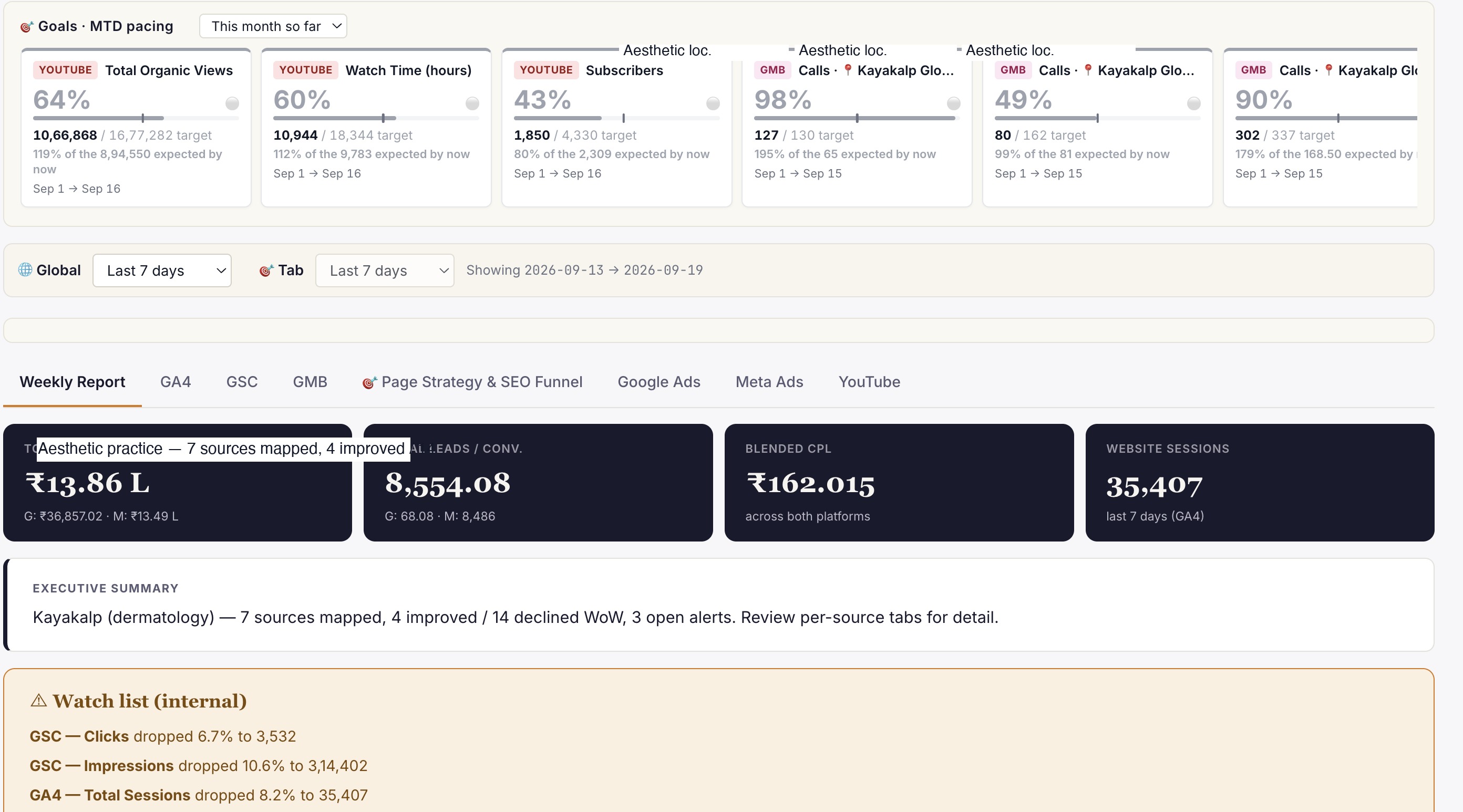
Live client dashboard. GSC, GA4, Google Ads, Meta Ads, IVR calls in one view. Login anytime, not monthly.
Phoenix
Clinic revenue intelligence over your PMS. Daily action queue: Prevent Loss, Maintain & Engage, Grow Revenue. Multi-centre rollout.
Or book a free 30-min audit to see all three in action on your account.
Healthcare brands
that already run on ICG.
A representative slice of the 150+ healthcare brands ICG has delivered for across India. Most engagements remain under NDA.


What ICG clients say · on video.
"Working with ICG transformed how we acquire IVF patients in Gurgaon. They understand the fertility journey from inquiry to consult..."
"ICG built our IVF marketing system from the ground up. The team understands healthcare specifics, not just generic digital marketi..."
Need help operationalising this?
Every ICG service is healthcare-only, NMC + DPDP-aware, and built around the patient-research patterns that drive Indian healthcare growth in 2026.
Every practice welcome — packages from ₹20,000/mo.
Goals-Driven engagements · Performance-Linked Payout Models available


More from
ICG.
Five trends shaping Indian healthcare marketing through 2027: AI-first patient research, Conversions API adoption, ABDM discovery, the AEO w...
Healthcare AIO is the discipline of getting your clinic or hospital cited inside Google AI Overviews, ChatGPT and Perplexity answers — not j...
Conversational-search advertising places brand messages inside AI chat answers — ChatGPT, Perplexity, Copilot — rather than beside a results...
Stop guessing.
Book a Diagnostic.
30 minutes. Free. With the AI-powered healthcare-only marketing agency 150+ brands already run on. No slides, no pitch, no hard close.


