


YODA 6-step workflow explained for healthcare marketing agencies in 2026: from raw channel data to decisions
YODA's 6-step workflow — Overview, Diagnostics, Strategy, Optimisation, Reputation, Competitor Intel — is how ICG turns a healthcare YouTube channel from a dashboard of vanity metrics into a sequence of decisions. This guide walks each step with a sample dermatology channel (Lumina Skin & Hair Clinic), what each step outputs, and how the steps connect end to end.
No pitch. Written root-cause diagnosis. AI-powered, healthcare only.
Direct answer
YODA's 6-step workflow — Overview, Diagnostics, Strategy, Optimisation, Reputation, Competitor Intel — is how ICG turns a healthcare YouTube channel from a dashboard of vanity metrics into a sequence of decisions. This guide walks each step with a sample dermatology channel (Lumi...
TL;DR

YODA's 6-step workflow is the operational spine of how ICG runs a healthcare YouTube channel — from raw data connection through to the decisions a marketing team executes on Monday morning. The steps are Overview, Diagnostics, Strategy, Optimisation, Reputation, and Competitor Intel, and they run left to right with each step consuming outputs from the step before it. This guide walks the entire workflow with a sample dermatology channel — Lumina Skin & Hair Clinic in Delhi, Dr. Meera Kapoor as the on-screen face — so healthcare agencies can see what each step actually produces, how the 40+ analysis modules organise under the six steps, and how the whole thing ladders back to the healthcare YouTube marketing engagement.
The shape of the workflow and why six steps and not four or ten
YODA's 6-step model is not arbitrary. Each step answers a specific question about a channel, and the questions are ordered such that answering step three requires the outputs of steps one and two. Skipping steps produces bad decisions — a Strategy recommendation is only as good as the Diagnostics that fed it, and Diagnostics is only as good as the clean data set the Overview step assembled.
Step 1 — Overview & Setup — answers "what does this channel look like and what are we measuring it against." Step 2 — Diagnostics — answers "where is this channel strong and weak today across content, audience, and funnel." Step 3 — Strategy — answers "what should we make next." Step 4 — Optimisation — answers "how do we improve what we've already published." Step 5 — Reputation (ORM) — answers "what does the audience say and how do we respond." Step 6 — Competitor Intel — answers "what are similar channels doing that we are not."
Every module inside YODA slots under one of these six steps. There are 40+ modules in total, and each module is a specific analytical view — sometimes a chart, sometimes a decision matrix, sometimes a writeback action queue. A healthcare marketing team runs the workflow weekly for tactical decisions and monthly for strategic decisions.

Step 1: Overview and Setup for Lumina Skin & Hair Clinic
Setup for a new channel takes 45 to 90 minutes. YODA connects the YouTube channel via OAuth, connects Google Analytics if there is a related clinic website, connects Google Search Console for the domain if applicable, and pulls the last 12 months of channel data.
For Lumina Skin & Hair Clinic — an invented dermatology practice used throughout this walkthrough — the Overview module shows the baseline state: 42 videos published over 18 months, 4,850 subscribers, 128,000 total views, average view duration 3 minutes 12 seconds, 62% of watch time from Indian audiences with the remaining 38% split between UAE, US, and UK diaspora traffic.
Overview also asks for benchmarks — the channel's own targets, the specialty benchmark set (YODA has healthcare specialty benchmark bands for dermatology, IVF, ophthalmology, dental, and multi-specialty hospitals), and the specific business goals (consult bookings, in-clinic footfalls, patient education reach). For Lumina, the primary goal is set as consult bookings through the WhatsApp link in the video description, with secondary goals around patient education and organic subscriber growth.
Overview also performs the first paid-vs-organic split — Lumina has run promoted campaigns on 6 of its 42 videos, contributing 34% of total historical views. From step 1 onwards, every downstream module presents organic-only as the primary line with paid shown as a separately-labelled overlay.
Step 2: Diagnostics across content clusters, formats, traffic, retention, and funnel
Diagnostics is the largest step by module count — roughly 12 of the 40+ modules live here. It answers the "where are we strong and weak" question across every diagnostic axis.
Content clusters. YODA groups Lumina's 42 videos into topical clusters using semantic embeddings — Acne (11 videos), Hair Loss (9 videos), Skin Whitening (4 videos — flagged for review under ASCI substantiation rules), Pigmentation (7 videos), Anti-Ageing (5 videos), Procedure Explainers (4 videos), Clinic Introduction (2 videos). Each cluster gets its own organic view total, subscriber conversion, and CTA click-through so the team can see which topics are earning attention and which are producing consults.
Formats. Separate from content clusters, YODA classifies each video by format — Explainer (23 videos), Myth-vs-Fact (6 videos), Testimonial-style patient story (2 videos flagged for NMC compliance review), Q&A (7 videos), Behind-the-scenes procedure (4 videos). Format performance is measured independently from content topic — Lumina's Myth-vs-Fact videos average 2.4x the retention of Explainers even though they cover the same topics.
Traffic surfaces. Views break out by YouTube search (34%), Suggested (28%), Browse (12%), External including Google web (16%), Direct/Channel pages (7%), and Notifications (3%). The high Suggested share tells the strategy step that Lumina's videos are being surfaced next to similar creators' videos — an authority signal worth preserving.
Retention curves. Aggregate audience retention across the channel is 42% at video midpoint — healthy for the specialty. But three specific videos show retention cliffs at 0:15 to 0:30, which the Optimisation step will target for hook rewrites.
Funnel. Lumina's consult-booking WhatsApp link in descriptions produced 89 clicks over the last 90 days, resulting in 34 booked consults per the clinic's CRM. Click-to-consult conversion is 38%, a strong number that suggests the description CTA architecture is working — the bottleneck is upstream (getting more people to click).
Step 3: Strategy — trending topics, content planner, ad-spend picks, action plan
Strategy consumes the Diagnostics outputs and answers "what to make next and what to promote." For Lumina, Strategy produces a 90-day content plan with specific video briefs.
The Trending Topics module scans Google Trends, YouTube search suggestions, and topical clusters where competitor dermatology channels have recent momentum. It surfaces topics like "microneedling for acne scars," "melasma treatment options in India," and "hair transplant recovery timeline" — all of which have rising interest and align with Lumina's existing content clusters.
The Content Planner module proposes 12 videos over 12 weeks — 5 in the Acne cluster (Lumina's strongest), 3 in Hair Loss, 2 Myth-vs-Fact format videos on Pigmentation, and 2 Procedure Explainer format videos on non-invasive treatments. Each proposed video has a suggested title, target keyword, thumbnail concept, and a 6-point script outline generated from top-performing competitor content in the same topic.
The Ad-Spend Picks module identifies which existing videos are organic Winners worth reinforcing with modest paid promotion — Lumina has 3 organic Winners that show above-median CTR and retention, and Strategy recommends ₹8,000 to ₹12,000 of paid promotion per video to accelerate what is already working. It explicitly recommends against paid promotion on the 2 Testimonial-format videos that are flagged for NMC compliance review.
The Action Plan module consolidates every strategy recommendation into a single prioritised task list with owner assignments — clinic team owns scripts and shoot scheduling, ICG's YODA-integrated team owns SEO, thumbnail production, paid campaign setup, and comment moderation.
Step 4: Optimisation — SEO Lab, AIO Engine, distribution, thumbnails, and impact
Optimisation is where YODA writes back to YouTube directly. Every recommendation in this step is executable — improved titles get pushed to YouTube via API, updated tags get applied, refined descriptions replace the existing ones, chapters get inserted, and thumbnail A/B tests get scheduled.
The SEO Lab module analyses each of Lumina's 42 videos against the specific YouTube search queries the video is trying to rank for. For each video it produces a recommended title, description, tags, and chapters. For the video "Best Acne Treatment for Oily Skin," SEO Lab recommends renaming to "Best Acne Treatment for Oily Skin: Dermatologist Guide (India 2026)" — adding the audience signal, credential signal, and freshness signal that YouTube's ranking algorithm reads.
The AIO Engine module scores each video for Google AI Overview citation readiness — structured intro, factual density, sourced claims, chapter timestamps, and description schema. For Lumina, the AIO Engine flags 8 videos that are close to citation-ready but missing structured chapters, and produces the recommended chapter markers.
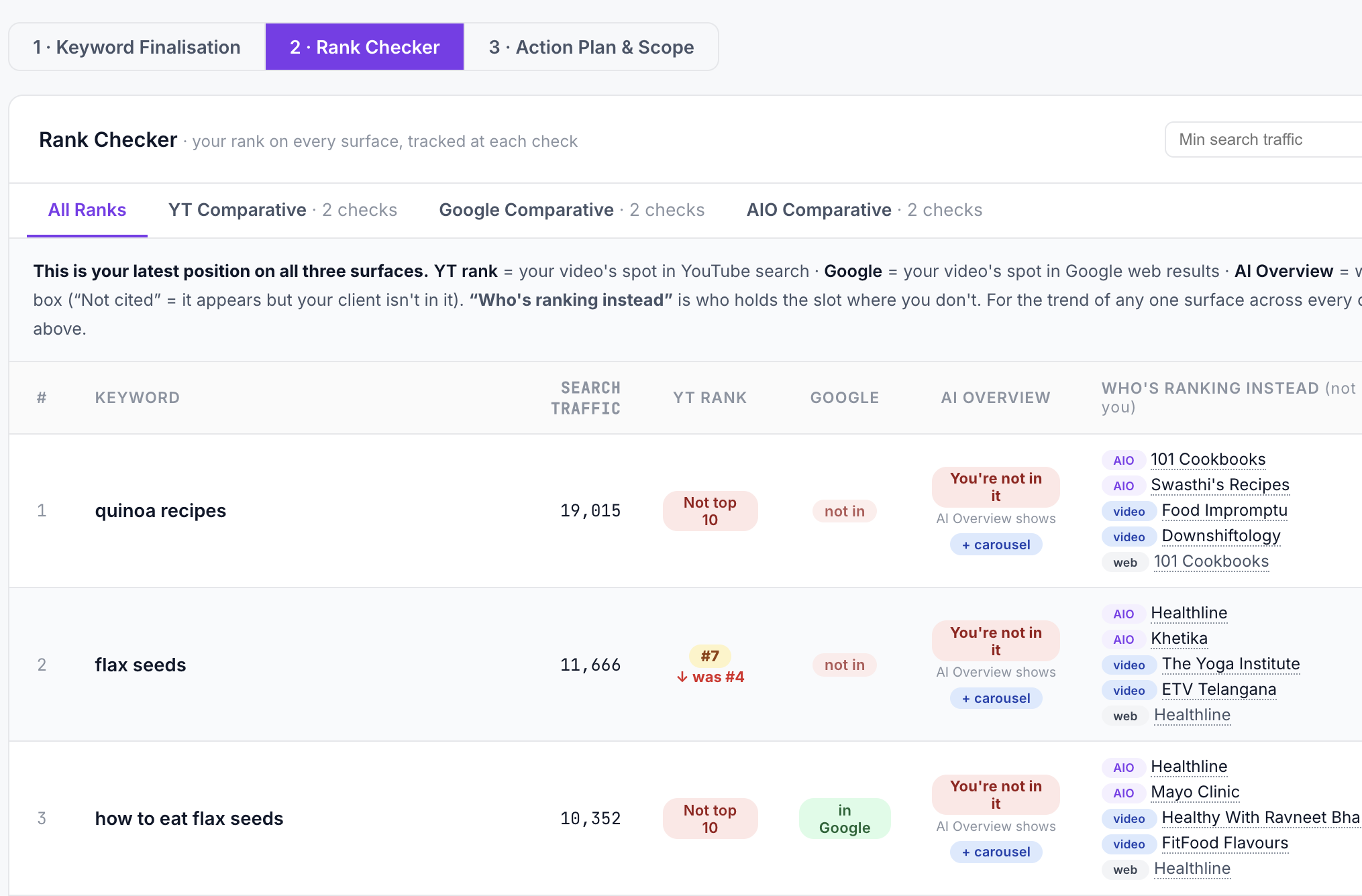
The Distribution module identifies additional surfaces where each video can be placed — pinned to the channel homepage for a period, added to a specific playlist to build session watch time, embedded in a specific clinic blog post to drive external referrals, cross-posted as a Short excerpt if a naturally clip-able 45-second segment exists.
The Thumbnail module produces A/B test variants for videos with weak CTR, then measures the impact after 14 days and applies the winning variant. For Lumina, 6 thumbnails are queued for A/B testing over the next month.
Step 5: Reputation (ORM) — audience voice, comment sentiment, audience profile
The Reputation step handles everything that happens after publication — comments, sentiment, audience feedback, and reputation management. It runs continuously in the background between weekly strategy cycles.
The Audience Voice module scrapes every comment across the channel and clusters them by theme. For Lumina, the top themes are treatment cost questions (28% of comments), treatment duration questions (19%), booking-process questions (14%), and off-topic praise/greetings (22%). The cost and duration clusters become explicit FAQ topics for future videos.
The Comment Sentiment module classifies each comment as positive, neutral, negative, or spam. Negative comments and spam are surfaced immediately for review — for a healthcare channel this matters because a single toxic comment left unaddressed for weeks visibly reduces channel trust. Positive comments feed into the audience profile.
The Audience Profile module builds a picture of Lumina's typical viewer — geography (Delhi NCR concentrated, Mumbai secondary), age band (peak 25-44), gender split (72% female for Lumina's specialty), and questions they're asking. This profile informs the next Strategy cycle's topic and format choices.
All comment activity respects the NMC and DPDP compliance perimeter — no clinical advice in reply text, no patient identification in reply text, no unsubstantiated claims about outcomes.
Step 6: Competitor Intel — competitor analysis and the decision engine
The final step compares Lumina against a specifically selected set of peer dermatology channels — 5 to 8 competing Indian dermatology channels of comparable size, plus 2 larger aspirational channels the strategy aims toward over 12 to 18 months.
The Competitor Analysis module tracks each peer channel's upload cadence, average view velocity, topic clusters, format mix, thumbnail patterns, and organic vs paid split (estimated). It surfaces content gaps — topics competitors are covering that Lumina is not — and format opportunities — formats that peers are consistently winning with.

The Decision Engine module synthesises Diagnostics, Strategy, Optimisation, Reputation, and Competitor Intel outputs into a weekly "top 5 actions" list. For Lumina's week in this walkthrough, the top 5 came out as: publish the Melasma Myth-vs-Fact script drafted in Strategy, apply the 8 chapter-marker updates queued in Optimisation, launch the ₹10,000 paid boost on the top organic Winner, reply to 12 flagged patient-question comments, and update the pinned comment on the Hair Transplant Recovery video with the cost FAQ from Audience Voice.
How the steps actually connect end to end in a weekly cycle
The workflow is designed to compound. Diagnostics feeds Strategy. Strategy's recommendations flow into Optimisation writebacks. Optimisation's impact feeds back into next-cycle Diagnostics via measurable CTR and retention deltas. Reputation surfaces content demand that feeds next-cycle Strategy. Competitor Intel calibrates aspirational benchmarks that shape next-cycle Strategy's aggressiveness.
The cycle length depends on channel maturity. New channels (under 6 months, under 1,000 subscribers) run a weekly full-cycle rhythm because every data point matters. Mature channels (over 12 months, 10,000+ subscribers) run weekly Diagnostics + Optimisation + Reputation with a monthly deeper Strategy + Competitor Intel refresh.
Every step operates on organic-only data by default. Paid campaigns are managed through Strategy's Ad-Spend Picks module and reported as an overlay in Diagnostics. This discipline — subtracting paid before making any judgement — is what separates YODA's decision quality from tools that report blended metrics.
The platform ICG uses to run this at scale: YODA
ICG runs healthcare YouTube marketing for clinics, hospitals, and specialty groups using YODA — our AI-native healthcare YouTube marketing platform. YODA sits on top of a channel's data and does four things no dashboard does: it separates organic from paid views at every step (so a promoted video can never masquerade as organic growth), it gives decisions not dashboards (every video gets a state + next action), it writes back to YouTube directly (improved titles, tags, descriptions, chapters applied straight to the platform), and it tracks the three rank races — YouTube search, Google web, and Google AI Overview citations.
YODA runs the full 6-step workflow — Overview, Diagnostics, Strategy, Optimisation, Reputation (ORM), and Competitor Intel — with 40+ analysis modules organised under those steps. ICG's managed YouTube service uses YODA end-to-end. See the Healthcare YouTube Marketing pillar guide for the full scope, or the Healthcare YouTube Marketing Agency service page for engagement details.
Book a YODA demo on WhatsApp → or request a free healthcare YouTube channel audit →
Related reading
- Healthcare YouTube marketing pillar guide 2026
- Organic vs paid YouTube views for healthcare channels
- YouTube Analytics vs Google Search Console for healthcare channels
- How a doctor YouTube channel generates consultations in India
- Healthcare YouTube marketing agency service page
FAQ
Can we run the YODA workflow ourselves without ICG's managed service? The platform is designed to be operated end-to-end. Many healthcare marketing teams run YODA in-house after an initial onboarding. ICG's managed service is available when the clinic prefers to hand execution to healthcare-marketing specialists who use the same platform.
How long does the initial setup take for a channel with 12+ months of history? 45 to 90 minutes for the connection and data pull. The first meaningful Diagnostics output arrives within 24 hours as YODA processes historical data, clusters content, and calibrates the specialty benchmark set. First Strategy recommendations arrive at day 3 to 7 depending on channel size.
Does YODA work for a channel with under 500 subscribers or under 20 videos? Yes, but Diagnostics is thinner because small sample sizes produce noisy retention and CTR data. New channels get more value from the Strategy and Optimisation steps than from Diagnostics until watch history builds up. The Competitor Intel step is fully useful from day one regardless of channel size.
How does YODA handle non-Indian audience segments for a channel with diaspora traffic? The Diagnostics step splits watch time and engagement by geography by default. Strategy recommendations can be filtered to prioritise the primary Indian audience while acknowledging diaspora share. For channels where diaspora represents primary consult-booking demand, Strategy shifts accordingly.
What happens if a channel has never run paid ads? The paid overlay in Diagnostics simply doesn't appear because there is no paid data to overlay. All metrics are effectively organic-only by default. When the Strategy step recommends paid Ad-Spend Picks, the team can execute them through Google Ads and YODA begins tracking the paid layer separately from that point.
Does YODA replace YouTube Studio? No. YODA sits on top of YouTube Studio data and adds the diagnostic, strategic, and writeback layers that YouTube Studio does not provide. Channel owners still open YouTube Studio for raw data confirmation and for functionality Google reserves inside its own platform (like community posts and membership management).
Which Optimisation writebacks require YouTube API permissions? Title, description, tags, and chapter marker updates all require the channel owner to have granted the OAuth scope during YODA setup. Thumbnail uploads require the same scope. Comment moderation requires an additional scope. All writebacks are logged inside YODA with a full audit trail.
How is compliance handled in the writeback flow? Every AI-generated or platform-generated content suggestion (titles, descriptions, comment replies) passes through a compliance filter before writeback is offered. Anything that trips the NMC, DPDP, PC-PNDT, ART Act, or ASCI rulebook is flagged for human review before it can be applied to the live channel.
Can multiple team members access the same channel inside YODA? Yes. YODA supports role-based access with named users — clinic owner, marketing lead, agency team member, compliance reviewer. Every action is logged with the user and timestamp so audit trails are clean.
How does YODA's Decision Engine handle conflicting recommendations across steps? The Decision Engine weights Diagnostics evidence heaviest, Reputation signals second, and Competitor Intel third when synthesising the weekly top-5. Ties are broken by asking which action produces measurable channel impact within the next 14 days.
Book a free 30-minute Brand & Growth Diagnostic.
It's a working session, not a sales pitch — you leave with a written root-cause analysis you can act on, whether or not you engage ICG.
The three platforms
behind every ICG engagement.
Beacon
CAPI middleware that fixes Event Match Quality, translates CRM statuses to Meta-standard events, dedups across channels.
Agency OS
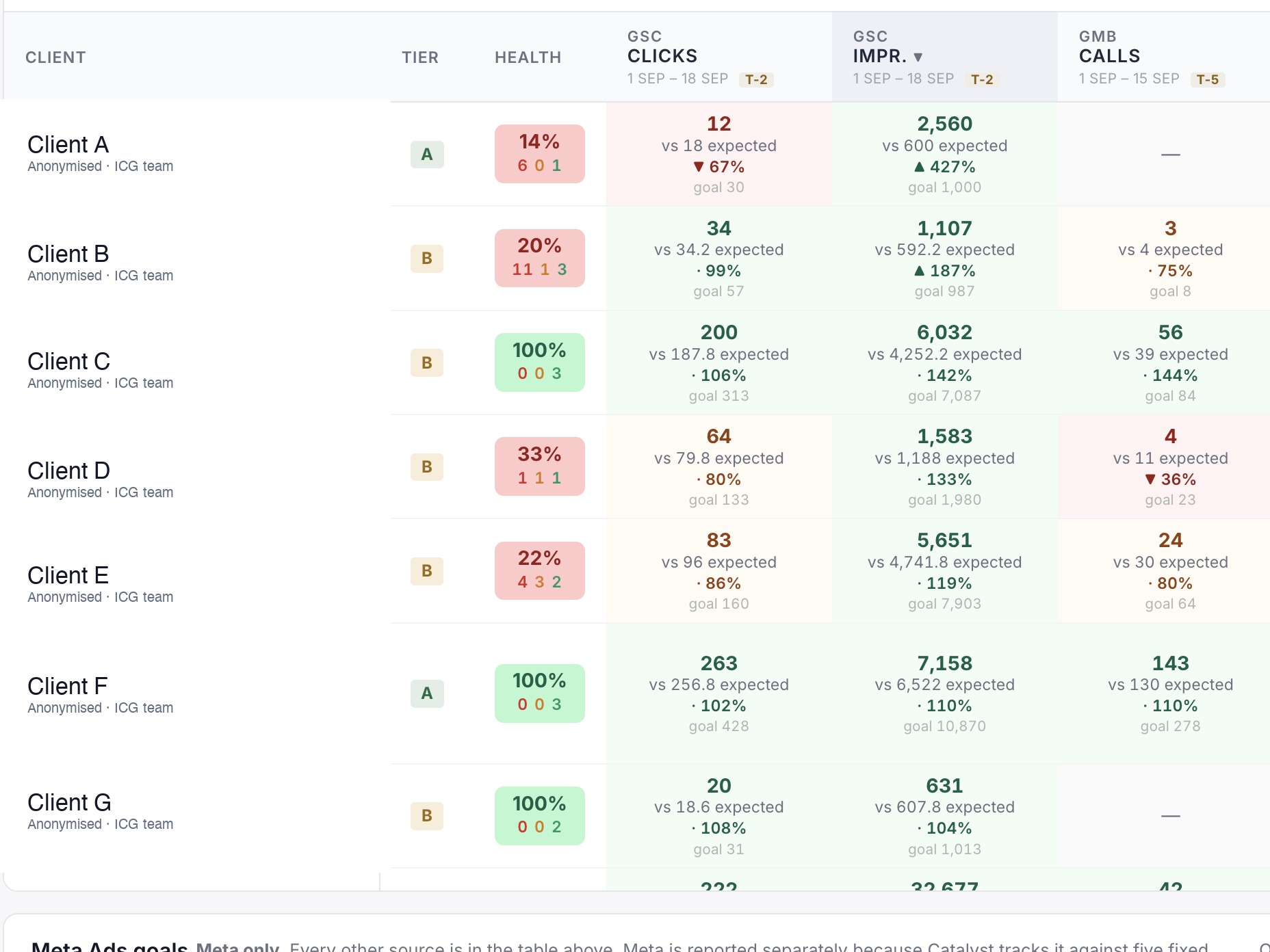
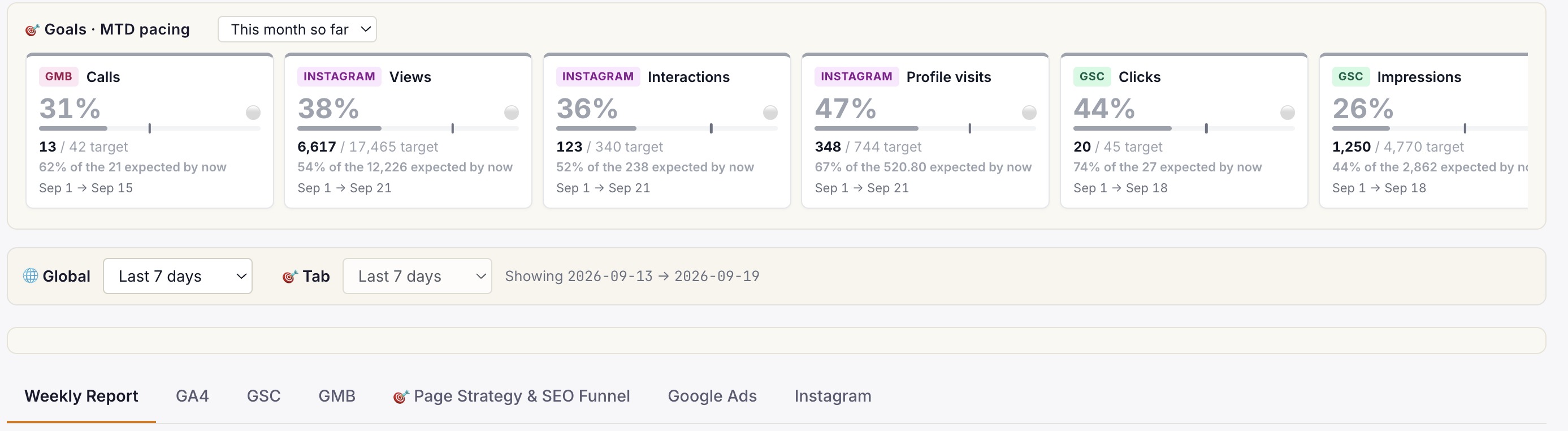
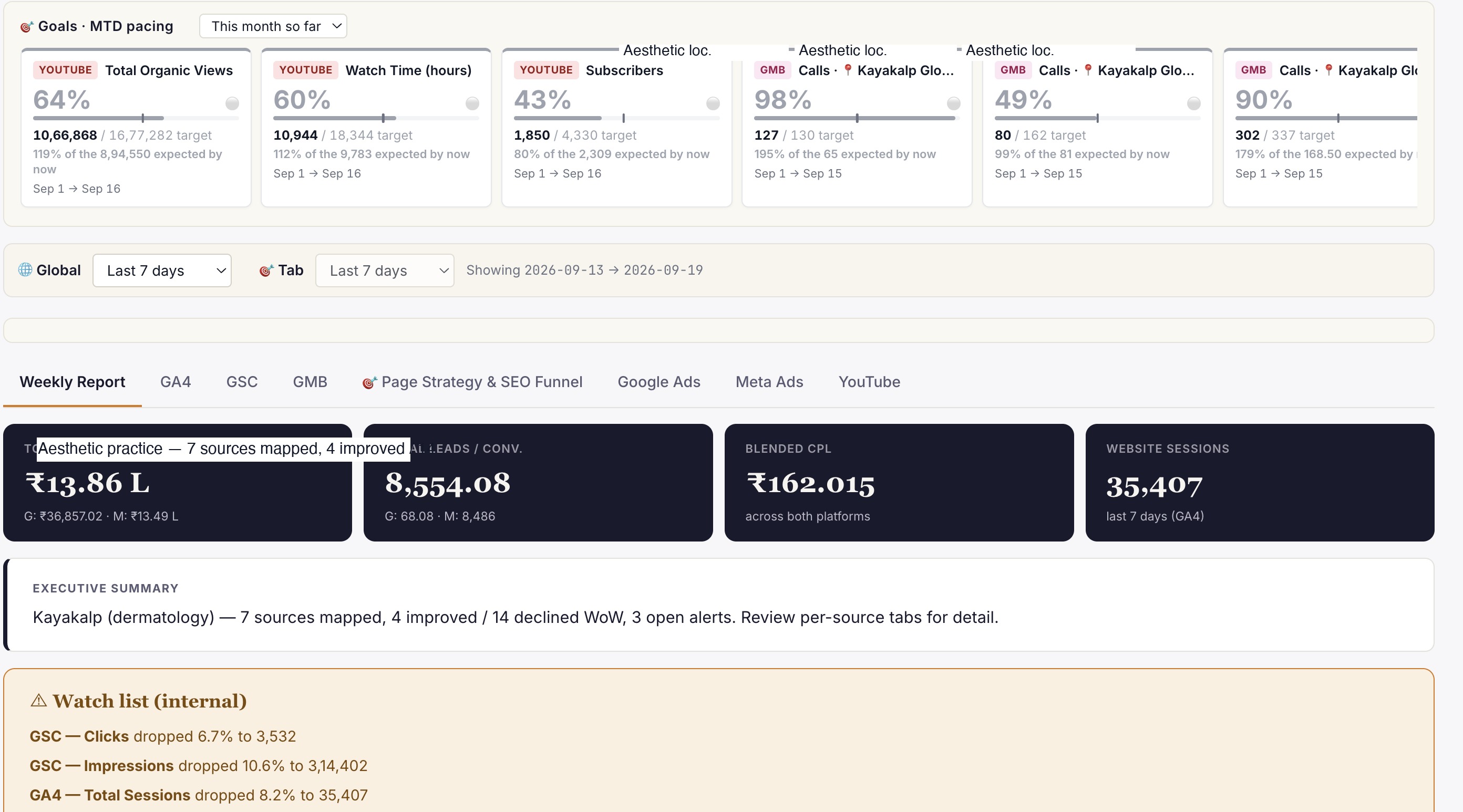
Live client dashboard. GSC, GA4, Google Ads, Meta Ads, IVR calls in one view. Login anytime, not monthly.
Phoenix
Clinic revenue intelligence over your PMS. Daily action queue: Prevent Loss, Maintain & Engage, Grow Revenue. Multi-centre rollout.
Or book a free 30-min audit to see all three in action on your account.
Healthcare brands
that already run on ICG.
A representative slice of the 150+ healthcare brands ICG has delivered for across India. Most engagements remain under NDA.


What ICG clients say · on video.
"Scale up of organic channels and business consulting. ICG has absolute domain authority in their field."
"Working with ICG transformed how we acquire IVF patients in Gurgaon. They understand the fertility journey from inquiry to consult..."
"What Ichelon accomplished — they got all my ideas and worked over 3-4 months to create an amazing, super-customised website."
Need help operationalising this?
Every ICG service is healthcare-only, NMC + DPDP-aware, and built around the patient-research patterns that drive Indian healthcare growth in 2026.
Every practice welcome — packages from ₹20,000/mo.
Goals-Driven engagements · Performance-Linked Payout Models available
More from
ICG.
Five trends shaping Indian healthcare marketing through 2027: AI-first patient research, Conversions API adoption, ABDM discovery, the AEO w...
Healthcare AIO is the discipline of getting your clinic or hospital cited inside Google AI Overviews, ChatGPT and Perplexity answers — not j...
Conversational-search advertising places brand messages inside AI chat answers — ChatGPT, Perplexity, Copilot — rather than beside a results...
Stop guessing.
Book a Diagnostic.
30 minutes. Free. With the AI-powered healthcare-only marketing agency 150+ brands already run on. No slides, no pitch, no hard close.


