


YouTube marketing for dental clinics in India (2026): dental channel playbook for implants, aesthetic dentistry, Invisalign, endodontics — with EMI integration and NMC + ASCI compliance
How dental clinics in India should run YouTube — content archetypes across implants, aesthetic dentistry, orthodontics and Invisalign, and endodontics; EMI and financing integration into video CTAs; before-after compliance for aesthetic dentistry under ASCI; thumbnail patterns that convert dental-anxious viewers into consult bookings; LTV maths per implant patient (₹40K-3L × 2-6 implants); and the YODA 6-step workflow adapted for a dental channel.
No pitch. Written root-cause diagnosis. AI-powered, healthcare only.
Direct answer
How dental clinics in India should run YouTube — content archetypes across implants, aesthetic dentistry, orthodontics and Invisalign, and endodontics; EMI and financing integration into video CTAs; before-after compliance for aesthetic dentistry under ASCI; thumbnail patterns th...
TL;DR

Dentistry is one of the most under-invested YouTube categories in Indian healthcare — and one of the most immediately profitable to build a channel around. A patient searching "dental implant cost India," a young professional researching "Invisalign vs braces," a parent looking up "root canal treatment for child," a woman weighing "smile makeover cost" — every one of these is a high-intent commercial query with a shorter consideration cycle than IVF but a higher single-transaction ticket than aesthetic derma. This guide is ICG's playbook for dental YouTube — the content clusters that convert cold viewers into consult bookings, how EMI and financing get integrated cleanly into video CTAs, the ASCI and NMC compliance perimeter around aesthetic dentistry visuals, and how the YODA 6-step workflow is adapted for a dental practice specifically.
Why dental YouTube is different from other healthcare YouTube
Dental patients research a specific procedure with a specific price point in mind. The question in the patient's head is rarely "am I sick" and almost always "which clinic will do this well and what will it cost." That commercial-intent-from-the-first-query pattern is different from cardiology (where the first search may be symptom-driven) or fertility (where the first search is often a broad life-question). It means dental YouTube converts to consults on a shorter timeline than most healthcare specialties — typically 3-8 weeks from first search to booked consult for a well-known procedure like implants or Invisalign.
Query volumes are large and cluster around distinct treatment verticals — Implants ("dental implant cost India," "dental implant procedure step by step," "single tooth implant vs bridge"), Orthodontics and Invisalign ("Invisalign cost India," "Invisalign vs metal braces," "how long does Invisalign take"), Aesthetic and Smile Design ("veneers cost India," "smile makeover process," "teeth whitening treatment"), Endodontics ("root canal treatment cost," "is root canal painful," "root canal vs extraction"), and Kids Dentistry ("pediatric dentist near me," "cavity treatment for kids," "when do baby teeth fall out"). Each cluster has its own audience profile, its own price expectation, and its own conversion path.
The LTV maths are strong and layered. A single dental implant runs ₹40,000/- to ₹1.5L/- per implant in metro Indian clinics, higher for full-arch or All-on-4 procedures at ₹2L/- to ₹8L/- for the arch. Most implant patients need 2-6 implants over an extended treatment plan, so ₹1.5L/- to ₹8L/- in initial revenue with maintenance revenue for years after. Invisalign runs ₹1.5L/- to ₹4L/- per case. Full smile makeovers using veneers run ₹1.5L/- to ₹6L/- per case. Even routine dental patients accumulate ₹8,000/- to ₹40,000/- per year in ongoing cleanings, fillings, and preventive care. A dental patient who books through YouTube and stays with the clinic for 3-5 years produces ₹2L/- to ₹10L/- in cumulative revenue.
The three ranking races a dental channel has to win
Race 1 — YouTube search. A user searches "dental implant procedure" or "Invisalign review after 6 months" or "root canal treatment explained." Title-query match and treatment-name specificity win here. The pattern is "Treatment Name: Dentist Explains Cost, Procedure, and Timeline (India 2026)" as the workhorse title structure.
Race 2 — Google web search. When Google returns a video carousel for "dental implant cost in Bangalore" or "Invisalign vs braces cost India," this is where dental videos surface inside standard web results. Description density with specific price references (compliance-safe, presented as typical rather than guaranteed), chapter timestamps at natural navigation points, and embed of the video on the treatment landing page all shape this race.
Race 3 — Google AI Overview citations. Dental informational queries are highly susceptible to AI Overview generation — "is root canal painful," "how long do dental implants last," "what is the difference between veneers and crowns." Overviews often cite video sources for the "show me the procedure" component of the answer. Dental videos with structured intros, factual density, and clear chapter markers get cited more often, and each citation is a compounding source of qualified traffic.
The three-races framing matters especially for dental because a patient in the consideration cycle typically consumes content across all three surfaces — a first-time search on Google that returns an Overview with a video citation, a follow-up search directly on YouTube for a deeper walkthrough, and a final search that combines "clinic name" and "reviews" once the patient has narrowed the shortlist.
The ASCI, NMC, and DPDP compliance perimeter dental content sits inside
Dental YouTube sits inside a compliance perimeter that most generalist agencies underestimate — particularly around aesthetic dentistry visuals and around pricing disclosures.
ASCI Guidelines 2022. Prohibits unsubstantiated superlative claims ("best implant clinic in India," "painless root canal guaranteed," "same-day smile makeover") and comparative advertising without evidence. For aesthetic dentistry — smile makeovers, veneers, whitening — before-after imagery has to represent typical results, disclose the treatment timeline, and avoid superlative-anchored voiceover. Any claim like "no pain" or "no side effects" needs substantiation on request.
NMC's 2026 advertising guidelines. Applies to dental surgeons registered under the Dentists Act 1948, though the framing is somewhat different from allopathic practice. The core restriction — no soliciting testimonials, no presenting patient stories as clinical evidence — applies. Dental patient testimonial videos are permissible with signed consent and with editorial framing that presents the story as personal experience.
DPDP Act 2023. Any patient-identifying dental footage — face-on-camera, smile close-ups, before-after comparison shots — is personal data and requires documented consent that covers the specific channels and retention period.
Pricing disclosure honesty. Dental has a specific pricing compliance dimension most other specialties do not — patients search for cost queries and expect the video to give a straight answer. The compliance-safe pattern is to present a typical price range with the specific case-complexity dimensions that shift the price (implant material, arch position, adjunctive procedures like bone grafting), and to explicitly disclaim that the actual quote requires clinical evaluation. This is compliance-safe under ASCI and honest to the patient.
Content format archetypes that work for dental channels
Cost Explainer. The single highest-converting dental format. The dentist explains the cost of a procedure with the typical range, the complexity dimensions that move the price, and the financing options available. Cost Explainers rank strongly on price queries (highest commercial-intent dental search category) and convert to consult bookings at rates 2-3x higher than generic procedure explainers. Should be 25-35% of a dental channel.
Procedure Explainer. The dentist walks through what happens during the procedure — root canal step by step, implant placement, Invisalign fitting. Procedure Explainers reduce patient anxiety, which is the largest single conversion barrier in dentistry. Should be 25-30% of the channel.
Myth-vs-Fact. The dentist addresses common dental misconceptions ("root canal always causes pain," "implants are only for older patients," "whitening damages enamel"). Should be 10-15% of the channel.
Before-After Case Walk-through (compliance-safe). The dentist walks through a real case — with signed consent, with typical rather than exceptional results, with the treatment timeline disclosed, and without superlatives. Highest visual conversion power in dental. Should be 15-20% of the channel with strict compliance discipline.
Q&A. The dentist answers real questions from patients and viewers. Should be 10-15% of the channel and can be produced quickly in short 8-12 minute segments.
EMI and financing integration into dental video CTAs
Dental has a lever most other specialties do not — EMI and financing partnerships materially expand the addressable patient pool. A ₹1.5L/- implant treatment converts at a materially higher rate when the CTA in the video description mentions "no-cost EMI available" versus a description that only lists the treatment cost.
The compliance-safe pattern is to mention EMI availability in the video mid-roll and in the description, to link to a landing page that discloses the financing partner and terms transparently, and to route the actual EMI application through the clinic's CRM or WhatsApp handoff rather than embedding a financing offer directly in the video. This satisfies both ASCI restrictions on financial-product advertising and the RBI framework for regulated lending products.
EMI integration typically lifts consult-to-treatment conversion by 15-25% on high-ticket dental procedures. YODA's Optimisation module includes an EMI-mention audit for high-ticket videos so no procedure-cost video ships without the financing option surfaced where relevant.
Thumbnail CTR patterns that convert dental viewers
Dental thumbnails follow patterns that reflect the specific anxieties and curiosities patients bring to the search. The winning pattern for procedure videos is the dentist's face on the left with a professional expression, the treatment name in bold on the right, and a small procedure-in-progress inset along the bottom. For cost videos, the pattern shifts — the dentist's face with the price band ("₹40,000-1.5L") in bold contrast typography, and no visual of the procedure itself. For before-after videos, the compliance-safe pattern uses a subtle before-after split with the treatment name overlay and no superlative text.
Colour palette for dental tests better with cool clinical tones for procedure videos (blues, teals) and with warm human tones for testimonial and before-after videos (warm neutrals, soft golds). Text must be readable at mobile-search-result size (roughly 120x68 pixels).
YODA's Thumbnail module runs A/B tests on every dental channel. Median CTR lift from a run of six tests is 25-45% on the tested videos — dental has one of the highest thumbnail-lift ceilings of any specialty ICG manages because the baseline thumbnails in the category are often generic stock imagery.
The YODA 6-step workflow adapted for a dental channel
Step 1 — Overview. Connect the channel, calibrate against the dental specialty benchmark band (dental channels average 4-6 minute view duration on procedure Explainers and 5-9% CTR on cost queries), separate paid promotion history from organic.
Step 2 — Diagnostics. Cluster videos by treatment vertical (Implants, Ortho/Invisalign, Aesthetic/Veneers, Endo/Root Canal, Kids Dentistry, General/Preventive) and by format archetype. Identify which clusters convert best to consult bookings and which have retention cliffs on the anxiety-topic videos.
Step 3 — Strategy. Produce a 90-day content plan weighted toward the highest-margin treatment verticals the clinic wants to grow. Include Cost Explainer coverage for every major treatment. Identify ad-spend picks on 2-3 organic Winners per month.
Step 4 — Optimisation. Rewrite titles for query-match and AI Overview citation readiness. Insert structured chapters (particularly for procedure walk-throughs where patients navigate to specific steps). Update descriptions with EMI mentions where applicable. Queue thumbnail A/B tests.
Step 5 — Reputation (ORM). Cluster comments by theme (cost questions dominate, followed by pain-and-anxiety questions, then booking-process questions). Reply inside NMC and DPDP constraints. Feed comment themes back into next-cycle Strategy as explicit FAQ topics.
Step 6 — Competitor Intel. Track 5-8 peer dental channels — a mix of independent dentists, mid-sized clinic groups, and 1-2 aspirational large chains. Identify content gaps by treatment vertical.
Sample 90-day channel build plan for a Mumbai dental clinic
Days 1-15. YODA setup, historical data pull, first Diagnostics output. Baseline Rank OS scoring on the top 40 target dental queries across YouTube search, Google web, and AI Overview. Shoot planning for the treating dentist including intro pieces, clinic tour, and treatment-vertical credibility segments.
Days 16-45. Publish 8-10 new videos weighted toward the two highest-margin treatment verticals — typically Implants and Aesthetic Dentistry. Include at least 3 Cost Explainer videos (the highest-converting format). Apply Optimisation writebacks to any existing library. Launch first thumbnail A/B tests. Start comment-reply cadence.
Days 46-90. Publish another 10-12 videos calibrated by first-45-day retention and CTR data. Introduce first Before-After Case Walk-through with full signed-consent compliance framing. Start ad-spend picks on 2 organic Winners at ₹8,000-15,000/- per boost. First measurable consult-booking uplift typically shows up in weeks 6-10 — faster than fertility, comparable to derma.
By day 90, a well-run dental channel typically has 20-24 videos published, 1,500-4,000 new subscribers, and a demonstrable channel-to-consult attribution trail through the WhatsApp CTA and treatment-landing-page embed.
Which ICG retainer tier fits a dental YouTube engagement
Chain tier — ₹75,000/- to ₹1.5L/- per month. Fits single-location dental clinics and small chains (up to 3 locations). Includes YODA platform access, monthly content plan for 6-8 videos, script support, SEO writebacks, thumbnail A/B tests, EMI-integration review, comment moderation inside compliance, and one strategy review per month. Suits clinics doing ₹50L/- to ₹3Cr/- annual dental revenue where new consult-booking flow materially changes P&L.
Hospital tier — ₹1.5L/- to ₹4L/- per month. Fits multi-location dental chains (4+ locations), dental hospitals, and dental groups with strong implant or aesthetic verticals. Includes everything in Chain tier plus multi-channel management if the group runs separate channels per city, deeper Competitor Intel across a larger peer set, and paid-media coordination through the Ad-Spend Picks module.
Below ₹75,000/- per month, ICG's honest recommendation is that a solo dentist should first invest in Angryturtle self-serve at ₹999/- to build local GBP dominance, and add YouTube once the marketing budget supports a Chain-tier engagement.
Angryturtle plus YODA together for a dental clinic — full local plus YouTube coverage
A dental patient in the consideration cycle typically searches "dentist near me" on Google Maps (where Angryturtle covers) and "dental implant cost" or "Invisalign review" on YouTube (where YODA covers). Owning both surfaces converts materially more of the addressable patient pool than owning one.
Angryturtle runs GBP intelligence, review operations, Google Posts, and Ask Maps AIO Readiness for the dental clinic's Google Business Profile. YODA runs the YouTube channel end-to-end. A patient who first finds the clinic through the local map pack then researches specific treatments on the clinic's YouTube channel — the two surfaces reinforce each other, and the consult booking rate is materially higher than either surface produces on its own.
The platform ICG uses to run this at scale: YODA
ICG runs healthcare YouTube marketing for clinics, hospitals, and specialty groups using YODA — our AI-native healthcare YouTube marketing platform. YODA sits on top of a channel's data and does four things no dashboard does: it separates organic from paid views at every step (so a promoted video can never masquerade as organic growth), it gives decisions not dashboards (every video gets a state + next action), it writes back to YouTube directly (improved titles, tags, descriptions, chapters applied straight to the platform), and it tracks the three rank races — YouTube search, Google web, and Google AI Overview citations.
YODA runs the full 6-step workflow — Overview, Diagnostics, Strategy, Optimisation, Reputation (ORM), and Competitor Intel — with 40+ analysis modules organised under those steps. ICG's managed YouTube service uses YODA end-to-end. See the Healthcare YouTube Marketing pillar guide for the full scope, or the Healthcare YouTube Marketing Agency service page for engagement details.
Book a YODA demo on WhatsApp → or request a free healthcare YouTube channel audit →
Related reading
- Healthcare YouTube marketing pillar guide 2026
- YODA 6-step workflow explained for healthcare marketing agencies
- Thumbnail CTR patterns for healthcare doctors and clinics
- Case study — 142 consults in 90 days from a healthcare YouTube channel
- Healthcare YouTube marketing agency service page
FAQ
How long before a dental YouTube channel starts producing booked consults? First measurable consult bookings from organic YouTube typically show up in weeks 6-10 for a channel publishing on a disciplined weekly cadence with Cost Explainer coverage. Dental has one of the fastest conversion timelines of any healthcare specialty because patient search intent is commercial from the first query.
Should we mention actual prices in dental videos or stay vague? Mention typical price ranges with the case-complexity dimensions that move the price. Vague price framing loses to specific price framing on both consult conversion and search ranking. Compliance-safe framing is a typical range with explicit disclosure that the actual quote requires clinical evaluation.
How do we integrate EMI and financing into dental video CTAs? Mid-roll voiceover mention plus description link to a landing page that discloses financing partner and terms. Route the actual EMI application through WhatsApp handoff or CRM rather than embedding a financing offer inside the video. This satisfies ASCI and RBI framework requirements.
Which dental treatment verticals should we build content clusters around first? The two highest-margin verticals the clinic wants to grow. Implants and Aesthetic Dentistry (veneers, smile makeover, whitening) are the most common priority verticals because they carry the highest per-case revenue and the strongest search demand.
What is the LTV per dental patient from a YouTube-sourced consult? ₹2L/- to ₹10L/- over 3-5 years for patients who convert into implants, orthodontics, or aesthetic dentistry and then stay with the clinic for ongoing preventive care. Even routine dental patients accumulate ₹8,000/- to ₹40,000/- per year in ongoing revenue.
Can we shoot before-after case walk-throughs for aesthetic dentistry? Yes, with signed consent under DPDP Act 2023, with typical rather than exceptional results, with the treatment timeline disclosed, and without ASCI-restricted superlatives in the voiceover. YODA's compliance filter reviews every before-after script and cut before publication.
How should our channel be branded — around the clinic or around the treating dentist? The credential-carrying dentist as the on-camera face, with the clinic as the affiliation in bumpers, descriptions, and pinned comments. Educational framing authored by the dentist satisfies NMC and dental-council restrictions better than promotional-of-clinic framing.
How much paid promotion should a dental channel run alongside organic content? Modest amounts on identified organic Winners — ₹8,000/- to ₹15,000/- per boost on 2-3 videos per month. Blanket paid promotion distorts the organic-vs-paid separation and produces unreliable Diagnostics outputs.
Does YouTube Shorts work for a dental channel? Yes as a supplementary format. Short procedure-in-progress clips, quick myth-vs-fact segments, and 45-second cost-range clips work well for reach. They rarely produce direct consult bookings on their own but they build subscriber growth and support the long-form videos where consult conversion actually happens.
What is the difference between running our own dental channel and ICG's managed service? Running the channel in-house works when the clinic has a dedicated marketing person who can execute the 6-step workflow weekly. ICG's managed service works when the clinic wants a healthcare-specialist team to run the workflow inside YODA end-to-end with EMI integration and compliance handled as a default.
Book a free 30-minute Brand & Growth Diagnostic.
It's a working session, not a sales pitch — you leave with a written root-cause analysis you can act on, whether or not you engage ICG.
The three platforms
behind every ICG engagement.
Beacon
CAPI middleware that fixes Event Match Quality, translates CRM statuses to Meta-standard events, dedups across channels.
Agency OS
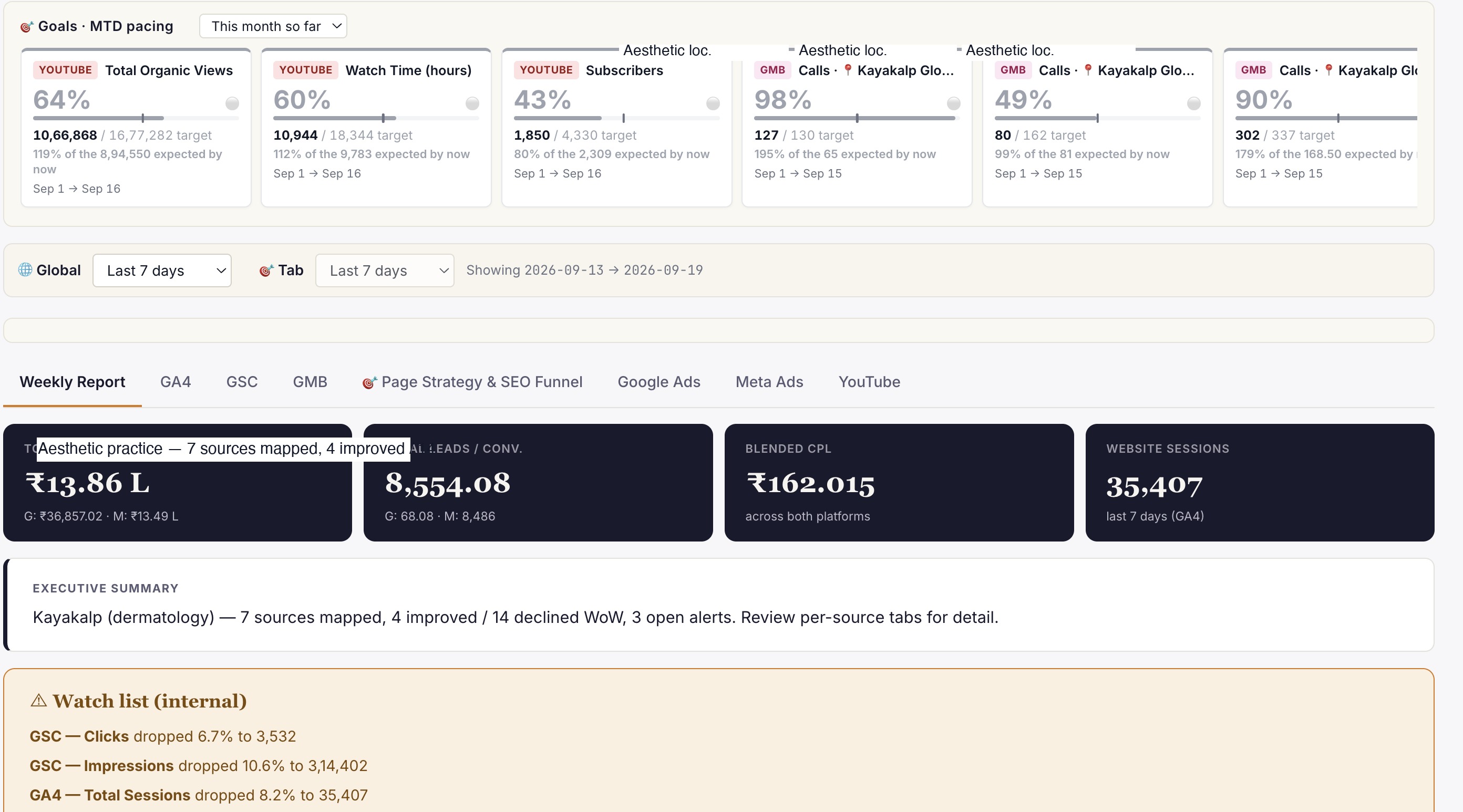
Live client dashboard. GSC, GA4, Google Ads, Meta Ads, IVR calls in one view. Login anytime, not monthly.
Phoenix
Clinic revenue intelligence over your PMS. Daily action queue: Prevent Loss, Maintain & Engage, Grow Revenue. Multi-centre rollout.
Or book a free 30-min audit to see all three in action on your account.
Healthcare brands
that already run on ICG.
A representative slice of the 150+ healthcare brands ICG has delivered for across India. Most engagements remain under NDA.


What ICG clients say · on video.
"Dental marketing in Delhi is brutally competitive. ICG's local SEO + Google Ads stack moved the needle steadily."
"Scale up of organic channels and business consulting. ICG has absolute domain authority in their field."
Need help operationalising this?
Every ICG service is healthcare-only, NMC + DPDP-aware, and built around the patient-research patterns that drive Indian healthcare growth in 2026.
Every practice welcome — packages from ₹20,000/mo.
Goals-Driven engagements · Performance-Linked Payout Models available
More from
ICG.
Five trends shaping Indian healthcare marketing through 2027: AI-first patient research, Conversions API adoption, ABDM discovery, the AEO w...
Healthcare AIO is the discipline of getting your clinic or hospital cited inside Google AI Overviews, ChatGPT and Perplexity answers — not j...
Conversational-search advertising places brand messages inside AI chat answers — ChatGPT, Perplexity, Copilot — rather than beside a results...
Stop guessing.
Book a Diagnostic.
30 minutes. Free. With the AI-powered healthcare-only marketing agency 150+ brands already run on. No slides, no pitch, no hard close.


