


IVF Clinic Local SEO in India (2026): Google Maps Playbook
IVF clinic local SEO India 2026 playbook: couple-intent keywords, ART Act GBP rules, geo-grid heatmaps, and review workflows that add booked cycles monthly.
No pitch. Written root-cause diagnosis. AI-powered, healthcare only.
Direct answer
IVF clinic local SEO India 2026 playbook: couple-intent keywords, ART Act GBP rules, geo-grid heatmaps, and review workflows that add booked cycles monthly.
TL;DR
TL;DR
- IVF local SEO is structurally different from other healthcare verticals: the patient is a couple (dual search behaviour), the consideration cycle is 3–9 months (longer than most elective specialties), and ART Act 2021 compliance adds restrictions on what can be said in GBP content
- The IVF keyword architecture has three distinct layers: condition queries (PCOS, unexplained infertility), treatment queries (IVF cost, IUI vs IVF), and provider queries (best IVF clinic near me) — each requires different optimisation
- Doctor-listing platforms have high penetration for IVF discovery in metro India; Google Maps is primary for non-metro; a dual-platform strategy is standard for metro IVF clinics
- Success rate claims in GBP content are restricted under both NMC's 2026 advertising guidelines and ART Act 2021 — the most common compliance violation ICG finds in IVF clinic GBPs
- Male infertility is an underserved content and keyword cluster in IVF local SEO — clinics that address it explicitly capture a significant unaddressed patient population
IVF local SEO is one of the most complex and highest-value local SEO verticals in Indian healthcare. A single converted IVF patient represents ₹1.5L–₹4.5L in treatment revenue, with significant repeat and additional service potential (multiple cycles, PGT, donor programmes, cryopreservation). The acquisition cost economics justify significant investment in local SEO infrastructure.
The complexity comes from three unique structural factors: the couple dynamic (two people making one decision), the extended consideration cycle (most IVF patients research for 3–9 months before booking a consultation), and the ART Act 2021 compliance layer that restricts what IVF clinics can say in their marketing.
This guide covers all three — plus the practical geo-grid, citation, and review management tactics that determine which IVF clinic gets the call.
Section 1 — The couple search dynamic
IVF patients are couples — two people, often with separate search behaviours, researching the same decision from different angles.
Female partner search pattern:
- Condition-first (PCOS symptoms, endometriosis treatment, unexplained infertility)
- Treatment research (IVF process, IUI vs IVF, egg freezing, embryo transfer)
- Provider comparison (IVF clinic reviews, doctor credentials, success rates — navigating ART Act compliance)
- Appointment booking
Male partner search pattern:
- Often enters the funnel at the treatment research stage (after female partner has done initial research)
- Male factor queries: semen analysis, azoospermia treatment, IVF for male infertility, sperm retrieval
- Often the one who ultimately calls or books the appointment
Implication for IVF GBP strategy: Your GBP and linked website content must address both search patterns. A GBP that only speaks to the female journey (PCOS, egg quality, IVF process) misses the male partner's entry point. ICG's IVF content architecture explicitly includes male infertility content clusters — semen analysis, male factor infertility, sperm donation — as a parallel track alongside female fertility content.
The Q&A opportunity for male factor: The Q&A section of a fertility clinic GBP is an underutilised channel for male factor content. Seed questions like "Do you treat male infertility at this clinic?" and "What tests are available for male factor infertility?" capture male partner search intent that the business description and services list typically don't address.
Section 2 — The IVF keyword architecture
IVF local SEO operates across three keyword layers simultaneously:
Layer 1 — Condition queries (top of funnel, 3–9 months before booking)
These queries represent patients who are not yet committed to IVF — they're researching whether they have a fertility issue and what their options are.
High-volume Indian condition queries:
- PCOS treatment / PCOS and fertility
- Endometriosis and pregnancy / endometriosis IVF
- Unexplained infertility treatment
- Low AMH levels / poor ovarian reserve
- Azoospermia treatment / zero sperm count
- Recurrent miscarriage treatment
GBP optimisation for condition queries: These queries are primarily served by blog content on the linked website (which feeds GBP topical relevance) and by the services list (which should include condition names explicitly). The business description cannot serve all condition queries — the services list can.
Services list example entries for an IVF clinic:
- "PCOS management and fertility treatment"
- "Endometriosis and fertility evaluation"
- "Male infertility evaluation and treatment"
- "Recurrent pregnancy loss workup"
- "Poor ovarian reserve — individualised protocols"
Layer 2 — Treatment queries (mid funnel, 1–3 months before booking)
These queries represent patients who have accepted they may need fertility treatment and are researching specific procedures.
High-volume Indian treatment queries:
- IVF cost India / IVF treatment cost [city]
- IUI vs IVF — which is better
- IVF success rate India (caution: ART Act compliance applies)
- Egg freezing cost India
- PGT-A testing India
- Donor egg IVF India
- Natural cycle IVF / minimal stimulation IVF
GBP optimisation for treatment queries: These queries are served by condition-specific landing pages (linked from GBP website URL), Google Posts addressing treatment process and what to expect (not success rates), and Q&A seeding.
ART Act compliance flag for treatment queries: IVF cost queries can be addressed factually. Success rate queries require compliance care — see Section 3.
Layer 3 — Provider queries (bottom of funnel, 1–4 weeks before booking)
These are the highest-intent queries — the patient is ready to book and is evaluating specific clinics.
High-volume Indian provider queries:
- Best IVF clinic in [city] / IVF clinic near me
- IVF specialist in [suburb/city]
- IVF centre with good reviews [city]
- [Doctor name] IVF specialist
- Affordable IVF clinic [city]
GBP optimisation for provider queries: This is where your GBP health score, review count and rating, geo-grid rank position, and citation footprint determine whether you appear. The content strategy for Layer 1 and 2 builds topical authority — Layer 3 is won by profile completeness, review velocity, and NAP consistency.


Section 3 — ART Act 2021 compliance in IVF GBP content
The Assisted Reproductive Technology (Regulation) Act 2021 imposes specific restrictions on ART clinic marketing. Combined with NMC's 2026 advertising guidelines, this creates a dual compliance layer for IVF GBP content.
Specifically restricted in IVF GBP content:
Success rate claims: "Our IVF success rate is 65%" stated as a promotional claim in the business description or Google Posts is restricted under both ART Act and NMC. The ART Act regulates how ART clinics present outcome data. The NMC Ethics Code prohibits outcome promises in medical advertising.
What is permitted: Referencing published national or international success rate data with source attribution. "IVF success rates in India vary by age and indication — ICMR data indicates clinical pregnancy rates of 25–45% per cycle across registered ART banks." This is citing published data, not making an individual clinic claim.
Donor programme advertising: The ART Act has specific restrictions on advertising related to gamete donation. IVF clinic Google Posts and GBP content should not promote gamete donation services in ways that suggest commercial incentives for donors.
Comparative claims: "Better success rates than [competitor clinic]" is prohibited under both NMC Ethics Code (comparative claim) and is problematic under ART Act provisions on misleading ART advertising.
What IVF clinics can say in GBP content:
- Factual descriptions of services (IVF, IUI, ICSI, PGT, egg freezing, donor egg programmes)
- Clinic credentials and doctor qualifications (fellowship in reproductive medicine, ISAR membership, years of experience)
- Laboratory capabilities (embryology lab description, incubator technology, time-lapse imaging)
- Process descriptions (what to expect at first consultation, IVF cycle timeline)
- NABH accreditation status (if applicable)
- ART registration status ("ART bank registered under ART Act 2021")
Section 4 — Doctor-directory platforms vs Google Maps for IVF discovery
IVF discovery in metro India is split between doctor-listing platforms and Google Maps in a way that differs from most other specialties:
| City | Google Maps share (IVF) | Doctor-directory share (IVF) |
|---|---|---|
| Delhi NCR | 60% | 40% |
| Mumbai | 52% | 48% |
| Bangalore | 55% | 45% |
| Hyderabad | 65% | 35% |
| Chennai | 68% | 32% |
| Tier-2 cities | 78% | 22% |
ICG estimates based on patient acquisition attribution data across IVF clinic portfolio, 2025–2026.
Doctor-directory IVF optimisation:
- Doctor profiles must be complete with reproductive medicine specialisation tags
- Consultation fee (range) listed — IVF patients frequently filter by consultation fee on doctor-listing platforms
- All conditions treated listed with full specificity
- Regular content on the platform's health-article feature — IVF-specific health articles improve directory search ranking
- Patient reviews on the doctor-directory platform should be generated alongside Google reviews (separate ask — directory review link vs Google review link)
Section 5 — Review management for IVF clinics
IVF reviews require particular care because the emotional stakes are higher than almost any other healthcare service. A couple reviewing an IVF clinic after a successful treatment cycle will write with gratitude and specificity. A couple reviewing after an unsuccessful cycle may write with grief, frustration, or both — and their review often contains clinical details.
NMC + DPDP compliance in IVF review responses:
An IVF clinic responding to a positive review that says "Thank you for helping us conceive after 4 failed cycles elsewhere — our baby was born last March" faces a compliance question: how to respond warmly without confirming the clinical relationship, outcome, or previous failed cycles.
Compliant response: "Thank you so much for sharing your experience with us. We're deeply moved by the support our team was able to provide during your journey. Wishing your family all the joy ahead. — [Clinic name] team"
What to avoid: Any mention of the specific treatment, the number of cycles, the outcome, or the comparison to other clinics. The patient's review already contains this information — the clinic's response must not add clinical context or confirmation.
Responding to negative IVF reviews: The most sensitive review category in healthcare. A couple who experienced an unsuccessful cycle and writes a negative review is expressing genuine grief. The response must be empathetic and careful:
"We understand how emotionally challenging this journey can be, and we're sorry to hear your experience with us fell short of what you needed. Please reach out to us privately at [contact] — we would like to understand your experience better and be of any support we can. — [Clinic name] team"
Review velocity targets for IVF clinics:
| City / Zone | Monthly new review target |
|---|---|
| Delhi NCR (South Delhi, Gurgaon) | 12–20/month |
| Mumbai (Western Suburbs) | 10–15/month |
| Bangalore (Indiranagar, Koramangala) | 10–15/month |
| Tier-2 cities | 6–10/month |
IVF review velocity is naturally lower than GP or dermatology (fewer total patients per month) — the focus should be on response quality and rating maintenance rather than raw volume acceleration.
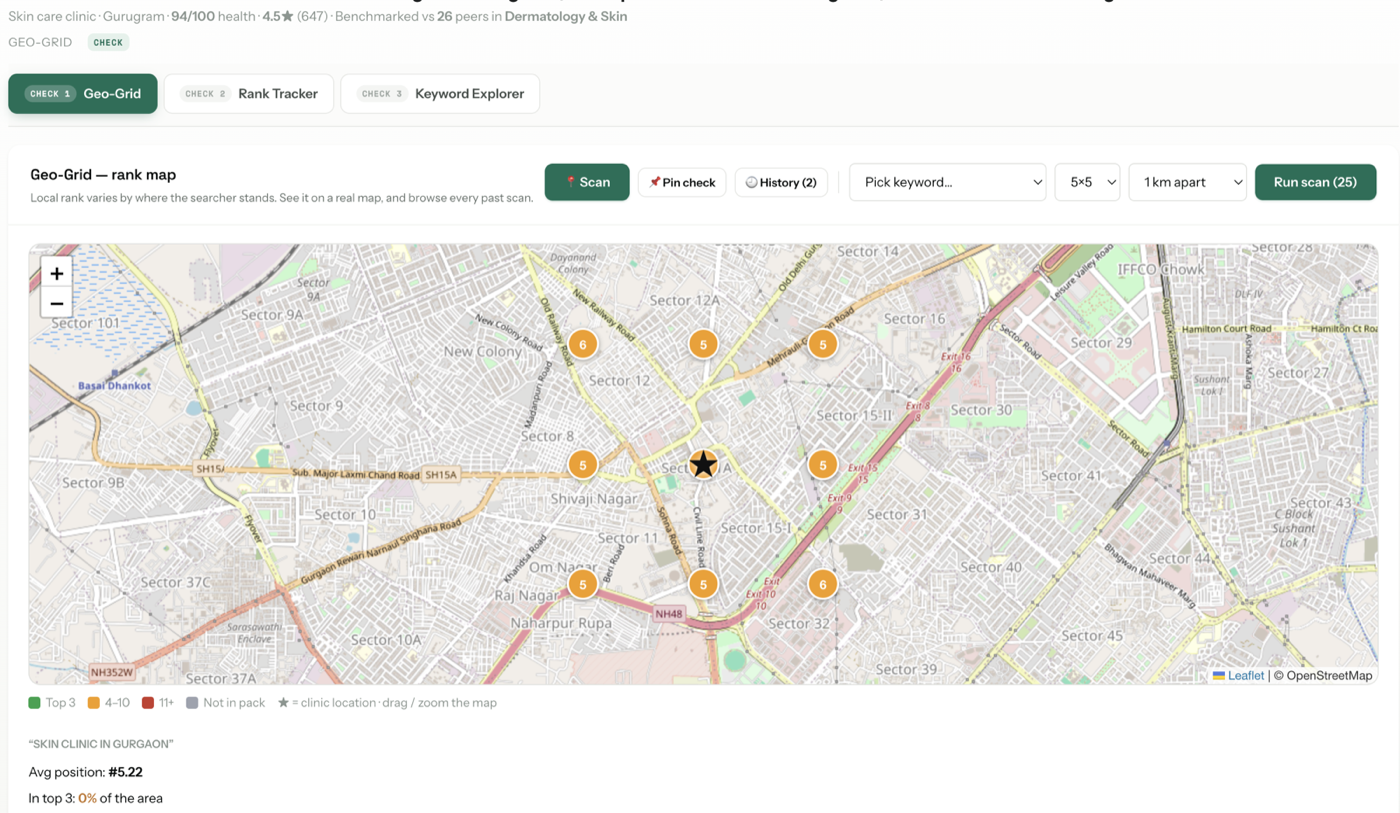
Section 6 — Geo-grid strategy for IVF clinics
IVF has a wider catchment than most specialties — couples travel further for fertility care than for a GP appointment. A 10–15km radius is not unusual for metro IVF patients; rural patients in some cases travel to the nearest city.
Geo-grid configuration for IVF clinics:
- Metro city (Delhi, Mumbai, Bangalore): 7×7 grid at 1.5km spacing — wider than standard to capture the extended IVF catchment
- Tier-2 city (Jaipur, Kochi, Nagpur): 9×9 grid at 2km spacing — IVF catchment extends across the city and into surrounding areas
- Single dominant city clinic: Also scan for "[city name] IVF" queries at 3–5km spacing to capture patients searching from adjacent areas
The geo-grid data consistently shows that IVF clinics have a longer visible radius than other specialty clinics — their combination of higher review counts (absolute, not relative — IVF clinics typically have more reviews than GP clinics) and stronger topical authority produces prominence signals that extend visibility further than proximity alone would suggest.
Frequently asked questions
Q1: Can an IVF clinic mention success rates in its Google Business Profile? No — not as a promotional claim about the clinic's own success rates. Both NMC's 2026 advertising guidelines and ART Act 2021 restrict individual IVF clinic success rate claims in marketing content. Published national or international success rate data with source attribution (ICMR, ESHRE) can be referenced in educational context on the linked website, not in the GBP business description.
Q2: How should IVF clinics address male infertility in their GBP? Explicitly, in both the services list and the Q&A section. Male infertility (azoospermia treatment, semen analysis, sperm retrieval for IVF/ICSI) should be listed as distinct services, not subsumed under generic "IVF services." The Q&A section should include seeded questions addressing male factor queries. Many IVF clinics have the clinical capability but have not optimised their GBP to capture male partner search queries.
Q3: Is doctor-directory optimisation worth the investment for an IVF clinic? For metro IVF clinics: yes, significantly. In Mumbai and Bangalore, doctor-listing platforms account for approximately 45–48% of IVF digital discovery — comparable to Google Maps. A paid listing tier with complete doctor profiles, fertility-specific condition tags, and active health-article content is a standard part of ICG's IVF clinic digital strategy.
Q4: How do we respond to a negative IVF review from an unsuccessful cycle? With empathy, without adding clinical context. Never confirm the treatment, the outcome, or the number of cycles. Express genuine care for the reviewer's wellbeing and invite private follow-up. The response should be written by someone who understands both the emotional weight of the reviewer's experience and the compliance requirements — ICG's review response team handles this for all managed IVF clinic clients.
Q5: What is the most important GBP field for an IVF clinic? Primary category ("Fertility Clinic" not "Medical Clinic") combined with a complete services list that explicitly covers both female and male fertility services. The category determines which queries you're eligible to appear for. The services list determines relevance matching within the eligible category. Together, these two fields have more impact than any other GBP element for IVF-specific queries.
Q6: How does ICG manage GBPs for IVF chains with multiple locations? Each location has its own GBP with location-specific doctor profiles and services. Shared brand elements (clinic name, primary category, brand description template) are managed centrally via Turtle. Review generation is location-specific (each location's patient contact goes to that location's review link). ART Act and NMC compliance review is applied to all content across all locations before publishing. ICG currently manages IVF chain GBPs across 5+ cities.
Sources:
- ART (Regulation) Act 2021 — Ministry of Health and Family Welfare
- NMC Guidelines on Ethical Advertising (6 Oct 2026) — nmc.org.in
- ICMR ART guidelines — icmr.gov.in
- ICG patient acquisition attribution data, IVF clinic portfolio, 2025–2026
Internal links:
- NMC-Safe GBP Content for Doctors
- Local SEO for Healthcare — Complete 2026 Guide
- Google Review Management for Healthcare
- Google Business Profile Management Services
- IVF Marketing Agency India
- Best Local Citation Sites India 2026
BLOG 2 of 3
IVF local-SEO benchmarks Indian fertility groups should hit in 2026
Most IVF-clinic marketing decks quote vanity impressions. The numbers below are the ones a founder-CFO conversation actually rewards — pulled from anonymised ICG engagements across Delhi-NCR, Bengaluru, Hyderabad and Ahmedabad fertility groups running the couple-intent playbook for at least two quarters.
| Metric | Baseline (single-location IVF clinic) | ICG 90-day target | ICG 180-day target |
|---|---|---|---|
| GBP calls / month | 18-32 | 55-80 | 110-160 |
| Direction requests / month | 40-70 | 120-180 | 240-320 |
| Geo-grid average rank (5km, couple-intent set) | 7.8 | 4.5 | 2.6 |
| Google reviews added / month | 2-4 | 10-14 | 18-24 |
| Website form-fills from GBP | 3-6 | 14-22 | 28-40 |
| Consultations booked from local search | 6-10 | 22-34 | 45-70 |
The five mistakes we see on 8 out of 10 IVF GBP profiles
- ART Act non-compliance in the GBP description — success-rate percentages, sex-selection hints, or gender-of-baby promises trigger both suspension risk and DHR scrutiny.
- Wrong primary category — 'Hospital' or 'Doctor' instead of 'Fertility clinic', which quietly loses the couple-intent map pack.
- Zero Q&A seeding — the Q&A tab is empty, so the first question a competitor plants becomes your public FAQ.
- Homogeneous review language — 40+ reviews all sounding identical, which Google's spam-review model down-weights heavily since the 2025 update.
- No treatment-level service posts — IUI, ICSI, donor programme, and fertility preservation should each be a Service, not one lumped 'IVF' line.
We fix these inside the first sprint of a Client Elevation Programme engagement, then bolt on Angryturtle as the GBP operating system so the daily posts, review replies and Q&A moderation keep running without a founder babysitting them. For clinic groups that also want to convert Instagram fertility-content viewers into booked consults, Prism Pulse ties Reels performance back to the same enquiry pipeline.
Book a free SEO diagnostic.
Hanuman Sihag's team runs a live crawl, checks technical health, cannibalisation, schema coverage and content gaps. 60 minutes, prioritised fix list.
Questions readers ask
about this topic.
The three platforms
behind every ICG engagement.
Beacon
CAPI middleware that fixes Event Match Quality, translates CRM statuses to Meta-standard events, dedups across channels.
Agency OS
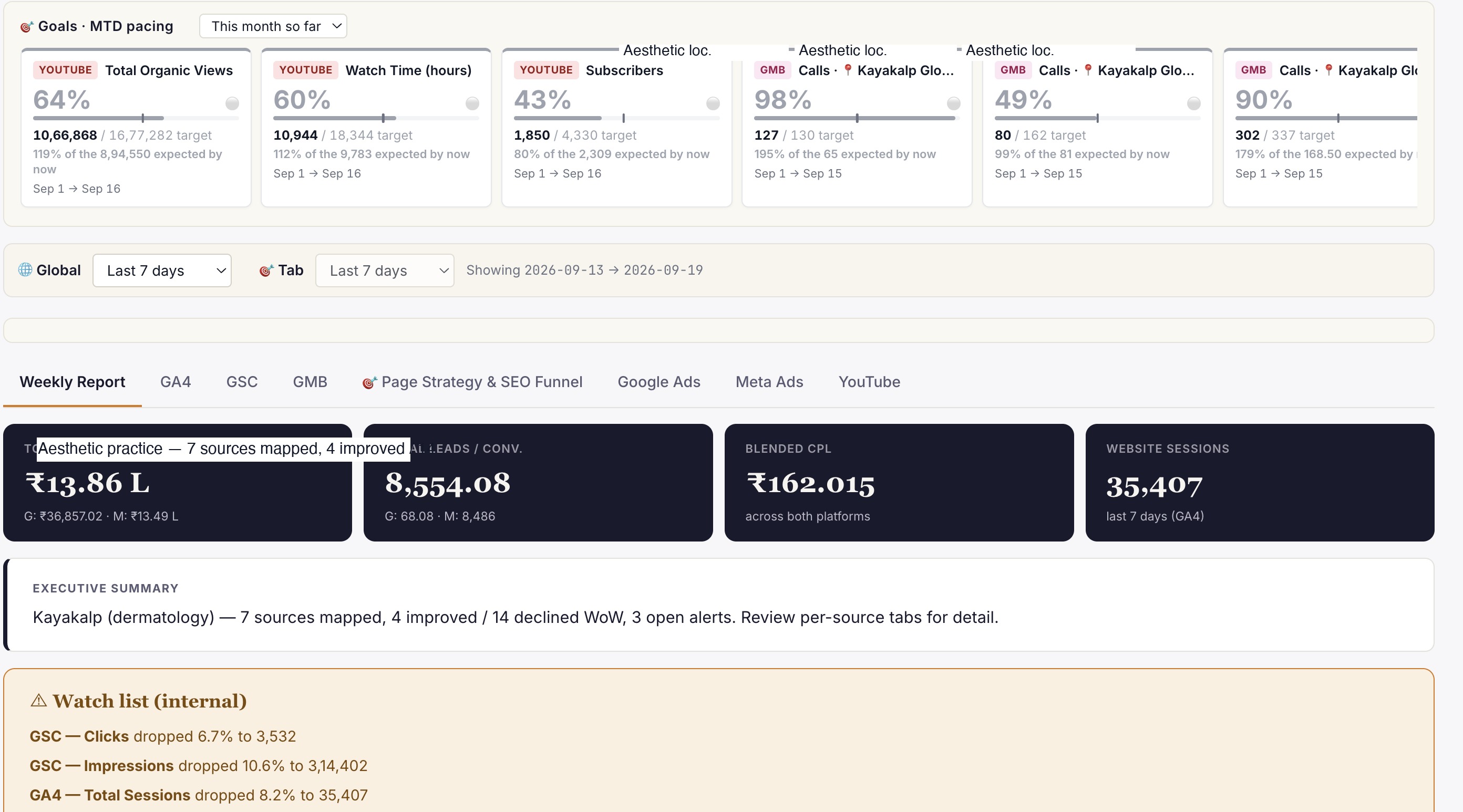
Live client dashboard. GSC, GA4, Google Ads, Meta Ads, IVR calls in one view. Login anytime, not monthly.
Phoenix
Clinic revenue intelligence over your PMS. Daily action queue: Prevent Loss, Maintain & Engage, Grow Revenue. Multi-centre rollout.
Or book a free 30-min audit to see all three in action on your account.
Healthcare brands
that already run on ICG.
A representative slice of the 150+ healthcare brands ICG has delivered for across India. Most engagements remain under NDA.


What ICG clients say · on video.
"Working with ICG transformed how we acquire IVF patients in Gurgaon. They understand the fertility journey from inquiry to consult..."
"ICG built our IVF marketing system from the ground up. The team understands healthcare specifics, not just generic digital marketi..."
The intelligence stack behind this playbook.
Every ICG engagement runs on the Search Intelligence Trifecta — Angryturtle for GMB, SIE for search and AI Overview, YODA for YouTube. Live product screens below.
Need help operationalising this?
Every ICG service is healthcare-only, NMC + DPDP-aware, and built around the patient-research patterns that drive Indian healthcare growth in 2026.
Every practice welcome — packages from ₹20,000/mo.
Goals-Driven engagements · Performance-Linked Payout Models available


More from
ICG.
Five trends shaping Indian healthcare marketing through 2027: AI-first patient research, Conversions API adoption, ABDM discovery, the AEO w...
Healthcare AIO is the discipline of getting your clinic or hospital cited inside Google AI Overviews, ChatGPT and Perplexity answers — not j...
Conversational-search advertising places brand messages inside AI chat answers — ChatGPT, Perplexity, Copilot — rather than beside a results...
Stop guessing.
Book a Diagnostic.
30 minutes. Free. With the AI-powered healthcare-only marketing agency 150+ brands already run on. No slides, no pitch, no hard close.


