


Healthcare CRM Buyer Guide India 2026: 10 Feature Categories That Actually Matter
A vendor-neutral, feature-first way to evaluate healthcare CRM options in India. Ten comparison axes, five category tiers, four buyer archetypes, ABDM and DPDP Act 2023 fit checks, and honest advice on when a CRM is the wrong problem to solve first.
No pitch. Written root-cause diagnosis. AI-powered, healthcare only.
Direct answer
A vendor-neutral, feature-first way to evaluate healthcare CRM options in India. Ten comparison axes, five category tiers, four buyer archetypes, ABDM and DPDP Act 2023 fit checks, and honest advice on when a CRM is the wrong problem to solve first.
TL;DR
Last updated: August 2026. Written for Indian healthcare buyers evaluating CRM options in the Rs 8,000 to Rs 3,00,000 per month band, with an eye on ABDM, the DPDP Act 2023, and NMC telemedicine rules.
TL;DR
- Healthcare CRM in India is not one market. It is at least five category tiers, each with a different data model, a different compliance posture, and a different total cost of ownership.
- The ten features that actually decide the buy are: healthcare-native data model, ABDM readiness, DPDP Act 2023 controls, NMC and telemedicine workflow support, WhatsApp and IVR automation, GBP and paid-channel attribution, multi-branch or multi-doctor scaling, reporting depth, integration surface, and implementation time.
- A single dental clinic doing 40 to 80 appointments a month rarely needs a full CRM. A 100-bed multi-speciality hospital cannot survive without one. A mid-tier IVF chain sits in the middle and usually gets the choice wrong in year one.
- Indian pricing bands sit roughly at Rs 8,000 to Rs 20,000 per month (light), Rs 20,000 to Rs 60,000 per month (mid), and Rs 1,00,000 plus per month (enterprise) for the CRM itself, before the marketing and RCM layers on top.
- The most expensive mistake is buying a global CRM that has no ABDM hook, no DPDP consent artefact, and no WhatsApp Business flow, and then paying an agency Rs 1,50,000 a quarter to duct-tape it together.
Table of contents
- Why this comparison matters for Indian healthcare buyers
- The 10 axes you should compare on
- The main comparison table
- Per-axis deep dives
- Which tier fits which buyer
- How ICG helps as a neutral advisor
- The 70-30 pricing model for marketing services on top
- FAQ
Why this comparison matters for Indian healthcare buyers
Most healthcare CRM shortlists in India start with the wrong question. The founder or the marketing head opens a comparison site, sees a grid of logos, picks the three with the biggest brand recall, and asks for demos. Six weeks later the sales team is fighting the tool, the front desk is still using a WhatsApp group, and the reporting is stuck in an Excel export.
The reason is simple. A CRM built for a US SaaS company or an insurance brokerage in London is not the same object as a CRM built for a 40-bed IVF clinic in Hyderabad. The compliance surface is different because the DPDP Act 2023 has its own consent, breach notification and data fiduciary rules. The data model is different because an Indian hospital has to represent one patient across an outpatient visit, an inpatient episode, a diagnostic order, a pharmacy sale and an insurance claim, often across two or three branches. The channel mix is different because 60 to 80 percent of qualified enquiries land through WhatsApp, Google Business Profile calls, or an IVR, not a web form.
Ayushman Bharat Digital Mission also changes the shape of the question. A CRM that cannot map to an ABHA number, cannot produce an FHIR-compatible record, and cannot honour a patient consent artefact is a CRM that will need a rip-and-replace inside 24 months. A hospital administrator buying in 2026 is really buying for 2028 and 2029.
So the useful comparison is not vendor against vendor. It is feature category against feature category, mapped to your buyer archetype, your compliance obligations, and the marketing surface you actually run.
The 10 axes you should compare on
Before looking at any tool, freeze the axes. Every serious CRM evaluation in Indian healthcare should score category tiers on the same ten dimensions. If you cannot answer a demo question against one of these ten, the demo is theatre.
- Healthcare-native data model — does the schema know what an episode, an encounter, an OP visit, an IP admission, a procedure and an insurance authorisation actually are.
- ABDM readiness — ABHA linkage, HIP or HIU registration, FHIR R4 export, consent manager integration.
- DPDP Act 2023 controls — consent capture, purpose limitation flags, data principal request handling, breach notification workflow, India data residency.
- NMC and telemedicine workflow — doctor registration validation, prescription formatting per 2020 telemedicine guidelines, audit trail of the consult.
- WhatsApp and IVR automation — WhatsApp Business API templates, IVR call disposition capture, missed call to lead conversion.
- GBP and paid-channel attribution — Google Business Profile call tracking, Meta lead form ingestion, YouTube lead capture, source-to-revenue reporting.
- Multi-branch and multi-doctor scaling — branch-level isolation, doctor-level commissions, cross-branch appointment routing.
- Reporting depth — cost per qualified lead (CPQL), procedure-level revenue, doctor productivity, insurance mix, LTV by acquisition channel.
- Integration surface — HIS, LIS, RIS, pharmacy, TPA, accounting, bulk SMS, WhatsApp BSPs.
- Implementation time and change management — realistic go-live in weeks, training load on the front desk, Hindi and regional-language interface.
The main comparison table
Five category tiers show up in almost every Indian healthcare shortlist. Below is how they generally score on the ten axes. Read the table as a starting map, not a verdict. A specific product inside any tier can be stronger or weaker than the tier average.
| Axis | DIY cloud CRM (repurposed SaaS) | Marketing-only CRM | Practice management + light CRM | Mid-market ABDM-native healthcare CRM | Enterprise EHR overlay CRM |
|---|---|---|---|---|---|
| Healthcare-native data model | Weak | Weak | Medium | Strong | Very strong |
| ABDM readiness | None out of the box | None | Partial (ABHA lookup) | Native HIP or HIU | Full HIP with FHIR R4 |
| DPDP Act 2023 controls | Needs custom work | Basic consent form | Consent + limited audit | Consent artefact + audit trail | Full data principal request workflow |
| NMC / telemedicine workflow | Not designed for it | Not applicable | Prescription pad only | Guideline-aligned e-Rx + audit | Full teleconsult module |
| WhatsApp + IVR automation | Via third-party glue | Strong for WhatsApp, weak for IVR | Basic reminders | Two-way flows + IVR disposition | Depends on partner ecosystem |
| GBP + paid attribution | Manual UTM only | Strong | Weak | Medium to strong | Weak unless bolted on |
| Multi-branch scaling | Possible but painful | Not the point | Usually single-branch | Designed for 2 to 20 branches | Designed for 100+ beds, many branches |
| Reporting depth | Generic dashboards | Funnel + campaign | Appointment + collection | CPQL to revenue, doctor-level | Full RCM and clinical reporting |
| Integration surface | Broad but generic | Ad platforms + WhatsApp | Narrow (billing, pharmacy) | HIS, LIS, TPA, BSPs | Full HIS, LIS, RIS, TPA, accounting |
| Implementation time | 2 to 6 weeks | 1 to 3 weeks | 2 to 4 weeks | 6 to 12 weeks | 4 to 9 months |
| Indicative monthly cost (Rs, CRM only) | 8,000 to 25,000 | 10,000 to 35,000 | 12,000 to 30,000 | 25,000 to 75,000 | 1,50,000 and up |
Per-axis deep dives
1. Healthcare-native data model
A generic CRM stores a Contact, an Account, an Opportunity and an Activity. A healthcare-native CRM stores a Patient, a Referrer, an Encounter, an Episode, a Procedure, a Payer and an Authorisation. The gap matters the moment a patient walks in for a second opinion, then converts to an IVF cycle, then returns 14 months later for a pregnancy scan. In a generic CRM this looks like three unrelated Opportunities. In a healthcare-native model, it is one Patient with three Episodes and a lifetime value line.
Ask any shortlisted tool to model a real 90-day patient journey on the demo call. If the answer involves custom fields, custom objects and a paid implementation partner, you are looking at a repurposed SaaS, not a healthcare CRM.
2. ABDM readiness
Ayushman Bharat Digital Mission is no longer optional posture. If your hospital plans to accept insurance under the National Health Claim Exchange, or if your clinic plans to be discoverable through the Health Facility Registry, ABDM integration is on the roadmap whether you like it or not.
The three questions that actually matter: can the tool link an ABHA number to a patient record, can it act as a Health Information Provider so the patient can pull records into their ABHA app, and can it consume a valid Consent Artefact before sharing. A CRM that only does the first is doing marketing theatre. A CRM that does all three is future-proof.
3. DPDP Act 2023 controls
The Digital Personal Data Protection Act, 2023 has moved from paper to enforcement. The three concrete artefacts you should be able to produce from your CRM are: a purpose-scoped consent record with a timestamp and a withdrawal path, an audit log that shows who accessed a patient record and why, and a workflow to fulfil a data principal request (access, correction, erasure) inside the notified timelines.
Indian hospitals with a large outpatient book underestimate the erasure workflow. When you have 40,000 patient records and 12 percent are inactive for over 24 months, you need a defensible retention policy encoded in the CRM, not written on a wall in the admin office.
4. NMC and telemedicine workflow
The 2020 Telemedicine Practice Guidelines, now enforced under the NMC framework, require doctor identity verification, mode of consultation logging, prescription format compliance, and consent for tele-consult. A healthcare CRM that supports teleconsult should be able to validate an NMC registration number, timestamp the mode of the consult, generate a prescription in the accepted format, and store the entire audit trail for the mandated retention period.
Marketing-only CRMs do not touch this and should not pretend to. If teleconsult is on your roadmap, the CRM and the practice management layer need to be evaluated together, or the compliance load lands on the doctor's laptop.
5. WhatsApp and IVR automation
India's healthcare buyer talks on WhatsApp. Between 55 and 78 percent of qualified leads for elective specialities such as IVF, cosmetic dentistry, orthopaedics, hair restoration and aesthetics land as a WhatsApp message or a missed call to a GBP-listed number. A CRM that treats WhatsApp as an add-on is a CRM that will lose 40 percent of your funnel to a shared inbox.
What good looks like: WhatsApp Business API templates managed inside the CRM, two-way conversation threads attached to the patient record, IVR call recordings and dispositions captured against the lead, and missed-call auto-response flows that push a booking link.
6. GBP and paid-channel attribution
Most Indian healthcare buyers cannot tell you their real cost per qualified lead by source. The reason is not laziness, it is that GBP calls, Meta lead forms, YouTube-driven direct calls and Google Ads calls all land in the same phone, get logged as "walk-in" or "phone", and lose their source tag. A serious CRM ingests GBP call insights, Meta lead form data, and campaign UTMs directly, and maps each lead through appointment, show-up, procedure, and revenue.
This is where most repurposed SaaS falls apart. It can do the front end of the funnel and the back end of the funnel, but the middle, where the front desk converts a call into an appointment, is a black hole. Fix that middle and your CPQL reporting suddenly becomes real.
7. Multi-branch and multi-doctor scaling
A single-clinic tool and a multi-branch tool are different animals. Multi-branch scaling requires branch-level user isolation so the Andheri front desk cannot see the Powai patient list unless the role allows it. It requires doctor-level revenue splits so consultant payouts are computed inside the system, not in a shared spreadsheet. It requires appointment routing so a patient calling the central number can be booked at the nearest available branch.
Chains with three or more branches almost always outgrow a practice management tool within 18 months. Buying for the branch count you will have in two years, not today, saves the second migration.
8. Reporting depth
Ask for four numbers on the demo: CPQL by source, show-up rate by lead source, procedure-level revenue by doctor, and 12-month LTV by acquisition channel. If the tool can produce all four without a data-warehouse project, the reporting is honest. If any of them requires an export to Excel, budget for a BI layer on top or accept that you will be flying half-blind.
For a 100-bed hospital, reporting depth is also about payer mix. Cashless versus reimbursement versus self-pay is a real financial signal, not a nice-to-have. The CRM should surface it against the marketing spend that acquired the patient.
9. Integration surface
A healthcare CRM does not live alone. It has to speak to the hospital information system, the lab information system, the pharmacy, the TPA desk, the accounting stack, and at least one WhatsApp Business Solution Provider. The question is not whether the CRM supports integrations. The question is whether the specific integrations your operation needs are pre-built or need custom API work.
A useful rule of thumb: if the CRM vendor cannot name three Indian HIS platforms it has integrated with in production, the integration story is marketing copy, not engineering reality.
10. Implementation time and change management
The unspoken cost of a healthcare CRM is the six to twelve weeks your front desk spends learning it, the two months your doctors spend complaining about it, and the quarter your marketing team spends waiting for clean reports. An honest vendor tells you this up front and gives you a change management plan. A dishonest one promises a two-week go-live for a mid-market implementation and then bills you for a nine-month "phase two."
Regional-language interface support is a real feature here. A CRM that only speaks English will slow adoption in a Tier 2 or Tier 3 city clinic where the front desk operates primarily in Hindi, Tamil, Marathi or Bangla.
Which tier fits which buyer
Archetype 1: Single dental or aesthetic clinic, 40 to 120 appointments a month
A single-chair or two-chair clinic doing under 120 appointments a month usually does not need a full CRM. A practice management tool with a WhatsApp reminder flow and a Google Business Profile connected to a call-tracking number covers 90 percent of the value. The right spend is Rs 8,000 to Rs 15,000 a month on the tool, and the marketing budget goes to acquisition, not to CRM licences. Layer in a lightweight lead capture CRM only when monthly enquiries cross 200.
Archetype 2: Mid-tier IVF or cosmetic surgery chain, 3 to 8 branches
This is the archetype that most often buys wrong. The chain grows past two branches, the founder tries to stretch the practice management tool, the marketing head buys a marketing-only CRM in parallel, and now there are two systems that do not talk. The right answer is a mid-market ABDM-native healthcare CRM at Rs 40,000 to Rs 75,000 a month, integrated with the practice management tool, with WhatsApp and IVR at the front and a clean CPQL-to-revenue dashboard at the back.
Archetype 3: 100-bed multi-speciality hospital
At this size the CRM is inseparable from the RCM and EHR conversation. The enterprise EHR overlay tier makes sense, but only if the hospital already has, or is buying, a proper HIS. If the HIS is weak, adding a heavy CRM on top makes the mess more expensive. The correct order is: fix the HIS and the ABDM posture first, add a mid-market healthcare CRM in parallel for the marketing and pre-admission funnel, and only move to the enterprise tier when clinical reporting demands it.
Archetype 4: 200-bed plus tertiary care hospital or a chain of hospitals
Enterprise EHR overlay CRM is the default here, with a multi-year implementation, a dedicated internal product owner, and a change management budget that matches. Expect Rs 1,50,000 per month and up on the CRM alone, and a full-time role to own the tool. The savings show up in payer mix optimisation, doctor productivity, and clinical outcomes reporting, not in marketing efficiency.
How ICG helps as a neutral advisor
Ichelon Consulting Group works with over 300 live healthcare clients across India, from single-chair dental clinics to 500-bed hospital groups. Because we are a marketing and growth partner, not a CRM reseller, we sit on the buyer's side of the table. Our job in a CRM evaluation is to translate your ten-axis scorecard into a shortlist, run structured demos with your team, model the total cost of ownership including integration and change management, and make sure the CRM decision does not become a bottleneck for your acquisition engine. We also run two India-first tools of our own that plug into whatever CRM you choose: AtomCRM at Rs 14,999 per month for clinics that want a lean, healthcare-native CRM without the enterprise price tag, and HealthPro 360 at Rs 14,999 per month as an RCM and EHR overlay for hospitals that need pre-admission and revenue-cycle visibility without a nine-month EHR project. Both are optional, both are honestly scoped, and both are recommended only when the buyer's ten-axis scorecard actually points at them.
The 70-30 pricing model for the marketing services on top
Once the CRM decision is made, the harder question is what you spend on demand generation to feed it. ICG's marketing engagements for healthcare buyers follow a 70-30 pricing model designed to align incentives. Seventy percent of the monthly fee is fixed and pays for the strategy, execution and team that runs your growth stack. Thirty percent is tied to a 12-month target on a sliding-scale slab, so the outcome you actually care about, not activity, drives the variable pay.
For search-led growth the tiers are Foundation at Rs 49,999 a month, Growth at Rs 74,999 a month, and Scale at Rs 99,999 a month. The same 70-30 structure extends to Google Ads engagements starting from Rs 5,00,000 in monthly ad spend, and to YouTube SEO and AIO-focused engagements starting from Rs 50,000 a month. Our full product stack, including Angryturtle for Google Business Profile, YODA for AI-native YouTube, Meta Catalyst IQ for Meta ads, Prism Spy for competitor Meta intel and Prism Pulse for Instagram analytics, plugs into any of the five CRM tiers above without lock-in. The CRM you buy should never dictate the marketing partner you work with.
FAQ


Is a healthcare CRM the same as an EHR or an HIS?
No. An EHR stores the clinical record. An HIS runs hospital operations end to end, including OP, IP, pharmacy and billing. A healthcare CRM is focused on the patient relationship, the acquisition funnel, and the post-visit engagement layer. In a 100-bed hospital you will usually need all three, and the boundaries between them are where most implementation problems live.
Do we really need an ABDM-ready CRM in 2026?
If you are a clinic doing under 100 appointments a month with no plan to accept cashless insurance, you can defer. Everyone else should treat ABDM readiness as a two-year requirement, not an optional feature. A CRM that cannot handle ABHA, HIP or HIU and Consent Artefact today is a CRM you will replace inside 24 months.
What does the DPDP Act 2023 mean for a marketing CRM?
It means every lead capture point needs a purpose-scoped consent, every WhatsApp broadcast needs a legitimate use ground, and every patient has the right to ask for access, correction and erasure. Your CRM has to make all three easy to prove in an audit. A tool that only captures a check-box next to "I agree" is not enough.
How much should a mid-tier IVF chain budget for a CRM?
For the CRM licence itself, Rs 40,000 to Rs 75,000 a month is a realistic band for a three to eight branch chain. Add another Rs 15,000 to Rs 30,000 a month for WhatsApp Business API costs, BSP fees and integration maintenance. The marketing spend on top follows the 70-30 model above and is a separate line item.
Can a global CRM be made to work for an Indian hospital?
Yes, but the total cost of ownership rarely wins. You will pay a global licence, an implementation partner to build ABDM hooks, another vendor for WhatsApp Business API integration, and a BI layer for reporting. By month 18 you are usually spending more than a native mid-market healthcare CRM would have cost, with a worse compliance posture.
How long does a mid-market healthcare CRM take to go live in India?
Six to twelve weeks for a three-branch clinic if the front desk is trained properly and the WhatsApp Business API and IVR flows are scoped in advance. Anything shorter is either a very simple deployment or a vendor over-promising. Enterprise EHR overlay implementations for 100-bed and larger hospitals routinely take four to nine months.
What is the single biggest mistake Indian buyers make?
Buying a marketing-only CRM and a practice management tool separately, and hoping they will talk to each other. They rarely do. The lead source data lives in one tool, the appointment and revenue data lives in another, and CPQL to revenue is stitched together in a Google Sheet. The mid-market ABDM-native tier exists precisely to close this gap.
Where do WhatsApp Business Solution Providers fit in?
Every serious CRM in India integrates with one or more BSPs. The BSP handles the actual WhatsApp Business API access, template approvals, and message routing. The CRM handles the conversation UI, the lead record and the automation logic. Do not confuse the BSP with the CRM. You will usually need both, and the pricing is separate.
Should the marketing agency own the CRM decision?
No. The CRM decision is an operations, compliance and clinical decision as much as a marketing decision. A good marketing partner will contribute to the ten-axis scorecard, run structured demos, and make sure the acquisition funnel is designed around the chosen CRM, but the final call sits with the hospital or clinic leadership. If your agency is pushing a single CRM regardless of your ten-axis scorecard, ask why.
How do we start if we have never done a structured CRM evaluation?
Start by writing down your buyer archetype in one line, then score your current setup on the ten axes above out of five. Any axis under three is a working problem. That single scorecard, honestly filled, is worth more than any vendor demo. If you would like an outside pair of eyes, ICG runs vendor-neutral CRM scoping sessions for Indian healthcare buyers as part of our Client Elevation Programme.
Book a free CRM stack review.
Deep Das walks through your current setup, integration friction with ABDM/DPDP requirements, and whether a build vs buy vs AtomCRM fit works for your scale.
Questions readers ask
about this topic.
The three platforms
behind every ICG engagement.
Beacon
CAPI middleware that fixes Event Match Quality, translates CRM statuses to Meta-standard events, dedups across channels.
Agency OS
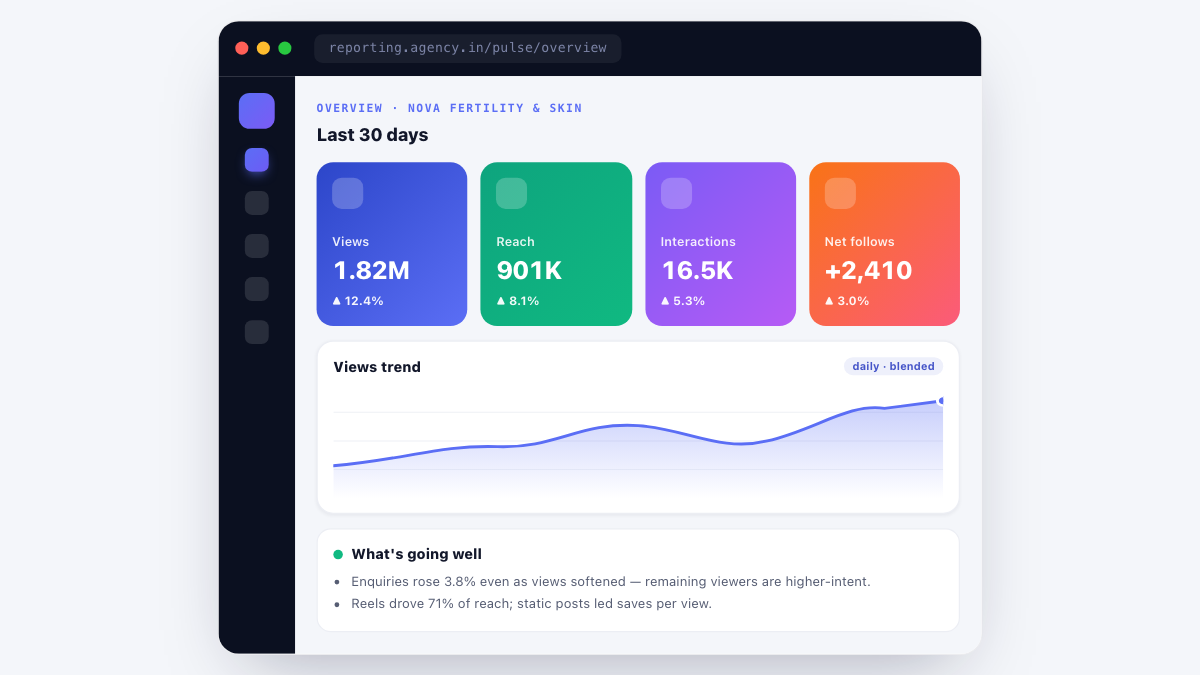
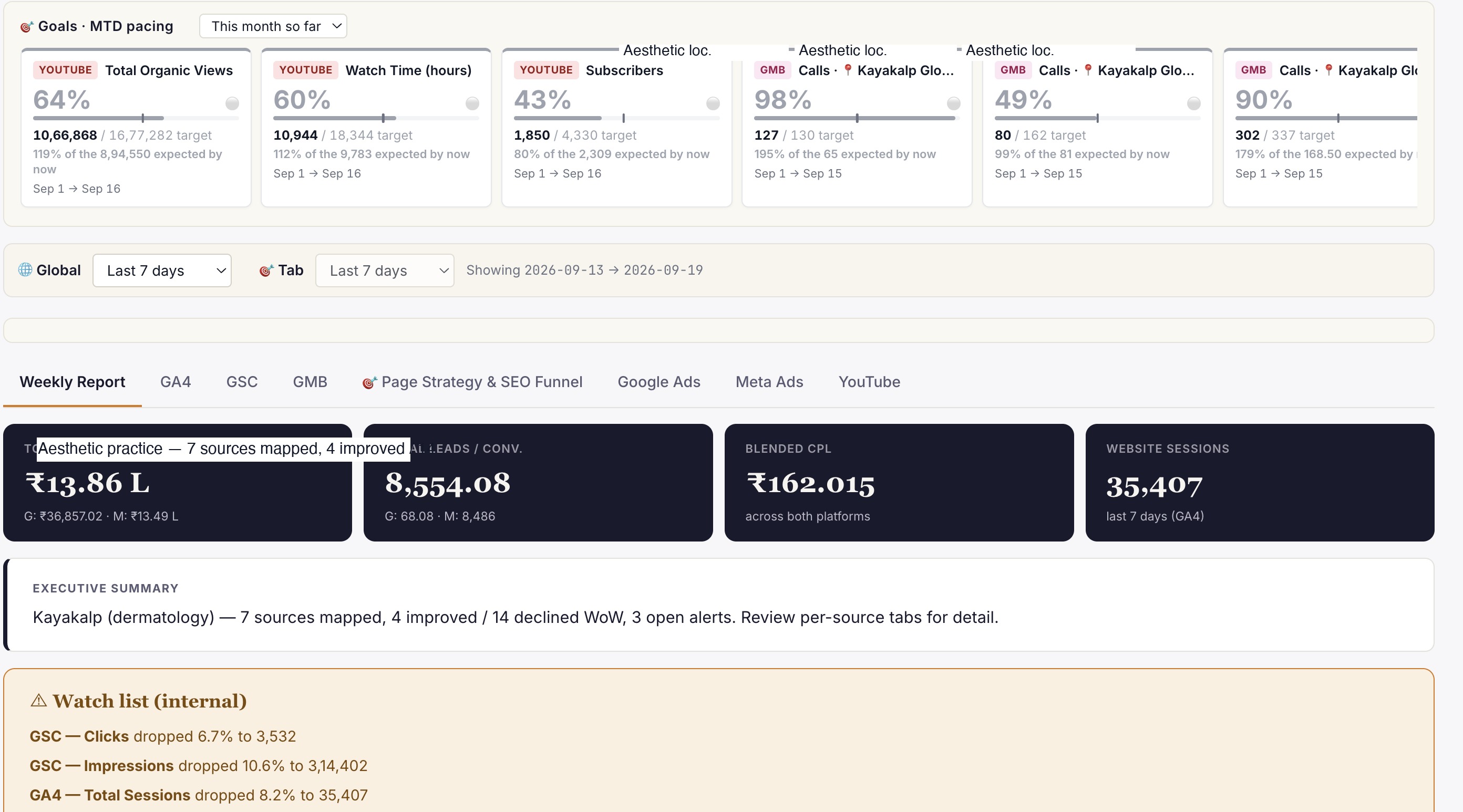
Live client dashboard. GSC, GA4, Google Ads, Meta Ads, IVR calls in one view. Login anytime, not monthly.
Phoenix
Clinic revenue intelligence over your PMS. Daily action queue: Prevent Loss, Maintain & Engage, Grow Revenue. Multi-centre rollout.
Or book a free 30-min audit to see all three in action on your account.
Healthcare brands
that already run on ICG.
A representative slice of the 150+ healthcare brands ICG has delivered for across India. Most engagements remain under NDA.


What ICG clients say · on video.
"Scale up of organic channels and business consulting. ICG has absolute domain authority in their field."
"Working with ICG transformed how we acquire IVF patients in Gurgaon. They understand the fertility journey from inquiry to consult..."
"What Ichelon accomplished — they got all my ideas and worked over 3-4 months to create an amazing, super-customised website."
Need help operationalising this?
Every ICG service is healthcare-only, NMC + DPDP-aware, and built around the patient-research patterns that drive Indian healthcare growth in 2026.
Every practice welcome — packages from ₹20,000/mo.
Goals-Driven engagements · Performance-Linked Payout Models available


More from
ICG.
Five trends shaping Indian healthcare marketing through 2027: AI-first patient research, Conversions API adoption, ABDM discovery, the AEO w...
Healthcare AIO is the discipline of getting your clinic or hospital cited inside Google AI Overviews, ChatGPT and Perplexity answers — not j...
Conversational-search advertising places brand messages inside AI chat answers — ChatGPT, Perplexity, Copilot — rather than beside a results...
Stop guessing.
Book a Diagnostic.
30 minutes. Free. With the AI-powered healthcare-only marketing agency 150+ brands already run on. No slides, no pitch, no hard close.


