


How to get a video viral on YouTube — and why healthcare channels should stop chasing viral and start chasing reach, retention, and real conversion
The honest answer to the "how do we go viral" question: viral is a misleading target for healthcare channels. This piece reframes the question around what YODA calls the 5 video states, unpacks the organic-vs-paid distinction hard, and gives clinics the model that actually compounds — reach, retention, and real conversion — instead of chasing the one-in-a-thousand accidental spike.
No pitch. Written root-cause diagnosis. AI-powered, healthcare only.
Direct answer
The honest answer to the "how do we go viral" question: viral is a misleading target for healthcare channels. This piece reframes the question around what YODA calls the 5 video states, unpacks the organic-vs-paid distinction hard, and gives clinics the model that actually compou...
TL;DR
Ask ten healthcare marketing teams what their channel goal is and at least three will say "we want to go viral." Ask the same team six months later what happened, and the answer is usually a familiar mix of frustration — "one video did unusually well but the rest are flat," "we got a spike and it did not convert," or "we boosted a video and it hit big numbers but no consults came." All three outcomes trace back to the same root problem — the word viral is doing enormous work in these conversations and it means almost nothing operationally. This piece reframes the question. If you are a healthcare channel trying to get patient bookings, "viral" is the wrong target. What you want is the three-part outcome — reach, retention, and real conversion — measured against YODA's five states model, with organic and paid ruthlessly separated at every step.
Why "viral" is the wrong word for healthcare and what it actually smuggles in
Viral in the entertainment-creator context means a specific thing — a video whose organic view velocity outstrips its channel's baseline by 10-100x within the first 48-72 hours, driven by sharing behaviour and algorithmic amplification. It is a real phenomenon. It is largely a lottery. Chasing it as a strategy is like chasing lottery wins as a retirement plan — statistically possible, economically indefensible.
For healthcare, viral smuggles in three assumptions that do not hold. First, that the goal is view count — but for a channel meant to book consultations, view count is a means, not an end. Second, that the "share" behaviour that drives virality is available for healthcare content — but people share entertainment content, funny content, controversial content; they rarely share their own health condition's explainer video into a WhatsApp group. Third, that a viral spike is durable — but viral spikes decay to near-zero over the following 30-90 days, and a channel with one viral video and 50 flat ones has less compounding equity than a channel with 51 videos that each do steady moderate numbers.
The honest data point — across the healthcare channels YODA runs, videos that get called "viral" internally almost always turn out on inspection to be either (a) heavily promoted paid campaigns with the paid views masking organic performance, or (b) real organic spikes that produced view count but poor consult conversion because the audience that came in through the spike was not the target audience. Sometimes both.
The YODA 5 states model — what every video actually is
Every video on a channel is in one of five states at any point in time. YODA's Diagnostics step assigns each state. Understanding the states removes the fuzzy "viral or not" question and replaces it with a specific state + a specific next action.
State 1: Winning. Organic views growing steadily. Retention above channel median. CTA click-through above channel median. Suggested surface placements accumulating. This video is compounding value. Next action — modest paid reinforcement (₹8-15k) to accelerate what is already working, embed on relevant clinic blog pages, add to related playlists.
State 2: Sleeping. Modest organic views. Retention healthy but no algorithmic amplification. Often this is a solid video that is one Optimisation fix away from moving to Winning — usually a title refresh, thumbnail A/B, or missing chapter markers. Next action — SEO Lab refresh, thumbnail test, monitor for 14 days.

State 3: Retention Weak. Impressions and clicks are healthy but audience drops off sharply in the first 30-45 seconds. The hook is broken. Next action — re-cut the intro, re-shoot the opening 45 seconds if possible, otherwise consider marking the video for retirement.
State 4: Compliance Flagged. The Optimisation step has flagged the video for a compliance concern (NMC, DPDP, PC-PNDT, ART Act, ASCI). Next action — pause any paid promotion, human compliance review, either re-edit or unpublish.
State 5: Sunset. The video's topic has aged out, its performance has decayed below floor, or its retention curve indicates the audience finds it unhelpful. Next action — either unpublish or hide from channel homepage. Sunset is not failure — it is disciplined pruning that helps the surrounding content perform better.
"Viral" does not appear on this list. A video that would have earned that label in a marketing meeting is either a Winning video with a very steep growth curve or — more often — a paid-amplified video masquerading as organic. YODA's state assignment gives the honest picture.
Reach, retention, real conversion — the three metrics that actually matter
Reach. The measure that replaces "views." Reach for a serious healthcare channel is Discovery Organic — the impressions × CTR combination on the three discovery surfaces (YouTube Search, Suggested, and Browse) that indicate YouTube's ranking systems are placing the video in front of real users who did not know the channel before. Views can spike from external sharing, WhatsApp groups, promotion, and other one-off events. Discovery Organic is what tells you the channel is compounding.
Retention. Where the audience stays and where they drop off. A video with 80% retention at midpoint and 40% at the end is telling you something specific — the audience is genuinely engaged through most of the content. A video with 30% retention at 45 seconds and 15% at midpoint is telling you the hook is broken. YODA's Diagnostics step maps every video's retention curve and flags the specific timestamp of the drop-off cliff.
Real conversion. Consults booked from the channel, tagged to the specific video where possible. This is the metric that separates marketing performance from marketing theatre. A video with 40,000 views and 3 booked consults is worse than a video with 4,000 views and 12 booked consults for a serious healthcare channel — the second is producing the outcome, the first is producing dashboard-friendly numbers.
The disciplined channel measures itself on these three, not on viral spikes. A quarter's report that shows Discovery Organic up 40%, average retention up 8 percentage points, and consult conversion up 20% is a quarter that will keep the channel funded for the next 4 quarters. A quarter's report that shows "one video went to 200K views" and nothing else has moved is a quarter that raises awkward questions with the CFO.
The organic vs paid distinction that cannot be skipped
The single most consequential discipline for healthcare channel measurement is separating organic from paid at every step. This is what YODA does by default — no metric anywhere in the platform blends organic and paid into a single number. A promoted video's view count on the paid side is subtracted before any state assignment or performance judgement.
Why this matters. A clinic runs ₹35,000 of paid promotion on a video. The video ends the campaign with 120,000 views. The blended dashboard shows this as a top performer. A junior marketer flags it as "our first viral video." Strategy plans the next quarter around replicating the "viral" pattern. Six months later, ₹4 lakh has been spent trying to replicate what turned out to be a mediocre organic performer riding on paid views.
YODA's discipline surfaces the honest picture on day one — the video had 8,000 organic views and 112,000 paid views. Organic Discovery is below channel median. The video is a State 2 (Sleeping) organic performer, not a Winner. The right decision is to fix the organic side (retention, thumbnail, SEO) before spending more paid. See organic vs paid and promoted vs viral for the deeper dive.
The rule that must never be broken — a promoted video is never viral and never "organic." Paid gets its own line in every report. Blending them is the specific practice that separates serious healthcare marketing measurement from theatre.
What actually drives a video into the Winning state
Setting aside the fantasy of viral, what actually moves a video from Sleeping into Winning?
Topical alignment. The video's topic matches a query patients are actually typing, and the video's title and thumbnail signal that match cleanly. This is the single biggest lever — 5-10x range on outcomes. A cardiology video titled "Understanding heart health" underperforms a cardiology video titled "Symptoms of a silent heart attack — dermatologist warning signs in men over 45."
Hook quality in the first 30-45 seconds. Retention drops in this window are the largest single cause of Sleeping-state videos. A hook that restates the exact question the viewer typed, promises a specific concrete answer, and delivers the first payoff of that answer within 45 seconds keeps retention in the healthy zone. See format comparison for how different formats hook differently.
Thumbnail CTR. A weak thumbnail limits impressions from ever converting to views. Thumbnail A/B testing (YODA's Thumbnail module) can shift CTR by 30-80% on videos with weak initial thumbnails. See thumbnail CTR.
Chapter markers. Structured chapters help both retention (viewers can find the segment relevant to them) and AI Overview citation readiness. Videos without chapters underperform videos with chapters by 15-25% on both metrics.
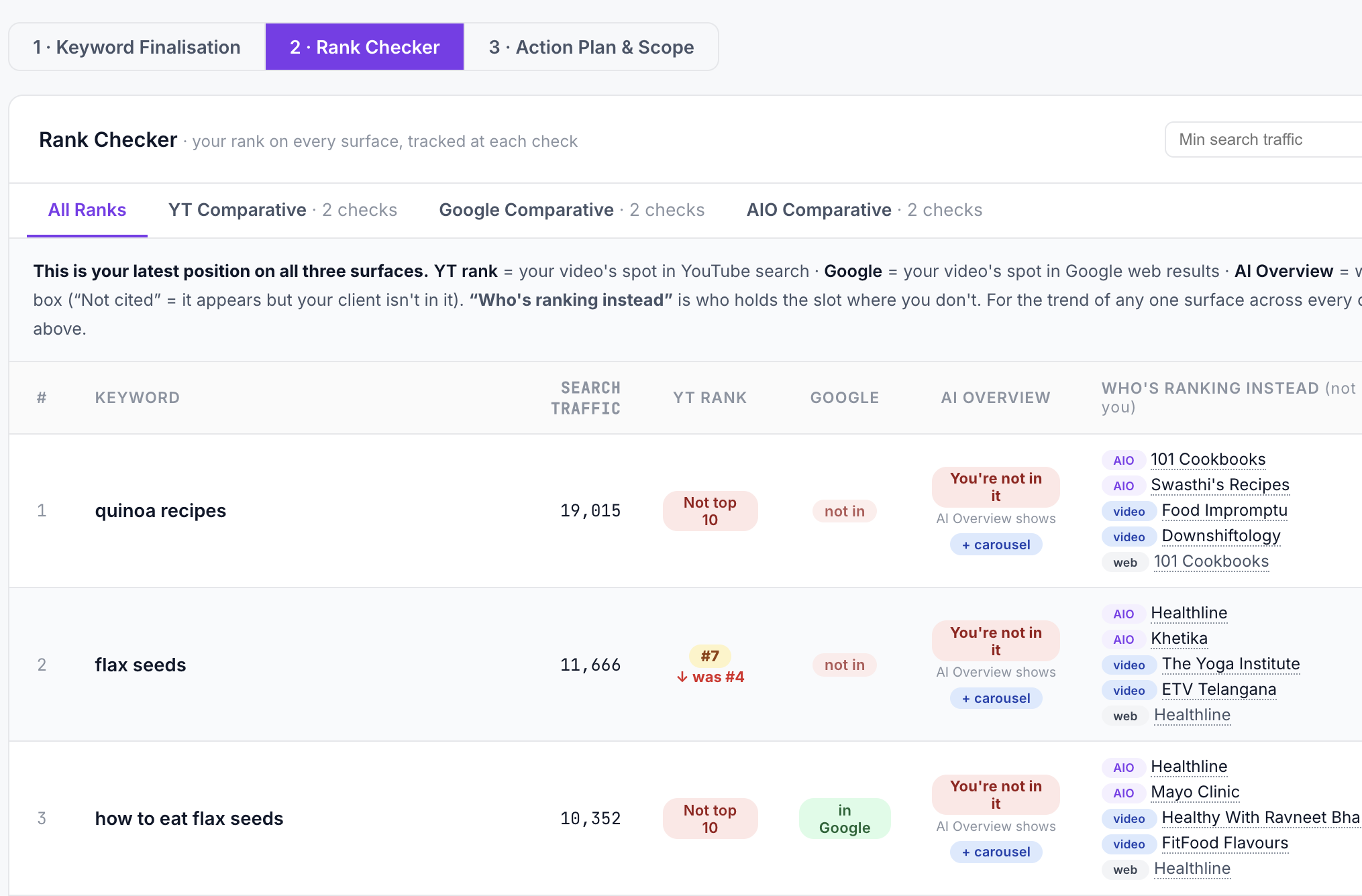
Description depth. A description that repeats the video's key claims in text, lists the CTA prominently, and includes clean chapter timestamps feeds both YouTube search and Google web search for the video. Thin descriptions leave rank surfaces unused.
Publishing cadence and channel authority. A video published on a channel that has consistent cadence and topical authority in the query cluster ranks materially higher than the same video on an inconsistent or off-topic channel. Cadence discipline compounds.
None of these individually is glamorous. Combined and applied consistently over 30-50 videos, they move a healthcare channel from "occasional lucky spike" to "consistent winning across most uploads." That is the honest replacement for the viral fantasy.
The paid strategy for videos that deserve paid
Paid promotion is not evil. It is a specific lever that, applied to the right video at the right time, materially accelerates the compounding of a healthcare channel. The rules for using it well:
Rule 1: Only promote Winners. A video in State 1 (Winning) that is already showing strong organic Discovery, healthy retention, and above-median CTA click-through is a candidate for modest paid reinforcement. A video in State 2 (Sleeping) should get its organic issues fixed before paid is applied. A video in States 3-5 should never get paid.
Rule 2: Cap the paid spend per video. ₹8,000-25,000 per video is the range where paid meaningfully accelerates without drowning the organic signal. Beyond ₹50,000 per video, the paid views start to overwhelm the organic performance measurement and the honest signal is lost.
Rule 3: Report the paid separately in every downstream metric. Every dashboard, every consult attribution, every state assignment — paid must stay separate from organic. YODA does this natively. Manual dashboards need explicit discipline to enforce.
Rule 4: Cap paid promotion at a defined channel-wide percentage. A healthy healthcare channel has paid contributing 15-25% of total views. Beyond 40% paid contribution, the channel is being propped up rather than growing.
See which video deserves ad budget for the specific decision framework and organic vs paid for the measurement discipline.
The occasional real viral spike and what to actually do with it
Once in a while — perhaps once per 30-50 videos for a well-run healthcare channel — a genuine organic viral spike happens. The video hits 40,000 or 200,000 or 800,000 views organically. This does happen. What to do with it:
First, verify it is organic. Cross-check YODA's paid/organic split. Rule out that someone on the marketing team quietly ran a boost campaign. Rule out that the video was shared in a large WhatsApp group by an unexpected external party (a legitimate but non-repeatable driver).
Second, understand why. Read the comments. Look at the geographic and demographic split. Check the traffic surface (usually Suggested when a video spikes). Identify the specific attribute of the video that caused the algorithm to place it heavily — was it a hook that hit a specific search cluster, a format that broke through, a topic that caught a news moment.
Third, do not try to replicate the spike directly. The specific viral moment is usually not replicable — the algorithmic conditions that produced it are opaque. What is replicable is the underlying quality — the hook, the format, the topic depth, the retention curve.
Fourth, ensure the CTA architecture on the video is working. A viral spike with a broken CTA is a wasted asset. Update the pinned comment, refresh the WhatsApp pre-fill message, add a chapter that ends with a stronger CTA. Ride the spike for consult conversion, not just view count.
Fifth, expect decay. Viral spikes decay to a lower baseline over 30-90 days. Plan for the decay in the next quarter's strategy — the channel's honest baseline is what it looked like before the spike, not what it looked like at the peak.
The platform ICG uses to run this at scale: YODA
ICG runs healthcare YouTube marketing for clinics, hospitals, and specialty groups using YODA — our AI-native healthcare YouTube marketing platform. YODA sits on top of a channel's data and does four things no dashboard does: it separates organic from paid views at every step (so a promoted video can never masquerade as organic growth), it gives decisions not dashboards (every video gets a state + next action), it writes back to YouTube directly (improved titles, tags, descriptions, chapters applied straight to the platform), and it tracks the three rank races — YouTube search, Google web, and Google AI Overview citations.
YODA runs the full 6-step workflow — Overview, Diagnostics, Strategy, Optimisation, Reputation (ORM), and Competitor Intel — with 40+ analysis modules organised under those steps. ICG's managed YouTube service uses YODA end-to-end. See the Healthcare YouTube Marketing pillar guide for the full scope, or the Healthcare YouTube Marketing Agency service page for engagement details.
Book a YODA demo on WhatsApp → or request a free healthcare YouTube channel audit →
Related reading
- The 5 states a clinic video moves through
- Organic vs paid YouTube views — the truth
- Promoted vs viral for healthcare clinics
- Vanity metrics — the dangerous metric
- Which video deserves ad budget
FAQ
Is it possible for a healthcare video to go genuinely viral in India? Yes, occasionally — perhaps once per 30-50 videos on a well-run channel. Usually driven by hitting a specific search cluster at a moment of rising interest, or a specific hook that breaks through Suggested placement. Not a strategy; a lucky byproduct of consistent quality.
Should we ever measure success in views alone? No. Views alone conflate paid and organic, mix accidental spikes with genuine growth, and ignore whether the audience that watched was the audience you wanted. Measure Discovery Organic, retention, and consult conversion.
What is the fastest way to move a video from Sleeping to Winning? Usually a title refresh + a thumbnail A/B test + chapter markers, applied together. In field data across our channels, this combination lifts about 30-40% of Sleeping-state videos into Winning within 21-45 days.
How much paid promotion is too much? Paid contributing more than 40% of channel views is a red flag — the channel is being propped up rather than growing. 15-25% paid contribution is healthy for most stages.
Can we manufacture a viral moment through influencer sharing? You can manufacture a spike. The spike almost never converts to consults because the audience arriving through an influencer share is usually the influencer's audience, not the target audience for your clinic. Better to invest the same budget in modest paid reinforcement of your own Winners.
What happens to a viral video 60-90 days after the spike? It decays to a new baseline that is typically 5-15% of peak. Sometimes higher if the video continues earning Suggested placements. The channel's honest post-spike baseline is what matters for the next quarter's planning.
How do we know if we are actually chasing viral or chasing compounding? Ask what the next 4 quarters look like. Compounding channels grow steadily quarter-on-quarter with slowly rising baselines. Viral-chasing channels look like a series of spikes and troughs with a flat trend line underneath.
What is the biggest mistake a marketing team makes after a viral spike? Reallocating strategy to try to replicate it. The next 8 videos get titled like the one that spiked, thumbnailed similarly, and topically clustered around it — and they all underperform because the algorithmic conditions have shifted and the audience quality was never the target audience anyway.
What should we report to leadership if they keep asking about viral? Reframe. Report Discovery Organic growth, retention improvement, and consult conversion. When they ask about viral, translate — "we do not chase viral because the specific channels of our size and specialty that grow fastest are the ones that get 30-50 videos into the Winning state, not the ones that hit one lucky spike."
How does YODA's state model actually help? It removes the fuzzy "how is this video doing" question and replaces it with a specific state + next action. Instead of a marketing meeting discussing "is video X viral," the meeting looks at YODA's state assignment (Winning / Sleeping / Retention Weak / Compliance Flagged / Sunset) and the recommended next action for each state. Decisions get made faster and cleaner.
Book a free 30-minute Brand & Growth Diagnostic.
It's a working session, not a sales pitch — you leave with a written root-cause analysis you can act on, whether or not you engage ICG.
The three platforms
behind every ICG engagement.
Beacon
CAPI middleware that fixes Event Match Quality, translates CRM statuses to Meta-standard events, dedups across channels.
Agency OS
Live client dashboard. GSC, GA4, Google Ads, Meta Ads, IVR calls in one view. Login anytime, not monthly.
Phoenix
Clinic revenue intelligence over your PMS. Daily action queue: Prevent Loss, Maintain & Engage, Grow Revenue. Multi-centre rollout.
Or book a free 30-min audit to see all three in action on your account.
Healthcare brands
that already run on ICG.
A representative slice of the 150+ healthcare brands ICG has delivered for across India. Most engagements remain under NDA.


What ICG clients say · on video.
"Scale up of organic channels and business consulting. ICG has absolute domain authority in their field."
"Working with ICG transformed how we acquire IVF patients in Gurgaon. They understand the fertility journey from inquiry to consult..."
"What Ichelon accomplished — they got all my ideas and worked over 3-4 months to create an amazing, super-customised website."
Need help operationalising this?
Every ICG service is healthcare-only, NMC + DPDP-aware, and built around the patient-research patterns that drive Indian healthcare growth in 2026.
Every practice welcome — packages from ₹20,000/mo.
Goals-Driven engagements · Performance-Linked Payout Models available



More from
ICG.
Five trends shaping Indian healthcare marketing through 2027: AI-first patient research, Conversions API adoption, ABDM discovery, the AEO w...
Healthcare AIO is the discipline of getting your clinic or hospital cited inside Google AI Overviews, ChatGPT and Perplexity answers — not j...
Conversational-search advertising places brand messages inside AI chat answers — ChatGPT, Perplexity, Copilot — rather than beside a results...
Stop guessing.
Book a Diagnostic.
30 minutes. Free. With the AI-powered healthcare-only marketing agency 150+ brands already run on. No slides, no pitch, no hard close.


