


Promoted vs viral video for healthcare clinics (2026): why paid is not organic and how to tell them apart
A promoted video is not a viral video. Paid promotion inflates numbers without proving organic pull. How to isolate real organic performance for an Indian healthcare channel, with a sample YODA dashboard walkthrough that separates paid from organic on every video, keyword and traffic source.
No pitch. Written root-cause diagnosis. AI-powered, healthcare only.
Direct answer
A promoted video is not a viral video. Paid promotion inflates numbers without proving organic pull. How to isolate real organic performance for an Indian healthcare channel, with a sample YODA dashboard walkthrough that separates paid from organic on every video, keyword and tra...
TL;DR

Promoted video and viral video for healthcare clinics look identical on the surface of a YouTube dashboard — both show a big view number, both show a spike in a period, both make a nice screenshot for a monthly stakeholder deck. Underneath they are completely different assets, and treating them as the same is the single most common reporting error ICG sees when auditing a healthcare channel. A promoted video is a video that had ad budget behind it — YouTube served it as an impression through TrueView, in-stream, discovery, Shorts or bumper ads, and someone clicked play because the algorithm placed it in front of them as an ad, not because they went looking for it. A viral video is a video that gained organic pull — search-driven views, suggested-video views, browse-tab views, external embeds and shares — without paid budget doing the heavy lifting. The two require different playbooks, prove different things about the channel, and predict different future outcomes. If you are evaluating healthcare YouTube marketing agencies or trying to understand why your channel's "wins" evaporate the moment ad spend pauses, the promoted-vs-viral distinction is where the honesty test lives.
Why the distinction matters for healthcare clinics
Healthcare buyers evaluate video marketing spend against a longer time horizon than most industries because the sales cycle is longer. A single-visit dental cleaning might convert quickly; a hair transplant, IVF cycle, cardiac procedure or oncology consultation involves weeks of research, family discussion, second opinions and comparison. The video asset that surfaces at the right moment during that research window is a compounding asset — it can generate enquiries for months or years after it is uploaded. That compounding is what viral pull looks like in healthcare.
Promoted views do not compound. They exist while ad spend runs and disappear when the campaign turns off. A hospital that celebrates a 500,000-view video that was 92% paid has celebrated a one-time ad delivery event, not an asset that will keep working. When the spend stops, the enquiries stop. The team looks at the next month's report and sees "views down 80%" and cannot explain what changed. The change is that the ad campaign ended.
This misreading of promoted views as organic performance is why so many healthcare video budgets look like they are working month over month while producing no long-run compounding effect on the channel. Every month resets. Every celebration is temporary. The channel does not build.
What counts as a promoted view
YouTube Ads inventory covers multiple placements that all send views into the same total view counter on a video:
Skippable in-stream ads — the 5-second-then-skip pre-roll on other videos. A viewer who watches past 30 seconds (or completes) counts as a view on the promoted video.
Non-skippable in-stream ads — up to 15-20 seconds forced. Every completion counts as a view.
Discovery ads — appear in search results and next to related videos with an "Ad" label. A click that starts play counts.
Bumper ads — 6-second non-skippable. Counted per completion.
Shorts ads — placed inside the Shorts feed. Counted per view.
Video action campaigns — ads optimised for actions (clicks to website/WhatsApp). Views still count in the video's view number.
All six of these send paid views into the same headline number as organic views. The dashboard does not visually separate them unless the analyst chooses to filter. Most agency reports do not choose to filter, either because they don't know to or because separating hurts the headline. YODA's first design principle — separate organic from paid at every step — exists to eliminate the ambiguity.
What counts as organic pull
Organic pull comes from four YouTube traffic sources and a handful of off-YouTube sources:
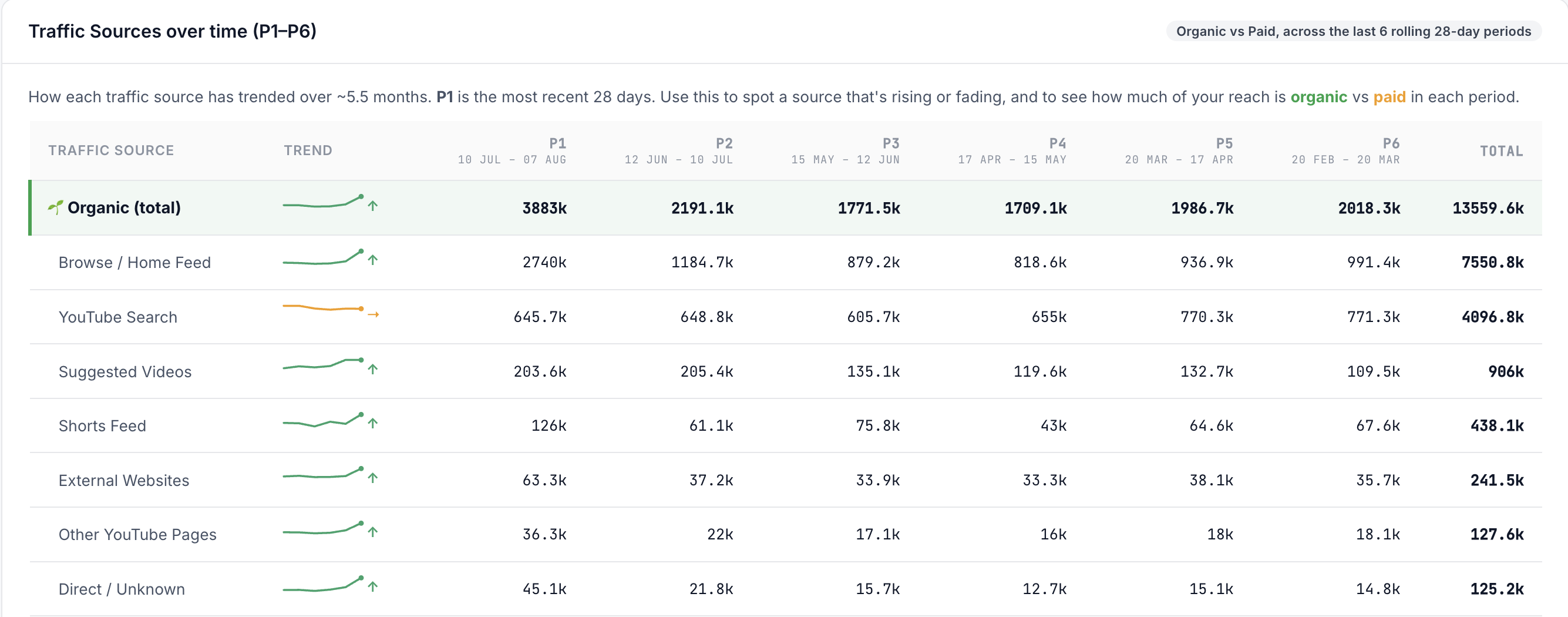
Search — someone typed a query into YouTube's search box and the video ranked well enough that they clicked. Strongest patient-intent signal, because the viewer had a question and the video answered it.
Suggested — the algorithm recommended the video next to another video the viewer was already watching. Broader, lower-intent, but still organic — the algorithm chose the video based on watch-history signal rather than paid placement.
Browse — the video appeared on the viewer's home feed, subscriptions feed, or trending. Purely algorithmic and often specialty-relevant.
External — the video was embedded on a website, shared on WhatsApp, linked in a newsletter, referenced in a Google search result. External is often the strongest topical-authority signal because someone chose to share the video with a real audience.
Plus channel-level sources — notifications to subscribers, playlist plays, direct URL. All four are unpaid — they represent choices the platform or a human made about where the video should appear, without money changing hands to move it there.
A video that draws heavily from Search, External and Browse without significant ad spend behind it is doing what "viral" is supposed to mean in a healthcare context — earned distribution driven by content quality, keyword coverage, and topical authority.
How paid inflates numbers without proving pull
Consider a real pattern ICG sees in Indian healthcare channels. A hospital's IVF service line uploads a 4-minute explainer on IUI vs IVF. The agency puts ₹40,000 behind it as a discovery + in-stream campaign over 3 weeks. The dashboard at day 21 shows:
Total views: 62,000. Watch time: 71,000 minutes. Subscribers gained: 84. Comments: 6.
Looks great in a report. The reality when paid is subtracted:
Organic views: 3,800. Organic watch time: 9,200 minutes. Organic subscribers gained: 71 (paid views convert to subs at much lower rates than organic because they are interruption traffic). Organic comments: 5.
The video looks like a hit at the aggregate level. In organic-only terms, it is a modest-performing asset in month one that will need real search-and-suggested traction over the next 60-90 days to become a compounding asset. Two very different conversations for the hospital's marketing team to have.
This is not an argument against ad spend. Ad spend on YouTube is legitimate for many use cases — cold-audience awareness before a launch, defending brand queries against competitor bidding, seasonal campaigns tied to health awareness days. It is an argument for reporting integrity — the paid and organic contribution must be split and reported separately for anyone to make a real judgement about the video's asset value.
How to isolate real organic performance
The organic-only view of any healthcare channel is built from three data pulls, all of which YODA does automatically and which any analyst can also do manually in YouTube Studio plus Google Ads:
Pull one — video-level view splits. In Google Ads → Video Campaigns, pull the view count each campaign contributed to each promoted video over the reporting period. Subtract those from the total video-level views in YouTube Studio. What remains is organic views on each video.
Pull two — traffic source distribution. In Studio → Analytics → Reach → Traffic Source Types, pull the split across Search, Suggested, Browse, External, Direct, Notifications, Playlists, Channel page and YouTube Ads. The Ads bucket is your paid contribution; everything else is organic (with the caveat that Suggested can itself be influenced by earlier paid views triggering the algorithm — not perfect, but directional).
Pull three — geography and demographic filter. Even within organic, filter for the clinic's serviceable catchment. An IVF centre in Delhi caring about Delhi-NCR patients should evaluate organic performance on Delhi-NCR viewers specifically.
The organic-only, catchment-filtered view is the number that predicts future compounding — whether the video will keep working after ad spend stops. That number is what agency reports for healthcare channels should be built around.
Sample YODA dashboard walkthrough
Inside YODA, the promoted-vs-organic split is the first cut on every screen — video table, keyword table, traffic-source panel, geography heatmap, cohort report. Nothing shows without disclosing what part of the number is paid.
On a typical Diagnostics screen for a demonstration dermatology channel (Lumina Skin & Hair Clinic, Dr. Meera Kapoor, Delhi — the sample client used across YODA's demo views), the video table shows for each upload:
Total views | Paid views | Organic views | Organic watch time | Organic average view duration | Organic subscribers gained | Traffic source distribution (organic) | Audience geography (organic) | Enquiry attribution (linked from CRM) | State (kill / keep / re-optimise / promote further) | Next action.
The organic-views column is the column decisions get made on. The paid column exists for context — it tells the operator how much was spent to reach the total number, which matters for ROI math but does not enter the "is this a good video" judgement.
Where a video shows strong organic pull (Search-heavy traffic, catchment-relevant geography, healthy retention, subscriber conversion above channel average), YODA marks it "promote further" — this is a video that has earned more ad spend because the underlying asset works organically and paid amplification will compound rather than substitute for the organic engine.
Where a video shows weak organic pull (Suggested-dominant traffic, out-of-catchment geography, cliff retention, poor subscriber conversion) despite decent total views, YODA marks it "kill promotion" — the paid spend is not compounding into organic traction, and the money is better spent elsewhere.
This is the promoted-vs-viral decision made explicit at the video level. Every month. Every video.
The compliance perimeter around paid video
Paid promotion of healthcare video content in India sits inside two overlapping rulebooks. NMC's 2026 advertising guidelines restricts what a doctor can advertise directly — solicitation of patients, comparative claims, and testimonial-based advertising all have restrictions. ASCI Guidelines 2022 apply to all advertising and require substantiation for any objective claim.
The relevant edge for the promoted-vs-viral discussion is that paid amplification of a video that makes an unsubstantiated claim carries greater regulatory exposure than the same video sitting organically on the channel. Paid placement transforms editorial content into advertising in the eyes of both frameworks, and any claim in a paid-promoted video needs to be defensible under ASCI substantiation standards.
For fertility and gynaecology channels, PC-PNDT Act 1994 restrictions on sex-determination content apply regardless of paid vs organic; the risk profile does not change with promotion, but promotion increases visibility of any breach.
What a healthy organic-only channel looks like
A healthcare channel that has been running the promoted-vs-organic separation discipline for 6-9 months typically shows a few consistent patterns: 20-40% of watch time coming from videos over 90 days old (compounding evidence), Search as a top-three traffic source contributing 25-50% of organic views, subscriber conversion on organic views running 2-5x the paid conversion, comment-to-view ratio on organic views 3-8x the paid ratio, and enquiries per 1,000 organic views trending upward as topical authority builds.
None of these patterns show up in a report that aggregates paid and organic. All of them are visible immediately once the split is enforced.
The platform ICG uses to run this at scale: YODA
ICG runs healthcare YouTube marketing for clinics, hospitals, and specialty groups using YODA — our AI-native healthcare YouTube marketing platform. YODA sits on top of a channel's data and does four things no dashboard does: it separates organic from paid views at every step (so a promoted video can never masquerade as organic growth), it gives decisions not dashboards (every video gets a state + next action), it writes back to YouTube directly (improved titles, tags, descriptions, chapters applied straight to the platform), and it tracks the three rank races — YouTube search, Google web, and Google AI Overview citations.
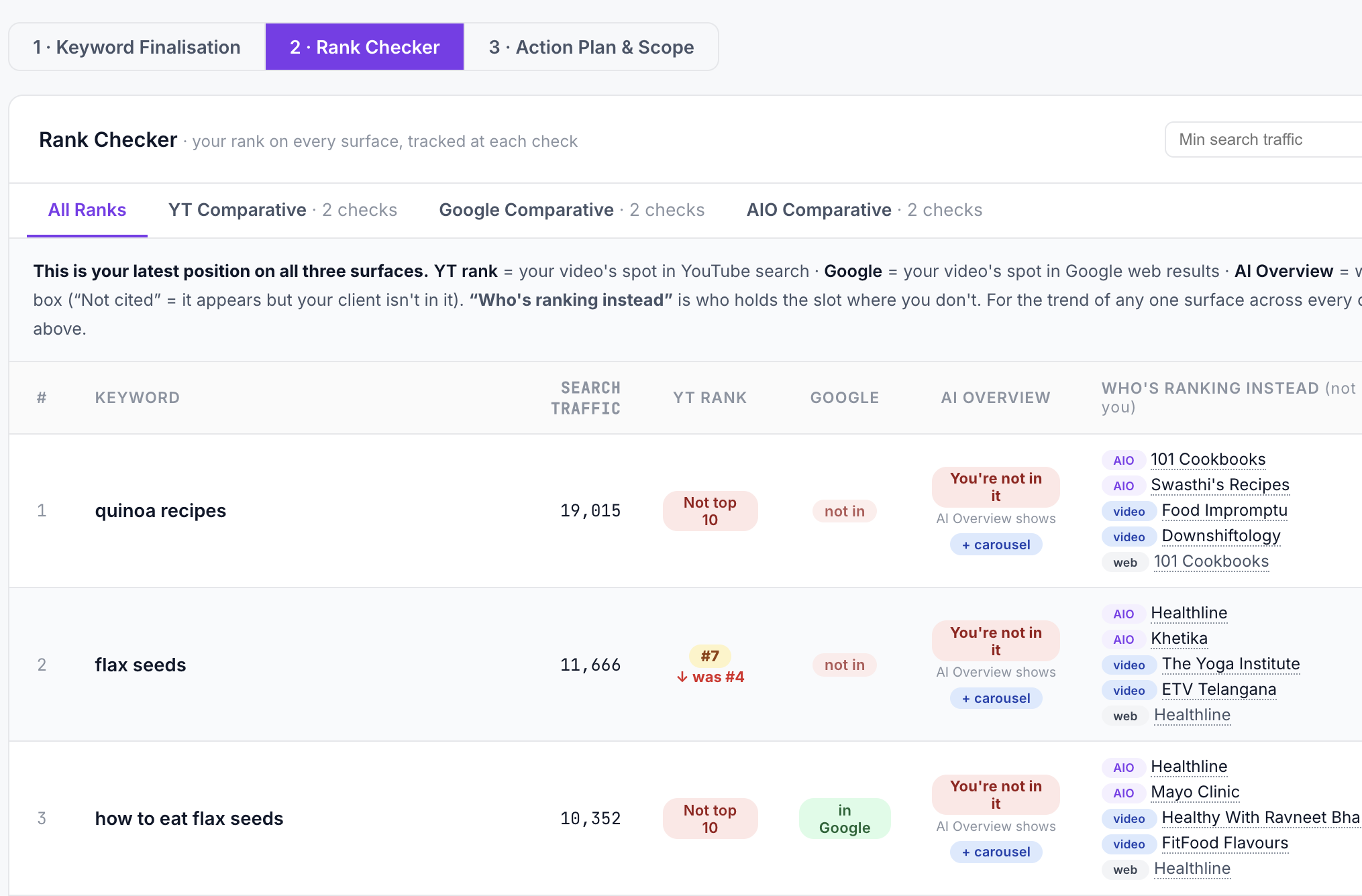
YODA runs the full 6-step workflow — Overview, Diagnostics, Strategy, Optimisation, Reputation (ORM), and Competitor Intel — with 40+ analysis modules organised under those steps. ICG's managed YouTube service uses YODA end-to-end. See the Healthcare YouTube Marketing pillar guide for the full scope, or the Healthcare YouTube Marketing Agency service page for engagement details.
Book a YODA demo on WhatsApp → or request a free healthcare YouTube channel audit →
Related reading
- Vanity metrics in healthcare video marketing — the broader framing this article slots into
- Which video deserves ad budget — the promotion decision framework
- YouTube views vs revenue for healthcare — the money-side counterpart
- Healthcare YouTube marketing pillar guide — the pillar reference
- Healthcare YouTube Marketing Agency service page — engagement scope
FAQ
Are all paid views bad for a healthcare channel? No. Paid views serve valid purposes — cold-audience awareness, defensive brand-query bidding, launch acceleration. The problem is not paid views existing; it is paid and organic being aggregated into one number without disclosure. Report paid and organic separately and the ad spend regains its usefulness.
How can I tell if my agency is hiding paid views inside "views" reporting? Ask for a video-by-video table with two columns — paid views and organic views — for the reporting period. Cross-reference the paid column against the Google Ads spend the agency reported for the same period. If the numbers don't reconcile, ask why. If the agency cannot produce the table, that is the answer.
Does the algorithm favour videos that had ad spend behind them? Indirectly and modestly. Paid promotion generates watch-history signal in the audience it reaches, and some of that signal feeds into the algorithm's suggested and browse decisions. This is why a video that starts with paid can sometimes gain organic tail. But the tail is not automatic and it is not proportional — a paid-heavy video with weak retention will not compound organically.
What's the fastest way to see organic-only traffic in YouTube Studio? Studio → Analytics → Advanced Mode → filter by Traffic Source Type → exclude "YouTube advertising". This gives an organic-only view of any metric. Save the filter as a preset if the account permits.
Is a "viral" healthcare video realistic? Healthcare rarely produces mass-market viral moments — the topic is niche, the audience is filtered, and the algorithm's viral distribution engine is tuned for entertainment. What is realistic and much more valuable is topical-authority pull — a video that consistently draws Search traffic for a set of patient queries for months or years. That is the healthcare equivalent of viral, and it compounds.
Should I pause all YouTube Ads to see my real organic performance? Not necessary. YODA (and any careful analyst) can separate paid and organic without turning off spend. But a 60-day pause on a specific video's promotion is a useful diagnostic if you want to see whether the video has any organic engine on its own.
How does this apply to Shorts? The same logic applies. Shorts ads exist inside the Shorts feed as paid placements; organic Shorts views come from the Shorts feed algorithm. Separate the two. Organic Shorts performance is a distinct read from long-form organic performance, and both are read separately from paid contribution.
What's the healthy paid-to-organic ratio for a healthcare channel? There is no single answer. In early channel-building phases, paid may dominate — that is fine as long as it is disclosed. Over 12-18 months of consistent uploads plus optimisation, a healthy channel should show the organic share of watch time growing month over month even as total watch time grows.
How does the "3 ranking races" framing apply here? Ranking on YouTube search, Google web search video results and Google AI Overview citations is entirely organic — paid amplification does not directly earn ranking on any of these surfaces. So an organic-only view is also the only view that predicts ranking performance across the three races. Paid views are irrelevant to whether a video ranks tomorrow.
Does ICG's managed service always separate paid from organic in reporting? Yes. Every ICG healthcare YouTube retainer report leads with organic performance and reports paid contribution separately. It is a discipline built into the delivery model and enforced by YODA's reporting architecture. There is no "let's just show the total" version of the report.
Book a free 30-minute Brand & Growth Diagnostic.
It's a working session, not a sales pitch — you leave with a written root-cause analysis you can act on, whether or not you engage ICG.
The three platforms
behind every ICG engagement.
Beacon
CAPI middleware that fixes Event Match Quality, translates CRM statuses to Meta-standard events, dedups across channels.
Agency OS
Live client dashboard. GSC, GA4, Google Ads, Meta Ads, IVR calls in one view. Login anytime, not monthly.
Phoenix
Clinic revenue intelligence over your PMS. Daily action queue: Prevent Loss, Maintain & Engage, Grow Revenue. Multi-centre rollout.
Or book a free 30-min audit to see all three in action on your account.
Healthcare brands
that already run on ICG.
A representative slice of the 150+ healthcare brands ICG has delivered for across India. Most engagements remain under NDA.


What ICG clients say · on video.
"Scale up of organic channels and business consulting. ICG has absolute domain authority in their field."
"Working with ICG transformed how we acquire IVF patients in Gurgaon. They understand the fertility journey from inquiry to consult..."
"What Ichelon accomplished — they got all my ideas and worked over 3-4 months to create an amazing, super-customised website."
Need help operationalising this?
Every ICG service is healthcare-only, NMC + DPDP-aware, and built around the patient-research patterns that drive Indian healthcare growth in 2026.
Every practice welcome — packages from ₹20,000/mo.
Goals-Driven engagements · Performance-Linked Payout Models available



More from
ICG.
Five trends shaping Indian healthcare marketing through 2027: AI-first patient research, Conversions API adoption, ABDM discovery, the AEO w...
Healthcare AIO is the discipline of getting your clinic or hospital cited inside Google AI Overviews, ChatGPT and Perplexity answers — not j...
Conversational-search advertising places brand messages inside AI chat answers — ChatGPT, Perplexity, Copilot — rather than beside a results...
Stop guessing.
Book a Diagnostic.
30 minutes. Free. With the AI-powered healthcare-only marketing agency 150+ brands already run on. No slides, no pitch, no hard close.


