


AI Overview citation for doctors in India — the personal-brand playbook for 2026 that earns Google generative citations without breaching NMC or ASCI
Google AI Overview cites doctor-branded pages differently from hospital or condition pages. Here is the six-signal playbook for individual practitioners in India, plus the NMC and ASCI constraints that shape what you can and cannot say.
No pitch. Written root-cause diagnosis. AI-powered, healthcare only.
Direct answer
Google AI Overview cites doctor-branded pages differently from hospital or condition pages. Here is the six-signal playbook for individual practitioners in India, plus the NMC and ASCI constraints that shape what you can and cannot say.
TL;DR

AI Overview citation for a doctor-branded page happens when Google's generative answer surface quotes the doctor's page verbatim and links it as a named source. For Indian practitioners, this is a distinct optimisation problem from ranking a clinic or hospital page — it requires Person schema, MCI-linked credentialing, a definition-first author biography, and a strict compliance-clean writing style. Six signals govern citation, and NMC's 2026 advertising guidelines govern what you can put on the page.
Most doctors in India think of their web presence as one of three things: a listing on a doctor-listing platform or local directory, a bio inside a hospital website, or a personal site built once and forgotten. AI Overview has quietly changed the value of that third option. When a patient searches for a condition, procedure, or specialty in India today, the AI Overview panel that appears above the organic results increasingly cites named individual practitioners — not just hospitals — where the practitioner's page carries the right structural signals. That citation is worth more than a doctor-listing platform listing because it names the doctor, quotes them as an authority, and links back to their own domain. For any doctor in India building a long-term personal brand, earning AIO citation is now a first-class SEO objective. This playbook covers the six signals that drive it, the schema fields that unlock it, and the compliance perimeter (NMC, ASCI, DPDP) that shapes what your page is allowed to say.
What doctor citation actually looks like in the AI Overview panel
When AIO cites a doctor, the citation surfaces one of three ways. The most common is an inline author attribution — the panel summary reads "According to Dr. X, a Mumbai-based dermatologist..." and links their bio page. The second is a quote-block — a specific statement from the doctor's page (a definition, a procedural note, a criterion) is pulled verbatim and attributed. The third is the "source card" that appears in the expanded panel, where the doctor's page shows up as one of the 3 to 8 cited sources with its title, favicon, and domain.
All three citation forms require the same underlying structural conditions on the doctor's page. The panel needs to identify the person as an authority, tie them to a specialty and location, and find a quotable statement that answers the query. That is not a marketing bio; that is a schema-marked, credentialed, definition-first content page authored by the doctor.
Why most Indian doctor pages fail to earn AIO citation today
The typical Indian doctor page is a hospital-hosted bio: name, degree list, hospital designation, one photograph, a two-line "about me" paragraph, appointment button. It has no Person schema, no jobTitle, no memberOf, no sameAs to the doctor's MCI registration, no LinkedIn linked as sameAs, and no substantive body content. AIO cannot cite what it cannot parse as an authority signal.
Even doctors who have built dedicated personal sites often fail on a second axis — the site is a portfolio of marketing copy rather than a substantive knowledge base. AIO cites doctor pages when the doctor has written about their specialty in enough depth that a specific statement is quotable. A page that says "Dr. X is a leading dermatologist" is unquotable (both because "leading" is an ASCI red flag and because it is not a substantive claim). A page that says "The three-tier approach to acne treatment I use combines topical retinoids for the epidermal layer, oral isotretinoin for moderate-to-severe cases, and adjunctive lasers for scar management" is quotable — and that is what AIO cites.
The six signals that drive AIO citation for an Indian doctor page
- Person schema with full credential graph. jobTitle, hasCredential, memberOf (medical councils), alumniOf (educational institutions), and sameAs to LinkedIn, ORCID, and NMC / State Medical Council registration.
- Definition-first author-authored content. The doctor's page must contain content the doctor authored — a definition of their subspecialty, an explanation of their approach, an FAQ they wrote. Not marketing copy about them.
- Named-author byline on every substantive page. Person schema on the byline, matched to the Person schema in the About page — a consistent entity graph across the site.
- Compliance-clean writing. No "leading", no "best", no "#1", no unsubstantiated success rates. The trust filter downgrades violations aggressively.
- Cross-references to authoritative sources. Outbound links to peer-reviewed journals, NIH, PubMed, WHO, ICMR, NMC — anchoring the doctor's claims to Tier-1 evidence.
- Recency signal. A visible "last reviewed by [author]" date on every clinical content page, plus dateModified in schema. AIO downweights stale medical content aggressively.
The Person schema fields that matter most for doctor citation
Person schema for a doctor is not a copy-paste job. AIO rewards a specific set of fields because they map to the credential-verification questions its trust filter asks. The following table shows the fields ICG configures on every doctor-branded page in the portfolio, ranked by observed AIO impact.
| Person schema field | What it signals to AIO | Observed impact |
|---|---|---|
| name + honorificPrefix | Canonical practitioner identity | Baseline — required |
| jobTitle | Specialty (Dermatologist, Cardiologist, Fertility Specialist) | Very high — used to match specialty queries |
| hasCredential (EducationalOccupationalCredential) | Degree with recognisedBy authority | Very high — YMYL trust signal |
| memberOf (Organization) | Medical councils (NMC, DCI, State Council) | Very high — validates practising authority |
| alumniOf (EducationalOrganization) | MBBS / MD / MS institution | Moderate — education prestige signal |
| sameAs (LinkedIn, ORCID, NMC profile URL) | Cross-platform identity confirmation | High — resolves entity uniqueness |
| knowsAbout | Sub-specialty areas explicitly listed | Moderate — improves topical match |
| worksFor (Organization) | Current hospital / clinic affiliation | Moderate — local relevance |
| award, description | Notable positions, publications, awards | Low individually, cumulative when combined |
The two fields with the highest citation lift are hasCredential and memberOf. Together they tell AIO "this person is a licensed medical practitioner recognised by a named regulatory body." For an Indian doctor, memberOf should always include the National Medical Commission (or the relevant State Medical Council, DCI for dentists, MCI for older records). Without these fields, AIO treats the person as an unverified content author and cites more cautiously.
The author bio page as a definition-first content page
The classic doctor "About Me" page is a marketing brochure and it is worthless for AIO. The AIO-optimised author bio page reads more like a specialty position paper. The recommended structure is a 40-60 word definition-first opening ("Dr. X is a consultant [specialty] practising in [city], with [n] years of experience in [subspecialty]. Registered with [council]. Areas of focus include [three specific conditions or procedures]."), followed by 800-1500 words of substantive content the doctor authored on their approach, philosophy, notable procedures they perform, and a short FAQ they answer.
The output is a page that carries three AIO-citation-ready pull-quotes per section: the opening definition, one method statement per subspecialty, and each FAQ answer. That is the pattern that gets cited.
The NMC and ASCI compliance perimeter for doctor-branded content
Every AIO-optimisation move for a doctor page runs into the compliance perimeter. The NMC's 2026 advertising guidelines prohibit doctors from advertising in ways that suggest superiority over other practitioners, from publishing testimonials, and from certain forms of self-promotion. ASCI Guidelines 2022 layer additional restrictions on healthcare advertising claims — no "best", no "#1", no unsubstantiated success rates, no before-after imagery without full context and disclaimers. DPDP Act 2023 restricts what patient information can appear on the page.
The compliance-safe framing that also happens to be AIO-friendly: describe your approach and methodology in specific terms, cite authoritative sources for any efficacy claim, use ranges rather than point estimates for outcomes ("success rates for this procedure typically range from X to Y percent, varying by patient factors"), and avoid any language that positions the practitioner as superior to others. Compliance-clean writing is AIO-clean writing.
The five-step audit ICG runs when a doctor page is not being cited
- Query the doctor's target specialty query in incognito on an Indian IP. Screenshot the AIO panel. Note the currently cited sources.
- Compare cited sources' Person schema and byline structure to the doctor's. The gap analysis usually points to missing hasCredential or memberOf.
- Extract the doctor's author bio and score it against the definition-first template. Marketing bios rarely pass; specialty-position bios do.
- Scan the doctor's content pages for ASCI red flags and NMC boundary violations. Remove all of them before publishing schema changes.
- Redeploy with Person schema, credential graph, definition-first author bio, compliance-clean content, and a named byline on every substantive page. Re-query in 21 to 45 days.
How YODA's AIO Lab tracks doctor-brand AIO citation over time
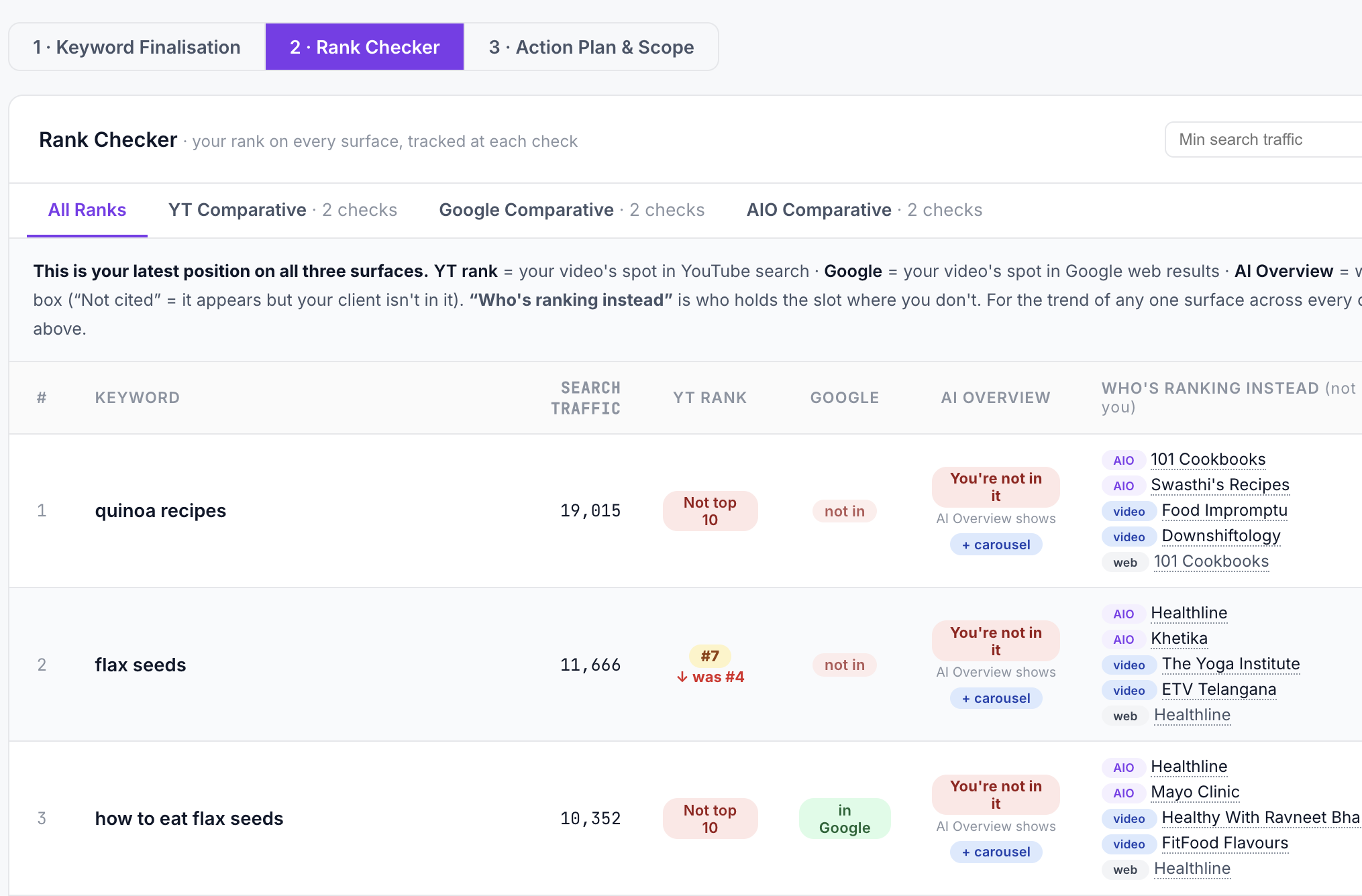
ICG's YODA platform includes an AIO Lab module that tracks doctor-brand AIO citation across a curated query list per practitioner. The lab captures incognito AIO screenshots weekly, extracts the cited sources, and diffs against the prior week to identify new citations, lost citations, and structural signal drift. For doctors building a personal brand, the AIO Lab provides the first quantified measure of "am I actually being cited as an authority" versus "am I ranking somewhere on page one." Angryturtle's Ask Maps AIO parallel module tracks the same for local-intent doctor queries ("dermatologist near me", "IVF specialist in Bandra") on the Maps surface — because doctor authority queries increasingly resolve on the Maps AIO panel as well as the Web panel.
FAQ — AI Overview citation for individual doctors
Do I need my own website, or can I optimise my hospital bio for AIO?
A hospital-hosted bio can be optimised, but only if the hospital allows you to add Person schema, credential fields, and substantive author-written content. Most hospitals do not. A dedicated doctor personal site is nearly always the higher-leverage move because you control schema, byline, content depth, and outbound linking. The hospital bio should still exist and link to your personal site as sameAs.
What if I do not have LinkedIn or ORCID — do I still need sameAs?
You need at least one sameAs to a public authority profile — the NMC public registry, your state medical council listing, or a hospital staff page that includes your name and specialty. sameAs is what lets AIO resolve you as a unique entity across the web. Without it, the panel cannot verify you are the same "Dr. X" being cited on another site.
How does NMC's 2026 advertising guidelines restrict what I can say on my personal site?
The Code restricts explicit self-promotion, comparative superiority claims ("best" or "leading"), unsubstantiated efficacy claims, testimonials from named patients, and specific forms of advertising. It does not restrict educational content, methodology descriptions, subspecialty focus areas, or credentialed authority signalling. The compliant framing is to describe your work and approach substantively without ranking yourself against other practitioners.
Can testimonials help AIO citation?
Testimonials do not help AIO citation directly and can breach NMC Ethics Code if they include patient names, before-after imagery, or efficacy claims. Case studies with de-identified data, cited with methodology and evidence, are the compliant alternative and do carry AIO trust-signal weight. Anonymised outcomes framed as ranges ("in a series of 40 patients treated with this protocol, response rates were X to Y percent") work; named patient quotes do not.
How long does it take a new doctor personal site to start earning AIO citation?
Median time-to-first-citation for a new doctor personal site with correct Person schema, substantive content, and compliance-clean writing is 90 to 150 days. Faster is possible if the doctor already has strong external authority signals (published in indexed journals, existing LinkedIn presence, hospital staff-page anchoring). Slower is common if the site launches with marketing-heavy copy that requires a rewrite pass before citation begins.
Should I write my own content or hire a medical writer?
Author authenticity matters for AIO because the trust filter rewards content patterns that match the credentialed author's specialty. A medical writer working from your interviews is fine — the byline, schema, and voice-of-doctor must be genuinely yours. Ghost-written content that reads generic will underperform even with correct schema.
Does adding my clinic's LocalBusiness schema alongside my Person schema help?
Yes, when linked correctly. worksFor on the Person points to an Organization or LocalBusiness node representing the clinic. That two-node graph gives AIO both the practitioner identity and the local business context, which is important for local-intent queries. Duplicating LocalBusiness on every branch page without differentiation, however, will hurt.
Related reading
- How to appear in Google AI Overview for healthcare queries in India
- The eight AI Overview ranking signals for Indian healthcare
- AIO SEO for hospitals in India — the 2026 guide
- Definition-first content structure for AIO citation
- FAQPage schema for healthcare AIO — implementation guide
Reference frameworks — India's National Medical Commission for the Ethics Code, the Advertising Standards Council of India for healthcare advertising rules, and India's Digital Personal Data Protection Act 2023 for patient data. For schema.org specifications, see the Person schema documentation and Physician schema documentation.
Book a free 30-minute Brand & Growth Diagnostic.
It's a working session, not a sales pitch — you leave with a written root-cause analysis you can act on, whether or not you engage ICG.
The three platforms
behind every ICG engagement.
Beacon
CAPI middleware that fixes Event Match Quality, translates CRM statuses to Meta-standard events, dedups across channels.
Agency OS
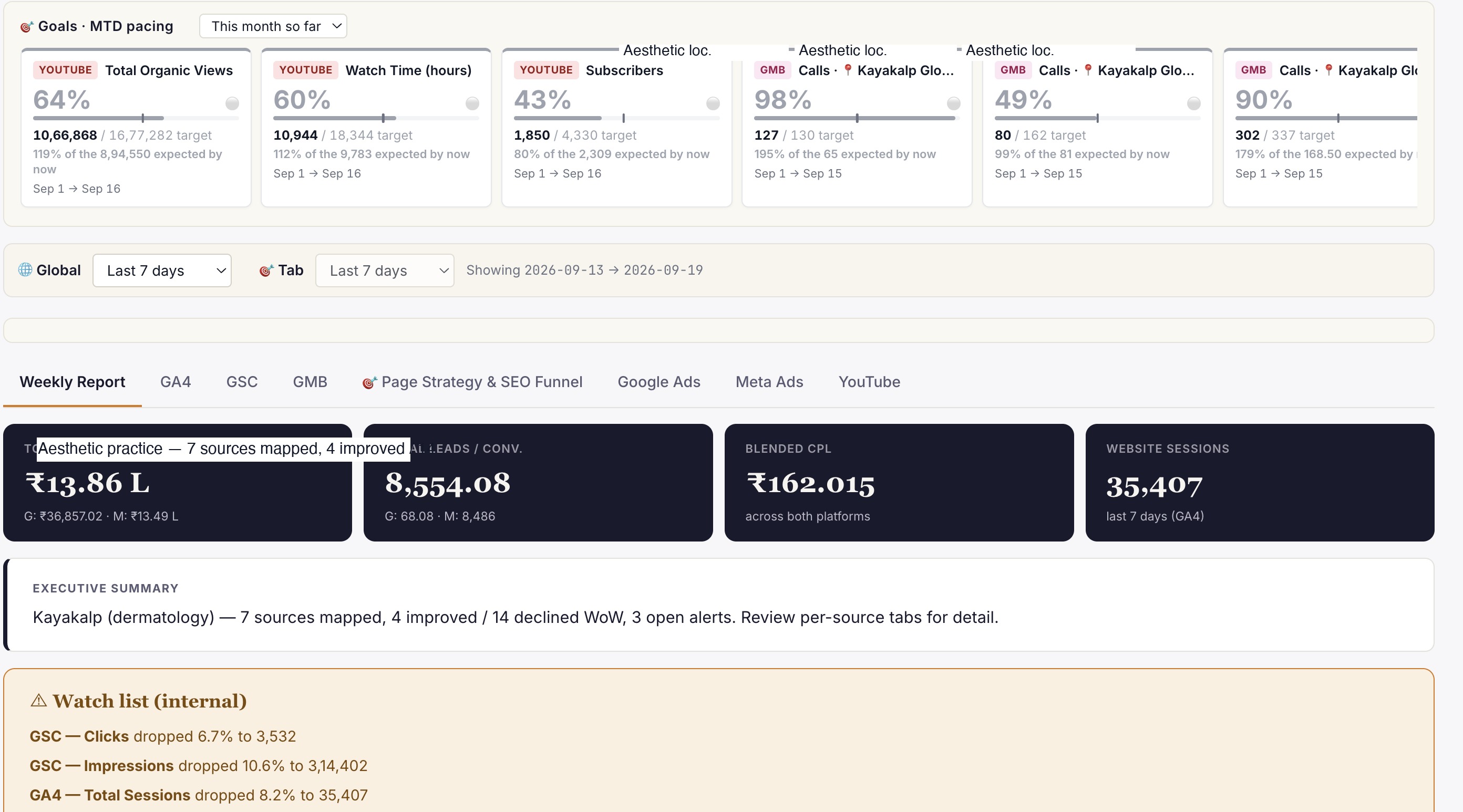
Live client dashboard. GSC, GA4, Google Ads, Meta Ads, IVR calls in one view. Login anytime, not monthly.
Phoenix
Clinic revenue intelligence over your PMS. Daily action queue: Prevent Loss, Maintain & Engage, Grow Revenue. Multi-centre rollout.
Or book a free 30-min audit to see all three in action on your account.
Healthcare brands
that already run on ICG.
A representative slice of the 150+ healthcare brands ICG has delivered for across India. Most engagements remain under NDA.


What ICG clients say · on video.
"Scale up of organic channels and business consulting. ICG has absolute domain authority in their field."
"Working with ICG transformed how we acquire IVF patients in Gurgaon. They understand the fertility journey from inquiry to consult..."
"What Ichelon accomplished — they got all my ideas and worked over 3-4 months to create an amazing, super-customised website."
The intelligence stack behind this playbook.
Every ICG engagement runs on the Search Intelligence Trifecta — Angryturtle for GMB, SIE for search and AI Overview, YODA for YouTube. Live product screens below.
Need help operationalising this?
Every ICG service is healthcare-only, NMC + DPDP-aware, and built around the patient-research patterns that drive Indian healthcare growth in 2026.
Every practice welcome — packages from ₹20,000/mo.
Goals-Driven engagements · Performance-Linked Payout Models available


More from
ICG.
Five trends shaping Indian healthcare marketing through 2027: AI-first patient research, Conversions API adoption, ABDM discovery, the AEO w...
Healthcare AIO is the discipline of getting your clinic or hospital cited inside Google AI Overviews, ChatGPT and Perplexity answers — not j...
Conversational-search advertising places brand messages inside AI chat answers — ChatGPT, Perplexity, Copilot — rather than beside a results...
Stop guessing.
Book a Diagnostic.
30 minutes. Free. With the AI-powered healthcare-only marketing agency 150+ brands already run on. No slides, no pitch, no hard close.


