


YouTube SEO for Medical Channels India: Complete 2026 Guide
YouTube is India's second-biggest search engine after Google, but medical channels ranking here need NMC-safe scripts, DPDP-safe cases, chapter engineering for AI Overviews, and a language stack. Here is the 2026 playbook Indian healthcare marketers use to turn views into qualified leads.
No pitch. Written root-cause diagnosis. AI-powered, healthcare only.
Direct answer
YouTube is India's second-biggest search engine after Google, but medical channels ranking here need NMC-safe scripts, DPDP-safe cases, chapter engineering for AI Overviews, and a language stack. Here is the 2026 playbook Indian healthcare marketers use to turn views into qualifi...
TL;DR

TL;DR
- YouTube India crosses 500 million monthly users and is the second-biggest search surface Indians touch after Google. For medical channels, ranking here often out-earns three months of Meta Ads.
- Winning at YouTube SEO for Indian healthcare in 2026 means NMC-safe titles, DPDP-compliant patient content, chapter-level answers that AI Overviews can extract, and a language stack (English plus Hindi plus one regional).
- Four formats consistently rank: doctor-explains-procedure long-forms, myth-vs-fact Shorts, before-after case discussions with written consent, and honest "cost of treatment in city" videos.
- ICG runs this through YODA, our AI-native YouTube stack, priced under the 70-30 fixed-variable model: Foundation Rs 49,999, Growth Rs 74,999, Scale Rs 99,999 per month.
Table of contents
- Why this matters for Indian healthcare marketers in 2026
- What is YouTube SEO for medical channels in India?
- How does YouTube's algorithm rank medical videos in 2026?
- Which video formats work best for Indian medical channels?
- How should Indian medical channels handle NMC and DPDP compliance?
- What keywords should Indian medical channels target on YouTube?
- How do you optimise titles, descriptions and chapters for Indian medical search?
- How does YouTube feed AI Overviews and answer engines in 2026?
- What does an Indian medical YouTube channel's monthly workflow look like?
- How ICG's approach differs
- The 70-30 model for YouTube SEO retainers
- FAQ
Why this matters for Indian healthcare marketers in 2026
India runs on YouTube. Over 500 million Indians open the app every month, and roughly 40% use it as a search engine before Google when they want something explained. For a healthcare marketer in Delhi, Mumbai, Bengaluru, Hyderabad or Chennai, this is the largest owned-discovery surface you will ever get, and it is still chronically underused by hospitals treating video as an afterthought to Meta Ads.
Two things shifted in 2026. YouTube's algorithm began surfacing individual video chapters as standalone answers inside Google AI Overviews, ChatGPT Search and Perplexity, so a 45-second chapter on "IVF cost in Chennai" can now earn traffic without the full video being watched. And NMC tightened its advertising code while DPDP Act enforcement matured, so what counts as a compliant medical video is now materially narrower than what most channels are still uploading.
Miss either shift and your channel stalls. Get both right and one long-form video can quietly compound for eighteen months.
What is YouTube SEO for medical channels in India?
YouTube SEO for Indian medical channels is the practice of engineering every element YouTube's ranking system reads (title, description, chapters, transcript, thumbnail, engagement, channel authority) so the video is served to Indian viewers searching for a health concern, treatment, procedure cost or doctor-discovery query, without breaking NMC advertising rules or DPDP Act consent norms.
It is a different discipline from web SEO. Watch time and session length matter more than backlinks. Retention curves matter more than word count. And the algorithm rewards vertical repetition: five videos on "PCOS symptoms" from one channel almost always outperform one on PCOS and four scattered topics.
The stack for Indian medical channels is a topical hub (IVF, oncology or paediatric dentistry), a language pair (English plus Hindi, plus one regional for city dominance), a doctor-led format on camera, and a posting rhythm that does not slip. Weekly is the floor. Twice-weekly is where compounding starts.
How does YouTube's algorithm rank medical videos in 2026?
In 2026 YouTube ranks medical videos on four weighted signals: click-through rate on impression, average view duration, session watch time (what viewers watched next on the platform), and topical authority of the channel. Layered on top is a health-specific trust classifier that quietly demotes channels making unverifiable clinical claims.
The trust layer is the change most Indian channels have not priced in. YouTube runs classifiers over speech-to-text transcripts on health uploads. Videos that promise cures, guarantee outcomes, quote survival rates without a source or contradict published Indian clinical guidelines get their reach throttled: not removed, just shown to fewer people until the pattern goes away.
The four signals stack in order. CTR earns the first 500 impressions. Retention converts those into the next 5,000. Session time decides whether the video breaks into browse and homepage traffic. Topical authority keeps it pulling views eighteen months later.
Practical benchmarks across the 40+ Indian medical channels ICG runs through YODA:
- Healthy CTR: 6-12% for evergreen explainers, 3-5% for cost-in-city long-forms.
- Healthy retention: 42% or more average view duration on 8-12 minute videos.
- Healthy session lift: at least 2 videos per viewer per session inside the same specialty.
Which video formats work best for Indian medical channels?
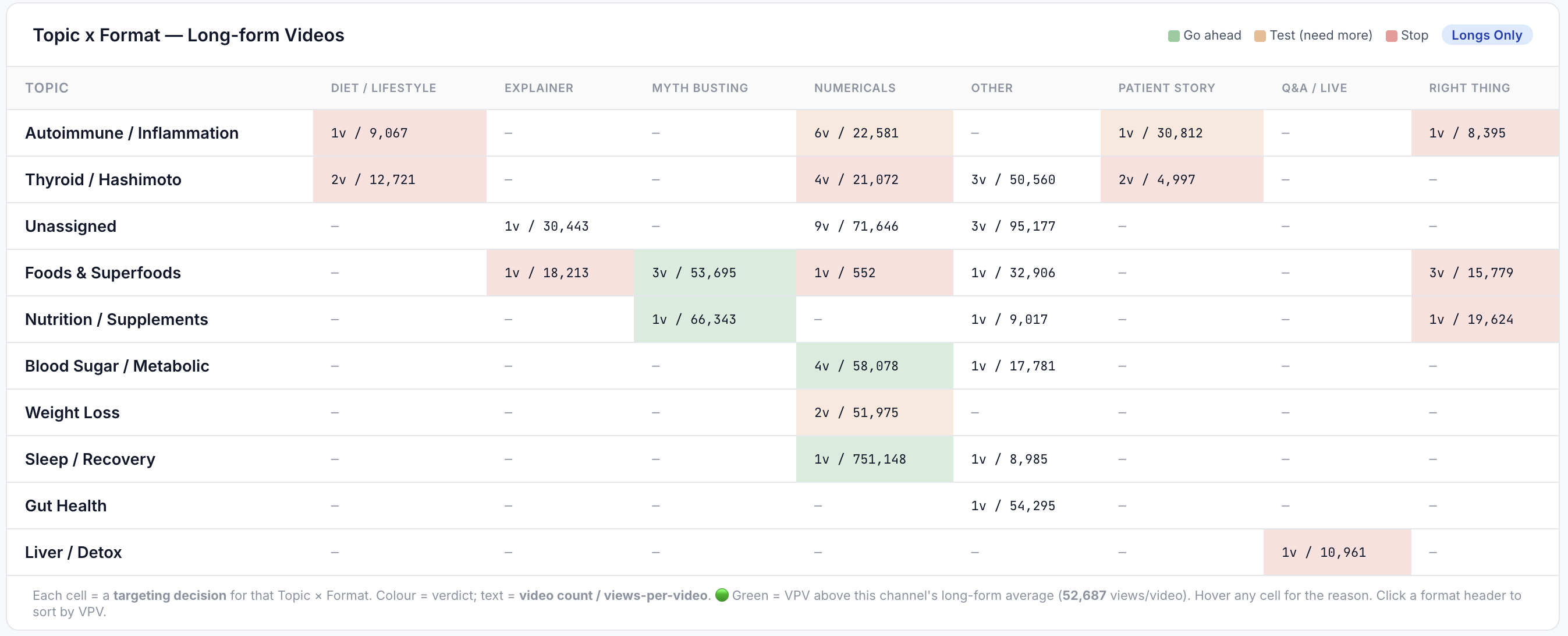
Four formats consistently rank and convert for Indian medical channels: doctor-explains-procedure long-forms of 8-14 minutes, myth-vs-fact Shorts of 30-50 seconds, before-after case discussions with written consent at 5-8 minutes, and "cost of treatment in city" long-forms of 10-15 minutes that Indian buyers actively search before booking a consultation.
Cost long-forms are the sleeper hit. Queries like "IVF cost in Mumbai 2026", "hair transplant cost in Hyderabad", "dental implant cost in Bengaluru" and "cataract surgery cost in Delhi" pull lakhs of monthly searches in India, and top-ranking videos are rarely from big hospital chains. They are from mid-size clinics that treated the video as a decision-tool, not a brochure. The winners are honest about pricing bands and use chapters ("Basic IUI package", "Standard IVF cycle", "ICSI with donor egg") so buyers jump straight to their scenario.
Shorts do a different job. They rarely convert directly, but they seed the algorithm with topical signal and pull first-time viewers in. For a dermatology clinic in Pune we track, 40 myth-vs-fact Shorts on adult acne lifted subscribers 4x in 90 days, and the long-form on "adult acne treatment cost in Pune" that went up in month three ranked top-3 within six weeks.
How should Indian medical channels handle NMC and DPDP compliance in video content?
Every medical video published from India in 2026 must clear three compliance checks. NMC's advertising code (no guaranteed outcomes, no comparative denigration, no unqualified superlatives). DPDP Act consent (written, informed, purpose-specific consent for any patient identifiable in the video). ABDM alignment where the video references any digital health record, ABHA ID or health-data claim.
For NMC compliance the practical rules are simple. Strip "best", "no.1", "guaranteed", "100% success" and "world class" from titles, chapters and voiceovers. Show credentials on screen: name, MBBS/MD/DM/MDS, state council registration number and city. Do not name-and-shame other clinics or doctors. Aesthetic before-after imagery needs an on-screen disclaimer that outcomes vary.
For DPDP compliance, patient case-discussion videos need a signed consent form on file that specifies the platform, retention period and right to withdraw. If a patient withdraws consent, the video must come down or move to unlisted. Build a consent register inside your CRM: AtomCRM (Rs 50,000/- setup + Rs 799/- per telecaller) has this built in for healthcare customers.
Compliance is not a growth blocker. Channels that follow it actually rank better, because the trust classifier stops throttling them.
What keywords should Indian medical channels target on YouTube?
Indian medical channels should target four keyword layers: symptom queries ("what causes PCOS"), procedure explainers ("how IVF works"), city-and-cost combinations ("dental implant cost in Chennai"), and doctor-discovery queries ("what to look for in a gynaecologist in Gurgaon", the NMC-safe rephrase of the "best" query users actually type).
The shortcut most Indian marketers miss: YouTube's own autosuggest, set to India, is a better keyword source than any third-party tool for this niche. Type "IVF cost in" and let YouTube complete. Chennai, Bengaluru, Hyderabad, Kolkata, Pune and Ahmedabad appear in order of real Indian demand. That is your priority stack.
Layer Hindi and regional queries in parallel. "गर्भावस्था के लक्षण" (pregnancy symptoms), "बवासीर का इलाज" (piles treatment) and "जोड़ों का दर्द" (joint pain) each pull crores of monthly YouTube searches in India with almost no doctor-led competition. Most channels ranking today are generic wellness accounts. A Hindi channel led by a qualified doctor with 30 well-optimised videos can hold top-3 for many of these within a quarter.
How do you optimise video titles, descriptions and chapters for Indian medical search?
Titles should carry the primary keyword in the first 45 characters, avoid clickbait and NMC-flagged superlatives, and include one Indian geo or language marker. Descriptions should open with a 40-word direct answer for AIO extraction. Chapters should be phrased as user questions, each starting with a natural timecode: that is what YouTube now surfaces to Google's AI Overviews and to ChatGPT.
A working title formula for Indian medical channels:
[Procedure or Condition] in [City or Hindi word] — [Doctor Name], [Credential]
Example: IVF Cost in Hyderabad 2026 — Dr Ramya Rao, MD
Descriptions should follow this order. A 40-word direct answer. The chapter list. Doctor credentials. Clinic address, which helps the local pack. Booking WhatsApp number. A DPDP-compliant disclaimer. Related-video links to keep session time high.
Chapters are where AIO extraction actually happens. Instead of "Introduction / Cost / FAQ", write them as questions:
- 0:00 What is IVF and who should consider it?
- 1:45 What does an IVF cycle cost in Hyderabad in 2026?
- 4:20 What is included in an ICSI package?
- 7:10 Are there hidden costs Indian couples should ask about?
Google's AI Overviews now cite individual chapters, with a video thumbnail, as standalone answers. That is free branded distribution most Indian medical marketers still leave on the table.
How does YouTube feed AI Overviews and answer engines like ChatGPT and Perplexity in 2026?
YouTube feeds AI answer engines through three channels: transcript indexing (Google, ChatGPT and Perplexity all index YouTube captions), chapter-level answer extraction (AI Overviews now cite specific chapters, not whole videos), and channel-authority signals (channels with a consistent topical vertical get quoted more often than one-off uploads).
For Indian medical channels this means the caption file matters as much as the video. Upload a manually corrected transcript in English and one Indian language. Auto-captions still mangle Hindi and Tamil pronunciations often enough that the transcript reads as gibberish to a classifier, and a garbled transcript is invisible to AI extraction.
Add speakable schema on the embed page if you host the video on your website. Structure the on-page copy around the same chapter questions. Video, transcript and on-page text should reinforce each other. That triangulation is what current AI systems reward.
What does an Indian medical YouTube channel's monthly workflow look like?
A working monthly workflow for an Indian medical channel: 2 long-form videos of 8-14 minutes per week, 8-12 Shorts per week, one consent-cleared case-discussion video per month, transcript polishing on every upload, a monthly chapter audit for AIO extraction, and a quarterly repackaging of top performers into regional-language versions.
That is roughly 40 pieces of video content per month. Most Indian clinics cannot do this in-house, and should not try. The doctor's job is 30 minutes on camera plus 15 minutes of clinical review. Everything else is production, transcription, SEO, chapters, thumbnails and distribution.
At ICG we run this through YODA, our AI-native YouTube stack for healthcare. YODA handles keyword research off YouTube autosuggest, transcript polishing across English and four Indian languages, chapter engineering for AI Overview extraction, thumbnail A/B testing, and monthly rank plus AIO reporting per channel. Because the workflow is AI-orchestrated, the same team can run YouTube for a Pune dermatology clinic and a pan-India IVF chain, and the unit economics make monthly retainers actually work.
How ICG's approach differs
Most Indian agencies bolt YouTube onto an SEO or social retainer as an afterthought. We treat it as a distinct discipline with its own product, YODA, because the ranking system, compliance surface and buyer journey are all different from Google web search or Meta Ads.
YODA is paired with our other healthcare stacks depending on the channel's stage. Angryturtle, our Google Business Profile OS, fills the local-pack layer so cost-in-city YouTube videos convert into GBP calls. Meta Catalyst IQ runs paid amplification for high-intent long-forms once they have earned organic ranking. Prism Spy tells us what competing hospitals are running on Meta so we do not waste video budget on saturated formats. Prism Pulse tracks Instagram cross-posting so we know which Shorts to double down on. For high-volume booking clinics we pair YODA with AtomCRM (Rs 50,000/- setup + Rs 799/- per telecaller) for consent management, or HealthPro 360 (Rs 14,999/month) for hospitals that need an RCM/EHR overlay.
The 70-30 model for YouTube SEO retainers



ICG's YouTube SEO retainers follow the same 70-30 fixed-variable model as our web SEO packages. 70% of the fee is fixed: production hours, transcription, chapter engineering, monthly reporting. 30% is tied to a 12-month rank and AIO-citation target agreed upfront on a sliding-scale slab.
Foundation is Rs 49,999/month, for a single-specialty clinic building its first 40-video library. Growth is Rs 74,999/month, for mid-size clinics running a Hindi-plus-English channel with 8+ long-forms and 30+ Shorts monthly. Scale is Rs 99,999/month, for multi-city hospital chains running two or three vertical channels with regional-language coverage. The variable 30% means we lose money if the channel does not hit its rank and AIO-citation targets. That alignment is the point.
FAQ
Is YouTube SEO different from Google SEO for Indian medical channels?
Yes. Google SEO rewards backlinks, structured data and topical depth on a page. YouTube SEO rewards watch time, session length and channel-level topical authority. The two overlap on transcripts and chapter questions, which is where the AIO extraction layer sits in 2026.
Which language works best for a medical YouTube channel in India?
An English-plus-Hindi pair is the default for pan-India reach. For city-level dominance, add the local regional language: Tamil in Chennai, Telugu in Hyderabad, Marathi in Pune and Mumbai, Bengali in Kolkata, Kannada in Bengaluru. Doctor-led Hindi channels remain the most underserved layer.
Does YouTube's algorithm penalise medical channels that mention brand names?
YouTube itself does not, but NMC's advertising code does. Avoid naming other clinics, doctors or specific drug brands in a comparative or promotional way. Category-level mentions ("a dental implant system") are fine. Named comparisons are the risk.
How long does it take a new Indian medical channel to rank?
With a doctor-led format, twice-weekly posting and clean NMC-safe scripts, first "cost in city" queries typically break the top-10 in 60-90 days and the top-3 in 120-180 days. AI Overview citations lag rank by 30-45 days.
Should Indian doctors run Shorts, long-forms, or both?
Both, with a 70-30 count split in favour of Shorts and a 70-30 revenue split in favour of long-forms. Shorts feed the algorithm and win subscribers; long-forms convert to bookings.
Can regional-language channels rank without English content?
Yes, and often faster. Hindi and Tamil medical channels face a fraction of the competition that English channels do. The retention on regional-language explainers is typically 8-12 percentage points higher because viewers are watching in their preferred medium.
How does an Indian clinic measure YouTube ROI without vanity metrics?
Track four numbers: qualified bookings sourced from YouTube (UTM on WhatsApp and website links), branded search lift on Google, AI Overview citation count per month, and cost per qualified lead versus your Meta Ads baseline. Views and subscribers alone will lie to you.
Book a free SEO diagnostic.
Hanuman Sihag's team runs a live crawl, checks technical health, cannibalisation, schema coverage and content gaps. 60 minutes, prioritised fix list.
Questions readers ask
about this topic.
The three platforms
behind every ICG engagement.
Beacon
CAPI middleware that fixes Event Match Quality, translates CRM statuses to Meta-standard events, dedups across channels.
Agency OS
Live client dashboard. GSC, GA4, Google Ads, Meta Ads, IVR calls in one view. Login anytime, not monthly.
Phoenix
Clinic revenue intelligence over your PMS. Daily action queue: Prevent Loss, Maintain & Engage, Grow Revenue. Multi-centre rollout.
Or book a free 30-min audit to see all three in action on your account.
Healthcare brands
that already run on ICG.
A representative slice of the 150+ healthcare brands ICG has delivered for across India. Most engagements remain under NDA.


What ICG clients say · on video.
"Scale up of organic channels and business consulting. ICG has absolute domain authority in their field."
"Working with ICG transformed how we acquire IVF patients in Gurgaon. They understand the fertility journey from inquiry to consult..."
"What Ichelon accomplished — they got all my ideas and worked over 3-4 months to create an amazing, super-customised website."
The intelligence stack behind this playbook.
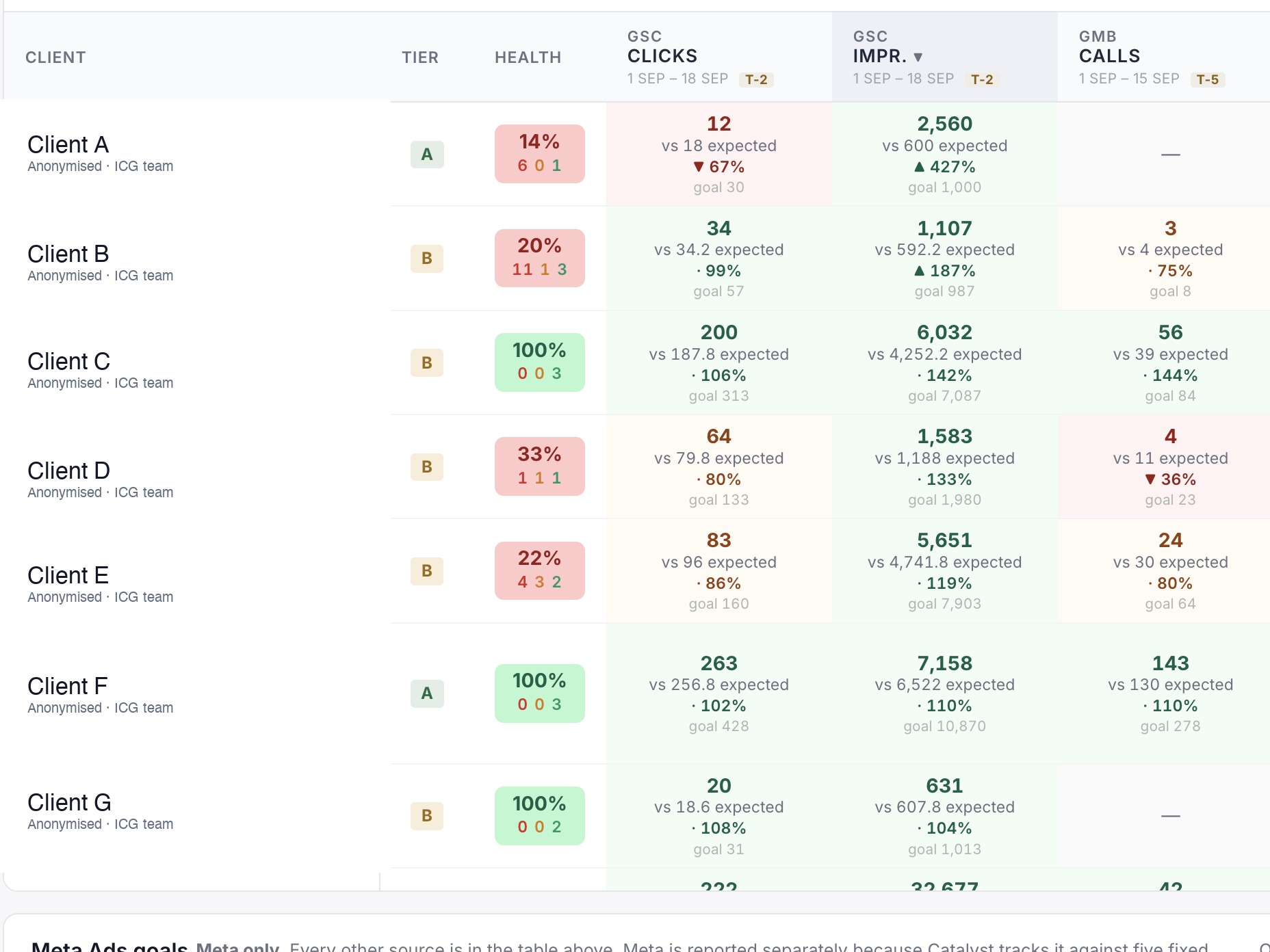
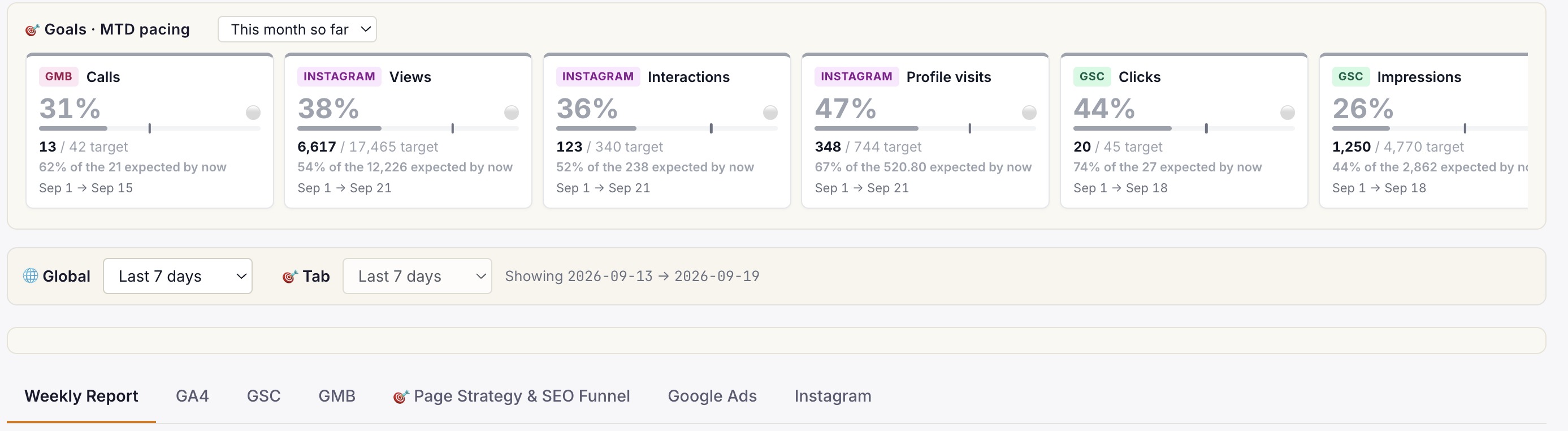
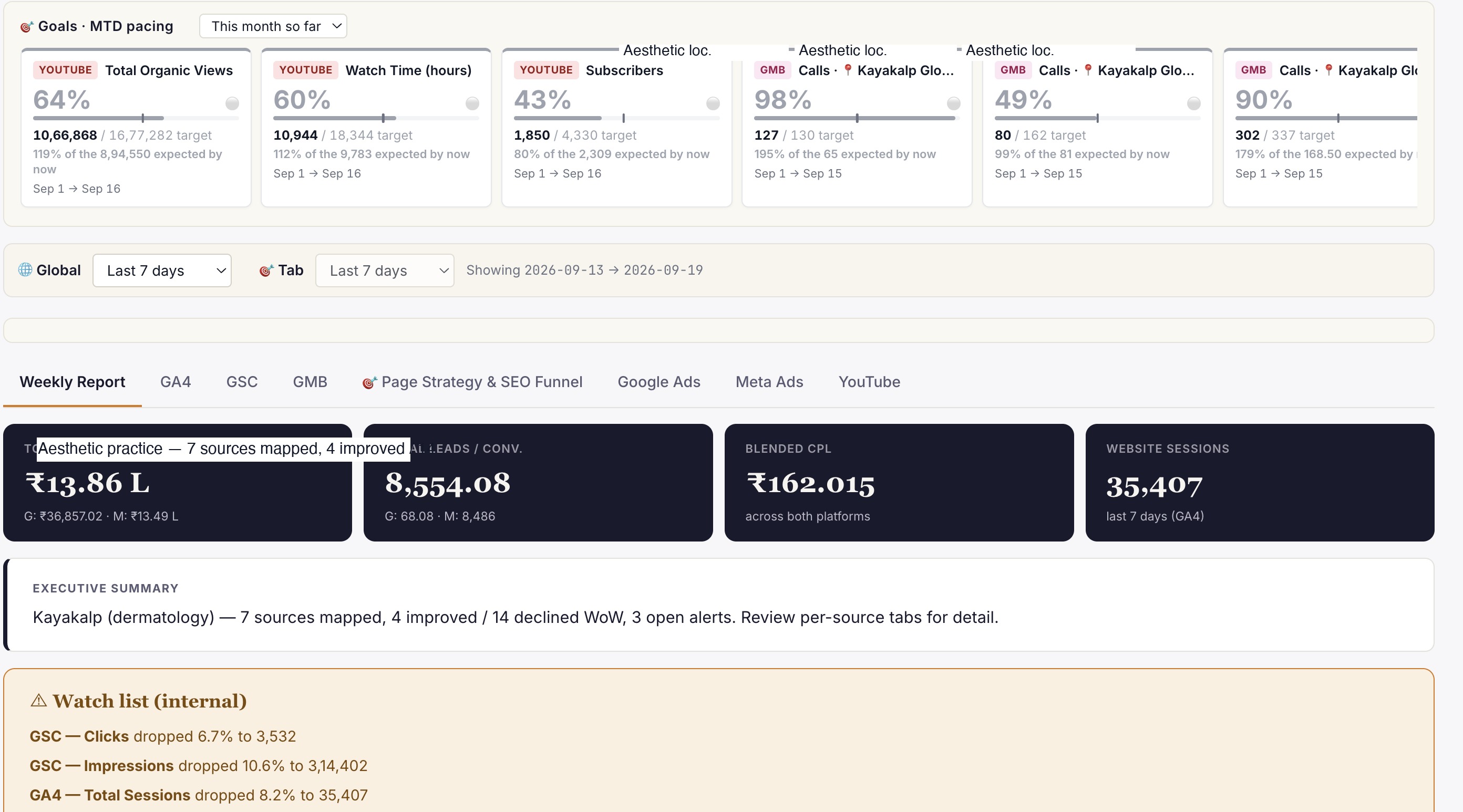
Every ICG engagement runs on the Search Intelligence Trifecta — Angryturtle for GMB, SIE for search and AI Overview, YODA for YouTube. Live product screens below.
Need help operationalising this?
Every ICG service is healthcare-only, NMC + DPDP-aware, and built around the patient-research patterns that drive Indian healthcare growth in 2026.
Every practice welcome — packages from ₹20,000/mo.
Goals-Driven engagements · Performance-Linked Payout Models available
More from
ICG.
Five trends shaping Indian healthcare marketing through 2027: AI-first patient research, Conversions API adoption, ABDM discovery, the AEO w...
Healthcare AIO is the discipline of getting your clinic or hospital cited inside Google AI Overviews, ChatGPT and Perplexity answers — not j...
Conversational-search advertising places brand messages inside AI chat answers — ChatGPT, Perplexity, Copilot — rather than beside a results...
Stop guessing.
Book a Diagnostic.
30 minutes. Free. With the AI-powered healthcare-only marketing agency 150+ brands already run on. No slides, no pitch, no hard close.


