


YouTube Shorts vs long-form for Indian healthcare clinics in 2026: two algorithms, two audiences, two conversion arcs
YouTube Shorts and long-form are two entirely different products inside the same YouTube app — different algorithm mechanics, different discovery surfaces, different retention economics, different conversion arcs. This guide covers when a dermatology clinic, IVF centre, or multi-specialty hospital should invest in Shorts, when they should invest in long-form, and the cadence templates that actually work.
No pitch. Written root-cause diagnosis. AI-powered, healthcare only.
Direct answer
YouTube Shorts and long-form are two entirely different products inside the same YouTube app — different algorithm mechanics, different discovery surfaces, different retention economics, different conversion arcs. This guide covers when a dermatology clinic, IVF centre, or multi-...
TL;DR

YouTube Shorts vs long-form is one of the most misunderstood strategic choices in Indian healthcare video marketing in 2026 — most clinic marketing teams treat Shorts and long-form as different lengths of the same product, when they are actually two entirely different platforms with different algorithms, different audience behaviours, different discovery surfaces, and different conversion arcs to booked consults. Investing in the wrong one for the wrong stage of a channel produces expensive noise. This guide covers how each format actually works, what content fits each, sample cadence templates for three healthcare business models (dermatology, IVF, multi-specialty hospital), and how ICG's YODA handles the two formats separately inside its 6-step workflow. Anchors back to the healthcare YouTube marketing pillar.
The two different algorithms operating inside the same YouTube app
YouTube Shorts and YouTube long-form videos are served by two distinct recommendation systems that share almost no signal with each other. A viewer who watches a channel's long-form videos is not measurably more likely to be served that channel's Shorts, and vice versa. Subscriber growth on Shorts rarely converts into long-form watch time, and long-form subscribers rarely engage with Shorts from the same channel.
The long-form algorithm is the mature YouTube recommendation system — search results, Suggested column, Browse feed, subscriptions, notifications. It optimises for session watch time, meaning it wants to serve videos that will hold a viewer inside the YouTube app for the longest continuous session. Retention curves, average view duration, and click-through rate on thumbnails are the primary signals.
The Shorts algorithm is a vertical scroll feed similar to TikTok and Instagram Reels. It optimises for individual video completion rate and swipe-away rate. There are no thumbnails to CTR through — the algorithm serves the video directly and measures whether the viewer watches or swipes. Retention is measured in seconds, not minutes.
The two algorithms have different topic sensitivities. Long-form favours explainer content that answers a searchable question in depth. Shorts favour pattern-interrupt content that hooks in the first 1.5 seconds. A healthcare topic that works as long-form may not work as Shorts and vice versa — a 12-minute explainer of "what to expect during an IVF cycle" cannot be compressed into a Short without losing what makes it useful.
The discovery surfaces and where viewers arrive from on each format
Long-form discovery flows through five main surfaces: YouTube search (a viewer types a query and picks from results), Suggested (a viewer is watching a related video and sees the recommendation in the right column or Up Next), Browse (the YouTube homepage, mobile app tab, subscription feed), Notifications (viewers who have hit the bell icon get pushed new uploads), and External (Google web search results, embeds on external sites, direct sharing).
Shorts discovery is dominated by a single surface: the vertical Shorts feed inside the YouTube mobile app. Viewers scroll through a rapid succession of Shorts, and the algorithm decides which Shorts to serve based on the viewer's watch and swipe behaviour on previous Shorts. Search on Shorts exists but is a minor discovery surface. External embeds of Shorts exist but are rare.
The practical implication for a healthcare channel: long-form content serves the researching patient — someone who has a question and is looking for an answer. Shorts content serves the passive scroller — someone who was not researching anything specific but stopped scrolling because a hook caught their attention. Different audiences at different points in the awareness journey.
Long-form audiences are more consult-ready. They arrived with intent, watched a video that answered part of their question, and are one CTA away from booking. Shorts audiences are earlier-stage — they may not have known they had a health concern before scrolling past the Short. The conversion arc from Short view to booked consult is meaningfully longer than long-form.
The conversion economics that actually determine ROI for each format
Long-form conversion economics for a healthcare channel in 2026 typically look like: 0.05% to 0.15% of organic views convert to booked consults (5-15 consults per 10,000 organic views) with cost-per-acquisition dominated by production time rather than paid spend. A 10-minute explainer produced weekly can, at scale, produce a meaningful share of a clinic's new-patient pipeline over 12 to 18 months.
Shorts conversion economics look completely different: 0.002% to 0.02% of organic Shorts views convert to booked consults (2-20 consults per 100,000 organic Shorts views). Shorts require 5-10x the view volume to produce the same consult count as long-form, but they are dramatically cheaper to produce per view because the format is faster to shoot and edit.
The ROI calculus depends on the marginal cost of production. A dermatology clinic with a doctor comfortable on camera can shoot 5-8 Shorts in an hour and edit them in another 2-3 hours — the cost per Short is low. That same doctor might need 4-6 hours of scripting and shoot time for a 10-minute explainer, plus another 4-6 hours of editing. Per-view Short cost is often 10-20x lower than long-form; per-consult cost is often similar or worse for Shorts.
Shorts win on brand reach and awareness at low unit cost. Long-form wins on consult attribution and long-tail search durability. The strategic decision is rarely "one or the other" — it is "what mix given our stage, budget, and audience."
When to invest in Shorts for a healthcare clinic
Shorts are the right investment when the goal is reach and awareness, when the on-screen doctor is comfortable producing high volumes of short content, when the topics naturally fit 30-60 second explanations, and when the clinic can absorb the softer conversion arc into a longer nurture funnel.
Shorts work well for dermatology because most dermatological topics have visual hooks (skin conditions, procedure demonstrations, product comparisons) and 30-60 second explanations satisfy viewer curiosity. Common winning formats: "which acne treatment for which skin type in 45 seconds," "myth vs fact on skin whitening in 30 seconds," "how retinol works in 45 seconds."
Shorts work moderately for multi-specialty hospitals when used for institutional awareness rather than specialty-specific consult conversion. A cardiology short covering "3 heart attack warning signs in 30 seconds" produces broad reach and hospital-brand recall but limited direct consult attribution.
Shorts work poorly for high-consideration specialties where the patient journey is measured in weeks or months of research — IVF, oncology, complex surgeries, chronic condition management. Viewers of these specialties want depth, not brevity, and Shorts audiences are structurally the wrong audience for these decisions.
Shorts also require ongoing NMC and DPDP compliance discipline. The compressed format tempts creators toward oversimplification and clinical claims that require caveats. Every Short still sits inside the ethics perimeter — no unsubstantiated outcome claims, no patient identification, no clinical advice masquerading as content.
When to invest in long-form for a healthcare clinic
Long-form is the right investment when the goal is consult conversion, when the specialty has genuine depth to explain (procedures, conditions, treatment options), when the audience is researching specific decisions, and when the clinic can sustain the production tempo.
Long-form is the primary vehicle for IVF centres because the patient decision journey requires deep information — "What to expect during IVF cycle," "How to choose an IVF centre," "IVF success rates by age" — all naturally sit in 8-15 minute explainer territory and rank durably in YouTube and Google search.
Long-form is the primary vehicle for multi-specialty hospitals for department-specific content — a 12-minute video on "How to prepare for knee replacement surgery" produces genuine consult attribution for orthopedic services because viewers who watch to the end are pre-qualified.
Long-form is a mixed fit for dermatology — some topics warrant depth (understanding a skin condition, procedure explainers) while other topics are better served as Shorts (quick tips, product recommendations, myth busting). A dermatology channel typically runs a mixed cadence.
Long-form also carries higher production overhead. A 10-minute healthcare video with proper scripting, on-camera doctor time, editing, thumbnail design, chapter marking, description writing, and SEO takes 8-12 person-hours to produce at quality. Cadence choices must be honest about production capacity.
Sample cadence templates for three healthcare business models
Dermatology clinic template. Weekly rhythm: 1 long-form video (6-10 minutes) on a specialty topic + 3-5 Shorts on quick tips, procedure demonstrations, or myth busting. Monthly output: 4-5 long-form + 12-20 Shorts. The Shorts feed awareness, the long-form drives consults. Consult attribution splits roughly 70% long-form, 30% Shorts (with Shorts contributing more to top-of-funnel patient interest that eventually flows to long-form watches).
IVF centre template. Weekly rhythm: 1 long-form video (8-15 minutes) on a specific IVF topic + occasional Shorts (0-2 per week) only when they can compress into meaningful clinical education. Monthly output: 4-5 long-form + 2-6 Shorts. The channel is fundamentally a long-form channel with Shorts as a supplementary awareness surface. Consult attribution splits roughly 90% long-form, 10% Shorts. Compliance under the NMC's 2026 advertising guidelines, ART Act 2021, and PC-PNDT Act 1994 requires additional care on any Shorts content around fertility topics.
Multi-specialty hospital template. Weekly rhythm: 2-3 long-form videos (varied lengths depending on specialty department) + 4-6 Shorts covering institutional content, doctor-introduction spots, and quick-tip content across departments. Monthly output: 8-12 long-form + 16-24 Shorts. Consult attribution varies by department but averages 65% long-form, 35% Shorts (Shorts contribute more here because hospital brand awareness translates broadly across departments).
The thumbnail and hook craft that differs completely between formats
Long-form thumbnails and Shorts hooks are different skills. A long-form thumbnail has 2-3 seconds to earn a click from a stationary viewer choosing among 6-12 competing thumbnails on screen. It needs visual clarity, on-face expression that matches the topic emotion, and text overlay that answers viewer intent. A Shorts hook has 1-1.5 seconds to earn a "don't swipe" decision from a viewer whose thumb is already moving.
Long-form thumbnails are produced once per video, tested against 2-3 variants over 14 days, and refined based on CTR data. Shorts hooks are baked into the first frame of the video itself — there is no separate thumbnail to design, but the opening visual and audio have to work as an involuntary attention grab.
The healthcare-specific constraint on both: NMC ethics guidelines discourage sensationalism, which limits the shock-face and exaggerated-emotion visual grammar that drives clicks in entertainment content. Healthcare creators earn attention through credibility signalling (visible credentials, clean clinical environment, professional presentation) rather than sensationalism.
How YODA handles Shorts and long-form separately inside the 6-step workflow
YODA treats Shorts and long-form as distinct content types throughout the workflow — never blended into a single set of metrics. The Overview step reports subscriber growth, view volume, and watch time separately for the two formats. The Diagnostics step calculates retention curves, CTR (long-form only, since Shorts have no thumbnail CTR), and traffic-source breakdowns independently.
The Strategy step recommends Shorts content and long-form content as separate content pipelines with different topic selection and different production cadences. The Optimisation step writebacks target format-appropriate signals — long-form gets title, description, tag, and chapter updates; Shorts get hook-timing suggestions and caption improvements.
The Reputation step monitors comments on both formats but recognises the different comment behaviour (Shorts comments are shorter, more emoji-heavy, less question-oriented). The Competitor Intel step tracks peer channels' Shorts-vs-long-form ratios and identifies whether a peer's success is attributable to one format or a mix.
This separation is what prevents the classic mis-strategy of treating Shorts view volume as substitutable for long-form watch time. A channel with 500,000 Shorts views and 20,000 long-form views is not producing the same value as a channel with 20,000 Shorts views and 500,000 long-form views — the two are producing entirely different things and require different next actions.
The platform ICG uses to run this at scale: YODA
ICG runs healthcare YouTube marketing for clinics, hospitals, and specialty groups using YODA — our AI-native healthcare YouTube marketing platform. YODA sits on top of a channel's data and does four things no dashboard does: it separates organic from paid views at every step (so a promoted video can never masquerade as organic growth), it gives decisions not dashboards (every video gets a state + next action), it writes back to YouTube directly (improved titles, tags, descriptions, chapters applied straight to the platform), and it tracks the three rank races — YouTube search, Google web, and Google AI Overview citations.
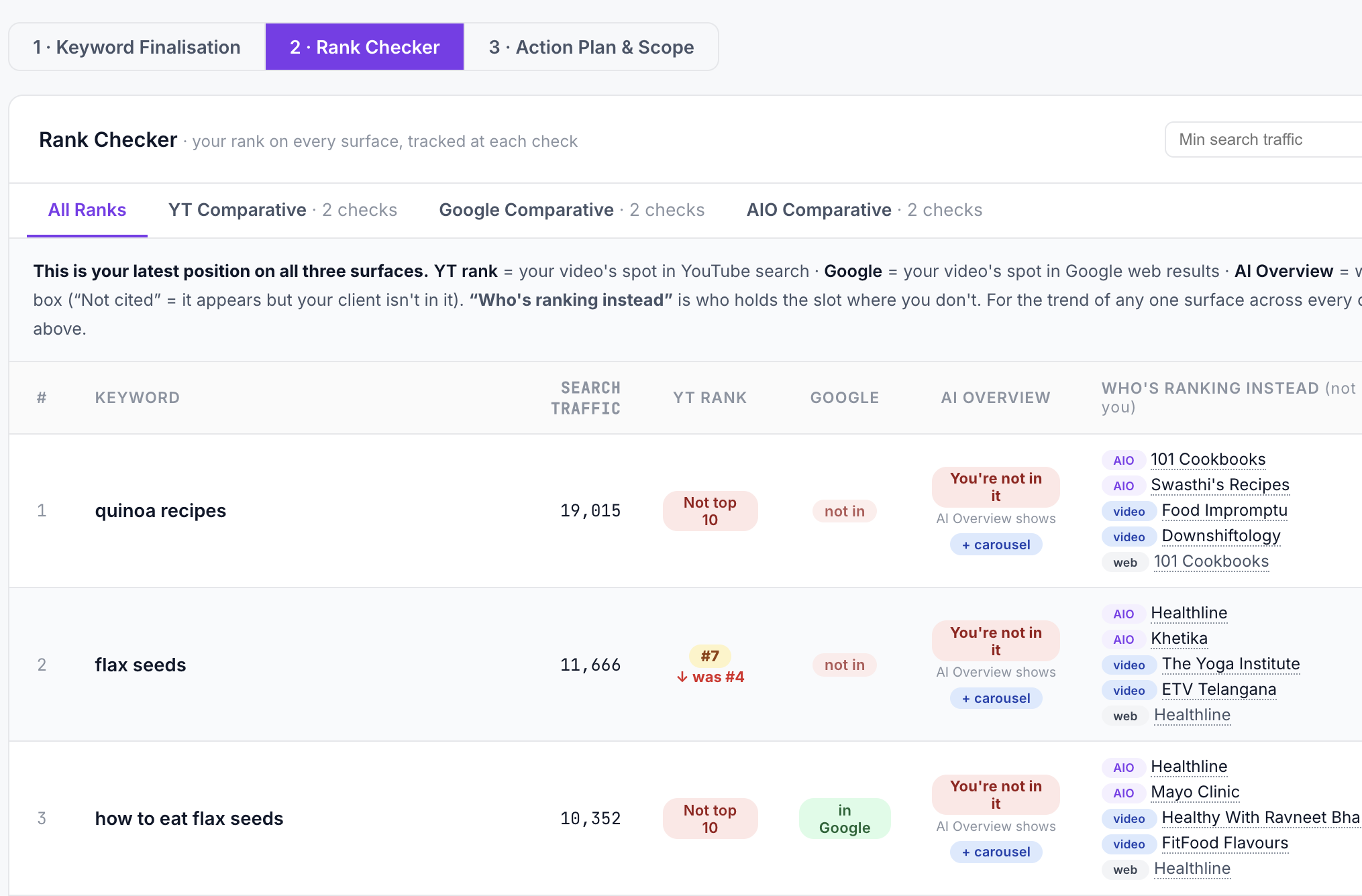
YODA runs the full 6-step workflow — Overview, Diagnostics, Strategy, Optimisation, Reputation (ORM), and Competitor Intel — with 40+ analysis modules organised under those steps. ICG's managed YouTube service uses YODA end-to-end. See the Healthcare YouTube Marketing pillar guide for the full scope, or the Healthcare YouTube Marketing Agency service page for engagement details.
Book a YODA demo on WhatsApp → or request a free healthcare YouTube channel audit →
Related reading
- Healthcare YouTube marketing pillar guide 2026
- Healthcare YouTube benchmarks India 2026
- IVF video consultation conversion impact
- Hospital video marketing India 2026
- Healthcare YouTube marketing agency service page
FAQ
Do Shorts subscribers convert into long-form watchers? Rarely. Subscribers acquired via Shorts show weak overlap with long-form watch behaviour on most healthcare channels — typically 5% to 15% of Shorts subscribers ever watch a long-form video from the same channel. The formats operate as near-separate products.
Can I republish a long-form segment as a Short? Yes, and it can work if the segment is naturally clip-able (a specific 30-60 second moment that stands alone) and shot in a way that works in vertical crop. Directly cropping a 16:9 shot to 9:16 rarely works well — the framing was designed for horizontal. Purpose-shot vertical Shorts always outperform re-cropped long-form segments.
Should a brand new healthcare channel start with Shorts or long-form? It depends on the goal. For fastest subscriber growth and awareness, Shorts. For fastest consult attribution and durable search rankings, long-form. Most channels benefit from starting with a light mix — 2-3 long-form videos to establish depth and searchability, plus a Shorts cadence to build early view volume and subscriber base.
Does YouTube's algorithm penalise channels that switch between formats? No. There is no penalty for mixed-format channels. The two algorithms operate independently and evaluate each video within its format. The only cost is that subscriber growth from one format doesn't compound the other as strongly as if the channel were single-format.
How long is the sustainable maximum for a healthcare long-form video? Up to 20-25 minutes for deep procedure or condition explainers where the audience genuinely wants depth. Beyond 25 minutes, retention curves collapse for most healthcare topics unless the format is a genuine podcast-style interview or an event recording. Comprehensive guides in the 12-18 minute range typically outperform 25+ minute videos even when the same information is being conveyed.
What's the minimum viable Shorts cadence for meaningful reach? 3-4 Shorts per week for at least 12 weeks before the format starts producing predictable reach. Lower cadences produce inconsistent algorithm favour. Sporadic Shorts (one every 2-3 weeks) produce almost no compounding benefit.
Do healthcare Shorts get flagged for compliance more often than long-form? Yes, in ICG's experience. The compressed format tempts oversimplification that violates NMC substantiation rules more often than long-form. Every Short still needs the compliance review pass — the format's brevity is not an excuse for looser claim standards.
Can we run paid ads on Shorts the same way as long-form? Video Reach Campaigns and Video Action Campaigns both support Shorts placements. Paid Shorts behave similarly to paid long-form on the attribution side — same principles about paid vs organic separation apply. Report organic Shorts separately from paid Shorts always.
How do we know when Shorts are worth doubling down on for our specific channel? When organic Shorts subscriber growth exceeds organic long-form subscriber growth for 3 consecutive months, and when Shorts view volume is producing measurable clinic brand-recall lift (survey-based, not just view counts). Without these signals, over-investing in Shorts often produces reach without downstream business value.
Does YODA recommend the same cadence for every specialty? No. YODA's Strategy step recommends specialty-appropriate cadence templates based on where the specialty's audience actually sits in the awareness-to-consult journey. Dermatology, IVF, and multi-specialty hospitals get materially different Shorts-to-long-form ratio recommendations.
Book a free 30-minute Brand & Growth Diagnostic.
It's a working session, not a sales pitch — you leave with a written root-cause analysis you can act on, whether or not you engage ICG.
The three platforms
behind every ICG engagement.
Beacon
CAPI middleware that fixes Event Match Quality, translates CRM statuses to Meta-standard events, dedups across channels.
Agency OS
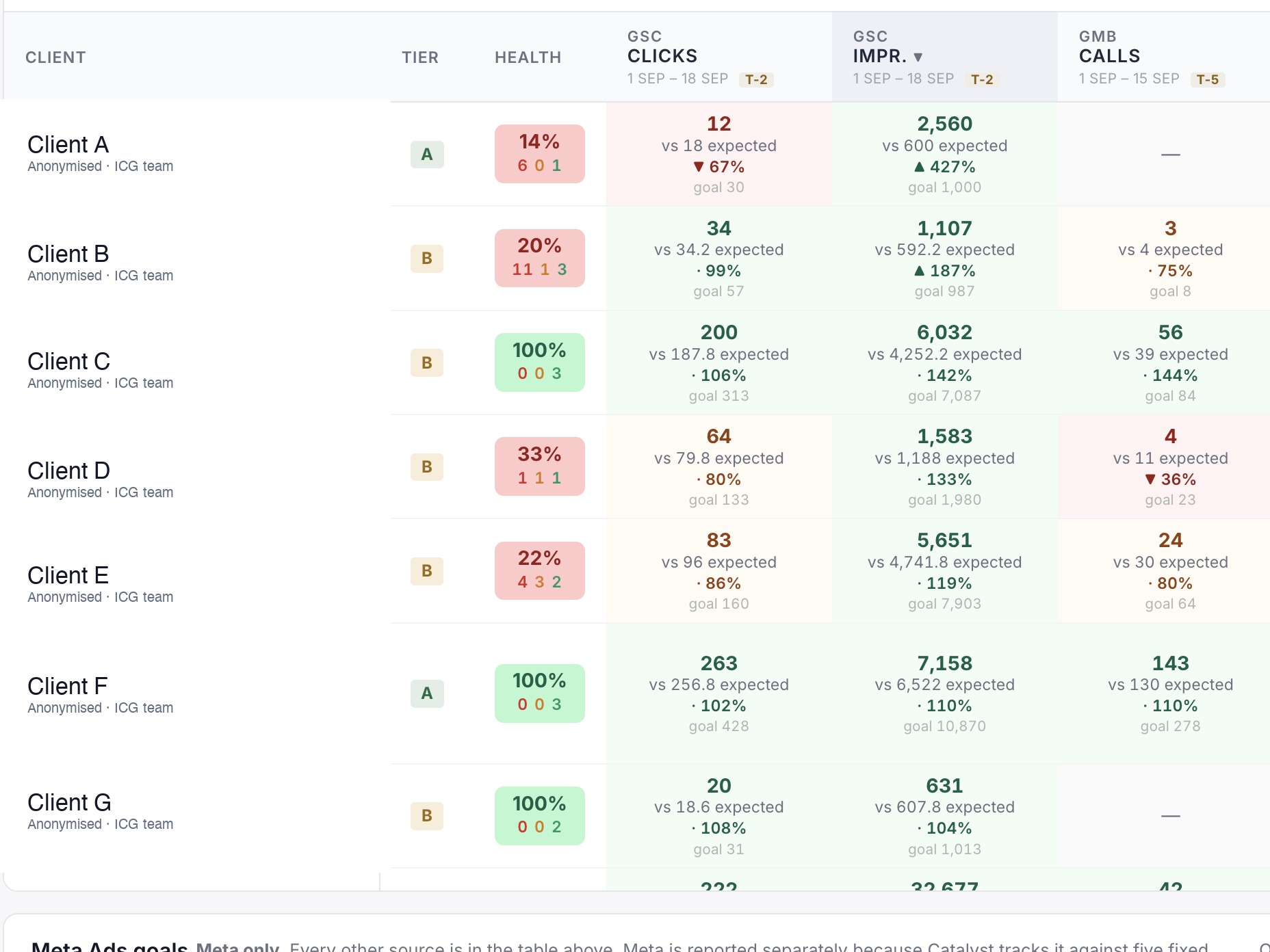
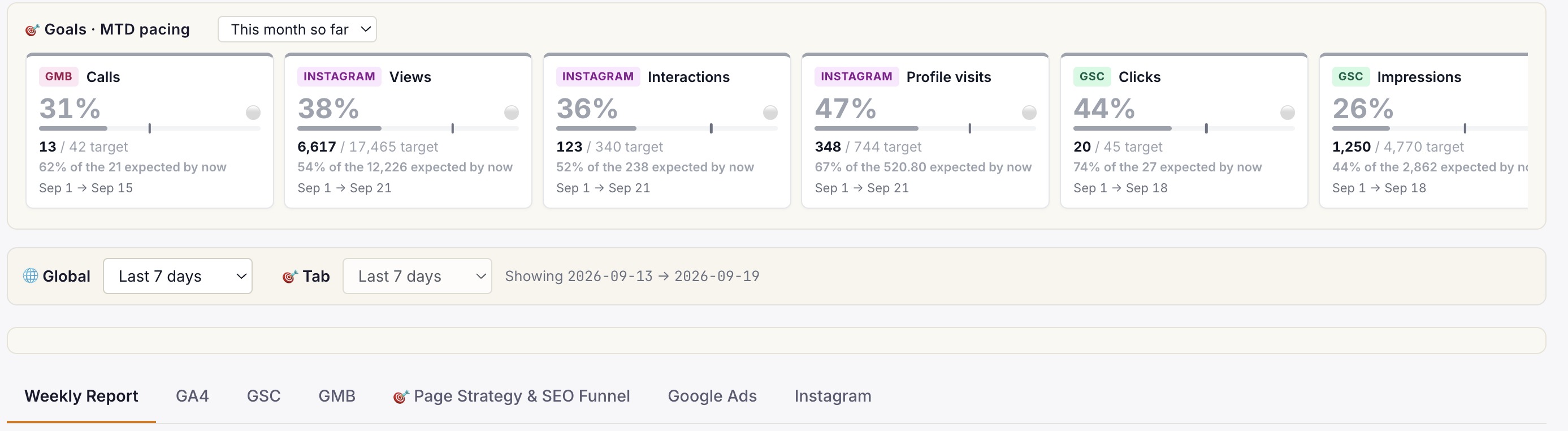
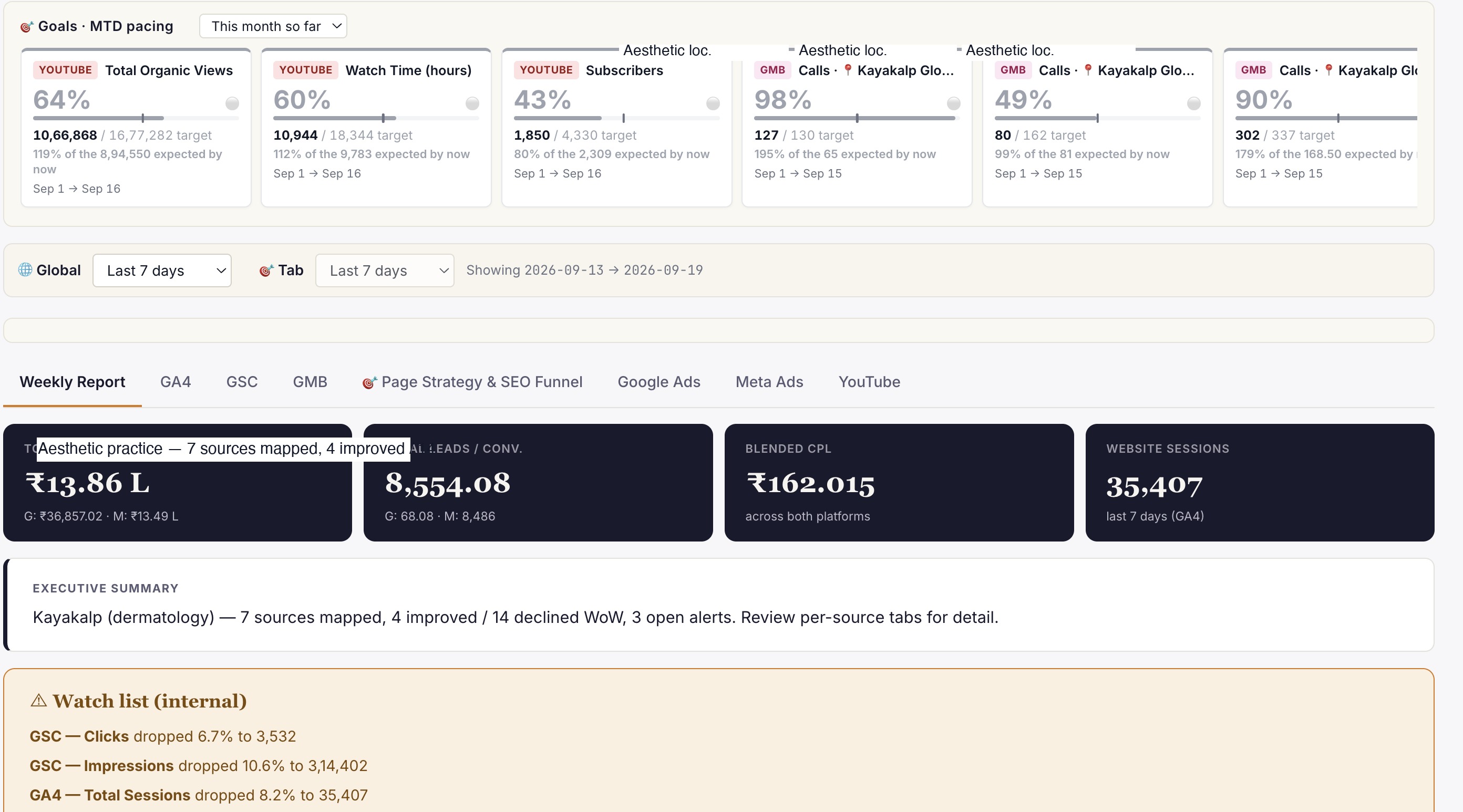
Live client dashboard. GSC, GA4, Google Ads, Meta Ads, IVR calls in one view. Login anytime, not monthly.
Phoenix
Clinic revenue intelligence over your PMS. Daily action queue: Prevent Loss, Maintain & Engage, Grow Revenue. Multi-centre rollout.
Or book a free 30-min audit to see all three in action on your account.
Healthcare brands
that already run on ICG.
A representative slice of the 150+ healthcare brands ICG has delivered for across India. Most engagements remain under NDA.


What ICG clients say · on video.
"Scale up of organic channels and business consulting. ICG has absolute domain authority in their field."
"Working with ICG transformed how we acquire IVF patients in Gurgaon. They understand the fertility journey from inquiry to consult..."
"What Ichelon accomplished — they got all my ideas and worked over 3-4 months to create an amazing, super-customised website."
Need help operationalising this?
Every ICG service is healthcare-only, NMC + DPDP-aware, and built around the patient-research patterns that drive Indian healthcare growth in 2026.
Every practice welcome — packages from ₹20,000/mo.
Goals-Driven engagements · Performance-Linked Payout Models available
More from
ICG.
Five trends shaping Indian healthcare marketing through 2027: AI-first patient research, Conversions API adoption, ABDM discovery, the AEO w...
Healthcare AIO is the discipline of getting your clinic or hospital cited inside Google AI Overviews, ChatGPT and Perplexity answers — not j...
Conversational-search advertising places brand messages inside AI chat answers — ChatGPT, Perplexity, Copilot — rather than beside a results...
Stop guessing.
Book a Diagnostic.
30 minutes. Free. With the AI-powered healthcare-only marketing agency 150+ brands already run on. No slides, no pitch, no hard close.


