


Hospital video marketing in India for 2026: department strategy, OT walkthroughs, multi-doctor coordination, NABH signal integration
The playbook for hospital video marketing that is honest about how hospitals actually operate — department-level channel architecture, OT walkthrough compliance, the physician-led vs brand-led content decision, multi-doctor multi-location coordination, and how NABH accreditation signals should be woven into video content without becoming corporate noise.
No pitch. Written root-cause diagnosis. AI-powered, healthcare only.
Direct answer
The playbook for hospital video marketing that is honest about how hospitals actually operate — department-level channel architecture, OT walkthrough compliance, the physician-led vs brand-led content decision, multi-doctor multi-location coordination, and how NABH accreditation...
TL;DR

Hospitals are not clinics with more beds. The video marketing that works for a solo dermatologist's channel does not scale linearly to a 200-bed multi-specialty hospital, and the mistakes that made a small channel plateau at month 6 become expensive systemic errors when repeated across 15 departments and 40 consultants. This piece is the honest playbook for hospital video marketing in India in 2026 — how to structure a channel, what to shoot inside an OT, when a physician should lead versus when the brand should, how to coordinate across doctors and locations, and how NABH accreditation signals become video content assets instead of legal disclaimers.
Everything here is what ICG runs at scale for hospital clients using the YODA 6-step workflow, adapted to the specific operational reality of a hospital.
One hospital channel, not fifteen department channels — and why
The first temptation every hospital marketing head resists is the pressure from department heads to have their own YouTube channels. Cardiology wants a Cardiology channel. Neurology wants a Neurology channel. The paediatrics team already has a WhatsApp broadcast list they want to feed video into. Every department is right that their content is distinct — and every department is wrong that this justifies its own channel.
One channel wins for four reasons. Subscribers compound at the hospital level — a patient who subscribes after watching a cardiology video will be recommended orthopaedic and paediatric videos when their family needs them; that cross-department discovery does not happen when the subscribers are fragmented across 15 channels. Search authority compounds at the domain level — YouTube's ranking systems recognise topical authority per channel, and a single hospital channel covering all specialties builds broader authority faster than 15 sub-authority channels ever will. Operational overhead is 15x smaller — one uploads schedule, one thumbnail template, one compliance review flow, one analytics dashboard, one strategy cycle. Cross-linking works — a video ending with "if you want to know more about pre-surgical cardiac clearance for orthopaedic procedures" links seamlessly to another department's video only if they are on the same channel.
The correct structure is one channel, playlists per department, with a clear naming convention on both video titles and thumbnails that signals the department. A patient searching "hip replacement recovery" finds the Orthopaedics playlist; a physician team member scanning their department's content filters to their playlist. Both users are served by the same channel architecture.
The department-level content plan inside a single-channel structure
Under one channel, each department gets its own quarterly content plan that ladders into the hospital's overall strategy. YODA's Strategy step produces this as a per-department block inside the master plan.
A typical quarter for a multi-specialty hospital allocates content roughly as: 4 videos on the largest revenue department (say, Cardiology), 3 videos each on the next 2 departments (Orthopaedics, Oncology), 2 each on the mid-tier departments (Gastro, Neuro, Nephro, Pulmonology), 1 each on smaller departments, plus 2-3 hospital-brand videos (accreditation stories, patient outcome journeys with consent, hospital anniversary or event content). Twelve to sixteen videos per quarter across the entire hospital is the sustainable pace; more than that and quality visibly drops.
The content plan needs a specific mechanism for department heads to feed inputs — a monthly 30-minute call between the marketing lead and each department head, capturing the specific patient questions that department has been hearing recently, the procedural updates, the new equipment or service launches, and the doctor availability for shoots.
OT walkthroughs — what is safe, what is illegal, and what is just poor taste
The temptation for a hospital marketing team is to shoot inside an operating theatre. It signals capability, technology, and scale in a way no talking-head video can. It is also the area where the largest number of hospitals get into compliance trouble.
What is generally safe — an OT walkthrough during a scheduled non-procedure time showing equipment, layout, sterility protocols, and the clinical team explaining what happens in a class of procedure (without any patient present). A pre-procedure setup walkthrough shot without a patient, focused on the technology stack (say, a robotic surgery arm or an advanced imaging system). A time-lapse of an OT being prepared and cleaned.
What is strictly conditional — footage of an actual procedure with a real patient. This requires the patient's explicit written consent under the DPDP Act 2023 for their personal data (including facial imagery, even if incidental) to be used in video content. It requires the clinical team's consent. It requires the anaesthesia team's consent. It requires a compliance review of the final edit before publish. And it requires the hospital's medical superintendent's sign-off. Skipping any of these is a serious regulatory risk.
What is illegal or dangerous — any footage that identifies a patient without their consent, even in the background. Any content that shows anatomical detail in a way that could be construed as advertising for a specific procedure outcome. Any before-and-after imagery that lacks specific patient consent, timeline attribution, and the standard "individual results vary" caveat. For fertility departments specifically, any content that could be construed under the PC-PNDT Act 1994 as sex-determination-related is a criminal-jurisdiction issue.
What is just poor taste and hurts the brand — footage that dwells on surgical instruments in a way that is more sensationalist than educational. Content that shows patient distress even with consent. Content that positions surgery as spectacle rather than solution. Patients evaluating hospitals for their own care are turned off, not impressed, by content that feels performative rather than genuinely informative.
The best OT content ICG has produced for hospital clients has been technology-focused and team-focused, not procedure-focused. A 6-minute video walking a viewer through how a modular OT is prepared, the safety protocols, the team roles, the sterility zones — that is the video that both educates the audience and signals hospital capability, without any of the compliance exposure of shooting a live procedure.
Physician-led vs brand-led content — the decision that shapes trust
Two content lanes exist. Physician-led content — a specific doctor is the on-screen face, speaking to their specialty, answering patient questions, walking through procedures they perform. Brand-led content — the hospital itself is the primary voice, with the on-screen face being a marketing narrator, or a rotating cast of clinical team members, or entirely voice-over with clinical footage. Both work. They work for different reasons.
Physician-led wins for consultation-oriented searches — a patient searching "best cardiologist in Chennai for angioplasty" wants to see the cardiologist, not the hospital's marketing team. It builds personal-doctor trust, which is what drives the specific consult booking. The tradeoff — physician-led content requires the physician's ongoing time and comfort on camera. When the physician leaves the hospital, the physician-led videos on their playlist lose relevance quickly.
Brand-led wins for facility, capability, and process-oriented searches — "what to expect before knee replacement surgery," "NABH accreditation and what it means for patient safety," "hospital walkthrough for out-of-town patients." It builds institutional trust. It is durable — the video does not become irrelevant if a specific physician moves on. The tradeoff — it converts less strongly for the specific consult booking, because patients still ultimately want to see the doctor.
The disciplined answer is roughly 70% physician-led and 30% brand-led in most quarters, with the mix shifting toward brand-led when the hospital is running a specific service launch, accreditation announcement, or facility upgrade. Every department has at least one physician-led content anchor — the "face" of that department's content — even when that physician is not the department head.
Multi-doctor coordination inside a single department
A department with 6-8 consultants creates a coordination problem that a single-doctor clinic does not have. Two consultants both want to be the on-screen face for the department. Three others do not want to be on camera at all. One is genuinely excellent on camera but only works Tuesdays and Thursdays. The department head technically outranks everyone else but is not the natural fit for the primary on-camera role.
Three coordination patterns work.
Pattern A: One primary physician face per department, rotating supporting cast. One physician is the recognisable face of the department's content. Other physicians appear in specific videos where their sub-specialty is the topic — a paediatric cardiologist appears in the paediatric cardiology video, even though the general cardiology videos are led by the primary face.
Pattern B: Sub-specialty rotation. If the department has clear sub-specialties (adult vs paediatric cardiology, interventional vs non-interventional), the on-screen face rotates by sub-specialty content. Each sub-specialty's recognisable face becomes durable to viewers searching within that sub-specialty.
Pattern C: Interview format with a marketing-side host. A trained on-camera marketing team member conducts interviews with each consultant. This lowers the on-camera burden on each doctor (they only need to be comfortable in a conversation, not to carry a monologue) and gets more doctors into the content pool. Works especially well for department where consultants are camera-shy but content-rich.
Whichever pattern is chosen, it must be written down and stuck to for at least 2 quarters. Switching mid-quarter fragments the audience's recognition of who fronts what content.
Multi-location coordination across a hospital chain
A hospital chain with 3-8 locations adds a further dimension. Should there be one channel for the entire chain, or one channel per location?
Overwhelmingly, one channel for the entire chain, with location signalling done through video titles, thumbnails, and playlists. The reasons — subscribers, search authority, and cross-location patient discovery all compound at the chain level. Patients researching a serious procedure often consider multiple locations of the same chain and want to see the whole capability.
The one exception where location channels make sense — hospital chains where each location operates under a substantially different brand identity, positioning, or service scope (rare in Indian hospital chains but does exist). Even then, the corporate brand should have a central channel with brand-level content, and the per-location channels should focus narrowly on location-specific consultant content.
Coordination overhead across locations is the operational challenge. A quarterly content-planning call across all location marketing leads, an integrated production calendar so shoots can pool resources, and a shared compliance review flow so a chain-wide standard is maintained — all these become non-negotiable at scale.
NABH accreditation signals woven into content, not nailed on as a disclaimer
Most hospital marketing teams treat NABH accreditation as a badge that goes in the footer of the website. In video content it typically shows up as a two-second logo card at the end of the video that nobody watches. That is a wasted asset — the accreditation carries real trust weight with patients, and video is the surface where that weight can actually land.
The disciplined approach is to weave NABH signals into the substance of at least one video per quarter. Not "we are NABH accredited" as a claim — but "here is how our patient safety protocol works, and here is how the NABH audit tests each of these elements." A 5-8 minute video that walks a viewer through how the hospital's medication administration protocol works, how patient identification is verified at every clinical touchpoint, how infection control is monitored — that video does the trust work that a logo card cannot. See NABH-specific content guidance for what defensible accreditation content looks like.
The reason this matters — NABH accreditation is a differentiator among Indian hospitals that most patients do not understand well enough to evaluate. A hospital that can explain what accreditation actually means for the patient's experience is a hospital that has already begun to earn the patient's trust.
The CTA architecture for a hospital channel
Clinic channels can point to a single WhatsApp number and be done. Hospital channels have to be more careful — the CTA needs to route to the right department's intake function, not to a generic hospital reception that then transfers the patient three times before they reach someone who can help.
The pattern that works — per-department WhatsApp numbers embedded in the description of videos on that department's playlist. The Cardiology playlist videos link to the Cardiology intake WhatsApp number with a pre-filled message that includes the department name. The Orthopaedics playlist videos link to Orthopaedics intake. The brand-level videos (accreditation content, hospital-wide content) link to a general enquiry number that has the training to route to the right department.
The telecaller function on the receiving end needs specific training — respond within 15 minutes during working hours, capture the video title the patient mentions (this becomes the attribution data that YODA correlates back), qualify the patient's specific need before slotting a consultation, and hand off cleanly to the department's appointment desk. See what an agency delivers monthly for the operational side of this.
The measurement model for a hospital channel
Hospital channel measurement adds a layer that clinic channels do not have — per-department attribution. Every consult that traces back to a video needs to be tagged to the specific department, the specific playlist, and where possible the specific video. This becomes the data YODA's Strategy step uses to allocate the next quarter's content mix.
Beyond attribution, the metrics that matter are the same as any serious channel — consult bookings from the channel, CTA clicks per video, retention curves, Discovery Organic (impressions × CTR on Search + Suggested + Browse), and organic-only performance (paid subtracted where any promotion has run). See vanity metrics for what to actively ignore.
One specific hospital metric — out-of-station consult bookings from the channel. For hospitals in Tier 1 cities serving patients from Tier 2 and Tier 3 India (medical tourism domestically), video is the trust-building layer that a patient watches from a smaller city before deciding to travel. Tracking out-of-station consult conversion separately reveals a lot about which content actually converts distant viewers.
The platform ICG uses to run this at scale: YODA
ICG runs healthcare YouTube marketing for clinics, hospitals, and specialty groups using YODA — our AI-native healthcare YouTube marketing platform. YODA sits on top of a channel's data and does four things no dashboard does: it separates organic from paid views at every step (so a promoted video can never masquerade as organic growth), it gives decisions not dashboards (every video gets a state + next action), it writes back to YouTube directly (improved titles, tags, descriptions, chapters applied straight to the platform), and it tracks the three rank races — YouTube search, Google web, and Google AI Overview citations.
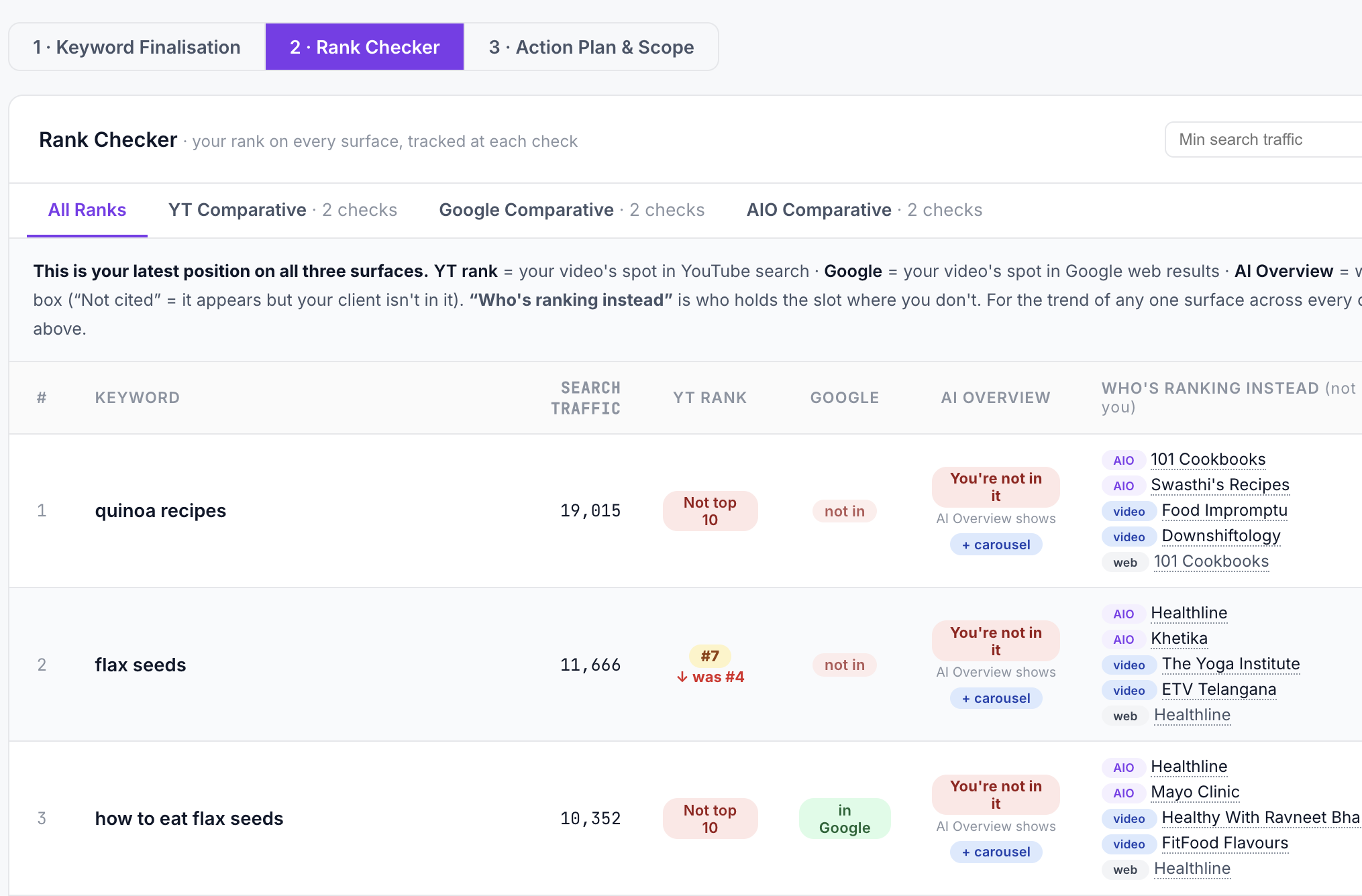
YODA runs the full 6-step workflow — Overview, Diagnostics, Strategy, Optimisation, Reputation (ORM), and Competitor Intel — with 40+ analysis modules organised under those steps. ICG's managed YouTube service uses YODA end-to-end. See the Healthcare YouTube Marketing pillar guide for the full scope, or the Healthcare YouTube Marketing Agency service page for engagement details.
Book a YODA demo on WhatsApp → or request a free healthcare YouTube channel audit →
Related reading
- Healthcare YouTube marketing pillar guide 2026
- How a doctor YouTube channel generates consultations
- Hospital department listings on Google — India strategy
- What a healthcare YouTube agency delivers monthly
- Healthcare YouTube benchmarks 2026
FAQ
Should we have separate YouTube channels for each of our specialty hospitals within a chain? Almost never. One chain-level channel with department playlists and location signalling in titles/thumbnails outperforms fragmented per-hospital channels. The exception is chains where locations operate under substantially different brand identities.
How do we get physicians who are camera-shy to participate? Interview format with a trained marketing-side host removes the burden of carrying a monologue. Many camera-shy physicians are perfectly comfortable in conversation. Alternatively, contribute only in supporting-cast roles (procedure walkthroughs, panel discussions) rather than fronting solo videos.
What is the correct release cadence for a hospital channel? 1-2 videos per week across all departments combined, sustained without gaps, outperforms bursts of 4-5 videos per week followed by dry periods. YouTube's ranking systems reward cadence discipline.
Can we use footage of a real surgery in a video? Only with explicit written consent from the patient (DPDP 2023), the clinical team, and the anaesthesia team, plus medical superintendent sign-off and compliance review of the final edit. In practice, technology-focused and team-focused OT content that does not require patient consent produces better trust signals with lower risk.
How much of the channel should be promotional vs educational? 80% educational (patient-question-answering, procedure explainers, myth-vs-fact), 15% institutional-trust (accreditation, capability, facility), 5% campaign or event content. Purely promotional content underperforms across every metric.
How does our hospital's NABH accreditation help our YouTube channel? It carries real trust weight when explained substantively, not just displayed as a logo. One video per quarter that walks the viewer through what accreditation means operationally (patient safety, medication protocols, infection control) does more brand work than a hundred logo-card placements.
What is the minimum team we need in-house to run a hospital channel? A marketing lead who owns strategy, a content producer who owns scripts and shoots, and an editor. All three roles can be part-time. The physician time budget is separate and comes from clinical schedules. An agency partner adds the platform (YODA), specialist SEO, thumbnail production, and compliance-aware content review.
How do we measure the ROI of our hospital YouTube channel? Consults booked from the channel, tagged by department. From those, tracked through to confirmed bookings, walk-ins, and (with a mature PMS integration) paid procedures. Views and subscribers are secondary. See vanity metrics.
How do we handle a video where a patient complaint has been made after publish? Unpublish immediately, review the specific concern, re-edit or permanently remove based on the review. Do not leave the video live while investigating. Document the decision.
Can we run paid promotion on hospital channel videos? Yes — on organic Winners that have already proven themselves. Boost with ₹8,000-25,000 per video for a 21-30 day window on videos that YODA's Ad-Spend Picks module has identified. Avoid paid promotion on any video that has a live compliance flag.
Book a free social media audit.
Akanksha Tyagi reviews your channels for NMC/DPDP compliance, creative velocity, and whether the effort is actually driving enquiries.
The three platforms
behind every ICG engagement.
Beacon
CAPI middleware that fixes Event Match Quality, translates CRM statuses to Meta-standard events, dedups across channels.
Agency OS
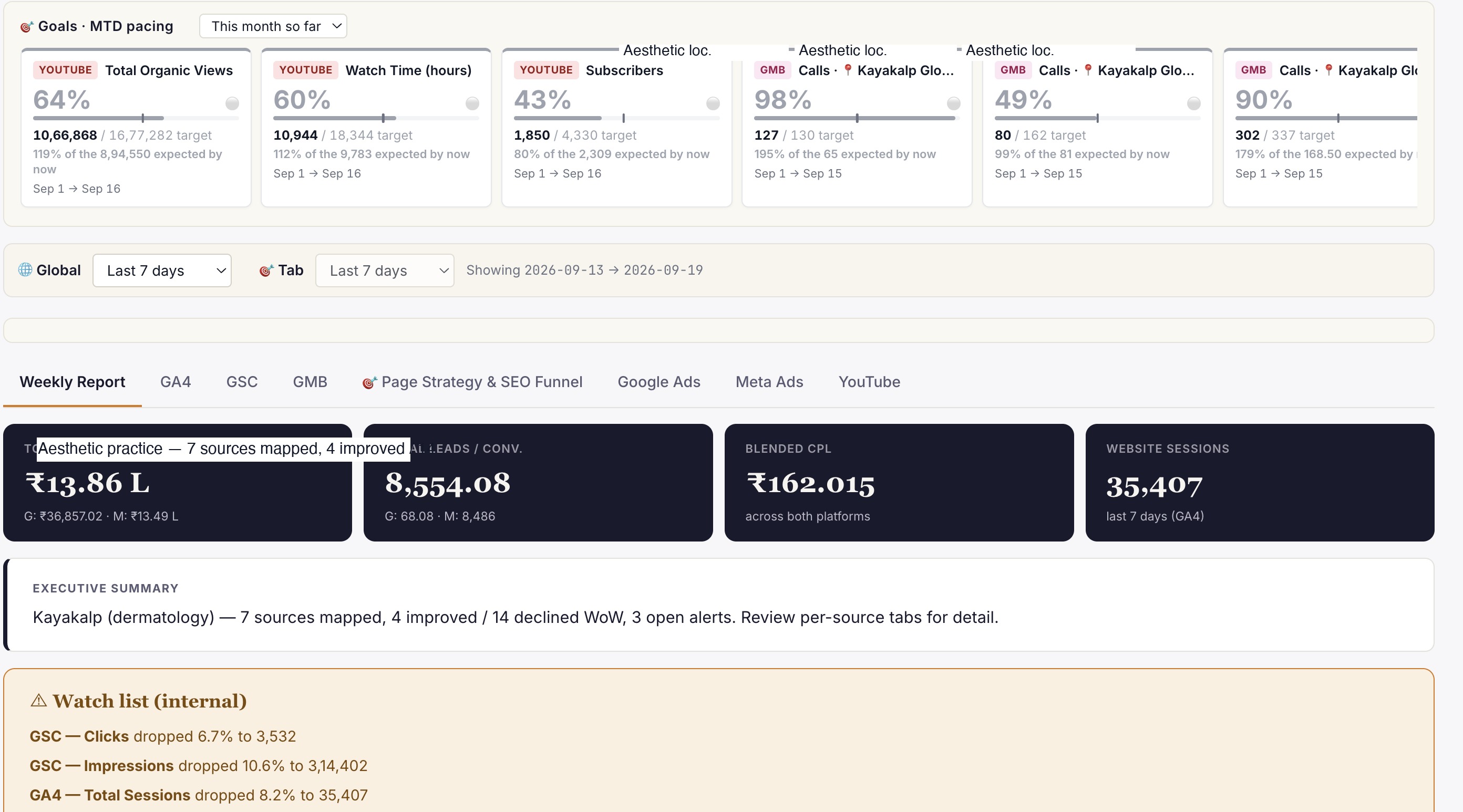
Live client dashboard. GSC, GA4, Google Ads, Meta Ads, IVR calls in one view. Login anytime, not monthly.
Phoenix
Clinic revenue intelligence over your PMS. Daily action queue: Prevent Loss, Maintain & Engage, Grow Revenue. Multi-centre rollout.
Or book a free 30-min audit to see all three in action on your account.
Healthcare brands
that already run on ICG.
A representative slice of the 150+ healthcare brands ICG has delivered for across India. Most engagements remain under NDA.


What ICG clients say · on video.
"Mental health marketing requires a different sensitivity. ICG built compliance-aware campaigns that respect both patients and our..."
"Bariatric surgery patients need a long consideration cycle. ICG built a content + paid system that respects that timeline."
"Working with ICG felt like working with an in-house growth team that happens to specialise in healthcare."
Need help operationalising this?
Every ICG service is healthcare-only, NMC + DPDP-aware, and built around the patient-research patterns that drive Indian healthcare growth in 2026.
Every practice welcome — packages from ₹20,000/mo.
Goals-Driven engagements · Performance-Linked Payout Models available


More from
ICG.
Five trends shaping Indian healthcare marketing through 2027: AI-first patient research, Conversions API adoption, ABDM discovery, the AEO w...
Healthcare AIO is the discipline of getting your clinic or hospital cited inside Google AI Overviews, ChatGPT and Perplexity answers — not j...
Conversational-search advertising places brand messages inside AI chat answers — ChatGPT, Perplexity, Copilot — rather than beside a results...
Stop guessing.
Book a Diagnostic.
30 minutes. Free. With the AI-powered healthcare-only marketing agency 150+ brands already run on. No slides, no pitch, no hard close.


