


YouTube marketing for IVF clinics in Delhi and NCR (2026): fertility channel playbook for Gurugram, South Delhi, Noida and Faridabad inside PC-PNDT, ART Act 2021, Delhi Medical Council and cross-border DPDP compliance
How IVF clinics in Delhi NCR should run YouTube — Hindi-primary content with English, Russian and Arabic subtitles across 200+ NCR centres in Gurugram, South Delhi, Noida and Faridabad; the six-framework compliance perimeter with heightened cross-border DPDP tracking for CIS republic, Bangladesh, Nepal and African medical tourism patients; the Delhi winter consultation surge (Oct-Feb); LTV maths per Delhi fertility patient (₹2L-6L); higher donor egg / donor sperm inquiry share in the 35-42 secondary-infertility band; and the YODA 6-step workflow adapted for a Delhi NCR IVF channel with international patient support workflows.
No pitch. Written root-cause diagnosis. AI-powered, healthcare only.
Direct answer
How IVF clinics in Delhi NCR should run YouTube — Hindi-primary content with English, Russian and Arabic subtitles across 200+ NCR centres in Gurugram, South Delhi, Noida and Faridabad; the six-framework compliance perimeter with heightened cross-border DPDP tracking for CIS repu...
TL;DR

Delhi NCR is the densest IVF market in India — an estimated 200-plus registered centres spread across Gurugram, South Delhi, Noida, and Faridabad — and simultaneously the most internationally exposed. Meaningful revenue comes from patients travelling in from Uzbekistan, Kazakhstan, Russia and other CIS republics, from Bangladesh and Nepal, and from a growing African inflow Delhi hospitals have quietly built specialised programs around. A Delhi couple watches materially more videos before booking than couples in other Indian cities — 7 to 14 per shortlisted clinic — across a longer, consultative arc that peaks in the cold months. This guide is ICG's playbook for how a Delhi NCR IVF clinic should run YouTube inside the Delhi Medical Council, PC-PNDT Act 1994, ART Act 2021, NMC's 2026 advertising guidelines, ASCI, and DPDP 2023 compliance perimeter — plus the cross-border consent layer international inflow makes non-negotiable — and how the YODA 6-step workflow adapts to NCR geography and demographics.
Why Delhi NCR is a distinctive market for IVF YouTube
NCR is not one market. Gurugram is corporate, high-income, English-fluent, dense with couples in the 32-40 first-cycle band. South Delhi holds the highest concentration of legacy IVF specialists and the deepest patient loyalty. Noida's IVF demand is younger and more price-sensitive. Faridabad is the fastest-growing sub-market with newer chain expansion. One channel needs content that reads local across all four without pandering to any.
The international overlay changes everything. CIS republic couples — Uzbek, Kazakh, Russian — arrive in Delhi in meaningful volume because IVF in Tashkent or Almaty costs 2x to 3x what a top-tier South Delhi centre charges, and English-plus-Russian video becomes the shortlisting mechanism before the patient boards a flight. Bangladeshi and Nepali patients arrive over land and shortlist through Hindi and Bengali video. African medical tourism (Nigeria, Kenya, Ethiopia) leans English content with structured pricing transparency. A monolingual English channel captures a fraction of this inflow.
Timing is distinct. Delhi's cold October-to-February window is when local NCR patients traditionally plan cycles — stable climate, indoor-centric daily patterns, year-end reflection. A smaller wave in April-May precedes summer heat. A channel that publishes counter-cyclically loses share of voice in the exact months NCR search demand peaks.
The 3-races math for IVF in Delhi
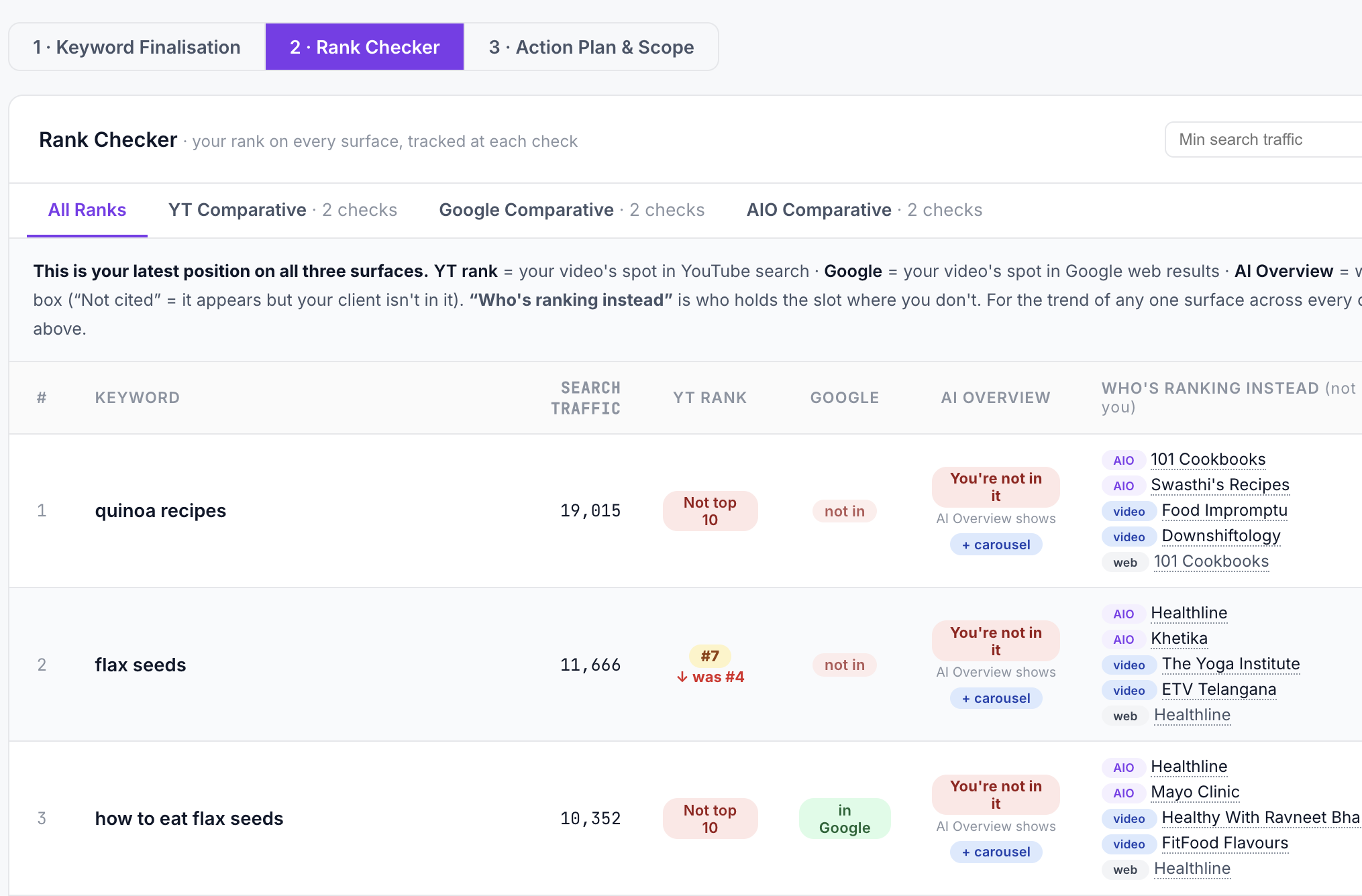
YODA's framing is that a fertility video's ranking lives in three separate places, and Delhi NCR forces a clinic to compete on all three across languages and across borders.
Race 1 — YouTube search. An NCR couple opens YouTube and types "IVF cost Delhi," "fertility doctor Gurugram," "donor egg IVF India," or "IVF success rate over 38." YouTube weighs title-query match, watch duration, and topical channel authority. Delhi winners are Hindi-primary titles with an English descriptor — "IVF Process Explained: Fertility Specialist in South Delhi (Hindi with English notes)" — and structured chapter markers that let a viewer skip to the specific section they need.
Race 2 — Google web. When a Delhi user searches Google for "IVF cost in Delhi NCR" or "donor egg IVF process," Google frequently returns a video carousel above or interleaved with the text results. Delhi clinics that embed their YouTube videos inside their treatment landing pages — with dense descriptions and matching schema markup — pick up the video carousel far more often than clinics that only upload to YouTube.
Race 3 — Google AI Overview. This is the highest-leverage surface in Delhi because AI Overviews now generate for a large share of fertility informational queries, and international patients researching from outside India get an AI Overview response before they see any organic results. Delhi videos with structured intros, source annotations, and clean chapter markers get cited disproportionately. A clinic that engineers 10 to 15 AI-Overview-ready videos in its first 90 days on YODA typically sees compounding Overview appearances by month 4, and — critically — starts appearing in AI Overview responses served to international users researching from Tashkent, Dhaka, or Nairobi.
Compliance perimeter for IVF content in Delhi
Fertility marketing in Delhi NCR operates inside a six-framework perimeter with a distinctive seventh consideration — cross-border patient data — that other Indian metros face less intensely.
Delhi Medical Council governs the professional conduct of the fertility specialist appearing on camera and has been active in enforcing advertising restrictions on registered practitioners.
PC-PNDT Act 1994 (federal) prohibits sex-determination-adjacent content absolutely. Delhi NCR has a specific historical sensitivity here because of the region's well-documented sex-ratio-at-birth issues; enforcement scrutiny is tighter, and any drift in framing is picked up faster. A YODA compliance audit of the existing library is the first step of any Delhi engagement.
ART Act 2021 (federal) requires clinic registration under the National Registry and restricts success-rate advertising. Every claim needs a specific age band, a defined protocol context, and a cycle-count denominator. Where donor programs are discussed — which happens frequently in Delhi given the higher donor-egg inquiry share — the ART Act's donor-registration and consent provisions apply on top. Where cycle stimulation is discussed, multiple pregnancy risk and ovarian hyperstimulation syndrome (OHSS) risk must be named in the same video.
NMC's 2026 advertising guidelines restricts patient testimonial framing. ASCI Guidelines 2022 prohibit "best" and unsubstantiated comparative claims.
DPDP 2023 with cross-border extension. This is where Delhi diverges. Every international patient who appears on camera or whose story is referenced needs consent language that covers cross-border data transfer, the specific channels the video will be distributed on (including the Russian and Arabic subtitle tracks), and a withdrawal mechanism that works from outside India. Delhi clinics that treat DPDP as a boilerplate consent form miss the international-patient extension entirely and expose themselves to enforcement risk that a domestic-only channel does not face.
Content archetypes that convert IVF patients in Delhi
Doctor credentials, deeply anchored. Delhi NCR patients — particularly the corporate Gurugram segment and the consultative South Delhi segment — research the specialist as a person before the clinic. A 2 to 3 minute credential-anchored intro per fertility specialist covering training, ART Act 2021 registration status, sub-specialisations, and hospital affiliations becomes the anchor video that most other channel content links back to.
Facility tours, with the international-patient lens. Delhi tours should show the OT, andrology lab, and embryo cryostorage — and additionally, the international patient counselling room, the translator arrangement, and the accommodation coordination workflow. A 6 to 8 minute walkthrough that explicitly addresses the "what happens when I arrive from Tashkent" question converts CIS-region viewers into confirmed bookings at a rate no generic tour matches.
Patient counselling walkthrough archetype. Delhi patients — especially in the 35 to 42 secondary-infertility band where donor programs are frequently discussed — want to see what the counselling conversation actually looks like before they book. A recreated counselling walkthrough (with the specialist, without a real patient) covering initial workup, protocol discussion, cost transparency, and the donor-program conversation converts materially better than an equivalent explainer video.
International patient support workflow archetype. A dedicated 5 to 7 minute video covering visa support, travel coordination, accommodation, translator support, cycle timing, and post-cycle follow-up from home country. Publish with English audio, Russian subtitles, and Arabic subtitles for the top medical-tourism corridors. This one video is often the highest-converting single asset on a Delhi channel that serves international patients.
Realistic-timeline archetype, with donor and PGT depth. Delhi's older first-cycle age band (35-42) means donor egg and PGT-A conversations happen earlier. Videos framing "what a realistic IVF journey looks like across 6 to 12 months when donor egg is on the table" outperform generic timeline framing on retention and consult conversion for the Delhi audience.
Real budget expectations for IVF YouTube in Delhi
A Delhi NCR IVF YouTube engagement has to be budgeted against the per-patient LTV. A single IVF cycle in Delhi runs ₹1.8L to ₹3.2L on antagonist protocol without add-ons. ICSI adds ₹40,000 to ₹75,000 per cycle. PGT-A adds ₹90,000 to ₹1.6L per cycle. Donor egg cycles run ₹3L to ₹4.5L, and are a larger share of Delhi volume than in Mumbai or Bangalore. Cryostorage runs ₹25,000 to ₹70,000 per year. LTV per Delhi fertility patient runs ₹2L to ₹6L, with international-patient cases (fewer moving parts around domestic follow-up but higher per-cycle capture) trending toward the upper end.
Chain tier — ₹85,000/- to ₹1.6L/- per month. Fits single-location NCR IVF centres and small chains up to 3 locations. Includes YODA platform access, monthly plan for 6 to 8 videos, script support with six-framework compliance review including cross-border DPDP checks, SEO writebacks across YouTube search, Google web, and AI Overview surfaces, thumbnail A/B tests, and comment moderation. Suits clinics doing ₹2.5Cr/- to ₹14Cr/- annual fertility revenue.
Hospital tier — ₹1.6L/- to ₹4L/- per month. Fits multi-location NCR chains, fertility departments inside larger hospital groups, and international-patient-heavy programs. Includes multi-channel management if the group runs separate Hindi and English channels, subtitle-track production in Russian and Arabic, deeper competitor intelligence across the NCR clusters, and quarterly compliance training including cross-border DPDP for the internal team.
Below ₹85,000/- per month, compliance overhead — especially the international consent layer — eats the budget. Start with Angryturtle self-serve at ₹999/- for local SEO first.
YODA 6-step workflow for a Delhi IVF channel
Step 1 — Overview. Connect the Delhi channel, calibrate against the Indian IVF benchmark band, and separate historical paid promotion from organic. For Delhi specifically, add international-viewer country dimensions (Uzbekistan, Kazakhstan, Russia, Bangladesh, Nepal, key African markets) alongside domestic language dimensions.
Step 2 — Diagnostics. Cluster the library by topical group (IVF basics, ICSI, PGT-A, donor egg, donor sperm, embryo freezing, secondary infertility, male fertility, age and fertility) and by format archetype. Delhi's audience profile typically shows a bimodal age split with a larger 35-42 slice than most cities and a distinct international-viewer segment that behaves differently on retention and CTR.
Step 3 — Strategy. Produce a rolling 90-day content plan that reinforces winning clusters, front-loads AI-Overview-ready videos for informational queries, and calibrates the publishing calendar against the September-to-December pre-winter surge and the April-May secondary wave. Plan Russian and Arabic subtitle tracks as first-class deliverables, not afterthoughts.
Step 4 — Optimisation. Rewrite titles for AI Overview citation readiness with Hindi-plus-English bilingual patterns, insert chapter timestamps, update descriptions with substantiated context, and queue thumbnail A/B tests. YODA's writeback applies changes directly to YouTube.
Step 5 — Reputation (ORM). Delhi fertility comment threads mix domestic emotional disclosure with international patient logistics questions. Never reply with clinical advice, never quote success rates in reply text. Route international patient questions to a WhatsApp path staffed for cross-border consult booking.
Step 6 — Competitor Intel. Track 8 to 12 peer NCR fertility channels across Gurugram, South Delhi, Noida, and Faridabad plus 2 to 3 international-patient-focused chains. Identify content gaps where competitors earn traffic and the clinic is silent, then close them without direct comparative framing.
The platform ICG uses to run this at scale: YODA
ICG runs healthcare YouTube marketing for clinics, hospitals, and specialty groups using YODA — our AI-native healthcare YouTube marketing platform. YODA sits on top of a channel's data and does four things no dashboard does: it separates organic from paid views at every step (so a promoted video can never masquerade as organic growth), it gives decisions not dashboards (every video gets a state + next action), it writes back to YouTube directly (improved titles, tags, descriptions, chapters applied straight to the platform), and it tracks the three rank races — YouTube search, Google web, and Google AI Overview citations.
YODA runs the full 6-step workflow — Overview, Diagnostics, Strategy, Optimisation, Reputation (ORM), and Competitor Intel — with 40+ analysis modules organised under those steps. ICG's managed YouTube service uses YODA end-to-end. See the Healthcare YouTube Marketing pillar guide for the full scope, or the Healthcare YouTube Marketing Agency service page for engagement details.
Book a YODA demo on WhatsApp → or request a free healthcare YouTube channel audit →
Related reading
- YouTube marketing for IVF clinics in India (parent guide)
- Local SEO for doctors and clinics in Delhi 2026
- YODA 6-step workflow explained for healthcare marketing agencies
- Top 15 IVF marketing agencies in India
- Healthcare YouTube marketing agency service page
FAQ
How large is the international patient share of a Delhi NCR IVF channel's audience? For a well-built channel with Russian and Arabic subtitle tracks, international viewers typically account for 12 to 22 percent of watch time by month 6, with CIS-region viewers the largest single overseas cohort. Conversion to actual booked cycles from international viewers runs lower than domestic in fraction terms but higher in per-patient LTV.
Do we really need Russian subtitles or can we get away with English-only for CIS patients? Russian subtitles materially outperform English-only for the CIS republics because a large share of Uzbek, Kazakh, and Russian couples researching IVF abroad process complex clinical content faster in Russian even when they are conversationally functional in English. YODA's international-viewer retention curves show the gap clearly.
How does cross-border DPDP consent actually work for an on-camera international patient? The consent document must specifically name cross-border data transfer, the channels the video will appear on including subtitle tracks, the retention period, and a withdrawal mechanism the patient can exercise from their home country. Bilingual signature (English plus the patient's primary language) is a reasonable standard. YODA's compliance filter flags any journey video missing the international extension.
Why is October to February the peak Delhi IVF planning window? Climate stability, indoor-centric daily patterns during the cold months, year-end insurance and financial planning cycles, and the emotional cadence of the winter-to-spring arc all combine. Delhi channels that front-load high-conversion content publishing in September to November capture the most consult bookings from the winter surge.
How should a Delhi channel handle the higher donor egg inquiry share without triggering ART Act 2021 issues? Cover donor egg IVF as an indicated protocol with clear age and clinical criteria, not as a marketed add-on. Reference the clinic's ART Act 2021 donor-registration status transparently. Never imply donor outcomes as generalisable success rates. YODA's script review flags any drift toward marketing framing on donor content.
Do Gurugram, South Delhi, Noida, and Faridabad patients respond differently to the same video? Yes. Gurugram over-indexes on English-plus-Hindi bilingual content and cost transparency framing. South Delhi over-indexes on specialist-credential and clinical-depth content. Noida over-indexes on cost-comparison and accessibility content. Faridabad over-indexes on newer-chain trust-building content. YODA's geo-diagnostic module surfaces the split during Step 2.
How do we frame international-patient testimonial videos without violating NMC or DPDP? Signed cross-border consent, editorial framing as personal experience not clinical evidence, treating specialist not appearing on-screen with the testimonial in an endorsement-adjacent frame, and Russian or Arabic voiceover or subtitle track. Multiple pregnancy risk and OHSS risk still get named where stimulation is discussed even in patient-narrative videos.
What CPQL and booked-cycle uplift does a Chain-tier Delhi engagement produce by month 6? Typically 5 to 9 booked cycles per month attributable to YouTube by month 6 to 8, at a fully-loaded cost per booked cycle of ₹8,500/- to ₹14,000/-. International patient conversions carry a longer decision arc but a higher per-cycle net contribution.
Book a free IVF clinic growth diagnostic.
Raman Soni walks through your current channel mix, CPQL vs cost-per-cycle, and where the 90-day patient journey is leaking.
The three platforms
behind every ICG engagement.
Beacon
CAPI middleware that fixes Event Match Quality, translates CRM statuses to Meta-standard events, dedups across channels.
Agency OS
Live client dashboard. GSC, GA4, Google Ads, Meta Ads, IVR calls in one view. Login anytime, not monthly.
Phoenix
Clinic revenue intelligence over your PMS. Daily action queue: Prevent Loss, Maintain & Engage, Grow Revenue. Multi-centre rollout.
Or book a free 30-min audit to see all three in action on your account.
Healthcare brands
that already run on ICG.
A representative slice of the 150+ healthcare brands ICG has delivered for across India. Most engagements remain under NDA.


What ICG clients say · on video.
"Working with ICG transformed how we acquire IVF patients in Gurgaon. They understand the fertility journey from inquiry to consult..."
"ICG built our IVF marketing system from the ground up. The team understands healthcare specifics, not just generic digital marketi..."
Need help operationalising this?
Every ICG service is healthcare-only, NMC + DPDP-aware, and built around the patient-research patterns that drive Indian healthcare growth in 2026.
Every practice welcome — packages from ₹20,000/mo.
Goals-Driven engagements · Performance-Linked Payout Models available



More from
ICG.
Five trends shaping Indian healthcare marketing through 2027: AI-first patient research, Conversions API adoption, ABDM discovery, the AEO w...
Healthcare AIO is the discipline of getting your clinic or hospital cited inside Google AI Overviews, ChatGPT and Perplexity answers — not j...
Conversational-search advertising places brand messages inside AI chat answers — ChatGPT, Perplexity, Copilot — rather than beside a results...
Stop guessing.
Book a Diagnostic.
30 minutes. Free. With the AI-powered healthcare-only marketing agency 150+ brands already run on. No slides, no pitch, no hard close.


