


YouTube Analytics vs Google Search Console for healthcare channels in 2026: which tool answers which question
YouTube Analytics and Google Search Console answer different questions for a healthcare YouTube channel — one measures what happens inside YouTube, the other measures how videos surface across Google web. This guide covers when to use each, the blind spots of both, and what YODA consolidates so healthcare marketing teams stop making decisions from half the data.
No pitch. Written root-cause diagnosis. AI-powered, healthcare only.
Direct answer
YouTube Analytics and Google Search Console answer different questions for a healthcare YouTube channel — one measures what happens inside YouTube, the other measures how videos surface across Google web. This guide covers when to use each, the blind spots of both, and what YODA...
TL;DR

YouTube Analytics vs Google Search Console is one of the more expensive confusions in Indian healthcare video marketing in 2026 — hospital marketing teams routinely look at one tool, miss the signal that lives in the other, and make cadence or content decisions from a partial view of reality. YouTube Analytics is the in-platform surface. Google Search Console is the web-search surface. A healthcare YouTube channel lives on both surfaces at the same time, but neither tool shows the full picture on its own. This guide covers what each tool actually measures, when to reach for which, the blind spots that trip up marketing teams, and how ICG's YODA platform consolidates both feeds against the healthcare YouTube marketing pillar.
What YouTube Analytics actually measures for a healthcare channel
YouTube Analytics is the in-platform reporting surface Google gives channel owners inside YouTube Studio. It reports what happens after a viewer is already on YouTube — impressions on the YouTube homepage, in search results within YouTube, on the Suggested column beside a currently-playing video, and on the Browse feed inside the mobile app. Every metric it shows is scoped to the YouTube surface: YouTube searches, YouTube suggestions, YouTube subscriptions, YouTube channel pages, YouTube playlists.
The metrics that matter for a healthcare channel inside this scope: impressions (how many times video thumbnails were shown to a YouTube user), click-through rate on those impressions, average view duration, audience retention curves per video, subscriber growth attributable to a specific video, traffic-source breakdown among YouTube-internal surfaces, and the geographic and device split of watch time. YouTube Analytics also exposes the Reach tab where impressions and CTR live side by side, and the Engagement tab where watch time, average view duration, and audience retention live.
What YouTube Analytics does not know: whether a healthcare video showed up as a video result on a Google web search for "IVF cost delhi," whether it was cited inside a Google AI Overview answer, whether it appeared in the video carousel on a mobile web SERP, or how many people watched an embedded version of the video on the clinic's own website. All of those are on the Google web side, not the YouTube side.
What Google Search Console shows for video content specifically
Google Search Console reports the web-search view of a domain — but there is a specific video sub-view that most healthcare marketers never open. Inside GSC, the Performance report has a Search Type filter with a Video option. When toggled, GSC shows the queries that surfaced any video result attributable to the property — impressions, clicks, and average position on Google web search when a video result appeared.
For a channel that has embedded its videos on the clinic's own website, GSC also shows the video URLs on the site that Google has indexed as video content, the video sitemap coverage, and any structural issues (missing thumbnail, missing duration, missing description) flagged in the Video Indexing report.
What GSC does not know: what happens on YouTube itself. YouTube search queries never appear in GSC. Suggested-video traffic never appears in GSC. Watch time never appears in GSC. Retention curves never appear in GSC. If a healthcare channel gets 80% of its traffic from YouTube-internal surfaces, GSC will show a near-empty video performance report — not because the channel is failing but because GSC is looking at the wrong surface.
The three ranking races and which tool covers which
Every healthcare YouTube channel is running three separate ranking races simultaneously, and each race has its own reporting surface. Understanding which race lives in which tool is what unlocks the real diagnostic value.
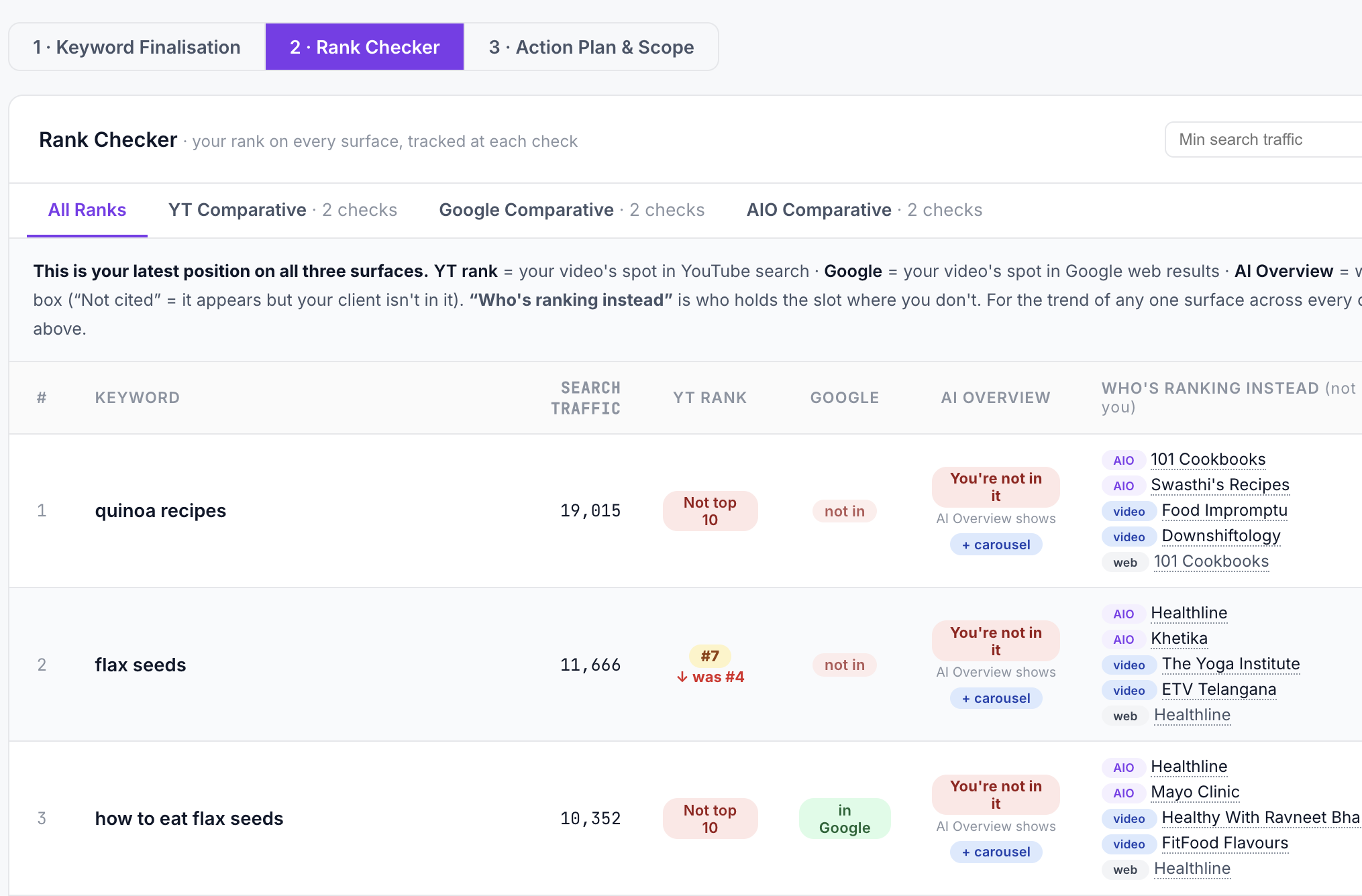
Race one — YouTube search. A viewer types "diabetic retinopathy treatment" into the YouTube search bar. YouTube's algorithm ranks videos by watch time, retention, freshness, click-through rate, and channel authority. Only YouTube Analytics reports this surface. GSC has no view of it whatsoever.
Race two — Google web search. The same viewer types the same query into Google search on the web. Google shows a mix of web pages, a video carousel, and sometimes a featured video snippet. Only Google Search Console reports this surface via the Video search-type filter. YouTube Analytics can hint at it via the "External" traffic source but cannot break out queries.
Race three — Google AI Overview citations. The same viewer types the same query into Google in 2026 and gets an AI Overview at the top of the results page. The AI Overview may cite specific YouTube videos as sources. Neither tool reports this cleanly today — GSC surfaces AI Overview impressions in aggregate without per-video attribution, and YouTube Analytics has no view of AI Overview at all. YODA reconstructs this via cited-source scraping.
The blind spots of using YouTube Analytics alone
A healthcare marketing team that only opens YouTube Studio and never opens GSC misses several patterns that materially change strategy.
The team sees YouTube search traffic but cannot see whether Google web search is sending views. A channel with weak YouTube search performance but strong Google web performance looks broken inside YouTube Studio when it is actually winning on a different surface.
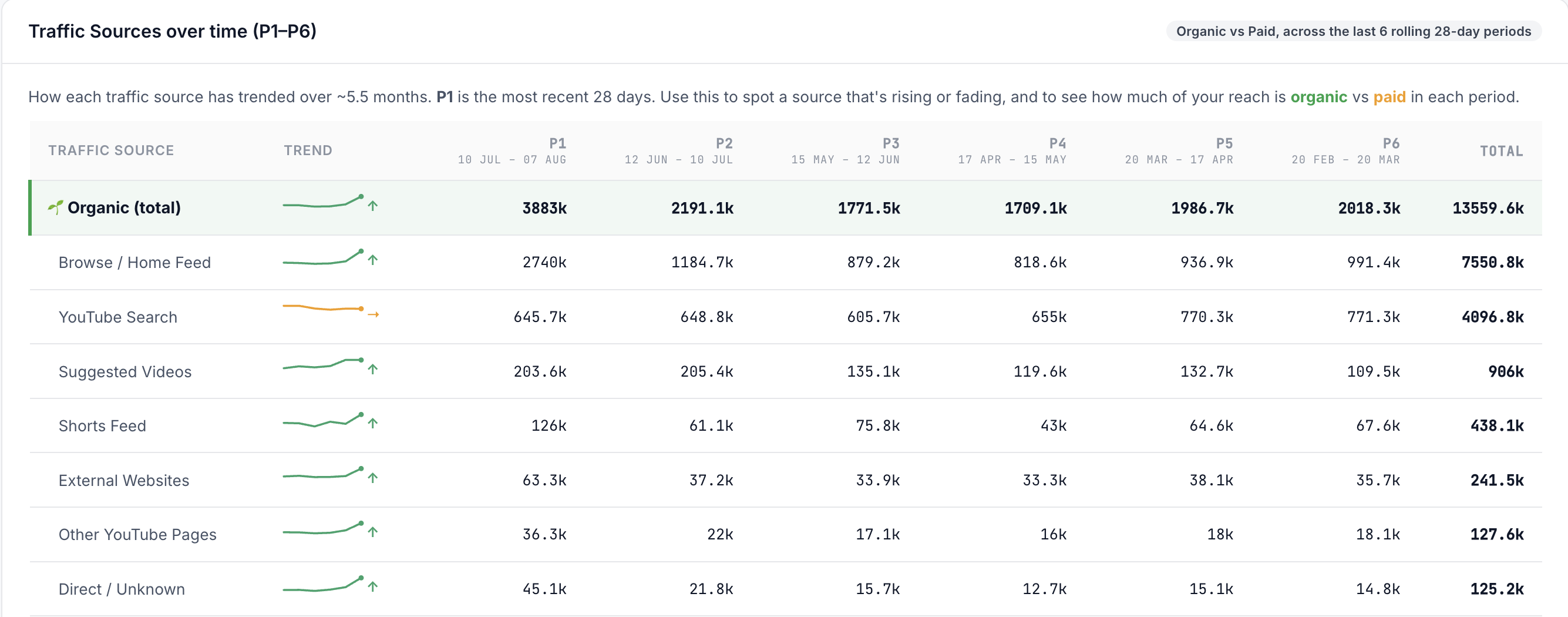
The team sees external traffic aggregated as "External" without a breakdown of which external source. If Google web is sending 15,000 impressions monthly to the channel via the video carousel, YouTube Analytics buckets that under External with no per-query view. The team cannot diagnose which topics are earning web-search video visibility and which are not.
The team cannot see impressions on Google mobile that did not result in a click. Impressions on Google web via GSC show which video-tagged queries surfaced the channel's content — even if nobody clicked. This is the earliest signal that a video is starting to earn Google web ranking, and YouTube Analytics never surfaces it.
The blind spots of using Google Search Console alone
A healthcare marketing team that only opens GSC and never opens YouTube Studio misses even more. GSC has no view of YouTube-internal traffic sources, which for most healthcare channels represent 60% to 80% of total watch time.
The team cannot see which videos are winning the YouTube search race. GSC does not know YouTube search exists. A video that ranks first for a competitive YouTube search query is invisible in GSC even when it is producing meaningful subscriber growth.
The team cannot see audience retention. GSC has no concept of watch time or retention. It reports impressions and clicks on Google web search only. For a healthcare channel where video length and retention curves determine YouTube algorithm favour, GSC provides zero diagnostic value.
The team cannot separate organic and paid views. GSC does not know a video was promoted with paid spend. YouTube Analytics does — the Advertising traffic source and the paid-vs-organic breakout live inside YouTube Studio.
The workflow when both tools are used together correctly
The correct pattern uses YouTube Analytics as the primary tool for content and channel decisions, and Google Search Console as the secondary tool for web-search opportunity diagnosis.
Weekly: open YouTube Studio, review the Reach and Engagement tabs, identify the videos with the strongest CTR on impressions and the strongest retention curves. Those are the videos worth doubling down on with follow-up content. Identify the videos with weak CTR — those need thumbnail or title A/B testing. Identify the videos with a retention cliff in the first 30 seconds — those need hook rewrites.
Monthly: open GSC, toggle Search Type to Video, look at the queries that produced video impressions on Google web search for the property. Cross-reference with the videos that YouTube Analytics shows are winning YouTube search. The overlap tells you which topics are winning both races. The GSC-only queries tell you which topics are winning web search without corresponding YouTube search strength — a signal to invest in the YouTube-native ranking of those topics.
Quarterly: audit the video sitemap on the clinic website inside GSC. Missing sitemap entries reduce Google web video visibility. Broken thumbnails or missing durations flagged in the Video Indexing report reduce the probability of the video appearing in mobile carousels.
What neither tool covers and where YODA fills the gap
Three critical questions for a healthcare YouTube channel are not answered by either YouTube Analytics or GSC in isolation, or even when used together.
First — organic versus paid separation at the video level. YouTube Analytics has a traffic-source filter for Advertising, but it does not automatically strip paid views out of every metric shown elsewhere in the tool. A video that ran ₹50,000 of promoted spend still shows the total view count as the headline number in the video overview. The team has to manually subtract paid to see organic. Most teams don't.
Second — Google AI Overview citation tracking per video. Neither tool tells you which of the channel's videos have been cited inside an AI Overview answer, for which queries, on which days. This is the fastest-growing discovery surface for healthcare topics and there is no built-in reporting for it.
Third — decisions per video. Both tools report metrics. Neither tool tells the marketing team "this video is worth investing another ₹15,000 in paid promotion because organic CTR is above the 75th percentile and retention is above the 90th percentile — but only after you rewrite the last 45 seconds where the retention cliff appears."
The compliance note for healthcare video reporting
Both YouTube Analytics and GSC handle patient-attribution data at aggregate levels — no identifiable patient information is exposed. But the moment a healthcare marketing team exports reports into a shared spreadsheet, adds a "leads generated" column with named patients or lead identifiers, and stores that spreadsheet on a shared drive, the Digital Personal Data Protection Act 2023 applies.
Keep reporting aggregate. Store any lead-level attribution inside a proper CRM with role-based access, not inside a marketing analytics spreadsheet. If external agencies are running the reporting, ensure their data-processor agreements include DPDP Act 2023 compliance clauses.
The platform ICG uses to run this at scale: YODA
ICG runs healthcare YouTube marketing for clinics, hospitals, and specialty groups using YODA — our AI-native healthcare YouTube marketing platform. YODA sits on top of a channel's data and does four things no dashboard does: it separates organic from paid views at every step (so a promoted video can never masquerade as organic growth), it gives decisions not dashboards (every video gets a state + next action), it writes back to YouTube directly (improved titles, tags, descriptions, chapters applied straight to the platform), and it tracks the three rank races — YouTube search, Google web, and Google AI Overview citations.
YODA runs the full 6-step workflow — Overview, Diagnostics, Strategy, Optimisation, Reputation (ORM), and Competitor Intel — with 40+ analysis modules organised under those steps. ICG's managed YouTube service uses YODA end-to-end. See the Healthcare YouTube Marketing pillar guide for the full scope, or the Healthcare YouTube Marketing Agency service page for engagement details.
Book a YODA demo on WhatsApp → or request a free healthcare YouTube channel audit →
Related reading
- Healthcare YouTube marketing pillar guide 2026
- YouTube views vs revenue: what actually drives clinic consults
- How a doctor YouTube channel generates consultations in India
- Best time to post on YouTube for healthcare in India 2026
- Healthcare YouTube marketing agency service page
FAQ
Can YouTube Analytics tell me which Google web queries sent traffic to my video? No. YouTube Analytics buckets Google web traffic under the "External" traffic source without a per-query view. Only Google Search Console with the Video search-type filter shows individual queries that produced video impressions on Google web search.
Can Google Search Console show me YouTube search queries? No. GSC has zero visibility into what happens inside YouTube. It only reports queries on Google web search. For YouTube-internal search terms, use the YouTube Studio Research tab or YouTube Analytics traffic source breakdown.
Do I need to verify my YouTube channel URL as a property in GSC? The channel URL itself lives at youtube.com and cannot be verified as a GSC property because you don't own the root domain. What GSC does track is video results attributable to any domain you have verified — including the clinic's own website if videos are embedded there with proper video schema.
Which tool should I check first every week? YouTube Analytics. For most healthcare channels, 60% to 80% of watch time originates from YouTube-internal surfaces (search, suggested, browse, subscribers). Weekly channel decisions should be grounded in that surface. GSC is a monthly or quarterly check for the web-search opportunity layer.
How do I see how much of my traffic is paid versus organic in YouTube Analytics? Open the Reach tab, use the traffic-source filter, and check the Advertising source. Subtract those views from the total to see organic. But YouTube does not automatically apply this subtraction to metrics shown elsewhere, so paid views inflate the headline number unless you manually strip them out.
Does GSC show YouTube video click-through rate? No. GSC shows impressions, clicks, and CTR on Google web search — including for the video result if the query surfaced one. But YouTube-native impressions and CTR (the thumbnail CTR inside YouTube Studio) are not in GSC.
Where do I see Google AI Overview citations for my healthcare videos? Neither YouTube Analytics nor GSC exposes this cleanly per video today. GSC shows aggregate AI Overview impressions on the domain but no per-video attribution. YODA reconstructs per-video AI Overview citation tracking by scraping cited sources for healthcare-relevant queries and matching them back to the channel.
Can I trust the traffic-source numbers when a video has been running paid ads? Only partially. YouTube Analytics reports the Advertising traffic source cleanly but does not by default subtract it from headline view counts, average view duration averages, or subscriber-gain figures that appear on the video overview. Any channel with paid spend on any video needs a workflow that strips paid before publishing internal reports.
Is the Search Type Video filter in GSC available for every property? It is available for any property where Google has indexed at least one video result attributable to the domain. Properties with no embedded video content or no video schema markup will see an empty video performance report.
Does watching my own videos while logged in skew YouTube Analytics? Marginally, but the impact is usually negligible at reasonable channel sizes. YouTube does exclude some obvious channel-owner activity from the reported metrics. For a channel getting 10,000+ monthly views, self-watching is noise. For a brand new channel with 500 monthly views, it can meaningfully skew retention curves — a good reason to watch your videos in an incognito window while a channel is small.
Book a free 30-minute Brand & Growth Diagnostic.
It's a working session, not a sales pitch — you leave with a written root-cause analysis you can act on, whether or not you engage ICG.
The three platforms
behind every ICG engagement.
Beacon
CAPI middleware that fixes Event Match Quality, translates CRM statuses to Meta-standard events, dedups across channels.
Agency OS
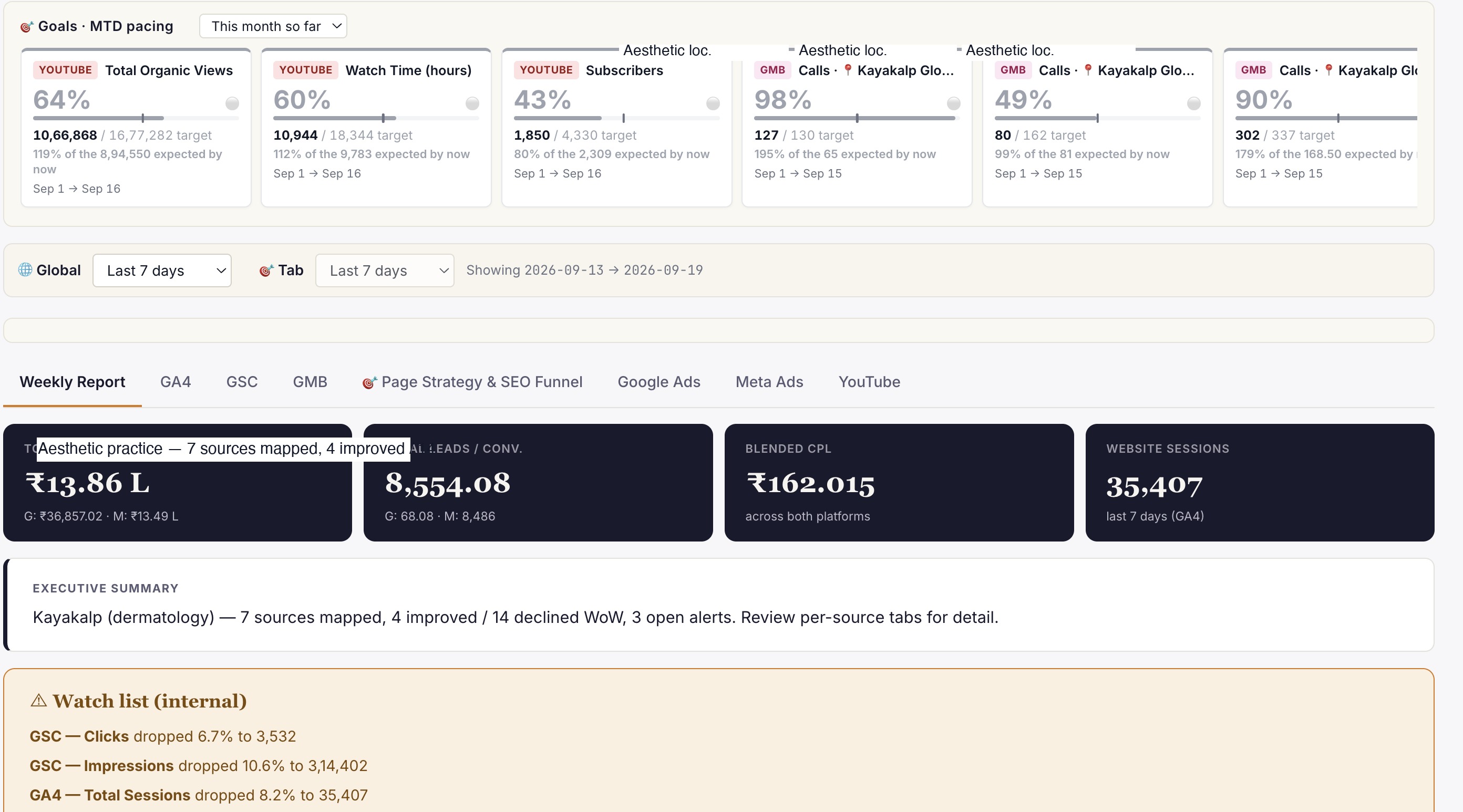
Live client dashboard. GSC, GA4, Google Ads, Meta Ads, IVR calls in one view. Login anytime, not monthly.
Phoenix
Clinic revenue intelligence over your PMS. Daily action queue: Prevent Loss, Maintain & Engage, Grow Revenue. Multi-centre rollout.
Or book a free 30-min audit to see all three in action on your account.
Healthcare brands
that already run on ICG.
A representative slice of the 150+ healthcare brands ICG has delivered for across India. Most engagements remain under NDA.


What ICG clients say · on video.
"Scale up of organic channels and business consulting. ICG has absolute domain authority in their field."
"Working with ICG transformed how we acquire IVF patients in Gurgaon. They understand the fertility journey from inquiry to consult..."
"What Ichelon accomplished — they got all my ideas and worked over 3-4 months to create an amazing, super-customised website."
Need help operationalising this?
Every ICG service is healthcare-only, NMC + DPDP-aware, and built around the patient-research patterns that drive Indian healthcare growth in 2026.
Every practice welcome — packages from ₹20,000/mo.
Goals-Driven engagements · Performance-Linked Payout Models available


More from
ICG.
Five trends shaping Indian healthcare marketing through 2027: AI-first patient research, Conversions API adoption, ABDM discovery, the AEO w...
Healthcare AIO is the discipline of getting your clinic or hospital cited inside Google AI Overviews, ChatGPT and Perplexity answers — not j...
Conversational-search advertising places brand messages inside AI chat answers — ChatGPT, Perplexity, Copilot — rather than beside a results...
Stop guessing.
Book a Diagnostic.
30 minutes. Free. With the AI-powered healthcare-only marketing agency 150+ brands already run on. No slides, no pitch, no hard close.


