


Why Your YouTube Views Don't Equal Revenue (And What Actually Does)
Views, watch time, and subscribers are the metrics every YouTube guru talks about. They are also the metrics that mislead healthcare businesses into pouring budget into channels that never generate revenue. The 6 metrics that actually predict business growth — and why most YouTube analytics tools don't measure them.
No pitch. Written root-cause diagnosis. AI-powered, healthcare only.
Direct answer
Views, watch time, and subscribers are the metrics every YouTube guru talks about. They are also the metrics that mislead healthcare businesses into pouring budget into channels that never generate revenue. The 6 metrics that actually predict business growth — and why most YouTub...
TL;DR
YouTube views, subscribers, and watch time are vanity metrics that mislead healthcare businesses into pouring budget into channels that never generate revenue. A 100,000-subscriber channel with zero attributable consultations is delivering less business value than a 5,000-subscriber channel with 50 monthly attributed bookings. The metrics that actually predict business growth are different — and most YouTube analytics tools don't measure them because they were built for content creators chasing ad revenue, not businesses chasing customer acquisition.
This article documents the 6 metrics that predict business growth, why traditional analytics miss them, and how ICG's YODA platform fills the gap.
The vanity metric trap
Most YouTube performance discussions optimise for what's measurable in YouTube Studio: views, watch time, CTR, subscribers, engagement rate. These metrics tell you:
- How many people saw your content (impressions)
- How many clicked through (CTR)
- How long they watched (retention)
- How many subscribed (audience growth)
- How they engaged (likes, comments)
None of these metrics tell you whether the channel generated patient consultations, service enquiries, or revenue. They tell you whether your content is popular — not whether it's profitable.
For YouTube creators monetising via the YouTube Partner Program, vanity metrics correlate with revenue (because ad revenue is paid per view). For healthcare businesses where the revenue model is consultation bookings → patient lifetime value, vanity metrics are at best a leading indicator and at worst a complete distraction.
What YODA actually shows
8 capabilities · 29+ analytics · zero competitive equivalents
Below are real screenshots from the live YODA tool — each one a capability VidIQ, TubeBuddy, and Social Blade don't have.
Explore YODA →
The 6 metrics that predict business growth
Metric 1 — Beacon-attributed bookings per video
The metric: for each video published, how many consultation bookings can be attributed (via UTM tracking, Beacon attribution, or Click-to-WhatsApp tagging) to that specific video?
Why it matters: this is the only metric that directly links content output to business outcomes. Videos that drive bookings get scaled (more content in that cluster, more promotion). Videos that don't get retired or repurposed.
Metric 2 — Revenue per video (12-month attributed)
The metric: for each video, the total revenue from bookings attributed to that video over a 12-month lookback (initial consultation fee + downstream procedures).
Why it matters: a video that generates 10 bookings of patients who only do the consultation (₹2,000 each) generates ₹20,000 of attributed revenue. A video that generates 5 bookings of patients who proceed to IVF (₹1.5 Lakh each) generates ₹7.5 Lakh. Both videos look similar by booking count; they are radically different by business value.
Metric 3 — Channel ROI
The metric: annual revenue attributed to the channel ÷ annual channel investment (production cost + agency cost + promotion spend).
Why it matters: this is the CFO question — "is our YouTube investment profitable?" Without ROI, every quarterly budget discussion devolves into political debates about subscriber growth.
ICG benchmark: established healthcare doctor channels typically reach 4-8x ROI by month 18 (₹4-8 of attributable revenue per ₹1 of channel investment). Hospital channels reach 6-12x ROI due to higher per-booking values.
Metric 4 — Comment-to-enquiry rate
The metric: percentage of comments that demonstrate buying intent (asking about pricing, appointments, locations, procedures) vs total comments.
Why it matters: comments are a real-time signal of audience match. A video that generates 50 comments of which 20 are buying-intent comments is generating a different audience than a video with 200 comments of which 5 are buying-intent. YODA's comment intelligence layer mines comments for these signals automatically.
Metric 5 — Branded search lift
The metric: month-on-month growth in branded searches (Google searches for "Dr. [Name]" or "[Brand] [city]") correlated with YouTube publishing cadence.
Why it matters: YouTube content drives downstream branded search. Every patient who watches a video and is then ready to book often searches the doctor's name on Google rather than returning to YouTube. Branded search volume measures this effect.
Metric 6 — AIO citation rate
The metric: percentage of relevant Google AI Overview answers that cite or link to the YouTube channel's content.
Why it matters: AI Overviews are increasingly the first answer Indian patients see for healthcare queries. YouTube content optimised for AIO citation gets recommended by AI tools as authoritative — driving qualified traffic at zero marginal cost.

Why subscriber count is misleading
Subscribers are an indicator of audience size, not buying intent. A channel grows subscribers by:
- Publishing viral lifestyle content (huge subscriber growth, zero buying intent)
- Publishing condition-specific clinical content (slow subscriber growth, high buying intent)
Optimising for subscriber growth pushes channels toward viral lifestyle content. The result: 100K subscribers, zero patient consultations.
The right framing: subscriber growth is a side-effect of publishing audience-relevant content. It is not the optimisation target.

Why YouTube Studio analytics miss these metrics
YouTube Studio shows you what YouTube can see: views, watch time, engagement happening within YouTube. YouTube cannot see:
- Whether a viewer clicked through to your website
- Whether that website visit triggered a WhatsApp enquiry
- Whether that enquiry converted to a consultation
- Whether that consultation generated revenue
- Whether the consultation patient referred others
These downstream events happen outside YouTube. Connecting them requires attribution infrastructure that traditional YouTube analytics tools (TubeBuddy, VidIQ, Social Blade) don't have because they were built for creators chasing ad revenue, not businesses chasing customer acquisition.
How YODA fills the gap
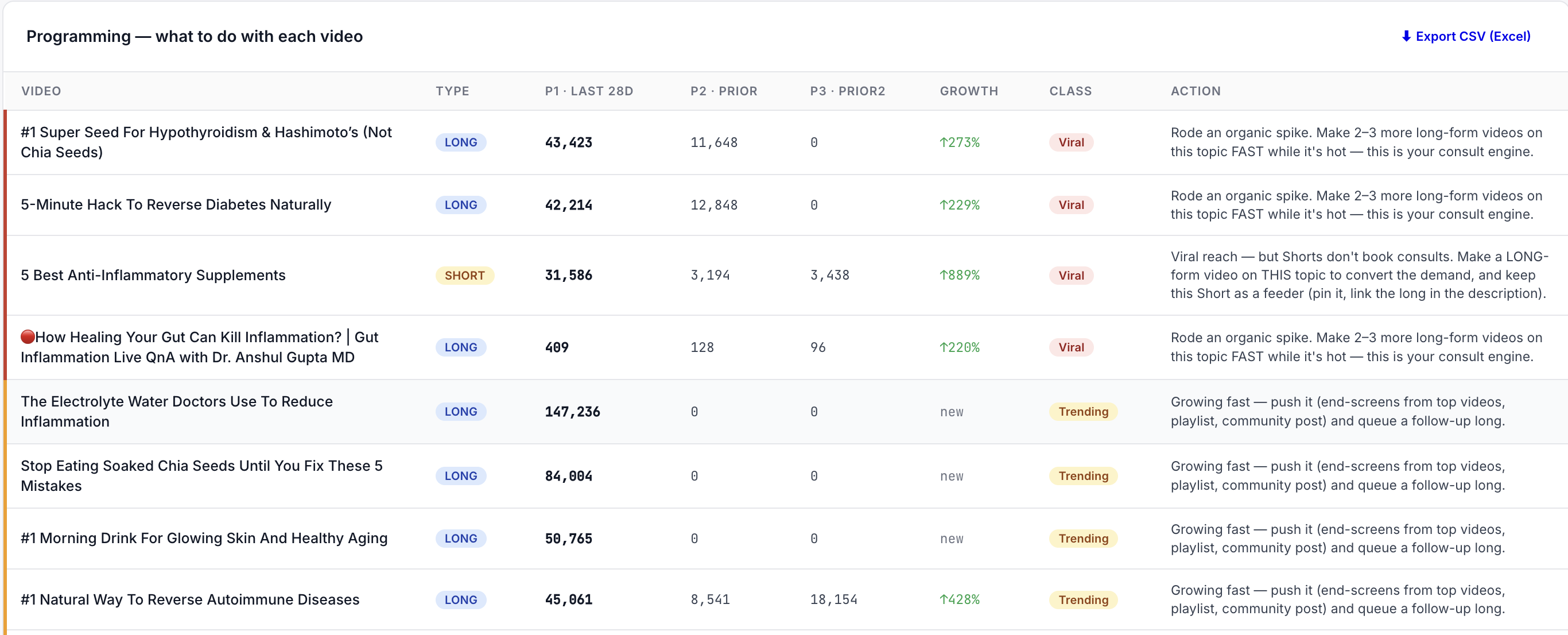
YODA (ICG's YouTube Outcome & Demand Analytics platform) connects YouTube performance to business outcomes via integration with Beacon (ICG's multi-touch attribution platform). Every view is tracked through to the resulting website visit, WhatsApp message, consultation booking, and lifetime revenue.
The result: every video on the channel has a measurable contribution to revenue. The dashboard shows:
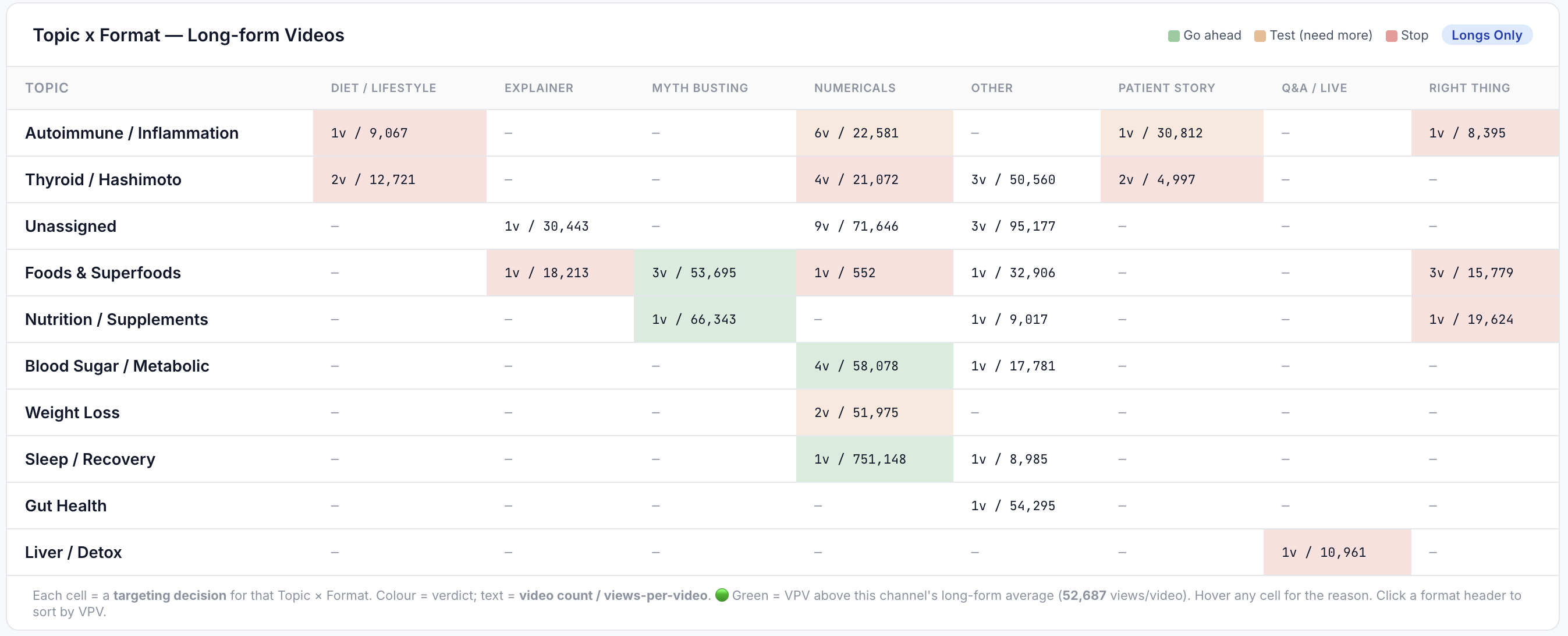
- Top 10 videos by attributed revenue (the ones to scale)
- Bottom 10 videos by attributed revenue (the ones to retire)
- Topic clusters by ROI (the content directions to expand)
- Format performance (long-form vs Shorts vs Lives, by business outcome)
- Publishing cadence vs attributed revenue correlation
This is the measurement infrastructure required to run YouTube as a business channel rather than a content creator hobby.
Book a free 30-minute Brand & Growth Diagnostic.
It's a working session, not a sales pitch — you leave with a written root-cause analysis you can act on, whether or not you engage ICG.
The three platforms
behind every ICG engagement.
Beacon
CAPI middleware that fixes Event Match Quality, translates CRM statuses to Meta-standard events, dedups across channels.
Agency OS
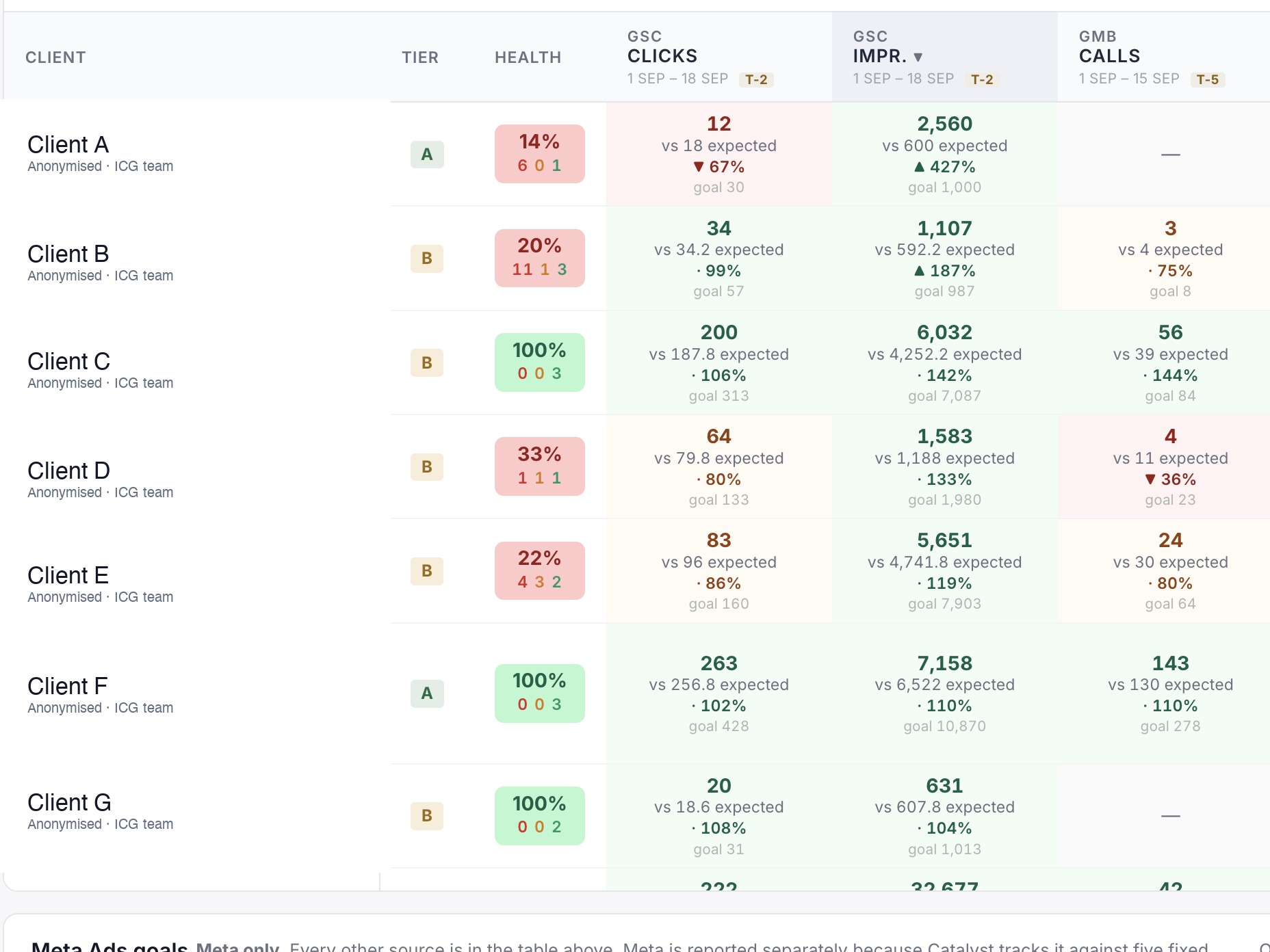
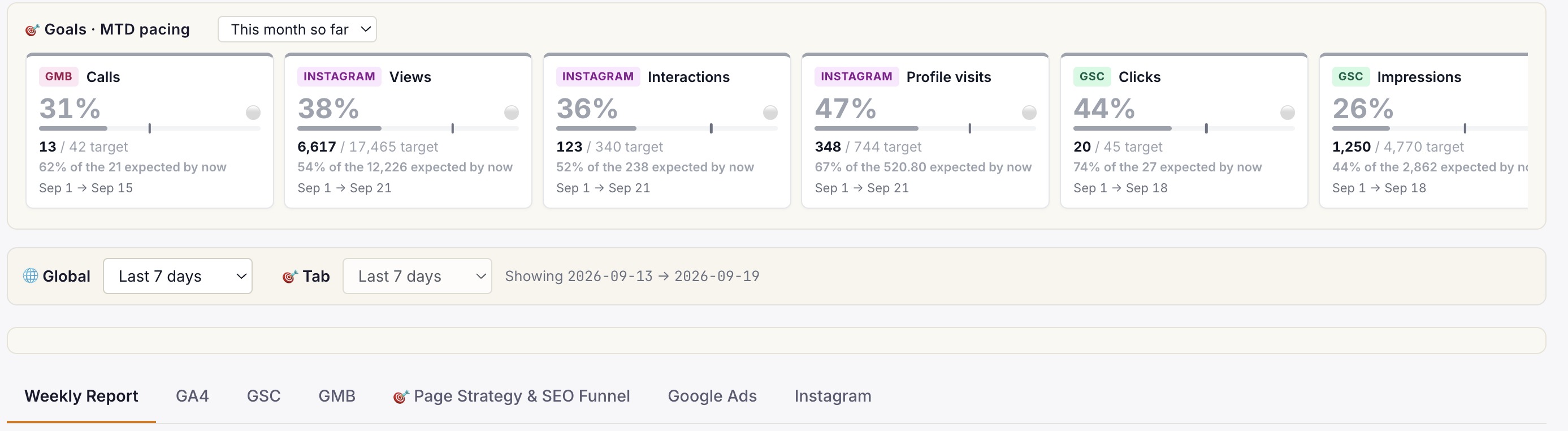
Live client dashboard. GSC, GA4, Google Ads, Meta Ads, IVR calls in one view. Login anytime, not monthly.
Phoenix
Clinic revenue intelligence over your PMS. Daily action queue: Prevent Loss, Maintain & Engage, Grow Revenue. Multi-centre rollout.
Or book a free 30-min audit to see all three in action on your account.
Healthcare brands
that already run on ICG.
A representative slice of the 150+ healthcare brands ICG has delivered for across India. Most engagements remain under NDA.


What ICG clients say · on video.
"Scale up of organic channels and business consulting. ICG has absolute domain authority in their field."
"Working with ICG transformed how we acquire IVF patients in Gurgaon. They understand the fertility journey from inquiry to consult..."
"What Ichelon accomplished — they got all my ideas and worked over 3-4 months to create an amazing, super-customised website."
Need help operationalising this?
Every ICG service is healthcare-only, NMC + DPDP-aware, and built around the patient-research patterns that drive Indian healthcare growth in 2026.
Every practice welcome — packages from ₹20,000/mo.
Goals-Driven engagements · Performance-Linked Payout Models available
More from
ICG.
Five trends shaping Indian healthcare marketing through 2027: AI-first patient research, Conversions API adoption, ABDM discovery, the AEO w...
Healthcare AIO is the discipline of getting your clinic or hospital cited inside Google AI Overviews, ChatGPT and Perplexity answers — not j...
Conversational-search advertising places brand messages inside AI chat answers — ChatGPT, Perplexity, Copilot — rather than beside a results...
Stop guessing.
Book a Diagnostic.
30 minutes. Free. With the AI-powered healthcare-only marketing agency 150+ brands already run on. No slides, no pitch, no hard close.


