


How a doctor's YouTube channel actually generates consultations in India: the honest workflow from first upload to first booked patient
The real workflow from starting a doctor's YouTube channel to the first paid consultation booked from a video — with specialty examples, compliance guardrails, the 90-day path, YODA-measured milestones, and the specific numbers a channel needs to hit for consult booking to become a repeatable outcome instead of a lucky one.
No pitch. Written root-cause diagnosis. AI-powered, healthcare only.
Direct answer
The real workflow from starting a doctor's YouTube channel to the first paid consultation booked from a video — with specialty examples, compliance guardrails, the 90-day path, YODA-measured milestones, and the specific numbers a channel needs to hit for consult booking to become...
TL;DR

Almost every doctor considering YouTube asks the same question in the first conversation. Not "how do I grow subscribers" or "how do I go viral" — those come later, from marketing people. The first question a doctor asks is simpler and more honest: will people I do not already know book a consultation with me because of a video I put on the internet? The answer is yes, but the path is specific and it is not the path most marketing decks suggest. This piece walks the honest workflow — from before you ever upload the first video to the moment a stranger walks into your clinic and says "I watched your video on hair transplant recovery and I want to book a consultation." Everything covered here is what ICG runs for clinics using YODA's 6-step workflow, distilled to the doctor's view of it.
The honest model of how a video becomes a consult
A consultation booked from YouTube passes through five stages. A viewer encounters the video (discovery). They click and watch enough of it to trust that the doctor knows the subject (retention). They form intent to know more about their own situation (consideration). They act on that intent by tapping the WhatsApp CTA or the description booking link (CTA click). They complete a booking and show up (conversion).
Each of these five stages has a specific failure mode. Discovery fails when the video's title, thumbnail, and topic do not match a query patients actually type. Retention fails when the first 30-45 seconds do not answer the specific promise made by the title. Consideration fails when the video answers the topical question but never bridges from information to "this doctor can help you." CTA click fails when the WhatsApp or booking link is buried, unclear, or requires the viewer to leave YouTube in a confusing way. Conversion fails when the CTA works but the front-desk or telecaller cannot close the booking cleanly.
Most channels that plateau are stuck on one specific failure — usually consideration (great information, no bridge) or CTA click (clear CTA, wrong placement). Diagnosing which one your channel is stuck on is the first job.
Before the first upload: the four decisions that determine everything downstream
Four decisions made in week zero shape the entire trajectory of the channel. Getting them wrong is fixable, but expensive.
Decision one: which of your services is the channel primarily about? A doctor with a broad practice — general physician, family medicine, multi-organ specialty — will be tempted to make videos across everything they do. Do not. Pick the one service where the consultation value is highest and the content depth is richest. A dermatologist choosing "hair loss and hair transplant" over "general skincare" is choosing higher-value consults, longer-consideration audience, and clearer content lanes. The channel can expand later; it cannot start diffuse and become focused.
Decision two: are you the on-screen face or is someone else? For a single-doctor practice this answers itself. For a multi-doctor practice, whoever appears on camera becomes the channel's face for the next 3-5 years. Choose the doctor who is comfortable on camera, willing to commit 2-3 hours per week, and whose speaking style is clear and unforced. Charisma helps; clarity matters more.
Decision three: what is the CTA? Almost always WhatsApp for Indian healthcare. A tap-through to a WhatsApp number with a pre-filled message ("Hi, I watched your video on [topic] and I'd like to book a consultation") outperforms a form or a booking page by a wide margin. The clinic's telecaller function must be ready to respond within 15 minutes during working hours. See GBP messaging vs WhatsApp integration for the deeper analysis on why WhatsApp wins.
Decision four: what is off-limits? This is the compliance perimeter. For a fertility clinic — no sex-determination content (PC-PNDT), no unsubstantiated success rate claims (ART Act). For any clinic — no comparative superiority claims without proof (ASCI), no patient testimonials without written consent (NMC, DPDP), no clinical advice pretending to be personalised. Writing this down before the first upload prevents a video from being pulled down three months later. See consent for testimonials on YouTube India.
The first six videos: what to actually make
The first six videos should be built for durability, not virality. The channel is a compounding asset — a video published in month one that gets 200 views in its first week can still be earning consults in month twenty-four if it targets an evergreen patient query.
Video 1: The "who I am and what I treat" video. Two to four minutes. Credential signalling, sub-specialty focus, the type of patient you help most, and the geography you serve. This is the video anyone who clicks your channel homepage will watch first. It is not the video that ranks — it is the video that converts on the channel page.
Videos 2-4: Three evergreen "what patients type into Google" explainers. Not "5 tips for glowing skin" — that's content marketing template noise. Something specific — "Hair transplant recovery week by week," "Why does acne come back after treatment," "Is it safe to get an IVF cycle after 40." Each 6-10 minutes. Each hooks in the first 30 seconds by restating the exact question the viewer typed.
Video 5: A Myth-vs-Fact video. Format matters. Myth-vs-Fact videos average significantly higher retention than Explainers in most healthcare specialties because they hook harder — the viewer wants to know which "myth" they've been believing is wrong. Choose one high-frequency myth that patients actually raise in consultations.
Video 6: A patient journey story or Q&A compilation. If a patient has provided explicit written consent, a journey story (10-15 minutes) becomes the trust-building anchor. If no consent-cleared patient is available yet, use a Q&A compilation — 8-12 real patient questions answered in sequence.
These six videos, done over 6-8 weeks, produce the first meaningful data set for YODA's Diagnostics step to work with.
The first 90 days: week-by-week what to expect
Weeks 1-2. Channel setup, brand kit, first video shoot and edit. Do not expect analytics to show anything meaningful. If a video gets 40 views in its first week, that is normal — most of those are you, your team, and people the doctor personally shared it with.
Weeks 3-4. Second and third videos published. YouTube's ranking systems are beginning to place videos into the Suggested and Search surfaces. The channel starts to see its first non-personal-network views. Do not touch the videos or change titles yet — the algorithm is still learning.
Weeks 5-8. Videos 4-6 published. Around week 6-7 a specific pattern usually emerges — one of the first six videos catches a rising Suggested placement or a search query and starts outperforming the others by 3-5x. This is not luck; it is the first signal about what topic your channel has topical authority in.
Weeks 9-10. First consult inbound. This is the milestone that matters. A patient WhatsApps saying they watched a specific video. In our observed base of dermatology, dental, and hair transplant channels, this typically arrives between week 6 and week 12. IVF and oncology channels arrive later — often week 14-20 — because the consideration cycle is longer.
Weeks 11-13. Optimisation cycle. Now the channel has enough data for YODA's SEO Lab and AIO Engine to produce specific writebacks. Titles get refined, chapters get added, thumbnails get A/B tested on the underperforming videos. Videos that are close to ranking on YouTube search jump into position after these writebacks.

By day 90, a well-run channel has 6-10 videos published, 1-4 consults booked, one video that is clearly a topical anchor for the channel, and clean data for the next 90 days of Strategy.
Specialty examples: what the first consult actually looks like
Dermatology / hair transplant. A woman in her late thirties in Delhi watches a video on female pattern hair loss treatment options. Video length 8 minutes, she watches to 6:20, taps the WhatsApp link, sends the pre-filled message. Telecaller replies within 12 minutes, screens for suitability, books a consultation for the following Saturday. Consultation happens; treatment plan discussed; she signs up for the ₹42,000 initial protocol.
Dental (implants or full-mouth restoration). A man in his fifties in Bangalore searches "cost of dental implants India" on Google, sees a video result from the clinic's channel, watches the full 12 minutes covering the cost breakdown, procedure timeline, and recovery. WhatsApps the clinic with a specific question about his case, gets a text conversation over 3 days, books a consultation, walks in for the exam.
IVF. A couple in their late thirties in Ahmedabad has been researching IVF options for 4 months. They have watched 6-8 videos from the clinic's channel across that time — cost, timeline, medication protocol, emotional support content, doctor Q&A. The consult booking is the culmination of a long consideration journey; the channel's job was to be present and credible throughout that journey. See IVF video consultation conversion impact.
Orthopaedic (joint replacement). A 62-year-old in Chennai with an adult daughter helping with research. The daughter watches 3-4 videos on knee replacement recovery timelines, complications to watch for, and post-surgery physiotherapy expectations. The consult is booked by the daughter on behalf of the patient. The channel served both audiences — the patient and the primary caregiver.
In every specialty, the pattern is the same — the video does not "sell." It builds enough trust that the viewer feels safe taking the next step, and the CTA architecture makes that next step obvious.
Compliance guardrails that cannot be broken
Every video published on a healthcare channel is a piece of doctor advertising under Indian law. That framing surprises doctors who think of themselves as making patient education content — but from the National Medical Commission's perspective, if the content invites patients to book with a specific doctor at a specific clinic, it is advertising, and the ethics code applies.
The specific guardrails on video content: no unsubstantiated superiority claims ("best hair transplant surgeon in Delhi" — not defensible unless there is a specific verifiable award). No outcome guarantees ("100% results" — never). No misleading before-and-after imagery — every before-and-after used must be from an actual patient with written consent, with the video's script accurately stating the timeline, the specific protocol used, and the caveat that individual results vary. No patient testimonials that pretend to be clinical evidence — a satisfied patient sharing their experience is fine with consent; a satisfied patient being used to imply the clinic's success rate is not.
For fertility specifically, the ART Act 2021 perimeter is stricter — success rate claims on video must be sourceable to the clinic's own clinical audit, and the audit methodology must be documented. Generic industry benchmarks are not enough. The PC-PNDT Act 1994 is the criminal-jurisdiction line — any content that could be construed as sex-determination-related is a crime, not a compliance nudge.
The safest workflow is a pre-publish compliance review for every video, with the reviewer being someone other than the doctor on-screen. YODA's Optimisation step includes a compliance filter that flags language that trips these rules before writeback happens, but the human review remains the final gate.
The CTA architecture that actually books consults
Most healthcare videos end weakly on the CTA. "Visit our website" or "leave a comment below" is the version most channels default to. Neither books consults reliably. Two CTA patterns work substantially better.
Pattern A: WhatsApp with pre-filled message. A clickable link (wa.me/91XXXXXXXXXX?text=Hi%2C%20I%20watched%20your%20video%20on%20...) placed as the first item in the video description, mentioned verbally in the video at the 30-second mark and again at the end, and pinned as the top comment. The pre-fill removes the friction of the viewer having to compose a message. Response SLA from the telecaller side is 15 minutes during business hours.
Pattern B: Direct booking link to a specific-slot calendar. Only works if the clinic has real online-booking infrastructure. Weaker than WhatsApp for most Indian healthcare because patients want a human touch before locking a slot. Suitable for procedures with standardised initial consults and clear pricing (dental checkups, dermatology first consults).
What does not work: form fills. A form fill on a landing page is 4-8x weaker than a WhatsApp CTA in observed conversion rates across ICG's healthcare portfolio. The friction of filling out a form is much higher than tapping a chat button.
Every video's description should have — WhatsApp link (first line), booking link if applicable, clinic address with Google Maps link, doctor's credentials, timestamps for chapters, and a short paragraph re-stating the video's promise. Descriptions matter more than most channels realise; they feed both YouTube search and Google AI Overview citation systems.
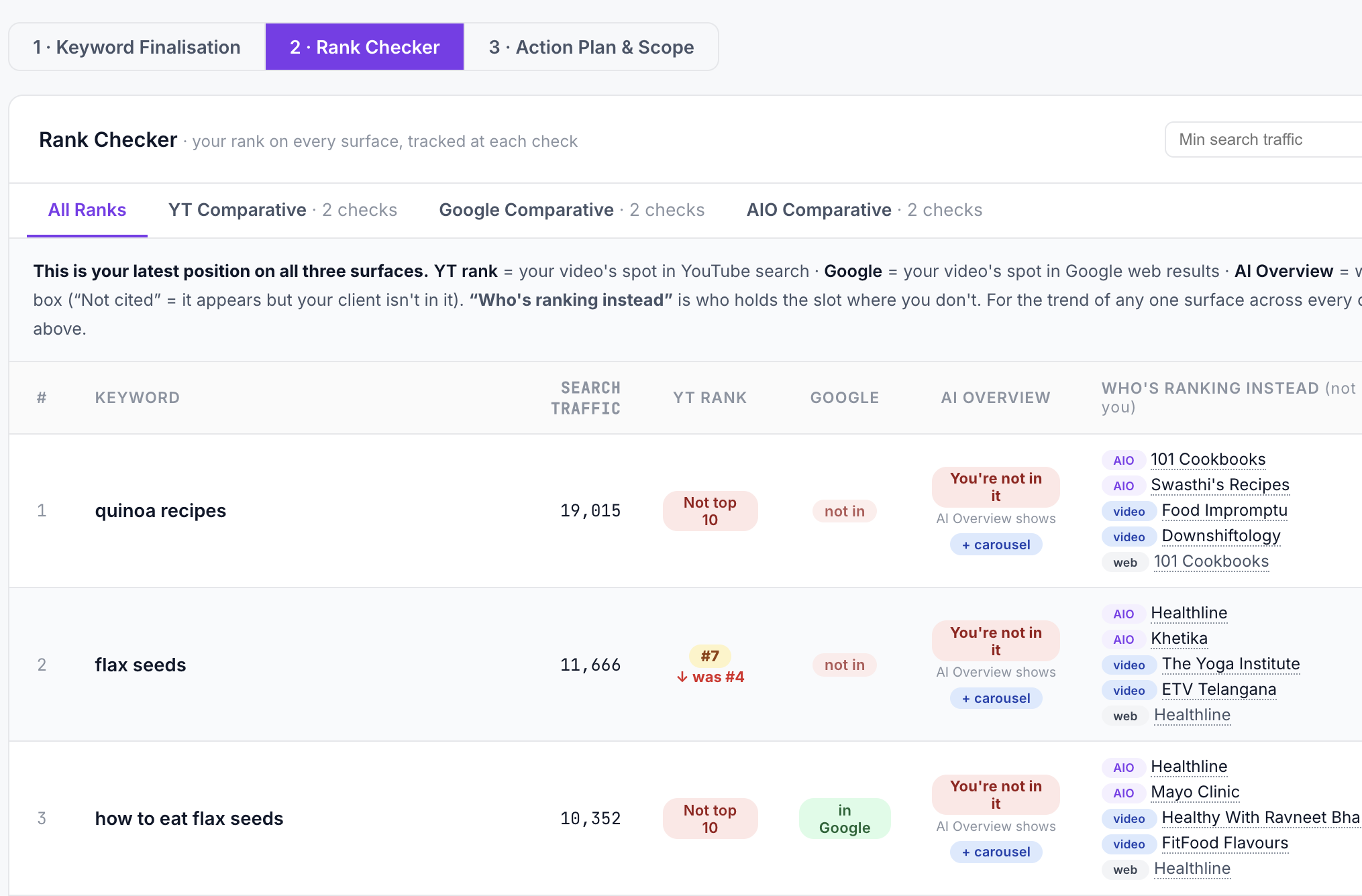
Measuring what actually matters, not what YouTube Studio shows first
YouTube Studio's home screen shows views, watch time, and subscribers. For a serious healthcare channel these are secondary metrics. What matters:
Consults booked from the channel. The primary metric. Tagged in the clinic's CRM or telecaller log as "source: YouTube channel." If the number is not being tracked, the whole exercise is guessing.
CTA clicks per video. Available in YouTube Studio under "Card clicks" and via the WhatsApp link tracking (a UTM-tagged link or wa.me tracking is trivial to set up).
Retention curve by video. Where the audience drops off tells you where the video failed. A video that loses 40% of viewers between 0:15 and 0:45 has a hook problem. A video that holds 65% through the middle and drops sharply at the CTA has a bridge problem.
Discovery Organic — impressions × CTR on Search, Suggested, and Browse. This is the honest measure of whether the channel is being placed by YouTube's ranking systems. Views can spike from external sharing; Discovery Organic is what tells you the channel has real algorithmic momentum.
Organic-only performance. If the channel has ever run paid promotion, every metric must be shown with paid subtracted. YODA does this at every step; a channel running only Studio needs a manual discipline for it. See organic vs paid YouTube views.
What goes wrong between months 4 and 9 — and how to fix it
The most predictable plateau in a healthcare channel arrives between month 4 and month 9. Videos are still being published, but view velocity is flat and consult flow has stopped growing. Almost always, one of four things is happening.
Cause 1: Topic drift. The channel started tightly focused on a specific service, but under content-team pressure to publish more, it has drifted into adjacent topics that dilute topical authority. Fix: return to the anchor topic for the next 6-8 videos, hard.
Cause 2: Format monotony. Every video looks identical — same intro, same style, same length, same thumbnail template. YouTube's Suggested surface begins to under-place videos that feel formulaic. Fix: introduce one new format (Myth-vs-Fact, or a Q&A compilation, or a walk-and-talk clinic tour) every 3-4 videos.
Cause 3: Weak CTA erosion. The CTA that worked in month 1-3 has stopped being refreshed. The WhatsApp pre-fill is the same wording as it was 40 videos ago. The description CTA has been buried below a marketing team's standard boilerplate. Fix: audit the last 10 videos' CTA architecture, refresh, and re-measure.
Cause 4: Compliance-driven caution has produced dull content. Somewhere between months 3 and 6, a legal review has come back conservatively and the doctor has started hedging every claim. Videos are still accurate; they are no longer compelling. Fix: work with a compliance-aware content team that knows how to make defensible claims that still land.
YODA's Diagnostics step diagnoses which of these four is happening. In the field, cause 1 (topic drift) and cause 3 (CTA erosion) are the most common — and the easiest to fix once diagnosed.
The platform ICG uses to run this at scale: YODA
ICG runs healthcare YouTube marketing for clinics, hospitals, and specialty groups using YODA — our AI-native healthcare YouTube marketing platform. YODA sits on top of a channel's data and does four things no dashboard does: it separates organic from paid views at every step (so a promoted video can never masquerade as organic growth), it gives decisions not dashboards (every video gets a state + next action), it writes back to YouTube directly (improved titles, tags, descriptions, chapters applied straight to the platform), and it tracks the three rank races — YouTube search, Google web, and Google AI Overview citations.
YODA runs the full 6-step workflow — Overview, Diagnostics, Strategy, Optimisation, Reputation (ORM), and Competitor Intel — with 40+ analysis modules organised under those steps. ICG's managed YouTube service uses YODA end-to-end. See the Healthcare YouTube Marketing pillar guide for the full scope, or the Healthcare YouTube Marketing Agency service page for engagement details.
Book a YODA demo on WhatsApp → or request a free healthcare YouTube channel audit →
Related reading
- Healthcare YouTube marketing pillar guide 2026
- YODA 6-step workflow explained
- Hospital video marketing India 2026
- Cost of YouTube marketing for doctors India
- Case study: 142 consults in 90 days
FAQ
How much time per week does the doctor need to commit for a channel to work? 2-3 hours per week during initial months (script review, shoot, minor takes). Once cadence is established, the doctor's time drops to 1-1.5 hours per week for shoots, with everything else handled by the marketing team. Below 1 hour per week the channel does not sustain quality.
Can a channel work with the doctor never appearing on camera? Very rarely, and never as well as with the doctor on camera. Patients want to see the doctor they are considering booking with. Animated explainers, staff-narrated content, and text-heavy videos underperform doctor-fronted content by wide margins in healthcare.
How do we handle a video that gets a negative comment or complaint? Respond within 24 hours with a calm, non-defensive, factual reply. Do not delete the comment unless it is spam or abusive. Suppressing genuine complaints reduces channel trust visibly. YODA's Reputation step surfaces these for immediate action. See comments as focus group.
What if we have a compliance concern about a video that has already been published? Unpublish immediately (make it private), review with a compliance-aware editor, either re-edit and republish or permanently remove. Do not leave a compliance-questionable video live "just to see." NMC or ASCI action against a video is public and durable.
How many subscribers do we need before consults start? Subscribers are not the gate. Consults have arrived on channels with under 500 subscribers when the specific video answered the specific query well and had a clear CTA. Discovery Organic and CTA architecture matter more than subscriber count.
Should we run paid promotion on our best videos? Yes, but only on organic Winners after they have proven themselves without help. Paid promotion on a mediocre video does not fix the mediocre video — it burns budget. YODA's Ad-Spend Picks module identifies the organic Winners that will amplify well. See which video deserves ad budget.
What about YouTube Shorts? Shorts are a discovery funnel to long-form. Publish 2-4 Shorts per long-form video, all clipped from the long-form itself. Shorts by themselves rarely convert to consults; long-form does the converting.
How do we handle multiple languages in one channel? For a bilingual audience (Hindi + English is the most common Indian case), one channel per language usually outperforms mixed uploads. Alternatively, one primary-language channel with strategic dubbed or subtitled versions of the strongest 4-6 videos.
What does an initial engagement with ICG on a doctor's channel look like? 90-day discovery-and-installation phase — channel audit, first 6-video content plan, YODA onboarding, telecaller readiness check, first optimisation cycle. Followed by 90-day cycles of strategy, execution, and optimisation. Typical monthly investment starts around ₹1.5-2.5 lakh depending on scope.
What is the biggest reason a channel fails to produce consults despite decent view numbers? CTA architecture. Views without conversion almost always trace back to a weak or missing WhatsApp CTA, a description that buries the CTA below marketing boilerplate, or a telecaller function that cannot respond fast enough when the CTA does get tapped. Fixable in 2 weeks; commonly overlooked for 12 months.
Book a free 30-minute Brand & Growth Diagnostic.
It's a working session, not a sales pitch — you leave with a written root-cause analysis you can act on, whether or not you engage ICG.
The three platforms
behind every ICG engagement.
Beacon
CAPI middleware that fixes Event Match Quality, translates CRM statuses to Meta-standard events, dedups across channels.
Agency OS
Live client dashboard. GSC, GA4, Google Ads, Meta Ads, IVR calls in one view. Login anytime, not monthly.
Phoenix
Clinic revenue intelligence over your PMS. Daily action queue: Prevent Loss, Maintain & Engage, Grow Revenue. Multi-centre rollout.
Or book a free 30-min audit to see all three in action on your account.
Healthcare brands
that already run on ICG.
A representative slice of the 150+ healthcare brands ICG has delivered for across India. Most engagements remain under NDA.


What ICG clients say · on video.
"Scale up of organic channels and business consulting. ICG has absolute domain authority in their field."
"Working with ICG transformed how we acquire IVF patients in Gurgaon. They understand the fertility journey from inquiry to consult..."
"What Ichelon accomplished — they got all my ideas and worked over 3-4 months to create an amazing, super-customised website."
Need help operationalising this?
Every ICG service is healthcare-only, NMC + DPDP-aware, and built around the patient-research patterns that drive Indian healthcare growth in 2026.
Every practice welcome — packages from ₹20,000/mo.
Goals-Driven engagements · Performance-Linked Payout Models available


More from
ICG.
Five trends shaping Indian healthcare marketing through 2027: AI-first patient research, Conversions API adoption, ABDM discovery, the AEO w...
Healthcare AIO is the discipline of getting your clinic or hospital cited inside Google AI Overviews, ChatGPT and Perplexity answers — not j...
Conversational-search advertising places brand messages inside AI chat answers — ChatGPT, Perplexity, Copilot — rather than beside a results...
Stop guessing.
Book a Diagnostic.
30 minutes. Free. With the AI-powered healthcare-only marketing agency 150+ brands already run on. No slides, no pitch, no hard close.


