


Getting a multi-specialty hospital named by ChatGPT and AI Overviews: a 90-day plan
A multi-specialty hospital gets recommended by ChatGPT and AI Overviews by being the clearest, most consistent source about its departments and doctors. In 90 days, build a prompt-panel baseline, rebuild priority pages answer-first, align entity data and earn credible third-party mentions.
No pitch. Written root-cause diagnosis. AI-powered, healthcare only.
Direct answer
A multi-specialty hospital gets recommended by ChatGPT and AI Overviews by being the clearest, most consistent source about its departments and doctors. In 90 days, build a prompt-panel baseline, rebuild priority pages answer-first, align entity data and earn credible third-party...
TL;DR
A multi-specialty hospital gets recommended by ChatGPT and Google AI Overviews by being the clearest, most consistent and well-corroborated source about its own departments, doctors and services. In 90 days you can measure where you stand, rebuild the department and doctor pages AI systems read, fix the hospital's entity data across the web and start earning mentions from credible third parties. Rankings in classic search still underpin most of it.
This plan is for marketing heads, digital teams and administrators at multi-specialty hospitals in India. It assumes a website with dozens of departments, a large doctor roster and an existing SEO effort that was built for blue links rather than AI answers.
How do ChatGPT and AI Overviews decide which hospitals to mention?
ChatGPT and Google AI Overviews mention hospitals that appear in sources they can retrieve and trust for the question asked. They favour pages that answer the question directly, facts that match across the hospital's site, Google Business Profile and third-party sources, and specific detail about departments and doctors. Vague brochure copy rarely gets cited.
The exact methods are not published, and they change. What is visible from the outside is consistent across systems:
- Retrieval comes first. Google AI Overviews draw on Google's index. ChatGPT, Perplexity and Gemini use web search for many current or local questions. If your page does not rank or cannot be crawled, it is unlikely to be used.
- Clear answers get quoted. A page that opens with a direct answer to "which hospitals in Pune offer robotic knee replacement" is easier to cite than one that opens with a mission statement.
- Agreement builds confidence. When your website, profile, directories and news coverage all say the same thing about a department, the system has more reason to repeat it.
- Specificity wins. Named departments, named doctors with qualifications, listed procedures, facilities and locations give the model something concrete to say.
For a hospital-specific view of answer engines, see our AIO for hospitals service.
Can ChatGPT do SEO for a hospital?
ChatGPT cannot do SEO for a hospital on its own. It can draft outlines, suggest questions, summarise competitor pages and speed up routine tasks. It cannot crawl your site, fix technical issues, verify medical facts, earn links or know your hospital's real capabilities. Human editors and clinicians have to check everything it produces.
Use it as an assistant, not an author. Sensible uses include drafting first versions of FAQ answers for a clinician to edit, turning a consultant's notes into a readable explainer, and generating lists of patient questions to research further. Riskier uses include publishing unreviewed text about treatments, outcomes or doctors.
There is also a regulatory point. Under the NMC's 6 October 2026 "Guidelines on Ethical Advertising and Public Communication", AI-generated promotional campaigns are restricted and permitted AI content must be disclosed. Build review and disclosure into your editorial workflow. We cover the practical side in can ChatGPT do SEO for clinics.
Is there a medical AI like ChatGPT, and does it matter for hospital marketing?
Yes. Alongside general assistants such as ChatGPT, Gemini, Perplexity and Google AI Overviews, there are specialised clinical AI tools built for doctors, used for documentation, literature search and decision support. For hospital marketing, the general assistants matter most, because they are what patients and families use to shortlist hospitals.
Clinical tools are worth knowing about for two reasons. First, your own doctors may already use them, and their experience shapes what they say publicly. Second, the same principle applies across both kinds of system: they repeat information that is clearly stated, consistent and supported by credible sources.
| System type | Who uses it | What it means for your hospital |
|---|---|---|
| Google AI Overviews | Anyone searching on Google | Depends heavily on your Google rankings and page clarity |
| ChatGPT, Gemini, Perplexity | Patients, families, referring doctors, corporate buyers | Draws on web search plus prior training; consistency across sources matters |
| Assistants in maps and phones | People searching on the move | Rely on Google Business Profile and listing data |
| Clinical AI tools | Doctors and clinical staff | Not a marketing channel; affects how clinicians research and talk |
How is SEO used in healthcare, and how does it change for AI answers?
SEO in healthcare makes a hospital's pages rank for the questions patients, families and referring doctors search: conditions treated, procedures, specialists, locations and costs of care. For AI answers, the same SEO work still matters, but pages also need direct answers, clean structure, structured data and facts that agree with what other sources say.
For a multi-specialty hospital, SEO usually covers:
- Technical health. Crawlable pages, fast mobile loading, clean internal links and no duplicate department pages competing with each other.
- Department and procedure pages. One strong page per department and per major procedure, written for the question a family asks.
- Doctor profiles. Factual pages with qualifications, registration number, specialties, languages and OPD timings.
- Local SEO. A Google Business Profile per location, with accurate departments and hours.
- Authority. Mentions and links from credible health, academic, government and local sources.
Answer-engine work adds a layer on top: question-led headings, short answer paragraphs under each, FAQ and organisation schema, and an entity profile that is consistent everywhere. Our healthcare SEO agency work combines both layers, because one without the other tends to stall.
What does the 90-day plan look like?
The 90-day plan runs in three blocks: measure and audit in the first month, rebuild priority pages and entity data in the second, and build third-party corroboration and re-measure in the third. Choose a small set of priority departments rather than all of them, so changes are visible and measurable.
| Block | Focus | Main tasks | Output |
|---|---|---|---|
| Days 1 to 30 | Baseline and audit | Build a prompt panel, record which hospitals AI systems name, audit technical SEO, map duplicate pages, check entity data across listings | Baseline report and a ranked fix list |
| Days 31 to 60 | Pages and entity | Rewrite priority department and procedure pages answer-first, complete doctor profiles, add schema, align Google Business Profiles and directory listings | Rebuilt priority pages and consistent entity data |
| Days 61 to 90 | Corroboration and re-measure | Doctor-led educational content, credible third-party mentions, local and medical association listings, rerun the prompt panel | Before-and-after comparison and next-quarter plan |
Days 1 to 30: build the baseline
Write a fixed list of prompts a patient or family would ask, for each priority department and city. Examples: "Which hospitals in Hyderabad do kidney transplants?" or "Where can I get a second opinion for spine surgery in Pune?" Run them across ChatGPT, Gemini, Perplexity and Google, and record whether your hospital appears, how it is described and which sources are cited. Our guide to checking whether ChatGPT recommends your clinic explains the method.
Days 31 to 60: rebuild what AI reads
Start with the pages that matter commercially and are weakest in the baseline. Put a direct, factual answer in the first paragraph. List procedures, technology, team and locations. Make every doctor profile complete. Fix duplicate department URLs. Some hospitals also add an llms.txt file as a low-cost signpost; see llms.txt for healthcare websites for what it does and does not do.
Days 61 to 90: earn corroboration
AI systems trust what others say about you. Encourage senior consultants to publish educational articles, speak at professional events and contribute to credible health publications. Keep hospital information identical across every listing. Then rerun the prompt panel and compare.
What can a hospital publish without breaking NMC rules?
A hospital can publish factual, verifiable information: departments, procedures offered, facilities, technology, doctors and their qualifications, and timings. Individual doctors may publish genuinely educational content in their own name with qualifications and registration number. Testimonials, before/after images, inducements and "best" or superlative claims are not permitted in promotion.
These points come from the NMC's October 2026 guidelines, read with the 2002 Regulations, as of October 2026. They suit AI visibility well, because factual, specific pages are exactly what answer engines prefer. Patient data on forms and chat tools also falls under the Digital Personal Data Protection Act 2023. Confirm specifics with your counsel or the National Medical Commission. For a structured review of your site and profiles, use our NMC compliance audit.
How do you measure AI visibility for a hospital?
Measure AI visibility with a fixed prompt panel run on a regular schedule, recording whether the hospital is named, how accurately it is described and which sources are cited. Pair that with Google Search Console data, referral traffic from AI assistants in analytics, and enquiries that mention AI tools as the source.
| Metric | How to measure | What a good trend looks like |
|---|---|---|
| Mention rate | Share of panel prompts where the hospital is named | Rising across priority departments |
| Description accuracy | Manual check of what the AI says about you | Fewer errors about services, doctors or locations |
| Cited sources | Which URLs the AI links when it mentions you | More of your own pages and credible third parties |
| AI referral visits | Analytics sessions from AI assistant domains | Steady growth, landing on department pages |
| Enquiry source | Ask callers and form-fillers how they found you | AI tools appearing as a named source |
Answers vary between runs, so look at trends across the whole panel rather than single prompts.
What can and cannot be achieved in 90 days?
In 90 days a hospital can establish a reliable baseline, fix its priority pages and entity data, correct how AI systems describe it, and often see first gains in mentions for less competitive departments. It usually cannot dominate competitive specialties in major metros in that time. Authority builds over quarters, not weeks.
Who should own the work inside the hospital?
AI visibility cuts across teams, so give one person clear ownership. In most hospitals that is the digital or marketing head, with named support from others:
- Clinical heads review department pages and approve medical accuracy.
- Doctors contribute educational content in their own name and keep profiles current.
- IT or the web vendor handles technical fixes, schema and site speed.
- The front office records how callers found the hospital, so AI-led enquiries become visible.
- Legal or compliance signs off claims against NMC and data-protection rules.
A short fortnightly review keeps these groups aligned and stops page updates from stalling in approval queues.
Treat the first 90 days as the setup for a longer programme. After it, extend the method to the next set of departments, keep the prompt panel running and feed what you learn into content and PR. If you want help running it, see how our hospital marketing team works. ICG has worked only in healthcare since 2018, with 150+ healthcare and life-sciences brands. Book a call to plan your hospital's first 90 days.
Book a free 30-minute Brand & Growth Diagnostic.
It's a working session, not a sales pitch — you leave with a written root-cause analysis you can act on, whether or not you engage ICG.
Questions readers ask
about this topic.
The three platforms
behind every ICG engagement.
Beacon
CAPI middleware that fixes Event Match Quality, translates CRM statuses to Meta-standard events, dedups across channels.
Agency OS
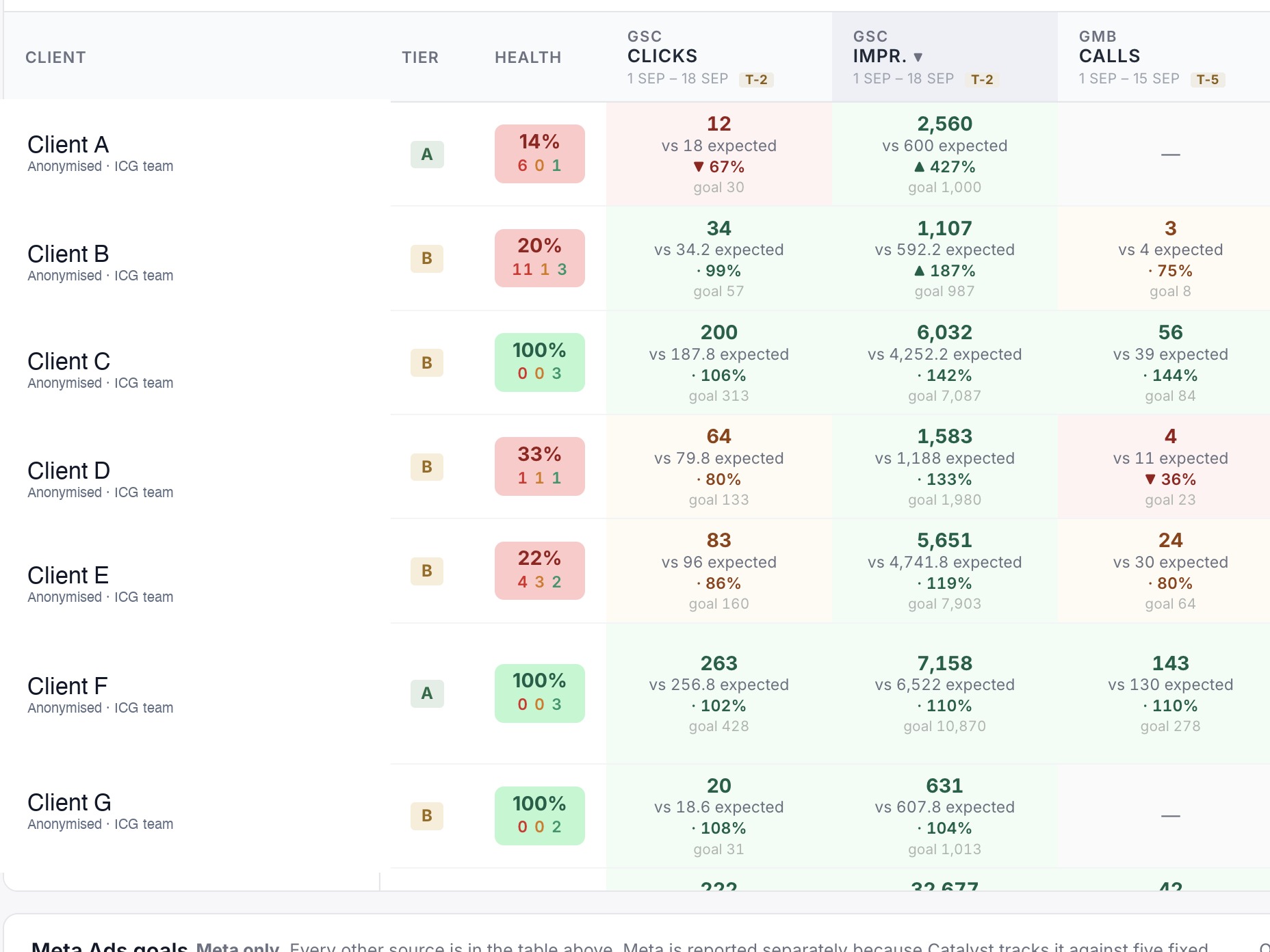
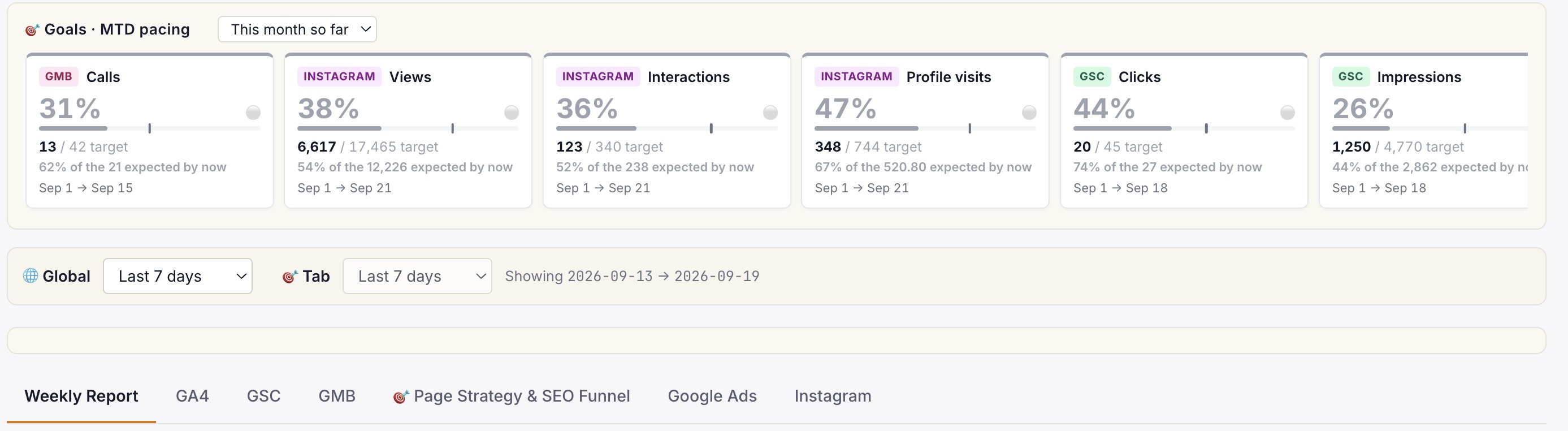
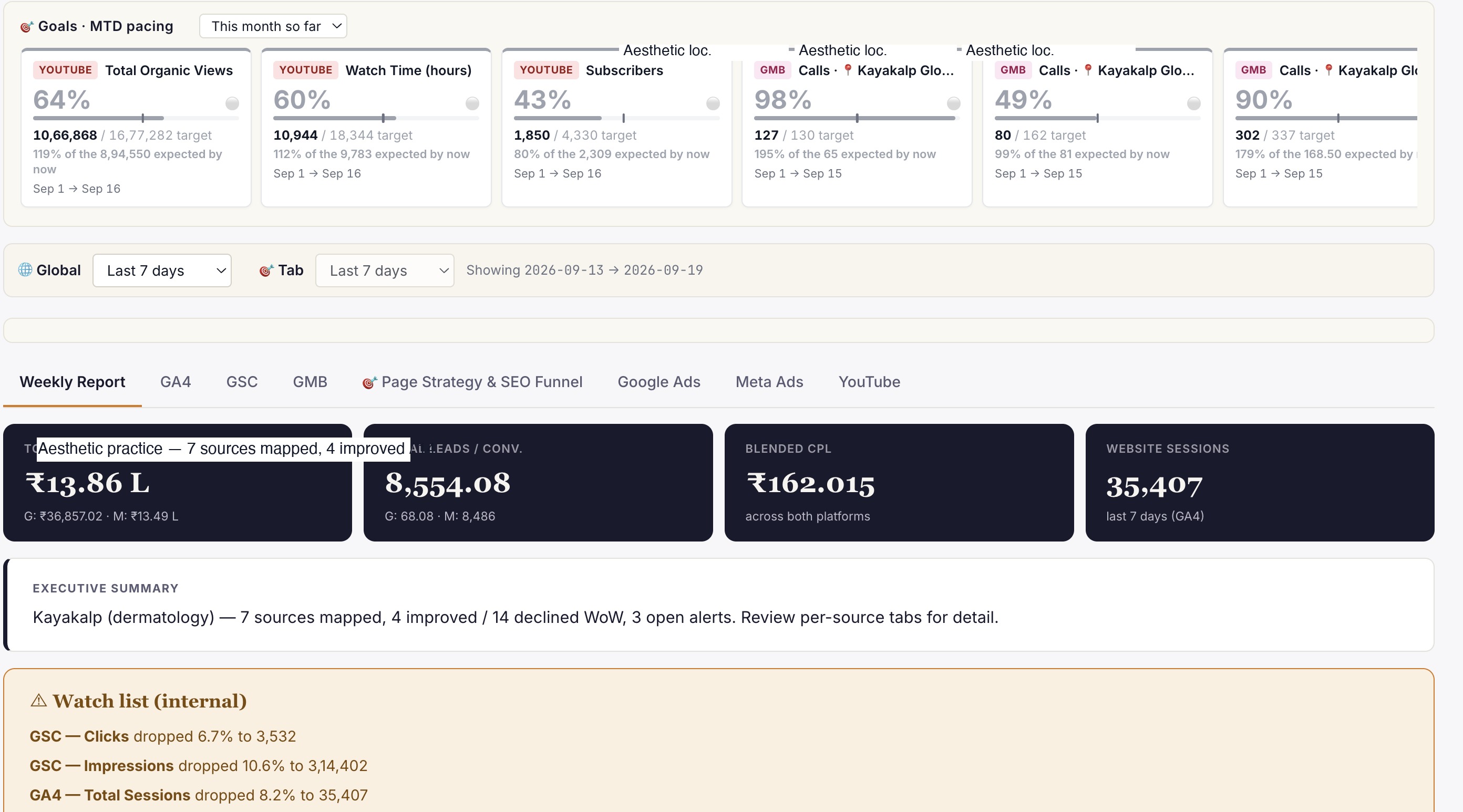
Live client dashboard. GSC, GA4, Google Ads, Meta Ads, IVR calls in one view. Login anytime, not monthly.
Phoenix
Clinic revenue intelligence over your PMS. Daily action queue: Prevent Loss, Maintain & Engage, Grow Revenue. Multi-centre rollout.
Or book a free 30-min audit to see all three in action on your account.
Healthcare brands
that already run on ICG.
A representative slice of the 150+ healthcare brands ICG has delivered for across India. Most engagements remain under NDA.


What ICG clients say · on video.
"Mental health marketing requires a different sensitivity. ICG built compliance-aware campaigns that respect both patients and our..."
"Bariatric surgery patients need a long consideration cycle. ICG built a content + paid system that respects that timeline."
"Working with ICG felt like working with an in-house growth team that happens to specialise in healthcare."
Need help operationalising this?
Every ICG service is healthcare-only, NMC + DPDP-aware, and built around the patient-research patterns that drive Indian healthcare growth in 2026.
Every practice welcome — packages from ₹20,000/mo.
Goals-Driven engagements · Performance-Linked Payout Models available
More from
ICG.
Hindi and regional-language SEO means publishing proper pages in the languages your patients search in, on their own URLs and linked with hr...
A new pharma brand in India should start digital work before launch, built around who it may legally address. This six-month plan covers pro...
Hospitals and clinics in India can still advertise after the NMC's 6 October 2026 guidelines, but only with factual, verifiable information....
Stop guessing.
Book a Diagnostic.
30 minutes. Free. With the AI-powered healthcare-only marketing agency 150+ brands already run on. No slides, no pitch, no hard close.


