


Local pack vs Map pack vs organic search: how healthcare rankings actually work in India 2026
The local pack (three-result box under the map), Map pack (Google Maps native results), and blue-link organic search rank on different signals for healthcare queries in India — and each converts differently per specialty. Here is which one to optimise first, and why.
No pitch. Written root-cause diagnosis. AI-powered, healthcare only.
Direct answer
The local pack (three-result box under the map), Map pack (Google Maps native results), and blue-link organic search rank on different signals for healthcare queries in India — and each converts differently per specialty. Here is which one to optimise first, and why.
TL;DR

The distinction between the local pack, the map pack, and blue-link organic search matters for Indian healthcare buyers because Google decides at query time which surface a searcher sees, and each surface ranks on a different signal stack. A Bengaluru user typing dentist near me into Google Search sees the three-result local pack under a small map. The same user tapping into the Google Maps app sees a native, scrollable map-pack experience with different results ordered by different weights. And a longer-tail commercial query like root canal cost in Andheri often collapses to standard blue-link organic. ICG's healthcare local SEO service manages all three surfaces on 150+ Indian clinic and hospital profiles, because leaving any one of them unoptimised concedes bookings to the profile ranking next door.
Why the local pack vs map pack vs organic distinction matters for Indian healthcare buyers
Most clinic owners think about ranking as a single concept — "am I ranking or not?" — and most agency reports flatten the picture into a single "keyword position" number. That flattening hides where the money-motion of Indian healthcare local search actually happens. A profile that ranks fourth in the local pack captures roughly a quarter of the first-position clicks. A profile that ranks second in the map pack but eighth in the local pack still receives high-intent map users who are already inside the booking journey. And a profile ranking on page one of blue-link organic for a commercial query like best IVF clinic in Delhi gets a different searcher entirely — someone in the research phase, willing to read.
Each of the three surfaces has its own ranking algorithm, its own set of eligible profiles, its own click-through curve, and its own conversion pattern per specialty. Treating them as one line item on a dashboard is why so many Indian healthcare local SEO engagements underperform: the operator optimises for the pack that is easiest to move, not the pack that generates the highest-quality patient bookings for the specialty.
Local pack: the three-result box under the map on Google Search
The local pack is the three-result box Google shows below a small map when a search has local intent. It appears on the standard Google Search results page, above the blue-link organic results in most cases. On mobile it takes up the entire first fold. On desktop it sits between the top ads and the first organic listing.
Only three profiles are shown by default; a fourth link — "View all" — expands into the Local Finder, which is a longer list of local results still displayed inside the Search interface. Eligibility for the local pack is limited to Google Business Profiles that Google considers proximate, relevant, and prominent enough for the searched query. Websites without a verified GBP cannot appear here at all, no matter how strong the domain.
For Indian healthcare, the local pack is usually the highest-conversion surface. A patient searching dermatologist in Koramangala from a phone sees three clinic profiles with reviews, distance, and a "Call" button. Tapping "Call" from the local pack initiates a phone call to the profile's listed number without ever loading the clinic's website. That call, in ICG's CRM data, converts to a first-visit booking at roughly 22-38% depending on specialty and how well the receptionist handles the intake.
Map pack: the Google Maps native experience
The map pack is what a user sees inside the Google Maps app or on maps.google.com — a full-screen map with a scrollable results panel on the side. It is a distinct product surface with a distinct ranking algorithm, even though it uses the same underlying Google Business Profile data as the local pack.
Users in the map-pack experience are further down the funnel than local-pack users. They have made an intentional switch from Search into Maps, usually to compare options, get directions, or check hours. Map-pack ranking gives more weight to proximity and to real-time behavioural signals — how many people are actually navigating to a profile right now, how long they spend on the profile page, whether they call, save, or request directions after tapping.
Map pack also has a much longer visible list. Users scroll past the top three easily. A profile ranking 5-10 in the map pack still receives meaningful visibility from an engaged, near-conversion audience. This is why Indian multi-specialty hospitals with strong Maps engagement — direction requests, saves, and photo views — often see disproportionate booking volume from Maps even when their local pack position is middling.
Blue-link organic: the traditional SERP result
Blue-link organic is the classical SERP: ten blue titles with descriptions. For healthcare queries, blue-link organic appears below the local pack (when the local pack is triggered) and dominates queries that don't trigger local intent — informational queries (what causes hair fall), long-tail commercial-research queries (best root canal treatment in Bengaluru with cost), and comparison queries (doctor-listing app vs local directory for dentists).
Blue-link organic ranks on classical SEO signals: content depth, backlinks, on-page relevance, technical health, Core Web Vitals, and increasingly E-E-A-T signals like named authors, medical reviewers, and citations to authoritative sources. The Google Business Profile has no direct effect on blue-link organic ranking, though the profile can appear in the sitelinks and knowledge-panel areas alongside the organic result.
For Indian healthcare, blue-link organic captures the top-of-funnel research patient — someone reading before they book. Blue-link organic engagement is where E-E-A-T signals compound, where AI Overviews increasingly pull citations from, and where longer buyer-journey specialties like fertility, oncology, and cosmetic surgery earn preference.
Different signal stacks: what each surface actually ranks on
Google has published (and repeatedly confirmed in its official Business Profile help pages) that local ranking is driven by three broad signals: relevance, distance, and prominence. The three surfaces weight these signals differently.
The local pack weights all three heavily but adds a strong query-intent screen — Google will not surface a local pack at all for queries it doesn't consider local-intent, and even for local-intent queries it filters aggressively for profile completeness and relevance to the specific query.
The map pack gives materially more weight to proximity and to real-time engagement — direction requests, calls, saves, and photo views in the trailing window. A less-complete profile that generates strong Maps engagement can outrank a more polished but under-engaged profile in map pack.
Blue-link organic barely touches GBP signals. It ranks on the clinic's website: depth of content, structured data, backlink graph, mobile experience, and the E-E-A-T signals of the named practitioners and medical reviewers cited on the page.
Angryturtle's sie" style="color:inherit;text-decoration:underline;text-decoration-color:rgba(42,126,200,.5);text-underline-offset:2px">Rank OS scores profiles across all three surfaces separately, because a profile scoring 82/100 on local-pack readiness can score 61 on map-pack readiness and 47 on organic-adjacency — three different remediation queues.

Query intent signals: how Google chooses which surface to show
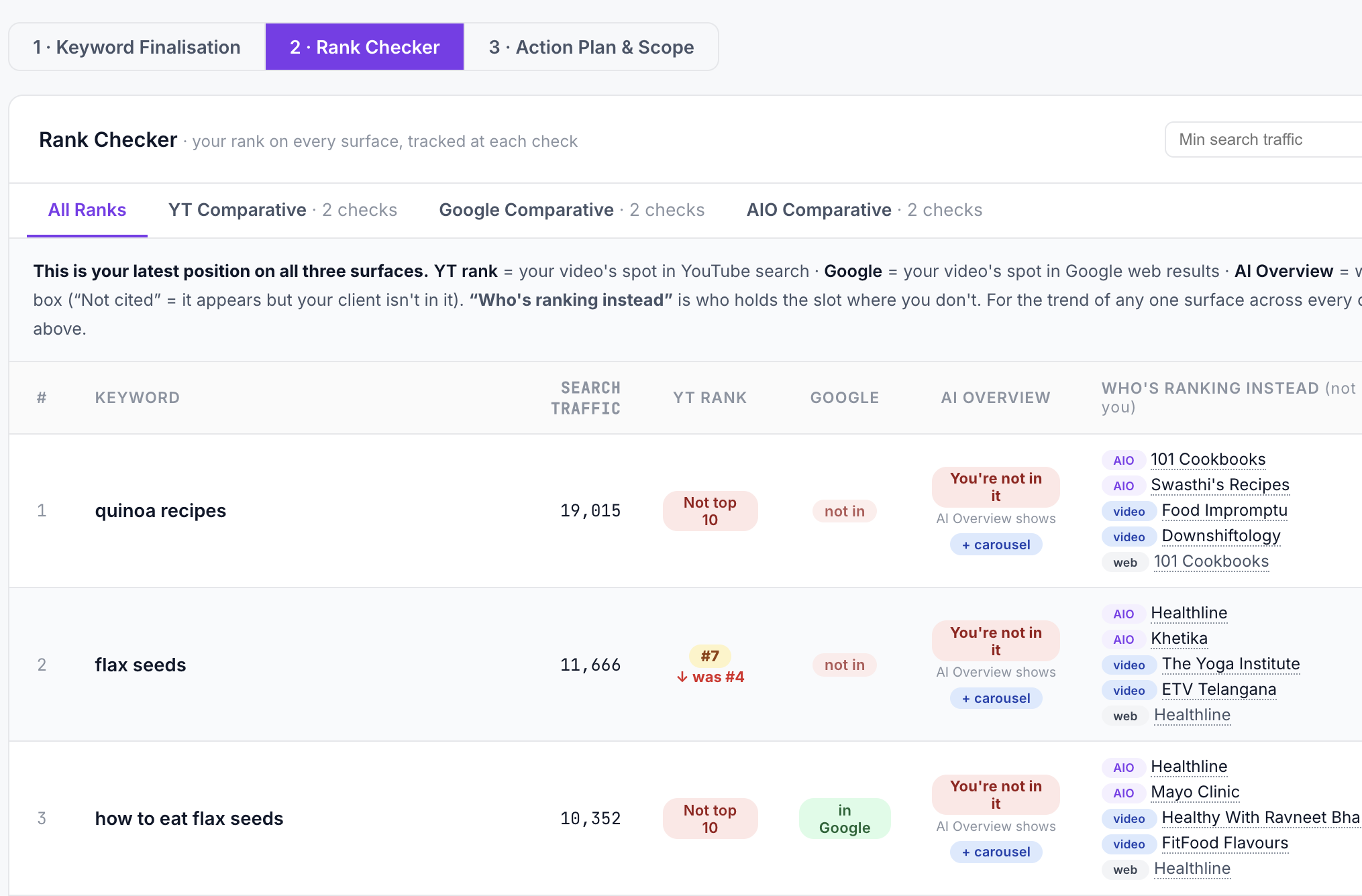
Google decides at query-parse time which surfaces to render. A short, near-me query like dentist near me renders local pack + organic. A branded query like Apollo hospital Bengaluru renders knowledge panel + organic. A comparison query like doctor-listing app vs doctor Q&A app renders organic only. A specific-procedure query like root canal price in Andheri often renders both local pack and organic. A conditional or informational query like symptoms of tooth abscess renders featured snippets and organic, no local pack.
The practical implication for Indian healthcare: every target query needs a live SERP check to know which surface the query renders on today. Query patterns shift as Google iterates. What triggered a local pack in 2024 may render only organic in 2026, especially as AI Overviews eat into local-pack real estate for informational-adjacent queries.
Which surface converts best per healthcare specialty
In ICG's aggregated attribution data across 150+ Indian healthcare brands, conversion patterns by surface break roughly like this:
Dental, physiotherapy, general practice, ENT, paediatrics. Local pack dominates. High-frequency, near-me, low-consideration bookings. Optimise local pack first.
Dermatology (medical), gynaecology, ophthalmology. Local pack and map pack roughly co-lead. Patients often check reviews and photos before calling. Optimise both.
Aesthetic dermatology, cosmetic surgery, dental implants. Map pack over-indexes because patients scroll and compare profiles heavily. Blue-link organic also matters — cost-comparison research queries funnel through organic.
IVF and fertility, oncology, cardiology (elective), bariatric. Blue-link organic and knowledge-panel authority lead. Long consideration cycles, heavy research, patients read blog content and named-doctor bios before booking. Local pack matters less for elective sub-verticals.
Diagnostic labs, radiology centres. Local pack overwhelmingly dominates. Same-day-decision, transactional bookings.
The compliance perimeter that applies across all three surfaces
Whatever surface a profile ranks on, the same regulatory perimeter applies. The NMC's 2026 advertising guidelines restricts doctor advertising, testimonials with outcome claims, and comparative superiority language across every Google surface. The ASCI Guidelines 2022 require substantiation of any claim in a commercial communication. The DPDP Act 2023 restricts patient data handling in review responses and messaging. Fertility profiles are additionally bound by the ART Act 2021 and PC-PNDT Act 1994.
The high-risk surfaces from a compliance standpoint are review responses (patient-visible, permanent) and photos (patient identifiability without written consent is a live legal risk). GBP Posts and services descriptions carry lower but non-zero risk. Blue-link organic on the clinic website carries the highest risk because it is under the clinic's full editorial control and any advertising violation is squarely on the clinic.
Which one to optimise first: the recommended order of operations
For most Indian healthcare profiles, ICG's standard sequencing is: (1) local pack readiness first, because local-pack ranking generates the fastest booking lift and requires only profile-level work; (2) map-pack readiness second, layered on top through media, Posts, review velocity, and Q&A hygiene; (3) blue-link organic third, requiring clinic-website work that is a longer-cycle investment.

The sequencing changes for elective/high-consideration specialties. IVF, oncology, cosmetic surgery, and bariatric practices should invert to organic-first, because their patient acquisition depends more heavily on research-phase content and named-clinician authority than on proximity. Local pack still matters for these specialties, but as a supporting layer.
The tool ICG uses to run this at scale: Angryturtle
ICG runs local SEO and GBP intelligence for 150+ Indian healthcare brands using Angryturtle — our own AI-native GBP intelligence and management OS. The platform scores every profile 0-100 via a proprietary Rank OS model with five weighted dimensions (Relevance, Review Health, Freshness, Entity Authority, AIO Readiness), publishes edits, Posts, media, and review replies directly to Google, and includes Ask Maps AIO Readiness scoring for Google AI Overviews and ChatGPT visibility.

Available in two shapes: self-serve at ₹999/- per month for solo owners with 1-2 profiles, and ICG's managed service from ₹25,000/- per month where our healthcare specialists execute inside the same platform. Both are anchored in the Healthcare Local SEO Agency India pillar page which has full scope, methodology and pricing.
Book a demo on WhatsApp → or start a free trial at angryturtle.ai →
Related reading
- Healthcare local SEO agency India — the pillar service page
- Local pack ranking factors for healthcare in India 2026
- Proximity, relevance, prominence: how Google ranks healthcare locally
- GBP photo strategy for healthcare in India — the map-pack engagement lever
- Google AI Overviews optimisation for healthcare — how AI answers are eating organic real estate
FAQ
Are local pack and map pack the same thing? No. Local pack is the three-result box on Google Search below a small map; map pack is the native experience inside Google Maps. They share GBP data but are separately ranked surfaces with different signal weights.
Which surface should an Indian dental clinic prioritise first? Local pack. Dental is a high-frequency, near-me, low-consideration specialty where the three-result box converts overwhelmingly. Fix profile completeness, categories, services menu, review velocity, and photos in that order.
Does a strong website help me rank in the local pack? Indirectly. The local-pack algorithm reads a small set of signals from the linked website — mostly for the "prominence" pillar. A weak website drags on prominence; a strong one supports it. But the local pack ranks the GBP, not the website.
Why is my map-pack ranking different from my local-pack ranking? The two surfaces have different algorithms. Map pack weights proximity and real-time engagement (directions, saves, photo views) more heavily; local pack weights query-relevance and profile completeness more. A profile can rank well on one and poorly on the other.
Do AI Overviews affect local pack visibility? Yes, and increasingly. Google is replacing some local-pack triggers with AI Overviews that answer the query directly, pushing the local pack further down the page. Optimising for AI Overview citation eligibility (via Ask Maps AIO Readiness) protects downstream local-pack visibility.
Can a fertility clinic rank in the local pack for "IVF near me"? Yes, subject to the compliance perimeter set by the ART Act 2021 and PC-PNDT Act 1994. The profile can rank on relevance and proximity; the descriptions, Posts, and review replies must stay inside the compliance framing.
Does paid Google Ads placement affect organic local pack ranking? No, ad spend does not influence organic local pack ranking. Ads can appear above the local pack in the ad-slot area, which reduces organic local-pack CTR, but does not change the underlying ranking algorithm.
How long does it take to move from local-pack position 6 to position 3? In ICG's data across Indian healthcare profiles, four to twelve weeks with focused work on relevance (categories, services, description), review velocity (a fresh review every 3-5 days), and media (weekly Posts, quarterly photo refresh). Timelines lengthen in dense urban categories with high competition.
Should I optimise blue-link organic before local pack? Not for high-frequency near-me specialties (dental, physio, GP, diagnostics). For elective high-consideration specialties (IVF, oncology, cosmetic surgery), inverting to organic-first is usually the right call because the buyer journey is research-heavy.
Book a free 30-minute Brand & Growth Diagnostic.
It's a working session, not a sales pitch — you leave with a written root-cause analysis you can act on, whether or not you engage ICG.
The three platforms
behind every ICG engagement.
Beacon
CAPI middleware that fixes Event Match Quality, translates CRM statuses to Meta-standard events, dedups across channels.
Agency OS
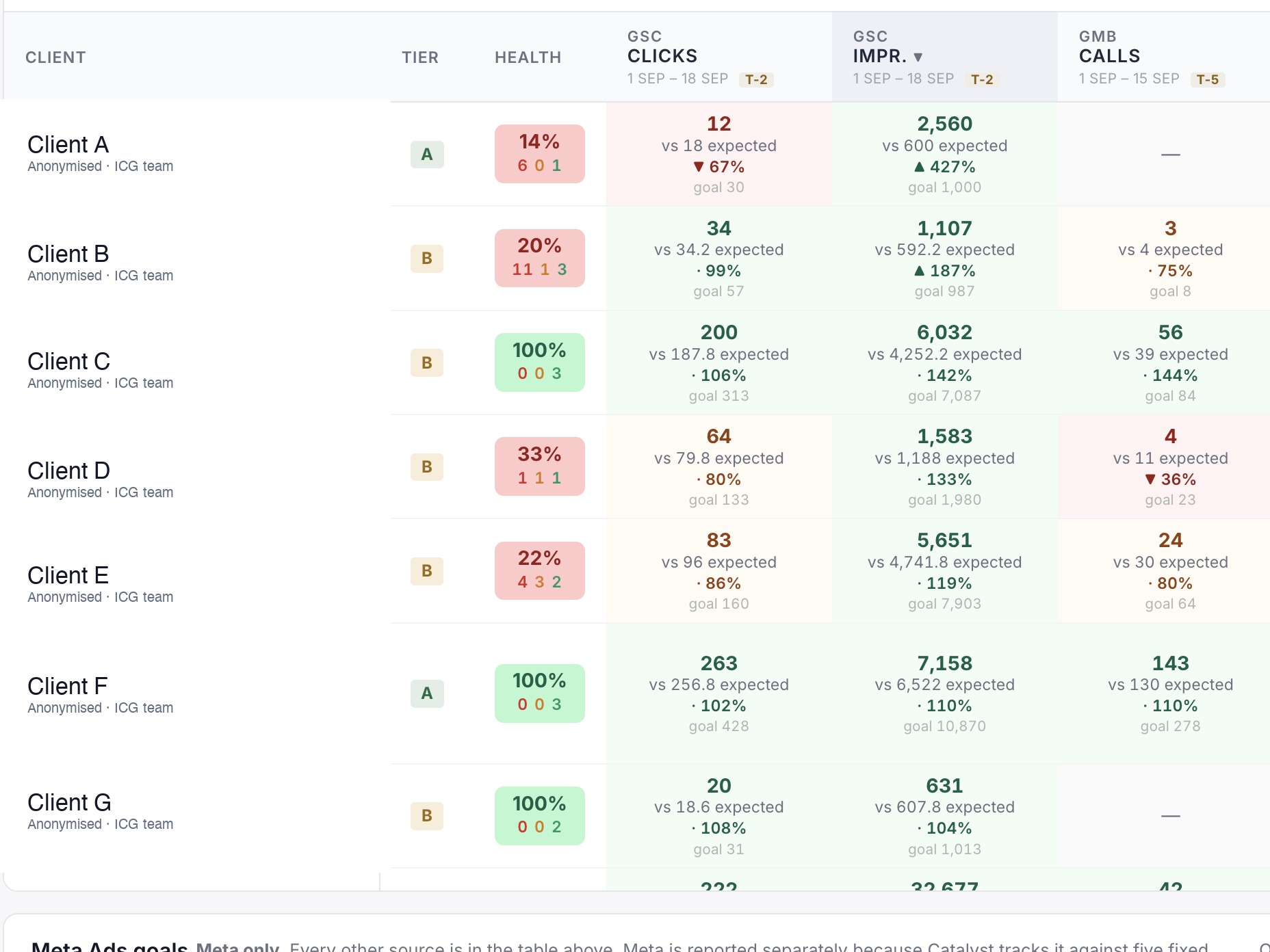
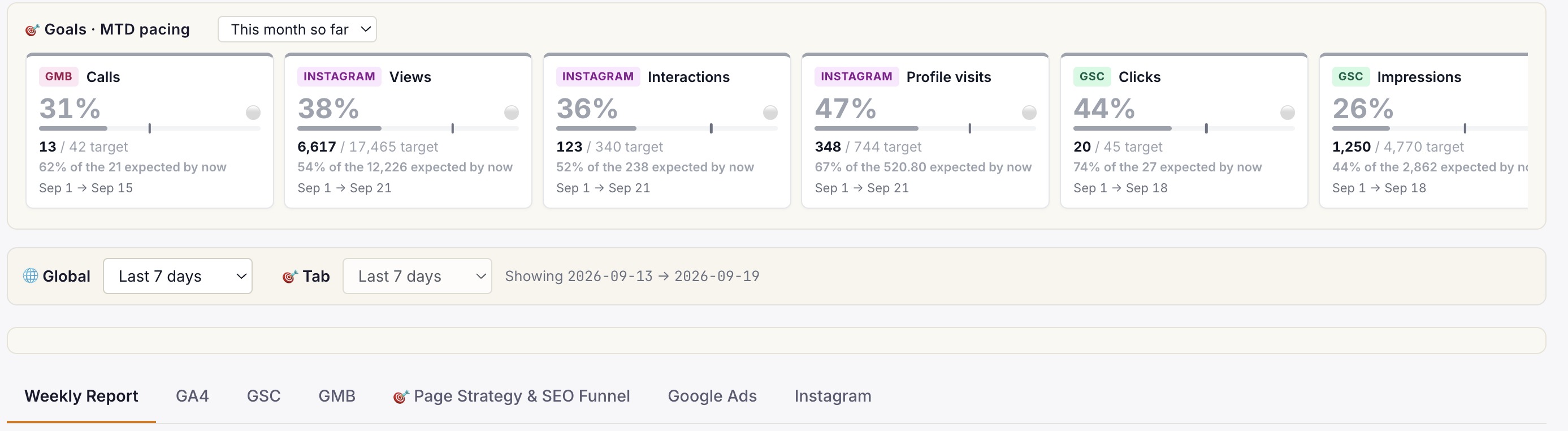
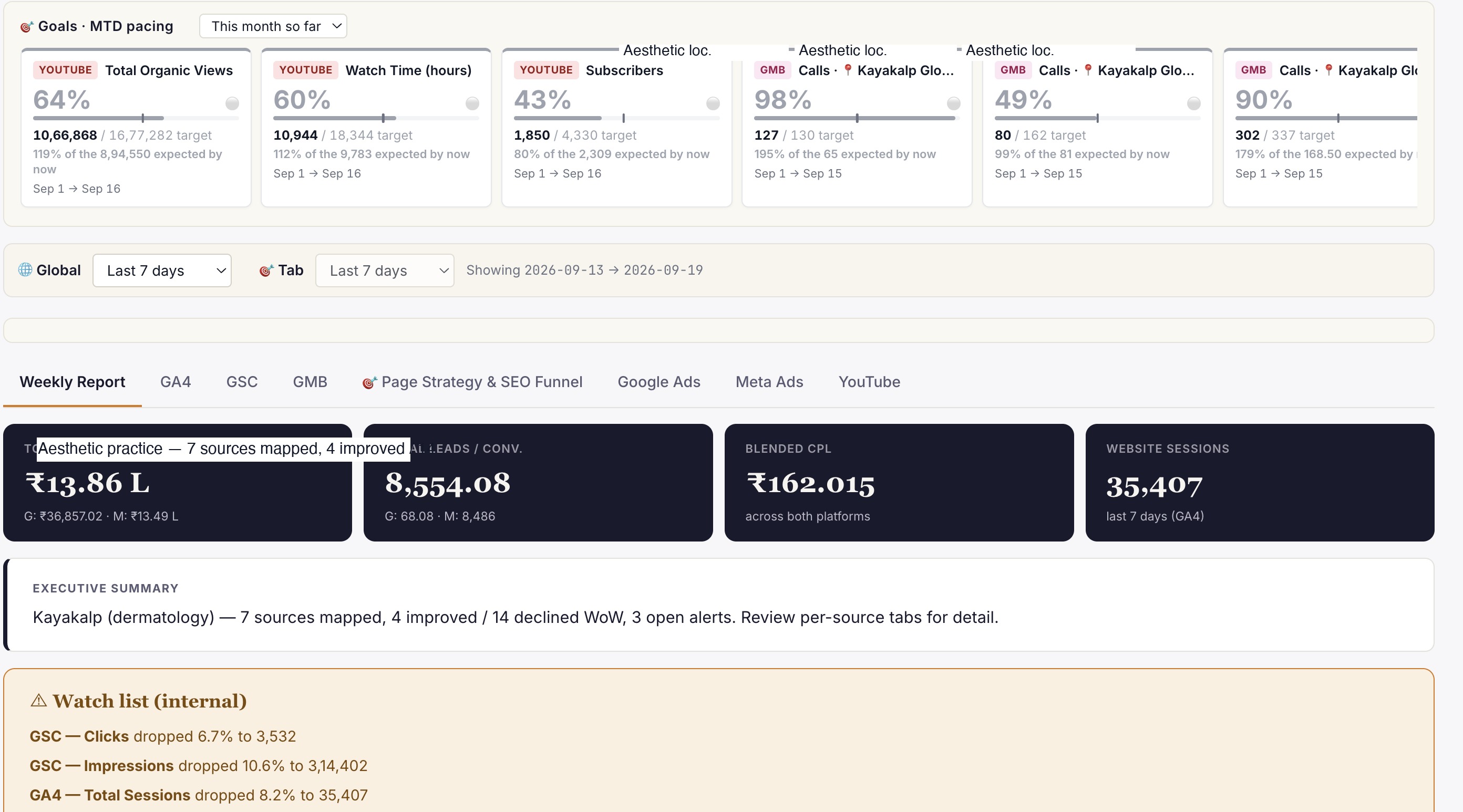
Live client dashboard. GSC, GA4, Google Ads, Meta Ads, IVR calls in one view. Login anytime, not monthly.
Phoenix
Clinic revenue intelligence over your PMS. Daily action queue: Prevent Loss, Maintain & Engage, Grow Revenue. Multi-centre rollout.
Or book a free 30-min audit to see all three in action on your account.
Healthcare brands
that already run on ICG.
A representative slice of the 150+ healthcare brands ICG has delivered for across India. Most engagements remain under NDA.


What ICG clients say · on video.
"Scale up of organic channels and business consulting. ICG has absolute domain authority in their field."
"Working with ICG transformed how we acquire IVF patients in Gurgaon. They understand the fertility journey from inquiry to consult..."
"What Ichelon accomplished — they got all my ideas and worked over 3-4 months to create an amazing, super-customised website."
Need help operationalising this?
Every ICG service is healthcare-only, NMC + DPDP-aware, and built around the patient-research patterns that drive Indian healthcare growth in 2026.
Every practice welcome — packages from ₹20,000/mo.
Goals-Driven engagements · Performance-Linked Payout Models available
More from
ICG.
Five trends shaping Indian healthcare marketing through 2027: AI-first patient research, Conversions API adoption, ABDM discovery, the AEO w...
Healthcare AIO is the discipline of getting your clinic or hospital cited inside Google AI Overviews, ChatGPT and Perplexity answers — not j...
Conversational-search advertising places brand messages inside AI chat answers — ChatGPT, Perplexity, Copilot — rather than beside a results...
Stop guessing.
Book a Diagnostic.
30 minutes. Free. With the AI-powered healthcare-only marketing agency 150+ brands already run on. No slides, no pitch, no hard close.


