


Google AI Overviews for healthcare in India 2026: which queries trigger AIO, how Google picks citations, and how clinics get cited
Google AI Overviews for healthcare in India 2026 now surface on a rising share of patient queries — and citation eligibility is decided by structured content, entity clarity, review signal, freshness and authority, not the classical local pack ranking factors.
No pitch. Written root-cause diagnosis. AI-powered, healthcare only.
Direct answer
Google AI Overviews for healthcare in India 2026 now surface on a rising share of patient queries — and citation eligibility is decided by structured content, entity clarity, review signal, freshness and authority, not the classical local pack ranking factors.
TL;DR

Google AI Overviews for healthcare in India in 2026 are the largest single change in search behaviour Indian clinic and hospital marketers have seen since Google Business Profile went mainstream. AIO answers a growing share of question-shaped patient queries directly at the top of the search page, cites specific sources — websites, GBP profiles, structured data feeds — and shifts click distribution downstream. Traffic that used to go to the local pack now often ends at the AI answer. Being cited inside the AI answer is a new visibility surface that generic local SEO frameworks do not measure and generic content strategies do not optimise for. ICG's healthcare local SEO service now includes AIO Readiness scoring as a first-class dimension in every managed account, executed through Angryturtle's Ask Maps module.

What Google AI Overviews are and why they matter for healthcare
Google AI Overviews (AIO) is the AI-generated summary that appears at the top of search results for a growing share of queries, above the classical organic listings and often above the local pack. The summary synthesises information from multiple sources — websites, structured data, Google Business Profile fields, and Google's own knowledge graph — and cites the sources inline.
For healthcare queries specifically, AIO changes the search-to-booking funnel in three ways. First, patients read the AI answer before scrolling to the local pack or organic results, so pre-click qualification happens inside the AI summary rather than on the profile card. Second, patients trust the AI answer as an authoritative synthesis, which means an incorrect or missing citation is a lost trust moment. Third, being cited inside the AI answer is itself a visibility win — the practice name and location appear at the top of the search page, even when the searcher does not click the citation link.
AI Overviews rolled into India through Search Generative Experience testing in 2024 and expanded through 2025 into general search for a widening query set. Healthcare queries are a high-priority surface because they are question-shaped, high-consideration, and directly served by structured medical information.
Which healthcare queries trigger AIO in India
AI Overviews do not appear on every query. The triggering patterns for Indian healthcare search are observable and follow four families.
Question-shaped informational queries. "What is the cost of IVF in Bengaluru," "does insurance cover root canal treatment," "what causes recurring UTI," "how long does knee replacement recovery take." These trigger AIO consistently.
Comparison queries. "Best cardiology hospital in Delhi," "IVF vs IUI difference," "dental implants vs bridges pros and cons." AIO surfaces comparative summaries pulling from multiple sources.
Procedure-specific queries. "Root canal treatment procedure," "coronary angioplasty explained," "PGT preimplantation genetic testing" — AIO explains the procedure with citations to authoritative medical sources.
Cost and coverage queries. "IVF cost India 2026," "dental implant cost Bengaluru," "cataract surgery insurance India" — AIO synthesises price ranges from multiple sources.
Queries that reliably do not trigger AIO in Indian healthcare today: emergency queries ("cardiac emergency near me"), navigational queries ("Apollo Hospital contact"), and very specific transactional queries ("book appointment [clinic name]"). These continue to resolve through classical local pack and organic results.
How Google picks AIO citations for healthcare answers
Google's citation-selection mechanism for AI Overviews is not publicly documented in full, but observable behaviour and Google's own stated principles for search quality point to six factors that consistently correlate with citation frequency.
Structured data quality. Sources with clean schema.org markup (MedicalBusiness, Dentist, Hospital, MedicalCondition, MedicalProcedure) are cited more frequently than sources with unstructured text alone. Structured data reduces uncertainty in Google's answer generation.
Entity clarity. A page or profile that clearly identifies itself as an authority on the specific topic — through primary category, service listings, author credentials, medical reviewer bylines — is cited more reliably than a source with ambiguous or unfocused topic authority.
Review signal and trust. For citations to a specific practice, review volume, rating, and reply activity all correlate with citation frequency. A profile with 200 reviews and a 4.6 rating gets cited more often than a profile with 20 reviews at the same rating.
Freshness. Content and profile data with recent updates gets preferred citation weight. Stale content — last updated three years ago — is cited less often for time-sensitive queries.
Authority signals. Backlinks from authoritative healthcare sites (professional associations, government sources, academic institutions), Wikipedia entries where applicable, and coverage in credible health publications feed the source-selection weighting.
Answerability. Content and profile data that directly answers the query — in structured form, in an FAQ, in a clearly-scoped page section — is easier to cite than content that requires the AI to reason across multiple paragraphs to extract an answer.
Structured content patterns that get extracted into AIO
Content that appears in AI Overviews follows recognisable patterns. Optimising for AIO extraction is a specific content craft, distinct from generic SEO writing.
Question-and-answer blocks with schema.org FAQPage markup are the highest-frequency citation surface. Each question is a discrete answer unit the AI can extract cleanly.
Definition-first paragraphs — where the topic is defined in the first sentence, with elaboration following — are more extractable than paragraphs that build to a definition.
Comparative tables with named entities are extracted for comparison queries. A table comparing IVF, ICSI, IUI on stimulation protocol, success factors, cost range, and typical patient profile is more extractable than three paragraphs describing the same distinctions.
Numbered lists and stepwise procedures are extracted for "how" and "what steps" queries. A numbered list of the root canal treatment process is more citation-eligible than a prose description.
Explicit source attribution and citation of authoritative bodies (WHO, ICMR, NMC, NABH) inside the content signals editorial rigour and increases citation weight. Reference: the Indian Council of Medical Research publishes healthcare guidelines directly.
Entity clarity and schema.org markup for healthcare
Entity clarity is the second-highest citation-eligibility factor. Google needs to unambiguously identify what the source is authoritative about before it will cite the source in an AI answer.
For a healthcare practice, entity clarity comes from consistent name-address-phone signalling across the website, GBP, and citations; schema.org markup identifying the site as MedicalBusiness with specific specialty (Dentist, Hospital, Physician); named authors and medical reviewers with credentials on content pages; and clear specialty focus across the top-navigation and service pages.
A dermatology practice that publishes content across nutrition, general medicine, and cosmetic dermatology has weaker entity clarity for dermatology-specific queries than a practice that publishes primarily on dermatology topics. Entity focus concentrates citation-eligibility.
Review signal in AIO citation selection for local queries
When AI Overviews cite specific practices (as opposed to citing informational content), the review signal on the cited practice's Google Business Profile carries substantial weight. Observable patterns: cited practices consistently have rating averages above 4.3, review volume above the specialty-market floor, and recent review velocity indicating active practice.

Review reply-rate also matters. Practices that reply to 90%+ of reviews signal active management, which the AI reads as a trust factor for citation. Practices with visible unreplied negative reviews are cited less frequently, even when other signals are strong.
The implication: sustained review-generation and review-management practice — inside the compliance perimeter set by NMC's 2026 advertising guidelines and ASCI Guidelines 2022 — is not just local pack ranking work, it is AIO citation eligibility work.
Freshness and update cadence signals
AI Overviews for healthcare queries preferentially cite sources with recent updates. Content that has been reviewed and updated within the trailing 12 months carries preference; content last updated three years ago is cited less often.
Two operational implications. First, evergreen healthcare content — procedure explainers, cost-context pages, condition guides — needs a scheduled review cadence at least annually, with visible "last updated" dates. Second, Google Business Profile freshness signals — weekly Posts, monthly photo uploads, current hours and services — feed the AIO citation weight for local practice citations.
Angryturtle's freshness scoring inside sie" style="color:inherit;text-decoration:underline;text-decoration-color:rgba(42,126,200,.5);text-underline-offset:2px">Rank OS tracks both content and profile freshness as a distinct axis, and flags stale surfaces in the action queue.


Authority signals: backlinks, medical review, byline
Authority signals fold into AIO citation weighting in ways parallel to how they fold into organic ranking, but with heightened sensitivity for healthcare.
Backlinks from authoritative healthcare-adjacent sources (professional associations, health publications, government health portals, academic institutions) increase citation weight. Backlinks from generic directories or low-quality sources add little.
Medical reviewer bylines on content pages — a named specialist with credentials who reviewed and endorsed the content — signal editorial rigour. Under Google's Search Quality Rater Guidelines, Your Money or Your Life (YMYL) content including healthcare is held to higher E-E-A-T standards, and named medical reviewers materially improve E-E-A-T scoring which correlates with citation eligibility.
Author bylines with real credentials and named identity, linked to author profile pages with credentials, publications, and affiliations, feed the authority signal at content-page level.
Measuring AIO visibility: GA4, GSC limitations, third-party tools
Measuring AI Overviews visibility is harder than measuring classical organic or local pack visibility, because Google does not currently report AIO impressions and clicks as a distinct segment in Search Console.
What is measurable today. GA4 traffic attribution can distinguish AI-referred sessions when the AI answer includes a click-through link and referral parameters propagate. Anecdotal citation frequency can be sampled by running a test bank of specialty-specific queries against Google Search regularly and logging when the practice is cited. Third-party tools including AIO tracking platforms and Angryturtle's Ask Maps module estimate AIO visibility through structured-answerability audits and observed citation frequency across a test query bank.
What is not directly measurable. Impressions inside the AI answer where the citation was shown but not clicked. Read-through rate — how many searchers read the AI answer and formed impressions of the cited practice without clicking. Google may add explicit AIO segment reporting to Search Console over time; today, indirect measurement is the practical standard.
Angryturtle's Ask Maps AIO Readiness scoring
Angryturtle's Ask Maps module scores AIO Readiness explicitly. The mechanism: a specialty-specific question bank of 40-80 patient queries is run against the profile's structured data, description, services list, attributes, Q&A section, and linked website content. Each query is scored on whether the profile is answerable — meaning whether a fair reader could extract a defensible answer from the profile's data.
Unanswerable queries surface as gaps in the action queue. The gap-fill workflow drafts compliance-safe content additions — Q&A entries, description edits, service description updates, FAQ additions on the linked website — to close each gap. Every draft passes through the operator's compliance-reviewer approval before publishing.
Rank OS folds AIO Readiness score into the composite 0-100 score alongside Relevance, Review Health, Freshness, and Entity Authority. Score improvements on AIO Readiness correlate with observed increases in AI Overviews citation frequency across the 150+ Indian healthcare brands ICG manages on the platform.
The tool ICG uses to run this at scale: Angryturtle
ICG runs local SEO and GBP intelligence for 150+ Indian healthcare brands using Angryturtle — our own AI-native GBP intelligence and management OS. The platform scores every profile 0-100 via a proprietary Rank OS model with five weighted dimensions (Relevance, Review Health, Freshness, Entity Authority, AIO Readiness), publishes edits, Posts, media, and review replies directly to Google, and includes Ask Maps AIO Readiness scoring for Google AI Overviews and ChatGPT visibility.
Available in two shapes: self-serve at ₹999/- per month for solo owners with 1-2 profiles, and ICG's managed service from ₹25,000/- per month where our healthcare specialists execute inside the same platform. Both are anchored in the Healthcare Local SEO Agency India pillar page which has full scope, methodology and pricing.
Book a demo on WhatsApp → or start a free trial at angryturtle.ai →
Related reading
- Healthcare local SEO agency India — the pillar service page
- Proximity, relevance, prominence for healthcare — Google's three pillars plus AIO as the de facto fourth
- Local pack ranking factors for healthcare — the 25+ signal list
- Angryturtle Ask Maps AIO explained — the AIO Readiness scoring mechanism
- Angryturtle Rank OS explained — how AIO Readiness folds into the composite score
Related reading
- See how the same principles apply to cardiac content in AI Overview optimization for cardiology hospitals.
FAQ
What is Google AI Overviews and when did it launch in India? Google AI Overviews (AIO) is the AI-generated summary at the top of many Google search results, synthesising information from multiple sources and citing them inline. It rolled into India through Search Generative Experience testing in 2024 and expanded through 2025 into general search for a widening query set.
Which healthcare queries trigger AIO most consistently? Question-shaped informational queries, comparison queries, procedure-specific queries, and cost or coverage queries. Emergency queries, navigational queries, and very specific transactional queries typically do not trigger AIO.
How does Google pick which sources to cite in AIO? Six correlated factors: structured data quality, entity clarity, review signal for local practice citations, freshness of content and profile data, authority signals (backlinks, medical reviewer bylines), and answerability of the query set by the source.
Does classical local pack ranking still matter now that AIO exists? Yes. AIO does not fully replace the local pack for most queries — it appears above it. High local-pack ranking is still where most healthcare booking clicks originate; AIO adds a new visibility surface on top of the classical stack.
Can I measure AIO visibility in Google Search Console? Not directly today. GSC does not currently break out AIO impressions or clicks as a distinct segment. Indirect measurement through GA4 referral attribution, sampled citation frequency, and third-party tools including Angryturtle's Ask Maps module is the practical standard in 2026.
What compliance risks apply to AIO-focused healthcare content? Same perimeter as other healthcare marketing content: NMC's 2026 advertising guidelines (no misleading claims, no outcome testimonials), ASCI Guidelines 2022 (substantiation of claims), DPDP Act 2023 (patient data protection), and specialty-specific frameworks (ART Act 2021 for fertility, PC-PNDT 1994 for sex-determination-adjacent content).
How long before AIO citation frequency improves after optimisation? Structured data and profile-level changes register within 2-4 weeks. Content-level changes register within 4-8 weeks after Google recrawls and reindexes. Compound effect visible in 3-6 months of sustained optimisation.
Do AIO citations drive booking clicks or just visibility? Both, in a shifting ratio. Citation-linked clicks are lower than classical top-of-page organic clicks, but citation-driven visibility (name and location shown at the top of the search page even without a click) contributes to brand recognition that increases downstream direct-search and repeat-patient rates.
What's the highest-leverage single change to improve AIO Readiness? FAQ schema markup on the linked website's key pages, mapped to the specialty's most-frequent patient questions, combined with clean MedicalBusiness or specialised medical schema across the site. Angryturtle's Ask Maps question bank identifies the highest-priority questions per specialty.
Should I optimise for Google AIO, ChatGPT search, or both? Both — the underlying signals overlap substantially. Structured data, entity clarity, review signals, freshness, and authority feed citation eligibility across Google AI Overviews, ChatGPT search, Perplexity, and other AI-first search surfaces. Optimising for the Google AIO signal set produces cross-surface benefit.
Book a free 30-minute Brand & Growth Diagnostic.
It's a working session, not a sales pitch — you leave with a written root-cause analysis you can act on, whether or not you engage ICG.
The three platforms
behind every ICG engagement.
Beacon
CAPI middleware that fixes Event Match Quality, translates CRM statuses to Meta-standard events, dedups across channels.
Agency OS
Live client dashboard. GSC, GA4, Google Ads, Meta Ads, IVR calls in one view. Login anytime, not monthly.
Phoenix
Clinic revenue intelligence over your PMS. Daily action queue: Prevent Loss, Maintain & Engage, Grow Revenue. Multi-centre rollout.
Or book a free 30-min audit to see all three in action on your account.
Healthcare brands
that already run on ICG.
A representative slice of the 150+ healthcare brands ICG has delivered for across India. Most engagements remain under NDA.


What ICG clients say · on video.
"Scale up of organic channels and business consulting. ICG has absolute domain authority in their field."
"Working with ICG transformed how we acquire IVF patients in Gurgaon. They understand the fertility journey from inquiry to consult..."
"What Ichelon accomplished — they got all my ideas and worked over 3-4 months to create an amazing, super-customised website."
The intelligence stack behind this playbook.
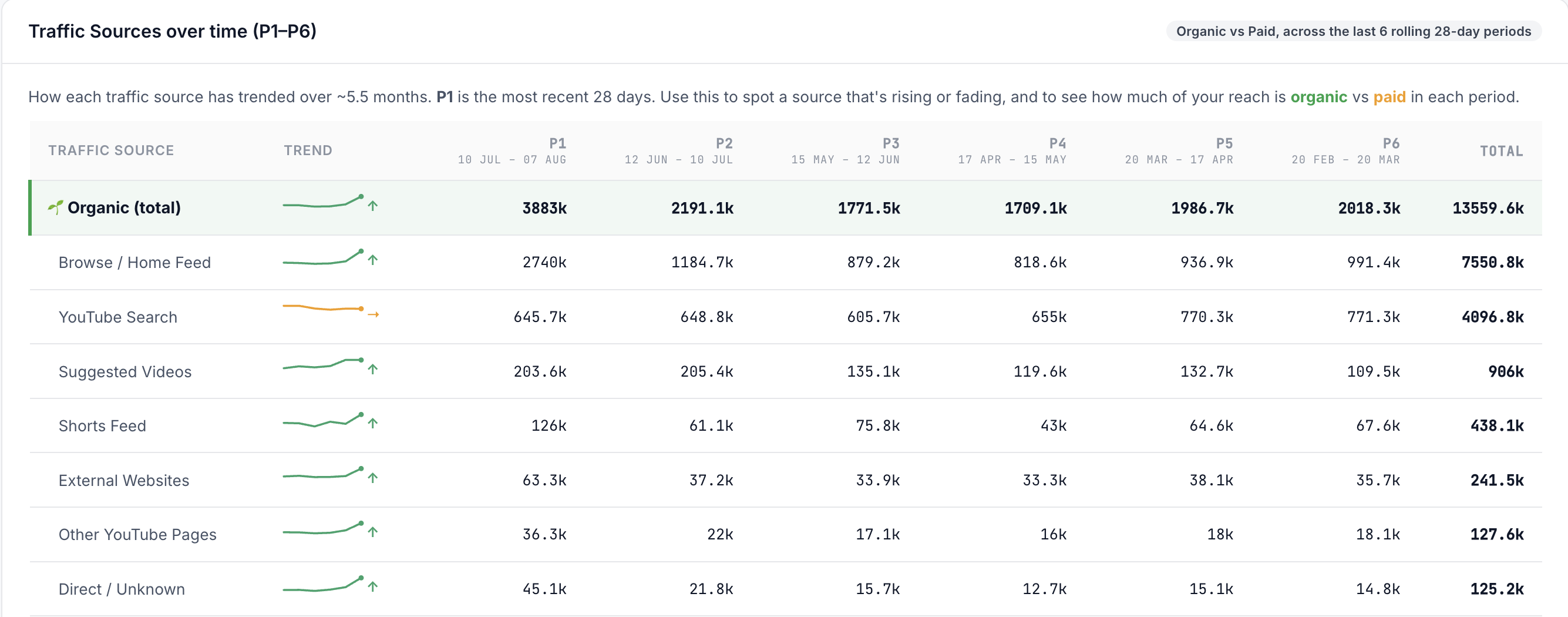
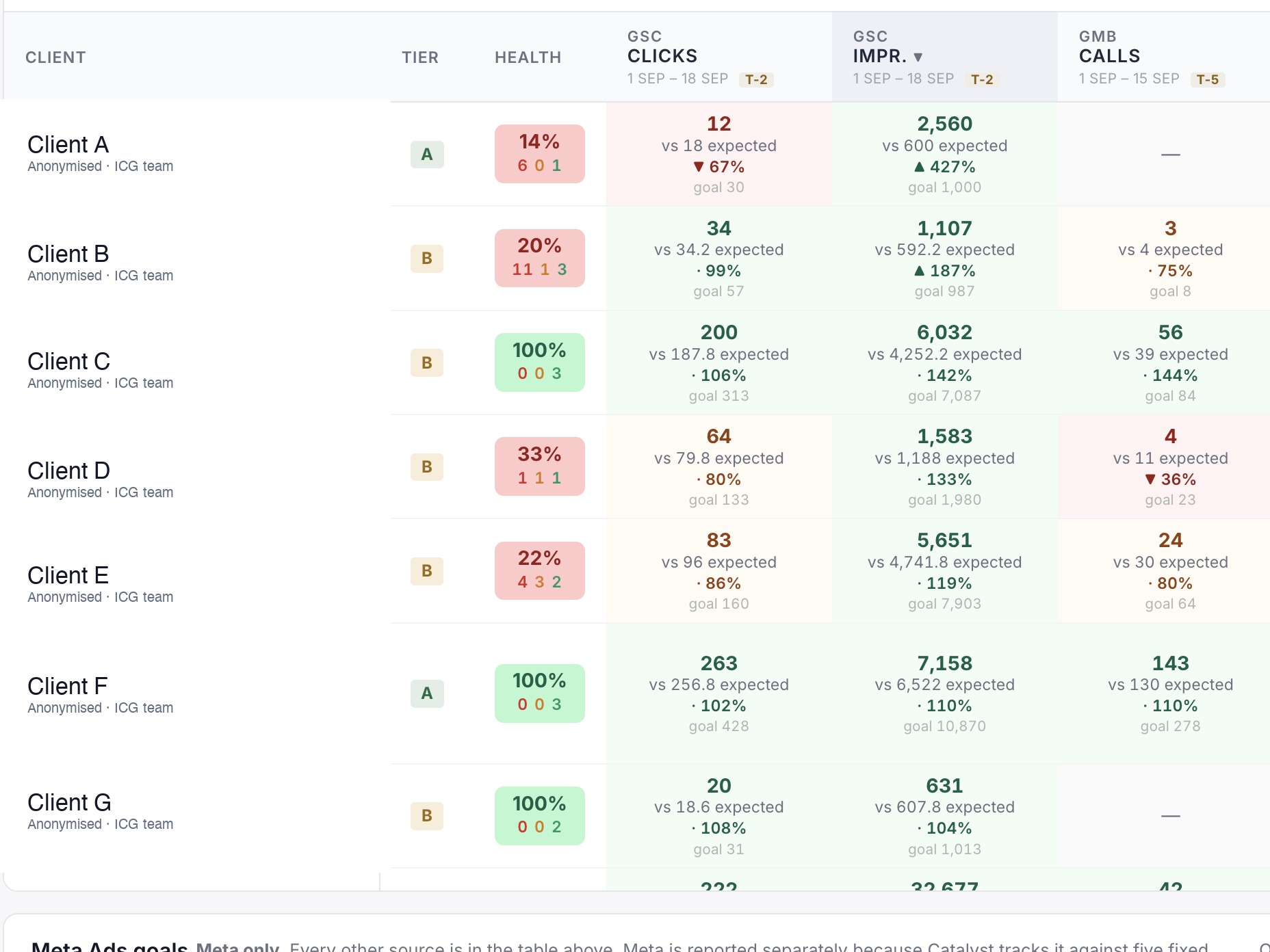
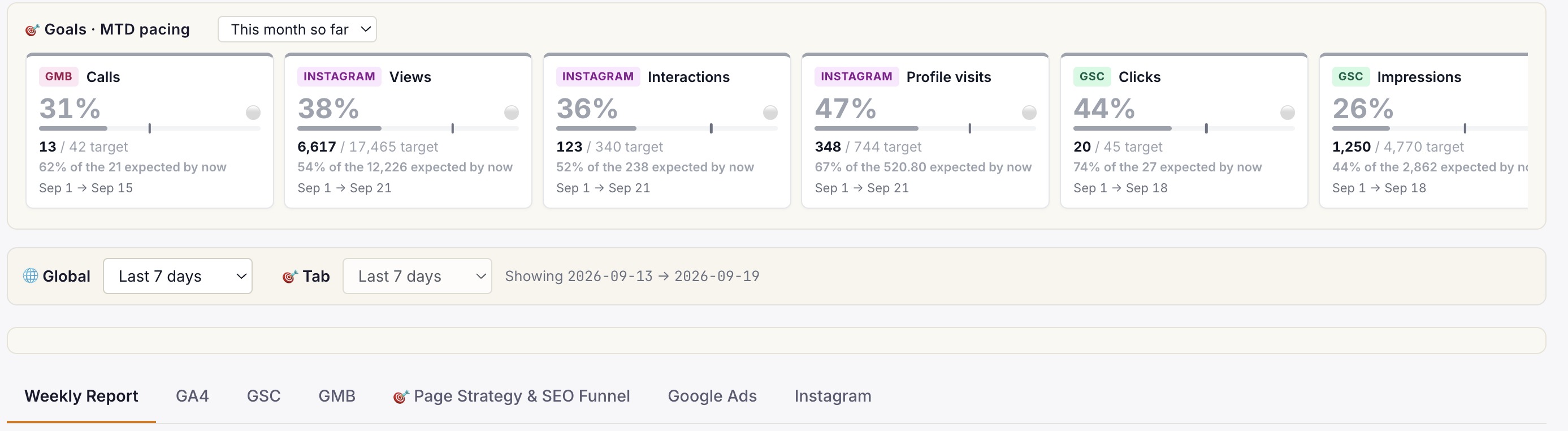
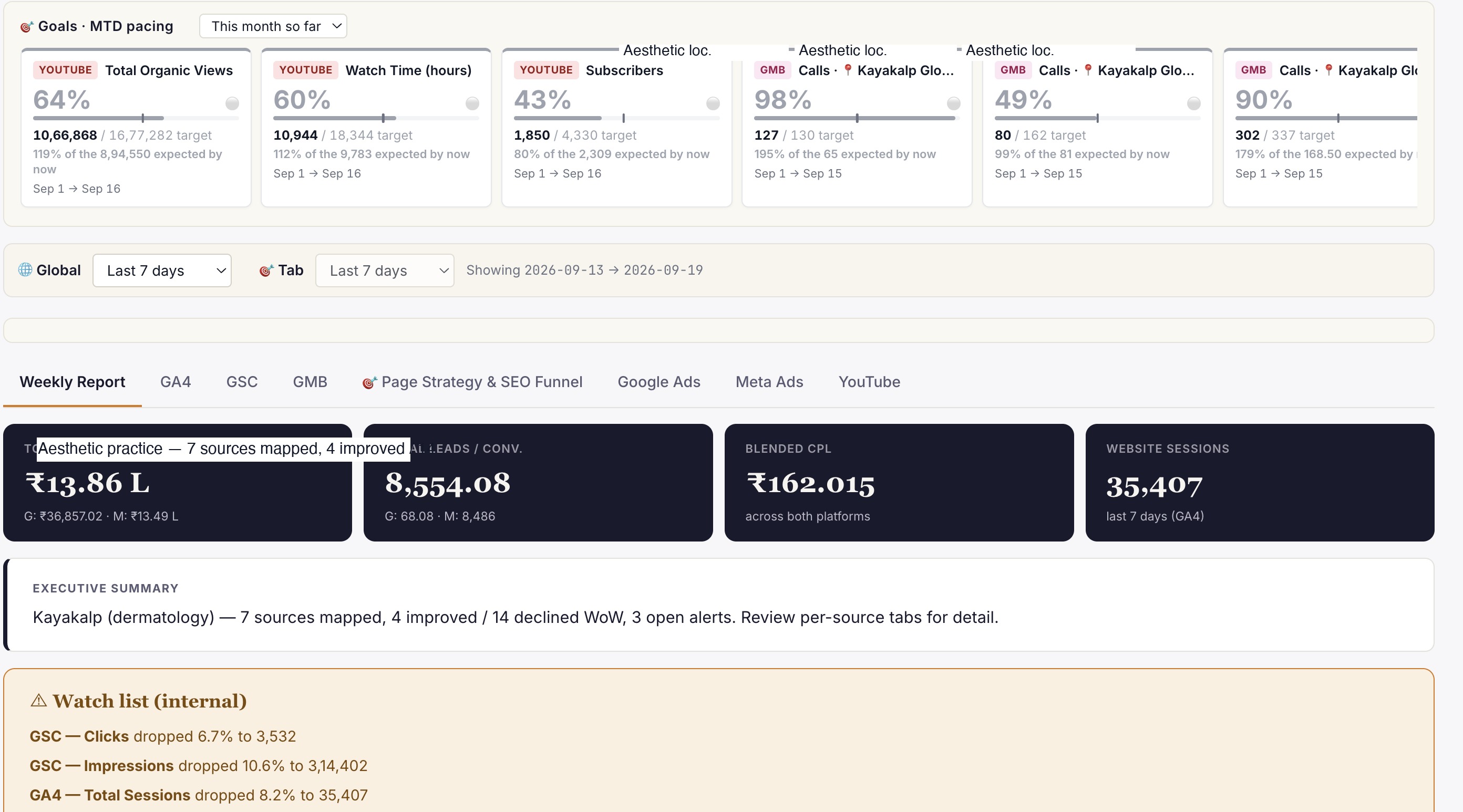
Every ICG engagement runs on the Search Intelligence Trifecta — Angryturtle for GMB, SIE for search and AI Overview, YODA for YouTube. Live product screens below.
Need help operationalising this?
Every ICG service is healthcare-only, NMC + DPDP-aware, and built around the patient-research patterns that drive Indian healthcare growth in 2026.
Every practice welcome — packages from ₹20,000/mo.
Goals-Driven engagements · Performance-Linked Payout Models available
More from
ICG.
Five trends shaping Indian healthcare marketing through 2027: AI-first patient research, Conversions API adoption, ABDM discovery, the AEO w...
Healthcare AIO is the discipline of getting your clinic or hospital cited inside Google AI Overviews, ChatGPT and Perplexity answers — not j...
Conversational-search advertising places brand messages inside AI chat answers — ChatGPT, Perplexity, Copilot — rather than beside a results...
Stop guessing.
Book a Diagnostic.
30 minutes. Free. With the AI-powered healthcare-only marketing agency 150+ brands already run on. No slides, no pitch, no hard close.


