


Local pack ranking factors for healthcare in India 2026: the 25+ signals that decide the three-pack, weighted for clinics and hospitals
Local pack ranking factors for healthcare in India in 2026 sit across proximity, relevance and prominence — but for healthcare specifically, category, reviews, service listings, attributes and AIO Readiness carry different weights than generic local SEO advice assumes.
No pitch. Written root-cause diagnosis. AI-powered, healthcare only.
Direct answer
Local pack ranking factors for healthcare in India in 2026 sit across proximity, relevance and prominence — but for healthcare specifically, category, reviews, service listings, attributes and AIO Readiness carry different weights than generic local SEO advice assumes.
TL;DR

Local pack ranking factors for healthcare in India in 2026 sit inside the three-pillar framework Google has publicly documented — proximity, relevance, prominence — but the healthcare-specific weighting of the 25+ signals underneath those pillars is materially different from generic local SEO advice. Reviews carry more weight in healthcare than in retail. Compliance signals matter in healthcare when they do not exist for restaurants. Website quality feeds into GBP ranking in ways specific to E-E-A-T sensitive verticals. And the AIO Readiness signal — how well a profile answers AI-first patient queries — is now a distinct ranking factor that generic local SEO frameworks do not track. ICG's healthcare local SEO service runs against this full-stack signal map every quarter using Angryturtle.

Google's three-pillar framework: proximity, relevance, prominence
Google publishes the framework openly. Local ranking is decided by three factors: proximity (how close the business is to the searcher or search location), relevance (how well the business matches the query intent), and prominence (how well-known and well-signaled the business is offline and online). Everything else is a signal that rolls up into one of these three pillars.
The confusion in most local SEO advice is treating the three as equal-weighted. They are not. For "dental clinic near me" in a dense urban market like Bengaluru or Gurgaon, proximity dominates. For "best cardiac surgeon in Chennai" the query intent shifts weight toward prominence. For "wheelchair-accessible clinic with online consultation in Andheri" relevance filtering dominates because the query is filter-heavy. Understanding which pillar a query is decided on is the first move in local SEO strategy.
Category and services as the primary relevance signals
Primary category is the single strongest topical-relevance signal on a Google Business Profile. A profile categorised as "Dental Clinic" is eligible for every dental-adjacent query in the local pack; a profile categorised generically as "Doctor" is not, even if the practice is a dental clinic in reality.
Secondary categories add topical breadth. A dental clinic that also offers orthodontics benefits from adding "Orthodontist" as a secondary category — the profile is now eligible for orthodontic queries as well as general dental queries.
The services menu is the query-level extension of the category signal. Every service listed is a discrete query surface. A "Dermatology Clinic" profile with 22 listed services covering both medical and aesthetic dermatology ranks for 22 procedure-specific query patterns; the same category without listed services ranks for the general category query only.
Reviews: rating, volume, velocity, recency, and reply-rate
Reviews are the largest single prominence signal in healthcare local ranking. Five distinct sub-signals matter and generic local SEO advice usually collapses them into one.
Rating average. The star-rating floor for local-pack competitive eligibility in Indian healthcare is 4.3-4.5 in most markets. Below 4.0 profiles slip below the fold even when other signals are strong.
Review volume. Total review count matters as a trust threshold. Metro-market competitive floors: dentistry 80-150 reviews for city-level competition, dermatology 60-120, cardiology 40-80, IVF and fertility 200-500 because the specialty carries longer consideration cycles and reviews per patient are richer.
Review velocity. The pace of new reviews. A profile with 200 reviews all from 2021 signals a plateau or churned patient base; the same 200 reviews with 3-6 new ones each month signals active practice. Google reads velocity as freshness.

Review recency. The date of the most recent review. A profile whose most recent review is 90+ days old drops in ranking regardless of total volume.
Reply rate. The percentage of reviews the business has replied to. Replied-to reviews signal active management. 90%+ reply rate is the healthcare benchmark; below 60% is a visible weakness.
Photos, video, and the visual signal
Google reads photo volume, photo recency, and photo quality as ranking signals — and more importantly as click-through drivers. A profile with 40+ photos across categories (exterior, interior, team, equipment, procedures where compliance-permitted) beats an identical profile with five photos for click-through even when their ranking positions are the same.
Video is a growing signal since Google added short-form video to the profile card. A profile with 3-8 short educational videos on procedures, team introductions, or facility walkthroughs signals both engagement depth and topical authority.
Google Posts as the ongoing freshness signal
Weekly Google Posts are the single most reliable freshness signal an operator can send. Posts appear on the profile card, feed the Updates section, and register as an activity signal for Google's ranking algorithm. Profiles with 30+ Posts in the trailing 12 months rank measurably better on freshness-weighted queries than profiles with zero or occasional Posts.
Healthcare-specific Post patterns that work: educational procedure explainers, compliance milestones (NABH accreditation, ART Act renewal, ISO certifications), team introductions, health-awareness content tied to WHO or ICMR-published observance days, facility upgrades. Post patterns to avoid: patient testimonials with named outcomes (NMC violation), success-rate claims (ASCI, ART Act), price wars against competitors.
Description field and the Q&A section
The 750-character business description is a moderate relevance signal. Density of specialty-relevant vocabulary and honest coverage of the practice's actual scope matter. Keyword stuffing is a spam signal that hurts ranking. Descriptions that read naturally and cover 4-8 specialty keywords in prose outperform descriptions written for keyword density.
The Q&A section — Google's built-in question-and-answer feature on the profile — is under-managed on most Indian healthcare profiles. Owner-answered questions signal active management; user-asked questions that sit unanswered signal neglect. Angryturtle's Ask Maps module flags unanswered Q&A entries and drafts compliance-safe answers for owner approval.
Attributes as filter and relevance signals
Attributes — wheelchair-accessible entrance, women-led, online-care, appointments-required, insurance-accepted, and 15-20 more — feed the relevance pillar as filter-inclusive query signals. A profile with the attribute set correctly appears preferentially for queries that include the filter; a profile without the attribute set is invisible to the filter even when the underlying reality is a match.
The complete healthcare attribute guide covers the full list. The summary: most Indian healthcare profiles set 3-6 attributes when 12-25 apply, leaving substantial ranking on the table.
Website quality on the linked domain
Google reads the website linked from the Google Business Profile as part of the prominence signal. Healthcare-specific quality checks that matter: HTTPS across every page, mobile-friendly rendering, page speed above Google's Core Web Vitals thresholds, LocalBusiness schema with matching NAP (name, address, phone), MedicalBusiness or specialised schema (Dentist, Hospital, Physician) where appropriate, and E-E-A-T signals — named authors with credentials, medical reviewer bylines, references to authoritative sources.
A website with weak technical health drags down GBP ranking of even a well-configured profile. This is why ICG's technical SEO and content teams work alongside local SEO on every managed account.
Backlinks and citations as prominence signals
Backlinks — inbound links to the practice's website from external sites — feed the prominence pillar. Healthcare-relevant backlinks (medical directories, professional associations, hospital referral networks, health publications) carry more weight than generic backlinks.
Citations — mentions of the practice's NAP on external directories — feed the prominence pillar even without a link. Healthcare-specific citation targets in India include doctor-directory platforms, local business directories, Sulekha, IndiaMart, and specialty-specific directories (ISAR for fertility, Indian Dental Association for dentistry, Cardiological Society of India for cardiology, and 20+ more). Angryturtle's citation engine ships with healthcare-specific target lists per specialty.
NAP consistency across all citations matters. A practice whose name, address, or phone number is inconsistent across doctor-directory listings, local business directories, and their website confuses Google's entity-resolution and dilutes the prominence signal.
Click-through rate as a behavioural ranking signal
Google measures whether searchers who see a profile in the local pack actually click through, call, request directions, or open the website. High engagement rates signal to the algorithm that the profile matches searcher intent well; low engagement rates signal a mismatch and downrank the profile over time.
Every attribute, photo, review reply, and Post that helps a searcher qualify the practice before clicking increases CTR and therefore feeds back into ranking. The signals compound.
GBP completeness, verification age, and account trust
Google gives ranking preference to profiles that are fully completed (all fields filled, hours accurate, categories set, services listed, attributes configured, photos uploaded), verified (postcard, phone, or video verification confirmed), and aged (older profiles carry more trust than newly-verified ones, all else equal).
Account trust also matters. Practices whose GBP account has never received spam-signal flags, no fake-review filtering events, and no policy violations rank better than accounts with negative history.
Spam signals that downrank healthcare profiles
Fake reviews (including reviews from staff, family, or paid third parties), keyword-stuffed business names ("Best Dental Clinic in Bengaluru Root Canal Implants"), category-abuse (dental clinic categorised as "Emergency Dental Clinic" to catch generic emergency queries), NAP inconsistency across citations, and profile-hijacking attempts (unauthorised claim changes) all trigger Google's spam-signal filters. Under the ASCI Guidelines 2022, fake reviews and misleading claims also carry statutory advertising-standards risk in India, verified through the ASCI code documentation available at ascionline.in.
AIO Readiness as the new 2026 ranking factor
Google AI Overviews and ChatGPT-style search answers now surface for a growing share of healthcare queries. A profile whose structured data, description, services list, and Q&A section clearly answer common AI-first patient queries gets cited in AI Overviews; a profile whose data is incomplete or ambiguous does not. AIO Readiness is a distinct ranking factor that generic local SEO frameworks do not measure.
Angryturtle's Ask Maps module scores AIO Readiness explicitly: it maps 40-80 specialty-specific patient queries to the profile's structured answerability, flags unanswered ones, and drafts compliance-safe additions to close the gaps.
What Angryturtle's Rank OS tracks vs Google's actual signals
Angryturtle scores profiles 0-100 across five weighted dimensions: Relevance (categories, services, attributes, description), Review Health (rating, volume, velocity, recency, reply-rate), Freshness (Posts, photos, updates), Entity Authority (citations, backlinks, brand mentions), and AIO Readiness (Ask Maps question coverage). The five dimensions map directly to the signal set Google's local algorithm reads.
sie" style="color:inherit;text-decoration:underline;text-decoration-color:rgba(42,126,200,.5);text-underline-offset:2px">Rank OS is not Google's algorithm — no one outside Google has that. It is a proprietary proxy calibrated to the signals Google publicly documents and to the observed ranking behaviour across the 150+ Indian healthcare brands ICG manages on the platform. Score improvements on Rank OS correlate with observed ranking improvements in Geo-Grid tracking across the managed base.
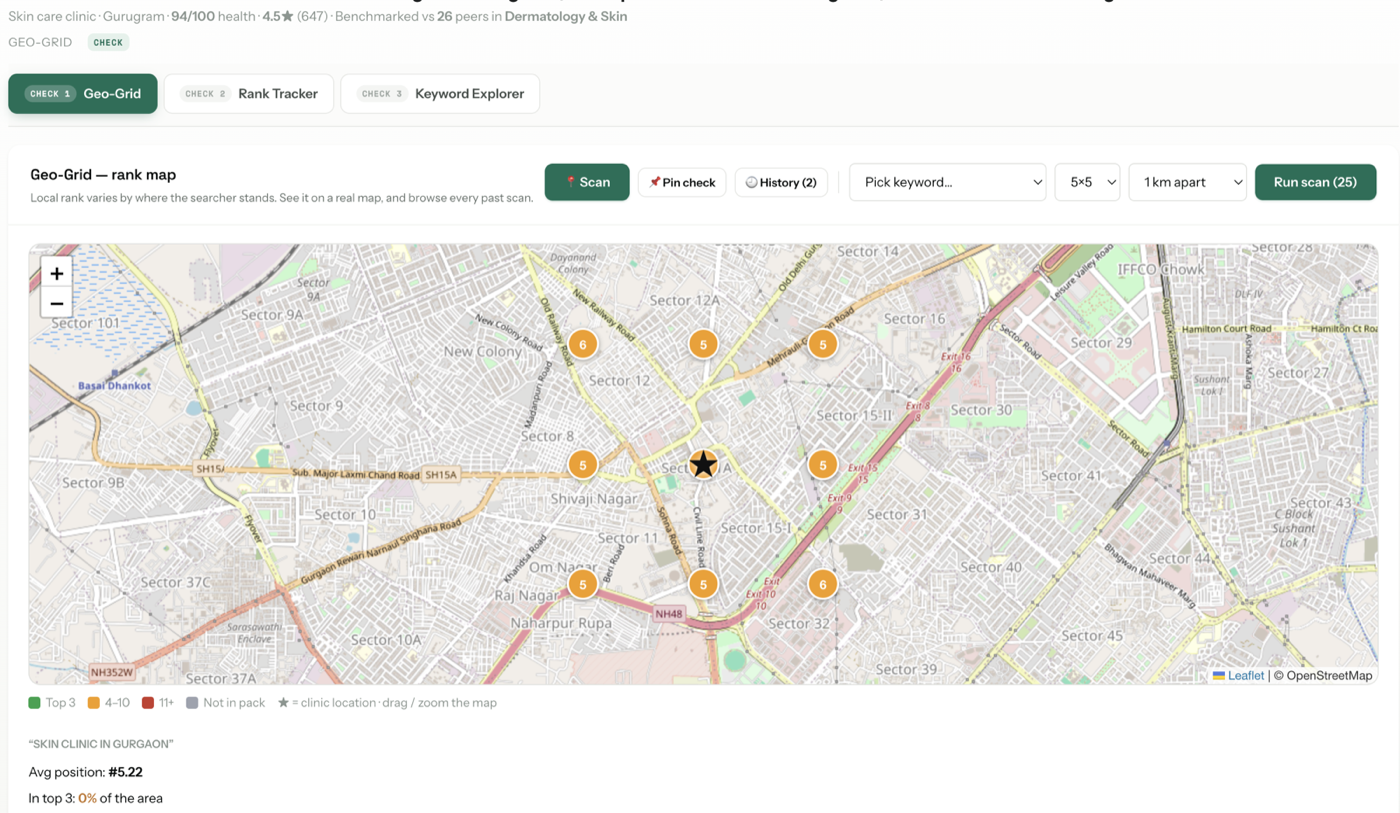
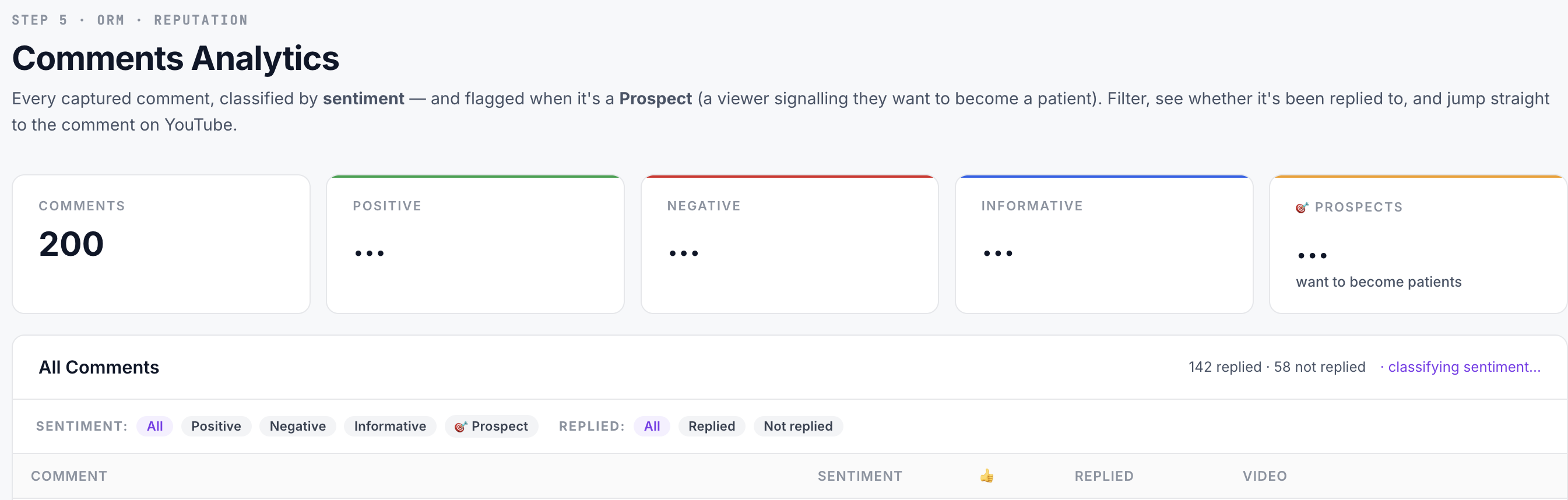
The tool ICG uses to run this at scale: Angryturtle
ICG runs local SEO and GBP intelligence for 150+ Indian healthcare brands using Angryturtle — our own AI-native GBP intelligence and management OS. The platform scores every profile 0-100 via a proprietary Rank OS model with five weighted dimensions (Relevance, Review Health, Freshness, Entity Authority, AIO Readiness), publishes edits, Posts, media, and review replies directly to Google, and includes Ask Maps AIO Readiness scoring for Google AI Overviews and ChatGPT visibility.
Available in two shapes: self-serve at ₹999/- per month for solo owners with 1-2 profiles, and ICG's managed service from ₹25,000/- per month where our healthcare specialists execute inside the same platform. Both are anchored in the Healthcare Local SEO Agency India pillar page which has full scope, methodology and pricing.
Book a demo on WhatsApp → or start a free trial at angryturtle.ai →
Related reading
- Healthcare local SEO agency India — the pillar service page
- Proximity, relevance, prominence for healthcare — deep dive on Google's three pillars
- GBP attributes for healthcare in India — the attribute signal layer
- GBP services menu for healthcare — the services signal layer
- Angryturtle Rank OS explained — how the 25+ signals fold into a 0-100 score
FAQ
How many ranking factors does Google use for local pack in healthcare? Google publicly documents three pillars (proximity, relevance, prominence). Under those pillars, healthcare-relevant signals number 25+, including category, services, attributes, reviews (five sub-signals), photos, Posts, description, Q&A, website quality, backlinks, citations, click-through-rate, completeness, verification age, spam signals, and AIO Readiness.
Which single ranking factor moves the needle fastest for a new healthcare profile? Category correction plus services-menu build. Getting the primary category right and adding 15-25 accurately-described services closes the biggest relevance gap in the first 30 days.
How much does proximity dominate over other factors? Very high for generic "near me" queries in dense urban markets. Moderate for specialty-specific or high-consideration queries where prominence signals compete. Low for filter-inclusive queries where relevance signals decide the pack.
Does the linked website quality actually affect GBP ranking? Yes. Google reads the linked website's technical health, mobile-friendliness, page speed, LocalBusiness schema, and E-E-A-T signals as part of the prominence signal. A weak website drags down GBP ranking of an otherwise well-configured profile.
How important is Google Posts to ranking? Moderately important as a freshness signal. Weekly Posts sustained for 6+ months are a documented ranking uplift; occasional or zero Posts is a documented signal weakness.
What compliance risks apply to review generation in healthcare? NMC's 2026 advertising guidelines prohibit soliciting reviews mentioning specific treatment outcomes; ASCI Guidelines 2022 prohibit fake reviews and unsubstantiated claims; Consumer Protection Act 2019 covers misrepresentation. Compliant review-request framing requests visit-experience feedback, not treatment-outcome testimonials.
Is AIO Readiness measurable outside of Angryturtle? Partially. Google Search Console does not currently break out AI Overviews impressions or clicks separately from web results, though limited surfacing exists. Third-party tools including Angryturtle's Ask Maps module approximate AIO visibility through structured-answerability audits and observed citation frequency across a test query bank.
How long before ranking improvement is visible? First measurable movement in 4-6 weeks for accounts with an active baseline. Substantive local-pack improvement in 3-4 months. Compound effect and category-competitive positions at 9-12 months.
Do citations still matter in 2026 or has Google moved past them? Citations still matter as a prominence signal, especially healthcare-specialty-specific directories. Their relative weight has softened as review signals and structured data have grown, but a citation-sparse profile in a citation-dense market still visibly underperforms.
Should I chase specific ranking factors sequentially or run everything in parallel? Parallel in the first 90 days. Category and services in weeks 1-2, attributes and description in weeks 3-4, review-request campaign initiation in week 4, weekly Posts from week 4 onward, citation build in months 2-3, AIO Readiness gaps in months 3-6. All of these should be running concurrently on a managed account.
Book a free 30-minute Brand & Growth Diagnostic.
It's a working session, not a sales pitch — you leave with a written root-cause analysis you can act on, whether or not you engage ICG.
The three platforms
behind every ICG engagement.
Beacon
CAPI middleware that fixes Event Match Quality, translates CRM statuses to Meta-standard events, dedups across channels.
Agency OS
Live client dashboard. GSC, GA4, Google Ads, Meta Ads, IVR calls in one view. Login anytime, not monthly.
Phoenix
Clinic revenue intelligence over your PMS. Daily action queue: Prevent Loss, Maintain & Engage, Grow Revenue. Multi-centre rollout.
Or book a free 30-min audit to see all three in action on your account.
Healthcare brands
that already run on ICG.
A representative slice of the 150+ healthcare brands ICG has delivered for across India. Most engagements remain under NDA.


What ICG clients say · on video.
"Scale up of organic channels and business consulting. ICG has absolute domain authority in their field."
"Working with ICG transformed how we acquire IVF patients in Gurgaon. They understand the fertility journey from inquiry to consult..."
"What Ichelon accomplished — they got all my ideas and worked over 3-4 months to create an amazing, super-customised website."
Need help operationalising this?
Every ICG service is healthcare-only, NMC + DPDP-aware, and built around the patient-research patterns that drive Indian healthcare growth in 2026.
Every practice welcome — packages from ₹20,000/mo.
Goals-Driven engagements · Performance-Linked Payout Models available



More from
ICG.
Five trends shaping Indian healthcare marketing through 2027: AI-first patient research, Conversions API adoption, ABDM discovery, the AEO w...
Healthcare AIO is the discipline of getting your clinic or hospital cited inside Google AI Overviews, ChatGPT and Perplexity answers — not j...
Conversational-search advertising places brand messages inside AI chat answers — ChatGPT, Perplexity, Copilot — rather than beside a results...
Stop guessing.
Book a Diagnostic.
30 minutes. Free. With the AI-powered healthcare-only marketing agency 150+ brands already run on. No slides, no pitch, no hard close.


