


How much does YouTube marketing for doctors cost in India in 2026: real tiers, real ranges, and what each spend actually buys
YouTube marketing for doctors in India costs anywhere from ₹50,000/- as a one-time channel starter kit to ₹4,00,000/- per month for a full healthcare-specialist retainer. This guide breaks down every tier — in-house hire, freelancer, general agency, YODA-powered specialist — and what each spend actually delivers.
No pitch. Written root-cause diagnosis. AI-powered, healthcare only.
Direct answer
YouTube marketing for doctors in India costs anywhere from ₹50,000/- as a one-time channel starter kit to ₹4,00,000/- per month for a full healthcare-specialist retainer. This guide breaks down every tier — in-house hire, freelancer, general agency, YODA-powered specialist — and...
TL;DR

YouTube marketing for doctors in India does not have one price. It has a ladder of prices, and the tier a clinic sits on depends on the ambition of the channel, the compliance perimeter the specialty demands, and whether the practice wants a starter kit or a permanent growth machine. ICG builds and runs healthcare YouTube channels using our own YODA platform across clinics, hospital groups and specialty chains, and this guide lays out the tiers we see in the Indian market — with what each spend actually buys and where the cost breaks travel from reasonable to wasted. For the full engagement scope, the Healthcare YouTube Marketing Agency service page anchors the money conversation, and the Healthcare YouTube pillar guide covers the strategy layer.
Why the cost question is slippery for healthcare YouTube
A general marketing agency will quote a clinic ₹40,000/- per month for "YouTube management" and mean four uploads, a couple of thumbnails, and a monthly report. A healthcare-specialist agency will quote ₹1,80,000/- per month for the same channel and mean scripted long-form videos with clinician review, compliance-checked descriptions, comment ORM inside NMC boundaries, YODA-driven optimisation loops, and organic-vs-paid separation on every dashboard. Both are called "YouTube marketing." Neither price is wrong. They buy different things.
Three variables move the price the most. Video output volume (one long-form a month vs eight long-form plus twenty shorts). Production quality (single-camera phone shoot vs multi-cam studio setup with lav mics, teleprompter, colour grade, and B-roll). Compliance depth (a generalist writing captions vs a healthcare-trained editor keeping every claim inside NMC and ASCI lines).
Everything else — thumbnail iteration, keyword research, ad support, WhatsApp funnels — layers on top of those three. So the price ladder below is built the same way: what the tier produces, at what quality, inside what compliance perimeter.
Tier 1 — Channel starter kit (one-time ₹50,000-₹1,50,000/-)
A starter kit is not a retainer. It is a one-time engagement that gets a channel from zero to operational: brand identity, banner, watermark, channel description, playlists, an About section that satisfies E-E-A-T signals, three to five pillar long-form videos scripted and shot, twelve to twenty starter shorts, initial keyword and topic research, and a 90-day content calendar the clinic's internal team can execute against.
Typical range: ₹50,000/- to ₹1,50,000/- depending on how many videos are produced and whether the shoot happens at the clinic or in a studio. A solo dermatologist getting a starter kit from a healthcare-specialist agency will land in the ₹75,000-₹1,00,000/- band. A five-doctor multi-speciality clinic wanting three doctors filmed and a full playlist architecture built will land at ₹1,25,000-₹1,50,000/-.
Who this tier suits: clinics that already have an internal marketing person who can execute a plan but does not know how to build one, and clinics that want to test whether YouTube is worth pursuing at all before committing to a monthly retainer.
Tier 2 — In-house full-time YouTube manager (₹6,00,000-₹15,00,000/- annual)
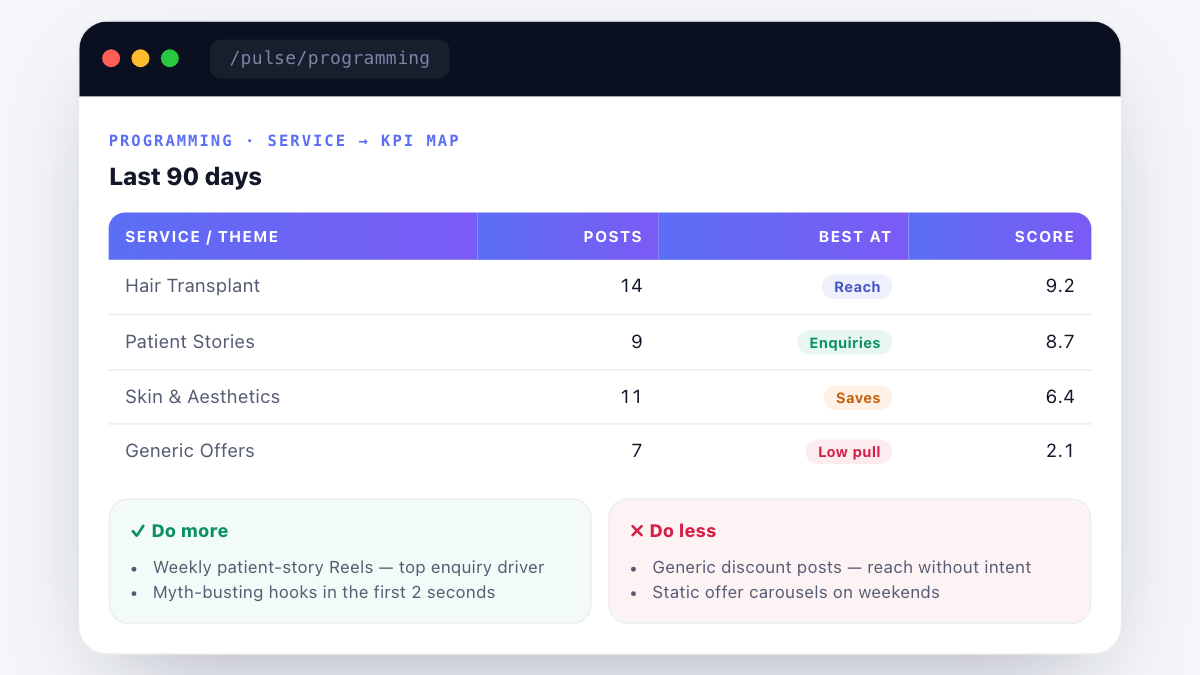
Hiring a full-time YouTube manager is a legitimate option for clinics that treat YouTube as a strategic channel and want the manager sitting inside the practice. A capable video producer with two to five years of experience in the Indian healthcare or lifestyle space costs between ₹6,00,000/- and ₹15,00,000/- annually as a base salary, depending on city and seniority. That is only the salary layer.
The real cost is higher because the in-house model demands three additional lines. Equipment — a starter kit of camera, lens, lav mic, lighting and teleprompter runs ₹1,50,000-₹4,00,000/-. Software — Adobe Premiere or DaVinci Resolve Studio, thumbnail tools, SEO tools like vidIQ or TubeBuddy at their agency tier, and any AI-assisted editing tool bring monthly software spend to ₹8,000-₹25,000/-. Editor support — one full-time manager cannot both shoot and edit at volume, so most in-house setups add a part-time or freelance editor at ₹25,000-₹60,000/- per month.
Realistically an in-house YouTube function inside a mid-sized clinic runs ₹85,000-₹1,80,000/- per month all-in when the salary, gear amortisation, software, and editor support are all counted. This tier suits hospitals and multi-specialty groups with the volume of doctors, patient stories, and events to justify a permanent internal team.
Tier 3 — Freelancer or part-time video producer (₹15,000-₹60,000/- monthly)
A freelancer is the middle ground between a starter kit and a full retainer. A capable freelance video editor in India charges ₹15,000-₹35,000/- per month for two to four edited videos, thumbnails, and basic upload optimisation. A more experienced healthcare-adjacent freelancer with knowledge of NMC-safe framing charges ₹35,000-₹60,000/- per month for the same output plus scripting support and comment moderation guidance.
Where the freelancer model works: clinics with a doctor who is genuinely comfortable on camera and produces raw content weekly. Where the freelancer model breaks: compliance depth, algorithm literacy, and the discipline to iterate on titles, tags and thumbnails after publication. Most freelancers post-and-forget. Growth on YouTube in 2026 belongs to teams that revisit and improve every video every 30, 60, and 90 days.
Tier 4 — General digital agency retainer (₹40,000-₹1,20,000/- monthly)
A general digital marketing agency will run a clinic's YouTube alongside its Meta ads, website, and SEO for ₹40,000-₹1,20,000/- per month. Typical deliverables are two to four long-form videos, four to eight shorts, thumbnails, monthly reporting, and comment moderation.
The problem with the general agency tier for healthcare is not price. The problem is the compliance perimeter. General agencies routinely write patient-testimonial-style scripts, use before-and-after cuts as evidence of outcomes, and publish claim-heavy descriptions that violate NMC's 2026 advertising guidelines and ASCI Guidelines 2022. Every one of those violations sits on the doctor's own YouTube channel — meaning the doctor, not the agency, is the one an ethics inquiry lands on.
General agencies also lack the tooling to separate paid from organic views. A promoted video with 40,000 views and 39,200 of them from a YouTube ad campaign gets reported as a "viral hit." The clinic pays for the illusion.
Tier 5 — Healthcare-specialist agency with YODA (₹75,000-₹4,00,000/- monthly)

ICG's tier for healthcare YouTube retainers starts at ₹75,000/- per month for a solo-practice or single-clinic engagement and scales to ₹4,00,000/- per month for hospital groups running full production, ads, ORM, and multi-doctor channel architecture. Between those two ends, the pricing bands look like this.
Starter retainer (₹75,000-₹1,20,000/-): 4 long-form videos, 8-12 shorts, thumbnail iteration, weekly comment ORM, monthly YODA optimisation loop, monthly reporting, quarterly strategy review. Suits solo consultants and single-location clinics with one recognised doctor.
Growth retainer (₹1,20,000-₹2,00,000/-): 6-8 long-form videos, 16-24 shorts, weekly thumbnail A/B rotation, weekly reporting, YouTube ads support up to ₹1,00,000/- monthly media, WhatsApp lifecycle integration, monthly Ask Maps AIO audit. Suits multi-doctor clinics and single-hospital brands.
Full retainer (₹2,00,000-₹4,00,000/-): 10-16 long-form videos across multiple channels, 30+ shorts, studio-quality production, multi-doctor scheduling, YouTube and Meta ads coordination, weekly reporting into the client's marketing dashboard, dedicated account manager, quarterly board-level strategy session, YODA competitor intel loop against 10 named competitors. Suits hospital groups and multi-city chains.
Media spend for YouTube and Meta ads runs separately on top of the retainer and is billed with an agency management layer through ICG's performance marketing service.
What changes the price inside a tier
Two clinics on the same tier can pay different fees inside the band. The most common movers are:
Doctor availability. If the on-camera doctor can give four two-hour shooting slots a month, the retainer runs efficiently. If the doctor gives one one-hour slot every six weeks, the agency has to over-engineer scripts, batch heavily, and lean on B-roll. Cost rises for the same output.
Specialty compliance load. Fertility (ART Act 2021 + PC-PNDT), oncology (outcome claims perimeter), and paediatrics (patient-identification restrictions) demand more legal review per video. Compliance-heavy specialties sit at the top of their band.
Number of doctors on the channel. A multi-doctor channel needs voice consistency, playlist architecture, and scheduling logistics that a single-doctor channel does not.
Ads integration. When YouTube or Meta ads run alongside the organic channel, YODA separates paid from organic on every dashboard, which is where general agencies stop and specialist agencies start earning their fee.
When to spend more vs when to spend less
Spend more when: the specialty is high-consideration (fertility, oncology, cardiology, cosmetic surgery); the clinic has a competitive metro catchment with 15+ competing practices in the same category; the doctor is early in personal-brand equity and needs volume to establish authority; the clinic is pursuing multi-city expansion where a single strong channel supports several locations.
Spend less when: the clinic is testing YouTube for the first time and is not yet sure the specialty converts on the surface; the doctor is not comfortable on camera and needs skill-building before scale-up; the clinic is in a tier-3 city with limited competitive density where a modest cadence outranks stronger production; the marketing budget has to prioritise Google Ads or local SEO first.
The mistake most clinics make is not spending too much or too little. It is spending correctly for the wrong tier — paying a general agency ₹80,000/- per month for output that a freelancer at ₹35,000/- could produce, or paying a freelancer at ₹40,000/- per month for work a healthcare-specialist agency at ₹1,20,000/- would do properly the first time.
The compliance cost nobody line-items
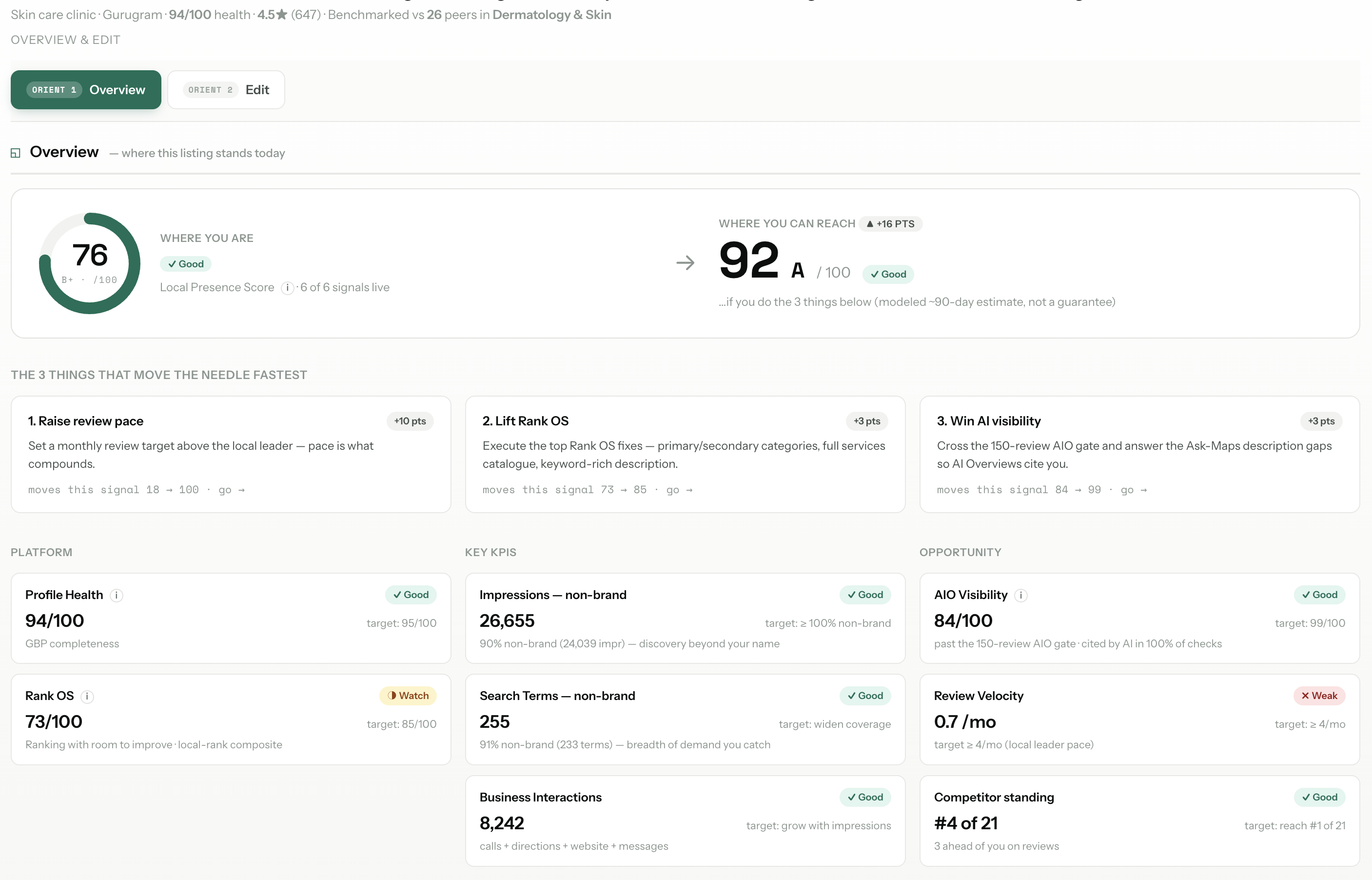
Every price above assumes the agency does not create work that later has to be taken down. In practice a lot of general-agency YouTube work does have to be taken down, and the invisible cost of that is real. A single NMC complaint against a doctor triggers a formal ethics inquiry that lawyers charge ₹40,000-₹1,50,000/- to defend. An ASCI complaint upheld against a clinic's advertising forces the takedown of all similar content across the doctor's digital footprint — often 40-100 videos and 200+ posts across YouTube, Instagram and the website. Rebuilding that footprint costs more than the original engagement.
Healthcare-specialist agencies build compliance into scripting, editing, description-writing, and reply moderation from the first day, and this is a real cost. It is why the specialist tier is priced above the general tier, and why the specialist tier is cheaper in the long run.
The platform ICG uses to run this at scale: YODA
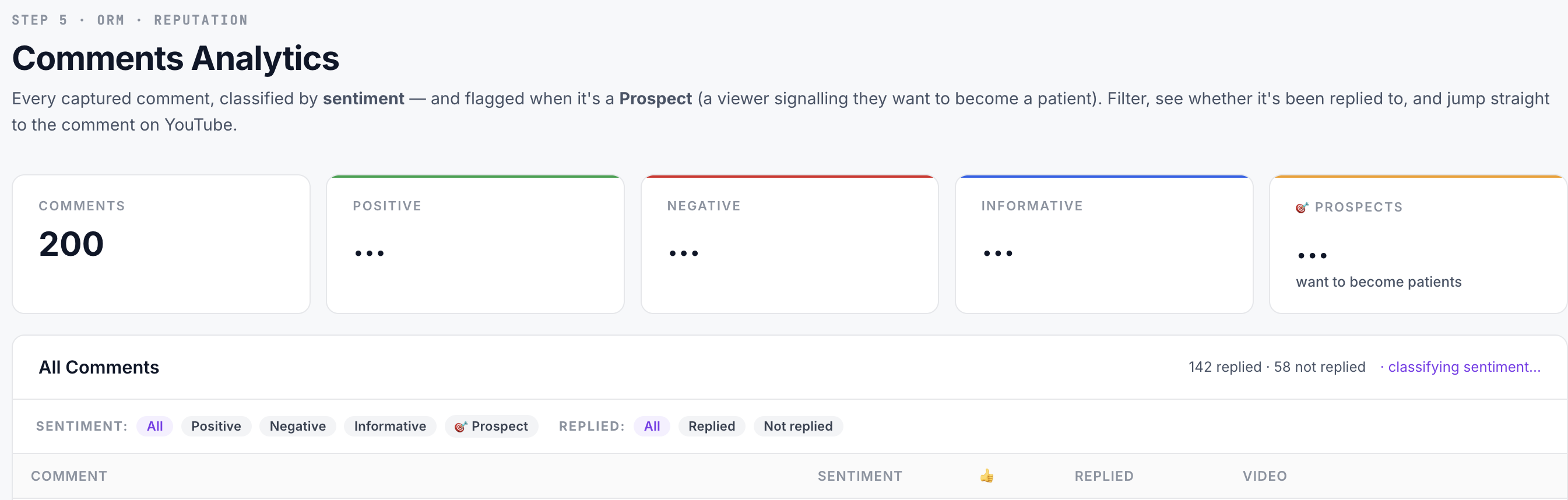
ICG runs healthcare YouTube marketing for clinics, hospitals, and specialty groups using YODA — our AI-native healthcare YouTube marketing platform. YODA sits on top of a channel's data and does four things no dashboard does: it separates organic from paid views at every step (so a promoted video can never masquerade as organic growth), it gives decisions not dashboards (every video gets a state + next action), it writes back to YouTube directly (improved titles, tags, descriptions, chapters applied straight to the platform), and it tracks the three rank races — YouTube search, Google web, and Google AI Overview citations.
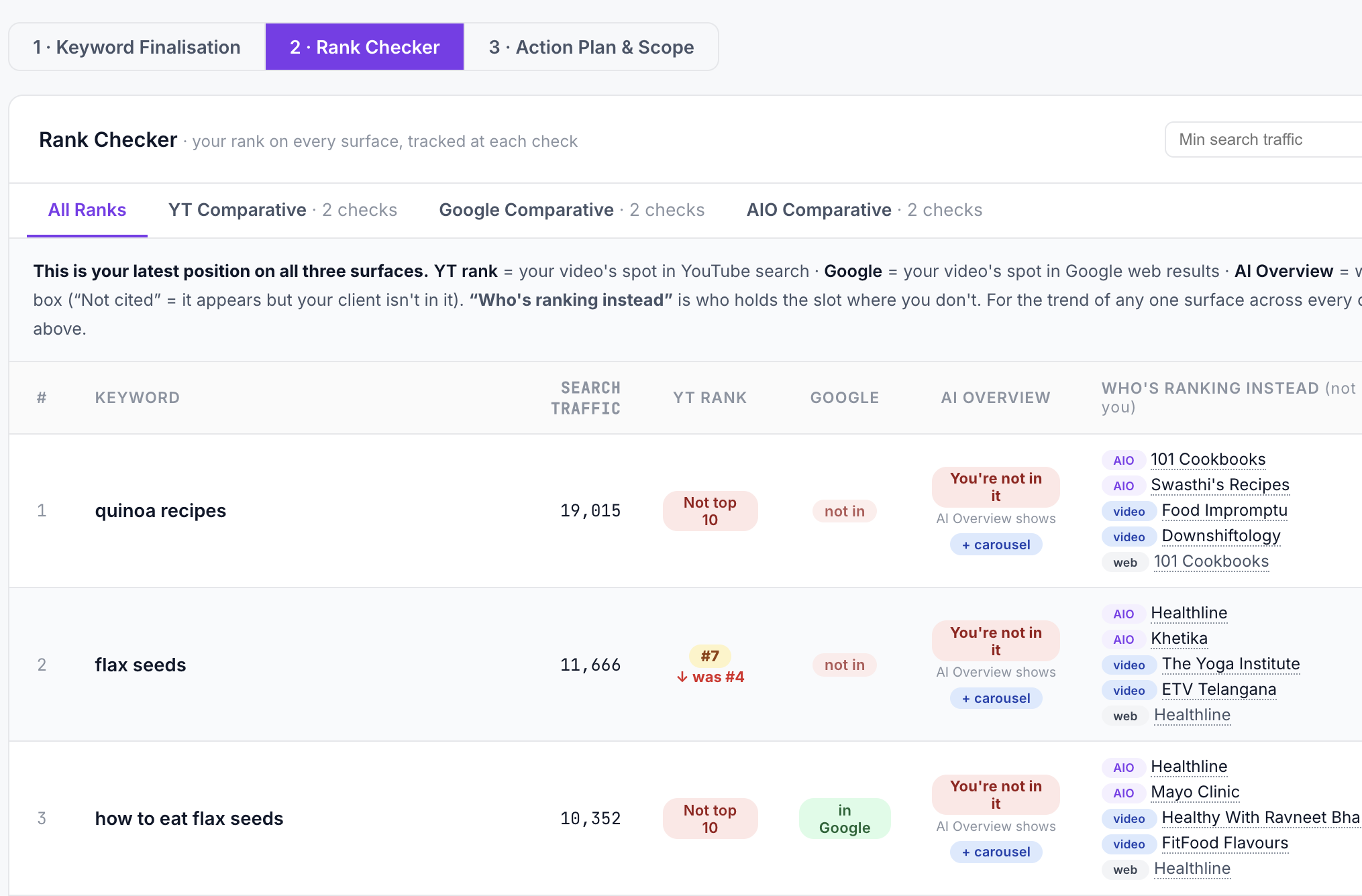
YODA runs the full 6-step workflow — Overview, Diagnostics, Strategy, Optimisation, Reputation (ORM), and Competitor Intel — with 40+ analysis modules organised under those steps. ICG's managed YouTube service uses YODA end-to-end. See the Healthcare YouTube Marketing pillar guide for the full scope, or the Healthcare YouTube Marketing Agency service page for engagement details.
Book a YODA demo on WhatsApp → or request a free healthcare YouTube channel audit →
Related reading
- Healthcare YouTube marketing pillar guide 2026 — full strategy stack
- Healthcare YouTube marketing agency service page — engagement details
- In-house vs agency for clinic YouTube management — the model decision
- How to choose a healthcare YouTube marketing agency — 12-point checklist
- What a healthcare YouTube agency delivers monthly — the deliverables list
FAQ
What is the cheapest realistic tier for a doctor to start on YouTube? The one-time starter kit at ₹50,000-₹1,50,000/- is the cheapest way to enter YouTube properly. Below that, quality collapses and the channel never gets traction. Freelancer retainers from ₹15,000/- exist but rarely produce the compliance and craft depth healthcare needs.
Can a solo doctor afford a healthcare-specialist agency retainer? Yes at the starter retainer band of ₹75,000-₹1,20,000/- per month. Solo consultants with an established niche and metro-city catchment typically break even inside 4-8 months when the channel starts feeding qualified consults.
How much of the retainer goes to production vs strategy? In a typical ₹1,20,000/- growth retainer, roughly 50-55% covers video production (script, shoot, edit, thumbnail), 25-30% covers strategy, optimisation, and reporting, and 15-20% covers ORM and compliance review. Ratios shift by specialty.
Is YouTube ads spend included in the retainer? Media spend is always separate. Ads management fees may be included in growth-tier retainers up to a media cap; above the cap or at hospital tier, ads carry a separate management percentage typically 12-18% of media spend.
What is the difference between a general agency and a healthcare-specialist agency for the same price? Compliance depth, algorithm literacy for healthcare-specific query patterns, and a data layer like YODA that separates organic from paid. General agencies at a similar price produce more visible volume but often at a compliance cost that surfaces later.
How long before a doctor sees consults from YouTube? First qualified consult attributable to YouTube typically arrives 6-12 weeks after launch on the growth retainer, faster on the full retainer with paid support. Steady-state consult volume from YouTube usually settles at month 4-6.
Does ICG guarantee subscriber or view counts? No agency should guarantee subscriber or view counts on YouTube — the platform is algorithmic and market-driven. ICG contracts on deliverables (videos shipped, optimisation cycles run, YODA loops closed) and reports on organic-vs-paid outcomes transparently.
Do healthcare YouTube retainers include long-form and shorts? Yes, in all growth-tier and above retainers. Shorts drive discovery for younger patient demographics; long-form drives consideration and consult conversion. A channel without both leaves discovery on the table.
How does ICG handle multi-doctor channels for hospital groups? The full retainer tier includes multi-doctor scheduling, playlist architecture per specialty, and YODA multi-tenant dashboards so each department head sees their own channel state without exposing others. Hospital groups typically start at ₹2,00,000/- per month for two departments and scale from there.
Can ICG take over an existing YouTube channel or only build from zero? Both. Most engagements are takeovers of channels that started in-house or with a previous agency. ICG's first 30 days on a takeover run a full YODA diagnostics pass — retention curves, keyword gaps, thumbnail performance, comment sentiment, competitor position — before the retainer content plan locks.
Book a free 30-minute Brand & Growth Diagnostic.
It's a working session, not a sales pitch — you leave with a written root-cause analysis you can act on, whether or not you engage ICG.
The three platforms
behind every ICG engagement.
Beacon
CAPI middleware that fixes Event Match Quality, translates CRM statuses to Meta-standard events, dedups across channels.
Agency OS
Live client dashboard. GSC, GA4, Google Ads, Meta Ads, IVR calls in one view. Login anytime, not monthly.
Phoenix
Clinic revenue intelligence over your PMS. Daily action queue: Prevent Loss, Maintain & Engage, Grow Revenue. Multi-centre rollout.
Or book a free 30-min audit to see all three in action on your account.
Healthcare brands
that already run on ICG.
A representative slice of the 150+ healthcare brands ICG has delivered for across India. Most engagements remain under NDA.


What ICG clients say · on video.
"Scale up of organic channels and business consulting. ICG has absolute domain authority in their field."
"Working with ICG transformed how we acquire IVF patients in Gurgaon. They understand the fertility journey from inquiry to consult..."
"What Ichelon accomplished — they got all my ideas and worked over 3-4 months to create an amazing, super-customised website."
Need help operationalising this?
Every ICG service is healthcare-only, NMC + DPDP-aware, and built around the patient-research patterns that drive Indian healthcare growth in 2026.
Every practice welcome — packages from ₹20,000/mo.
Goals-Driven engagements · Performance-Linked Payout Models available



More from
ICG.
Five trends shaping Indian healthcare marketing through 2027: AI-first patient research, Conversions API adoption, ABDM discovery, the AEO w...
Healthcare AIO is the discipline of getting your clinic or hospital cited inside Google AI Overviews, ChatGPT and Perplexity answers — not j...
Conversational-search advertising places brand messages inside AI chat answers — ChatGPT, Perplexity, Copilot — rather than beside a results...
Stop guessing.
Book a Diagnostic.
30 minutes. Free. With the AI-powered healthcare-only marketing agency 150+ brands already run on. No slides, no pitch, no hard close.


