


Angryturtle Agency OS: white-label workflow for healthcare marketing directors managing 30 clinics (2026)
A deep dive into Angryturtle's multi-tenant Agency OS for healthcare marketing directors — white-label reports, per-location dashboards, role-based access, monthly reporting cadence, client-side change approval and a sample end-to-end workflow for managing 30 clinics on one platform.
No pitch. Written root-cause diagnosis. AI-powered, healthcare only.
Direct answer
A deep dive into Angryturtle's multi-tenant Agency OS for healthcare marketing directors — white-label reports, per-location dashboards, role-based access, monthly reporting cadence, client-side change approval and a sample end-to-end workflow for managing 30 clinics on one platf...
TL;DR

If you run marketing for a healthcare group with 30 clinics — or an agency that services 30 clinic clients — the operational problem is not "we need a better GBP tool". The problem is orchestration: seeing every location's health at once, moving work to the right specialist, reporting to the right stakeholder in their branding, and doing all of it without a spreadsheet of shame. Angryturtle's multi-tenant Agency OS is built for exactly this shape of workload. This piece walks a healthcare marketing director through the actual workflow, from portfolio dashboard to monthly client-side sign-off, in the same sequence you would use on a real Monday morning. The full service scope sits on the Healthcare Local SEO Agency India pillar.
Why multi-tenant architecture matters for a 30-clinic portfolio
The single-tenant local SEO tool works for one clinic. At three clinics it feels awkward. At 30 clinics it breaks — you end up with 30 separate logins, 30 separate report exports, 30 separate action queues and no way to see the portfolio as one system. Multi-tenant architecture solves four problems the single-tenant tool cannot.
Portfolio visibility. One dashboard shows every location's sie" style="color:inherit;text-decoration:underline;text-decoration-color:rgba(42,126,200,.5);text-underline-offset:2px">Rank OS score, action-queue depth, review-response backlog and cadence status. Sorting by "worst trend this week" replaces clicking through 30 logins.

Role separation. Different people need different scopes. The marketing director sees everything; the regional account managers see their assigned clusters; the compliance reviewer sees only the approval queue; the location-level clinic managers see only their own tenant.
White-label reporting. Reports going to internal stakeholders or client leadership carry your brand, not the platform's. Report design, colour scheme and cover-page content match your organisation.
Cross-tenant operations. Bulk-schedule Geo-Grid scans across the portfolio for end-of-month reporting. Portfolio-wide search for the same competitor showing up in multiple locations. One-click Post publishing across a subset of locations for a group-wide campaign.
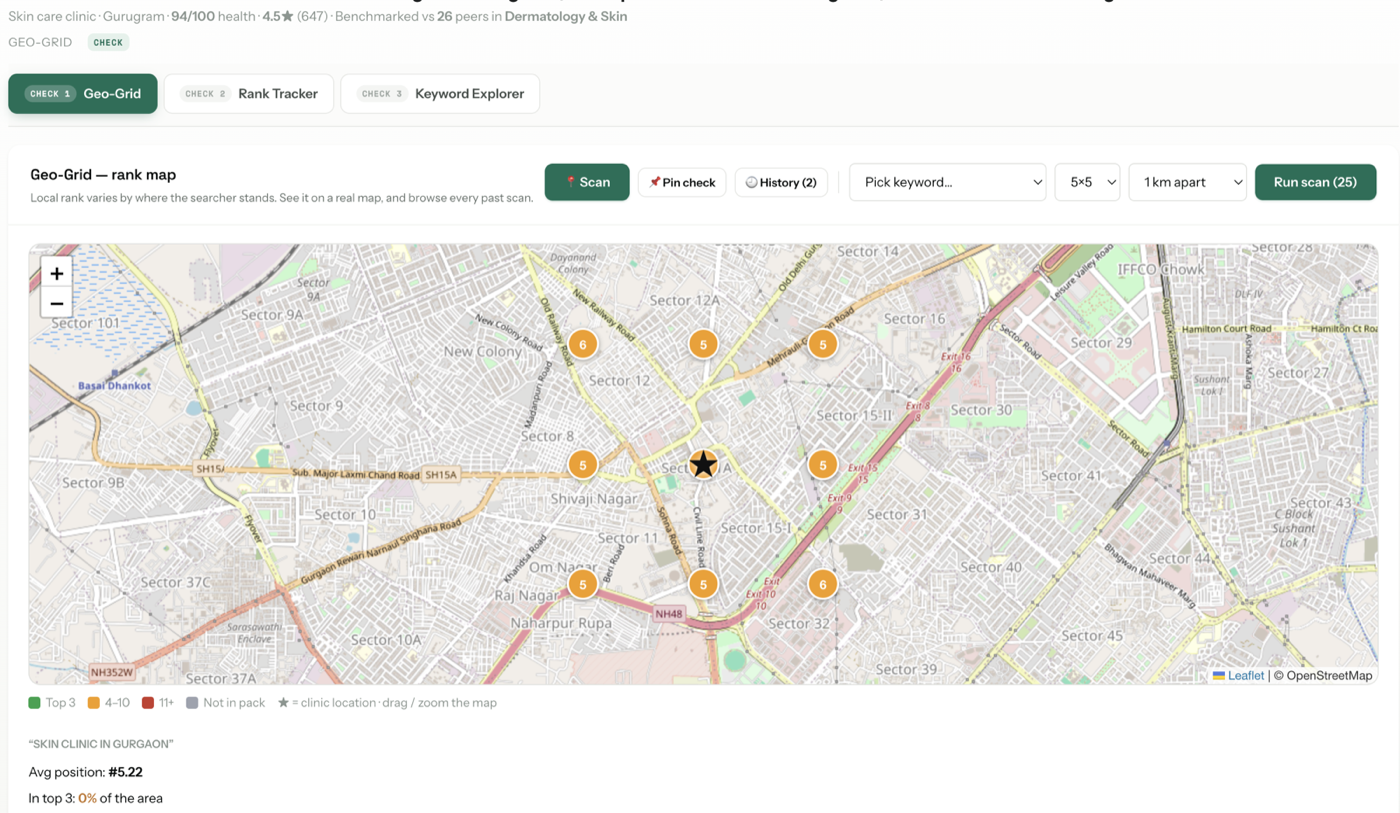
These four capabilities differentiate an agency-scale tool from a stitched-together stack of single-tenant tools plus spreadsheets.
The portfolio dashboard: the Monday morning view
A marketing director opens the portfolio dashboard first thing Monday. The default view shows every location as a card sorted by "attention required this week" — locations with dropped Rank OS, growing action queues, unresolved review-response backlog, or new competitor alerts float to the top.
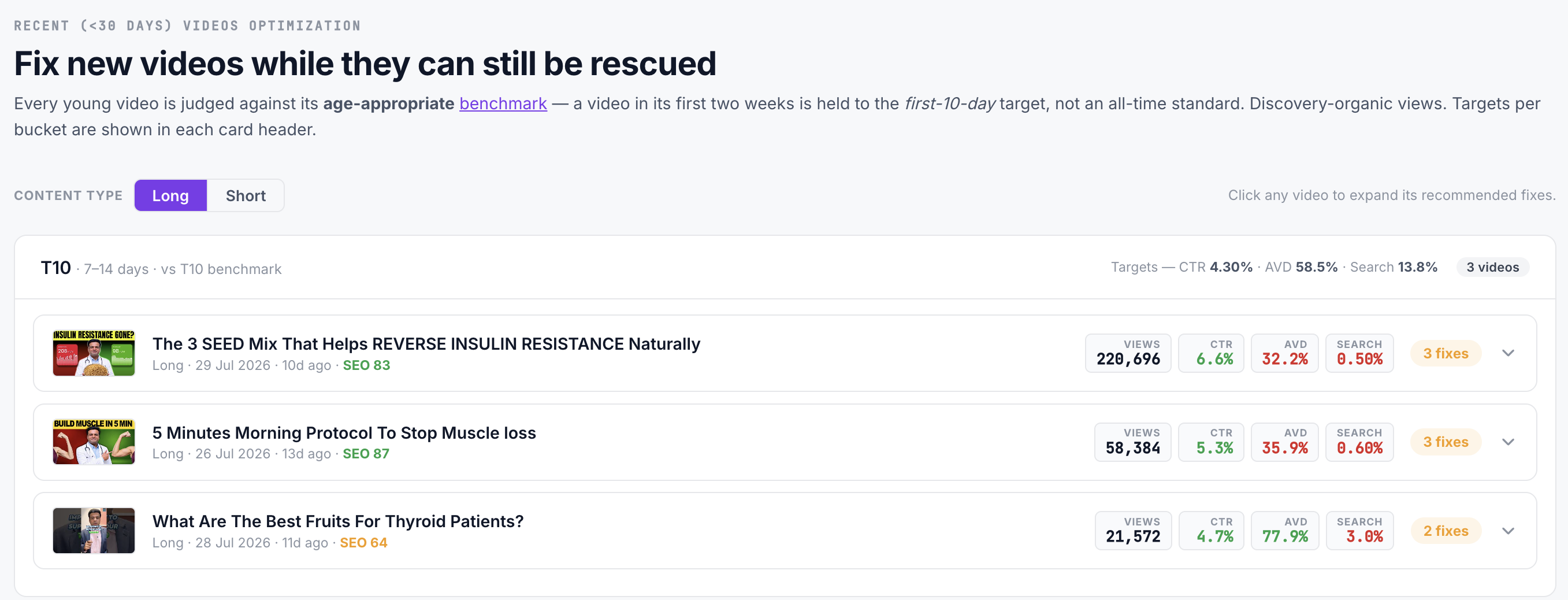
Each card exposes four fields at a glance: Rank OS score with 30-day delta, action-queue count with high-priority items highlighted, review-response backlog count and days-since-last-Post. The card colour tags green/yellow/red so scanning the portfolio takes under two minutes even at 30-50 locations.
Filters narrow the view — by region, by account manager, by specialty, by client-group. A regional account manager can filter to their 8-12 assigned locations; a compliance reviewer can filter to "pending approval this week"; the director can pull "all locations with Rank OS delta below negative-5 this month" as a triage list.
The dashboard is designed as a triage tool, not an analytics tool. It answers "what needs my attention now?" — not "what did we accomplish last quarter?". That second question lives in the reports.
Per-location dashboards and drill-downs
Clicking a location card opens the per-location dashboard. This is where actual work happens.
The per-location view shows Rank OS score with dimension breakdown (Relevance, Review Health, Freshness, Entity Authority, AIO Readiness), Geo-Grid heatmap for the location's catchment, action queue prioritised by expected Rank OS lift, review pipeline with response status, Post calendar, competitor snapshot, and citation footprint status.


From the per-location dashboard, work happens in three places. The action queue is where the specialist executes prioritised tasks. The review pipeline is where responses get drafted and sent. The Post calendar is where Content Studio drafts get approved and scheduled. Every action taken here is auditable — who did what, when, and against which client tenant.
For hospital-chain clients where one legal entity owns multiple locations, the per-location dashboard rolls up into a "client group" view showing portfolio-level metrics for that specific client with each of their locations underneath.
Role-based access in a real agency
Access control is not a bureaucratic feature — it is what makes a 30-clinic operation safe to run. Angryturtle's Agency tier supports a role hierarchy that maps onto how healthcare marketing teams actually work.
Agency Admin. One or two people at the organisation with unrestricted access. Founder/CEO and head of operations, typically.
Account Manager. Assigned to a specific cluster of client tenants. Can execute actions, publish content and respond to reviews for assigned clients only. Cannot see other account managers' clients — a hard partition.
Operations Specialist. Cross-portfolio execution rights. Runs Geo-Grid scans, publishes bulk content and executes citation building across any client tenant. Typically 2-5 people.
Compliance Reviewer. Approval-gate access for content publishing. Reviews Content Studio drafts before they go live to Google, particularly for content that touches NMC, ASCI, PC-PNDT or ART Act rules. A named healthcare-compliance-trained person owns this role.
Client Viewer. The client's own team members get read-only access to their tenant — their Rank OS, their action queue, their monthly report, their review pipeline. Cannot edit or see anything outside their tenant.
The Client Viewer role is the underrated one. It changes the client relationship from "the agency sends us reports we can't verify" to "we can log in and see the same data the agency sees". Trust improves; back-and-forth reduces.
White-label reporting and monthly cadence
Monthly reports are the primary artefact clients receive. White-label configuration lets the report carry the agency's logo, colour scheme, cover-page copy, footer contact information and (on Enterprise tier) custom section templates. The Angryturtle branding is entirely absent from the client-facing PDF.
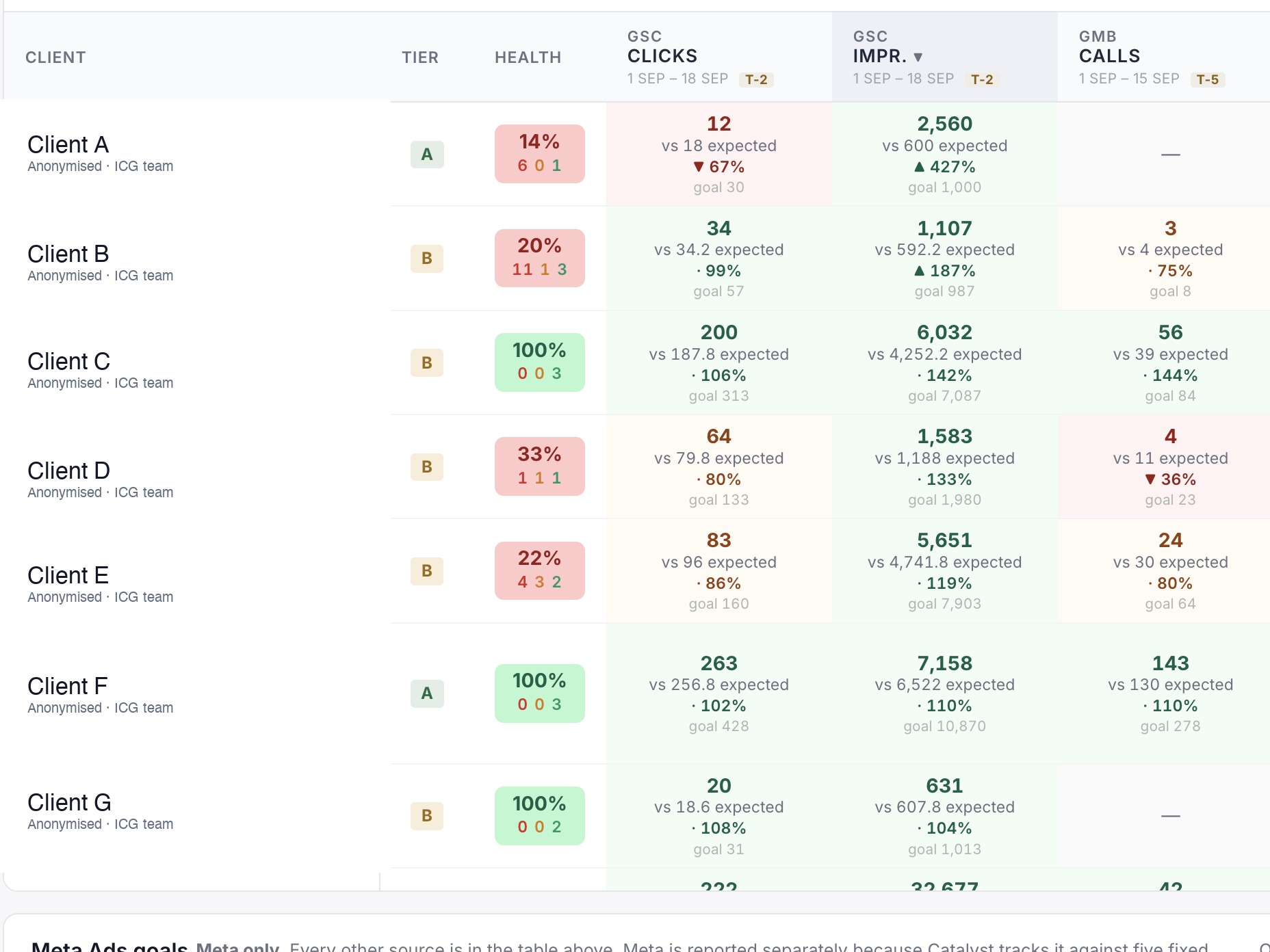
The default monthly report structure covers six sections. Rank OS trend with dimension breakdown. Local pack ranking summary from Geo-Grid data. Review pipeline summary (new reviews, response cadence, rating trajectory). Content activity (Posts published, photos added, updates shipped). Competitor snapshot (top-5 competitors with movement flags). Recommended focus for the coming month.
Reports generate on a scheduled cadence — first Monday of the month is the default, adjustable per-tenant to match client preferences. Reports auto-deliver via email to the client contacts listed in the tenant configuration. Reports are also available for download from the client tenant's dashboard.
For agency directors, the portfolio-level meta-report summarises how many tenants shipped on cadence, which reports flagged material regressions and which tenants surfaced strategic issues worth agency-leadership review.
Client-side change approval workflow
Not every change should ship without client approval. Angryturtle's approval workflow lets specific action classes be gated on explicit client sign-off before publishing.
The three action classes most commonly gated are Post publishing (client wants to see the draft before it goes live), category changes (the client wants to sign off on how their GBP is positioned) and services-list changes (adding or removing services touches business definitions the clinic wants to control).
The gated workflow runs three steps. The specialist stages the change in the client tenant's pending queue. The client tenant's designated approver — typically a marketing manager or the clinic owner — sees the pending item in their read-only view and either approves or requests edits via a comment thread. Approved items publish; requested edits route back to the specialist.
Approval gates can be turned off entirely for high-trust clients who want the agency to ship without gate-review, or turned on selectively (e.g., Post-publishing gated but citation building not gated). The default is a middle configuration that most healthcare clients find comfortable.
A sample workflow: managing 30 clinics through a month
Concretely, what does a month look like for a marketing director running 30 clinic tenants on Angryturtle Agency OS?
Week 1. Reports from the previous month generate and auto-send on the first Monday. The director reviews the portfolio-level meta-report to see which tenants regressed or surfaced strategic issues. Regression tenants get scheduled for a strategic review with the assigned account manager mid-week. The month's Content Studio calendar publishes into the pending-review queue for each tenant.
Week 2. Account managers work through the action queues for their assigned tenants. Priority-1 items (category corrections, citation cleanups on missing directories) get executed. Content Studio drafts flow through the compliance-reviewer queue and the client-approval gates.
Week 3. Mid-month competitor-alert review. Alerts that clustered into sustained patterns over the trailing three weeks get escalated into strategic reviews with the affected clients. Geo-Grid scans run mid-month to establish the month's ranking trajectory.
Week 4. Reputation focus week. Review-response backlog gets cleared across every tenant. Review-collection campaigns for tenants below their cadence baseline get triggered. Month-end Geo-Grid scans run to lock in the month's Rank OS closing snapshot.
The director spends 2-3 hours per week in the platform itself; the specialists spend most of their working hours in the platform; the clients spend 30-60 minutes per month reviewing their tenant view and signing off on gated changes.
What Agency OS doesn't do
Angryturtle's Agency OS is not a general-purpose agency practice management system. Client contracts, invoicing, time tracking and internal project management are out of scope — those workflows live in your CRM or PSA of choice and integrate via export rather than being replaced.
Agency OS is not a website CMS. Content that goes on the client's own website is drafted elsewhere; only the GBP-Post subset of content flows through Content Studio.
Agency OS does not replace the account-management relationship. The platform gives specialists the operational infrastructure; the client relationship still runs through a named human account owner. That is by design — healthcare marketing is a judgment-heavy domain and the automation is meant to remove drudgery, not judgment.
The tool ICG uses to run this at scale: Angryturtle
ICG runs local SEO and GBP intelligence for 150+ Indian healthcare brands using Angryturtle — our own AI-native GBP intelligence and management OS. The platform scores every profile 0-100 via a proprietary Rank OS model with five weighted dimensions (Relevance, Review Health, Freshness, Entity Authority, AIO Readiness), publishes edits, Posts, media, and review replies directly to Google, and includes Ask Maps AIO Readiness scoring for Google AI Overviews and ChatGPT visibility.
Available in two shapes: self-serve at ₹999/- per month for solo owners with 1-2 profiles, and ICG's managed service from ₹25,000/- per month where our healthcare specialists execute inside the same platform. Both are anchored in the Healthcare Local SEO Agency India pillar page which has full scope, methodology and pricing.
Book a demo on WhatsApp → or start a free trial at angryturtle.ai →
Related reading
- Healthcare Local SEO Agency India — pillar service page
- Angryturtle Multi-tenant Agency OS explained — the underlying architecture in depth
- Hospital chain local SEO India guide — chain-specific playbook
- Multi-location GBP management for Indian healthcare — location-level operations
- Angryturtle Rank OS explained — the scoring model reports reference
FAQ
How many clients can Agency OS realistically handle? The architecture scales linearly. ICG runs 150+ tenants in production. Most agencies at 50-100 tenants find the portfolio dashboard and role-based access sufficient without needing custom infrastructure.
What is the minimum tier that supports white-label reporting? Agency tier at ₹3,499+/- per month. Solo tier does not include white-label. Enterprise tier adds custom report-template sections and per-client branding overrides.
Can the client see everything I see? No. Client Viewer role is scoped strictly to that client's tenant. They cannot see other tenants' data or the portfolio-level views. Within their tenant they see the same data the agency team sees.
Can we integrate with our CRM for lead pass-through? Yes. Angryturtle exposes webhook endpoints for review events, action-queue completions and monthly report generation that can drive CRM automations.
How does credit budgeting work across tenants? Each tenant has its own credit budget for Rank OS scans, Geo-Grid scans, Pin Checker tests and Ask Maps analyses. Agency Admin allocates per client. Low-credit alerts fire before exhaustion so one tenant's aggressive scanning does not consume another's budget.
Can I white-label the client login page too? On Enterprise tier, yes — including custom subdomain routing. Agency tier white-labels the reports and dashboards but the login uses Angryturtle's standard authentication surface.
How does the compliance-reviewer role work in practice? Content Studio drafts route into a compliance queue before publishing. The compliance reviewer approves, edits or rejects. Rejected drafts return to the specialist with the reason cited. Approvals fire the publish. The workflow is the same across every tenant in the portfolio.
What happens when we lose a client tenant? The tenant archives; connections release; the agency's own operations continue with other tenants. Historical data for the archived tenant is retained for compliance and audit purposes.
Can we run multiple agencies inside one Angryturtle account? Enterprise-tier configuration supports agency-of-agencies structures with sub-agency partitions. Standard Agency tier is one agency with many client tenants.
How does ICG's own delivery use Agency OS? ICG's local SEO team operates across the 150+ client portfolio using the same Agency OS you would use. Each named ICG specialist owns a cluster of clients; the compliance-reviewer role is held by a named healthcare-compliance-trained team member; every managed-tier client has a named account manager as the single relationship owner.
Book a free 30-minute Brand & Growth Diagnostic.
It's a working session, not a sales pitch — you leave with a written root-cause analysis you can act on, whether or not you engage ICG.
The three platforms
behind every ICG engagement.
Beacon
CAPI middleware that fixes Event Match Quality, translates CRM statuses to Meta-standard events, dedups across channels.
Agency OS
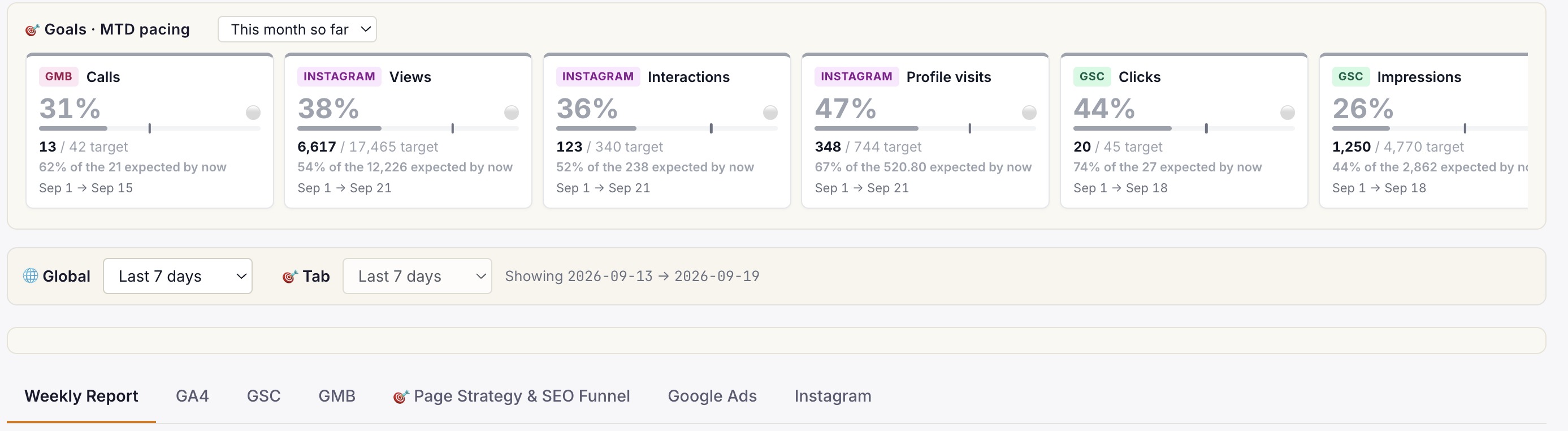
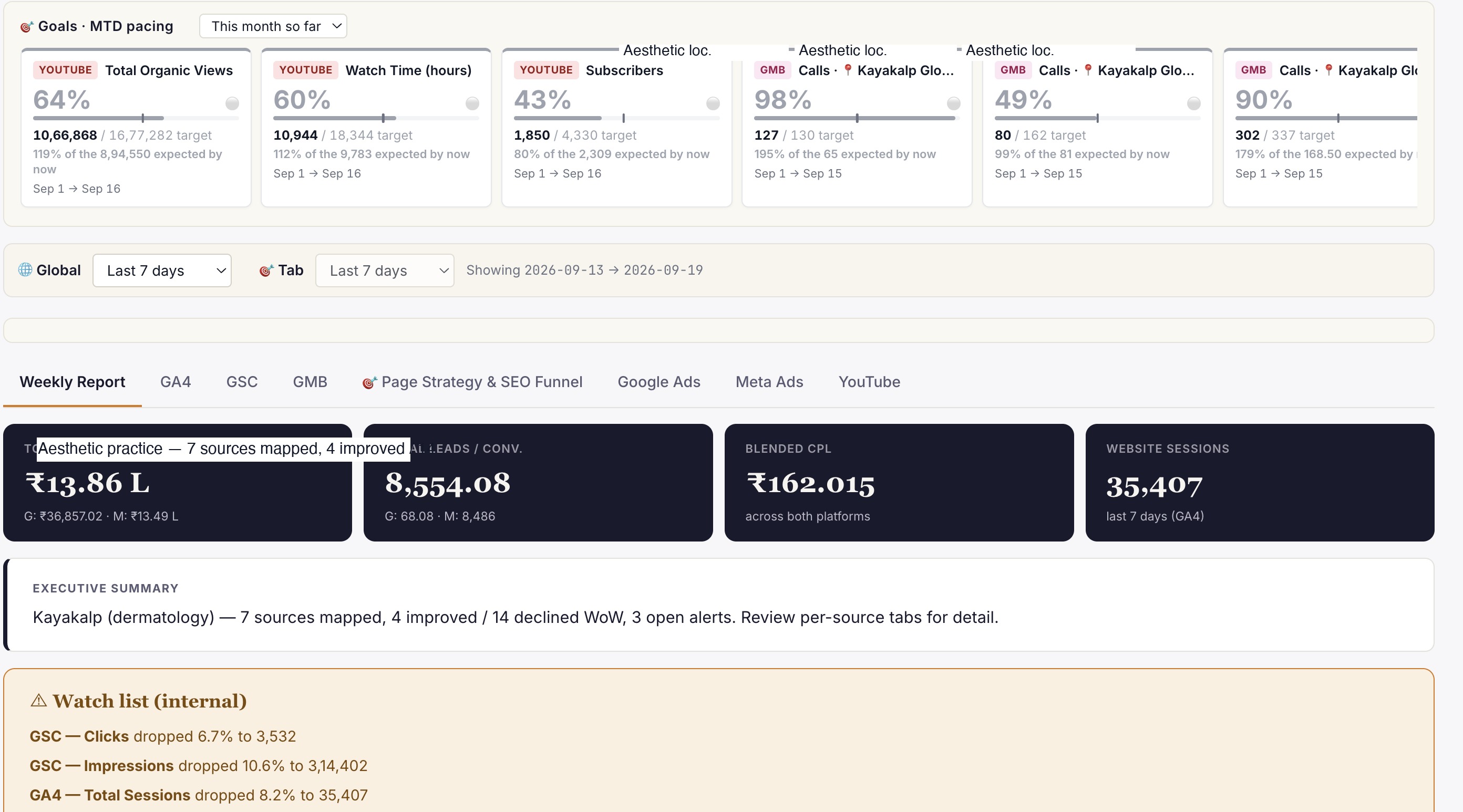
Live client dashboard. GSC, GA4, Google Ads, Meta Ads, IVR calls in one view. Login anytime, not monthly.
Phoenix
Clinic revenue intelligence over your PMS. Daily action queue: Prevent Loss, Maintain & Engage, Grow Revenue. Multi-centre rollout.
Or book a free 30-min audit to see all three in action on your account.
Healthcare brands
that already run on ICG.
A representative slice of the 150+ healthcare brands ICG has delivered for across India. Most engagements remain under NDA.


What ICG clients say · on video.
"Scale up of organic channels and business consulting. ICG has absolute domain authority in their field."
"Working with ICG transformed how we acquire IVF patients in Gurgaon. They understand the fertility journey from inquiry to consult..."
"What Ichelon accomplished — they got all my ideas and worked over 3-4 months to create an amazing, super-customised website."
Need help operationalising this?
Every ICG service is healthcare-only, NMC + DPDP-aware, and built around the patient-research patterns that drive Indian healthcare growth in 2026.
Every practice welcome — packages from ₹20,000/mo.
Goals-Driven engagements · Performance-Linked Payout Models available
More from
ICG.
Hindi and regional-language SEO means publishing proper pages in the languages your patients search in, on their own URLs and linked with hr...
A new pharma brand in India should start digital work before launch, built around who it may legally address. This six-month plan covers pro...
Hospitals and clinics in India can still advertise after the NMC's 6 October 2026 guidelines, but only with factual, verifiable information....
Stop guessing.
Book a Diagnostic.
30 minutes. Free. With the AI-powered healthcare-only marketing agency 150+ brands already run on. No slides, no pitch, no hard close.


