


YouTube SEO for doctors 2026: how to rank healthcare videos where patients actually search
YouTube SEO for doctors is a specific discipline that runs on YouTube's own ranking system, on Google web search, and on Google AI Overview citations. This guide covers keyword research, title optimisation, descriptions, chapters, captions, thumbnails, the first-24-hour engagement window, and the NMC-compliant variations that keep everything inside the medical advertising perimeter.
No pitch. Written root-cause diagnosis. AI-powered, healthcare only.
Direct answer
YouTube SEO for doctors is a specific discipline that runs on YouTube's own ranking system, on Google web search, and on Google AI Overview citations. This guide covers keyword research, title optimisation, descriptions, chapters, captions, thumbnails, the first-24-hour engagemen...
TL;DR

YouTube SEO for doctors is a specialised discipline that borrows some machinery from web SEO but runs on a different ranking system, a different attention economy, and a very different compliance perimeter. ICG runs healthcare YouTube channels for clinics and hospital groups where the practical question is never "how do I go viral" but "how do I turn keyword-targeted videos into steady, ranked assets that patients find when they search for the conditions our doctors treat". This is the operator's manual — keyword research using Ahrefs, vidIQ, and YODA Ask Maps, title optimisation, descriptions YouTube actually indexes, chapters, tags, closed captions, thumbnail CTR, the first-24-hour engagement window, playlists, end screens, and the compliance-safe variations that keep it all inside NMC's 2026 advertising guidelines. For the fuller programme, our healthcare YouTube marketing service and the healthcare YouTube pillar guide start from the same premise: video is a durable acquisition channel when treated as a search asset, not a vanity project.
Why YouTube SEO for doctors is different from web SEO
Web SEO ranks a page. YouTube SEO ranks a session — the platform is optimising to keep the viewer watching one more video, then another, and it weights every ranking signal through that lens. A doctor's video that earns 50,000 views but sends viewers straight to another channel will underperform against a smaller video that keeps the viewer inside the channel for two more videos. Session watch-time, average view duration, click-through rate on impressions, and returning-viewer share matter more than raw views.
The compliance perimeter is the second difference. A dermatology blog on a website can carry treatment-outcome language that a dermatology video cannot, because a video with the doctor visible on camera reads as personal solicitation under the NMC framework. Personal solicitation, unsubstantiated superlative claims, and identifiable-patient testimonials are the three failure modes we see most on doctor channels — usually inserted by well-meaning agencies unfamiliar with the medical advertising rulebook.
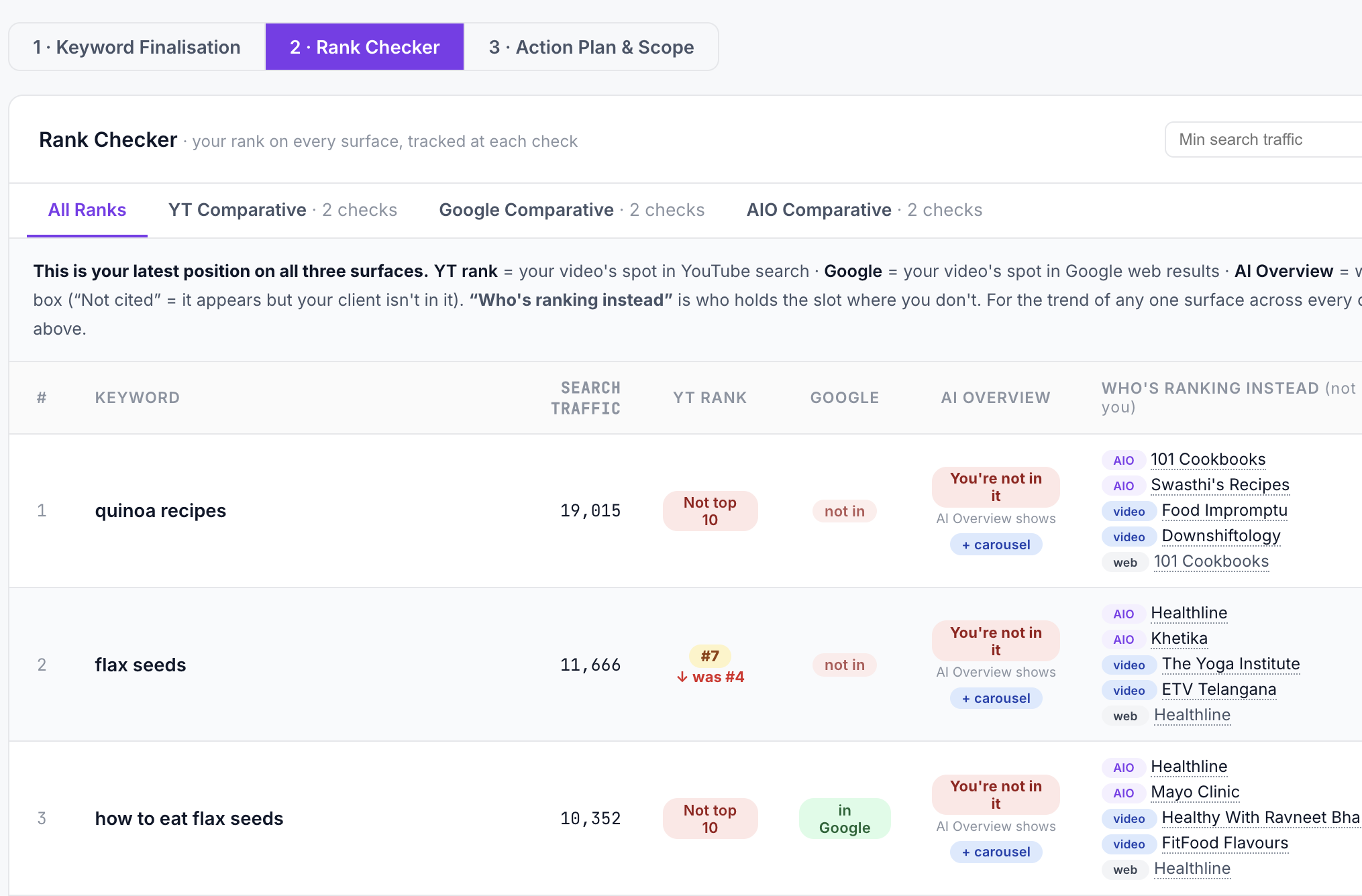
The third difference is the ranking surface. A doctor's video competes on YouTube search, in the Google web search video carousel, and increasingly for citation inside Google AI Overviews when a patient asks a health question. These are three separate races with three separate signal sets. YouTube SEO for doctors that ignores any one of them leaves visibility on the table.
Keyword research that maps to actual patient queries
Most healthcare channels start keyword research inside a generic YouTube keyword tool and end up with a list that sounds right but converts nothing. The better workflow starts from the queries patients actually type and speak.
Ahrefs and vidIQ are useful for surfacing search volume and competition on the YouTube surface itself. Use Ahrefs' YouTube keyword report or vidIQ's keyword score to find the intersection of adequate search volume and low competitive strength for the doctor's specialty. The tools are commodity — every competitor uses them — so the intelligence layer that matters is the layer on top.
That layer, for our clients, is YODA Ask Maps. Ask Maps ingests real patient-side questions from Google Autocomplete, People Also Ask, YouTube Autocomplete, Reddit medical subs, and the actual patient conversations transcribed from consultation calls (with consent). It clusters the questions by intent and specialty and returns a ranked question bank the channel should answer as videos. The output is not "keywords" in the classical sense — it's the actual questions patients ask, in the words patients use, mapped to the videos most likely to earn ranking and AI Overview citation.
Practical starting list for a dermatology channel: "adult acne treatment options", "PRP hair treatment before and after what to expect", "chemical peel recovery day by day", "psoriasis versus eczema difference". Each one is a video slot. Each one has a clear intent and a clear compliance boundary.
Title optimisation inside the NMC compliance perimeter
The title has three jobs — carry the primary query, earn the click at impression, and stay inside the medical advertising code. The most common failure is a title written for clicks that inserts a superlative or a claim, then invites an ASCI complaint six months later.
Working title patterns for doctor channels:
Explainer: "What is [condition] — signs, causes, and treatment options"
Options-focused: "[Treatment] for [condition]: how it works and who it suits"
Myth-versus-fact: "[Common belief] about [condition] — what the evidence actually says"
Question-answering: "How long does [treatment] take to show results"
Comparative-neutral: "[Treatment A] vs [Treatment B] for [condition] — what the difference actually is"
Avoid: "best doctor for", "guaranteed cure", "no.1 clinic", any first-person outcome claim ("I cured 500 patients"). These read as personal solicitation and comparative superlative claims — flagged by both NMC and ASCI.
Front-load the primary query in the first 40 characters. Include the condition or treatment name. Keep total title length under 60 characters so mobile YouTube doesn't truncate it before the value proposition lands.
Description patterns YouTube actually indexes
YouTube reads roughly the first 200 characters of the description as strong ranking signal, and the remaining ~4,800 characters as extended context. The first paragraph should restate the video's core question in the patient's own words, deliver a one-sentence answer, and preview what the video covers. This paragraph is what YouTube surfaces in search snippets and what Google reads when deciding whether to show the video in web-search results.
Below the first paragraph, the structural blocks that consistently earn ranking on doctor channels:
Chapter timestamps — every video with more than one segment should carry timestamps. YouTube uses them for chapter markers in search and Google uses them for "key moments" in web search. The format matters — "0:00 Introduction" on the first line, then 0:32 [chapter name], 1:15 [chapter name], and so on. Chapters below 10 seconds are ignored.
Doctor and clinic identification — one paragraph naming the doctor (with degree and registration credential where relevant for E-E-A-T), the clinic, and the specialty, without personal-solicitation phrasing. Link to the doctor's clinic page on the website, not to a booking landing page.
Related videos and playlists — three to five links to related videos on the same channel with descriptive anchor text. This drives session watch time.
Compliance notice — a standard disclaimer line: "This video is educational information and not a substitute for a personal medical consultation." Weakly required by norms; strongly protective if a complaint arrives.
Chapters, timestamps, and why they compound rankings
Chapters do three things simultaneously. They increase average view duration because viewers who arrive from search can skip to the segment they care about instead of bouncing. They add another indexable surface — each chapter title is separately readable to YouTube and to Google, effectively multiplying the query coverage of one video. And they surface as "key moments" in Google web search results, which sometimes rank above the video itself for long-tail queries.
For a healthcare explainer, a good chapter structure looks like: 0:00 Introduction, 0:30 What is [condition], 2:15 Signs and symptoms, 4:00 What causes it, 6:30 Treatment options, 9:15 When to see a doctor, 11:00 Common questions, 13:00 Recap. Each chapter is 90-180 seconds. Total runtime 10-15 minutes for a substantive explainer.
Chapter titles carry the same compliance rules as video titles — no superlatives, no unsubstantiated claims, no personal solicitation. They should read like textbook section headings, not marketing copy.
Tags, hashtags, and closed captions
Tags are weak ranking signal in 2026 but non-zero. Use 10-15 tags per video mixing exact-query, related-query, condition-name, treatment-name, doctor-name, clinic-name, and city. Don't stuff — YouTube's spam filter recognises tag-stuffing and demotes.
Hashtags in the description behave differently. Three hashtags maximum, placed either at the end of the description or in the first line. The first three hashtags appear above the video title in the YouTube app, so they should be brand-relevant not keyword-stuffed. Common pattern: #DermatologyExplained, #DrLastName, #ClinicName.
Closed captions are the most under-invested ranking asset on doctor channels. Auto-generated captions are approximate and often miss medical terminology. Uploaded, human-edited captions do four things: they improve accessibility (a compliance and audience-reach win), they add another full transcript surface that YouTube and Google index, they enable Google to lift quotable segments for AI Overview citation, and they materially improve average view duration for viewers who watch muted on mobile — a substantial fraction of the audience.
Upload SRT or VTT files for every video. Budget 15-30 minutes of editing per video for a specialist medical channel.
Thumbnail CTR without misleading imagery
Thumbnail click-through rate is the largest single lever for YouTube growth on a doctor channel — a 2% CTR lift on a video that impressions well can double its ranking trajectory. But medical thumbnails carry constraints that mainstream YouTube thumbnails do not.
What works: clean thumbnails with the doctor visible (face and shoulders, professional attire, clinical setting), a bold text overlay of the video's core question (four to six words maximum), high contrast between text and background, and consistent thumbnail template across the channel so the brand is recognisable at grid-view scale.
What fails: clickbait shock imagery (bloody wounds, extreme conditions used for shock value), before-and-after imagery presented as evidence of specific outcomes, identifiable-patient photos without documented consent, comparative superlatives on the thumbnail ("best treatment", "no.1 doctor"). All four attract complaints and platform demotion; the last two attract NMC and ASCI action.
The compliance-safe alternative for the "before-and-after" impulse is a "condition-versus-treatment-mechanism" split — one side of the thumbnail shows a stylised diagram of the condition, the other side shows a stylised diagram of the treatment mechanism. It carries the same visual weight as a before-and-after without the compliance risk.
The first 24-hour engagement window
YouTube's algorithm makes most of its ranking decision for a new video inside the first 24-48 hours. Videos that earn high CTR, long average view duration, and strong session watch time in that window get pushed to a larger audience; videos that don't are quietly deprioritised and rarely recover.
The operating implications for a healthcare channel are practical. Publish on a consistent day and time when subscribers are most likely to engage — for Indian healthcare channels, this typically clusters between 7-10 PM IST weekdays and mid-morning Saturday. Send a Community post 30 minutes before publish for channels with 1,000+ subscribers. Cross-post the video to the clinic's WhatsApp broadcast list, Instagram Reels teaser, and website blog embed in the first two hours.
Monitor CTR and average view duration inside YouTube Studio during the first 24 hours. If CTR is below 3-4% for a specialist medical channel, the thumbnail or title is losing the impression battle — swap the thumbnail. If average view duration is below 40% of runtime, the intro is losing viewers — the next video should tighten its opening.
Playlists, end screens, and channel architecture

Playlists organise the channel for both viewers and the algorithm. A dermatology channel should have playlists for each major condition area (acne playlist, hair-loss playlist, cosmetic-procedures explainer playlist, skin-cancer awareness playlist). Playlists rank in YouTube search independently of individual videos and can appear in Google web search for broader queries.
End screens should route viewers to two other videos on the channel and to the "subscribe" element. Choose end-screen video suggestions manually per video rather than letting YouTube auto-select — the manual choice keeps viewers inside topical clusters, which lifts session watch time.
Channel architecture matters at the meta level. The channel description carries the primary specialty keywords, the doctor's credentials, and the clinic's identity. The channel keywords (in YouTube Studio settings) should mirror the top 10-15 primary queries the channel targets. Featured video should be the strongest evergreen explainer, not the most recent upload.
The platform ICG uses to run this at scale: YODA
ICG runs healthcare YouTube marketing for clinics, hospitals, and specialty groups using YODA — our AI-native healthcare YouTube marketing platform. YODA sits on top of a channel's data and does four things no dashboard does: it separates organic from paid views at every step (so a promoted video can never masquerade as organic growth), it gives decisions not dashboards (every video gets a state + next action), it writes back to YouTube directly (improved titles, tags, descriptions, chapters applied straight to the platform), and it tracks the three rank races — YouTube search, Google web, and Google AI Overview citations.
YODA runs the full 6-step workflow — Overview, Diagnostics, Strategy, Optimisation, Reputation (ORM), and Competitor Intel — with 40+ analysis modules organised under those steps. ICG's managed YouTube service uses YODA end-to-end. See the Healthcare YouTube Marketing pillar guide for the full scope, or the Healthcare YouTube Marketing Agency service page for engagement details.
Book a YODA demo on WhatsApp → or request a free healthcare YouTube channel audit →
Related reading
- Healthcare YouTube marketing pillar guide — the full channel operating manual
- How a doctor YouTube channel generates consultations in India
- Five states every clinic video sits in: viral to dormant
- Three ranking races: YouTube, Google web, and AI Overviews
- Healthcare YouTube marketing service — engagement details
FAQ
How long should a healthcare explainer video be?
10-15 minutes for a substantive explainer, 3-6 minutes for a focused Q&A, 30-60 seconds for a Short. The sweet spot on doctor channels is 8-12 minutes because it accommodates a real explanation and hits YouTube's advertiser-friendly monetisation thresholds without losing average view duration.
What is the biggest NMC compliance mistake in YouTube titles?
Personal solicitation phrasing — "book with the best dermatologist in Mumbai" or "India's top IVF doctor". NMC's 2026 advertising guidelines restrict direct solicitation and comparative superlatives. Reframe as educational — "understanding IVF options" or "what to look for in a dermatology consultation".
Do YouTube tags still matter in 2026?
Weakly. Use 10-15 tags mixing exact-query, related-query, condition, treatment, and location. The stronger ranking signals are title, description, transcript, chapters, and CTR. Don't skip tags but don't rely on them.
Should we upload human-edited captions or use auto-captions?
Human-edited SRT/VTT captions. Auto-captions miss medical terminology, misspell drug names, and confuse condition names. Uploaded captions improve accessibility, indexing, and AI Overview citation eligibility. Budget 15-30 minutes of editing per video.
How often should a healthcare channel publish?
Weekly is optimal for a specialist channel. Fortnightly is acceptable if resource-constrained. Daily is counterproductive on a doctor channel — quality falls, average view duration drops, and the algorithm penalises the channel. Consistency of day and time matters more than absolute frequency.
Do YouTube Shorts help a doctor channel?
Shorts drive reach but rarely drive consultations directly. Use Shorts to teaser long-form explainers — a 45-second Short answering a specific question that ends with "full video linked below". Don't rely on Shorts as the primary format; the audience they build is often unqualified for medical consultation.
How do we measure whether YouTube SEO is working for the practice?
Three metrics: rank on target patient queries (tracked in YODA's SEO Lab), organic average view duration (excluding paid views), and attributed consultation flow from YouTube-tagged UTM links or "how did you hear about us" intake fields. Views alone are vanity — the ranking-plus-attribution combination is signal.

Should the doctor appear on camera or use a voiceover?
On-camera builds E-E-A-T and personal trust — patients want to see the doctor before booking. Voiceover works for procedural explainers or animated content. The strongest channels mix: on-camera for explainer and Q&A formats, voiceover-plus-animation for anatomical or procedural detail.
What about video SEO on the clinic website — does that interact with YouTube SEO?
Yes, materially. Embedding the YouTube video on a matching clinic website page with a VideoObject schema block, transcript, and FAQ schema improves Google web-search visibility for both the video and the page. Covered in detail in the indexed website videos guide.
Can Angryturtle help with YouTube SEO or is that YODA's job?
YODA is the YouTube-side platform. Angryturtle is the GBP-side platform. The two integrate — YODA feeds ranked video assets into the GBP profile via Angryturtle's Content Studio (Posts, media, video embeds), and Angryturtle feeds patient-question data back into YODA's Ask Maps. Both are ICG-built.
Book a free SEO diagnostic.
Hanuman Sihag's team runs a live crawl, checks technical health, cannibalisation, schema coverage and content gaps. 60 minutes, prioritised fix list.
The three platforms
behind every ICG engagement.
Beacon
CAPI middleware that fixes Event Match Quality, translates CRM statuses to Meta-standard events, dedups across channels.
Agency OS
Live client dashboard. GSC, GA4, Google Ads, Meta Ads, IVR calls in one view. Login anytime, not monthly.
Phoenix
Clinic revenue intelligence over your PMS. Daily action queue: Prevent Loss, Maintain & Engage, Grow Revenue. Multi-centre rollout.
Or book a free 30-min audit to see all three in action on your account.
Healthcare brands
that already run on ICG.
A representative slice of the 150+ healthcare brands ICG has delivered for across India. Most engagements remain under NDA.


What ICG clients say · on video.
"Scale up of organic channels and business consulting. ICG has absolute domain authority in their field."
"Working with ICG transformed how we acquire IVF patients in Gurgaon. They understand the fertility journey from inquiry to consult..."
"What Ichelon accomplished — they got all my ideas and worked over 3-4 months to create an amazing, super-customised website."
The intelligence stack behind this playbook.
Every ICG engagement runs on the Search Intelligence Trifecta — Angryturtle for GMB, SIE for search and AI Overview, YODA for YouTube. Live product screens below.
Need help operationalising this?
Every ICG service is healthcare-only, NMC + DPDP-aware, and built around the patient-research patterns that drive Indian healthcare growth in 2026.
Every practice welcome — packages from ₹20,000/mo.
Goals-Driven engagements · Performance-Linked Payout Models available



More from
ICG.
Five trends shaping Indian healthcare marketing through 2027: AI-first patient research, Conversions API adoption, ABDM discovery, the AEO w...
Healthcare AIO is the discipline of getting your clinic or hospital cited inside Google AI Overviews, ChatGPT and Perplexity answers — not j...
Conversational-search advertising places brand messages inside AI chat answers — ChatGPT, Perplexity, Copilot — rather than beside a results...
Stop guessing.
Book a Diagnostic.
30 minutes. Free. With the AI-powered healthcare-only marketing agency 150+ brands already run on. No slides, no pitch, no hard close.


