


VidIQ & TubeBuddy Alternative for Healthcare YouTube — YODA
Beyond VidIQ and TubeBuddy: YODA is ICG's healthcare-specific YouTube OS — clinical accuracy, AI Overviews lab, business outcomes over vanity metrics. See how.
No pitch. Written root-cause diagnosis. AI-powered, healthcare only.
Direct answer
Beyond VidIQ and TubeBuddy: YODA is ICG's healthcare-specific YouTube OS — clinical accuracy, AI Overviews lab, business outcomes over vanity metrics. See how.
TL;DR

vidIQ and TubeBuddy are the two names that come up in almost every clinic marketing team's "what tool should we use for YouTube" conversation. Both are excellent products. Both have shipped a decade of features, hit millions of users, and earned the reputation they have. If you are a beauty vlogger, a gaming channel, a lifestyle creator, or any of the categories these tools were built for, they are the right answer. But if you are a dermatology clinic, a hospital YouTube channel, an IVF chain running video for consult booking, or an agency running healthcare YouTube for clients — the tools are systematically the wrong fit. This piece is the honest walkthrough of why, extends the comparison beyond the head-to-head yoda vs vidiq and yoda vs tubebuddy pieces, and gives a defensible decision matrix for teams currently paying for these tools.
The generic creator tool thesis and where it breaks for healthcare
vidIQ and TubeBuddy both operate on the same core thesis — a solo creator or small creator team can improve channel performance materially by getting better tag suggestions, better title recommendations, competitor analytics, keyword research, and thumbnail A/B testing. The thesis is correct for the audience the tools were built for. The tools have shipped good execution of it.
The thesis breaks for healthcare in five specific ways.
Break 1: The tag and title recommendations are drawn from broadly-successful creator patterns. A vidIQ recommendation for a hair loss video may suggest sensationalist language ("SHOCKING truth about hair loss that doctors don't want you to know") that would be highly effective for a general-audience creator and would violate the NMC Ethics Code for a dermatologist's channel. The tool does not know the compliance perimeter exists.
Break 2: The competitor analytics compare against generic channels. A TubeBuddy competitor benchmark for an IVF channel may include lifestyle-adjacent channels or non-Indian fertility channels that are not real competitors for the specific market. The specialty benchmark set that a healthcare channel needs — Indian IVF clinics, comparable size, comparable procedure mix — is not what generic tools produce.
Break 3: Neither tool separates organic from paid. Both report on blended metrics. For healthcare where the compounding organic story is what matters and paid promotion is a reinforcement tool for organic Winners, this blending is the single biggest measurement issue.
Break 4: Neither tool tracks Google AI Overview citations. AI Overviews are increasingly citing video sources for healthcare procedure queries. This is a distinct ranking race that neither vidIQ nor TubeBuddy currently reports on because their focus is YouTube-native ranking, not the cross-surface ranking picture.
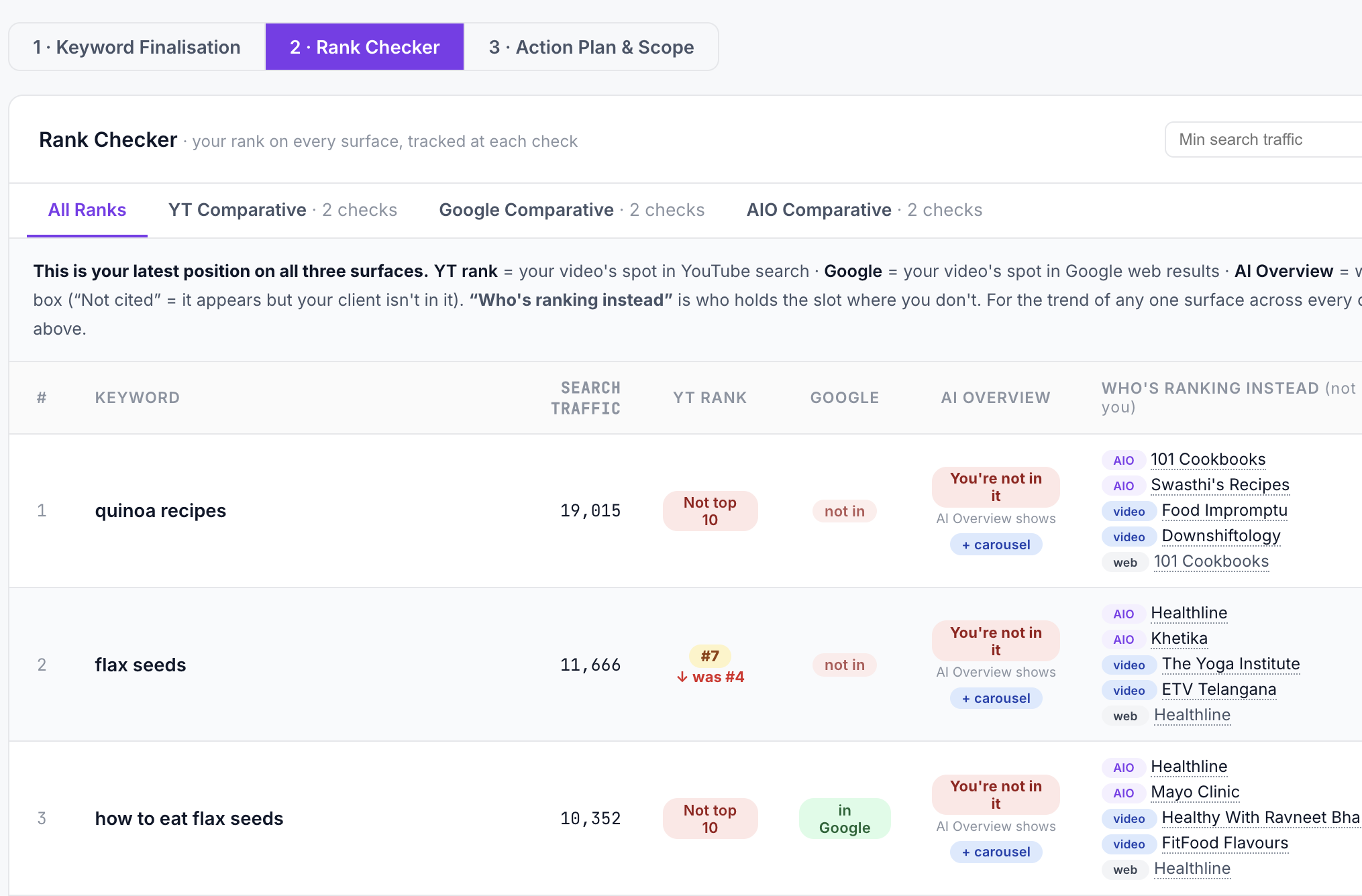
Break 5: Neither tool produces decisions. Both are dashboard and suggestion tools. The output is data and options. The healthcare marketing team still has to interpret, decide, and execute. For a clinic marketing team of 1-2 people running a channel alongside 8 other responsibilities, "here is more data" is often worse than "here is the specific action for this specific video this week."
These five breaks are not vidIQ's or TubeBuddy's fault. They are horizontal tools solving a horizontal problem well. Healthcare is a vertical problem that requires vertical tooling.
Why healthcare-specific tooling actually matters (not marketing spin)
The temptation for any specialist vendor is to over-claim that their vertical focus matters. Sometimes the vertical focus is a rebrand of a generic capability. In healthcare YouTube marketing, four specific capabilities cannot be delivered by a generic tool retroactively:
Compliance-aware writebacks. When a tool suggests improving a title, description, or tag, the suggestion must pass through the NMC / DPDP / PC-PNDT / ART Act / ASCI filter before it is offered. A generic tool has no way to enforce this because its recommendation engine is trained on general creator content. Healthcare-specific tooling has this filter as a first-class part of the recommendation flow, not a bolt-on legal review after the fact.
Specialty benchmark calibration. A dermatology channel should be benchmarked against other Indian dermatology channels of comparable size, not against the top 10,000 YouTube channels globally. An IVF channel needs benchmarks that reflect the extended consideration cycle and the format mix (Q&A, cost explainer, doctor introductions) that IVF audiences actually watch. Generic tools cannot produce these because their benchmark data is horizontal.
Cross-race tracking. YouTube search, Google web organic, and Google AI Overview citations are three separate races with different rulebooks (covered in the three ranking races). A tool that only measures YouTube-native ranking misses two-thirds of the picture for healthcare where AI Overview citations increasingly drive procedure-query traffic.
Funnel-integrated attribution. A healthcare video's success is measured in consults booked and paid, not views. That requires integration into the clinic's telecaller function and (ideally) practice management system so views can be traced to booked consultations. Neither vidIQ nor TubeBuddy has this integration because their audience does not need it — a lifestyle creator measures success in views, ad revenue, and sponsorship deals.
What YODA does that vidIQ and TubeBuddy structurally cannot
YODA is not a "better" creator tool. It is a differently-scoped platform designed for the healthcare vertical.
The 6-step workflow. Rather than a menu of features, YODA runs a defined workflow — Overview and Setup, Diagnostics, Strategy, Optimisation, Reputation, Competitor Intel — that produces sequenced decisions. Every video and every keyword flows through this workflow. See the full workflow walkthrough.
State-based decisions per video. Every video gets one of five states — Winning, Sleeping, Retention Weak, Compliance Flagged, Sunset — and a specific next action. Not a dashboard; a decision.
Writeback capability. Improved titles, descriptions, tags, and chapters get applied to YouTube directly via API from within YODA, after passing the compliance filter. vidIQ and TubeBuddy suggest changes; YODA can execute them.
Three-race tracking. YouTube search ranking, Google web organic ranking, and Google AI Overview citations tracked as three separate races with race-specific optimisation actions.
Organic-paid separation. Every metric shows organic-only by default. Paid overlays appear as a separately-labelled layer. This is the single most important measurement discipline for a healthcare channel and it is baked into every YODA view.
Indian healthcare compliance perimeter. Every content suggestion, every writeback, every recommendation passes through the compliance filter calibrated to NMC 2026, DPDP 2023, PC-PNDT 1994, ART Act 2021, and ASCI 2022.
Consult-outcome attribution. YODA integrates with the clinic's telecaller function and (in Elevation-tier engagements) with the practice management system through Pharos, so views trace through to booked and paid consultations.
A fair comparison — where vidIQ and TubeBuddy still win
Not everything about YODA is better than the alternatives. Both vidIQ and TubeBuddy have genuine advantages worth naming honestly.
vidIQ has broader keyword research depth. For a channel that operates outside a specific compliance perimeter and needs broad keyword discovery across many topics, vidIQ's keyword database is deeper than YODA's (which is intentionally narrower to healthcare).
TubeBuddy has a richer bulk-operations toolset for creators managing hundreds of videos. Bulk find-and-replace, bulk tag operations, bulk end-screen management. For a creator with 500+ videos who needs to make sweeping changes, TubeBuddy's bulk operations are more mature.
Both are cheaper individually. vidIQ Boost is around $29/month, TubeBuddy Legend around $99/month, both aimed at individual creators or small teams. YODA's pricing structure is different because the buyer is different — a healthcare agency or a serious hospital operation.
Both have longer track records. Both have been in-market for a decade. YODA is newer and its feature set is optimised for the healthcare use case rather than trying to serve every creator vertical.
The honest positioning — vidIQ and TubeBuddy each do X well; YODA wins where Y for Indian healthcare specifically. This is the framing every serious comparison should follow.
Migration path from vidIQ or TubeBuddy to YODA
For a clinic or agency currently paying for vidIQ or TubeBuddy and considering the move, the migration path is straightforward but has specific steps worth doing in order.
Step 1: Export historical data from the current tool. Both vidIQ and TubeBuddy allow export of the channel's optimisation history — titles, tags, and descriptions that were changed, plus the analytics for each. Export this before disconnecting the tool.
Step 2: Run YODA's Overview and Setup on the channel. Connect the YouTube channel via OAuth, connect Google Analytics if there is a related clinic website, connect Google Search Console if applicable. Setup takes 45-90 minutes.
Step 3: Let YODA's Diagnostics complete. First meaningful Diagnostics output arrives within 24 hours as YODA clusters content, calibrates the healthcare specialty benchmark, and produces the first state assignment per video.
Step 4: Reconcile the state assignments with the vidIQ/TubeBuddy history. Videos that vidIQ or TubeBuddy had flagged as top performers may or may not be in YODA's Winning state — the difference is usually paid promotion masking organic performance, or generic ranking factors versus healthcare-specific ranking factors. This reconciliation is a useful learning moment for the marketing team.
Step 5: Run one full 6-step cycle before terminating vidIQ or TubeBuddy. The overlap period (typically 30-45 days) lets the team compare the outputs and confirm the migration is producing better decisions before letting the old tool go.
Step 6: Terminate the old tool. After the overlap window, cancel the vidIQ or TubeBuddy subscription. Preserve the exported historical data for reference.
The decision matrix — who should choose what
YODA is not the right answer for every healthcare-adjacent channel. Two specific tables clarify which tool fits which situation.
Choose vidIQ if — you are a solo creator or small team operating outside a strict compliance perimeter, your primary metric is views and channel growth, your budget is under $50/month, you value depth of keyword research over decision-oriented workflow, and you do not need integrated attribution to consult bookings.
Choose TubeBuddy if — you manage a large existing catalogue of videos and need bulk operations, you are a creator or agency operating across multiple non-healthcare verticals, your budget is under $100/month per user, and you value feature depth over vertical specialisation.
Choose YODA if — you run a serious Indian healthcare channel (clinic, hospital, specialty group), consult booking is the primary success metric not views, you need enforcement of the Indian healthcare compliance perimeter on every writeback, you value decisions over dashboards, you need the three-race ranking picture (YouTube + Google + AI Overview), and you are willing to invest in a vertical-specific tool rather than a horizontal one.
Choose to hire an agency that runs YODA if — your marketing team is under 3 people, you do not have YouTube-specific SEO expertise in-house, you want the platform plus the delivery team, or you want to focus on running your clinic while a specialist team runs the channel end-to-end.
What agencies choosing tools for healthcare clients specifically should consider
Agencies deserve a separate note because their situation is distinct. An agency running 5-15 healthcare clients on a single vidIQ or TubeBuddy account is trying to fit a client-services workflow into a solo-creator tool. Four specific pain points typically emerge:
Client-specific compliance calibration. A vidIQ account cannot enforce different compliance rules per client (this dermatology clinic vs that IVF chain vs that hospital). YODA's tenant model allows per-client compliance and per-client benchmark calibration.
Per-client reporting. Generating client-facing reports from vidIQ or TubeBuddy typically means manual export and reformatting. YODA's reporting is per-client-native.
Team collaboration and audit trail. Multiple team members touching writebacks needs clean logging — who suggested what, who approved, who executed. Generic tools have some collaboration; healthcare-specific tools take audit trail seriously because the compliance stakes require it.
Cross-client learning. An agency with 10 dermatology clients accumulates learning that a per-client generic tool cannot surface. YODA's cross-client benchmarking (anonymised) helps individual client decisions by drawing on the broader pattern.
For agencies specifically, the economic case for switching is usually stronger than for individual clinics — the amortised platform cost per client-account often beats the per-account cost of a generic creator tool once the agency reaches 4-5 healthcare clients.
The platform ICG uses to run this at scale: YODA
ICG runs healthcare YouTube marketing for clinics, hospitals, and specialty groups using YODA — our AI-native healthcare YouTube marketing platform. YODA sits on top of a channel's data and does four things no dashboard does: it separates organic from paid views at every step (so a promoted video can never masquerade as organic growth), it gives decisions not dashboards (every video gets a state + next action), it writes back to YouTube directly (improved titles, tags, descriptions, chapters applied straight to the platform), and it tracks the three rank races — YouTube search, Google web, and Google AI Overview citations.
YODA runs the full 6-step workflow — Overview, Diagnostics, Strategy, Optimisation, Reputation (ORM), and Competitor Intel — with 40+ analysis modules organised under those steps. ICG's managed YouTube service uses YODA end-to-end. See the Healthcare YouTube Marketing pillar guide for the full scope, or the Healthcare YouTube Marketing Agency service page for engagement details.
Book a YODA demo on WhatsApp → or request a free healthcare YouTube channel audit →
Related reading
- YODA vs vidIQ for healthcare
- YODA vs TubeBuddy for healthcare
- YODA vs Morningfame
- YODA vs Social Blade
- Healthcare YouTube marketing pillar guide 2026
FAQ
Are vidIQ and TubeBuddy bad tools? No. Both are excellent for their intended audience — solo creators and small teams operating outside a compliance perimeter. They are the wrong fit for Indian healthcare channels, not bad products in general.
Can we use YODA and vidIQ together? Technically yes — they operate independently. In practice, once YODA's workflow is running, most teams find vidIQ's outputs redundant and cancel it. During the 30-45 day migration overlap, running both makes sense; long-term it usually does not.
How much does YODA cost compared to vidIQ Boost or TubeBuddy Legend? YODA's pricing is different because the buyer is different — a healthcare agency or a serious hospital operation, not a solo creator. The comparison is not "$30/month vs $X/month" — it is "generic creator tool for one channel vs healthcare-specific platform for a serious operation." Pricing conversations happen after a demo tailored to the specific channel.
Does YODA replace YouTube Studio? No. YODA sits on top of YouTube Studio data and adds the diagnostic, strategic, and writeback layers Studio does not provide. Channel owners still open Studio for raw data confirmation and platform-native functionality (community posts, membership management).
What if we are a healthcare adjacent brand — nutrition, wellness, fitness — should we consider YODA? Depends on your compliance perimeter. Nutrition and wellness brands in India operate under FSSAI advertising rules that overlap partially with healthcare rules. If a substantial share of your content involves health claims, YODA's compliance filter offers value. If your content is pure lifestyle without clinical claims, generic creator tools may fit better.
How does YODA's Google AI Overview tracking work? YODA's AIO Engine monitors specific healthcare query clusters and reports when videos from the connected channel appear as cited sources in Google AI Overview results. It also scores each existing video for citation-readiness and produces the specific fixes (chapter markers, structured intros, factual density improvements) needed to lift citation probability.
Is YODA available outside India? YODA is calibrated for Indian healthcare and the Indian regulatory perimeter. The core workflow generalises to other markets in principle, but the specialty benchmark data, compliance filters, and integration ecosystem (Indian PMS vendors, WhatsApp Business API, etc.) are India-specific.
Can a solo doctor with a small channel afford YODA? Standalone YODA licensing exists but is aimed at serious channels making a real investment in YouTube. Solo doctors just starting out are usually better served by the managed ICG YouTube marketing service at a defined monthly fee that includes YODA, or by starting with vidIQ or TubeBuddy for the first 15-25 videos to prove the base case.
What is the biggest single reason healthcare channels leave vidIQ or TubeBuddy for YODA? The organic-paid separation and the compliance filter. Once a healthcare marketing team sees a report that separates organic from paid honestly, they cannot go back to blended dashboards. And once a compliance-aware writeback flow saves the team from a would-have-been NMC-flagged title going live, the value becomes obvious.
Where can we see YODA in action before deciding? Book a demo via WhatsApp — 918130226224 — and ask for the Lumina Skin & Hair Clinic demo channel walkthrough. It covers the full 6-step workflow on a realistic dermatology channel example. Alternatively, request a free healthcare YouTube channel audit and see the first Diagnostics pass on your own channel.
2026 update: what shifted for healthcare YouTube since VidIQ and TubeBuddy last mattered
Three things changed in the last twelve months that make generic creator tooling structurally weaker for clinics, hospitals and healthtech brands. If you're evaluating tools in 2026, the calculus is different from 2024.
- YouTube results now feed AI Overviews and Perplexity answers. A video that ranks p8 but gets cited in an AI Overview earns qualified traffic that a p3 vanity-optimised video no longer does. VidIQ and TubeBuddy score titles for CTR against generic creator benchmarks — YODA scores them against citation likelihood inside AI Overviews. See how we track this on the AIO dashboard.
- Medical misinformation policy enforcement got stricter. Generic keyword tools happily suggest titles like "Miracle cure for PCOS in 7 days" because they optimise for search volume. That title will get a healthcare channel demonetised or removed. YODA's suggestions are pre-filtered against the medical-misinformation policy surface before they reach the writer.
- Doctor-led channels are the new content moat. Buyers (referring GPs, hospital admins, insurance panels) trust a face + credential more than a channel logo. Tools that don't help you operationalise a doctor's on-camera time are missing the highest-leverage lever. Our doctor-led channel playbook is built into YODA's editorial workflow.
Common mistakes we see clinics make when picking a YouTube tool
- Buying VidIQ Boost because a creator YouTuber recommended it. Creator advice optimises for view velocity. Healthcare needs qualified-lead velocity — different scoring, different keywords, different thumbnail language.
- Ignoring the analytics-to-CRM gap. Neither VidIQ nor TubeBuddy tells you which video drove the WhatsApp enquiry that closed last Tuesday. YODA closes that loop through the same measurement stack the Client Elevation Programme uses.
- Treating YouTube as a standalone channel. The compound comes from YouTube + Instagram + GBP working as one funnel — which is why we pair YODA with Prism Pulse for Instagram and Angryturtle for GBP inside a single dashboard.
Book a free 30-minute Brand & Growth Diagnostic.
It's a working session, not a sales pitch — you leave with a written root-cause analysis you can act on, whether or not you engage ICG.
The three platforms
behind every ICG engagement.
Beacon
CAPI middleware that fixes Event Match Quality, translates CRM statuses to Meta-standard events, dedups across channels.
Agency OS
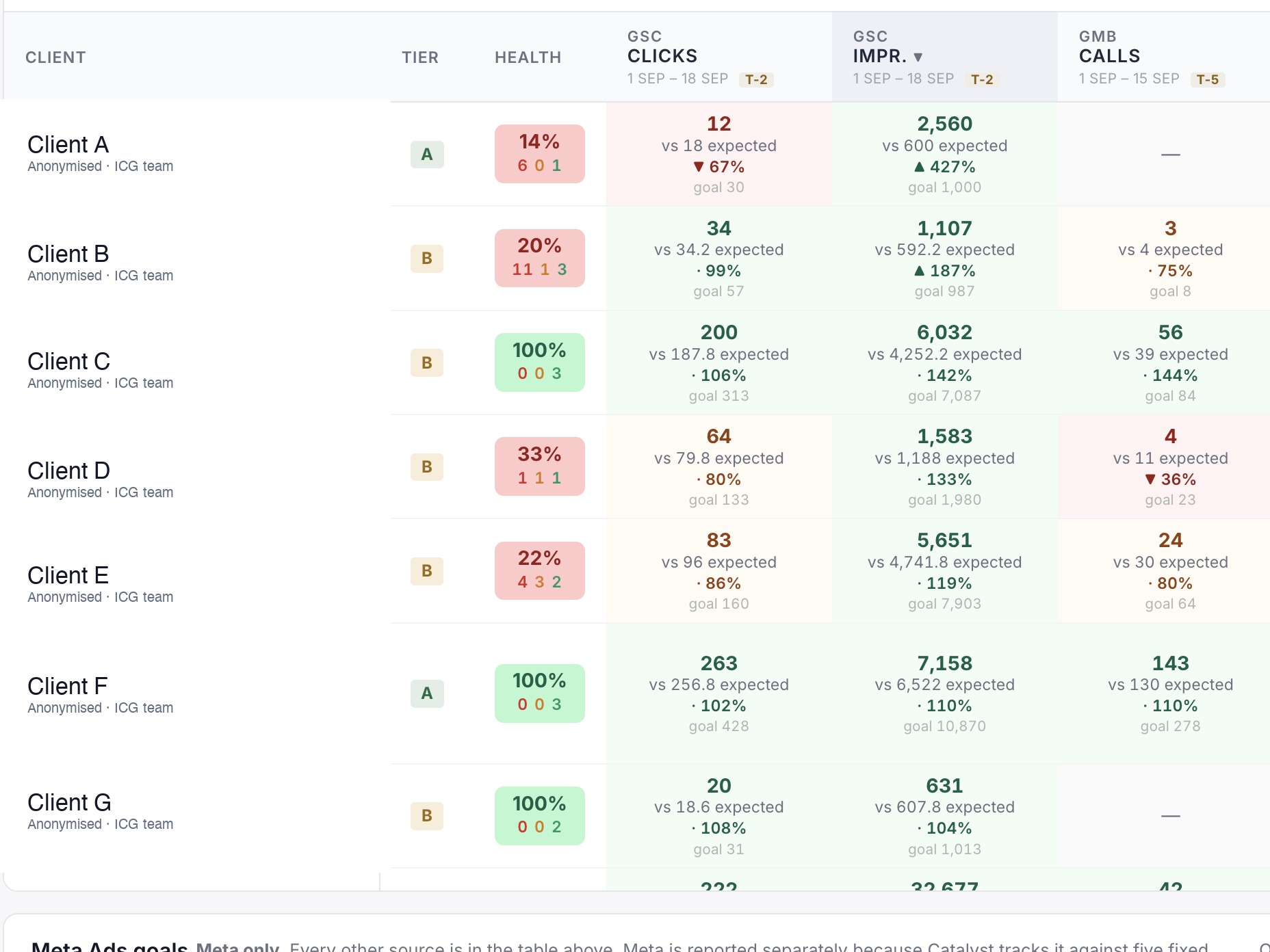
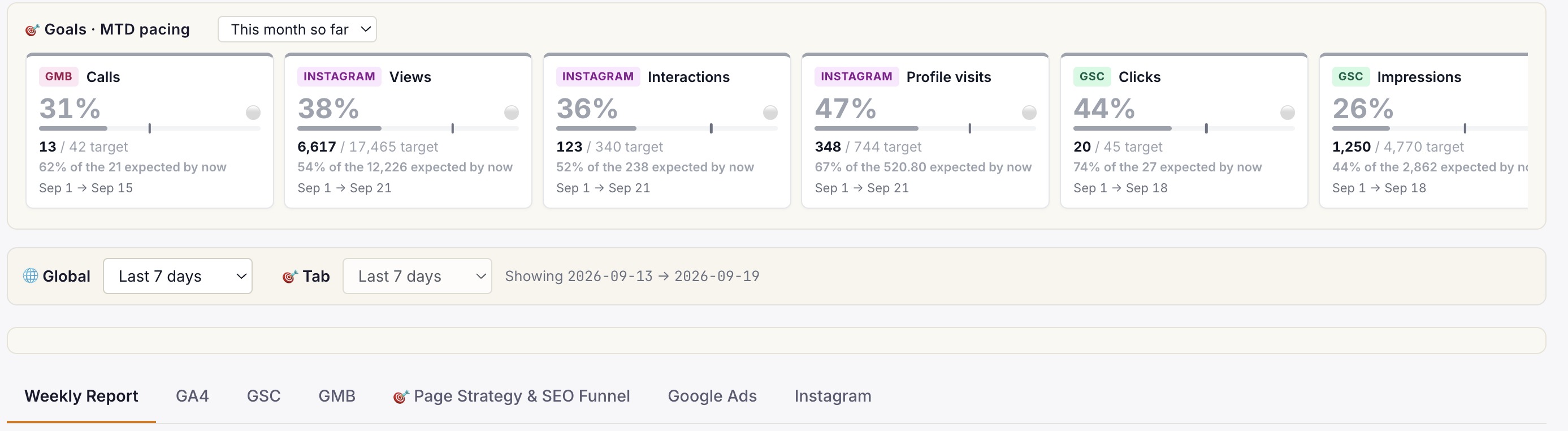
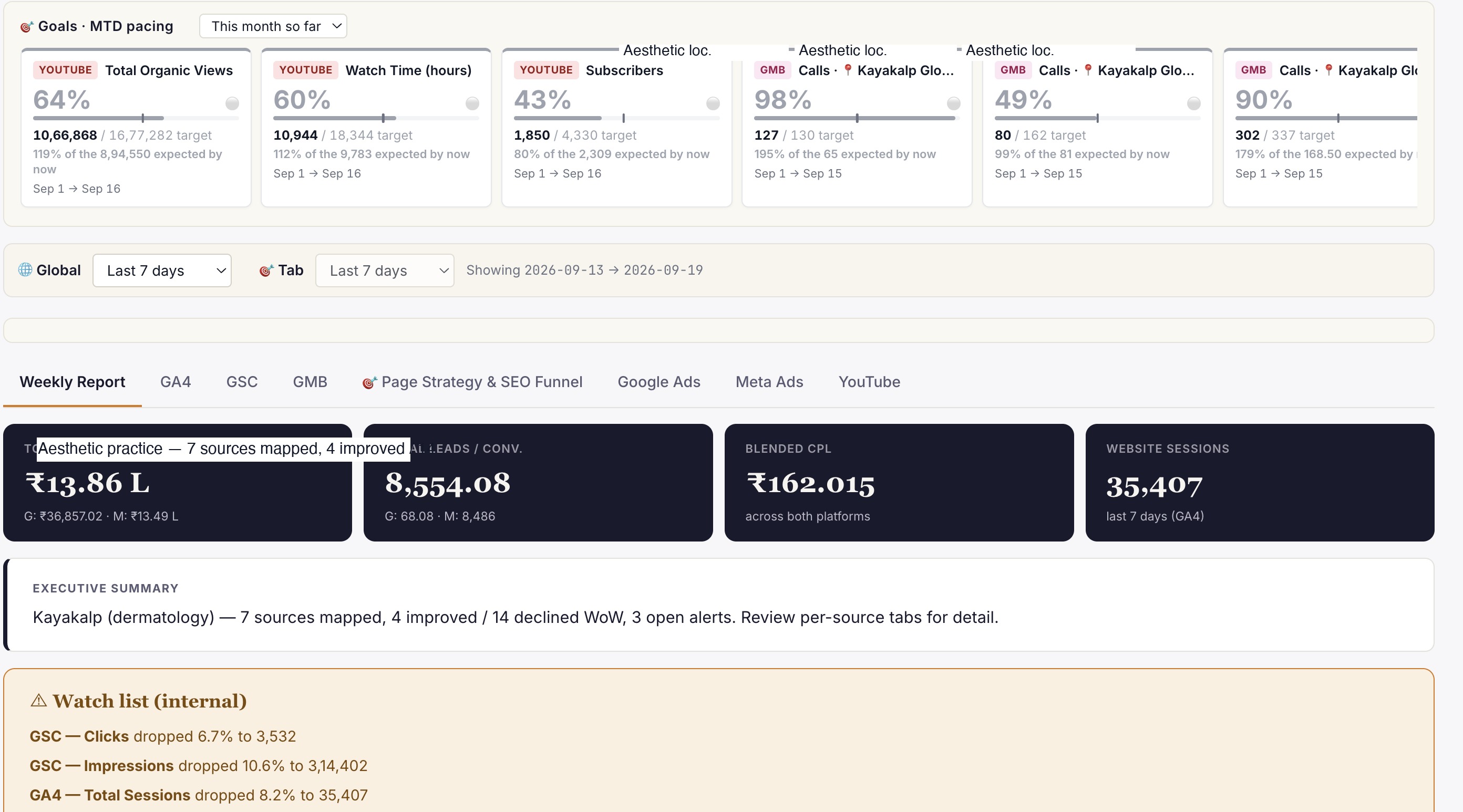
Live client dashboard. GSC, GA4, Google Ads, Meta Ads, IVR calls in one view. Login anytime, not monthly.
Phoenix
Clinic revenue intelligence over your PMS. Daily action queue: Prevent Loss, Maintain & Engage, Grow Revenue. Multi-centre rollout.
Or book a free 30-min audit to see all three in action on your account.
Healthcare brands
that already run on ICG.
A representative slice of the 150+ healthcare brands ICG has delivered for across India. Most engagements remain under NDA.


What ICG clients say · on video.
"Scale up of organic channels and business consulting. ICG has absolute domain authority in their field."
"Working with ICG transformed how we acquire IVF patients in Gurgaon. They understand the fertility journey from inquiry to consult..."
"What Ichelon accomplished — they got all my ideas and worked over 3-4 months to create an amazing, super-customised website."
Need help operationalising this?
Every ICG service is healthcare-only, NMC + DPDP-aware, and built around the patient-research patterns that drive Indian healthcare growth in 2026.
Every practice welcome — packages from ₹20,000/mo.
Goals-Driven engagements · Performance-Linked Payout Models available
More from
ICG.
Five trends shaping Indian healthcare marketing through 2027: AI-first patient research, Conversions API adoption, ABDM discovery, the AEO w...
Healthcare AIO is the discipline of getting your clinic or hospital cited inside Google AI Overviews, ChatGPT and Perplexity answers — not j...
Conversational-search advertising places brand messages inside AI chat answers — ChatGPT, Perplexity, Copilot — rather than beside a results...
Stop guessing.
Book a Diagnostic.
30 minutes. Free. With the AI-powered healthcare-only marketing agency 150+ brands already run on. No slides, no pitch, no hard close.


