YODA vs vidIQ for healthcare YouTube marketing in India: generalist YouTube SEO tool versus healthcare-first intelligence platform (2026)
vidIQ is a mature YouTube SEO and creator-analytics tool used by millions of channels worldwide. YODA is ICG's healthcare-first YouTube intelligence platform with three-race rank tracking, organic-vs-paid separation, ORM sentiment, and Indian healthcare compliance built in. This piece maps where the fit lands for clinics, hospitals and specialty groups in India.
No pitch. Written root-cause diagnosis. AI-powered, healthcare only.
Direct answer
vidIQ is a mature YouTube SEO and creator-analytics tool used by millions of channels worldwide. YODA is ICG's healthcare-first YouTube intelligence platform with three-race rank tracking, organic-vs-paid separation, ORM sentiment, and Indian healthcare compliance built in. This...
TL;DR
YODA vs vidIQ for healthcare YouTube marketing is a question hospital marketing directors and clinic owners raise regularly once a channel starts producing 4-6 videos a month and the analytics dashboard stops being enough to make decisions. vidIQ is a mature, well-priced YouTube SEO tool that has served the global creator economy for the better part of a decade. YODA is our own healthcare-first YouTube intelligence platform, purpose-built for Indian clinics, hospitals and specialty groups that need to convert views into consultations under the NMC Ethics Code 2026 and DPDP Act 2023. If you are evaluating options, the Healthcare YouTube Marketing Agency service page and the healthcare YouTube pillar guide lay out the full scope this piece compares against.
What vidIQ actually is, and what it was built for
vidIQ is a browser extension plus web dashboard for YouTube creators. It surfaces keyword search volume, competitor benchmarks, tag suggestions, a thumbnail generator, trend alerts and a "Coaching" mode that pushes daily improvement prompts to the operator. Pricing runs roughly from a free tier through Pro at around $7.50 per month, Boost at around $39 per month, and Boost Plus at around $79 per month, with Enterprise plans available for teams. The core buyer vidIQ has served for years is the individual creator or a small production studio managing one to a handful of channels across gaming, lifestyle, education, tech reviews and comedy verticals.
For that buyer the tool is genuinely useful. Keyword ideation for the next video, quick tag suggestions before publish, a look at how a competitor titled their most-viewed video last month, a nudge in the coaching feed — these are real workflows and vidIQ executes them cleanly. Where the picture changes is when the channel is not a creator channel but a clinical service business, the buyer is a hospital marketing lead rather than a content creator, and the outcome that matters is qualified consultations rather than watch time.
Where vidIQ is genuinely strong
Being honest about where vidIQ is strong helps anyone making the evaluation. The tool has real capability in five areas.
Keyword research inside YouTube. vidIQ pulls YouTube-specific search volume, competition scoring and related-query suggestions faster than most alternatives. For a creator trying to ideate the next upload against demonstrated demand, this is a clean workflow.
Competitor tracking on view/subscriber counts. Quick reads on how a competitor channel is growing, which of their videos are performing, and what titles they have shipped recently. Useful for creators watching a peer set.
Thumbnail generator. A functional AI-assisted thumbnail generator with templated designs. Faster than briefing a designer for every upload if the channel is a solo creator.
Coaching mode. A daily-nudge system that surfaces one improvement action per day. Behavioural nudge that keeps creators moving. Real value for a creator without a dedicated marketing team.
Accessible pricing. Free tier plus paid tiers under $80 per month means the tool is genuinely reachable for individual creators globally.
The healthcare specialisation gap
vidIQ is deliberately vertical-agnostic. The keyword corpus, the competitor benchmarks, the coaching prompts and the thumbnail templates are built for the median YouTube creator — which is not a clinician, a dermatologist, an IVF specialist or a hospital marketing director. The consequence is that the tool cannot distinguish a hair-transplant explainer from a gaming let's-play in how it scores keyword opportunity, cannot flag when a comparative claim in a video description crosses the ASCI substantiation line, cannot recognise when a video generates high views but zero appointment enquiries because the target keyword is patient-education rather than commercial-intent.
YODA is built specifically for Indian healthcare channels. The keyword universe is pre-tagged for healthcare intent (symptom, condition, procedure, comparison, cost, doctor-brand, hospital-brand), the competitor benchmark set is limited to healthcare peers in the same specialty and city, the "next action" engine takes clinical topic sensitivity into account, and every recommended edit runs through a compliance check for the NMC Ethics Code 2026 and the ART Act 2021 restrictions on fertility outcome claims before it is offered to the operator.
The three ranking races YODA tracks that vidIQ does not
YouTube visibility for a healthcare channel does not live in one place any more. It lives in three separate races with three separate rulebooks, and vidIQ tracks only the first.
Race 1 — YouTube search. Both tools cover this. vidIQ scores search volume and competition for a query inside YouTube; YODA does the same and adds healthcare-specialty benchmarking.
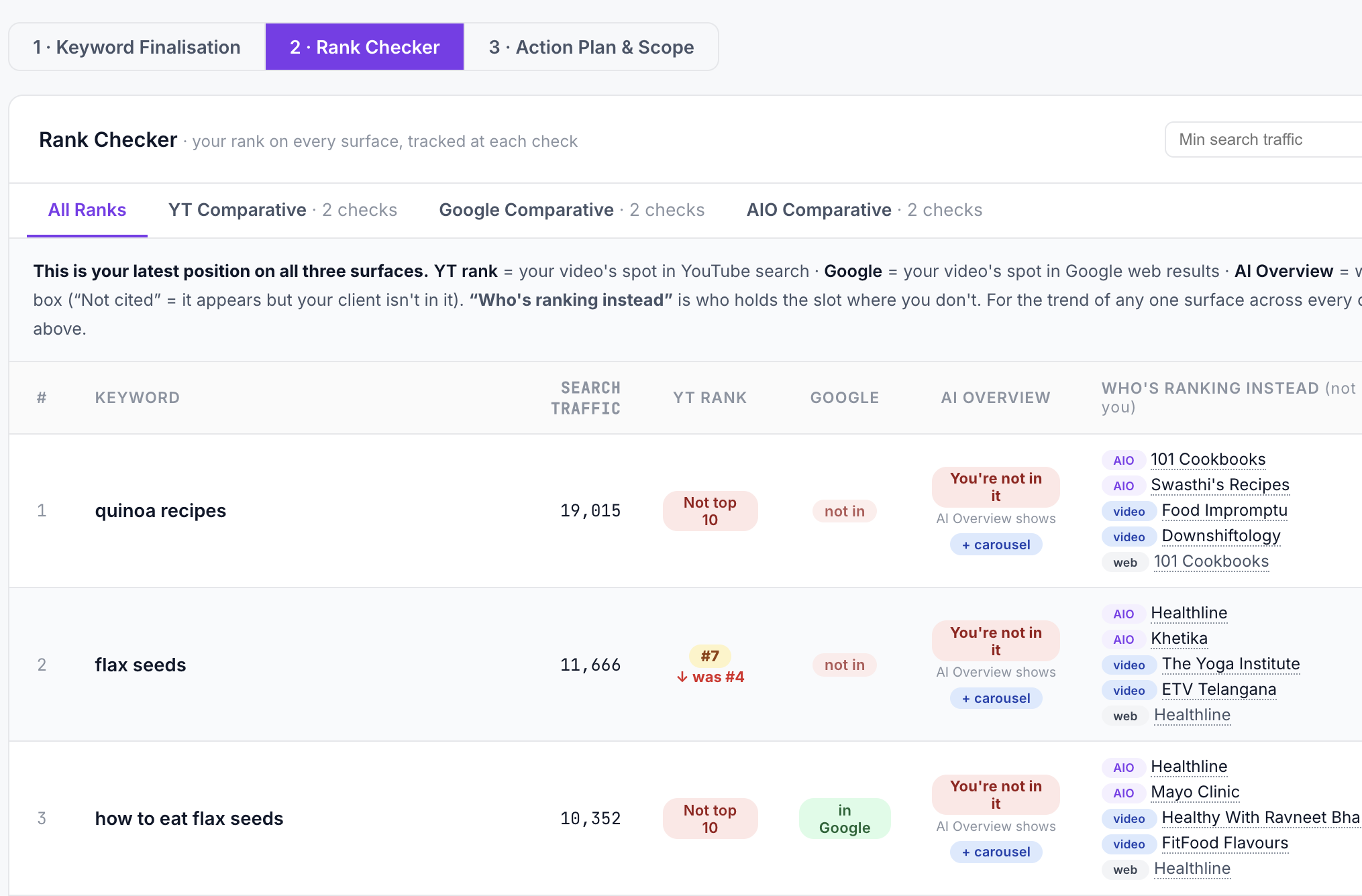
Race 2 — Google web SERP. Videos appear on Google web results as video carousels, featured video snippets and thumbnail-rich cards for queries like "gynaecomastia surgery cost delhi". vidIQ does not track how a healthcare video ranks on Google web. YODA tracks web-SERP rank for every target query, records the format Google is showing (video carousel, blue link, video pack), and separates YouTube-search rank from Google-web rank so the operator sees where the traffic is actually coming from.
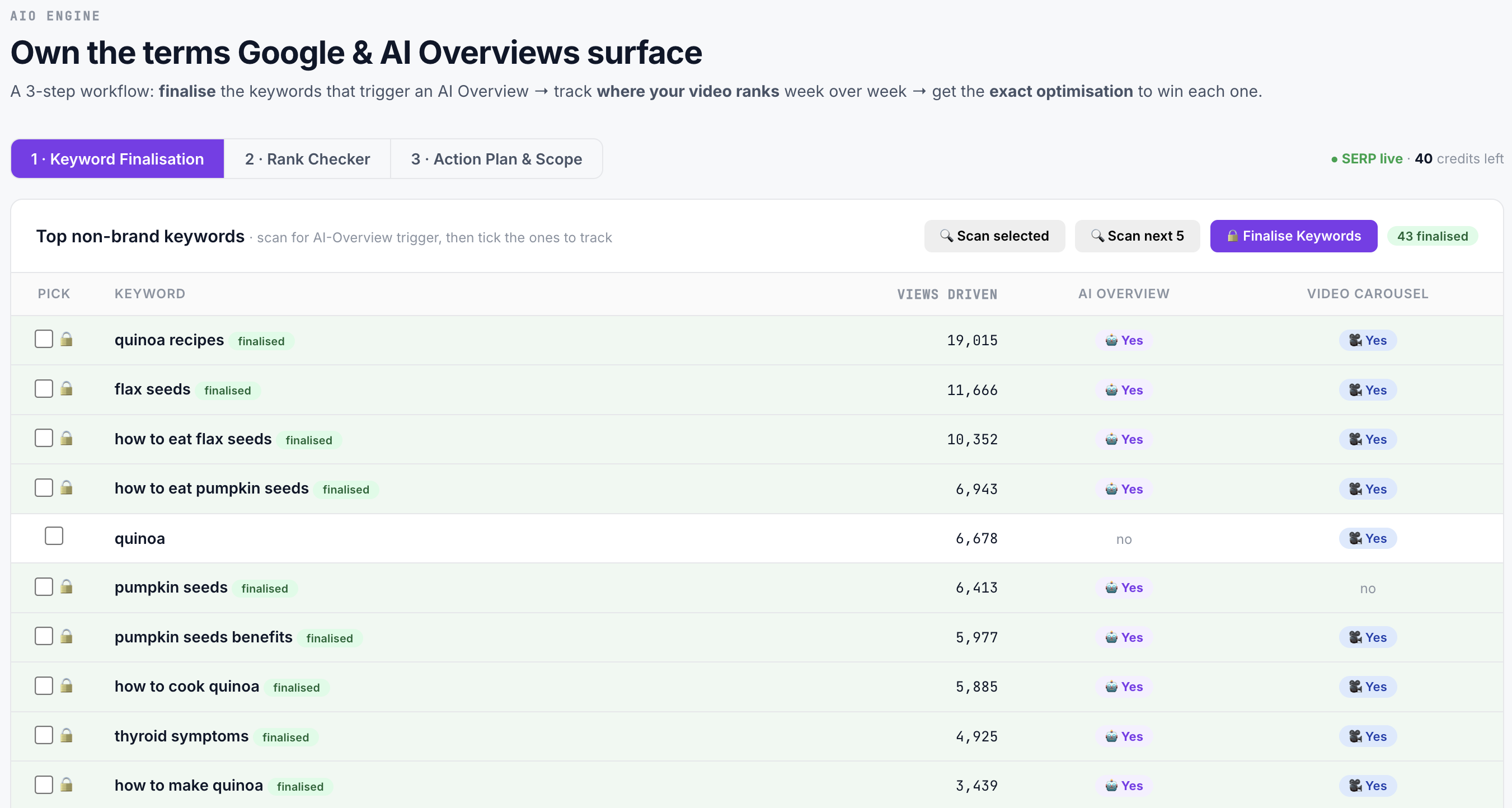
Race 3 — Google AI Overview citations. When Google's AI Overview summarises an answer to a healthcare query, it sometimes cites a YouTube video as source. vidIQ does not measure or optimise for this. YODA's AIO engine scores every video for AIO-citation readiness (structured description, chapter markers, transcript quality, entity coverage, schema signals), tracks whether a video is currently being cited, and produces edits that lift a video toward citation-ready state. For an Indian healthcare brand where 20-40% of top-of-funnel queries now surface an AI Overview, tracking only Race 1 misses the majority of the opportunity.
Organic versus paid separation
Every healthcare channel that has run a YouTube advertising budget of any size has this problem: paid views inflate every dashboard metric, and it becomes almost impossible to know which videos are actually earning attention. A promoted explainer video looks "viral" because it has 200,000 views — 195,000 of them were skippable pre-roll on cold audiences.
vidIQ does not natively separate paid views from organic views on the analytics it surfaces. The Analytics tab shows aggregate view counts pulled from YouTube's public metrics, which include everything.
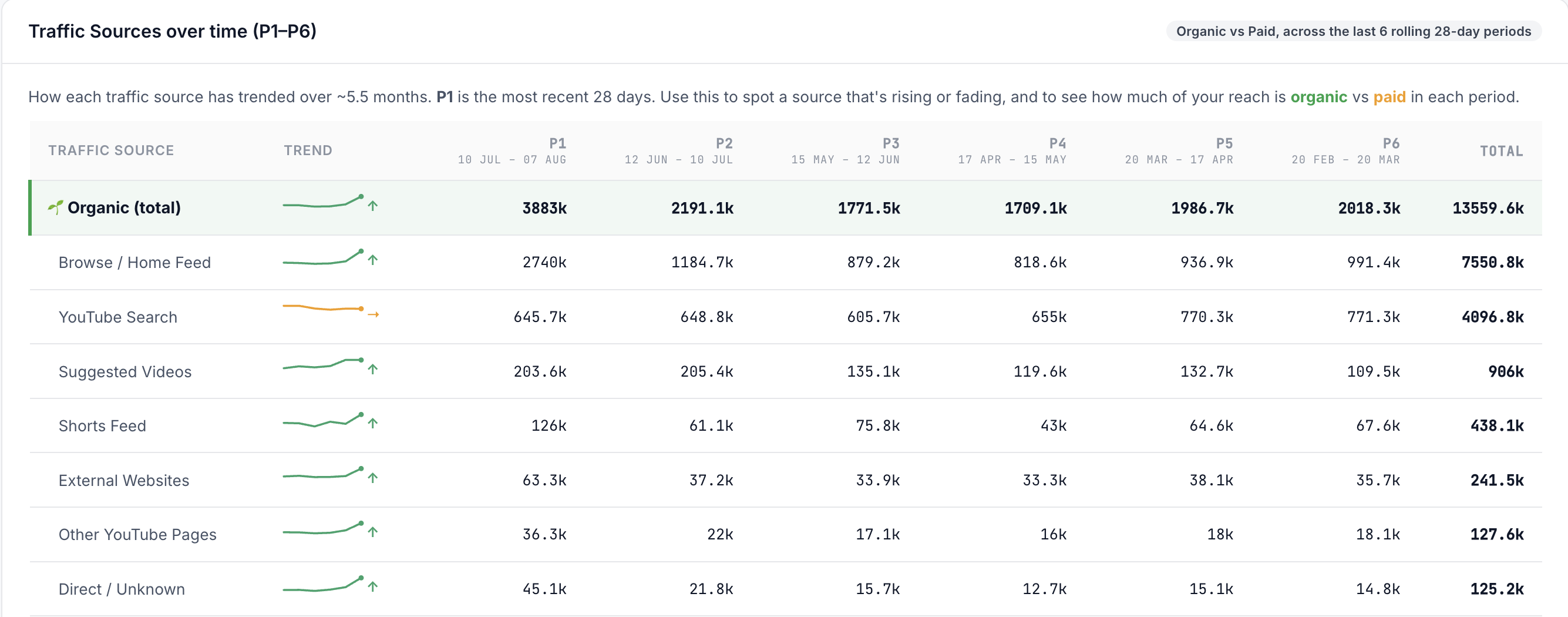
YODA subtracts paid views from every metric at every step of the workflow. Organic impressions, organic views, organic average view duration, organic click-through rate on suggested video, organic retention percentiles — all reported net of the YouTube Ads spend for that video. This means a healthcare marketing director looking at YODA can genuinely tell whether the money spent on production and promotion is producing organic pickup, or whether the video is only ever viewed when the ad budget is on. That distinction is the difference between building a channel asset and renting attention repeatedly.
ORM, sentiment and audience voice
Healthcare video comments are a compliance surface as much as they are an engagement surface. Patient questions about specific treatment plans, testimonial-style comments that could be construed as unverified clinical claims, aggressive competitor comments, comments that reveal personal health information — all need triage under both the NMC Ethics Code 2026 and the DPDP Act 2023.
vidIQ has basic comment tools around bulk actions and moderation, appropriate for the creator use case where comment risk is low.
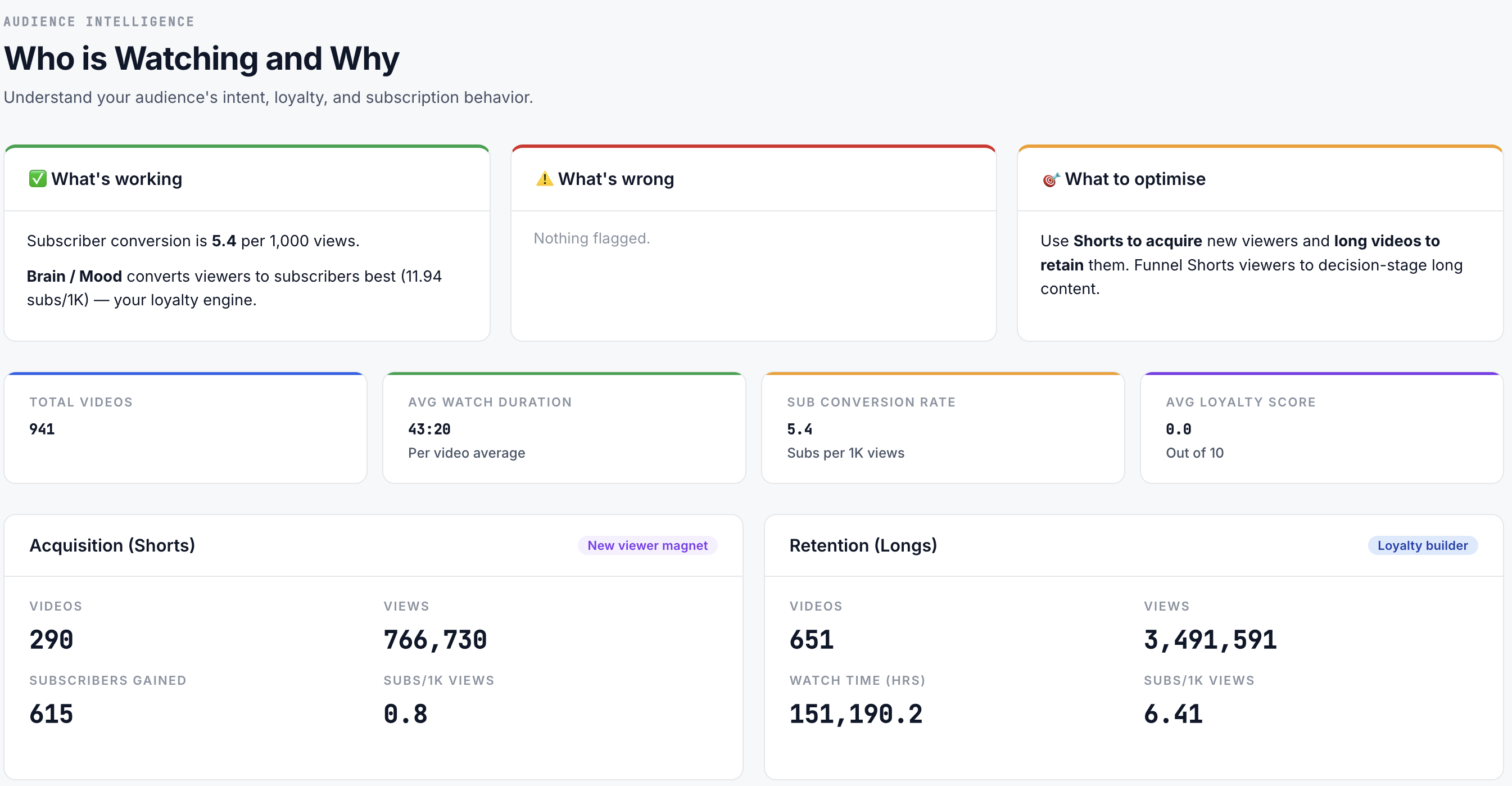
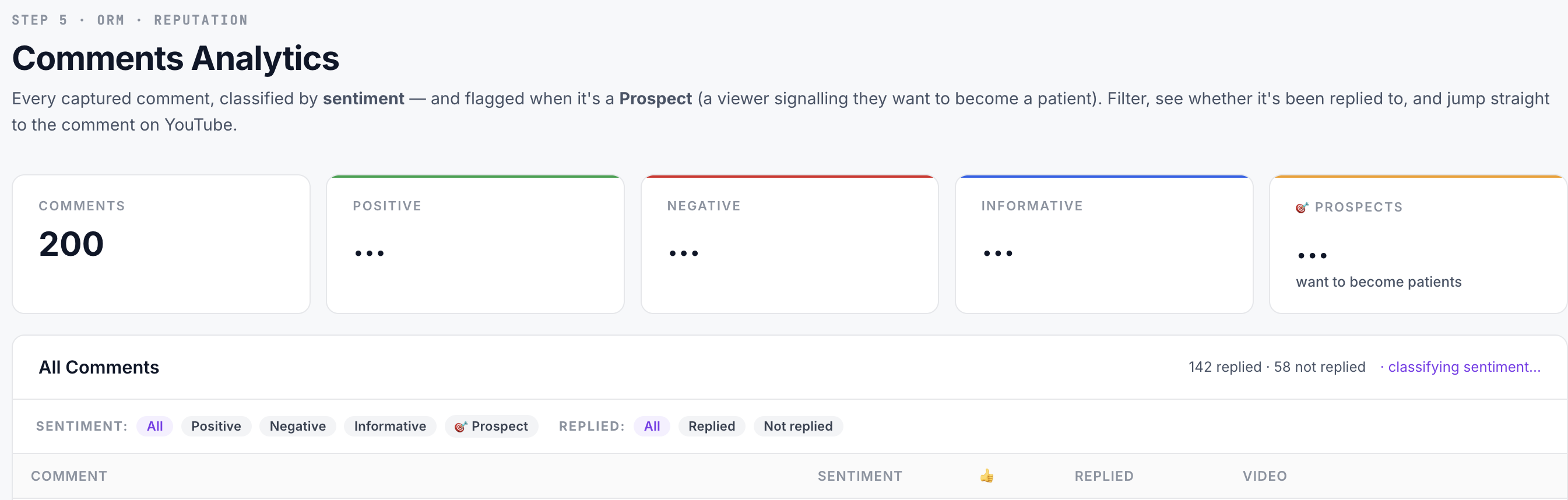
YODA's Reputation (ORM) step covers comment sentiment scoring per video and per topic, audience-voice extraction that reads the comment corpus for what patients are actually asking, an audience profile that maps the commenting population by demographics and journey stage, and a compliance-triage flow that surfaces comments requiring clinical or legal review before response. The layer is not an add-on — it is one of the six workflow steps every YODA-managed channel runs.
The Indian compliance layer
Every recommended edit YODA makes runs through an Indian healthcare compliance check. Title suggestions are screened for outcome guarantees that violate the NMC Ethics Code 2026, description edits are checked for comparative superlatives that violate ASCI Guidelines 2022 substantiation standards, fertility-specialty edits are checked against the ART Act 2021 restrictions on success-rate claims, and any user-generated content that could be construed as patient-identifying is flagged for DPDP Act 2023 review before publication.
vidIQ is compliance-agnostic. The tool was not built for a regulated vertical, and the recommended title or tag will happily suggest phrasing that a clinician cannot lawfully publish under Indian medical advertising rules. For a solo creator this is fine; for a hospital marketing team it means every vidIQ suggestion needs a manual compliance pass before use, which erodes the productivity gain the tool was meant to deliver.
Agency multi-tenant needs
ICG manages YouTube channels across a portfolio of clinics, hospital groups and specialty chains. A single dashboard needs to hold dozens of channels, isolate client data, run role-based access for account teams, produce white-label reports, and route decisions across a shared inbox.
vidIQ Enterprise supports multi-channel management but the workflow is built for creator networks and MCNs, not for a healthcare agency operating under client-side compliance obligations. Custom fields, healthcare taxonomy, compliance-flagging routing and NMC-safe report language sit outside the tool.
YODA is multi-tenant by default. Every channel sits in its own workspace with role-based access, decisions and comments route across a shared inbox for the assigned team, reports are white-labelable, and compliance flags surface to the account lead automatically.
Pricing comparison
vidIQ: free tier, Pro at around $7.50 per month, Boost at around $39 per month, Boost Plus at around $79 per month, Enterprise custom (approximate — verify with vendor). Per-user or per-seat billing.
YODA is delivered as part of ICG's managed healthcare YouTube service starting at ₹25,000/- per month, which includes platform access, channel operations, monthly strategy and reporting. The comparison is not apples-to-apples because vidIQ is a self-serve tool and YODA is a managed service on a platform — the correct comparison for a healthcare buyer is total cost of running a compliant, ranking, converting channel, not tool subscription in isolation.
Who should choose what: decision matrix
| Choose vidIQ if... | Choose YODA (with ICG) if... |
|---|---|
| You are an individual creator or a small production studio outside regulated verticals. | You are a clinic, hospital, or specialty group in India operating under NMC, ASCI, DPDP and ART Act. |
| Your primary metric is watch time, subscribers and general channel growth. | Your primary metric is qualified consultation enquiries attributed to organic video. |
| You need cheap, self-serve keyword and thumbnail tooling. | You need a managed platform that separates organic from paid and tracks three rank races. |
| You have no advertising spend on the channel, or a very small one. | You run YouTube Ads and need paid views subtracted from every organic metric. |
| Compliance and comment triage are not material risks for your content. | Comment sentiment, patient PHI risk and ASCI/NMC compliance are day-to-day concerns. |
| You are managing 1-3 channels and coaching mode is helpful. | You are running a portfolio (agency, hospital group, chain) with multi-tenant needs. |
Both tools have a legitimate home. The question is which home matches the buyer's reality.
The platform ICG uses to run this at scale: YODA
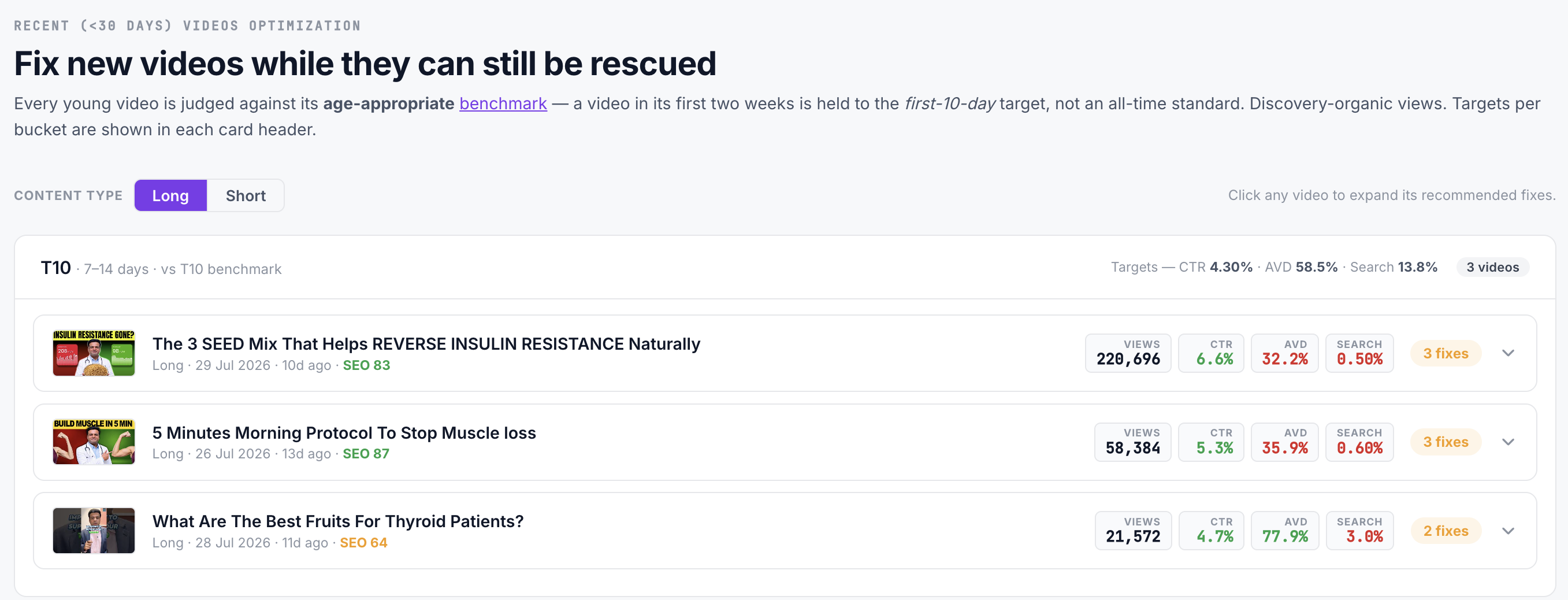
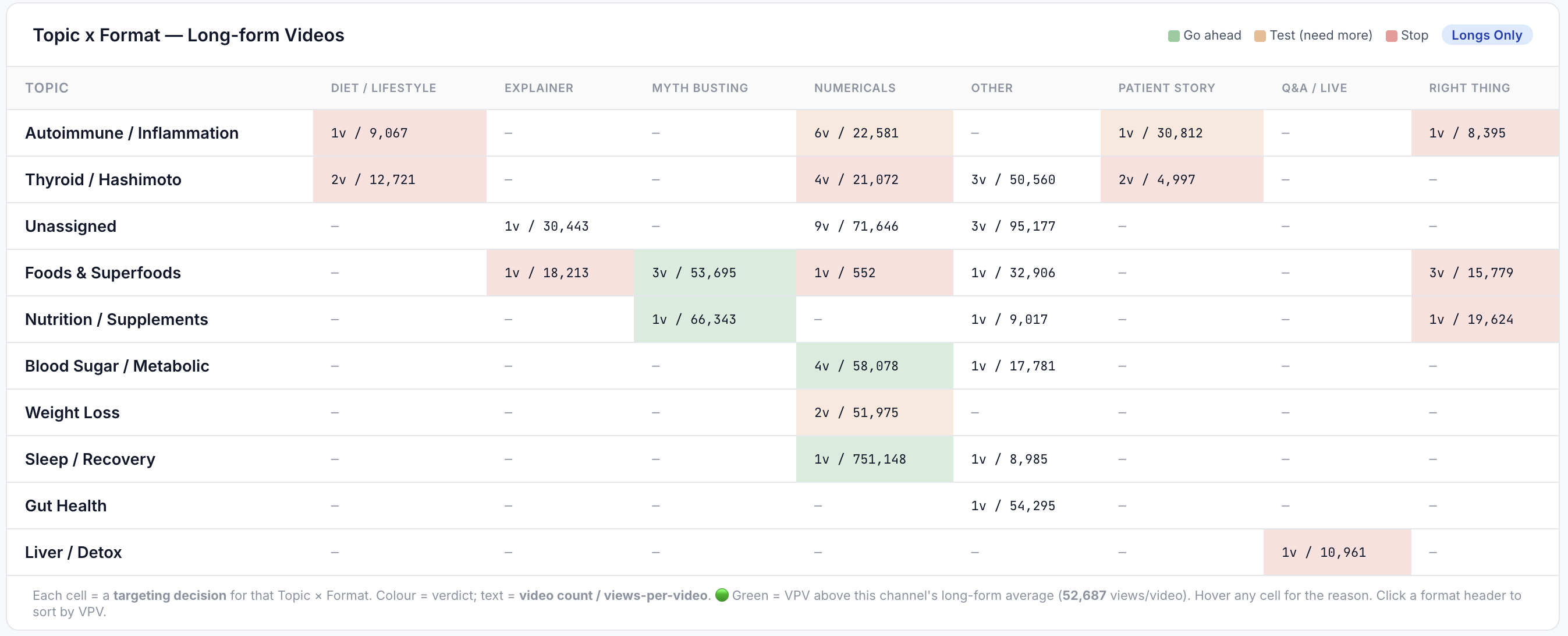
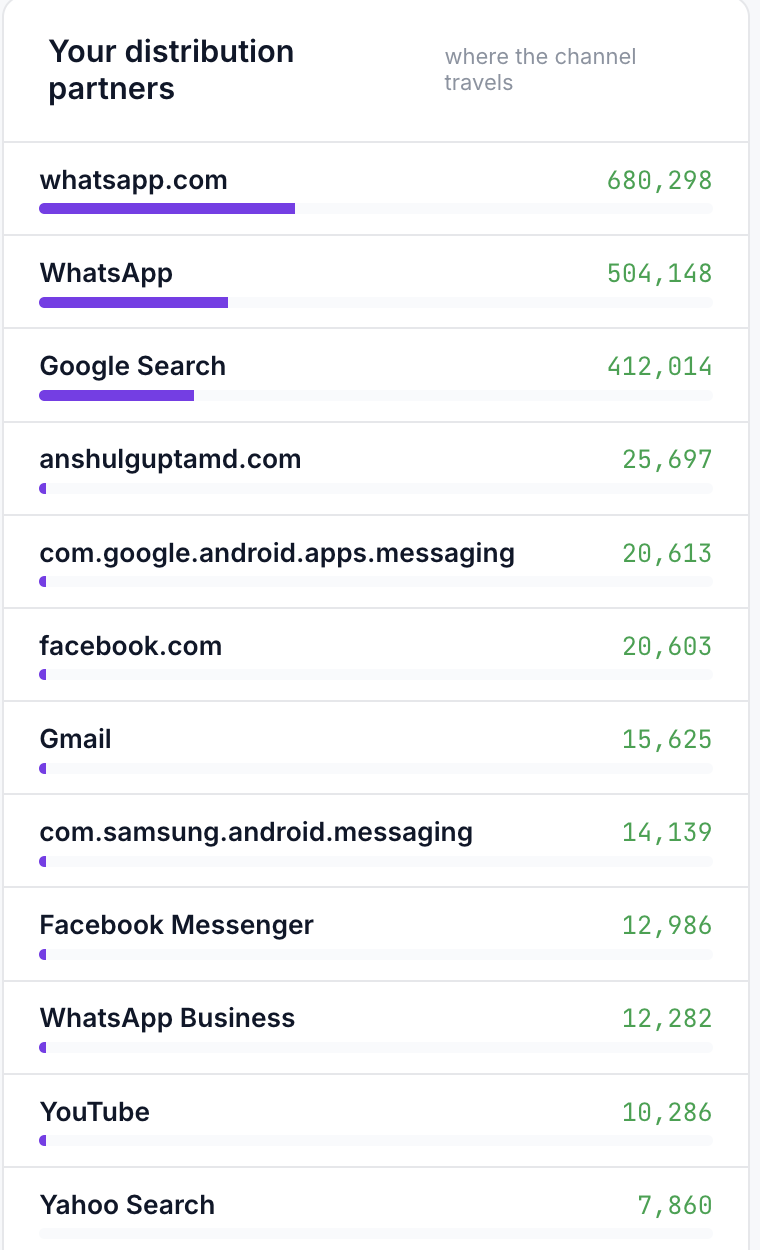
ICG runs healthcare YouTube marketing for clinics, hospitals, and specialty groups using YODA — our AI-native healthcare YouTube marketing platform. YODA sits on top of a channel's data and does four things no dashboard does: it separates organic from paid views at every step (so a promoted video can never masquerade as organic growth), it gives decisions not dashboards (every video gets a state + next action), it writes back to YouTube directly (improved titles, tags, descriptions, chapters applied straight to the platform), and it tracks the three rank races — YouTube search, Google web, and Google AI Overview citations.
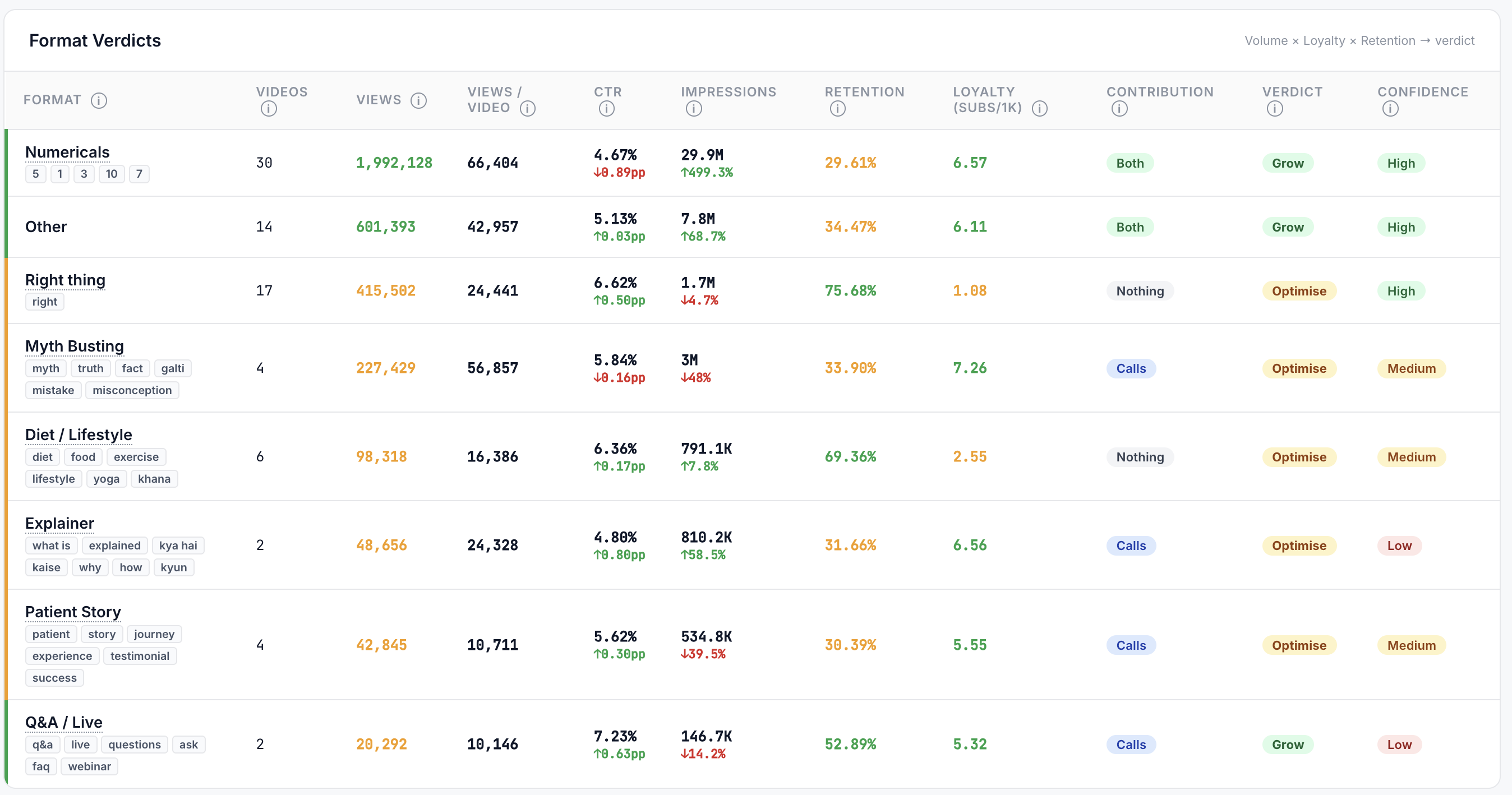
YODA runs the full 6-step workflow — Overview, Diagnostics, Strategy, Optimisation, Reputation (ORM), and Competitor Intel — with 40+ analysis modules organised under those steps. ICG's managed YouTube service uses YODA end-to-end. See the Healthcare YouTube Marketing pillar guide for the full scope, or the Healthcare YouTube Marketing Agency service page for engagement details.
Book a YODA demo on WhatsApp → or request a free healthcare YouTube channel audit →
Related reading
- Healthcare YouTube marketing pillar guide 2026
- How a doctor YouTube channel generates consultations in India
- YouTube vs Meta vs Google ROI for IVF clinics
- Hospital video marketing in India 2026
- ICG technology ecosystem: Beacon, Hawk, YODA, Agency OS, Pharos
FAQ
Is YODA a vidIQ alternative? For Indian healthcare channels, yes. YODA covers what vidIQ does for keyword ideation and competitor tracking on YouTube search, and adds Google web SERP tracking, Google AI Overview citation tracking, organic-vs-paid separation, ORM sentiment, Indian compliance workflow and multi-tenant agency architecture. For a solo creator outside a regulated vertical, vidIQ remains a perfectly reasonable pick.
Does vidIQ track Google AI Overview citations? No. vidIQ tracks YouTube-internal search metrics and channel analytics. Google AI Overview citation tracking sits outside its scope. YODA's AIO engine is purpose-built for that race.
Can vidIQ separate paid views from organic views? Not natively. The analytics vidIQ surfaces reflect aggregate YouTube view counts, which combine organic and paid. For channels running any YouTube Ads spend, this makes it very hard to read organic performance cleanly. YODA subtracts paid views from every metric at every step.
Is vidIQ NMC-compliant out of the box? vidIQ is compliance-agnostic — it was not built for a regulated vertical. Recommended titles, tags and descriptions do not run through Indian medical advertising checks, so any suggestion needs a manual compliance pass by a healthcare marketing team before use.
How much does vidIQ cost? vidIQ has a free tier and paid tiers approximately at Pro $7.50, Boost $39 and Boost Plus $79 per month, plus custom Enterprise (verify current pricing with the vendor). Billing is USD.
How does YODA pricing work? YODA is delivered as part of ICG's managed healthcare YouTube service starting at ₹25,000/- per month. That includes platform access, monthly strategy, video-level decisions, publish-side execution, ORM triage and reporting. The comparison to a self-serve tool subscription is not one-to-one — YODA is a managed platform, not a self-serve SaaS.
Which tool is better for a solo dermatologist starting a YouTube channel? If the channel is very small, budget is tight and there is no immediate advertising spend, starting with vidIQ Pro to learn YouTube SEO fundamentals is reasonable. Once the channel needs to convert views into consultations, needs multi-race rank tracking, and starts running paid spend, the fit for YODA becomes clearer.
Can vidIQ do competitor tracking? Yes, vidIQ tracks competitor channels on public YouTube metrics — view counts, subscriber growth, video counts, average views. YODA's competitor intel goes further into healthcare-specialty benchmarking, format-mix comparison, discovery-surface share and AIO-citation share.
Does vidIQ have thumbnail A/B testing? vidIQ has a thumbnail generator but native A/B testing on YouTube's official experiment framework is a YouTube-side feature. YODA integrates the YouTube A/B thumbnail results into its impact-analysis module so the outcome is read back into the decision engine.
Should a hospital marketing director use both? Usually not needed. If the operation is on YODA managed service, vidIQ becomes redundant because keyword ideation, competitor tracking and thumbnail work are covered inside YODA with healthcare specialisation added. If a specific vidIQ feature is genuinely missing (a very narrow creator-side workflow), running vidIQ on the side is possible but rarely the right use of budget for a healthcare buyer.
Book a free 30-minute Brand & Growth Diagnostic.
It's a working session, not a sales pitch — you leave with a written root-cause analysis you can act on, whether or not you engage ICG.
The three platforms
behind every ICG engagement.
Beacon
CAPI middleware that fixes Event Match Quality, translates CRM statuses to Meta-standard events, dedups across channels.
Agency OS
Live client dashboard. GSC, GA4, Google Ads, Meta Ads, IVR calls in one view. Login anytime, not monthly.
Phoenix
Clinic revenue intelligence over your PMS. Daily action queue: Prevent Loss, Maintain & Engage, Grow Revenue. 46-centre rollout.
Or book a free 30-min audit to see all three in action on your account.
Healthcare brands
that already run on ICG.
A representative slice of the 150+ healthcare brands ICG has delivered for across India. Most engagements remain under NDA.
What ICG clients say · on video.
"Scale up of organic channels and business consulting. ICG has absolute domain authority in their field."
"Working with ICG transformed how we acquire IVF patients in Gurgaon. They understand the fertility journey from inquiry to consult..."
"What Ichelon accomplished — they got all my ideas and worked over 3-4 months to create an amazing, super-customised website."
The intelligence stack behind this playbook.
Every ICG engagement runs on the Search Intelligence Trifecta — Angryturtle for GMB, SIE for search and AI Overview, YODA for YouTube. Live product screens below.
Need help operationalising this?
Every ICG service is healthcare-only, NMC + DPDP-aware, and built around the patient-research patterns that drive Indian healthcare growth in 2026.
More from
ICG.
Healthcare AIO is the discipline of getting your clinic or hospital cited inside Google AI Overviews, ChatGPT and Perplexity answers — not j...
Conversational-search advertising places brand messages inside AI chat answers — ChatGPT, Perplexity, Copilot — rather than beside a results...
NABH digital compliance means every claim, image and testimonial your hospital publishes online matches what an accreditation surveyor can v...
Stop guessing.
Book a Diagnostic.
30 minutes. Free. With the AI-powered healthcare-only marketing agency 150+ brands already run on. No slides, no pitch, no hard close.