


VideoObject schema for healthcare YouTube in India — the 2026 guide to AI Overview video citation and rich video results
Every clinical explainer, procedure walk-through, and patient-story video on your YouTube channel is invisible to Google without VideoObject schema. Here is the field-by-field implementation, the AI Overview citation pattern, and how YODA generates it at scale.
No pitch. Written root-cause diagnosis. AI-powered, healthcare only.
Direct answer
Every clinical explainer, procedure walk-through, and patient-story video on your YouTube channel is invisible to Google without VideoObject schema. Here is the field-by-field implementation, the AI Overview citation pattern, and how YODA generates it at scale.
TL;DR
VideoObject is the schema.org type that describes a video to search engines — its title, thumbnail, upload date, duration, transcript, and hosted URL. For an Indian healthcare YouTube channel, VideoObject schema is the difference between a video that surfaces in Google video results and AI Overview video previews versus a video that lives only inside YouTube's own search. Without VideoObject markup on the page that embeds or references the video, the video is effectively invisible outside YouTube.
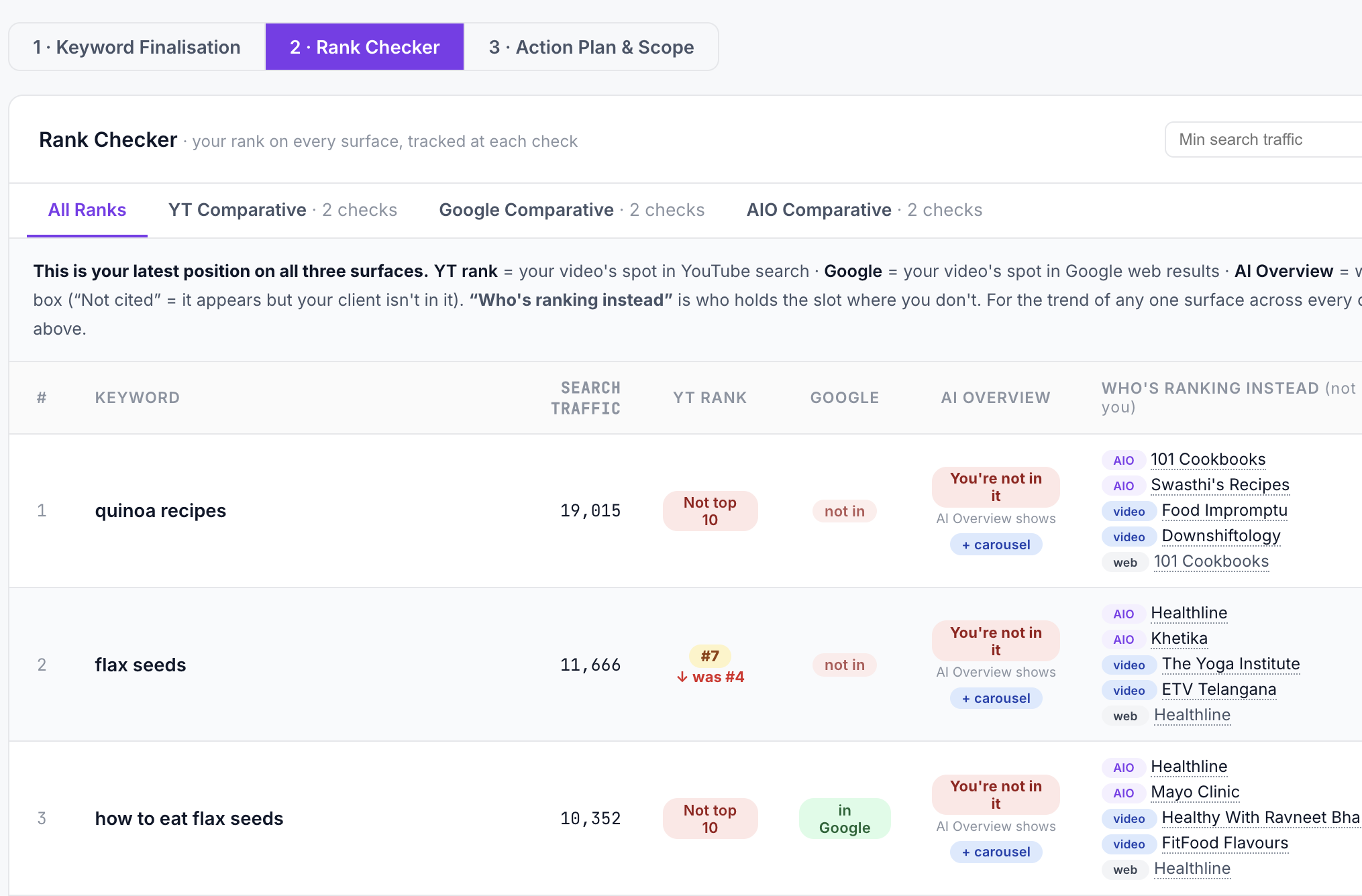
Indian clinics, hospitals, and healthcare DTC brands have poured serious money into YouTube through 2024, 2025, and 2026 — patient testimonials, procedure explainers, doctor Q and As, condition awareness reels. What most teams miss is that the video itself, hosted on YouTube, does not automatically appear in Google web search results, in Google video search, or in the AI Overview video carousels. Google needs a structured hint on the referring web page telling it what the video is, when it was uploaded, how long it runs, and where to fetch the thumbnail and content. That structured hint is VideoObject schema. This post walks through the required and recommended fields, the exact JSON-LD block ICG uses on healthcare pages, the AI Overview video citation pattern we have observed across 40+ healthcare channels, and how YODA — ICG's AI-native YouTube platform — generates VideoObject markup at scale across an entire channel library.
What VideoObject schema actually does for a healthcare video
VideoObject is a schema.org type that lets you describe a video as structured data embedded in a web page. Google reads the JSON-LD block, indexes the video, and becomes eligible to show it in three distinct surfaces: (1) classic video search results (the video tab in Google), (2) video rich results on the main SERP (the video thumbnail carousel above or beside blue links), and (3) AI Overview video previews (a new surface rolling out through 2026 where the AIO panel embeds a short video clip alongside its text answer).
Without VideoObject markup, Google may still discover the YouTube video through its normal YouTube crawl, but the association between the video and the referring web page is weak. The page itself will not get video rich results, will not surface in Google video search under its own domain, and cannot be cited as a video source inside AI Overview. For healthcare brands trying to build discoverability outside YouTube's own walled search, VideoObject on the embedding page is not optional.
Required and recommended VideoObject fields for healthcare content
Google's video rich results documentation splits VideoObject fields into required and recommended. Miss a required field and the video is ineligible for rich results. Miss a recommended field and eligibility survives but citation lift drops.
| Field | Status | What it does | Healthcare-specific guidance |
|---|---|---|---|
| name | Required | The video title | Match the YouTube video title exactly; do not rewrite for the web page |
| description | Required | Plain-text description | 150-250 words; include condition name, procedure, doctor name, clinic city |
| thumbnailUrl | Required | URL to at least one thumbnail image | Use YouTube's maxresdefault.jpg or a self-hosted 1280x720 static thumbnail |
| uploadDate | Required | ISO 8601 date the video was published | Match YouTube upload date; time zone matters for freshness signals |
| duration | Recommended | ISO 8601 duration (PT4M32S = 4 min 32 sec) | Essential — Google shows duration in the video thumbnail overlay |
| contentUrl | Recommended | Direct URL to the video file | Set to the YouTube watch URL; some brands host MP4 on a CDN as a fallback |
| embedUrl | Recommended | URL that plays the video embedded | YouTube embed URL (youtube.com/embed/VIDEO_ID) |
| transcript | Recommended | Text transcript of the spoken content | Critical for AIO citation — the LLM reads the transcript to extract facts |
| hasPart (Clip) | Recommended | Chapter markers with start / end offsets | Unlocks key-moments carousel; procedure explainers benefit most |
| publisher | Recommended | Organization or Person schema for the channel | Point to the clinic / hospital / doctor entity, not just "YouTube" |
The single most underused field on Indian healthcare video pages is transcript. Google's AIO panel reads the transcript when deciding whether to cite the video for a query. A three-minute procedure explainer with no transcript on the embedding page will lose AIO video citation to a competitor's two-minute explainer with a clean transcript, even if the first video has more views and better production.
The JSON-LD block ICG uses on healthcare video pages
Below is the exact JSON-LD VideoObject block ICG deploys on healthcare video pages. Fields in curly braces are placeholders — the rest is the boilerplate we standardise across the portfolio.
<script type="application/ld+json">
{
  "@context": "https://schema.org",
  "@type": "VideoObject",
  "name": "{Exact YouTube video title}",
  "description": "{150-250 word plain-text description}",
  "thumbnailUrl": "https://i.ytimg.com/vi/{VIDEO_ID}/maxresdefault.jpg",
  "uploadDate": "2026-07-18T09:00:00+05:30",
  "duration": "PT4M32S",
  "contentUrl": "https://www.youtube.com/watch?v={VIDEO_ID}",
  "embedUrl": "https://www.youtube.com/embed/{VIDEO_ID}",
  "transcript": "{Full spoken transcript, plain text}",
  "publisher": {
    "@type": "MedicalOrganization",
    "name": "{Clinic or hospital name}",
    "logo": {
      "@type": "ImageObject",
      "url": "https://{domain}/logo.png"
    }
  },
  "hasPart": [
    {
      "@type": "Clip",
      "name": "What is IVF",
      "startOffset": 0,
      "endOffset": 45,
      "url": "https://www.youtube.com/watch?v={VIDEO_ID}&t=0s"
    }
  ]
}
</script>
Ship the block inline in the head or immediately before the closing body tag on any page that embeds or references the video. If the same video is embedded on multiple pages, ship the block on each — Google treats page-level schema as page-level. The URL you designate as canonical for the video should also carry the fullest and cleanest version of the block.
The AI Overview video citation pattern for healthcare queries
AIO video previews are a rising citation surface for Indian healthcare queries. When a query is video-eligible (procedure explainers, how-to prep queries, condition symptom walk-throughs), the AIO panel now increasingly includes a video thumbnail with a short auto-generated summary of the video's content and a citation back to the source page. The video pulled is almost always one with clean VideoObject schema, a transcript, and a matching content signal.
Across the ICG portfolio and monitored competitor set, five conditions correlate with AIO video citation. The video's embedding page ranks organic top-20 for the query. VideoObject schema is present and complete. A transcript is either on the page or in the schema block. The video duration is under 8 minutes (short-form is preferred). The video title and description contain the query terms in natural language, not keyword-stuffed.
How YODA generates VideoObject schema at scale for healthcare channels
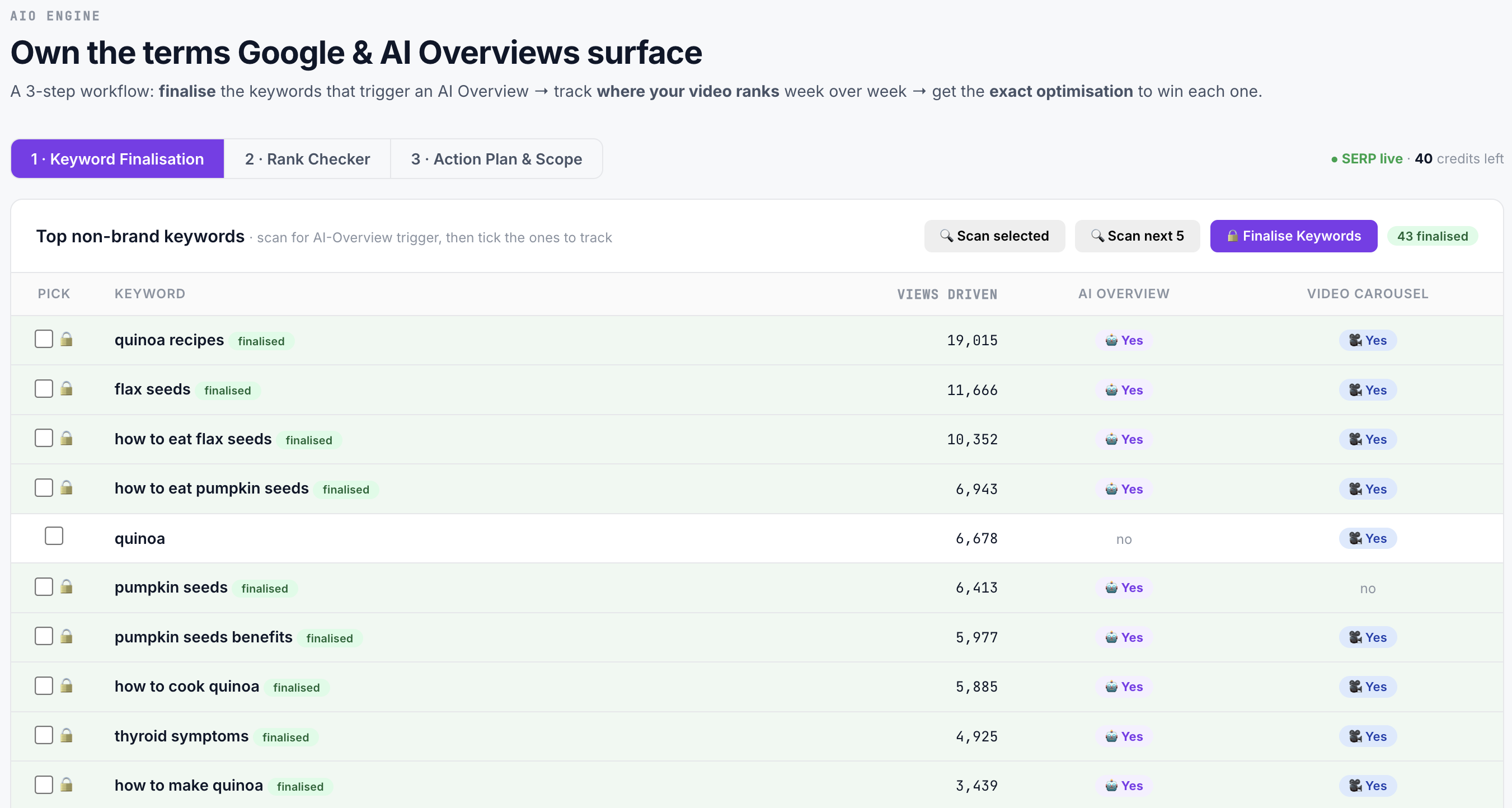
ICG built YODA — the AI-native healthcare YouTube platform — because manual VideoObject markup across a 200-video channel library is unrealistic. YODA runs three rank races simultaneously — YouTube search (native), Google web results (via VideoObject-marked embed pages), and AI Overview video citation. For every video ingested into YODA, the platform generates the full VideoObject JSON-LD block automatically, pulling the title and description from YouTube, computing the duration from the video metadata, and either using YouTube's captions as the transcript or transcribing the audio via Whisper when captions are absent or low quality.
YODA's AIO Lab module then monitors which videos in the channel are being cited in AIO panels for a curated query list, refreshed weekly. When a video starts driving citation, the pattern (transcript length, thumbnail composition, first-45-second content) is extracted and offered as a template for producing similar videos across the wider channel. YODA also manages 40+ downstream modules — chapter marker generation, thumbnail A/B, description SEO, community post scheduling — but the VideoObject generation is the foundation. Without clean schema on every video's embedding page, the AIO Lab has nothing to measure.
For channels not on YODA, the manual alternative is to build a small script that pulls video metadata from the YouTube Data API and templates the VideoObject block into the page's CMS. It is doable at 50 videos. It stops being doable at 500.
The six-step VideoObject audit ICG runs on a healthcare YouTube channel
When a healthcare brand comes to ICG asking why their YouTube videos are not showing up in Google search or AI Overview despite good view counts on YouTube itself, ICG runs a six-step audit.
- Enumerate the channel — pull every video from the last 24 months via the YouTube Data API, capture title, description, upload date, duration, and current thumbnail URL.
- Map each video to its embedding page(s) — identify which pages on the brand's website embed or reference each video. Videos with no embedding page are invisible outside YouTube regardless of schema.
- Check each embedding page for existing VideoObject schema — use the Rich Results Test or a scripted crawl. Flag pages with missing, incomplete, or malformed schema.
- Verify required fields — name, description, thumbnailUrl, uploadDate must be present. Recommended fields (duration, transcript, contentUrl, embedUrl) should be present.
- Check transcript presence — either in a visible on-page transcript block or inside the schema's transcript field. Absent transcript is the single most common gap.
- Cross-check against AIO citation — run the target query set in incognito with Indian IP, screenshot AIO video previews, identify which pages ARE being cited today, and compare their schema completeness to the client channel.
Nine times out of ten the audit surfaces three or four missing required fields across most of the channel plus universal absence of transcripts. Fixing those in bulk moves the needle within 30 to 60 days.
Google's video rich results guidelines and what changed in 2026
Google's video rich results documentation, updated through 2026, now emphasises three things that were softer earlier. First, uploadDate must include a time zone offset — a bare date without offset is treated as ambiguous. Second, thumbnailUrl must resolve to an image of at least 720 pixels height for rich results eligibility. Third, transcript is now called out as a specific quality signal for AI Overview video previews, elevated from a general "recommended" to a "strongly recommended" for YMYL categories including healthcare.
The other 2026 update relevant to Indian healthcare channels: Google's NMC and ASCI compliance filters now flag videos whose descriptions contain unsubstantiated superlatives ("best doctor", "guaranteed cure", "world's number one clinic"). Those videos remain indexed but their AIO citation eligibility is downweighted. Writing description text to the compliance perimeter is now also writing to the AIO citation criteria.
YODA — where VideoObject schema, transcripts, and AIO tracking live in one system
ICG built YODA because Indian healthcare YouTube is an under-optimised surface — the vast majority of clinic and hospital channels are producing good video but shipping it without the schema, transcript, and AIO tracking layer that unlocks Google discoverability. YODA runs 3 rank races (YouTube native + Google web + AI Overview), packs 40+ workflow modules (VideoObject generation, transcript ingestion, chapter marker creation, thumbnail testing, description SEO, community posts, comment triage, cross-channel promotion), and includes the AIO Lab that tracks which videos in the channel are earning AIO citation week over week.
YODA sits alongside the wider ICG product stack — PrismSpy (75+ Indian healthcare brands' Meta ads tracked daily), Angryturtle (India's AI-native healthcare GBP OS, 143+ listings under management), Meta Catalyst IQ (23+ Meta ad accounts on the shared optimisation stack). Across ICG's schema deployment, the current coverage is 325 pages with FAQPage schema, 320 pages with Speakable schema, and 32 with HowTo schema — VideoObject rollout across the YODA channel base is the next layer.
Standalone YODA access starts at ₹9,999 per month per channel, or bundled inside HealthApex OS (₹14,999/- flat, 9 tools). Book a 30-minute YODA walkthrough on WhatsApp — Hanuman or Rohit will show you the AIO Lab live for your specialty.
FAQ — VideoObject schema for healthcare YouTube
Do I need VideoObject schema if my video is already on YouTube?
Yes, if you want it to surface in Google web search, Google video search under your own domain, or AI Overview video previews. YouTube's own search does not need VideoObject. Everything outside YouTube does. For a healthcare brand trying to build discoverability across the wider Google surface, VideoObject on every embedding page is the base layer.
Should thumbnailUrl point to YouTube's image or a self-hosted one?
Either works for eligibility. YouTube's maxresdefault.jpg is the pragmatic default because it always exists and is 1280x720. Self-hosted thumbnails give you more control over the composition and can be updated without re-uploading the video. If you self-host, ensure the image is at least 720 pixels tall and served over HTTPS.
How important is transcript for AI Overview citation?
Very. Google's AIO panel reads the transcript to decide whether to cite the video for a query. Videos without a transcript can still surface in classic video rich results but consistently under-cite in AIO video previews. For healthcare content the transcript also lets the LLM verify factual accuracy, which matters for YMYL trust filtering.
Can I use ChatGPT to generate a fake transcript if I don't have one?
No. The transcript must accurately reflect what is actually spoken in the video. Google spot-checks by transcribing the video's audio and comparing. A fabricated transcript risks the video being deranked for schema abuse. Use YouTube's auto-captions, correct them, and use the corrected version.
How long should the description field be?
150 to 250 words of plain text. Include the condition or procedure name, the doctor speaking, the clinic name and city, and the primary query the video is meant to answer. Do not stuff keywords. The description text is what AIO uses to decide topical fit alongside the transcript.
Do I need chapter markers (Clip / hasPart) on every video?
No — only where the video has natural sections and you want the key-moments carousel treatment on the SERP. Procedure explainers, condition walk-throughs, and long doctor Q and As benefit. Short testimonials, brand films, and reels usually do not.
Does VideoObject schema help my YouTube ranking on YouTube itself?
No direct effect. YouTube's ranking is driven by watch time, click-through rate, engagement, and metadata inside YouTube. VideoObject schema affects Google web, Google video search, and AI Overview — external surfaces. The two systems are separate but complementary: a video that ranks well on YouTube AND has clean VideoObject on its embedding page compounds discoverability.
Related reading

- How to appear in Google AI Overview for healthcare queries in India — the 2026 playbook
- FAQPage schema for healthcare AIO — implementation guide
- Speakable schema, voice search, and AI Overview for Indian healthcare
- Definition-first content structure — the AIO citation pattern
- YouTube for clinics in India — the YODA workflow guide
Reference documentation — Google's Video Rich Results guidelines for the required and recommended VideoObject fields, and the schema.org VideoObject specification for the canonical field definitions. For compliance context, India's National Medical Commission and the Advertising Standards Council of India shape what claims your video description and transcript can carry.
Book a free SEO diagnostic.
Hanuman Sihag's team runs a live crawl, checks technical health, cannibalisation, schema coverage and content gaps. 60 minutes, prioritised fix list.
The three platforms
behind every ICG engagement.
Beacon
CAPI middleware that fixes Event Match Quality, translates CRM statuses to Meta-standard events, dedups across channels.
Agency OS
Live client dashboard. GSC, GA4, Google Ads, Meta Ads, IVR calls in one view. Login anytime, not monthly.
Phoenix
Clinic revenue intelligence over your PMS. Daily action queue: Prevent Loss, Maintain & Engage, Grow Revenue. Multi-centre rollout.
Or book a free 30-min audit to see all three in action on your account.
Healthcare brands
that already run on ICG.
A representative slice of the 150+ healthcare brands ICG has delivered for across India. Most engagements remain under NDA.


What ICG clients say · on video.
"Scale up of organic channels and business consulting. ICG has absolute domain authority in their field."
"Working with ICG transformed how we acquire IVF patients in Gurgaon. They understand the fertility journey from inquiry to consult..."
"What Ichelon accomplished — they got all my ideas and worked over 3-4 months to create an amazing, super-customised website."
The intelligence stack behind this playbook.
Every ICG engagement runs on the Search Intelligence Trifecta — Angryturtle for GMB, SIE for search and AI Overview, YODA for YouTube. Live product screens below.
Need help operationalising this?
Every ICG service is healthcare-only, NMC + DPDP-aware, and built around the patient-research patterns that drive Indian healthcare growth in 2026.
Every practice welcome — packages from ₹20,000/mo.
Goals-Driven engagements · Performance-Linked Payout Models available



More from
ICG.
Five trends shaping Indian healthcare marketing through 2027: AI-first patient research, Conversions API adoption, ABDM discovery, the AEO w...
Healthcare AIO is the discipline of getting your clinic or hospital cited inside Google AI Overviews, ChatGPT and Perplexity answers — not j...
Conversational-search advertising places brand messages inside AI chat answers — ChatGPT, Perplexity, Copilot — rather than beside a results...
Stop guessing.
Book a Diagnostic.
30 minutes. Free. With the AI-powered healthcare-only marketing agency 150+ brands already run on. No slides, no pitch, no hard close.


