


Register a Clinic in India (2026): Fees, Licences & Timeline
Register a clinic in India in 2026: 8-step checklist covering CEA, NMC, GST, biomedical waste and fire NOC. Real fees (₹15K-₹2L) and timelines from 30+ setups.
No pitch. Written root-cause diagnosis. AI-powered, healthcare only.
Direct answer
Register a clinic in India in 2026: 8-step checklist covering CEA, NMC, GST, biomedical waste and fire NOC. Real fees (₹15K-₹2L) and timelines from 30+ setups.
TL;DR
2026 Edition · Authored by Hanuman Sihag
Every clinic in India needs these 10 registrations.
Setting up a clinic in India means navigating 5-10 separate registrations across state, central, and municipal bodies. This 2026 checklist covers every required + recommended registration with current timelines, costs, documents, and the recommended sequence — so you can open in 6-10 weeks, not 6 months.
Jump to registration
Personal Medical Council Registration
Your individual licence to practise medicine in India.
Requirement: MBBS minimum; specialty registration for PG qualification.
Already have this: Yes, as a practising doctor. Verify it is current and renewed if your state requires periodic renewal.
Action: Ensure your registration matches the state where you are opening the clinic.
Clinical Establishment Registration
The primary business licence for operating a medical facility.
Legal basis: Clinical Establishments (Registration and Regulation) Act 2010 (central), or equivalent state act.
Documents required:
- Completed application form
- Doctor's MCI/State Council registration certificate
- Proof of premises (rent agreement / ownership document)
- Building plan or floor layout
- Equipment list
- Staff qualifications
- Affidavit of compliance with minimum standards
State-specific note: UP, MP, Rajasthan have adopted the central act. Maharashtra, Karnataka, TN, Kerala have their own equivalent regulations with different fee structures and requirements.
Municipal / Local Body Trade Licence
Licence to operate a commercial establishment within municipal jurisdiction.
Documents required:
- Application form
- Property/premises documents
- NOC from building owner (if rented)
- ID and address proof of proprietor/director
Renewable annually.
GST Registration
Goods and Services Tax registration for tax compliance.
Requirement: Mandatory once turnover exceeds ₹20 lakh/year (₹10 lakh for some states). Optional below this but advisable for professionalism and input credit.
Healthcare services note: Most healthcare services (OPD, inpatient, diagnostic) are GST-exempt. However, purely cosmetic procedures (non-medically necessary) may attract 18% GST. Consult a CA who specialises in healthcare GST.
CA fees for ongoing compliance: ₹10,000–25,000/year.
Biomedical Waste (BMW) Authorisation
Authorisation for generation, segregation, storage, and disposal of biomedical waste.
Legal basis: Biomedical Waste Management Rules 2016.
Requirement: You must also have a tie-up with a CPCB-authorised Common Biomedical Waste Treatment Facility (CBWTF) for waste collection.
Documents required:
- Application form
- Site plan showing waste storage area
- Copy of CBWTF agreement
- Details of waste categories generated
Past the halfway mark
Registrations are step one. Patient acquisition is what makes the clinic viable.
ICG sets up the marketing infrastructure for new clinics from week 1 of opening — so your registration milestones and first paying patients arrive at the same time.
Fire NOC
No Objection Certificate from Fire Dept confirming fire safety compliance.
Required when: Clinic space exceeds 200 sqft in most urban areas, or whenever the building authority requires it.
Requirement: Fire extinguishers, emergency exit signage, fire-rated doors in some cases.
PCPNDT Registration
Registration under Pre-Conception and Pre-Natal Diagnostic Techniques Act.
Required when: Any clinic using ultrasound equipment.
Requirement: Every ultrasound machine must be separately registered. Form F must be filled for every ultrasound performed (including gynaecological scans). Strict compliance required — violations carry significant penalties.
AERB Licence (X-Ray)
Licence from Atomic Energy Regulatory Board for X-ray equipment.
Required when: Any dental, orthopaedic, pulmonology, or other clinic using X-ray or fluoroscopy.
Note: X-ray operators must complete AERB-approved radiation safety training.
Drug Licence
Licence to store and dispense prescription medications from clinic premises.
Required when: If you maintain a clinic pharmacy or dispense more than samples.
Not required if: You prescribe only — patients collect from an external pharmacy.
NABH Accreditation
National Accreditation Board for Hospitals & Healthcare Providers quality certification.
Required: Not mandatory for outpatient clinics.
Recommended when: Premium positioning, insurance empanelment requirements, or chain expansion.
Recommended Sequence
Open in 6-10 weeks. File registrations in parallel, not sequentially.
Frequently Asked
Common questions on clinic registration in India.
How long does the entire clinic registration process take?
6-10 weeks if all applications are filed simultaneously. 4-6 months if filed sequentially. The longest single registration is BMW authorisation (21-45 days), followed by AERB licence (30-60 days if X-ray equipment is involved).
What is the total cost of all registrations?
Total fees: ₹35,000–95,000 for the 5 mandatory registrations + applicable conditional ones (excluding NABH if pursued). Add ₹15,000–35,000 for consultant/CA fees if you don't manage applications in-house. Add ₹50,000–1,50,000 for NABH accreditation if pursued.
Can I start patient consultations before all registrations are complete?
No. Operating a clinic without Clinical Establishment Registration + Municipal Trade Licence is illegal and subject to penalties. You must wait for at least the 3 mandatory registrations (Personal Medical Council, Clinical Establishment, Trade Licence) before seeing patients.
Do I need PCPNDT if I only use ultrasound occasionally?
Yes. Any clinic with ultrasound equipment — used regularly or occasionally — must register under PCPNDT before performing any ultrasound. Every individual ultrasound machine requires separate registration. Form F must be filled for every scan, including gynaecological scans. Violations carry significant penalties.
Is GST registration mandatory for clinics?
Only if your annual turnover exceeds ₹20 lakh (₹10 lakh in some special category states). Most healthcare services are GST-exempt. However, cosmetic procedures that are non-medically necessary attract 18% GST. Consult a CA who specialises in healthcare GST.
When should I pursue NABH accreditation?
NABH is not mandatory for outpatient clinics but is highly recommended if you're pursuing premium positioning, insurance empanelment (most insurers prefer NABH-accredited providers), or planning a multi-location chain expansion. The process takes 3-6 months and costs ₹50,000-1,50,000.
Authored by Hanuman Sihag · Head of Innovation Chamber, ICG
Opening a clinic in India?
Let ICG set up the marketing infrastructure from week 1.
ICG works with 30+ clinics every year — from single-doctor practices to multi-specialty hospital chains. Your registration milestones and first paying patients arrive at the same time. Free 30-min Brand and Growth Diagnostic. Written findings you can act on. No commitment.
ICG canonical destinations
Find ICG for your specific need.
Five mistakes that delay clinic registration in India (and how to avoid them)
Across 30+ clinic setups we have supported through our Client Elevation Programme, the same handful of avoidable errors keep pushing the go-live date out by 6-10 weeks. If you are opening a clinic in 2026, watch for these before you sign the lease.
- Filing CEA registration before the building plan is sanctioned. State health authorities reject the file if fire NOC and municipal trade licence are not attached. Sequence: building sanction → fire NOC → CEA. Skipping the order costs 4-6 weeks and a fresh application fee.
- Registering GST under the owner's PAN instead of a separate entity. Fine for a single-doctor clinic. Painful the moment you add a second location or take investor money. Set up an LLP or Pvt Ltd on day one, then map GST, current account and PoS terminal to it.
- Assuming BMW authorisation is optional for small clinics. Every clinic that generates any biomedical waste — even a dermatology OPD doing injectables — needs authorisation under the 2016 rules. Penalty for operating without it: closure notice within 15 days of inspection.
- Missing PCPNDT registration for ultrasound. If the clinic has an ultrasound machine of any kind (even a portable one for gynae or MSK), PCPNDT registration is mandatory before the machine is switched on. Retrospective filing is not allowed.
- Launching without a marketing infrastructure. Registrations get the doors open. Patients come from Google Business Profile, Meta and Instagram — set up before day one, not month three. Our Angryturtle GBP OS and Meta Catalyst IQ plug into a new clinic in under a week.
The pattern behind all five: treat compliance and growth as one workstream, not two sequential ones. Founders who file registrations in parallel and start GBP + local SEO in the same fortnight open at 40-60 patients/week instead of 8-12. If you want the exact parallel-track playbook, chat with a Co-Founder on WhatsApp.
What digital compliance and launch setup should a new Indian clinic run alongside statutory registration?

Short answer: Three things run in parallel with your 12-20 week statutory filings — ABDM registration (Health Facility Registry + Healthcare Professionals Registry), a DPDP Act 2023 consent framework for patient data, and a pre-launch discoverability stack (GBP, website, tracking) so you open the door with pipeline, not silence.
1. ABDM registration (HFR + HPR) — file in week 2, not month 6
Under the National Health Authority's Ayushman Bharat Digital Mission, every clinical establishment should hold a Health Facility ID (HFI) via the Health Facility Registry, and every treating clinician a Healthcare Professional ID (HPID) via HPR. Both are free, application takes 20-40 minutes each, and government-scheme empanelment (CGHS, ECHS, state-scheme panels) increasingly asks for HFI at intake. New clinics that skip HFR spend 4-8 weeks retro-fitting later when a TPA or PMJAY panel requests it.
2. DPDP Act 2023 — patient consent before day one
The Digital Personal Data Protection Act treats every clinic as a Data Fiduciary. Before the first patient walks in, you need: (a) a written privacy notice at reception in English + the state language, (b) explicit consent capture in your appointment/CRM flow (checkbox + timestamp), (c) a nominated grievance officer, and (d) a data-retention schedule aligned to NMC's 2002 record-keeping clause (3 years minimum, 10 years for medico-legal). Retrofitting DPDP after 500 patient records exist is roughly 6x the cost of building it clean.
3. Pre-launch discoverability — the first 90-day CPQL benchmark
Most new Indian clinics open with zero online footprint and burn month one on referrals alone. A cleaner pattern:
| Setup (weeks 4-10) | Typical spend | Day-1 CPQL benchmark |
|---|---|---|
| Google Business Profile + 25 seed reviews | ₹0-15,000 | Organic — ₹0 |
| 10-page website + call/WhatsApp tracking | ₹40,000-1,20,000 | Foundation |
| Google Ads (local, 15-30 km radius) | ₹35,000-75,000/mo | Dental ₹180-320 · IVF ₹1,400-2,600 · Derma ₹250-450 · Ortho ₹320-540 |
ICG's 70-30 launch model puts 70% of the first-quarter marketing budget into these compounding assets (GBP, website, SEO, review velocity) and 30% into paid — so month four does not need to double spend to survive.
Mini-FAQ
Is ABDM registration legally mandatory for a new clinic?
Not statutorily mandatory yet under CEA 2010, but functionally mandatory for CGHS/ECHS/PMJAY empanelment, ABHA-linked prescriptions, and most TPA panels from FY26 onwards. Treat it as a week-2 filing, not an optional add-on.
What is a realistic day-1 lead volume for a Tier-1 clinic that launches with the digital stack ready?
With GBP live 4 weeks pre-opening, a tracked website, and ₹50-75K/month of local Google Ads, most single-doctor clinics see 8-18 qualified enquiries in the opening week — versus 0-3 for clinics that begin marketing after inauguration.
The 2026 clinic-registration matrix — every Indian state and UT, side by side
A doctor opening a clinic in Kerala and a doctor opening in Bihar go through completely different processes. The central Clinical Establishments (Registration and Regulation) Act 2010 was designed to standardise the landscape — but only 11 states and 6 union territories have adopted it. The rest run their own state acts, with different fees, different appropriate authorities, and different renewal cycles. This matrix is what our team hands every new-clinic client on Day 1 of their Client Elevation Programme.
| State / UT | Governing act | Typical fee (single-doctor OPD) | Turnaround | Appropriate authority |
|---|---|---|---|---|
| Andhra Pradesh | AP Allopathic Private Medical Care Establishments Act | Rs 5,000-8,000 | 4-8 weeks | DM&HS, district level |
| Arunachal Pradesh | Central CEA 2010 (adopted) | Rs 3,000-6,000 | 6-10 weeks | State Council for Clinical Establishments |
| Assam | Assam Health Establishments Act | Rs 4,000-9,000 | 5-8 weeks | Joint Director, Health Services |
| Bihar | Central CEA 2010 (adopted) | Rs 5,000-10,000 | 6-12 weeks | CS, district health society |
| Chhattisgarh | Chhattisgarh Upcharya Griha Act | Rs 4,000-8,000 | 6-10 weeks | CMHO |
| Goa | Central CEA 2010 (adopted) | Rs 6,000-12,000 | 4-8 weeks | Directorate of Health Services |
| Gujarat | Central CEA 2010 (adopted) | Rs 7,000-15,000 | 5-10 weeks | CDHO, district |
| Haryana | Central CEA 2010 (adopted) | Rs 5,000-10,000 | 4-8 weeks | Civil Surgeon, district |
| Himachal Pradesh | Central CEA 2010 (adopted) | Rs 4,000-8,000 | 6-10 weeks | CMO, district |
| Jharkhand | Central CEA 2010 (adopted) | Rs 5,000-10,000 | 6-12 weeks | Civil Surgeon |
| Karnataka | Karnataka Private Medical Establishments Act (KPME) 2007 | Rs 8,000-25,000 | 6-12 weeks | Registering Authority (District Registration Committee) |
| Kerala | Kerala Clinical Establishments Act 2018 | Rs 5,000-15,000 | 5-10 weeks | DMO / District Registering Authority |
| Madhya Pradesh | MP Upcharya Griha Adhiniyam | Rs 4,000-9,000 | 5-9 weeks | CMHO |
| Maharashtra | Bombay Nursing Homes Registration Act 1949 | Rs 8,000-20,000 | 6-12 weeks | Local Supervising Authority (BMC in Mumbai) |
| Manipur | Central CEA 2010 (adopted) | Rs 3,000-7,000 | 6-10 weeks | Director of Health Services |
| Meghalaya | Central CEA 2010 (adopted) | Rs 3,000-7,000 | 6-10 weeks | DHS |
| Mizoram | Central CEA 2010 (adopted) | Rs 3,000-6,000 | 4-8 weeks | Director of Health Services |
| Nagaland | Central CEA 2010 (adopted) | Rs 3,000-6,000 | 6-10 weeks | Directorate of Health & Family Welfare |
| Odisha | Odisha Clinical Establishments Act 1990 | Rs 4,000-9,000 | 5-9 weeks | CDMO |
| Punjab | Punjab State Clinical Establishments Rules | Rs 5,000-10,000 | 5-9 weeks | Civil Surgeon |
| Rajasthan | Central CEA 2010 (adopted) | Rs 5,000-10,000 | 5-10 weeks | CMHO |
| Sikkim | Central CEA 2010 (adopted) | Rs 3,000-6,000 | 6-10 weeks | Director of Health Services |
| Tamil Nadu | Tamil Nadu Clinical Establishments (Regulation) Act 1997 | Rs 7,000-18,000 | 6-12 weeks | Director of Medical & Rural Health Services |
| Telangana | Telangana Allopathic Private Medical Care Establishments Act | Rs 6,000-14,000 | 4-8 weeks | DM&HS (online portal available) |
| Tripura | Central CEA 2010 (adopted) | Rs 3,000-6,000 | 6-10 weeks | Directorate of Health Services |
| Uttar Pradesh | Central CEA 2010 (adopted) | Rs 5,000-12,000 | 6-12 weeks | CMO, district |
| Uttarakhand | Central CEA 2010 (adopted) | Rs 4,000-9,000 | 5-9 weeks | CMO |
| West Bengal | WB Clinical Establishments Act 2017 | Rs 6,000-15,000 | 6-12 weeks | WB Clinical Establishment Regulatory Commission |
| Delhi (UT) | Delhi Nursing Homes Registration Act 1953 | Rs 8,000-20,000 | 6-12 weeks | Directorate of Health Services, GNCTD |
| Chandigarh (UT) | Central CEA 2010 (adopted) | Rs 5,000-10,000 | 5-9 weeks | Director Health Services, UT |
| Puducherry (UT) | Central CEA 2010 (adopted) | Rs 4,000-8,000 | 5-9 weeks | Directorate of Health & Family Welfare |
| Jammu & Kashmir (UT) | J&K Clinical Establishments Act | Rs 4,000-9,000 | 6-10 weeks | Director Health Services |
| Ladakh (UT) | Central CEA 2010 (adopted) | Rs 3,000-6,000 | 6-10 weeks | Directorate of Health Services |
| Andaman & Nicobar (UT) | Central CEA 2010 (adopted) | Rs 3,000-6,000 | 6-10 weeks | Directorate of Health Services |
| DNH and Daman & Diu (UT) | Central CEA 2010 (adopted) | Rs 4,000-8,000 | 5-9 weeks | Directorate of Medical & Health Services |
| Lakshadweep (UT) | Central CEA 2010 (adopted) | Rs 3,000-5,000 | 6-10 weeks | Directorate of Medical & Health Services |
Practical takeaway: if you are opening in a state-act jurisdiction (Maharashtra, Karnataka, Tamil Nadu, West Bengal, Delhi, Kerala, Odisha, Punjab, AP, Telangana, Chhattisgarh, MP, Assam, J&K), plan for 20-40% higher fees and a longer document list than the central CEA baseline. If you are opening in a CEA-adopted state, the fee is lower — but the appropriate authority is usually the district CMO's office, which means physical inspection scheduling is the constraint, not paperwork.
The complete document checklist — 14 papers every clinic application needs
This is the master list. Every state adds 1-3 items on top; no state asks for fewer than 12 of these 14. Missing even one triggers a "deficiency memo" — 2-4 weeks lost per iteration.
- Application form of the state health authority — always the exact current-year format (old forms are rejected by default). Download from the state health portal on the day you file.
- Aadhaar + PAN of the proprietor and all directors — self-attested, colour scan. Some states also want passport copies for foreign-national directors.
- Personal medical council registration certificate — for the doctor whose licence anchors the clinic. Must match the state where the clinic is being opened.
- PG or specialty registration — if any specialty service is offered (dermatology, ophthalmology, gynae, dental).
- Proof of premises — sale deed if owned, or registered rent agreement (minimum 11 months, notarised) if rented. Utility bill (electricity or water) in the clinic's or landlord's name.
- NOC from building owner or society — for rented spaces or gated societies. Must be on stamp paper (Rs 100).
- Sanctioned building plan — approved floor plan from the municipal building department, showing clinic use permitted. This is the single most common rejection reason for first-time filers.
- Fire NOC — from the state fire department for spaces >200 sqft. Provisional NOC is acceptable at the time of application; final NOC before inspection.
- Biomedical waste tie-up letter — signed agreement with a CPCB-authorised Common Biomedical Waste Treatment Facility (CBWTF). This letter is what unlocks your BMW authorisation from the State Pollution Control Board.
- Staff qualification certificates — MCI, DCI or INC registrations of every clinical staff member (doctor, dentist, nurse). Support staff: ID proof only.
- Equipment list with invoices — inventory of all diagnostic and treatment equipment; original purchase invoices for equipment above Rs 25,000.
- PCPNDT Form A — if the clinic has any ultrasound machine, even a portable one. Filed before the machine is switched on. Machine-wise separate registration.
- AERB registration certificate for X-ray — if the clinic has any radiographic equipment (dental IOPA, orthopantomography, chest X-ray, C-arm).
- Self-declaration of minimum standards — affidavit on stamp paper (Rs 100) declaring that the clinic meets the minimum-standards schedule of the relevant act (list varies by state, always includes minimum room sizes, sanitation, sterilisation, and staff-to-patient ratios).
Keep both a digital and a physical folder of all 14 — cloud plus printed binder. Every state inspector asks for the printed binder on inspection day, and refuses to accept phone-screen copies.
Clinical Establishments Act 2010 — the adopted vs not-adopted map, and why it matters for you
The central Clinical Establishments (Registration and Regulation) Act 2010 was passed by Parliament under Article 252 — meaning states have to actively adopt it via a state assembly resolution. As of 2026, the map looks like this.
States and UTs that have adopted the central CEA 2010: Arunachal Pradesh, Bihar, Goa, Gujarat, Haryana, Himachal Pradesh, Jharkhand, Manipur, Meghalaya, Mizoram, Nagaland, Rajasthan, Sikkim, Tripura, UP, Uttarakhand, Chandigarh, Puducherry, Ladakh, Andaman & Nicobar, DNH + Daman & Diu, Lakshadweep. That is 11 states plus 6 UTs, with a handful of northeastern additions since 2024.
States running their own state act (not adopted CEA): Andhra Pradesh, Assam, Chhattisgarh, Delhi, Karnataka, Kerala, Madhya Pradesh, Maharashtra, Odisha, Punjab, Tamil Nadu, Telangana, West Bengal, Jammu & Kashmir. 14 jurisdictions.
Why this matters commercially:
- In state-act jurisdictions, the compliance layer is deeper. Karnataka's KPME requires a district-level Registration Committee inspection; West Bengal's 2017 act mandates rate-display boards; Tamil Nadu requires quality council registration alongside the base licence. Budget 20-40% more time and money if you open in one of these.
- In CEA-adopted states, the rules are lighter but the enforcement infrastructure is thin. Some CMO offices process applications in 3 weeks; others take 12. Physical follow-up is unavoidable.
- Multi-state chains (5+ locations across state lines) end up maintaining two parallel SOPs — one central-CEA, one for state-act jurisdictions. Our hospital management system deployments account for this from Day 1.
Your 12-week registration gantt — the exact week-by-week filing sequence we use with new-clinic clients
The single biggest failure pattern in first-time clinic setup is sequential filing — waiting for one licence to arrive before starting the next. Do the opposite. This is what our operations team files, in what order, across a typical 12-week new-clinic engagement.
| Week | Filing action | Prerequisite (must be done first) |
|---|---|---|
| Week 1 | Company or LLP incorporation, PAN, TAN, current account opening, GST portal registration | Nothing — start Day 1 |
| Week 1 | Registered rent agreement plus notarisation; utility bill transfer; society NOC | Lease signed |
| Week 2 | Municipal trade licence application; Shops & Establishments registration | Rent + utility bill |
| Week 2 | CBWTF agreement signed with authorised biomedical waste vendor | Nothing — parallel |
| Week 3 | BMW authorisation application to State Pollution Control Board | CBWTF letter |
| Week 3 | Fire NOC application (if premises >200 sqft) | Sanctioned building plan |
| Week 3 | ABDM Health Facility Registry (HFR) plus Healthcare Professional Registry (HPR) — free, online | Nothing — parallel |
| Week 4 | Clinical Establishment or Nursing Home registration application to CMO or DHS | All above + fire NOC (provisional) |
| Week 4 | PCPNDT registration (if ultrasound) — file Form A per machine | Sonologist qualification proof |
| Week 4 | AERB registration (if X-ray) via the eLORA portal | Room shielding certificate |
| Week 5 | Drug licence application (if in-clinic pharmacy) — Form 19 + Form 24 | Pharmacist Council registration |
| Week 6-7 | Fire NOC final inspection; deficiency memo responses on trade licence and CEA files | Original filings |
| Week 8-9 | CEA inspection (physical); PCPNDT inspection; drug licence inspection | All prerequisites present on site |
| Week 10-11 | All certificates delivered; display board manufactured with licence numbers; soft launch | All certificates in hand |
| Week 12 | Clinic opens to first paying patient. Marketing infrastructure (GBP live, website indexed, tracking wired) is already 6-8 weeks live. | Everything above |
If a state authority is slower than average, the last-mile week can slip to Week 14-16 — still under the 20-week industry median for solo-doctor clinics that file sequentially.
10 common rejection reasons — and the exact fix for each
Every one of these is drawn from real rejection letters our team has read in the last 18 months. Read them once before you file; you will avoid 90% of avoidable delays.
- Rent agreement not registered. A notarised agreement is not enough — most state authorities require the lease to be registered at the sub-registrar's office. Fix: register the lease (stamp duty 2-6% depending on state), then re-file the affected applications.
- Building plan sanctioned as commercial, not hospital or clinic. Municipal by-laws in most cities have a separate clinic-use category. Fix: apply for change-of-use with the building department (4-8 weeks), or move to a building already sanctioned for medical use.
- Personal medical council registration from a different state. A Delhi Medical Council registration does not automatically permit practice in UP. Fix: apply for reciprocal registration with the target-state council (2-4 weeks, Rs 500-2,000).
- Fire NOC provisional but not final. Provisional NOC gets your CEA application into the queue; final NOC is required before inspection. Fix: pass the fire inspection first (extinguishers, exit signage, fire-rated doors as applicable).
- BMW authorisation applied without CBWTF agreement in hand. The State Pollution Control Board will not process the BMW file without a signed vendor agreement. Fix: sign the CBWTF contract in Week 2 of your gantt — before you file BMW.
- PCPNDT Form A filed after the ultrasound machine is switched on. Retrospective registration is not permitted; using an unregistered machine is a criminal offence. Fix: file Form A before machine installation; don't unpack the machine from its box until the acknowledgement is received.
- Missing minimum-standards declaration. Some states expect a specific affidavit format with clause-by-clause compliance. A generic self-declaration is rejected. Fix: use the exact format prescribed in the state act's schedule; get it notarised on Rs 100 stamp paper.
- Equipment invoices in a personal name, not the clinic entity's name. If invoices are in the founder's personal name, the state authority may reject the equipment inventory. Fix: purchase all equipment in the clinic company or LLP name from Day 1; if pre-purchased, execute a transfer deed to the entity.
- Staff qualification certificates expired or unverified. Nursing staff whose Indian Nursing Council registration has lapsed cannot be counted in the minimum-staff table. Fix: verify every clinical staff member's current registration before submission; renew any lapsed ones.
- Application fee paid but challan not attached. The payment challan (bank receipt or online payment PDF with reference number) must be attached to the physical file, not just the online record. Fix: print two copies of the payment challan — one for the file, one for your records.
Bottom line for new clinic owners: registration is a project management exercise, not a legal one. File in parallel from Week 1, keep two copies of every document, verify sanctioned building use before signing the lease, and wire up marketing in the same fortnight. If you want the parallel-track playbook — statutory filings plus marketing infrastructure — book a free 30-minute diagnostic or WhatsApp +91 81302 26224.
Book a free 30-minute Brand & Growth Diagnostic.
It's a working session, not a sales pitch — you leave with a written root-cause analysis you can act on, whether or not you engage ICG.
Questions readers ask
about this topic.
The three platforms
behind every ICG engagement.
Beacon
CAPI middleware that fixes Event Match Quality, translates CRM statuses to Meta-standard events, dedups across channels.
Agency OS
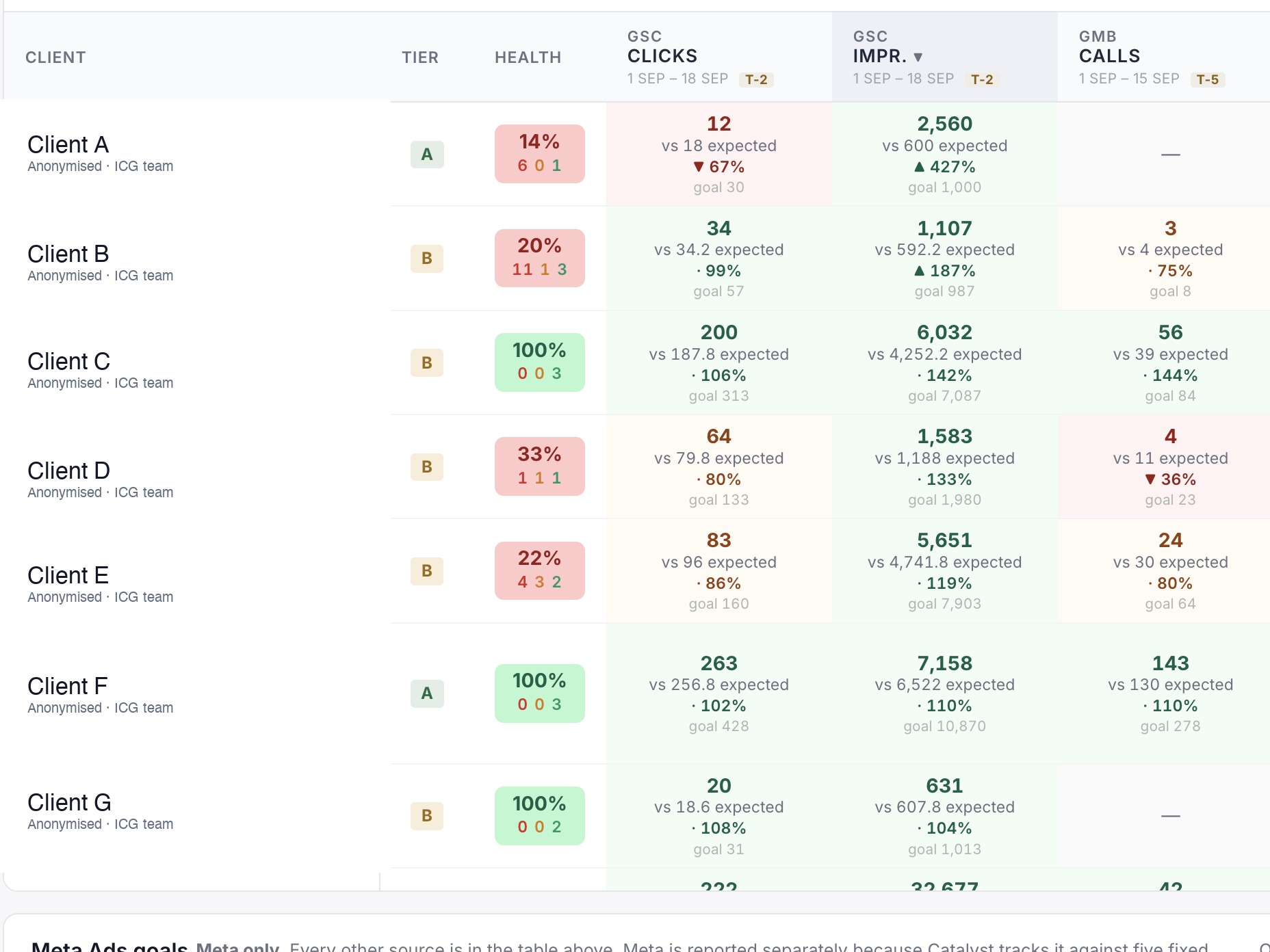
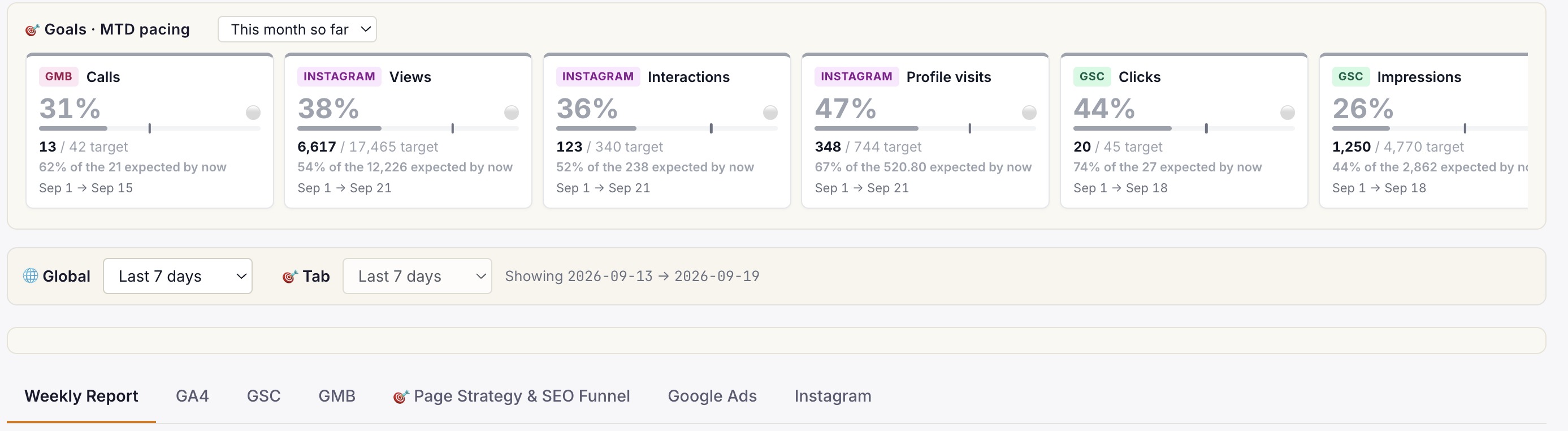
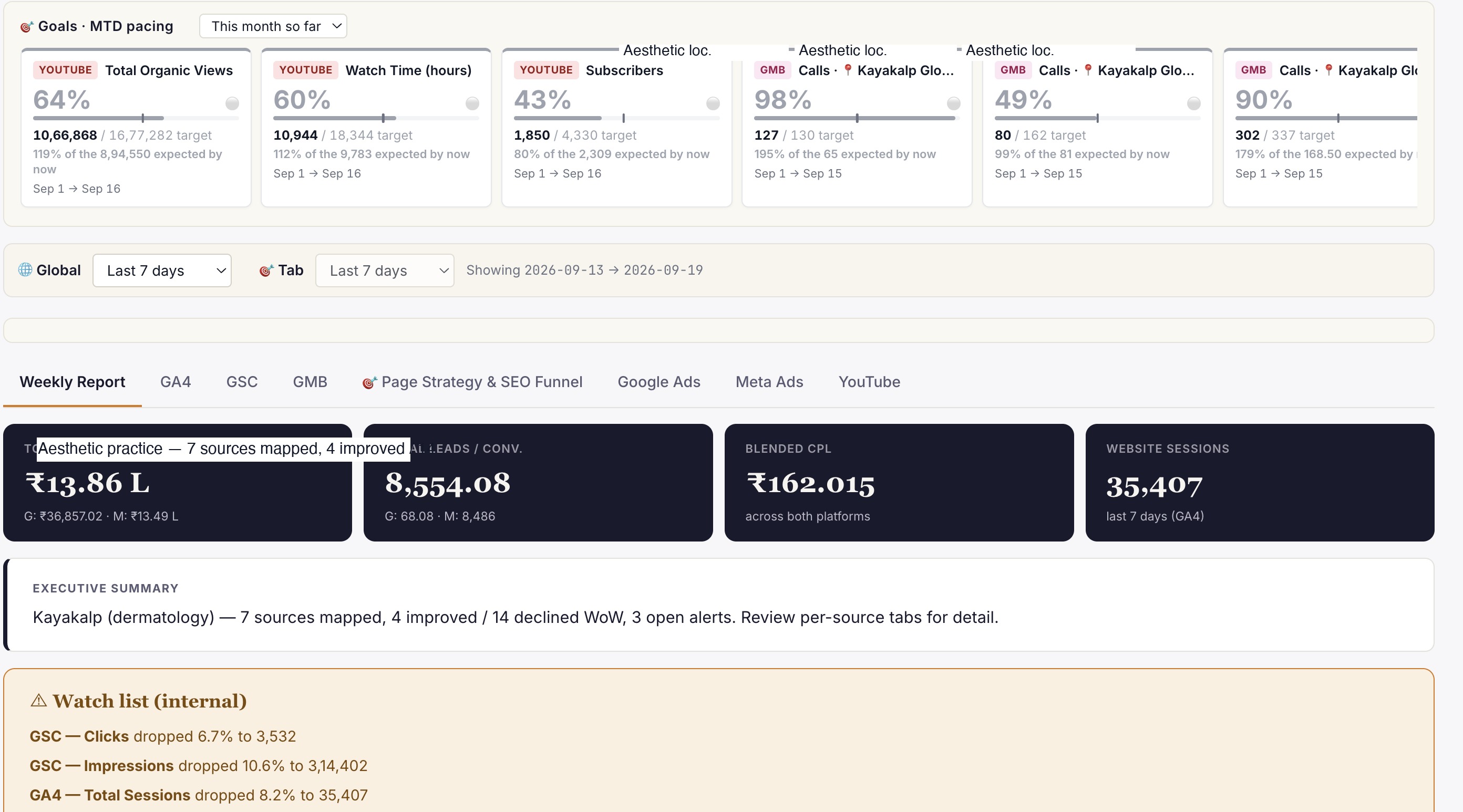
Live client dashboard. GSC, GA4, Google Ads, Meta Ads, IVR calls in one view. Login anytime, not monthly.
Phoenix
Clinic revenue intelligence over your PMS. Daily action queue: Prevent Loss, Maintain & Engage, Grow Revenue. Multi-centre rollout.
Or book a free 30-min audit to see all three in action on your account.
Healthcare brands
that already run on ICG.
A representative slice of the 150+ healthcare brands ICG has delivered for across India. Most engagements remain under NDA.


What ICG clients say · on video.
"Scale up of organic channels and business consulting. ICG has absolute domain authority in their field."
"Working with ICG transformed how we acquire IVF patients in Gurgaon. They understand the fertility journey from inquiry to consult..."
"What Ichelon accomplished — they got all my ideas and worked over 3-4 months to create an amazing, super-customised website."
Need help operationalising this?
Every ICG service is healthcare-only, NMC + DPDP-aware, and built around the patient-research patterns that drive Indian healthcare growth in 2026.
Every practice welcome — packages from ₹20,000/mo.
Goals-Driven engagements · Performance-Linked Payout Models available
More from
ICG.
Five trends shaping Indian healthcare marketing through 2027: AI-first patient research, Conversions API adoption, ABDM discovery, the AEO w...
Healthcare AIO is the discipline of getting your clinic or hospital cited inside Google AI Overviews, ChatGPT and Perplexity answers — not j...
Conversational-search advertising places brand messages inside AI chat answers — ChatGPT, Perplexity, Copilot — rather than beside a results...
Stop guessing.
Book a Diagnostic.
30 minutes. Free. With the AI-powered healthcare-only marketing agency 150+ brands already run on. No slides, no pitch, no hard close.


